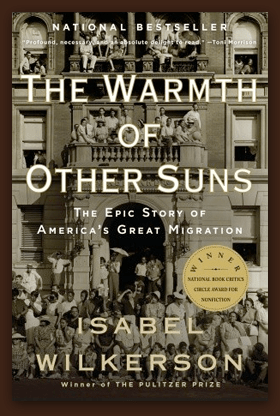
 Beginning around 1915, six million people left their native land hoping for a better life. Nearly all of them were Americans, but they were poor, without prospects. For the next half century, they left the South, many for northern cities where they knew a relative or felt they could find work, some for the west, where they hoped Jim Crow would not be a factor in their lives. They left in faith, and without much information. Three of them were fortunate because their stories were told, in considerable detail, by a compassionate, literate, well-informed journalist named Isabel Wilkerson. Her work, which she completed in 2010, involved thirteen years of her life and over a thousand interviews. the book is a solid ten-hour read (it’s over 500 pages), and you won’t want to miss a single story about her chosen few, the Americans whose stories she tells so well. They are: Ida Mae Brandon Gladney, Robert Joseph Pershing Foster and George Swanson Starling. Ida Mae starts out in Van Vleet, Mississippi in 1928, and survives the completion of the book. Leaving Monroe, Louisiana far behind, Robert survives a punishing trip to the California of his dreams, and becomes a wealthy doctor in Los Angeles with a soft spot for people in need. George is a bit of troublemaker in his native Florida, and ends up working on a New York-Florida train while living a new life in Harlem. (I use their first names because of the kinship that the author kindled in me; I feel as though I knew them from the neighborhood.)
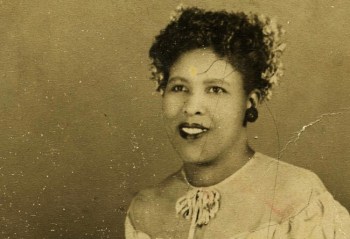
Ida Mae, with flowers in her hair, sharecroppers’ daughter, living in Chicago in the 1930s
Wilkerson takes care to paint a full picture of these people, their lives back down South, their struggles in making the decision to leave, the tough times they endured during their period of relocation, family and friends who weave in and out of their lives. The sense of never quite being at home is a constant companion; so is the the sense that they don’t completely belong where they ended up. They resolve these conflicts in their own minds, sometimes rationalizing, sometimes considering just how fortunate their lives became, sometimes trying to untangle the equally tangled thoughts and behaviors of others.
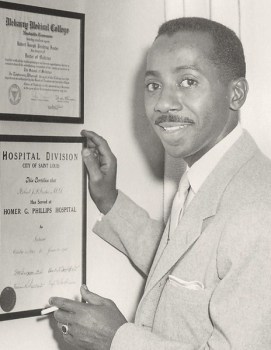
Young Doctor Robert Foster in the years before he made enough money to do anything he pleased.
George was known as “schoolboy” because he was among the few citrus workers in his area who had attended any college at all. His father talked him out of the idea, and George spent the rest of his life wondering what might have been.
Wilkerson also scores scholarly points by resolving not to accept common knowledge. Her responsibility to Ida Mae, Robert and George is powerful, and she insists on providing commentary and context to keep the reader on track and clear about what actually happened, and why it matters.
Intrigued? Watch an excellent hour-plus interview with Ms. Wilkerson on the award-winning public affairs series that survived the old New Jersey Network and now resides at Rutgers University. Find it here.







 Three across, seats A, B, and C in a exit row. All three of us reading a book. The ten year old girl who happened to sit in the window seat: a fat novel by Rick Riordan. My wife: The One Hundred Mile Walk, now being released as a Helen Mirren motion picture. Me, a terrific long novel by New York City newspaper legend Pete Hamill, who writes about his city with street smarts and an appealing sense of mysticism.
 On Tuesdays and Wednesdays, Bob Mankoff rejects most everything he sees. He works as the cartoon editor at the New Yorker, a magazine whose sense of cartoon humor is famous, but extraordinarily difficult to define. This is not a new problem. In fact, the New Yorker has always suffered from a rough case of not being able to explain itself (the problem goes back to the 1920s when Writer’s Digest asked the New Yorker’s editors to advise writers interested in the magazine; in essence, the New Yorker editors could not).
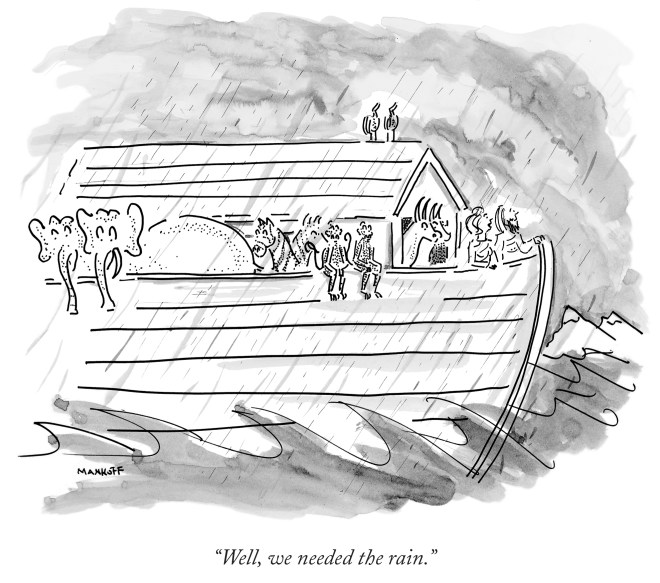 “How About Never – Is Never Good for You?: My Life in Cartoons” is a kind of small-scale coffee table biography, half text and half cartoons. As with the New Yorker magazine, it’s difficult not to be attracted to the cartoons, but I was good: I read the whole book including all of Mankoff’s confessional text and all of his chosen cartoons. What surprised me: only a few of the cartoons made me smile or laugh. And that got me to thinking about how difficult it must be, to select from the stack of 500 cartoons from regular contributors and an equal number from wannabes. Mankoff writes, “eventually, I cull the pile down to fifty or so, which I’ll take to the Wednesday afternoon cartoon meeting…” where the stack will be winnowed down to just seventeen, maybe eighteen cartoons that will be published in the magazine. (There are, and have always been, so many rejects, Mankoff started a new venture called Cartoon Bank to give exposure to the rejects—and earn some money for himself [before he joined the magazine as cartoon editor] and for other working cartoonists.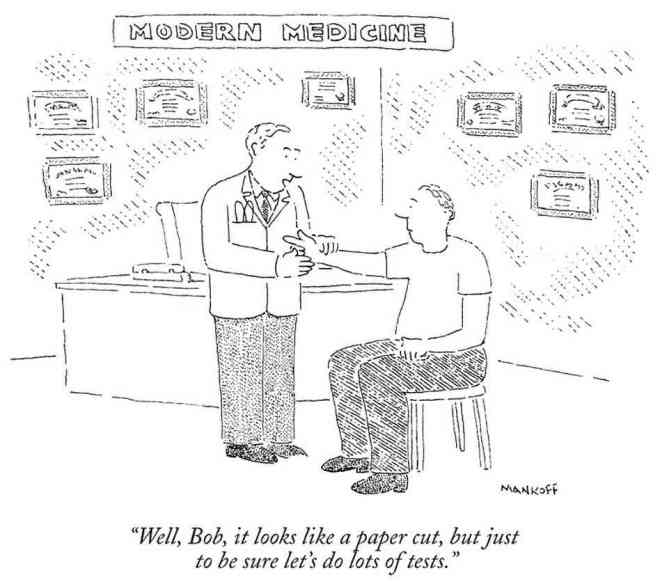


 Much as the 1960s was associated with independent thinking—and free love, for they often come together—so, too, were the 1920s. Before that, in the 1910s, Greenwich Village began to take shape as a neighborhood Bohemia. Today’s hipsters seem to be a pale counterpart, in part because they have money in one pocket and the internet in the other. A century ago, “Bohemians” (a bundle of misnomers generally not associated with the Czech region) “flocked to avant-garde exhibitions and modern dance performances, and bought paintings, lithographs, and photographs, helping the real bohemians pay the rent and get public attention…”

 The old ratio was 3 by 4: a reliable compression of reality, the extra window in every household that looked out at the world. It offered a limited view, controlled by powerful producers and directors, versatile performers, intense journalists who learned the trade by explaining why and how the Germans were bombing the guts out of London during World War II. Very few people were allowed to put anything into that window: NBC, CBS, ABC and a few local television companies controlled every minute of the broadcast day. It was radio with pictures, a new medium that learned its way through visual storytelling when the only colors were shades of grey.

 Digital Insider