A Friend in the Audio Business

You may not know the name Paul McGowan. If you’re interested in high-end audio, and/or you listen to a lot of recorded music, Paul is someone you ought to know. He’s the “P” in “PS Audio,” a leading maker of quality loudspeakers. He and his team have designed and built all sorts of audio products. And he’s been doing this for a half-century. That experience is now captured in a library of ten (!) volumes of a series called The Audiophile’s Guide. They’re available as a set (www.theaudiophilesguide.com) and as individual books. Each book is substantial — several hundred pages long, and costs about $40.
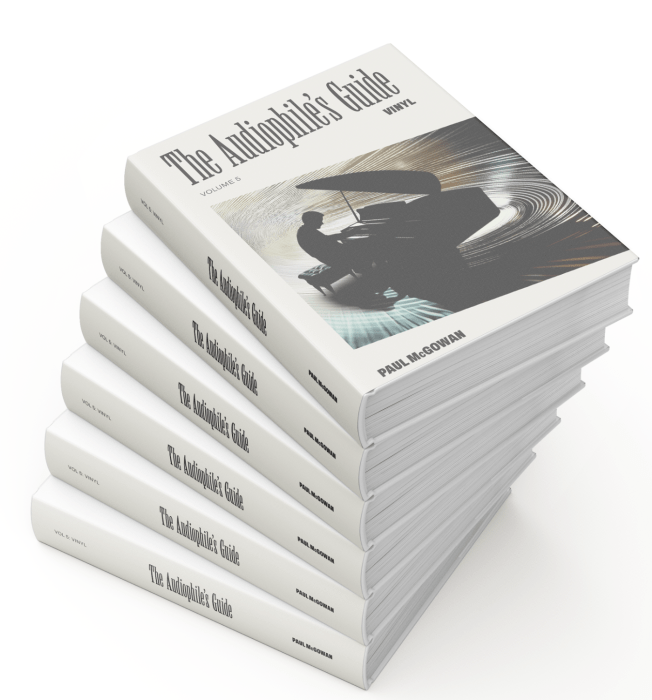
There are ten books. They cover, for example, The Stereo, The Loudspeaker, Analog Audio generally, Digital Audio generally, Vinyl, the all-important Listening Room, the Subwoofer, Headphones, Home Theater, and a distilled version of the series called The Collection.

The book about Vinyl is especially helpful. It begins at the beginning: the development and evolution of records, followed by a very clear explanation of “groove modulation” — the way record grooves interact with a phonograph stylus, which leads to a discussion of cutting masters, plating and pressing, and my favorite part, the debate about the quality of records vs. other recorded media. And so, the author eases into groove wall resistance, natural compression curves, and other particulars that make records sound so good — especially when the playback equipment is right.

The sound of vinyl is much affected by the operation of the turntable — the way the motor turns the circular table, for example — and the design of the tonearm. These concepts ride in the background of audiophile discussions, but here, author Paul McGowan shines — his articulate, direct, simple language makes the concepts compressible. The chapter called “Engineering Challenges of Tonearms” is not a lesson in technical engineering, but instead, a 2-page essay that pretty much tells the listener what they might want to know. Cartridges are also confusing and difficult to understand, but here, moving magnets, moving coils, cantilevers and other types of cartridge technology come to life, make sense, and provide the listening with a good basic understanding of what matters and why.

McGowan is equally good on the practice of buying just the right product for your individual purpose. And so: choosing a pre-amplifier, choosing a cartridge, and so on. There’s a turntable setup guide here, too, but I wish it included diagrams. If you’ve heard terms such as tracking force and azimuth, this book provides an easy way to learn the basics.

If you want to listen to music, but you feel as though you ought to know just enough about technology to advance your listening experience, this book series can be a very useful tool.

Just So We Don’t Forget…

Around the World with Joe Boyd

Every night, for the past two months, I have gone to bed with Joe Boyd. He wrote a book that’s more than 900 pages long — far too cumbersome to be read anyplace except on my pillow.

Here’s a photo of the author, the UK cover art, and the US cover art.

As it happens, it’s a terrific book, and I loved every minute of it. The title is: And the Roots of Rhythm Remain: A Journey Through Global Music. Basically, this is a social and political tour, a history of the cultures that produced music we’ve come to associate with Jamaica, D.R. Congo, Brazil, Mexico, and dozens of other places around the globe whose artists have defined the concept of “world music.” The terminology is cumbersome, but the storytelling is not. It’s clear, and as engaging as any good history book, but this particular book explains, for example, how and why the likes of reggae, flamenco (see below), and the cha-cha are all part of a hyperlocal and a wonderfully global story. Happily, the story goes back a ways — back to the fifteenth century in some cases.

For example, you’re probably familiar with flamenco music, from Spain. Well, not exactly from Spain. Flamenco is more like gypsy music than Spanish music, but where’s the gypsy connection? And what, exactly, is a gypsy? The word gypsy derives from Egyptian, because that’s where these people sometimes claimed they had originated. But they didn’t. They came from India, but they often played on the streets, and saying they were Egyptian caused the people who were listening to give them more money. So, sure, they’re from Egypt. Or maybe they’re from Hungary — part of their story takes shape, there, too, which leads to Béla Bartók, and later, to world music star Márta Sebestyén. So, back to India: there were about 10,000 musicians imported from India to what becomes Pakistan, then dismissed when they were no longer wanted in Pakistan due to change of regime. So they traveled toward Europe, scattered, stayed close to one another, and continued to perform music for themselves and to earn the money they needed to stay alive. Later, when the king of Spain forbade the use of the term gitano in the late 18th century — the gitanos were gypsies — he determined that they were from Flanders, hence the term, flamenco. But that’s such a small part of the story, and music is only one aspect of the gypsy culture — if there even is a single gypsy culture because the people scattered to so many different places in Europe (and often seeded what is perceived to be music of specific local cultures).

The reason I love this book is simple. It’s not a linear history. Instead, it’s the grand story of interwoven cultures, places, peoples, instruments, political pressures against certain kinds of music (in many places, at various times in history, rulers prohibited the use of drums, for example). And so, the Rastafarians connect Ethiopia to Jamaica, and Cuba is connected to the Congo, Senegal and Ghana to England, and England to what was the empire.

In one chapter, we’re on the dance floor in the Latin jazz clubs of New York City, or in Cuba when Cuba was still an exciting place to visit and do things that might not be okay at home. In another, jazz saxophone player Stan Getz is making a record with João Gilberto, building a foundation that would solve a problem for middle-of-the-road singers as they tried to make their way through the 1960s. Traditionally, these singers relied upon songwriters we now associate with the great American songbook — Gershwin, Rogers & Hart, Rogers & Hammerstein, Cole Porter — but those sources had aged out, and they were replaced by rock musicians who wrote and performed their own material. The older singers needed a new source of fresh material — and found it in, of all places, Brazil. When Brazilian musician Sergio Mendez recorded a song by Antonio Carlos Jobim, the likes of Tony Bennett and Frank Sinatra paid close attention. Jazz provided the bridge. And, of course, jazz was rooted in blues, and blues was rooted in music brought from Africa.

Joe Boyd is a wonderful storytelling, and a well-organized historian, but he is also a music producer who was often in the room where it happened — because he was the one who flew to Bulgaria or India, attended the performance of a magical artist with a spectacular local following, gained their trust, signed them, and got them into the studio to make records. Those backstage stories are fascinating because, more often than not, they take place in clubs and other venues in far away places with magic of their own.

You probably know at least some of the musicians in the book, but many others are likely to be new to you. Heck, I wrote a book (for Billboard Books) about world music CDs, and many of the names are now on my buy lists (yes, I still buy CDs). My sloppy list would certainly include Los Van Van, Ali Farka Touré (from Mali, in Africa, along with many other musicians from that vital country), Celia Cruz, Ravi Shankar, Nusrat Fateh Ali Khan, Fela Kuti, Tabu Ley Rochereau, Kanda Bongo Man — so many names, so much music that I want to hear again and again (much of my world music listening took place in the previous century!)

I should probably mention the many unlikely names in this book, too, because their stories provide a lot of valuable connective tissue, and lots of points of entry: Desi Arnaz, Igor Stravinsky, Dizzy Gillespie, Fidel Castro, Nikolai Rimsky-Korsakov…

This is not a book to read on a lazy weekend afternoon, but each (long) chapter is filled with a lovely combination of deep history and context. Taking it slow and easy is my recommendation. And, I would suggest you do something that I should have done — take notes. You will want to hear a lot of the music that the author discusses, but over nearly 1,000 pages, you will forget most of what you wanted to hear. Now, I find myself going page-by-page, constructing a proper list, finding some of the music on YouTube and some of it in my own collection, and, inevitably, buying more. It makes me very happy to buy a CD of ¡Cubanismo!, used, for $1.99, and to find out that there are concert videos on YouTube if I want to listen more, or listen for free.

That is: reading a very good book about music is not the end of the journey. It’s only the beginning.

A Forever Job

Tenure is a strange concept. Imagine — a job for life!

Not many professions support the idea of tenure. Outside of education, Federal judges work with a lifetime guarantee, as long as their behavior is “good” (a term that can be widely interpreted). Some clergy, and some research scientists may enjoy tenured positions, and some union workers, with especially strong contracts, may be assured lifetime employment, but the term tenure does not officially apply to them.

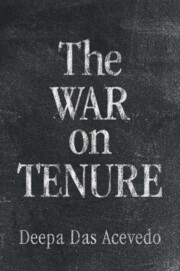
Mostly, tenure is used to describe the employment guarantee associated with teaching. K-12 teachers are afforded tenure, so even if their current compensation is lower than it might be in other professions, there is a assurance that it will go on for a very long time (and there is often an ample rest-of-life pension following that employment). Tenure is also associated with teaching at the college or university level, but the situation may not be simple, may be messy, and seems to be losing favor. This, according to Deepa Das Acevedo, a law associate professor at Emory University, and author of a new book entitled, The War on Tenure. It’s a world of work that’s largely unfamiliar to most people, except, perhaps when a professor’s private life is revealed in a movie or TV series.

Tenure applies to a very small portion of the overall population, but that doesn’t stop political campaigners from including the abolition or undermining of tenure in their speeches. When a scholar (assume all professors are scholars) works for a public university, they are, in fact, state employees. This may generate political conflicts — almost anything taught in a classroom these days may be deemed controversial and inappropriate by somebody — and that often affects stable employment.

Of course, it’s easy enough for any university to sweep away a current batch of pre-tenure or non-tenure employees with simple budget cuts, or in more difficult situations, through workplace pressure. This pressure can be strategically timed so that an individual scholar may believe they are on the path to tenure, only to find that state or board of governors or a third party has the power to erase the track completely. And then, of course, there is a question of academic integrity — at some point, many university scholars are required to make an ugly decision. Do they do what has been demanded and keep the pre-tenure or tenure job, or do they refuse, and place themselves on the job market with a vague black mark on their record?

There are lots of reasons why tenure may be denied, or pulled. These include academic misconduct (including plagiarism, which is now exceedingly difficult to sort out, given the growing role of AI), sexual misconduct (including, for example, well-founded or unfounded claims by students), or unprofessional conduct (such as bullying, which is often difficult to prove or disprove). When a university decides to shuffle departments, perhaps reorganize because their academic offerings require updating, tenure may disappear. Ditto for financial hard times for the institution.

So, tenure is not really a forever job. It may be better than most. Until it’s not. And when it’s not, a scholar with a fairly specific area of study may find themself difficult to place in another institution. That’s one reason why we have tenure in the first place — to support the many academic scholars whose fields of study are narrow but whose work is important. (But is all work important? How important?)

For the person seeking tenure, the path begins as an undergraduate. There is future value in selecting a program of study at a respected, sometimes specialized, institution. Often, this comes at a cost (and so, the debt begins to accumulate). Then, there’s graduate school, first for the master’s degree, then for the doctorate. Again, there is debt, and because these activities are so time-consuming, little opportunity to earn significant money in the process. So the debt becomes larger. There is a term for this situation: “PhD poverty.” Many institutions of higher learning operate food pantries. Hunger is a real issue. For those who come from low income poverty, “keeping mind and body together” is a real problem.

Then comes the post-doc phase: cheap labor for universities, and a necessary step if you want to become a professor. You may know post-docs by other names, such as fellows, lecturers, and visiting assistant professors.

The odds are lousy. Maybe 1 in 8 people make it to tenure track. As for the others — including the many who invest heavily, take on significant debt, and watch their dreams of an academic life go astray — there may be staff jobs at the university (that is, non-tenure track, and often, without the same prestige), or jobs in the larger marketplace (without tenure, and often not repaying the investment made by previously hopeful student).

Why should we care? Assume there are about 1.4 million college professors in the U.S., and about a third of them are tenured. Is that a lot? And why does this whole issue matter? Why write a book about tenure?

It matters because knowledge matters, because these people are the keepers of our knowledge, and they are the people who construct new knowledge, presumably with high standards in mind. Their work is different from other peoples’ work. They go deep. They think and construct models, then challenge one another’s models so everyone can think even more clearly. Their time horizons are different from other workers’ — they may take 10 or 20 years to work out what needs to be known, or done, and may work for lifetime, often with colleagues, to accomplish a very specific goal. Without institutional stability, and employment stability, this becomes very difficult to do. Why? In part because there aren’t many alternative ways to get this work done. Yes, it’s different. No, not every tenured scholar is producing essential knowledge. And no, it’s not a perfect system. But this is a situation where the perfect can easily become an enemy of the good. Although they are currently under attack, and always seem to be coping with the low hum of criticism, universities have a role, and scholars have a role, too. Which is why, in the end, we should be working to improve the system, and not tear it down.

A Sharpener for Colored Pencils

I never thought this would be a problem. Turns out, some colored pencils are not only fragile, but too wide to fit into a traditional pencil sharpener. Too wide by a part of a millimeter, but still too wide to fit into the hole of many sharpeners.

To begin, let’s be specific. We’re talking about some traditional colored pencils, many types of pastel pencils, many types of watercolor pencils, even some black graphite pencils. Without obsessing about micro measurements, note that a Faber-Castell Polychromos colored pencil has a diameter of 7.6 millimeters, and that’s just too big to fit into a hole that is, say, 7 millimeters. It just won’t fit! Ditto for several other types of pencils made by Faber-Castell (a personal favorite), but also for the wonderful Caran D’Ache Museum Acquarelle — the finest colored pencils available — which measure 7.4 millimeters.

Many colored pencils are fragile. They’re not made of graphite (which people mistakenly call “lead”). Instead, they’re made from a mix of color pigments and a binder. A pastel pencil is, essentially, thin piece of pastel in a wooden tube. The part that is pastel is mostly pigment (finely ground particles of color) in a mix with some kaolin, clay, pumice or other minor additives. Even inside the pencil, the slender piece of pastel breaks easily. It shatters easily. Similarly, a watercolor pencil is a dowel of dried watercolor — similar to what you would find in a pan of watercolor — which is pigment, binder, and some dispersants (to disperse the paint evenly on the paper), preservatives in small quantities. Neither pastel pencils nor watercolor pencils have the stability associated with traditional graphite pencils. That’s why they break so easily when they are sharpened by, say, an electric pencil sharpener.

So, what are the options? I remember my uncle used to use a scalpel to sharpen each pencil by hand, essentially whittling the point, then rubbing it against an artist’s sandpaper tool. The process yields good results, but it is messy, and it’s hardly foolproof — the point can break.

A small handheld sharpener is a good idea, but sharpening many pencils often results in some wrist strain or pain. And the shavings must be collected, or the work must be done directly above a trash bin. Ah, but it’s not so simple. Many hand-held sharpeners have a hole that’s not large enough for the extra fractional millimeter of many colored pencils. So, you must try each sharpener to be sure your pencils will fit — and you must remember which brands of pencils fit into which sharpeners. Some hand-helds have two holes, one that’s too big and the other, too small. A hole that’s too big allows the pencil to fit, but as it bounces around while being sharpeners, the point often breaks. Grrrr…

Still, you might find a sharpener well-suited to the task. For example, I found the M+R cylinder sharpener, a heavy brass device with a replaceable blade. The small hole is a good fit for many colored pencils. Problem is, my wrist starts to ache if I sharpen too many pencils in one sitting.

Try an electric sharpener? Sure, but I have yet to find one that treats colored pencils gently. They break too often, and because they’re on the expensive side — several dollars per pencil — I question about whether this is a wise decision.

Stepping up, what I thought I wanted was an old-school rotary sharpener that attached to the wall. Turns out, these are kind-of rough on colored pencils, too.

That’s when I discovered the Caran d’Ache Pencil Sharpening Machine. It looks something like the old-school sharpeners, but it’s all-metal and built so it will last for a few generations. The design is reasonably clever, but flawed. Basically, you pull a front plate away from the sharpener and insert your pencil into a hole. Then, you feed your pencil further into the machine. It is held in place by three gnarly metal teeth — they bite into the pencil, and they leave an indentation that turns out to be exactly where I place my fingers when I draw. So, it’s uncomfortable. Once the pencil is in place, you turn the crank and the pencil is sharpened.But it is an elegant sharpener, and it does a nice job. Except that it’s not very adjustable — you can either generate a sharp point or a slightly stubby point. No other adjustments in the shape of the cone, the amount of wood being eaten up, none of that. In today’s market, this product is an insanely expensive pencil sharpener. It costs about $200! It even comes in designer colors — Klein Blue, bright red, military green, and blue. Those cost even more than the basic silver model.

Are there similar models that cost less? Yes, and one comes from Caran d’Ache. It’s made of plastic, not metal, and it is very good, but it costs about $100. I didn’t find much of a difference between that model and several similar models from M+R, Derwent (which makes watercolor and other pencils), or Carl (a leading Japanese maker). As I shopped, I kept an eye out for metal teeth — I wanted something that would sharpen effectively but not scuff up the pencils.

It took some effort, but I finally discovered a viable answer. It’s made by Carl, but it’s not the model that you are likely to find on most art or office supply websites. That is: this is not the Carl Angel-5, not the Royal and not the Premium. Instead, look for the Carl Custom, also known as the Carl CC-2000 (and, sometimes, the CC-2200). It is promoted as an especially quiet sharpener (which it is not). Adding to the confusion, if you order the CC-2000 from Amazon, they will send you the Angel-5. (This happened twice.) Instead, order directly from the manufacturer, pay a bit more, and accept the fact that you will pay for shipping.

The good news — it has teeth, but they are rubberized so they don’t mess with your pencils. It is solidly built, easily attached to any desktop, and it sharpens every pencil in my kit without issue.


We Have Some of the Answers

There’s a new book called Another World Is Possible: Lessons for America from Around the Globe, but I think the subtitle under-sells the book. The subtitle should probably be Lessons for Every Country from Around the Globe. The author is Natasha Hakimi Zapata, a journalist and university lecturer based in London.

Answers to big questions may not be so hard to find. Better public schools? Renewable energy? Health care? These problems are being solved all over the world, but most people don’t know much about what’s being done and why it might just work in our own countries.

She begins a book of nine solutions with health care, and describes “the United Kingdom’s groundbreaking universal health care system.” It’s not perfect, but Zapata believes, and offers convincing reasons, why this model could and should work in the U.S. (and elsewhere). As she outlines the history — “prior to the twentieth century, health care in the United Kingdom was provided by a disjoined mix of charity hospitals, the local welfare committees that ran so-called poor law workhouses, and private care.” The system was oriented toward low income communities, leaving those in the middle class with few good options, so they came to rely upon emergency care in emergency care facilities at local hospitals. In the U.S. today, we are trying to solve a similar problem, this time for our lower income residents. Government programs incrementally improved the situation, but did not solve it, but the situation changed with the end of the Second World War, when Britain was in dire straits. “The key principle enshrined in the 1946 Bill was that health was a right, not a community to be bought or sold, or subject to market forces.”

And there’s the pivot. The 1946 Act was an “extraordinary success” because it “incontrovertibly made people’s lives better.” Service began in 1948. In England and Wales, it now employs 68 thousand nurses, 12 thousand doctors, and 22 thousand midwives — and they are a small portion of a workforce of 1.4 million people. (And this does not include Scotland.) It’s funded by general taxation. The range of services is vast, including not only ambulance, maternity care, dental care, prescriptions, mental health, long-term care, and optical care. “Patients rare, if ever, pay out of pocket for anything.”

Yes, there has been enormous political capital poured into the service and its growth, and yes, there are special issues of all sorts — an “immigration health surcharge,” for example.” Overall, the system works, and because it is right and not a privilege, it is very much a part of British life.

The important idea here: it is possible for a large country to operate a national health service. There is a model. More people ought to know how it works, and the power of large numbers of people should make sure the success is widely known so it can become the basis for a new U.S. healthcare system. Certainly, there are reasons why this will never work, but that has been the rallying cry for the (hugely successful) opposition. Zapata provides a useful starting place for discussion, here and in other large area of life.

Estonia is a much smaller country, but it has pursued a very big idea. It’s a simple one: access to the internet is a human right (yes, human rights are a theme in this book). This is a country that was part of the Soviet world, with clunky technology, crumby infrastructure, not a lot of money, and political inflexibility. As the nation began to enjoy the new realities of independence, several organizations worked with government to make free internet connections possible. “In 1992, two of the biggest universities in the country [were] provided with free internet service. Soon enough, fiber optic cables were being laid throughout the country.” The pathways led through government, and a new concept of “e-government” was established as a means to operate the nation by, essentially, distributing power and responsibility to the people. This ignited a very different way of thinking about the relationship between a citizen and the government. “One of the main ideas behind Tiger Leap,” which placed education at the center of Estonia’s future, “was to raise a new generation of computer- and internet-savvy Estonians that could create innovations that could spur socioeconomic growth.” In time, Estonia’s Look@World Foundation helped Estonians of all ages to collaboration “in close cooperation,” and begin to see the importance of 100 percent internet access for all Estonians. And the story continues to unfold, with nearby Finland providing more examples and fueling a competitive spirit, too. Estonia is ahead of international curve on I-voting (via the internet, e-ID systems, and more. Estonia raises serious questions about private control of digital technology in the U.S. — they have certainly demonstrated the value of public-private partnerships, respect for the needs of individuals and the evolving role of government.

The author tells similar stories about Portugal and its drug policy; Norway and its family-friendly laws; Uruguay’s approach to renewable energy, and Aotearoa New Zealand’s approach to universal pensions.

Indeed, another world is not only possible, it has taken shape, but the future is not evenly distributed. In many ways, the U.S. seems to be far behind, a remnant of old thinking about power and the unproductive alliances between government, big money and big companies. There are other ways to think about running countries on behalf of their people, and Zapata’s book is enormously useful in imagining what could and should be.


Generational Loss

According to the charts and analysis in Jean W. Twenge’s new book, Generations, some disturbing patterns are emerging. In this case, we seems to be the children and teenagers, our offspring, the people who will manage peace and prosperity as they engage in human progress. Perhaps “will” is an unreasonable term because, in many ways, that progress has already begun.

There has been a precipitous drop in 12th graders who attend religious services once a week or more. For many years, until around 2015, the percentage hovered around 60 percent. Today, it’s about 30 percent. Anyway, that’s the trend for Black Americans. It’s worse for White Americans (gee, I hate these terms, but that’s another story). The drop among White Americans has been more-or-less steady since 1982 or so, with a brief bump around 2000, but just for a while. Pretty much, there’s half as much interest as there was before. Certainly, religion is not a perfect solution to sense of self and community engagement, but it’s an indicator, and it’s not heading in a healthy direction. Among people 18-25 in the U.S., belief in God has dropped from about 85 percent in the early 1970s down to about 55 percent today. No problem if religion has been replaced by an equally distinguished philosophical basis for life. However, if we just drop the idea altogether, then we don’t think much about ethnics, or beyond ourselves, outside of the often-self-serving political arena. One hopes there is more to life than that.

Next institution: government. Back in 2000 or so, about 25 percent of U.S. adults were dissatisfied with government. Today, about 70 percent are dissatisfied. Big change, and that’s across the whole adult population, not just the younger ones.

Twelfth-grade boys have become far more politically conservative — in the late 1970s, conservative applied to about 40 percent of boys, and now, it’s up to over 60 percent. At the same time, girls start in the early 170s at about 35 percent, and they’re now DOWN to about 30 percent. So, we’ve got a lot more conservative males and a lot fewer conservative females growing up.

Comparing U.S. children, ages 2-5, from 2010 to 2019, less than 10 percent were physically active less than four days a week in 2010, but the number is now 18 percent — a big change in just a decade. The situation is worse for kids 6-11 — in 2012, it was 14 percent and now it’s 28 percent.

Some good news — in 1959, about 28 percent of children lived in poverty, and that number has been cut in half. Unfortunately, adults have not fared as well — 18 percent in 1959 compared with 10 percent today (so, a cut of 1/3).

There are many more lonely 15 year olds today than there were in 2000 or so — about 10 percent then, and about 35 percent now. Many more 15-25 year olds are unhappy now (about 20 percent) than there were in about 2005 (less than 5 percent).

Far fewer people who are 20-24 years old are getting married in the U.S. — nearly 70 percent of females were married around 1970, down to about 15 percent today. Good reasons why, certainly. As for men, it’s 45 percent down to 8 percent.

It may not be surprising to learn that the percentage of high school students identifying as lesbian gay or bisexual has been steadily increasing. In 9th, 10th, 11th and 12 grades, the 2015 figures looked like about 8 or 9 percent, then, and about 14 or 15 percent now. Soon, those numbers will approach 1 in 5 high school students. This seems to be true in both red and blue states.

These are among the biggest changes I found in Twenge’s new book. What do they mean? More independent decision-making among young people. Less reliance upon institutions. Less support for decisions that diverge from older established ways. Good reasons for fear that the world is, indeed, changing — and veering away from tradition. The book looks at each generation alive today, and considers the changes each group has experienced.

Trying to frame clear, concise, straightforward opinions based on the information in this book is very hard to do because, in the end, everyone is so different from one another. It’s become difficult to make blanket statements about any generation — and this may have always been true. Still, reviewing the many graphs and explanations in this book is provocative, good stuff for deeper thought, challenging assumptions, and changing one’s mind about long-held beliefs. It’s a good read, and because so much of the real estate is filled with graphs (lots and lots of them), it’s a book that reads fairly quickly, but this does not diminish the book’s value.

How to (Video) Record Just One Person on ZOOM

This seems like it should be easy, but it’s not, so I thought I would capture the steps I used to record ONLY the person I am interviewing — and not my own video image.

In an ideal world, you would (a) open your ZOOM account, and (b) select the person to be recorded. In the real (and sometimes complicated) world of ZOOM, you must (a) sign up for a more expensive ZOOM account, such as ZOOM Pro, and (b) go through a dozen steps for each individual recording. Yes, this is crazy, and I sure wish ZOOM would read this article and make things much easier for everyone. Until they do, here’s what I now know how to do. I hope it’s helpful.

1 – Sign into the ZOOM call, and make sure you are the HOST.

2 – Blur your video background, if you like.

3 – Log into a second computer on a ZOOM account that is not your own. The computer can be the same wifi network as your first computer, but it must use a different ZOOM account. Be sure to JOIN the conversation. NOTE: It’s best for the second computer to be an actual computer, not a phone or tablet — unless you can completely silence the phone or tablet, Otherwise, you may hear feedback. If you must use a phone or tablet, place it in a drawer in another room.

4 – On the first computer’s ZOOM screen, ADMIT the second log-in by pressing “Admit.”

5 – Return to the second computer. Press RETURN to accept the audio question. MUTE the microphone, and shut off the computer’s speaker(s).

6- Now you are ready to ADMIT the interviewee’s computer on your first computer.

7 – Immediately after admitting the interviewee’s ZOOM account, click on the upper right corner to see a drop-down menu. Select SPOTLIGHT FOR EVERYONE.

8 – Be sure you are in SPEAKER view on your first computer. Now, press the RECORD button. You can record either to your ZOOM cloud account or to your first computer’s selected disk drive.

9 – Begin the conversation. You will be seeing, and recording, only the interviewee. Check to make sure that (a) the spotlight is in place (upper left corner of the ZOOM screen), and (b) you are indeed recording (upper right corner of the ZOOM screen).

10 – When the conversation ends, STOP the recording and end the ZOOM call. ZOOM will automatically begin to process the recorded files (audio, video, and some other files). Leave your first computer alone, let the processing take place without interruption. Meanwhile, go to the SECOND computer to confirm that there is no active ZOOM conversation. (It should have disconnected when the ZOOM call ended).

11 – After a few minutes, ZOOM will open a new file that is labelled with time and date, and the name of the ZOOM conversation. The file will contain the audio and video files, etc. Find the .mp4 file and play it, or play parts of it. You should see ONLY the interviewee, but you should hear all of the voices that spoke during the ZOOM call.

12 – If you are doing this multiple times, it’s wise to issue a separate ZOOM invitation for each conversation. That way, each conversation will record separately, in its own file folder.

Living in the Mechanical World

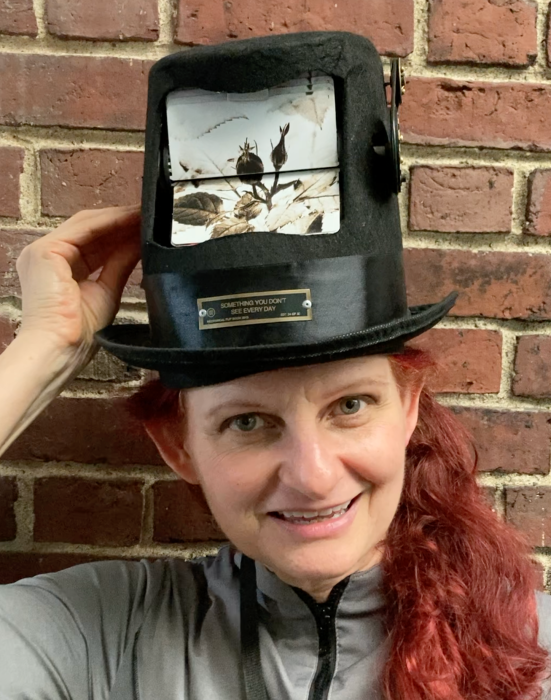
Wendy is walking around in top hat. The hat contains a window. Inside the window, there is a rosebud. During our brief conversation, the rosebud blooms into a full-sized red rose. With her partner, Mark, they have found a niche, making very clever flip books that capture the heart and the imagination. At their display table at the recent Automatoncon, an animal travels from one flip to another and another, employing mechanics and images printed on paper to bring ideas to life. In fact, anybody can do it — they sell a popular D-I-Y Flip-o-Scope that allows children, parents, and creative souls to animate images, and bring them to life.

That’s the whole point of automatons — you may recall the automaton in the center of the HUGO movie directed by Martin Scorsese, which was based upon the delightful picture book, The Invention of Hugo Cabret, by Brian Selznick — to simulate life through mechanical means. Every two years, AutomataCon provides a gathering place for wonderfully creative souls to compare notes, talk tech (which, in their world, is not digital), and show off their latest work. Significantly, the event is held at the small Morris Museum in Morristown, New Jersey, which houses one of the world’s largest collections of Murtogh D. Guinness Collection of historic mechanical musical instruments and automata. Mr. Guinness, of the famed brewing family, was a collector so serious about his prized assets, he built a building for the Morris Museum in exchange for a promise to keep the collect intact, alive, and productive.

Part of the promised outreach effort is AutomataCon, which brings, for example, Cecilia Schiller from her workshop in Northern Wisconsin to northern New Jersey. Cecelia’s long history in puppetry, theater special effects, and exhibits (such as a magical Christmas display, held annually in St. Paul, Minnesota’s Macy’s Department Store).

A puppet simulates life with the help of a talented human operator, but Cecilia’s sense of story takes her further with a full-scale puppet show that includes several children, puppets in a Punch and Judy stage, an puppet operator controlling those two puppets, and a colorful assembly of gears and operators down below the stage. All of it is control with a crank. It is magnificent. The images below provide some sense of what it does and how it works.

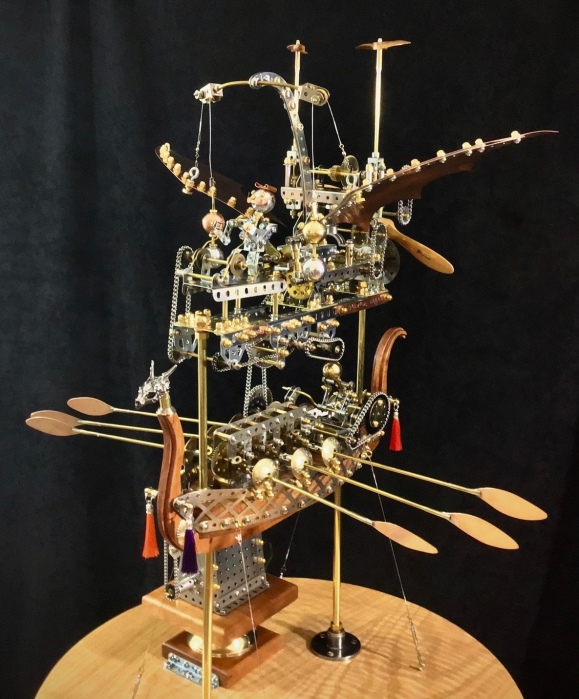
Dave Bowman discovered automata by visiting the Morris Museum. That was eleven years ago. Now, he makes magnificent metal automata of his own. We begins with Meccano parts — similar to an Erector set — but he uses only older sets because the steel girders are better for his purposes, and because the gears are brass-plated. Two recent favorites: a viking ship and a large bird, each with its own elaborate back story. He does not plan the creations. Instead, he engages in a long conversation with the imaginary beings. “You bond with them. You spend so much time creating them.” As with puppetry, the line between reality and fantasy can become blurry.

And yes, that is a real animal skull that forms the head. And, below, the made-up history is worth reading.

Of course, there is much more to discover. More artists whose work mimics real life. If you haven’t seen the movie HUGO, that’s a good place to start. And if you’re curious about AutomataCon, be sure to visit their website.

Dogmen & Dynasty

The castle and the surrounding landscape are magnificent, so I thought I would begin with a big picture.

Martyn Rady is a historian and a very good storyteller. He is a Professor Emeritus of Central European History at University College London. He is also a leading expert on the history of Central Europe, which happens to be one of the regions of the world that is, for many people, myself included, very difficult to capture as a coherent idea. Along the way, I’ll place Rady pretty high on my list of historian / storytellers — and I hope he will write another book that is equally wide-ranging.

Rady begins long ago, when early Christian scholars debated the existence of dogmen — creatures with canine and human characteristics who lived on the margins of the known world. He is specific: “One ninth-century account tells of how a missionary bishop in what is now Austria denied a place at the table to visiting pagan chieftains, instead laying out bowls on the floor.” A few centuries later, Turks were “described as agents of Satan, with an insatiable taste for blood…and all sorts of extravagances including bestiality and sexual relations with fish… but from the very first, they, too, were associated with dogmen.”

Where, exactly, does Central Europe begin and end? That question is difficult to answer. Depends upon when, of course, because countries keep expanding and contracting, and gaining/losing parts of their territory. Roughly, Central Europe seems to be what is now Germany to the West, what is now Russia to the East, not quite Scandinavia to the North, and down into what was once Yugoslavia to the South, but sometimes, parts of what is now Italy, Ukraine, and Greece, too. It is here that the vague and changeable boundaries of Prussia take shape and shape-shift, where Poland is and then is not a country, where unimaginable violence was the rule for many of the centuries covered in this 500+ page volume, and where Beethoven, Mozart, Chopin and Western classical music originated and continues to thrive. There are knights, castles, pogroms, insane monarchs, endless political intrigue, war after war after war, peasants galore, Catholics dominating religious beliefs, and, generally, miserable lives for the people who lived there until very, very recently.

It’s the story of people whose names you may have heard, but don’t know much about. One example: Louis Kossuth (“spell-binding orator who could hold audiences of both politicians and peasants mesmerized in speeches that lasted more than three hours…a master of self-advertisement … [who] led Hungary to disaster.”

Another: “Otto von Bismarck remained a gluttonous, hard-drinking oaf for the rest of his life — eventually, even his doctor refused to treat him, recommending instead that he consult a veterinarian.”

Another: “as a ruler, Frederick William [of Brandenburg, a hotchpotch of territories reaching from the Lower Rhine to the Polish frontier] avoided war as much as possible, while doubling the size of his army to make it the fourth largest in Europe. Frederick’s drillmaster instilled discipline with ferocious punishments and by having his troops learn to march in goose step….[which showed at a glance whether the troops were marching in unison]. But Frederick William’s quest for abnormally large grenadiers was a pointless conceit because the men were often disabled as a result of their height. Altogether, the king had several thousand of these giants, whom he personally drilled and tried to marry off to equally tall women. All had to be at least 188 centimeters (6 feet 3 inches), but there were plenty who hit 213 centimeters (7 feet) . In order to magnify their appearance, Frederick William gave them tall mitre cap, and we are told, deliberately dressed them in uniforms that were too small. Frederick William himself measured just 160 centimeters (5 feet 3 inches).”

Sensationalism and goofy stories aside, this is an extraordinarily well-constructed saga of what is now Slovenia and Slovakia, Latvia and Poland, Moldova and Belarus, the Czech Republic and Lithuania, Russia and Germany, Austria and Hungary, and countries that no longer exist. It is the origin story of much of Europe, with tales of the Huns and the Mongol-Tatars and the Goths, the Hapsburgs and the Holy Roman Empire. And it is the story of the Nazis.

If this book was assigned to me, I never would have read it. If this book was suggested by a friend, I might have wondered whether I would ever take the time to read a book about the history of central Europe. Probably not. But there it was in the library, with the magnificent castle on the cover, so I picked it up and started browsing. Rady’s prose and storytelling invited me in. And, just as he began this tale with dogmen, that’s where he ends it, too: “Today’s dogmen may lack the imaginary snouts and tails of their forebears, but with their rocket launchers, tanks, and drones, they are just as terrible and no less subversive…”