There is a dead frog with its guts all over the place. More about this unfunny amphibian later.
 For now, the challenge is to figure out what’s funny, why it’s funny, how funny is constructed, what happens inside our brains when funny is happening, how funny works in different countries and why funny often misfires. Although I want to believe that this is a fascinating intellectual and scholarly pursuit, the whole idea of studying funny seems, to me, to be an odd pursuit that’s not likely to yield meaningful results. And yet, there are these two books, each with an embarrassingly unfunny cover, that have been staring at me all summer long. One puts Groucho glasses on a globe and calls itself The Humor Code: A Global Search for What Makes Things Funny and the other has a big goofy grin with the word “Ha!” writ large with “The Science of When We Laugh and Why” down below. The former was written by a University of Colorado professor named Peter McGraw; he runs the Humor Research Lab (or, “HuRL”) and promises to be “a leading expert in the interdisciplinary fields of emotion and behavioral economics.” His co-author us a free-lance writer named Joel Warner. HA! was written by Scott Weems, whose Ph.D. is in cognitive neuroscience.
Weems taught me that it’s possible to make a rat laugh. How? Tickling works pretty well—scratch its belly and a rat will emit a high pitched screech at around 50kHz (which other rats can hear, but humans cannot). If you stroke a rat, it doesn’t laugh. Young rats are more likely to laugh, and laugh bigger, and more often, than older rats. Apparently, humans are the same way. If you leave a rat alone for an extended period, then tickle him, the rat is more likely to laugh a lot.
And then, things get weird. A rat scientist named Burgdorf (I’m sure there’s a better title) inserted electrodes into each rat’s dopamine-producing center and “achieved the same result.” Then, Burgdorf taught his rats to tap a metal bar to administer the dopamine provocation on their own. Similar result. All of which leads Weems to this conclusion, “Apparently, rats aren’t so different from humans, which suggests that laughter might have been around for a very long time.”
Yeah, you’re seeing the same problem I am. It’s cool that we can make rats emit a sound by tickling them, but there’s a pretty large gap between explaining that screech—which may or may not be laughter—and, say, what Richard Pryor or Robin Williams could do on their least productive days. Or why, when I’m bored, I will try (and often succeed) in making others laugh and lose focus (I’ve been doing this since fourth grade). Or why elephant jokes are still funny.
Q: Why did the Elephant stand on the marshmallow?
A: So she wouldn’t fall in the hot chocolate.
Men and women seem to laugh at different things, at different times, in different ways. We don’t yet understand how computers might make us laugh. Research related to laughter, short-term health and longevity is inconclusive (but it couldn’t hurt). Ethic humor remains popular (throughout the world), but the 21st century’s political correctness limits its use in polite company. We’re still okay making fun of animals, and even in our enlightened world, nothing succeeds like a good poop joke:

All in all, I didn’t learn much, but I did find out that scientists are taking an interest. That’s nice, but frankly, I’d rather watch a funny movie.
The comedy team of McGraw and Warner trekked a lot further (“two guys…19 experiments…five continents… 91,000 miles…”) but didn’t manage to cover any more ground. Studying humor is exceedingly difficult, probably because we’re not smart enough to understand what’s happening, which is why scientists come up with theory and do their thing, but the process is not much fun to watch. McGraw’s intrepid performance at a comedy club—these guys really are trying—is a flop. Their Venn diagrams are promising (one circle: “vomit in church” and the other “causing mass vomit in church” with the intersection marked, simply, “funny”). Both books tell the story of the girls in Tanzania who couldn’t stop laughing and comedian Gilbert Gottfried’s “too soon?” excuse to roll into the Aristocrats schtick shortly after NYC’s towers came down; and, sure enough, on page 81, the authors are talking about tickling rate here, too.
Their world tour is interesting, mostly for people who don’t usually follow the comedy business. This book attempts to be a global comedy road trip, and it’s interesting to visit Yoshimoto Kogyo in Japan: a comedy school that also manages 800 Japanese comedians (not sure why, but the image of 800 Japanese comedians makes me laugh). The company owns many of Japan’s comedy clubs and used to own a comedy theme park, too. There are Yoshimoto Kogyo golf balls, and instant ramen meals, too. The authors make good use of their travel budget, visiting Scandinavia where their obsession with the Danish cartoons that rattled Islam sensibility tends to overshadow the warmth and classy outrage that has been part of Danish humor since the days of Victor Borge (don’t miss this!). Humor on the Gaza Strip (conflict and humor are often linked), and in a chapter about the Amazon (where the inevitable Norman Cousins story about laughter as medicine is told, along with some notes on Patch Adams).
In the Montreal chapter—which is about the world’s largest comedy festival, the authors summarize what seems to be a list of items that didn’t require a full volume:
– Make fun of yourself before others get the chance to do so.
– Laughter is disarming. Make light of the stuff everyone’s worried about and you’ll negate its power.
– Create a safe, playful space where folks are free to laugh.
And so on.
I read these two books because I was hoping that the state of the science had greatly advanced (two books from two major publishers in the same year), but I was mostly wrong. We don’t know much more than we did before. And after thinking about that on a rainy weekend afternoon, I came to the conclusion that there is no problem in not understanding comedy. Maybe there is a point in studying it—or, at least, continuing to study laughter—but in some ways, I hope we never figure it out. I don’t think I want a science of humor. And I certainly don’t want a funny robot to be programmed into my brain to provoke dopamine provocation. Really, I’m good not knowing, I’m great knowing that Robin Williams and Victor Borge were funny, and not knowing or caring how or why that happened or how to replicate his magic.
So what about the frog? For that answer, everyone seems to refer to what E.B. White wrote in 1941:
“Humor can be dissected, as a frog can, but
the thing dies in the process and the innards are discouraging
to any but the our scientific mind.”





 Three across, seats A, B, and C in a exit row. All three of us reading a book. The ten year old girl who happened to sit in the window seat: a fat novel by Rick Riordan. My wife: The One Hundred Mile Walk, now being released as a Helen Mirren motion picture. Me, a terrific long novel by New York City newspaper legend Pete Hamill, who writes about his city with street smarts and an appealing sense of mysticism.
 On Tuesdays and Wednesdays, Bob Mankoff rejects most everything he sees. He works as the cartoon editor at the New Yorker, a magazine whose sense of cartoon humor is famous, but extraordinarily difficult to define. This is not a new problem. In fact, the New Yorker has always suffered from a rough case of not being able to explain itself (the problem goes back to the 1920s when Writer’s Digest asked the New Yorker’s editors to advise writers interested in the magazine; in essence, the New Yorker editors could not).
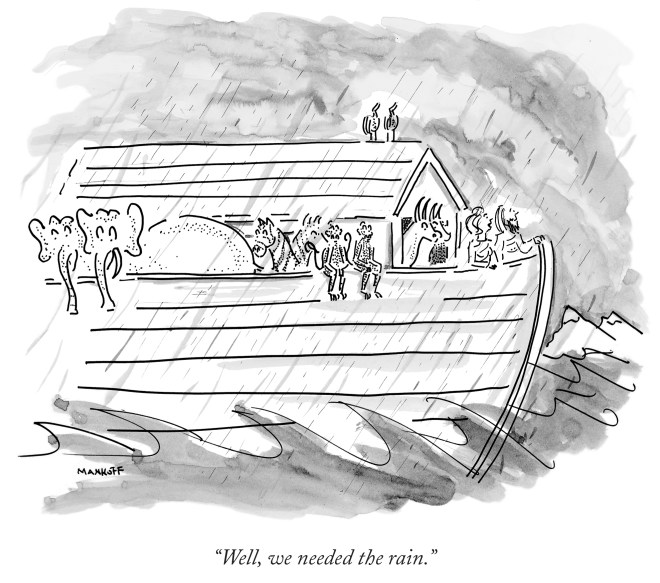 “How About Never – Is Never Good for You?: My Life in Cartoons” is a kind of small-scale coffee table biography, half text and half cartoons. As with the New Yorker magazine, it’s difficult not to be attracted to the cartoons, but I was good: I read the whole book including all of Mankoff’s confessional text and all of his chosen cartoons. What surprised me: only a few of the cartoons made me smile or laugh. And that got me to thinking about how difficult it must be, to select from the stack of 500 cartoons from regular contributors and an equal number from wannabes. Mankoff writes, “eventually, I cull the pile down to fifty or so, which I’ll take to the Wednesday afternoon cartoon meeting…” where the stack will be winnowed down to just seventeen, maybe eighteen cartoons that will be published in the magazine. (There are, and have always been, so many rejects, Mankoff started a new venture called Cartoon Bank to give exposure to the rejects—and earn some money for himself [before he joined the magazine as cartoon editor] and for other working cartoonists.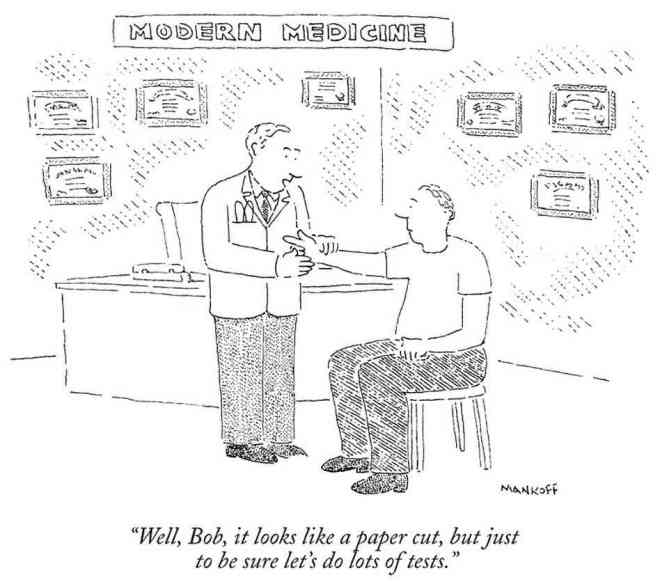


 Much as the 1960s was associated with independent thinking—and free love, for they often come together—so, too, were the 1920s. Before that, in the 1910s, Greenwich Village began to take shape as a neighborhood Bohemia. Today’s hipsters seem to be a pale counterpart, in part because they have money in one pocket and the internet in the other. A century ago, “Bohemians” (a bundle of misnomers generally not associated with the Czech region) “flocked to avant-garde exhibitions and modern dance performances, and bought paintings, lithographs, and photographs, helping the real bohemians pay the rent and get public attention…”



 The old ratio was 3 by 4: a reliable compression of reality, the extra window in every household that looked out at the world. It offered a limited view, controlled by powerful producers and directors, versatile performers, intense journalists who learned the trade by explaining why and how the Germans were bombing the guts out of London during World War II. Very few people were allowed to put anything into that window: NBC, CBS, ABC and a few local television companies controlled every minute of the broadcast day. It was radio with pictures, a new medium that learned its way through visual storytelling when the only colors were shades of grey.


 Digital Insider