When a student faces a new subject, there is a certain comfort in structure, process, facts, and the rigorous routine that defines most teaching situations. Teachers find comfort in that structure: first, the basics, then, perhaps, the materials, then, the history followed by waves of increasingly specific information. In theory, it all makes sense. In practice, when faced with the sloppiness of real life, the structure may be exactly what’s not needed because it interferes with the real learning that occurs as a result of experimentation and making glorious mistakes.
I guess that’s why I had so much trouble understanding what Tom Hoffman was doing. Instead of writing a book that began with materials (in this case, watercolor paints, brushes, papers, and accessories), he begins by admitting that watercolor painting is not easy to do, that it is sloppy, messy, difficult to master, wasteful of expensive paper, and then eschews anything resembling a traditional learning process. Instead, he focuses on the most dangerous of all educational concepts: ideas.
Allow me to begin where he first captured my imagination, with a watercolor painting by an extraordinarily talented artist named Lars Lerin.
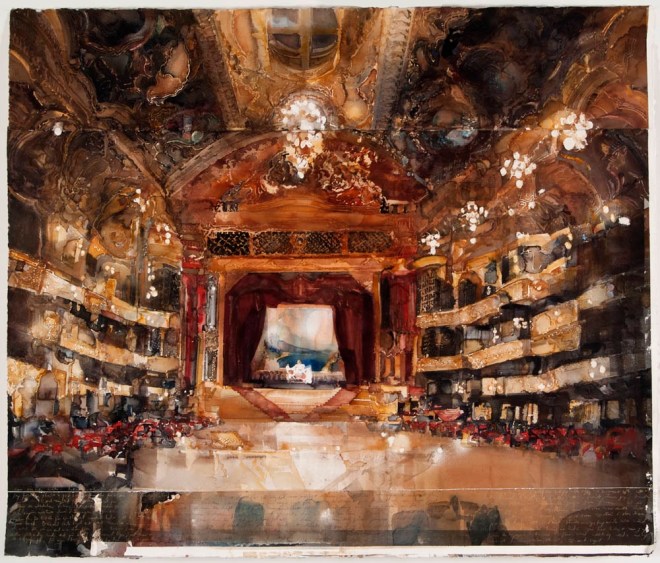 Quoting Hoffman:
The palette is limited to three colors, and almost all of the edges of the shapes are hard. In the realm of value, however, the artist pulls out all the stops. Never merely black, his deepest darks remain full of color. He limits the lightest lights to just a few stops, making everything else seem to be lit by the low gleam of a lantern in a gilded pattern.
With this glorious visual introduction, he begins where most instruction books ought to begin: by encouraging direct observation, followed by critical thinking (would this make a good painting? what appeals to me, and might also appeal to the person looking at my finished work?) and creative thinking (how can I bring the visual ideas to life in the best possible way?) Hoffman does not begin by focusing on materials. He begins by focusing on the process that every artist shares. This leads to two very helpful essays, one entitled “Knowing Where to Begin” and the other, quite reasonably, “Knowing When to Stop.” In between, he explains the process by examining a very common part of the painting process: thinking through the best way to visualize the shapes and forms and values with just enough detail to pull it all together.

Simplicity in pattern and form, a very effective work by Tom Hoffman.
Step back for a moment. Imagine learning history that way. It’s never about the details. It’s always about the whole form. (But in school curriculum, it’s always about the details. Which we always forget.)
A very colorful Juarez Market in Oaxaca is filled with detail. It’s the centerpiece of a chapter entitled “Knowing What Not to Paint.” This leads to thoughts and illustrations about shape and form, and a key concept: simplicity.
A lovely streetscape by the esteemed watercolorist Alvaro Castagnet show how color and light can be handled in the simplest possible way, and yet, with skill, they can result in a painting that appears to be quite complex. The secret, Hoffman explains, is thinking in layers.
Thinking in layers is an additive technique–place one layer of color, then another–but it requires subtractive thinking to begin. That is, you must look at a scene, observe it carefully, determine which areas can be isolated and painted with a single color wash without interfering with other areas. For example, a red wall might be washed, but the blue roof should not be washed in the same layer–unless you’re seeking purple results.

A market in Puerto Rico, painted by Tom Hoffman, provides an illustration of wide dynamic range (note the darks at the top, the lights in the distance), layering and simple design for optimum impact.
Hoffman also encourages the use of a wide dynamic range: the lightest lights and the darkest darks are what makes a painting come to life. Too often, he explains, the range is almost exclusively in the middle tones, and, as a result, the work lacks energy, contrast, and a compelling reason for anybody to pay much attention. Again, appreciate the metaphor because it applies to so many aspects of life: dark and light, silent and boisterous, and so on.
Final lesson: simplify to the point of abstraction. His most powerful work tends to be simple masses of color, artfully arranged.
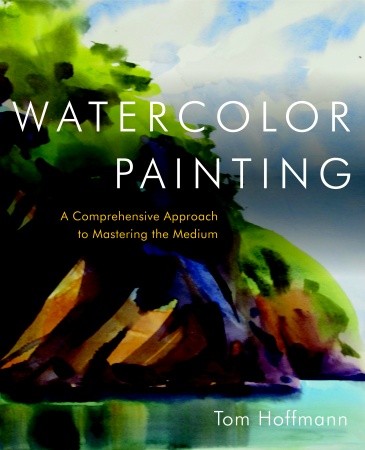
The name of the book is Watercolor Painting: A Comprehensive Approach to Mastering the Medium.
![(Copyright 2006 by Zelphics [Apple Bushel])](https://diginsider.com/wp-content/uploads/2013/03/apple_bushel.png?w=660)

 Much of Kurzweil’s theory grows from his advanced understanding of pattern recognition, the ways we construct digital processing systems, and the (often similar) ways that the neocortex seems to work (nobody is certain how the brain works, but we are gaining a lot of understanding as result of various biological and neurological mapping projects). A common grid structure seems to be shared by the digital and human brains. A tremendous number of pathways turn or or off, at very fast speeds, in order to enable processing, or thought. There is tremendous redundancy, as evidenced by patients who, after brain damage, are able to relearn but who place the new thinking in different (non-damaged) parts of the neocortex.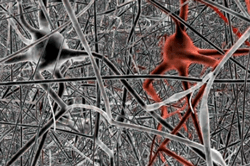

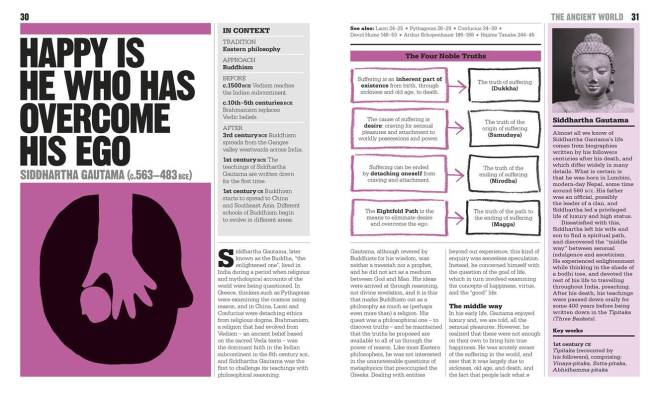
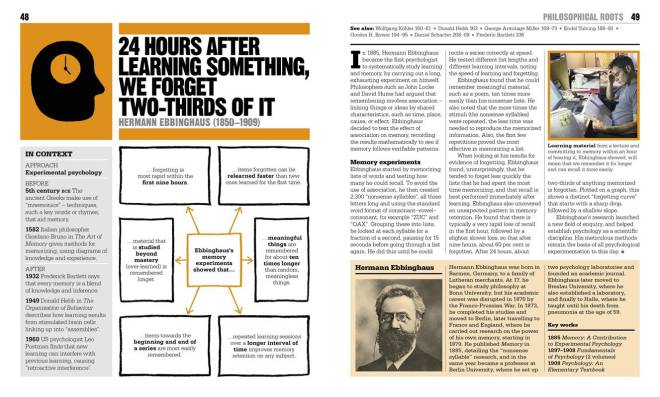 Third in the trilogy is the bright red volume, The Psychology Book. As early as the year 190 in the current era, Galen of Pergamon (in today’s Turkey) is writing about the four temperaments of personality–melancholic, phlegmatic, choleric, and sanguine. Rene Descartes bridges all three topics–Philosophy, Economics and Psychology overlap with one another–with his thinking on the role of the body and the role of the mind as wholly separate entities. We know the name Binet (Alfred Binet) from the world of standardized testing, but the core of his thinking has nothing whatsoever to do with standardized thinking. Instead, he believed that intelligence and ability change over time. In his early testing, Binet intended to capture a helpful snapshot of one specific moment in a person’s development. And so the tour through human (and animal) behavior continues with Pavlov and his dogs, John B. Watson and his use of research to build the fundamentals of advertising, B.F. Skinner’s birds, Solomon Asch’s experiments to uncover the weirdness of social conformity, Stanley Milgram’s creepy experiments in which people inflict pain on others, Jean Piaget on child development, and work on autism by Simon Baron-Cohen (he’s Sacha Baron Cohen’s cousin).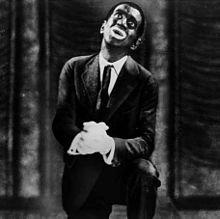
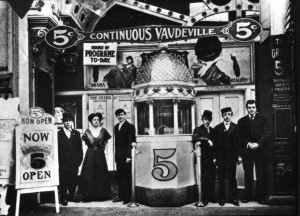

 By 1930, 40 percent of US households owned a radio, and by 1940, radio’s penetration was more than 80 percent. By 1930, there was a bona fide motion picture industry with large studios (Fox, Paramount, Loew’s/MGM, RKO and Warner), each with an elaborate distribution network of theaters throughout the country and a distribution infrastructure to service the nation and parts of the world. At the same time, the new NBC and its lesser rival CBS had built a similar structure for radio broadcasting. This structure supported the next level of development: a star system. Lon Chaney, Al Jolson, Fatty Arbuckle, Theda Bara, Duke Ellington, James Cagney, Fred and Adele Astaire, so many others became household names.
















 Digital Insider