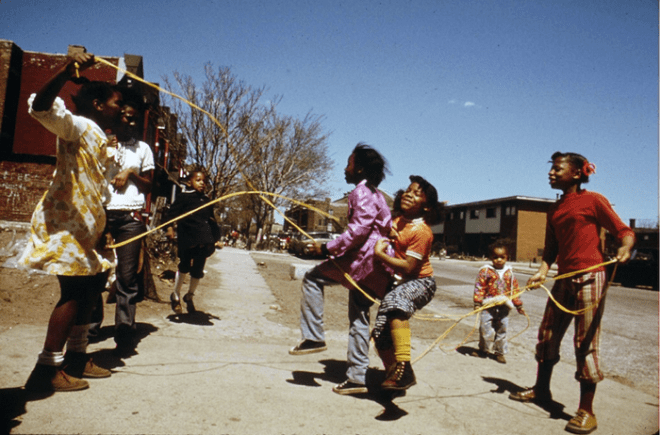
Black Children Play Outside The Ida B. Wells Homes, One Of Chicago’s Oldest Housing Projects. There Are 1,652 Apartments Housing 5,920 Persons In 124 Buildings On The South Side, 05/1973
John H. White was laid off this week. He is a photographer, or, more specifically, an out-of-work photojournalist.
He was replaced by an iPhone.
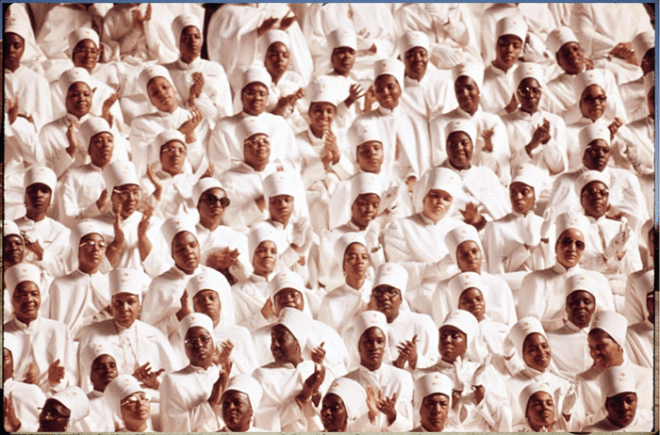
Black Muslim Women Dressed In White Applaud Elijah Muhammad During The Delivery Of His Annual Savior’s Day Message In Chicago, 03/1974
As a much-deserved tribute to Mr. White, Chicago Magazine put together an online portfolio. The two images you see here are my favorite images; click on either one of them to see a portfolio of fifty superb examples of the extraordinary journalism that can be achieved by a skillful photojournalist. The presentation of White’s work for the EPA is not as well-presented, but this site is also worth a visit.
Before moving on to the sharp point of this article, a word about the poetry of John H. White’s work. Consider the exquisite rhythm of both images, the special timing that allows the jump rope to wiggle and wave, the exquisite visual judgement Mr. White employed when filling his frame with Muslim women all in white. The sunny smile of the girl in orange and the placement of the innocent child in the background. This is photography at a high level; it is exceedingly difficult for most people, even serious amateur photographers with decades of experience, to achieve these results with the best possible equipment. (Imagine trying to achieve these results with an iPhone.)
The Chicago Sun-Times is one of America’s largest newspapers. Somehow, the management of the paper stumbled into what must have seemed like a wonderful idea at the time: teach the reporters to use an iPhone, and fire all of the photojournalists (including Mr. White). There’s been a lot of online chatter about the “difficult decision” and “the future,” but I have placed both phrases in quotation marks because both concepts are so insanely wrong-headed.
In today’s image-is-everything society, I suppose I could construct an equally compelling case for firing all of the writers on the staff of the paper, instead filling every page with photographs. Or, perhaps, establish some clever version of crowd sourcing, in which Chicago takes pictures of itself every day, and then, everyone posts captions (the most popular caption wins the top spot).
Certainly, there is a problem in the newspaper business: most papers have lost their business models, and much of their readership. And they have experienced a terrible cost-cutting decade (and more).
Firing the photojournalists may be a fine example of executive leadership discussions gone astray, but there is a larger problem here. The Chicago Sun-Times, and many other papers, aren’t sure how they should face the uncertain future. There are some answers, and, well, I sure hope the management of the Chicago Sun-Times (at one time, the largest of the 100 newspapers where my newspaper column appeared weekly), will consider them:
1. The Chicago Sun-Times is a very strong local brand. Even in a “newspaper town” like Chicago, the future of the “paper” is online.
2. Online, regardless of the platform, it’s all about multimedia: pictures, videos, infographics. Good writing matters, but anything longer than 1,000 words is too long for current use of the medium.
3. Investment in superior multimedia storytelling is the way to go. If the story makes use of video, some writing, lots of pictures, some audio, and powerful graphics, people respond.
4. If people respond, advertisers respond.
5. Focus on the best possible storytelling. Double down your previous investment in visual storytelling. Invest in more photojournalists, and teach them to become videographers if they’re willing and able. By all means, teach every writer how to shoot still images and video with their iPhones (or, go really crazy and invest in a high-quality pocketable digital camera for each of them–for far better results). Figure out how to get the crowd source journalism operating at its highest possible level, for that, too is the future.
I will steer clear of recommending that the executives who concocted this insane plan may find budget cuts in their own roles at the company, but only on the condition that they focus (a word that photographers often use, and for good reason) on the future of journalism so that the next budget cycle doesn’t require firing all of their writers.

To read the Chicago Tribune story and watch the video, click on the image.


 I just finished reading a book about the New Deal, that remarkable FDR-era transformation of America for the average American. Certainly, I knew and understood pieces and parts of the story, but there were so many factors, I needed a good writer (the author won a Pulitzer Prize) to put the whole thing into context for me. The author is Michael Hiltzik, and the book is called, simply, “
 The woman in the photograph was a poor soul, without friends, the subject of ridicule among Seattle schoolchildren. She lived in a hovel. When the growing city of Seattle cleared its native population, she remained where she was, and the city grew up around her. Kick-is-om-lo was her name, but that was difficult to pronounce, so the local folk called her Princess Angeline. In 1896, Kick-is-om-lo was paid one dollar to pose for this picture–the equivalent of what she was able to earn in a whole week–by a struggling young photographer named Edward Curtis. To say this would be the first of many such images would be a substantial understatement.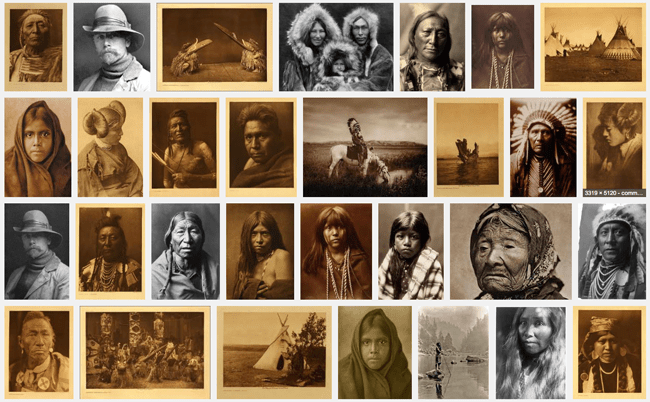





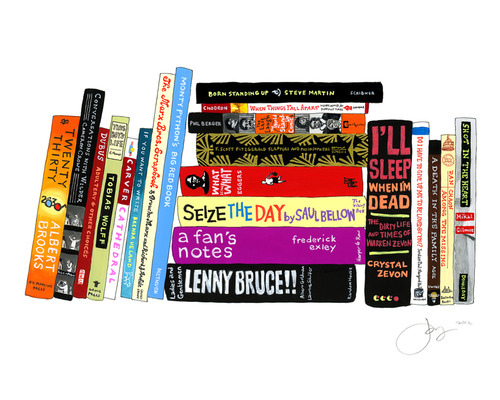 Judd Apatow, famous for his comedy movies, surprised me with James Agee’s A Death in the Family, and reminded me of a popular book about comedians that I wanted to read, but never did: The Last Laugh.
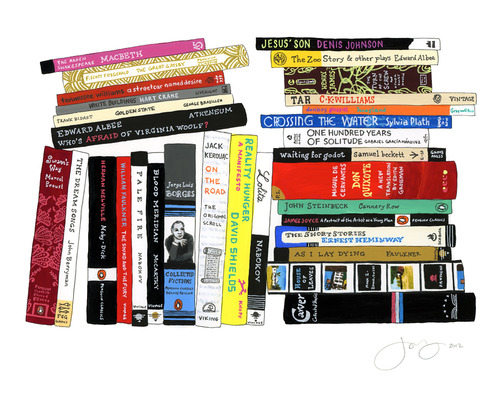 James Franco wins for the most cluttered bookshelf, also the one with the most books. From his stacks, I think I will pick up another set of Raymond Carver stories, and the original scroll version of Kerouac’s On The Road. I suppose I should read Melville’s Moby Dick, which I have avoided so far for no good reason. Ditto for writer Philip Gourevitch’s suggested A Good Man Is Hard to Find by Flannery O’Connor and Dostoevsky’s The Idiot.

 Digital Insider