Outsourcing the Human Brain

(Copyright 2006 by Zelphics [Apple Bushel])

(Copyright 2006 by Zelphics [Apple Bushel])

Before we start outsourcing, let’s prepare an inventory and analysis with this concept in mind:

Our intelligence has enabled us to overcome the restrictions of our biological heritage and to change ourselves in the process. We are the only species that does this.”

And, this one:

We are capable of hierarchical thinking, of understanding a structure composed of diverse elements arranged in a pattern, representing that arrangement with a symbol, and then using that symbol as an element in an even more elaborate configuration.”

Simple though it may sound, we may think in terms of not just one apple, but, say, a bushel filled with, say, 130 medium sized apples, enough to fill about 15 apple pies.

We call this vast array of recursively linked ideas knowledge. Only homo sapiens have a knowledge base that itself evolves, grows exponentially, and is passed from one generation to another.

Remember Watson, the computer whose total Jeopardy! score more than doubled the scores of its two expert competitors? He (she, it?) “will read medical literature (essentially all medical journals and leading medical blogs) to become a master diagnostician and medical consultant. Is Watson smart, or simply capable of storing and accessing vast stores of data? Well, that depends upon what you mean by the word “smart.” You see, “the mathematical techniques that have evolved in the field of artificial intelligence (such as those used in Watson and Siri, the iPhone assistant) are mathematically very similar to the methods that biology evolved in the form of the neocortex (from Science Daily: “[the neocortex is part of the brain and] is involved in higher functions such as sensory perception, generation of motor commands, spatial reasoning, conscious thought, and in humans, language.”

Kurzweil bookGenius author Ray Kurzweil has spent a lifetime studying the human brain, and, in particular, the ways in which the brain processes information. You know his work: it is the basis of the speech recognition we now take for granted in Siri, telephone response systems, Dragon, and other systems. No, it’s not perfect. Human speech and language perception are deeply complicated affairs. In his latest book, How to Create a Mind: The Secret of Human Thought Revealed, Kurzweil first deconstructs the operation of the human brain, then considers the processing and storage resources required to replicate at least some of those operations with digital devices available today or likely to be available in the future. At first, this seems like wildly ridiculous thinking. A hundred pages later, it’s just an elaborate math exercise built on a surprisingly rational foundation.

Kurzweil-headshotMuch of Kurzweil’s theory grows from his advanced understanding of pattern recognition, the ways we construct digital processing systems, and the (often similar) ways that the neocortex seems to work (nobody is certain how the brain works, but we are gaining a lot of understanding as result of various biological and neurological mapping projects). A common grid structure seems to be shared by the digital and human brains. A tremendous number of pathways turn or or off, at very fast speeds, in order to enable processing, or thought. There is tremendous redundancy, as evidenced by patients who, after brain damage, are able to relearn but who place the new thinking in different (non-damaged) parts of the neocortex.

Where does all of this fanciful thinking lead? Try this:

When we augment our own neocortex with a synthetic version, we won’t have to worry about how much additional neocortex can physically fit into our bodies and brains as most of it will be in the cloud, like most of the computing we use today.”

What’s more:

In order for a digital neocortex to learn a new skill, it will still require many iterations of education, just as a biological neocortex does today, but once a digital neocortex somewhere and at some time learns something, it can share that knowledge with every other digital neocortex without delay. We can each have our own neocortex extenders in the cloud, just as we have our own private stores of personal data today.”

So the obvious question is: how soon is this going to happen?

2023.
TED-neocortex

Skeptical? Click the image and watch the 2009 TED Talk by Henry Markham. It’s called “A Brain in a Supercomputer.”

In terms of our understanding, this video is already quite old. Kurzweil: “The spatial resolution of noninvasive scanning of the brain is improving at an exponential rate.” In other words, new forms of MRI and diffusion tractography (which traces the pathways of fiber bundles inside the brain) are among the many new tools that scientists are using to map the brain and to understand how it works. In isolation, that’s simply fascinating. Taken in combination with equally ambitious, long-term growth in computer processing and storage, our increasing nuanced understanding of brain science makes increasingly human-like computing processes more and more viable. Hence, Watson on Jeopardy! or if you prefer, Google’s driver-less cars that must navigate through so many real-time decisions and seem to be accomplishing these tasks with greater precision and safety than their human counterparts.

Is the mind a computer? This is an old argument, and although Kurzweil provides both the history and the science / psychology behind all sides of the argument, nobody is certain. The tricky question is defining consciousness, and, by extension, defining just what is meant by a human mind. After considering these questions through the Turing Test, ideas proposed by Roger Penrose (video below), faith and free will, and identity, Kurzweil returns to the more comfortable domain of logic and mathematics, filling the closing chapter with charts that promise the necessary growth in computing power to support a digital brain that will, during the first half of this century, redefine the ways we think (or, our digital accessory brains think) about learning, knowledge and understanding.

Closing out, some thoughts from Penrose, then Kurzweil, both on video:

Big Ideas Simply Explained

Three subjects that I can never seem to understand as completely as I would like:

  • Philosophy
  • Economics
  • Psychology

Whenever I read a book about any of these subjects, I feel like a student, which means, I am reading because duty requires me to complete the book. The subjects interest me, but too many of the books I have read on these subjects are dreary, slow-moving, too dense with ideas for any reasonable person to sort out and retain their valuable understanding. Pictures help, but many of the ideas held within these disciplines are difficult to illustrate with anything better than wordy diagrams.

A year or so ago, I noticed a series of three books put together by Dorling Kindersley (DK)’s collaborative teams in the UK and India. They’ve got the formula right, and as a result, I have spent the last year happily browsing, and learning, from:

  • The Philosophy Book: Big Ideas Simply Explained
  • The Economics Book: Big Ideas Simply Explained
  • The Psychology Book: Big Ideas Simply Explained

A month or so ago, the same company released The Politics Book: Big Ideas Simply Explained, and at some point, I’ll get to that one, too. Right now, I’m still working my way through the first three volumes (about 1,000 pages total).

Three DK BooksSo what’s so special?

First,there is no single author. The collaborative approach focuses on presentation, clarity and consistency. This is less the work of a brilliant psychology teacher, more like a good old fashioned browse through, say, The World Book Encyclopedia from days of old. The type treatments are bold. There are pull-out quotes. There is color. No single idea runs more than a few pages. Everything is presented in a logical flow. There are boxes filled with biographical details. There is a clear statement of predecessor ideas and influences for each idea, and there is an equally clear statement about those in the future who built upon each idea. There are color pictures and diagrams. It’s tidy, presented for smart adult readers but certainly suitable research material for any school report.

The Philosophy Book is written by four academics and two writers: Will Buckingham is a philosopher and novelist with a special interest in the interplay between philosophy and narrative storytelling. Marcus Weeks is a writer, and author. Clive Hill is an academic focused on intellectualism in the modern world. Douglas Burnham is a philosophy professor and prolific writer on the subject. Peter J. King is a doctor of Philosophy who lectures at Pembroke College, University of Oxford. John Marenborn is a Fellow of Trinity College, Cambridge, UK, whose expertise is medieval philosophy. Taken as a group, they’ve got their philosophical bases covered (each of the books is put together by a team with similar skills). Marcus Weeks is the connection between all three books.

The bright yellow Philosophy book introduces the whole idea in comfortable language:

Philosophy is…a chance simply to wonder what life and the universe are all about…Philosophy is not so much about coming up with the answers to fundamental questions as it is about the process of trying to find out those answers, using reasoning rather than accepting…conventional views or conventional authority.”

So begins an introductory essay that introduces debate and dialogue, existence and knowledge, logic and language, morality, religion, and systems of thought and beliefs. A red color burst is the bridge into a timeline that begins the conversation in 624 B.C.E. And so, early on, we meet Pythagoras, who should be famous for more than his geometric theorem. In 428 B.C.E.–that’s about 2,500 years ago–Pythagorus developed a remarkable idea, that everything in the universe conforms to mathematical rules and ratios, and determined that this was true both of forms and ideas. Pythagorus was the leader of a religious cult, in which he was the Messiah, and his followers thought of his work as revelations. Here was a man for whom reasoning was the secret of the universe. He wrote, or said:

There is geometry in the humming of the strings, there is music in the spacing of the spheres.”

And:

Reason is immortal. All else is mortal.”

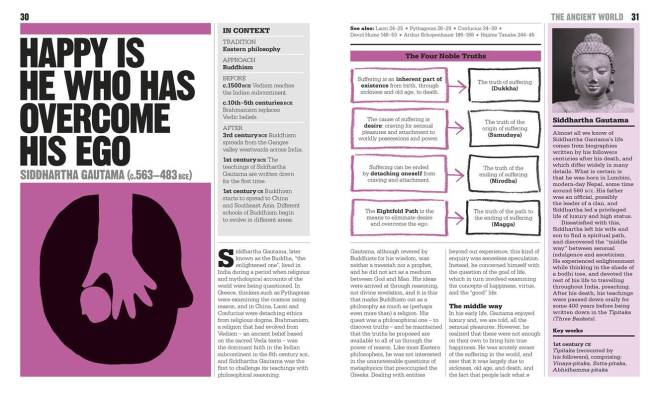
SiddharthaTurn the page and there’s Siddhartha Gautama and Buddhism’s four noble truths, explained in terms that anybody can understand, followed by the Eightfold Path presented in the Dharma Wheel. Siddhartha is covered in four good pages, and then, it’s time for Confucius and his Five Conscious Relationships.

All three of these men–Pythagorus, Siddhartha and Confucius–lived and worked around 500 B.C.E. More or less, they were contemporaries. A century later, philosophy turns to what is later called science, as Democritus and Leucippus come with the idea of atoms and the emptiness of space. (Seemed very early to me, too!) At about the same time, this from Socrates:

The life which is unexamined is not worth living.”

Jumping ahead to the middle of the book, Britain’s David Hume is considering human nature in the mid-1700s, and, in particular, the ways we cobble together facts:

In our reasonings concerning fact, there are all imaginable degrees of assurance. A wise man therefore proportions his beliefs to the evidence.”

Thinking in the present day, Palestinian philosopher Edward Said criticizes imperialism, Australian Peter Singer advocates for animal rights, and Bulgarian-born French philosopher Julia Kristeva questions the relationship between feminism and power. It’s a large field, and with The Philosophy Book, it’s possible for the average person to navigate with greater confidence than before.

The other two books are equally good.

The Economics Book begins with an article about Thomas Aquinas’s thoughts on prices, markets, and morality; the provision of public goods with thoughts by David Hume, whose words from the 1700s certainly resonate today:

Where the riches are engrossed by a few, these must contribute very largely to the supplying of the public necessities.”

Hume is among the few whose ideas appear in more than one of these volumes. And–I just noticed–The Philosophy Book tends to be stories about the people behind the ideas, The Economics Book tends more toward the ideas with less frequent stories about the people behind them (often because economic ideas are credited to multiple sources, I suppose). Making our way through The Age of Reason (“man is a cold, rational calculator;” “the invisible hand of the market brings order”);  on to economic bubbles (beginning with tulip mania in 1640); game theory and John (A Beautiful Mind) Nash; market uncertainty, Asian Tiger economies, the intersection of GDPs and women’s issues, inequality and economic growth, and more. Great book, but a bit slower going than Philosophy.

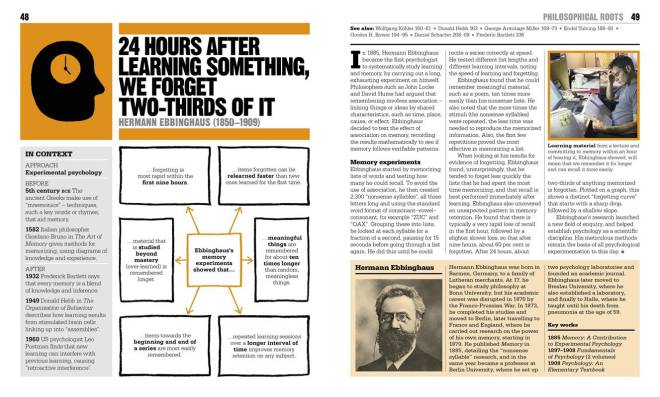
Psych Book SpreadThird in the trilogy is the bright red volume, The Psychology Book. As early as the year 190 in the current era, Galen of Pergamon (in today’s Turkey) is writing about the four temperaments of personality–melancholic, phlegmatic, choleric, and sanguine. Rene Descartes bridges all three topics–Philosophy, Economics and Psychology overlap with one another–with his thinking on the role of the body and the role of the mind as wholly separate entities. We know the name Binet (Alfred Binet) from the world of standardized testing, but the core of his thinking has nothing whatsoever to do with standardized thinking. Instead, he believed that intelligence and ability change over time. In his early testing, Binet intended to capture a helpful snapshot of one specific moment in a person’s development. And so the tour through human (and animal) behavior continues with Pavlov and his dogs, John B. Watson and his use of research to build the fundamentals of advertising, B.F. Skinner’s birds, Solomon Asch’s experiments to uncover the weirdness of social conformity, Stanley Milgram’s creepy experiments in which people inflict pain on others, Jean Piaget on child development, and work on autism by Simon Baron-Cohen (he’s Sacha Baron Cohen’s cousin).
When I was in high school and college,  I was exposed to all of this stuff, but only a small amount remained in my mind. Perhaps that was because I was also trying to read the complete works of Shakespeare, a book a week of modern utopian fiction, The Canterbury Tales, and studying geology at the same time. In high school and college, these topics were just more stuff to plough through. No context, no life experience, no connection to most of the material. Now, as an adult, it’s different. Like everyone I know, and everyone you know, I’m still juggling way too much in an average week, but I can now read this material with a real hope of understanding and retaining the material. Cover to cover, times three, these books will take you a year or two, but… without a test the next morning, you’ll be surprised how interesting philosophy, psychology and economics turn out to be. Just read them in your spare time, and behold (great word, “behold”) the ways in which humans have put it all together over several millennia. It’s a terrific story!

You Know, A Lot Can Happen In A Century

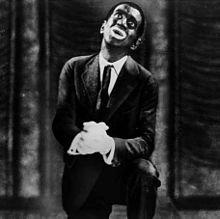
In his time, Al Jolson was a superstar. We've managed to get past the need for blackface, and although it keeps changing, showbiz marches on.

In his time, Al Jolson was a superstar. Thankfully, we’ve managed to get past the need for blackface. Show business keeps changing, adapting to times and tastes. And until recently, there was one place to read about these changes, day after day, year after year. Now, that’s changing, too. How? Read on. (You ain’t heard nothin’ yet!)

Today, we’re digital. We live in modern times. These times, we believe, are so new, so unique, that they have no historical precedent. The mythology is tempting, but that’s because the history is just beyond the edge of our ken. We focus on the new. We forget what happened before. Until, of course, we’re reminded of our history as the result of a really good documentary, or a really good book.

vaudeville theatre

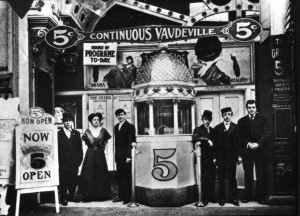
A hundred years ago, minstrel shows were just beginning to lose their luster, but it was unclear whether theater audiences would eventually prefer skating rinks, a vaudeville industry based upon national tours (new, in 1906), or bawdy burlesque as a the most popular ways to spend leisure time. Movies were just starting out with an industry of tiny, dubious start-ups and few places where they could be seen by anyone. Live theater was the popular entertainment; actors traveled from one city to another to perform in popular plays, just as they had since the time of John Wilkes Booth. It was a confusing time… The Great War was just beginning and the large theater lobbies were as useful as recruiting stations as they were for pre-performance gatherings. After the war, everything seemed to coalesce. Charlie Chaplin, who had debuted in a US theater in 1910, was sufficiently powerful by 1918 to join forces with movie stars Douglas Fairbanks, Mary Pickford, and director D.W. Griffith to form United Artists. Then as now, everything happened quickly.

Prior to the 1920s, just about all entertainment was live. The movies were beginning to change that, and as the decade began, a new idea called radio was began as a kind of experiment, it’s post-military use future not yet clear. The year 1920 was one of vaudeville’s best ever. By 1925, radio was becoming popular, but its business model was entirely unclear. From a July 1925 article:

the broadcasters and radio manufacturers continue to tell Department of Commerce officials that no broadcasting station in the country is making money.

Paramount theaterParamount studioBy 1930, 40 percent of US households owned a radio, and by 1940, radio’s penetration was more than 80 percent. By 1930, there was a bona fide motion picture industry with large studios (Fox, Paramount, Loew’s/MGM, RKO and Warner), each with an elaborate distribution network of theaters throughout the country and a distribution infrastructure to service the nation and parts of the world. At the same time, the new NBC and its lesser rival CBS had built a similar structure for radio broadcasting. This structure supported the next level of development: a star system. Lon Chaney, Al Jolson, Fatty Arbuckle, Theda Bara, Duke Ellington, James Cagney, Fred and Adele Astaire, so many others became household names.

The industry grew. There were cartoons from Warner Bros, and Disney, comedy shorts from Hal Roach (Our Gang, Laurel and Hardy), child stars including Shirley Temple, and within a decade, major long-term successes including Gone with the Wind and The Wizard of Oz. There was Mussolini, Hitler, FDR, the Roaring Twenties followed by the Great Depression.

Variety bookVariety covered it all. This small, speciality newspaper, a trade rag, was always at the center of it all. When anything happened in or near show biz, Variety told the world. Everybody in “the business” read it, and to be mentioned in it was a clear indication of career success (I was in it, at lease once, and I still have the clipping).

This week, Variety announced that it would cease publishing its daily edition (the weekly remains in print, at least for the foreseeable future). This is not simply a cost cutting measure. Variety, once the trendiest of publications, has been badly beaten in the online entertainment journalism game, and some industry insiders question its survival as a 21st century brand.

Given its illustrious past, I suspect Variety has more fight in it than pundits allow. If you have any doubt, you must spend some time with a book about Variety’s history published by Rizzoli in a tidy coffee table format. The book is entitled Variety: An Illustrated History of the World from the Modt Important Magazine in Hollywood. The last headline in this volume: “Comcast buys 51% of NBC Universal.” I think it’s interesting to note that neither Comcast nor NBC nor Universal existed when Variety’s story began, and even more interesting to consider just how much has happened over the span of a single century. (Parallels with today’s innovative world are particularly fascinating).

Okay, why not? Here’s one of my favorite Variety headlines. This one was on the front page on July 12, 1950:

VIDEO NOW VAUDE’S VILLAIN
Acts and Agents Fear TV Inroads

Can’t help but wonder about a headline that could be written for July, 2050:

WEB, VID DEAD
TV and internet replaced by…

Big Data, Bigger Ideas

face pic human face

Every animate and inanimate object on earth will soon be generating data, including our homes, our cars, and yes, even our bodies”— Anthony D. Williams on the back of a big book entitled The Human Face of Big Data

From the dawn of civilization until 2003, humankind generated give exabytes of data. Now, we produce five exabytes every two days.” — Eric Schmidt, Executive Chairman, Google

The average person today processes more data in a single day than a person in the 1500s did in an entire lifetime.

Big Data is much more than big data. It’s also the ability to extract meaning: to sort through masses of numbers and find the hidden pattern, the unexpected correlation, th surprising connection. That ability is growing at astonishing speed, it won’t be long before Amazon’s ability to dazzle customers by suggesting just the right book will seem as quaint as our ancestors’s amazement at horseless carriages.– Dan Gardner, from the book’s introduction

human face big dataClearly, big data is a massive idea. Let’s see if we can’t break it down, if not by components, then, at least, by illustrations of classes and contexts.

The connection between data collection and pattern recognition is not new. In fact, we know the earliest example, which still exists, in book form, in a small, private Library of Human Imagination in Ridgefield, Connecticut. The book is called Bills of Mortality, and it records the weekly causes of death for London in 1664. This data was used to study the geographic (block-by-block) growth of the plague, and to take measures to prevent its future growth.

Two hundred gigabytes per day may not seem like much data, not in the days when you can buy a terabyte drive from Staples for a hundred bucks or so, but collect that much data day and day out, for a few years, and the warehouse becomes a busy place. That’s what MIT Media Lab’s Seb Roy did to learn how his newborn son learned language. The work was done at home with eleven cameras and fourteen microphones recording the child’s every move, every sound. The recording part of the project is over–their son is now seven years old–but analysis of “unexpected connections between the routines of everyday life and how one child learned his first words” continues as a research project.

On the other end of the age scale, there’s Magic Carpet, now in prototype. The carpet contains sensors and accelerometers. When installed in the home of, say, a senior, the carpet observes, records, and learns the person’s typical routine, which it uses as a baseline for further analysis. Then, “the system checks constantly for sudden (or gradual) abnormalities. If Mom is moving more slowly than usual, or it’s 11 a.m., And her bedroom door still hasn’t opened, the system sends an alert to a family member or physician.”

Often, big data intersects with some sort of mapping project. Camden, New Jersey’s Doctor Jeffrey Brenner “built a map linking hospital claims to patient addresses. He analyzed patterns of data, and the result took him by complete surprise: just one percent of patients, about 1,000 people, accounted for 30 percent of hospital bills because these patients were showing up in the hospital time after time…a microcosm for what’s going on in the whole country (in) emergency room visits and hospital admissions…” Subsequently, he established the Camden Coalition of Healthcare Providers to help address this “costly dysfunction.” He collected the data, analyzed it, then brought out meaningful change at a local level.

One of the many superb photographs depicting the intersection between human life and technology use. The book was put together by Rick Smolan, an extraordinary photographer, curator and compiler whose past work includes A Day in the The Life of America and other books in that series.

One of the many superb photographs depicting the intersection between human life and technology use. The book was put together by Rick Smolan, an extraordinary photographer, curator and compiler whose past work includes A Day in the The Life of America and other books in that series.

Yes, there’s a very scary dark side. Bad people could turn off 60,000 pacemakers via their Internet connections. A real time, technology enabled 2008 terrorist attack in Mumbai killed 172 people and injured 300 more thanks to Blackberries, night vision goggles, satellite phones and other devices.

If you control the code, you control the world. There has not been an operating system or a technology that has not been hacked.

Fortunately, the good guys have tools on their side, too. The $40 million Domain Awareness System in Manhattan includes “an array of 3,000 cameras known as ‘The Ring of Steel” that monitor lower and midtown Manhattan as well as license plate readers, radiation detectors, relevant 911 calls, arrest records, related crimes, and vast files on characteristics such as tattoos, body marks, teeth, and even limps. They can also track a suspicious vehicle through time to the many locations where it has been over previous days and weeks.”

Google’s self-driving car is safer than a human-controlled vehicle because the digital car can access and process far more information more quickly than today’s humans.

By 2020, China will complete Compass/Beidou-2. This advanced navigation system will outperform the current (and decades old) GPS system. Greater precision will be used for public safety (emergency response, for example), commercial use (fishing, automotive), and, inevitably, for far more productive war.

Data can mean the difference between life death when the weather turns ugly. Thousands of lives are saved each year by weather earnings in wealthier countries. Yet thousands of lives are lost in poor ones when monsoons, tornadoes and other storms strike with little public warning, an intensifying threat as the planet warms,,,

If you’ve ever wondered what Amazon’s true business is, or why it uses the name of a gigantic river, the answer is big data. Ultimately, Amazon intends to become a public utility for computing services. Take a careful look at Amazon Prime and you will see a prototype. The streaming side of PBS and Netflix are among the enterprises enabled by Amazon’s big data operations.

For FedEx, “the information about the package is as important as the package itself.”

human face big data movementsWhether its eliminating malaria or making art, text messaging for blood donors or tracking asteroids, the future will be defined by the collection, analysis and use of big data. It will shape our individual knowledge about our own bodies, our children’s growth and our parents’ health, our collective tendencies for public good, safety, and bad behavior. It will be embedded in robots and intelligent systems that may, soon, control aspects of life that we once considered wholly human endeavors. It is a change of epic proportions and yet, most of us are unaware of its importance.

The book, The Human Face of Big Data, along with its related website and app, provide a useful gateway into this brave new world.

Amazon: Any Thing, Any Where, Any Time

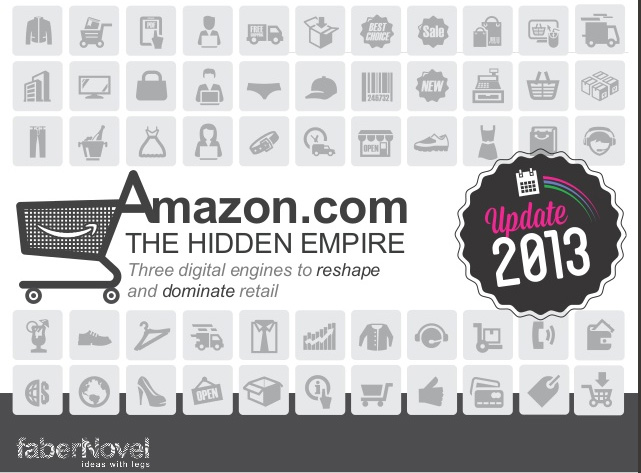
Amazon-HiddenEmpireFaberNovel is a website filled with interesting, well, I’m not sure what to call these packages of visual information. They’re kinda sorta PowerPoint presentations, but they feel more like a new kind of business book.

Originally, I was going to tell you that there’s a good (updated 2013) story of how Amazon is taking over the world. The presentation, above, tells a compelling tale about how the e-commerce giant has grown, offering considerable detail on the business side, and lots of insight about Amazon’s likely future.

As I went through the 84 slides, I became curious about who was telling the story, and became interested in FaberNovel, the publisher who offers this material under a Creative Commons license. As I browsed, I found an All About Google FaberNovel, too. And another about Google, Facebook, HTML5, the list is both impressive and multi-lingual (that is, presentations are available in multiple languages).

The stories are well-told, simply illustrated, and rely upon diagrams and other simple PowerPoint graphic techniques (nobody will be impressed by the visuals, but the stories are good; Edward Tufte’s magic wand would greatly benefit this material).

I’d start with the Amazon story because it contains so many “oh, that’s why!” or “that’s how, that’s a really good idea” or “what an awesome story of business strategy.” moments. Some of it is likely to be familiar, but it’s unlikely that most people have connected the dots. Sure, 84 pages may seem like a lot, but it’s not more than a half-hour of your life, unless you’re a serious student of e-commerce business.

Interesting discovery.

A Parisian History in Color

sennelier_couvertureIn Paris, on the Quai Voltaire, amidst antique dealers of the highest order, along the left bank of the Seine, directly across the river from the famous Louvre museum, there is a shop.

Sennelier-Interieur-In 1887, or, perhaps, 1888, the shop was nearly bankrupt. With the sale, former shop owner M. Prevost, makes dreams come true. The new owner, Gustave Sennelier, always hoped to own a shop where he could manufacture and sell his own artist’s pigments. And so, the shop became known by the sign visible to all of Paris, Sennelier: Couleurs Pour Artistes.

This was an especially exciting time to be selling colors and working with artists in Paris. The impressionists enjoyed their first successful group show in Paris in 1886.  Painters were experimenting with color and light, trying new formulas and new ideas, and often relied upon the good advice of the chemists who were emerging as colorists. (Previously, pigments were sold in pharmacies as a sideline; art supply stores were still a relatively new idea.) As chemistry and art intertwine, artists now regarded as legend were working professionals who purchased their supplies from Sennelier. Cezanne was one of many in Paris who frequented the shop; others included Pierre Bonnard, Robert Delauney, and Pablo Picasso.

Seeking new products and new opportunities, Sennelier’s pigments found popular use for batik (the pigmentation of decorative fabrics), painting on porcelain, and in new formulations for artists, including, for example, new oil pastels. “Picasso adopted it immediately. He asked for it in 48 colors of which–Picasso’s grey period required it–10 were shades of grey, a heresy in the age of colors.” Artists used the new oil pastels to start an oil painting, allowing the fluidity and ease of sketching onto the canvas. Then, the painting would be completed in a classical oil painting style.

facade-quai-GFThe Sennelier family has passed knowledge, chemistry, color sense and business sense from generation to generation. In a sense, the new book, Sennelier: A History in Color by Pascale Richard, is a family biography. As with the Parisian landscape, the family is part of a bolder story: the powerful relationship between science (chemistry) and a tremendous assortment of artistic accomplishments. The book is filled with full-page images of Jackson Pollack paintings and store shelves filled with pigments; photos of antique paint tubes and pastel drawings by Edgar Degas; spectacular old city scape photos of the old shop and inside the old lab and photos of the shop today, a place that hasn’t changed much in a century. If you are planning a visit to the Louvre, do find the time to cross the Seine, make the left turn, follow the classic old buildings until you reach number 3 Quai Voltaire. At the least, you will buy a notebook or a sketchbook (Picasso bought lots of them), and perhaps you will be persuaded to buy a set of Sennelier pastels, which are among the finest in the world, or oils or watercolors, or artist’s pads. You can buy some, or even most, of this merchandise in many U.S. art supply stores, but it’s not the same experience. There is magic in the old shop, magic that is so loving transported into book format.

dan

Daniel Greene is one of my favorite artists. Click on the picture to explore his spectacular work.

It is a joy filled story: the idea of bringing Sennelier products to the U.S., the magic of those pastels in the hands of a great contemporary artist. Daniel Greene is such an artist, and his two-page spread of Manhattan’s Franklin Street subway station is a wonder. So, too, are the simple photos of the neatly-ordered tortillons in a century-0ld drawer in the old shop.

For about ten years, I have so enjoyed using Sennelier pastels. The freshness and depth of their color makes every painting special. When I have a Sennelier pastel in my hand, I sense that there is legend there. I visited the shop in Paris, and sensed some of the history, but it was difficult to understand how the story fit together. When I started reading the book, I loved the combination of new and vintage photographs, art and artists at work, and the story told in both French and English blocks of prose. About a third of the way through the book, I realized that I was grinning. And I wondered about the last time I had grinned my way through the reading of an entire book.

Several years ago, NPR did a wonderful story about the Sennelier shop. Listen to it here.

Even better, I think, is the photo essay and commentary on the blog A Painter in Paris. The photo below should encourage you to visit both the blog and the store. Enjoy!

aa_DSCN3354

Only Half of This Is True

Maybe not now. But soon.

Turns out, facts are like radioactive materials, and, for that matter, like anything that’s not going to last forever.

arbesmanMore or less, this is half-life principle, developed just over 100 years ago by Ernest Rutherford, applies to facts, or, at least, a great many facts. This persuasive argument is set forth by Samuel Arbesman in a new book called The Half-Life of Facts. I especially like the sub-title: “What Everything We Know Has an Expiration Date.” Arbesman is a math professor and a network scientist, and, as you would expect, this is a smart book. The book seems more like a musing than a fully worked-out theory, but I suspect that’s because facts are not easy to tame. Herding facts is like herding cats.

HalfLifeOfFactsLet’s begin with “doubling times”–the amount of time it takes for something (anything) to double in quantity. The number of important discoveries; the number of chemical elements known; the accuracy of scientific instruments–these  double every twenty years.  The number of engineers in the U.S. doubles every ten years. Using measures fully detailed in the book, the doubling time for knowledge in mathematics is 63 years, in geology it’s 46 years. In technology knowledge, half lives are quiet brief: a 10 month doubling for the advance of wireless (measured in bits per second), a 20 month doubling time for gigabytes per consumer dollar. With sufficient data, it’s possible to visualize the trend and to project the future.

So that’s part of the story. Of course, it’s one thing to know something, and it’s another to disseminate that information. As the speed of communication began to exceed the speed of transportation (think: telegraph), transfer of knowledge in real time (or, pretty close to real time) became the standard. But not all communications media is instantaneous. Take, for example, a science textbook written in 1999. The textbook probably required several years of development, so let’s peg the information in, say, 1997. If that textbook is still around (which seems likely), then the information is 16 years old. If it’s a geology text, the text is probably valid, but if it’s an astronomy text, Pluto is still a planet, and there are a lot of other discoveries that are absent. And, there are facts rapidly degrading, some well past their half life.

Trans-Neptune

Although you can click to make the image bigger, Pluto still won’t be a planet…

And, then, of course, there are errors. Sometimes, we think we’ve got it right, but we don’t. Along with the dissemination of facts, our system of knowledge distribution transfers errors with great efficiency. We see this all the time on the internet: a writer picks up old or never-accurate information, and republishes it (perhaps adding some of his or her own noise along the way). An author who should know better gets lazy and picks up the so-called fact without bothering to double check, or, more tragically, manages to find the same inaccurate information in a second source, and has no reason to dispute its accuracy. Wikipedia’s editors see this phenomenon every day: they correct a finicky fact, and then, it’s uncorrected an hour later!

Precision is also an issue. As we gain technical sophistication, we also benefit from more precise measures. The system previously used for measurement degrades over time–it has its own half-life. Often, errors and misleading information are the result.

The author lists some of his own findings. One that is especially disturbing:

The greater the financial and other interests and prejudices in a scientific field, the less likely the research findings are to be true.

And, here’s another that should make you think twice about what you see or hear as news:

The hotter a scientific field (with more scientific teams involved), the less likely the research findings are to be true.

My favorite word in the book is idiolect. It is used to describe the sphere of human behavior that affects the ways each of us sends and receives information, the ways in which we understand and use vocabulary, grammar, pronunciation, accent, and other aspects of human communication. A fact may begin one way, but cultural overlays may affect the way the message is sent or received. This, too, exerts an impact on accuracy, precision, and, ultimately, the half-life of facts.

Word usage also enters in the picture. He charts the popularity of the (ridiculous) phrase “very fun” and finds very strong increase beginning in 1980 (the graph begins in 1900, when the term was in use, but was not especially popular).

Time is part of the equation, too. The Long Now Foundation encourages people to think in terms of millennia, not years or centuries. Arbesman wrote a nice essay for WIRED to focus attention not only on big data but on long data as well.

Given all of this, I suspect that the knowledge in the brain of an expert is also subject to the half-life phenomenon. Take Isaac Newton–pretty smart guy in his time–but the year he died, most of England believed that Mary Toft had given birth to sixteen rabbits.

Last week, on CBS Sunday Morning, Lewis Michael Seidman, a Georgetown University professor commented about our strong belief in the power and relevance of the U.S. Constitution (signed 1787, since amended, but not substantially altered):

This is our country. We live in it, and we have a right to the kind of country we want. We would not allow the French or the United Nations to rule us, and neither should we allow people who died over two centuries ago and knew nothing of our country as it exists today.

CBS News Constitution

The Triple Revolution

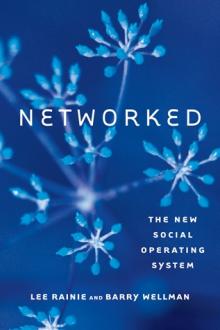
I think I prefer that name to the simpler Networked: The Social Operating System by Lee Rainie, who runs the Pew Research Center for Internet and American Life, and Barry Wellman, a professor who runs NetLab in Toronto. The triple revolution is easy enough to understand: we’re living at intersection of three significant changes in modern life:

  1. Social networks, which encourage connections between people regardless of their physical location
  2. The widespread availability of the internet, which provides a never-before-possible power for information access, and transmission and reception of messages in every medium.
  3. The mobile revolution has transformed digital devices into “body appendages” that allow “people to access friends and information at will, wherever they go…”

These trends define the new space in which we live, and, armed with both the necessary research and a knack for explaining a wide range of interlocking ideas with clarity, the adventure begins.

NetworkedProfessor Wellman’s work helps to make the case that the old idea of groups has become the new idea of networked individuals. At first, the distinction may seem, well, academic. Then again, consider the number of people with whom you interact every day or every week. If you lived in, say, Europe of the 1800s, most of these people would share proximity, language, culture, friends, family members, transportation routes, and more. Today, those ties are not fixed in a group. Instead, the connections are more fluid, more varied, more precisely defined by the individual and not by his or her membership in a group. Boundaries are permeable. Connections may or may not be long-term. Something’s lost here in terms of long-term friendships and relationships with family members (some or many may no longer live nearby), and something’s gained in the richness of more diverse lives.

I remember working for a client named Steve, who carried his cell phone in a case the size of a lunchbox, and I remember working for a successful entrepreneur whose phone was built into her car’s dashboard, like a car radio. Both date back to the 1980s. At the time, not more than a few thousand people owned mobile phones. In fact, that first decade was slow going, but after 1995, the trajectory is very nearly a 45-degree angle, running uphill to over 300 million cell phones today, and more on their way. Fully 83% of the U.S. population owns a cell phone.

Those stats aren’t surprising, but the combination of internet growth, changes in our individual behavior, and the fact that so much can now be accomplished any time and anywhere sets up the story. Public and private spaces begin to blur–think about the number of people you saw on TV during the inauguration who were checking their cell phones. Nowadays, it’s perfectly acceptable to work just about anywhere–and the need for offices is beginning to fade, certainly for creative workers, and now, for many other types of workers, too. Companies are shrinking or closing their offices and instructing employees to conduct their business from home (in one case, a friend was told to “take the office furniture because it is no longer needed.” The authors consider the idea of “place-to-place” networks to be hopelessly old-fashioned; these days, it’s all about “person-to-person” networks. As family composition and roles have shifted (women working outside the home; household free time spend on digital devices; the individual activity of computing; a 25% drop in the average number of hours devoted to housework since 1965), we interact in different ways that don’t always connect generations effectively. For example, the authors describe a young woman who communicates daily with both of her parents while they complain that they never hear from her. What they want is personal touch. What she wants is regular contact. These are not the same, and as a result, there is conflict.

When attempting to explain the changed world of journalism, the explanations do not come so easily, in part because it is so very difficult to understand what’s really happening and why. With so many people writing and communicating on the web, in so many different ways, the old and traditional role of a reporter is difficult to outline in the new world. Where does credibility or experience or context fall? Do we perceive more value in a local person telling a story on the spot in, say, the changing Middle East, or an experienced reporter who provides the experience and wider view? What about people who comment on the work of the local observer or the reporter? Not all are pundits; many are simply trying to understand what happened by reviewing many sources and many stories.

And so the layers are applied, one after another. It’s not just that there’s a remarkable internet or an astonishing Wikipedia, and it’s not just that we’re able to access this material and respond to it at any moment from any location. It’s these phenomena mapped over a much-changed society and dramatically shifted individual behavior patterns. It’s all one large idea, and it’s time that we begin to think about these changes in a more holistic way. The data is here… enough of it to get the conversation started, anyway. And in this iteration, the writing and smart and the analysis is sharp. It was written about 18 months ago–one of the ironies of the book writing, publishing and reviewing process is that it takes more time than our triple revolution deems reasonable.

P.S. After I write each article, I search for pictures. My first search on the term “Networked” yielded a Wikipedia article that provided my evening’s dose of irony:

networked book is an open book designed to be written, edited, and read in a networked environment. It is also a platform for social exchange, and is potentially linked to other books and other discussions. Wikipedia is a networked book.

Best in Class

I guess I ought to begin with the obvious question: what is common thread that connects Louis Armstrong, Bob Dylan, Johnny Cash, Michael Jackson, Bruce Springsteen, Barbra Streisand, Frank Sinatra, Leonard Bernstein, Aaron Copland, Adele, and Beyoncé?

The answer is Columbia Records. Founded in 1888, it’s probably the oldest record label. Along with sister labels Epic, Okeh, and a few others–set the standard for the U.S. recording industry for half of the 20th century. This story, now in book form by Princeton history professor Sean Wilentz, is, well, epic. The book is called 360 Sound: The Columbia Records Story (the term “360 Sound” refers to a tagline associated with Columbia’s stereo LPs).

220px-BertWilliamsPhotoPortraitWithCigarette

“(I Ain’t Got) Nobody” was one of the many songs that made Bert Williams famous. He was among the first non-white stars in the United States.

After some novelty acts, Columbia establishes a firm footing with vaudeville superstar Al Jolson; the great singer and comedian who later starred in the Ziegfield Follies, Bert Williams, and one of the fathers of country music, Emmett Miller. A short time later, John Philip Sousa joined the label (at the time, his full band could not be recorded due to early microphones, so the sound was thinner than it was in live performances). Add W.C. Handy, and an equally impressive range of classical performers.

Columbia became a major force in “race records,” recognizing, early on, White consumer interest in Black performers. From this era came Bessie Smith, Louis Armstrong, Duke Ellington and artists that those familiar with the genres continue to buy: Blind Willie Johnson, for example. There was country (and western) music, too: Gene Autry, Bob Wills, Roy Acuff. Next came jazz pianist Art Tatum, Cab Calloway, and Count Basie. And Benny Goodman and Bing Crosby. And gospel music: The Golden Gate Quartet, Mahalia Jackson. And that’s all before the organization really found its way.

(As I said, this is an astonishing story. It’s wave after wave of the superb artists in every genre, all working, at one time or another, for the same label, or cluster of labels.)

So here comes the 1950s with Tony Bennett, Leonard Bernstein, West Side Story, My Fair Lady, South Pacific, Glenn Gould, Doris Day, Rosemary Clooney… and almost no rock n’ roll. Mitch Miller–a company executive and in his own right, a very popular recording artist as a leader of a singing group–was against the whole idea. Still, they were strong in every other genre–classical in particular, and jazz. It was here that Miles Davis recorded most of his best work, with Thelonious Monk, Dave Brubeck, and so many others. Unfortunately, although quite classy, there wasn’t much profit in classical, jazz or (most) Broadway recordings. Country was better: Flatt and Scruggs, Lefty Frizell, The Stanley Brothers, and eventually, Johnny Cash.

Along the way, there’s some tasty back-and-forth between Columbia and its long-time arch-rival (in just about every musical category), RCA Victor (which, in its golden age, was owned by RCA, which owned NBC to Columbia’s CBS). The two companies do their best to mess with the other, stealing artists, introducing competing record formats (the LP came from Columbia and the 45 came from RCA).

For a while longer, they stick with easy choices, and steer clear of the growing revolution: they sign Barbra Streisand, Andy Williams, Johnny Mathis (who sells an insane number of records), and Robert Goulet.

Columbia RecordsAnd then, it happens. They sign Bob Dylan. Everything begins to change. Simon & Garfunkel come next. Suddenly, the cool jazz label, the reliable country label, the powerhouse classical label, becomes the unbelievably great rock label. The Byrds are covering Dylan songs and selling lots of Byrds and Dylan records. Donovan is signed to Epic, and debuts with a hit (“Sunshine Superman”). There’s a new executive in charge (much of the whole story is told through the eras of individual executives). His name is Clive Davis, and now, Columbia is the place to hear Janis Joplin and Santana, Sly and the Family Stone, Leonard Cohen, Blood Sweat & Tears, and Chicago. They sign Earth Wind and Fire; Johnny Cash records an album at Folsom Prison; Monk and Miles are selling lots of jazz, with Miles into fusion, and appealing to rock audiences. And then, by the mid-1970s, there’s another wave of newcomers: Billy Joel, Aerosmith, and Bruce Springsteen. A great story is becoming better and better.

And then, another wave, this time bringing Willie Nelson to the company and making him a star. The jazz story continues to heat up with Weather Report, Herbie Hancock, and a newcomer from the young lions of jazz, Wynton Marsalis. On the classical side, Yo-Yo Ma is becoming a star.

All of this is one company, basically one record label. Of course, the story continues through hip-hop, Ricky Martin, an aging Bob Dylan, Michael Bolton and Lauryn Hill, Destiny’s Child and John Mayer. Chris Botti and Joshua Bell.

Yes, they’ve been bought and sold, multiple times (now owned by Sony). For me, the best part of the journey (oh yes, Journey was one of theirs, too), the best part of this coffee table book, is the era that picks up in the early 1950s and winds down about twenty years later. That’s when CBS was a very special place, in part because Columbia was just about the coolest record label around. It’s a good story, fun because of the memories, remarkable because of the achievement. And, I think, the best way to experience the era is on the vinyl records that Columbia invented, most of them now available, used, for about $5 at just about any good used record store.

columbia labels

So, I’ve been thinking about other labels with equally rich histories. The Warner Music Group includes Atlantic, Elektra, Nonesuch, and Warner Bros. Records. Historically, Atlantic’s strengths have been R&B and rock; Elektra’s have been folk and rock; Nonesuch has evolved into something like a (smaller) modern day Columbia Records with interesting artists, Broadway, classical, and international; Warner Bros. is, more or less, a popular music label. The crazy history of the labels that became Sony Music now encompasses Columbia’s long-time competitor RCA (Victor) as well as the Columbia labels; in just about every category, from Broadway to classical to country, RCA and Columbia were head-to-head, and although I want to write that Columbia did it just that much better on the rock and pop side, I’m reminded of the Jefferson Airplane (less so, the Starship), John Denver and others from the heyday (none were Dylan or Miles Davis–so maybe Columbia did do it better). In classical music, the labels now assembled under the current Decca Label Group, now part of Universal, include London/Decca and Deutsche Grammophon, but neither attempted the breadth of genres associated with Columbia. Similarly, the likes of Verve, A&M, and other Universal labels, lacked the grand ambition (and, probably, the monies available from CBS). EMI’s story is more complicated, and although its U.S. division, Capitol Records, released many pop and rock records, and some Broadway, it never established the breadth of material available from Columbia.

So, in terms of wide-ranging, deep-repetoire, and long history, it’s Columbia Records and its best competitor, RCA (Victor), but I urge you to have a look at all that Nonesuch has done, too.

The Multiplier Effect

Quickly now… If you multiply 633 by 11, what’s the answer?

No doubt, you recognize the pattern, and you may recall the mental math process:

633 x 10, plus 633 x 1, or 6,330 plus 633, or 6,963, which is the answer (or, in terms used by math teachers, the “product”).

There is another way to solve the problem, a faster way that assures fewer computational errors, and does not involve any sort of digital or mechanical device. It does, however, involve a simple rule and a different way to write the problem down.

The rule is: “write down the number, add the neighbor.” The asterisk just above each number is there only to help you to focus. If you prefer, think of it as a small arrow.

Here’s how it works:

Mult by 11

Try multiplying 942 x 11  and you’ll quickly get the hang of it.

Do it once more, this time with a much larger number: 8,562,320 x 11. It goes quickly, as you’ll see.

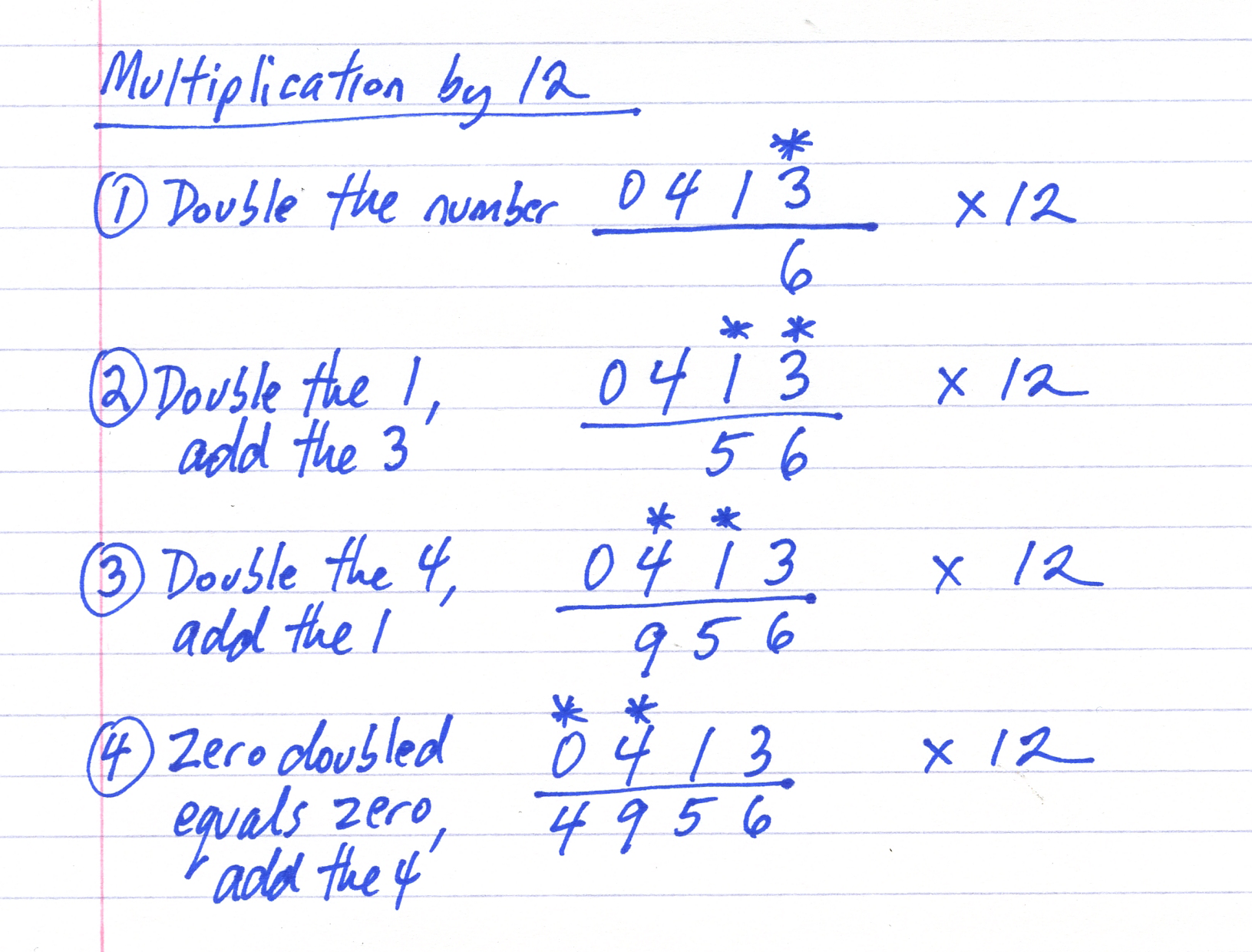
Multiplying by 12 is just as easy, but the rule changes to: “double the number, add the neighbor.” Here, my explanation includes specific numbers.

Mult by 12

In fact, there is a similar rule for multiplication by any number (1-12). And there are rules for quickly adding long, complicated columns of numbers, as there are for division, square roots and more.

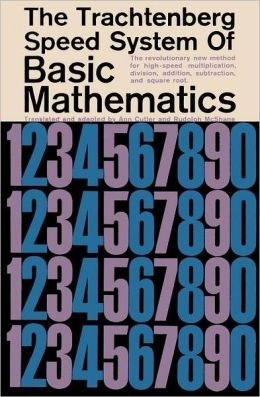
These rules were developed by a man facing his own demise in the Nazi camps during the Second World War. Danger was nothing new to him…this is the story and the enduring legacy of Jakow Trachtenberg, who first escaped the wrath of the Communists as he escaped his native Russia, then became a leading academic voice for world peace. His book, Das Friedensministerium (The Ministry of Peace), was read by FDR and other world leaders. His profile was high; capture was inevitable. He made it out of Austria, got caught in Yugoslavia, and was sentenced to death at a concentration camp. To maintain his sanity, Trachtenberg developed a new system for mathematical calculation. Paper was scarce, so he used it mostly for proofs. The rest, he kept in his head.

Madame Trachtenberg stayed nearby, in safety. She bribed officials, pulled strings, and managed to get Jakow moved to Dresden, which was a mess, allowing him to escape. Then, he was caught again, and was moved to Trieste. More bribes and coercion from Madame. He escaped. The couple maneuvered into a more normal existence beginning at refugee camp in Switzerland. By 1950, they were running the Mathematical Institute in Zurich, teaching young students a new way to think about numbers. A system without multiplication tables. A system based upon logic. A system that somehow survived.

A system that, against all odds, made it into my elementary classroom. One classroom in the New York City school district. For one year. The parents were certain that the teacher was making a terrible mistake, that the people in my class, myself included, would never be able to do math in the conventional way again. Of course, we learned a lot more than an alternative from of arithmetic.

And now, after decades out of print, in an era when arithmetic hardly matters because of calculators and computers, the original book is back in print. The brilliance of system remains awesome, and the book is worth reading just to understand how Trachtenberg conceived an entirely fresh approach under the most extraordinary circumstances.

20130113-222930.jpg