Just So We Don’t Forget…

A Forever Job

Tenure is a strange concept. Imagine — a job for life!

Not many professions support the idea of tenure. Outside of education, Federal judges work with a lifetime guarantee, as long as their behavior is “good” (a term that can be widely interpreted). Some clergy, and some research scientists may enjoy tenured positions, and some union workers, with especially strong contracts, may be assured lifetime employment, but the term tenure does not officially apply to them.

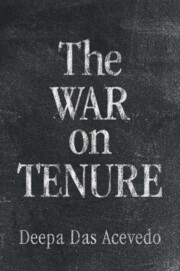
Mostly, tenure is used to describe the employment guarantee associated with teaching. K-12 teachers are afforded tenure, so even if their current compensation is lower than it might be in other professions, there is a assurance that it will go on for a very long time (and there is often an ample rest-of-life pension following that employment). Tenure is also associated with teaching at the college or university level, but the situation may not be simple, may be messy, and seems to be losing favor. This, according to Deepa Das Acevedo, a law associate professor at Emory University, and author of a new book entitled, The War on Tenure. It’s a world of work that’s largely unfamiliar to most people, except, perhaps when a professor’s private life is revealed in a movie or TV series.

Tenure applies to a very small portion of the overall population, but that doesn’t stop political campaigners from including the abolition or undermining of tenure in their speeches. When a scholar (assume all professors are scholars) works for a public university, they are, in fact, state employees. This may generate political conflicts — almost anything taught in a classroom these days may be deemed controversial and inappropriate by somebody — and that often affects stable employment.

Of course, it’s easy enough for any university to sweep away a current batch of pre-tenure or non-tenure employees with simple budget cuts, or in more difficult situations, through workplace pressure. This pressure can be strategically timed so that an individual scholar may believe they are on the path to tenure, only to find that state or board of governors or a third party has the power to erase the track completely. And then, of course, there is a question of academic integrity — at some point, many university scholars are required to make an ugly decision. Do they do what has been demanded and keep the pre-tenure or tenure job, or do they refuse, and place themselves on the job market with a vague black mark on their record?

There are lots of reasons why tenure may be denied, or pulled. These include academic misconduct (including plagiarism, which is now exceedingly difficult to sort out, given the growing role of AI), sexual misconduct (including, for example, well-founded or unfounded claims by students), or unprofessional conduct (such as bullying, which is often difficult to prove or disprove). When a university decides to shuffle departments, perhaps reorganize because their academic offerings require updating, tenure may disappear. Ditto for financial hard times for the institution.

So, tenure is not really a forever job. It may be better than most. Until it’s not. And when it’s not, a scholar with a fairly specific area of study may find themself difficult to place in another institution. That’s one reason why we have tenure in the first place — to support the many academic scholars whose fields of study are narrow but whose work is important. (But is all work important? How important?)

For the person seeking tenure, the path begins as an undergraduate. There is future value in selecting a program of study at a respected, sometimes specialized, institution. Often, this comes at a cost (and so, the debt begins to accumulate). Then, there’s graduate school, first for the master’s degree, then for the doctorate. Again, there is debt, and because these activities are so time-consuming, little opportunity to earn significant money in the process. So the debt becomes larger. There is a term for this situation: “PhD poverty.” Many institutions of higher learning operate food pantries. Hunger is a real issue. For those who come from low income poverty, “keeping mind and body together” is a real problem.

Then comes the post-doc phase: cheap labor for universities, and a necessary step if you want to become a professor. You may know post-docs by other names, such as fellows, lecturers, and visiting assistant professors.

The odds are lousy. Maybe 1 in 8 people make it to tenure track. As for the others — including the many who invest heavily, take on significant debt, and watch their dreams of an academic life go astray — there may be staff jobs at the university (that is, non-tenure track, and often, without the same prestige), or jobs in the larger marketplace (without tenure, and often not repaying the investment made by previously hopeful student).

Why should we care? Assume there are about 1.4 million college professors in the U.S., and about a third of them are tenured. Is that a lot? And why does this whole issue matter? Why write a book about tenure?

It matters because knowledge matters, because these people are the keepers of our knowledge, and they are the people who construct new knowledge, presumably with high standards in mind. Their work is different from other peoples’ work. They go deep. They think and construct models, then challenge one another’s models so everyone can think even more clearly. Their time horizons are different from other workers’ — they may take 10 or 20 years to work out what needs to be known, or done, and may work for lifetime, often with colleagues, to accomplish a very specific goal. Without institutional stability, and employment stability, this becomes very difficult to do. Why? In part because there aren’t many alternative ways to get this work done. Yes, it’s different. No, not every tenured scholar is producing essential knowledge. And no, it’s not a perfect system. But this is a situation where the perfect can easily become an enemy of the good. Although they are currently under attack, and always seem to be coping with the low hum of criticism, universities have a role, and scholars have a role, too. Which is why, in the end, we should be working to improve the system, and not tear it down.

Living in the Mechanical World

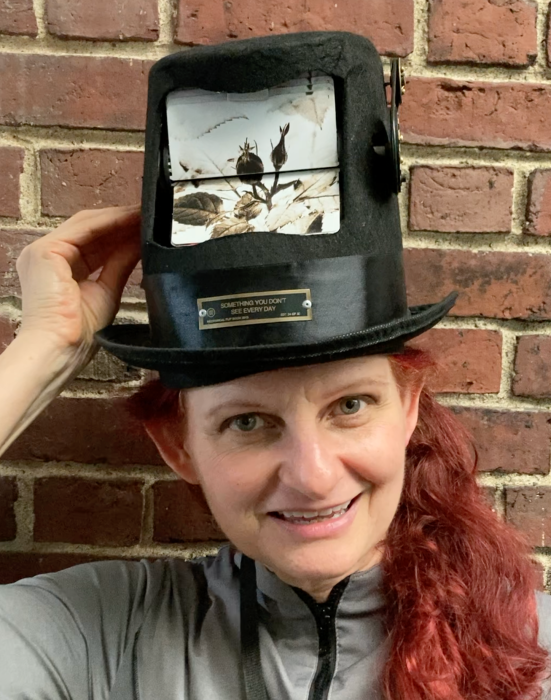
Wendy is walking around in top hat. The hat contains a window. Inside the window, there is a rosebud. During our brief conversation, the rosebud blooms into a full-sized red rose. With her partner, Mark, they have found a niche, making very clever flip books that capture the heart and the imagination. At their display table at the recent Automatoncon, an animal travels from one flip to another and another, employing mechanics and images printed on paper to bring ideas to life. In fact, anybody can do it — they sell a popular D-I-Y Flip-o-Scope that allows children, parents, and creative souls to animate images, and bring them to life.

That’s the whole point of automatons — you may recall the automaton in the center of the HUGO movie directed by Martin Scorsese, which was based upon the delightful picture book, The Invention of Hugo Cabret, by Brian Selznick — to simulate life through mechanical means. Every two years, AutomataCon provides a gathering place for wonderfully creative souls to compare notes, talk tech (which, in their world, is not digital), and show off their latest work. Significantly, the event is held at the small Morris Museum in Morristown, New Jersey, which houses one of the world’s largest collections of Murtogh D. Guinness Collection of historic mechanical musical instruments and automata. Mr. Guinness, of the famed brewing family, was a collector so serious about his prized assets, he built a building for the Morris Museum in exchange for a promise to keep the collect intact, alive, and productive.

Part of the promised outreach effort is AutomataCon, which brings, for example, Cecilia Schiller from her workshop in Northern Wisconsin to northern New Jersey. Cecelia’s long history in puppetry, theater special effects, and exhibits (such as a magical Christmas display, held annually in St. Paul, Minnesota’s Macy’s Department Store).

A puppet simulates life with the help of a talented human operator, but Cecilia’s sense of story takes her further with a full-scale puppet show that includes several children, puppets in a Punch and Judy stage, an puppet operator controlling those two puppets, and a colorful assembly of gears and operators down below the stage. All of it is control with a crank. It is magnificent. The images below provide some sense of what it does and how it works.

Dave Bowman discovered automata by visiting the Morris Museum. That was eleven years ago. Now, he makes magnificent metal automata of his own. We begins with Meccano parts — similar to an Erector set — but he uses only older sets because the steel girders are better for his purposes, and because the gears are brass-plated. Two recent favorites: a viking ship and a large bird, each with its own elaborate back story. He does not plan the creations. Instead, he engages in a long conversation with the imaginary beings. “You bond with them. You spend so much time creating them.” As with puppetry, the line between reality and fantasy can become blurry.

And yes, that is a real animal skull that forms the head. And, below, the made-up history is worth reading.

Of course, there is much more to discover. More artists whose work mimics real life. If you haven’t seen the movie HUGO, that’s a good place to start. And if you’re curious about AutomataCon, be sure to visit their website.

A Perfectly Curious Book

Professor Susan Engel remembers growing up. She recalls small details. Not only did she eat bugs, she remembers when and where, and which bugs she ate (potato bugs). As a pre-schooler, she remembers watching TV while sitting under the ironing board, comfortably asking all sorts of questions of Nonna, who was ironing the family’s clothes above her. In a one-room school house, Mrs. Grubb’s imbalanced approach to curiosity and education began a lifetime of inquiry. One of Professor Engel’s works-in-progress is a evaluative measure for curiosity, which seems consistent with the way most people think about school in the 21st century, and, to me, wildly  counterintuitive.
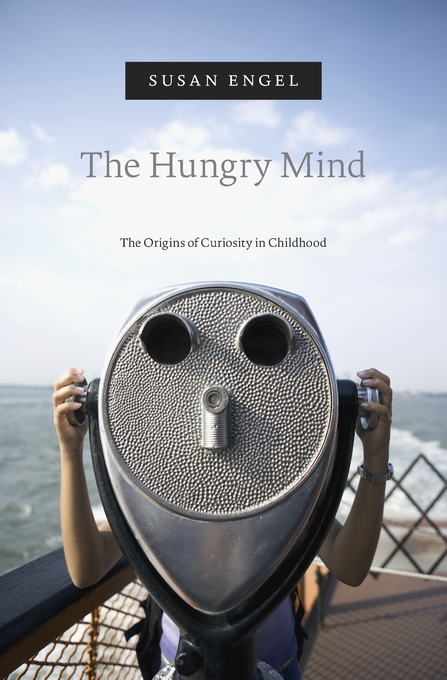
The right book tends to find me at precisely the right time. That’s what happened yesterday when I started The Hungry Mind: The Origins of Curiosity in Childhood. It’s fair to say that I devoured it in a single weekend.

In my studies and writing about creativity, curiosity has always been an underground river. I can hear it and sense it,  but it’s difficult to see. Curiosity differs with each person and their current motivation, and with every situation. It also tends to vary in duration and intensity depending upon personal interest at the moment, and available information.

Curiosity behaviors are familiar, easy to recognize: “We pick up objects to look at them more closely, peel things open and take them apart, ask other people questions, read books, do experiments, and wander into unfamiliar situations.”

Some people are more likely to do this than others.

“The quality of a child’s attachment has a powerful influence on the vigor and depth of her exploration of the world around her.” When a child is insecure or uncertain about their bond with mom, he or she is less likely to “make physical and psychological expeditions to gather information.” As the book unfolds, this becomes one of its most important ideas. In lower-income, and/or lower-education households, parents tend to provide specific operating instructions for life (“put that down,” “come to the table,” “not now,” “leave the dog alone”), but parents in households less troubled with economic issues often encourage and entertain open questions, theoretical ideas, and forms of play. Reading and storytelling may have little to do with the practical. Open-minded freedom builds self-confidence, resilience, and curiosity. (Not so sure? This is a 200 page book extensive references to past work by serious scholars).

Unfortunately, curiosity is very difficult to define and even harder to measure. (Not that learning is easy to measure, unless it’s wrapped in the short-term evaluative tools that structure contemporary education.)

This 2015 book pays less attention to mobile devices and the internet and social media than I do. A Second Edition would be wonderful, especially if Professor Engel expands the book to connect these innovations to curiosity and personalized learning.

Returning to economic advantage and curiosity, “children growing up in poverty hear far fewer total number of words, have a harder time learning to read, and ultimately are less likely to do well in school by the time they are in third grade…” Professor Engel goes on, “if a child lives with parents who only use words to manage practical tasks, he may struggle to use language for less practical, more contemplative purposes.” In turn, this affects the ability of children to formulate and ask good questions, which is a very important way to express curiosity and learn about the world and one’s place in it.

Focus not on the school experience, because that’s only part of child’s experience. Instead, focus on what children hear adults say and see adults do. Early on, children overtly mimic. Grown adults mimic too… following a parent or aunt or uncle’s path as a result of a gift or what seemed to be an inconsequential conversation at the time. I just found a book about world cultures that my aunt and uncle gave me when I was nine years old. I remember reading the book dozens of times. Many decades later, it’s clear that the book shaped my current professional activities in global education. I did not learn much of this in school, or in any formal setting. It was my own curiosity that shaped these ideas, and continues to shape them today.

School simply isn’t the place to nurture curiosity. There’s just too much other stuff to do. There is constant pressure to prepare the students for the upcoming test, to complete the project on schedule, to score the grades necessary for advancement. Distractions–which are essential to curiosity and exploration–are deeply discouraged. Inquisitive students must be not derail the classroom conversation, however interesting and significant their questions may be.

Is curiosity the opposite of education?

The good Professor doesn’t take the argument this far, but she sometimes comes close. Borrowing some of her own thinking and adding it to my own… Curiosity is intuitive, fluid, wide, deep, driven by interest, exceedingly difficult to measure, and essentially unrestricted by time and space. Education is defined by curriculum experts and highly structured. It is highly structured to make efficient use of time and space, and adheres to a strict timetable measured by 45 minute intervals, weeks of achievement, school years and grade levels. Education cannot run too deep or too wide because there are so many items that must be taught to so many people. Education is driven by rules, not student interest (for some, this changes in higher education). Measurement of short-term impact can be done, but the longer the period of measurement, the more variables complicate the results.

Traditional coursework on The Civil War takes students through causes (difficult to understand without lots of broader context), Lincoln, Gettysburg Address, Emancipation Proclamation, John Wilkes Booth, funeral cortege, and the dull political history of Andrew Johnson and reconstruction. Lots of education happening here, but the sheer volume of information smothers any attempt at global context or personal investigation of related stories. The story is just too complicated for education. It’s better suited to the uneven and long-term learning that curiosity can provide.

A student guided by curiosity might begin with the failure of tobacco as the South’s cash crop, its replacement with cotton and big cotton’s reliance upon the slave trade. Follow that line and you’ll bump into the enormous economic leap made possible by the cotton gin. Then, it’s off to England where Manchester’s mills make a fortune with cheap cotton from American slaves. When that supply is threatened by events leading up to the Civil War, the British look to India for an alternative cotton source, amplifying the growth and power of the British Empire. India becomes a glorious distraction–stunning history, spectacular music, art, dance, religion, food. Later, a fight for independence with Gandhi and nonviolent protest as a new way of thinking that informs US student protests to help end the Vietnam War, and Martin Luther King, Jr. to challenge authority in very productive ways. Back to Manchester for its rivalry with nearby Liverpool; follow  that line to the economic and social conditions that breed The Beatles and change popular music and culture (including George Harrison’s encounters with Indian music, and so on).

I know we don’t teach that way, but I know I learn that way.

As I understand more about how we teach, and how we learn, there may be more to eating bugs than there is to textbooks.

A Credible Faker–and A Future of Journalism

I’ve never been a fan of the term “fake news” because it over-simplifies the problem of poor instruction in critical thinking and media literacy. News stories have always been fabricated, and always constructed to persuade, disrupt, or otherwise confuse the audience or the reader. And honest journalism has long existed on the far side of the spectrum. Most of what’s in between is the mediocrity that describes most of the contents of a 24-hour news cycle.

It’s always been easy to print and publish truth or nonsense under an assumed or otherwise made-up identity. The now-esteemed Alexander Hamilton did it, and so did founding fathers James Madison and John Jay. In my early days of magazine writing, I sometimes wrote under an assumed name.

And, of course, we’ve been enjoying doctored photographs for a long time. If a friend cannot attend a wedding, he or she can be Photoshopped (a new verb?) into the image. We add sunrises and sunsets, make photographic models that much prettier, and so on. Many of us are now learning to do this with video as well. “I can’t believe my eyes” seems like a good way of thinking about what we see, especially on screens.

And that brings us to the fake news anchor, with the adjective fake referring not to the news itself, but to the anchor who is confidently delivering information as a kind of digital puppet (lots of connotations for puppet in that scenario). He can be programmed to read just about anything, from any source, but he looks quite human and his delivery, which will only improve, is already pretty darned good.

Have a look. And consider the possibilities for teachers, professors, and politicians, all programmed to say what you, or somebody else, wants them to say.

Reform School

The memory is hazy, but the term is familiar from childhood. Kids who behaved badly were threatened with reform school. I just read up on the term. Sure enough, it was a teacher’s idle threat—reform schools were popular beginning just before the Civil War, and mostly fell apart nearly a hundred years ago. Reform school was a place to send incorrigible boys while keeping them out a adult prisons, where they were abused, transformed into criminals, and often, both.

“Reform school” is one of the few English phrases that might be a tesseract—a multidimensional geometric shape (square is to cube as cube is to tesseract). When the word “reform” is used as a verb, not an adjective, it leads the way to the school reform.

We can flip that term on its head, too. Like reform school, public schooling is an ingenious idea born of a far away period when families were in need of literacy, and citified behavior. Learn to read, write, speak and behave properly, and, odds were, you would find worthwhile, long term employment and economic success.

Looking at the term today, school reform feels anachronistic. Henry Ford’s comment about faster horses comes to mind (“If I had asked people what they wanted, they would have said faster horses”), even though he never said or wrote those words. We accept school as a permanent institution because we cannot imagine a better modern solution. What else would we do with 50-55 million kids every day? Our economic system is now based upon parents who, by and large, work every day to support increasingly expensive lives. So we think in terms of constantly improving, perhaps even reforming (that is, re-forming, or forming in a new way) our schools.

Perhaps the phrase, and the concept, or reformed schools are too limiting. Perhaps the generation of children and teenagers are as diverse in their interests as they are in their heritage. Perhaps their insistence upon trusting the video and social media on their cell phones is, in fact, a very powerful tool for customized learning.

Perhaps children and teenagers have already bypassed their concerned parents’ desire or need to reform school. Instead, many are already pursuing the divergent, often disruptive, path to learning on their own. Or, perhaps, reformation into classrooms with rows of permanent desks, all eyes on the teacher in the front of the room, really is the best way to train young minds.

Or should we be concerned, instead, with learning reform, or, more clearly, learning reorganized, recontextualized, re-formed, or just plain reformed? How might that look? Would we move from the well-intentioned IEP to a celebration of well-organized self-directed learning?

How does any of that marry the once all powerful needs of industry? Or is everything just moving too darned fast for those needs to matter in a world where digital changes everything much faster than contemporary educators can teach? Are students reforming the beliefs, knowledge and understanding in their minds with a reformulated version of a teacher? Perhaps the key is teacher reform?

Finally, there are the strange bedfellows, curiosity and education. The former is associated independent thinking—parents encourage children to “think for yourself.” The latter is concerned with consistent results for the good of society—teachers encourage children to “learn the curriculum” which allows limited opportunity and encouragement for individual thinking, self-expression, divergent paths, and imagination. We certainly need to regenerate the curiosity and creative thinking that becomes lost in so many students, so many children, as the education system helps them to mature. In short, we ought to re-form or reconstitute curiosity in every grade and in every way. So we might be attempting to reform curiosity, and maybe that’s wise because reforming education sounds like something that might be impossible to do because school boards, principals, teachers and other educators are not trained to think or behave as reformers in any sense of the term.

Reform school? Sure, but let’s not spend all of our intellectual capital on a movement that digital transformation will eradicate with or without our help. Reform learning? Sure, and if we don’t get to it soon, Google will take care of the problem for us, or a Facebook might. And, in any case, kids are already reforming learning, on a massive scale, without adult supervision. Reform the teachers? Their own political solidity may assure the demise of a once noble profession. Reform education? Read your Clayton Christensen—this is an industry ripe for a massive disruption because the incremental variety almost always leads to a forgotten enterprise. Re-form curiosity? You bet! Encourage students to pursue their own paths, albeit in an organized way! Sounds good. Also sounds like, well, like college on a very good day.

img_1055-1

Above, John Dewey, who was doing a lot of writing and thinking about these ideas long before I was born. He wasn’t the only one, of course, and there have been many since, but some of Dewey’s ideas continue to resonate. From PBS: “To Dewey, the central ethical imperative in education was democracy. Every school, as he wrote in The School and Society, must become “an embryonic community life, active with types of occupations that reflect the life of the larger society and permeated throughout with the spirit of art, history and science. When the school introduces and trains each child of society into membership within such a little community, saturating him with the spirit of service, and providing him with instruments of effective self-direction, we shall have the deepest and best guarantee of a larger society which is worthy, lovely and harmonious.”

To Many Teachers; Too Many Teachers

Basic arithmetic yields a surprising result, and some equally surprising insights. My working assumptions probably match those associated with the school years of about half of Americans; your results may vary.

After one year of pre-school (1 teacher), I attended grades K-6 (total: 7 teachers, plus an equal number of specialists in art, gym, etc.). Then, three years of junior high school (assume 6 different classes, so 6 teachers, plus specialists takes the total up to 9, then multiply by 3 years = 27 teachers). Similar math for three years of high school (assume 6 classes, 3 specialists, 3 years =27 teachers). Four years of college nearly completes my total (5 classes, 8 semesters = 40 teachers). Add a few post-graduate courses (5 teachers).

How many teachers were paid to educate just one person?

1 pre-K

7 K-6

27 JHS (7, 8, 9)

27 HS (10, 11, 12)

40 College (freshman, sophomore, junior, senior)

5 Post-Graduate (after that)

TOTAL: 107

Let’s round the number of teachers to 100 because there were probably a few teachers who taught more than one course.

How much time did I spend with each teacher?

  • Pre-K: probably 20 hours per week for about 40 weeks (summer off) = 800 hours = the equivalent of 100 8-hour days
  • Each of the K-6 teachers: 6 hours each day x about 180 days = about 1,200 hours = the equivalent of 150 8-hour days
  • Each junior high and high school teacher: 3/4 of an hour each day x about 180 days = about 135 hours = a bit more than 3 weeks
  • Each college professor/instructor (per class section): 3 hours per week x 12 weeks = 36 hours = just under 1 working week

Teacher

Being a teacher remains one of the best jobs in the world. The best teachers make direct connections with students. Elementary school students spend lots of time with students, so these connections occur more naturally and more often. High school teachers spend far less time with individual students. To learn more about why you, or someone you know, ought to become a teacher, watch the video by clicking on the image. The video comes from a wonderful site called Teach.com.

I remember the names of every elementary school teacher, but few of my college teachers. Now I understand why: I spent the equivalent of about 30 weeks with the former and the equivalent of about a week with the latter.

That got me to thinking. What’s life like on the other side? A high school teacher is seeing perhaps 150 students per year. Divide that by a 40-hour work week, and if each student’s needs were addressed individually, each of us would receive an average of 15 minutes of instruction per week.

Efficiency

Of course, we don’t distribute resources that way. Instead, we mass produce junior high / middle school and high school education. One teacher, 150 students per 9-month session, managed as 5 groups of about 30 students. The most efficient way to manage this process would seem to be standardization and extensive testing to assure an acceptable degree of effectiveness. In college, this system stretches the extremes: more than 100 people in lecture halls during the early years, and perhaps fewer than ten people in a senior seminar. The underlying premise: people who teach in college ought to be specialists, allowing undergraduate students to learn about Shakespeare from one teacher and Chaucer or John Steinbeck from another. Certainly, no reasonable college educator in an institution with sufficient resources would consider the possibility of one professor teaching both Introduction to Psychology and Environmental Geology.

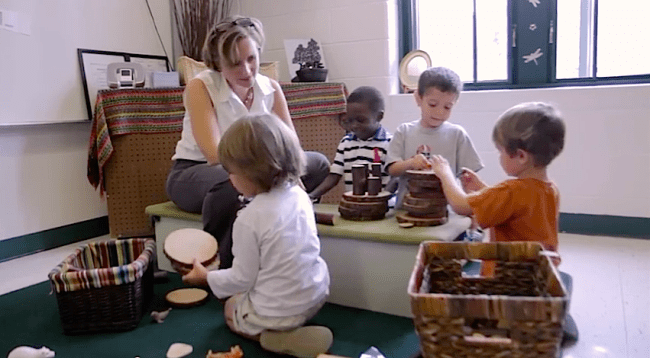
And yet, that’s precisely what we require of our K-6 teachers. Most elementary school teachers are able to cope with more than half a dozen school subjects, and probably closer to a dozen of them. They manage the same students for the better part of a working year. As teachers, they spend enough time with the students to develop one-to-one relationships, and to craft lessons so that they are effective for thirty individual, naive, developing minds. One teacher spending a lot of time on a lot of topics with a few dozen students makes intuitive sense. It seems as though that would be a good way for a teacher to operate, and it seems as though it would be a good way for students to learn.

The Switch

So why do we change modes in junior high school? Why do we replace one teacher with nine people? Do we believe that students in sixth grade require no specialized instructors, and that students in the seventh grade require each teacher to be an expert in his or her field? Certainly, middle schoolers are coping with all sorts of challenging changes in their lives. Why not offer the stability of a single teacher for the entire day, one who is reasonably well-versed in a half-dozen school subjects?

Let’s take the argument into high school. Our high school model encourages students to interact with many adults who teach, but the amount of time that each student spends with each teacher is so modest, the argument is easily dismissed. Maybe the answer is not 9 high school teachers in 45 minute sessions, but 3 high school teachers in 2 hour sessions. Parse the subjects any way that makes sense—our current system of math, science, social studies, English, etc. is no more or less of an arbitrary way to organize the world’s knowledge as it applies to a tenth grader. Fewer teachers, more time with each teacher, more time for each student-teacher relationship.

What about college?

As an English major who was required to read every one of Shakespeare’s plays and other works in two semesters [24 weeks] (I recall some of the names of his works, but not much more), I’m thinking there are probably too many courses, and not enough time spent on any one of them. Perhaps it would be better to provide freshmen with a breezy introduction to many topics in preparation of in-depth explorations in subsequent years. I want to be a freshman experiencing a parade, a dozen topics that may interest me: Shakespeare for the first two weeks, geology for the next, Gender Studies for the third, then comparative religions, law for the fifth, and robotics for the fourth, fifth and sixth. Let me spend fifty or sixty concentrated hours on each of these topics—without the silly distraction of four other classes that have little to do with one another—and I’ll feel as though I’m learning something. By the end of my freshman year, I may be able to participate in an informed conversation about infrastructure, fractals, the future water needs in Sub-Saharan Africa, the economics of Brazil, and Joseph Campbell’s ideas on primitive mythology. (Sounds like TED on steroids.)

After an invigorating freshman year, college students choose what they want to learn. Maybe they spend half of their time in a deep concentration of their own choosing, a quarter of their time learning what others insist they must know in order to graduate, and a quarter exploring topics unrelated to their major. If they want to enter a profession with specific requirements—engineering, medicine, law, etc., maybe that specialization follows a solid general education.

Reducing the Total

How does that affect the number of teachers involved in a students’ life? Reduce the 60+ teachers in K-12 to 2o. Students spend more time with each teacher, and teachers spend more time with each student.

Not a perfect solution. Just musings on the one-hundred people who educated me. To those teachers, thank yo! To the many, perhaps too many, we ought to work together, as communities, to determine whether there might be a better way.


Hard at Work in 2025

What does 2025 look like?

Lots of grey hairs, that seems likely. Americans are living longer, and working longer, too. If we plan to live to 90, then 30 years is a mighty long time to live without the intellectual stimulation, social interaction, sense of accomplishment and financial security that a good job provides. This is a very demanding population, many well aware of the importance of good food, fitness, mental health, recreation. By 2025 (about ten years from today), the 60-plus population in the US will increase by 70 percent.

That’s only part of the story. Forget about work as a series of repetitive tasks. These will be done by machines, or they will be outsourced. This type of work simply won’t be done by humans. And that raises the question, “what kinds of work are best done by humans, and not by smart machines?”And don’t think in terms of what machines, or computers, or devices can do today. Instead, think in terms of a decade ago (no YouTube, few phones with cameras, no tablets), and assume that the technology will advance at two or three times the current rate. Machines will be much, much smarter than they are today. And they will communicate with one another, often without human involvement. Much as I love reading, it’s clear that video and animation are going to occupy an ever-increasing share of everyone’s media diet. Cultural norms are changing. If you want to learn to fix a toilet, you no longer read about it—you watch a video. We are connecting data with an intensity and velocity never before imagined. This, plus a globally connected world, will make 2014 seem real old, real fast.

Add these trends to the longevity trend and the contours of 2025 begin to take shape.

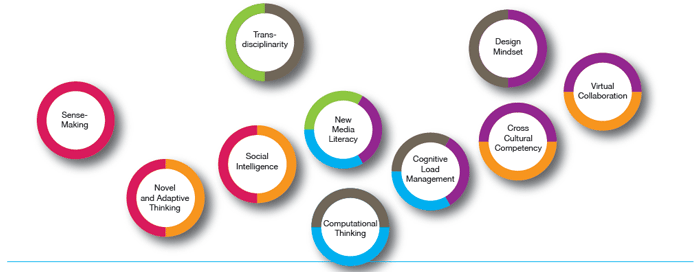
CirclesSo what are we supposed to do about this? How are we supposed to think about 2025? Some of the answers are in a report prepared by the Institute for the Future for the (yes, I was dubious, too) University of Phoenix Research Institute. It’s good work. And it goes on to look carefully at ten skills for the future workforce that are worth browsing here and worth reading about, in greater detail, here. More or less (with some of my own interpretation added), they are:
  1. Sense-making: the ability to determine the deeper meaning or significance of what is being expressed. These are higher-level thinking skills related to creative and critical thinking, decision sciences, environmental scanning, extensive knowledge of environmental factors, and much more.
  2. Social Intelligence: the ability to connect to others in a deep and direct way, to sense reactions and quickly assess emotional impact, and then, rapidly adapt or lead to achieve the optimum result.
  3. Novel and Adaptive Thinking: This set of skills expands upon the two above, “the ability to respond to unique unexpected circumstances of the moment.” Routine solutions are useful, but those who can combine the routine with the new, those who are naturally resourceful, are most likely to succeed.
  4. Cross-cultural Competency: This goes far beyond tolerance and equality. It requires an ease in working across generations, across what was once called an organizational chart, gaining and contributing insights to an extraordinarily wide range of stakeholders, coworkers, clients, competitors, vendors, customers, participants and much more.
  5. Computational Thinking: What’s the point of all of that computing power if you don’t know what the machines can do, should do, and might someday do? This is akin to buying a fabulous car—you’re paying for the most extraordinary performance, but it’s yours only if you demand it. In other words, to succeed, you’ll need to understand how and why it all works (and not from a technical point of view, but from a high-level perspective instead).
  6. New Media Literacy: Critical assessment of videos, understanding of the techniques used to shape and deliver messages, how to write and speak and produce. Forget about PowerPoints—they were the 1990s. We’re entering the era of widespread transmedia, where text, graphics, photos, interactivity, connectivity, video and games are only the beginning.
  7. (I love this made-up word!) Transdisciplinarity: Not sure that this needs any commentary.
  8. Design Mindset: Or, more commonly, a skill in design thinking. What’s that? Planning based upon community, customer or participant needs—these come first, and old ways of thinking, such as profitability, flow from these decisions. There is a lot of information about design thinking on the web, including a good Wikipedia introduction, and a blog by Tim Brown, the CEO of Ideo, and the author of “Change by Design: How Design Thinking Transforms Organizations and Inspires Innovation.”
  9. Cognitive Load Management: Yeah, I like this phrase, too. More or less, it’s thinking about ways to avoid a “overload” light from blinking inside your brain. Learn to say “no” to the junk that attempts to fill the media diet; learn to discriminate, to dig deep, to contextualize, to become a “sufficient expert” (I just made that up;  the phrase makes sense to me).
  10. Virtual Collaboration: To work productively on you own (never give your boss or client a reason to worry about time spent away from the office), and to do so with lots of other people to generate and maintain high levels of productivity. Use Skype, use other forms of technology to do great things (and some routine things) with people who you have never met, and never will meet in person.

I think that’s a great list. And with it, two (REALLY IMPORTANT) suggestions:

First, score yourself. On each of the ten items above, score yourself 1 (the worst) through 10 (the best). If your score is 85, 90 or better, you will be welcome in 2025. If your score is a lot lower, you’ve got some honest work to do.

Second, reconsider school. If school isn’t nourishing you on these ten points, you should begin to ask some very serious questions about your investment of time and money, and you should immediately focus your school’s administration, faculty and curriculum advisors that the world will change sooner than they believe possible. Work with them. Or, learn without them. But get moving!

What’s a MOOC Good For, Anyway?

This week, I’ve spent several hours with a friend whose intellect is recognized by a Ph.D. from an Ivy League university. We’re both deeply engaged at the intersection of media and learning, most often for some form of public good. Yesterday, we talked about why people go to school.  To be more specific, why people go to school beyond the point where law requires them (us) to do so.

Harvard-MOOCWhen I read this readwrite article, an interview with Harvard’s new vice provost of advances in learning (excellent job title!), I started thinking about why anybody bothers with, say, TED Talks, or for that matter, why we read non-fiction books.

Just as we’ve managed to bottle up massive quantities of spirituality into the structures we call religions, we’ve managed to do the same with massive quantities of learning into the notion of school and organized education. MOOCs shake up that formula. A MOOC–a massively open online course–carries no price tag, and, although it may be offered by the likes of Harvard or Stanford or UPenn, it carries no credit, either. You take the course because, well, because you want to learn.

The distinction is a simple one, or so one might argue. There is learning, and there is education, and if they sometimes overlap (as they are intended to do), they might serve different purposes. Learning is all about personal development, and refinement of understanding. Education’s purpose is a degree, a formal recognition, typically for a price, that serves as an admission ticket into parts of the job marketplace that are otherwise inaccessible.

So what’s a MOOC good for? Same thing as a book, I think. It’s for learning. Turns out, millions of people simply want to learn, on line, for their own development and understanding.

Of course, that’s not the whole story. Do read the readwrite article (interesting phrase, that), and you’ll find that a bit more of the picture comes into focus.

College Through the Looking Glass

About a hundred years ago, Oxford professor John Alexander Smith addressed the first session of his moral philosophy class as follows: “Gentlemen, nothing that you will learn in the course of yours studies will be of the slightest possible use to you in after life [that is, after college, not after death–HB], save only this: that is you work hard and intelligently, you should be able to deter when a man is talking rot, and that, in my view, is the main, if not the sole, purpose of education.”

j9651Inevitably, author Andrew Delbanco continues: “Americans tend to prefer a two-syllable synonym…for the Angicism, rot–and so we might say that the most important thing one can acquire in college is a well-functioning…” Okay, you get the idea. (Odd that I am  reluctant to spell out B.S. given that the quote comes from a book published by Princeton University. Anyway…)

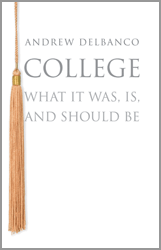
The book is called College: What It Was, Is, and Should Be, and it’s actually fun to read, not stuffy at all, rather like a good lecture about the dubious history, dubious purpose, and dubious results of a college education, or, if you prefer, as I do and the author does, to consider the dubious and to celebrate the remarkable. Both are present, and have been since the very start. Early in the book, Abigail Adams can be found complaining about the current state of students, professors and education in general–that’s in 1776, but the complaints and criticisms date back to Greek and Roman times, long before our current institutions were a thought in anybody’s mind.


Today, there are about four thousand colleges in the United States. The author has visited about 100 of them, so I respect what he has to say, particularly as he discusses the liberal arts education that would provide, at least in part, the mechanism for the bullshit detector (there, I wrote it!) that is, in part, the reason for going to college in the first place. For a very long while, well, this is best said by Ohio State economics professor Richard Vedder:

with the possible exception of prostitution, teaching is the only profession that has had absolutely no productivity advance in the 2400 years since Socrates.”

A quote from former Johns Hopkins president William Brody is a nice addition:

if you went to a [college] class circa 1900 and you went today, it would look exactly the same, while you went to an automobile plant in 1900 and today, you wouldn’t recognize the place.”

The author is a college professor, and although he’s critical of the industry he clearly adores, he is quite clear on the statistics, and the reasons why college makes sense, worts and all.

Although not completely consistent with importance of a liberal arts education, or a college education generally, a college degree, even a Bachelor’s Degree, is a very good investment: those with a B.A. earn about 60 percent more than those whose resume lacks the degree. This fact leads to another one, and here, we begin to get at the real story of college in America:

if you are a child of a family making more than $90,000 per year, your odds of getting a B.A. by age twenty-four are roughly one in two; if your family’s income is between $60,000 and $90,000, your odds are roughly one in four; if your parents make less than $35,000, your odds are one in seventeen.”

It’s wrong to think about these patterns in isolation. Upscale students attend more selective colleges whose prestigious graduates are funneled into leadership roles in business, law and government. It’s a self-perpetuating system, the engine of social mobility in the United States even in the 21st century.

So that’s one argument in favor of college: economic success. The other argument demands a well-educated citizenry, what Professor Delbanco calls “the incubation of citizenship” as he defends the small group discussion in the above video. Strangely, this is not the argument that legislators focus upon–instead, they tend toward the more practical, and, in the long run, perhaps less significant, concern about the need for a population that understands ideas and makes wise decisions. College has always struggled with that role; those in law school and the like receive these messages and tend to think about these issues, but as for the rest of college students (and the rest of us, including those who have been through a more generalized college experience), not so much.

So here we are with a realist, a professor who seems to understand the arguments from multiple perspectives, stressing “a community of learning” on the one hand and recognizing, when considering a New York Times article, “for every one of those college-bound cars, there are scores of families whose children will be staying home to attend a commuter school without anything resembling traditional college life. Moreover, millions of college-age Americans never get to college in the first place.”

By the time they reach age twenty-six, “fewer than two-thirds of white high school graduates have enrolled in college.” The number is half for blacks, and slightly less for Hispanics. Among students who do enroll, more than a third never finish their degree.

There are so many issues, and often, it’s difficult for the average person to gain traction with many of them. This is precisely the place where a good college professor can make all the difference. And if you can’t afford or can’t quite make it to Princeton this month or this year, well, you (and I) now more fully understand the reason why many universities publish their professors’ best work in book form. Turns out, the book, which is also undergoing attack from every possible direction, remains a darned good idea for a hot sunny afternoon. I now know some things I didn’t know this morning, and I’m thinking about them hours later. Not quite the same as being in the presence of the man, but spending three hours reading about 200 pages of his well-written, well-edited ideas for just $17.95 (less if you buy online) is, simply, a good old-fashioned idea.