 It might not mean much to people who don’t buy paint to create artwork, or ink to make prints, but Dan Smith’s company went ahead with a big decision this month. They stopped selling art supplies. That is, they stopped selling art supplies made by others, and decided to bet the farm on the paints, inks and other supplies that they make and sell under their own name.
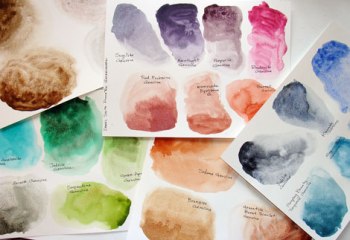 Putting this another way, Daniel Smith Art Supply decided to leave the business of being a middleman. The company didn’t have much to say about the change, apart from the warehouse clearance notices that now arrive in my email box every day. On their website, one statement clearly expresses the company’s purpose: “Daniel Smith is a leading manufacturer of superior-quality lines of watercolor paints, sticks & grounds, acrylic paints & gesso, oil & water-soluble oil paints. Our products are available worldwide.” This is not a new idea: when Brooks Brothers has been selling its own clothing, in its own stores, Zachary Taylor was our 12th President.
And that made me start wondering about Ken Burns, and a guy who worked for me twenty years ago who just showed up with his own documentary. If the connections are not immediately clear, please bear with me.
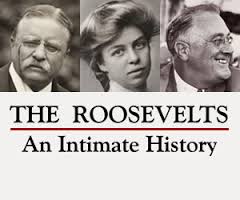 This week, millions of Americans are spending their evenings with the Roosevelts. That is, they are watching a series of documentaries made by Ken Burns and his Florentine Films staff, a series that tells the story of Theodore, Franklin, Eleanor, their families, and their political careers. Burns is closely aligned with WETA, a public television station in Washington, DC, but neither Burns nor WETA is the distributor. Instead, that job first falls to PBS, and then, to nearly 200 local television stations. That’s the way it has worked since The Civil War, or, at least, since around 1990. I didn’t think much about that until someone I know ranted about missing the first half hour of one of the episodes. I figured the episode was available online, did a bit of exploring, and found that all of the episodes were available online, even before they were released on television. And that made me wonder about the chain of distribution. Quite reasonably, there is a website devoted entirely to The Roosevelts. The site’s logo is the show’s logo. The top menu items seem to be focused on the project, not on the distribution. Scroll down to the bottom and the site is copyrighted by WETA and Florentine Films. In fact, there is a modest PBS presence, and in fact, there is no real need for a middleman here at all. Ken Burns has made a fine series of films, and now, with the miracle of web distribution, he can distribute those films directly to his (admiring) public. Something feels right about PBS’s relationship with Ken Burns and his work, but look closely, and it’s clear that PBS, Burns, Florentine, WETA, and PBS’s member stations are taking this new digital distribution idea one step at a time.
And that made me think about the guy who used to work for me who produced an independent documentary. It’s a lovely documentary about the nasty behavior of a big company, and, of all things, a public passion for a particular soda pop. The produce and I were exploring how this documentary gain some exposure. In essence, the producer was seeking a middleman, a Netflix, an exhibitor to bring the film to the public. Old habits die hard. New thinking would probably involve, somehow, contacting every person passionate about the soft drink, and encouraging them to (a) watch the film, and (b) tell their friends. This is a new kind of magic, and it only works sometimes.
And that made me think about a friend who is wondering about the future of the music business. In times past, record labels signed and marketed artists. Now, artists communicate directly with fans, and many record labels are struggling to find their way. At the same time, authors are publishing their own books while dreaming of the money and marketing clout that a large publisher could provide (no more crates of books in the garage, no more handling every detail).

 So here we are, caught between two ideas, two eras. In the former, large fortunes were made by the middleman. In the latter, there is no middleman. Make what you sell—the old American way (and, in fact, the way that many people in undeveloped nations continue to operate, with no clear path to a digital future). And then I think about Macy’s, Wal-Mart, and going back a bit, the much-criticized market domination of A&P and Rexall Drug. All of them hawking their self-branded merchandise, all of them making a fortune by selling other companies’ stuff.
Usually, I finish an article with a sense of direction. This time, it’s more complicated. Kudos to Dan Smith for doing something that makes sense instead of doing too many things that don’t. Kudos to the musicians and the authors and the documentary producers who have figured it out, and to Ken Burns and WETA for working within and beside and around the system as they invent a future that sustains everyone in their food chain. Let’s not pretend that this is easy, and let’s accept our era as the mass of contradictions that our world has become. In fact, some of our greatest internet success stories have been stories of middlemen with eBay and Amazon leading the way, and plenty of successful companies including Pinterest, Etsy, and Netflix populating a very long list of middleman enterprises.
At first, I thought I’d be writing an article entitled “Death of the Middleman,” but as I wrote, I realized that my initial approach was naive. Now, I suspect there will always be a role for the middleman. That’s the reason why the altogether excellent Brattleboro Food Co-op exists, to create a marketplace for local farmers and small time operators who make, but cannot directly market, their local cheeses (imagine visiting every creamery for every block of cheese, every week). And thank goodness for the local artisinal ice cream makers who have opened small shops nearby, more than compensating for the closing of the century-old country dairy that closed before its time (and sold only its own ice cream).
Has the digital revolution washed over the middleman? Nope. Not yet. He’s still traveling from town to town, still making the same sales calls he did a century or so ago. Looks a bit different now, made and lost a few fortunes along the way, but he’s still a part of the landscape, not about to give it up any time soon, near as I can see.

 Driving the rural roads of Scotland, Ireland, and Wales, I’ve occasionally been fortunate enough to be blocked by sheep being moved from one pasture to another.
 Here’s a question: Why are one-size-fits-all performance standards inappropriate to the point of silliness when applied to dogs, but accepted without question when applied to kids? If someone tried to set up a national program to teach every dog to do everything that various breeds are able to do, the Humane Society and the American Society for the Prevention of Cruelty to Animals would have them in court in a New York minute. But when authorities mandate one-size-fits-all performance standards for kids, and the standards aren’t met, it’s the kids and teachers, not the standards, that get blamed.
 Geri Allen is one of those extraordinary jazz musicians whose influence runs wide and deep, but somehow, has not become as well-known as it ought to be. She’s a pianist with a resume that begins with a serious educational foundation: a master’s degree in ethnomusicology that has served her well (easy for me to see this because I’m approaching her life’s work some 35 years into a very good story). Her professional work begins with Mary Wilson and the Supremes in the early 1980s, and Brooklyn’s
  The awards began to roll in. Allen was in and out of the remaining avant-garde, which sounds much less radical now than in 1996 when she recorded “Hidden Man” with Ornette Coleman’s Sound Museum. In fact, by 1999, she was sounding very comfortable in a commercial setting, recording her popular CD, The Gathering, with Wallace Roney on flugelhorn and trumpet, Robin Eubanks on trombone, Buster Williams on bass, and Lenny White on drums, and others whose names are well-known from mainstream jazz records. A 2010 record, “Flying Toward the Sound,” made it to the top of many critic’s best-of-the-year lists.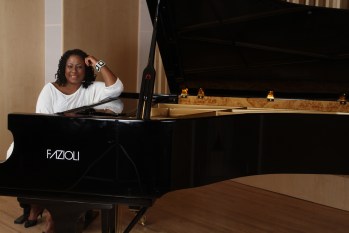
 Geri Allen has been one of those artists that I’ve wanted to know more about. Now that I’ve written this article, now that I’ve done some concentrated listening, I’m realizing that I am just beginning to understand what she’s all about. The latest album is elegant and wonderful, soulful and reflective, sophisticated and consistently interesting, but my collection is now woefully incomplete. I have listened to the two predecessors in the trilogy, but I want them for my very own. The same is true for the work she did with Paul Motian and Charlie Haden, and for the work she did in 2010 with her group, Timeline.






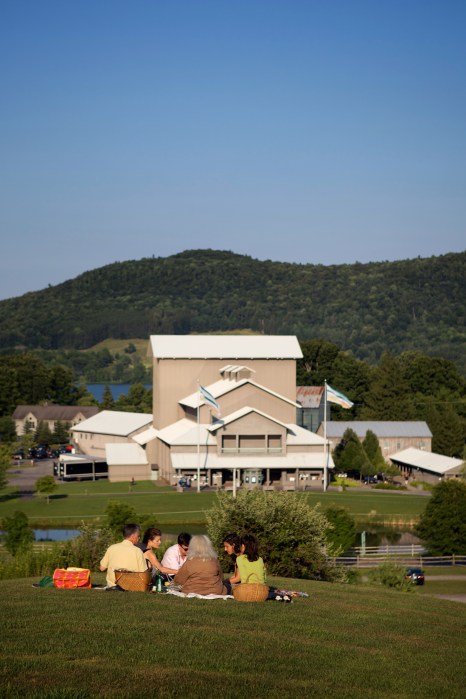
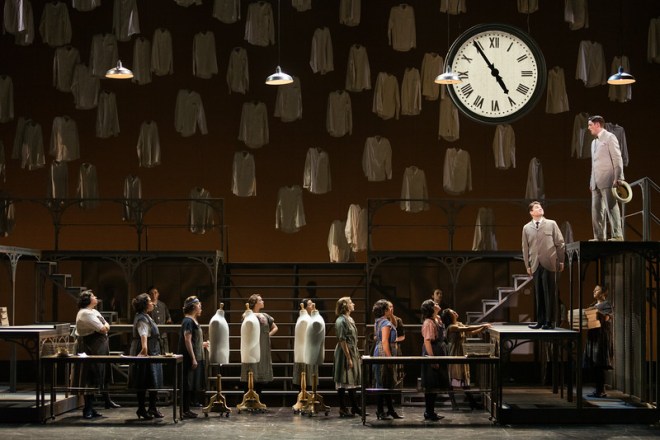 The next character in what turned out to a fascinating Saturday night at the Glimmerglass Festival just north of Cooperstown NY is Tobias Picker. If you don’t know the name, you should. “An American Tragedy” is his fourth opera (and one of several he has written with Gene Scheer’s libretto—you may know


 In 1969, most people, even those who were following the progression from jazz to fusion, hadn’t yet heard the work of a British guitar player named John McLaughlin. That was the year that he recorded his first album, “Extrapolation.” At the time, it was wildly experimental, but as I listen to it in the background while writing this article, it’s really delightful, gentle, meditative, not at all explosive. McLaughlin is a gifted guitar player and composer. He shares the stage with an another young British musician, a man who plays the somewhat unusual combination of soprano and baritone sax. His name is John Surman. At the time, Surman was already recording on his own for the
 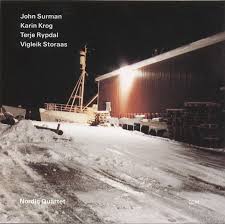 Traces, there is a deep female voice whose sound more closely resembles an instrument than an upfront vocalist—and she’s singing phrases that feel more like poetry than lyrics. She was not credited as a singer, but instead, as “voice.” Her name is Karin Krog.
 Earlier this year, late at night, I decided to do a Google Search on
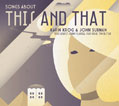
 Of the three CDs, the most interesting is also the most experimental, a cycle of songs originally composed for a 2010 jazz festival. It’s called “Songs About This and That,” and I like it because it recalls my earlier interest in their exuberant experimental side, but places it in a more artful, more carefully arranged setting. There is a sense of open time and space to explore, to allow for long lines, an ease with the maturation of Karin’s voice. On this CD, I think my favorite track may be “Cherry Tree Song” because the poetic lyrics wind so gracefully around John’s baritone sax and bass clarinet, a warm combination of electric guitar, vibraphone, and John’s bass recorder. In fact, I jotted down some other favorite tracks, and found the list was too long to manage, but I will mention the vibe solo that begins “Moonlight Song” and Karin’s waking-up voice, looking backward on memory. Wrapping up an article I’ve so enjoyed writing, I happened to notice that Karin’s credit on this CD is what it was so many years before, not “vocals” but simply, “voice.”

