 On Tuesdays and Wednesdays, Bob Mankoff rejects most everything he sees. He works as the cartoon editor at the New Yorker, a magazine whose sense of cartoon humor is famous, but extraordinarily difficult to define. This is not a new problem. In fact, the New Yorker has always suffered from a rough case of not being able to explain itself (the problem goes back to the 1920s when Writer’s Digest asked the New Yorker’s editors to advise writers interested in the magazine; in essence, the New Yorker editors could not).
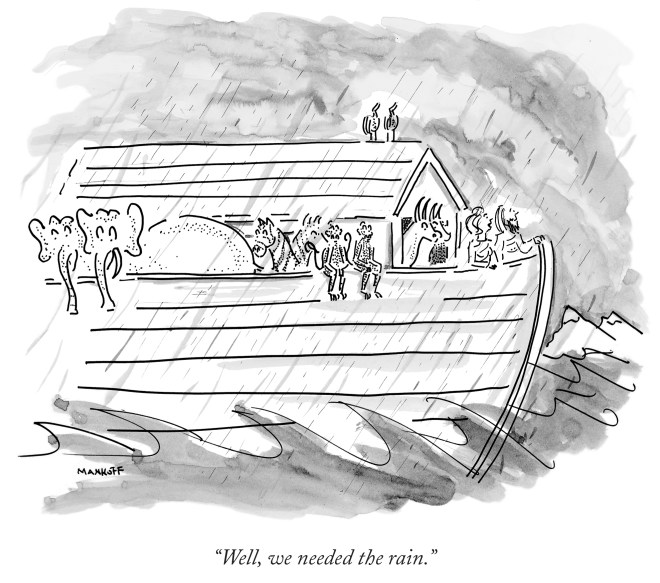 “How About Never – Is Never Good for You?: My Life in Cartoons” is a kind of small-scale coffee table biography, half text and half cartoons. As with the New Yorker magazine, it’s difficult not to be attracted to the cartoons, but I was good: I read the whole book including all of Mankoff’s confessional text and all of his chosen cartoons. What surprised me: only a few of the cartoons made me smile or laugh. And that got me to thinking about how difficult it must be, to select from the stack of 500 cartoons from regular contributors and an equal number from wannabes. Mankoff writes, “eventually, I cull the pile down to fifty or so, which I’ll take to the Wednesday afternoon cartoon meeting…” where the stack will be winnowed down to just seventeen, maybe eighteen cartoons that will be published in the magazine. (There are, and have always been, so many rejects, Mankoff started a new venture called Cartoon Bank to give exposure to the rejects—and earn some money for himself [before he joined the magazine as cartoon editor] and for other working cartoonists.
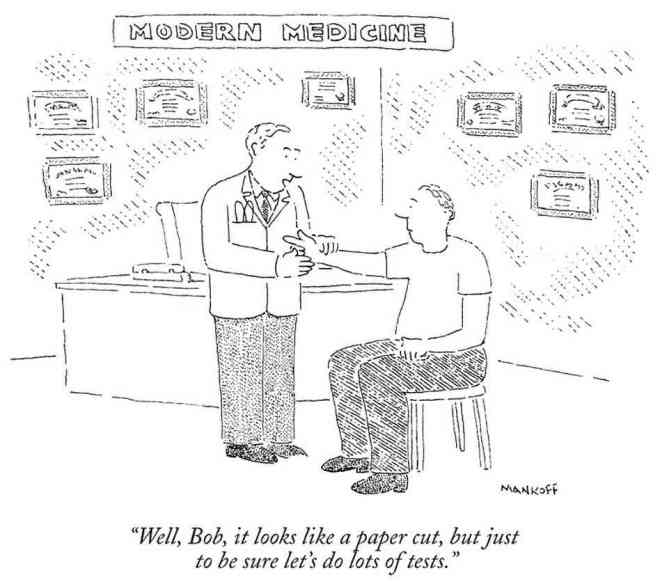
So what’s funny? Or, perhaps more to the point, what does the New Yorker believe to be funny?
I just read a book about that topic and I still don’t know the answer. But I know a good New Yorker cartoon when I see one.
There are good ones on page 148.
The first shows a pair of snails with large spiral shells on their backs. They are staring at a plastic Scotch tape dispenser which resembles them. The caption: “I don’t care if she is a tape dispenser. I love her.” Very spare, right to the point, softly funny.
The second shows a man about to lose his head to a guillotine. The executioner offers a choice of two baskets to catch the head. The caption reads, “paper or plastic?”
On page 156, a cat is being instructed about litter box use by his owner: “Never, ever think outside the box.”
On page 251, under the sign, “Horse Play,” a horse is up on his hind legs shouting to a horse in the barn loft, “Stella!!”
On page (I lost count and they’re not all numbered), a croissant and tea on one side of the breakfast table and a whole lot of bacon, pancakes, sausage, eggs, juice, coffee, and the caption, “Welcome to America, bitch.”
On 284, a man has been murdered, and he is lying face down as two detectives look on. The room’s walls and floors resemble a crossword puzzle. One detective says to the other, “any clues?”

So what have we learned? It’s no easier to write a book about cartoons than it is to select cartoons for the magazine. What’s funny is just funny—once again, there is no science to any of it. Which leads back to Mankoff on page 4, where he writes, “I’ve ignored E.B. White’s famous admonition, ‘analyzing humor is like dissecting a frog. Few people are interested and the frog dies of it.”
BTW: The statement about the dog that titles this article

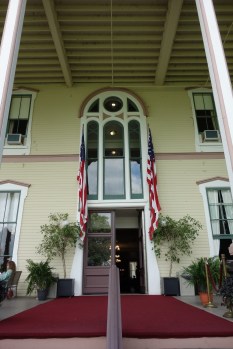 Yesterday afternoon was busy with reading on the Hotel Atheneum’s wraparound porch, studying the lake, selecting the perfect rocking chair, becoming distracted by what sounded like a full orchestra nearby. Wandering is what folks do on a summer’s day at Chautauqua, so I followed the music to the amphitheater where a rehearsal of Madame Butterfly kept me and perhaps two hundred other people busy for an hour. On Saturday night, the theater will be filled with nearly four thousand people, mostly residents who either spend their summers here, or, at least, several weeks each year. I was reluctant to linger: I wanted dinner before heading to the theater. Back at the
 Me? I’m off to Sol Messinger’s “Yiddish Language Conversation” back up near the main road at the relatively new (few Chautauqua structures are new) Emerson Jewish Life Center, built in 2009. Sol is sitting at a conference table with four or five people, interviewing each of them, each of us, about our family history. He is speaking in Yiddish. I understand only a bissel—the tiniest portion—but just the act of listening is joyful. Here and there, one of the people at the table translates key ideas for me. The conversation drifts in and out of English. The people are not young. I wonder what will happen to Yiddish, but only for a moment. My head is filled with ideas, but the yellow broadsheet—the detailed schedule for this Chautauqua week, contains far too many things for me to do, so I keep moving, grab a quick quiche at the informal lunch place above the bookstore (not wonderful: Chautauqua’s food for short-term visitors is a weak link), and manage to get to Philosopher’s Hall in time to get a seat just on the perimeter. It has been raining, so some seats are wet. I sit on my Daily, my bun is a little wet for a while, but I quickly forget my personal issue when the speaker begins. He’s compelling—
 No time to linger. A Chautauquan keeps busy, does not lollygag (except when the day is beautiful and there is a book to be read under a century-old tree while children are racing around on bicycles and otherwise living a perfect small town American life). That glimpse of what America might have been is just that—a glimpse—for there is music to be enjoyed in one of the old churches. An hour of art songs performed by students from Chautauqua’s music school on the north side of town (no time to visit, but I understand practice sessions and rehearsals are open, and a bit like Tanglewood). Then, at 5:00PM, I wander back to the hotel for a daily wine tasting. I was invited by my new friends at last night’s Community Table. Mostly, my contribution to the table of six chatty people was recommendations of novels by Reynolds Price because one of the women was interested. Then, we headed down to dinner in the hotel’s main dining room. Steak dinner. Fresh cut.
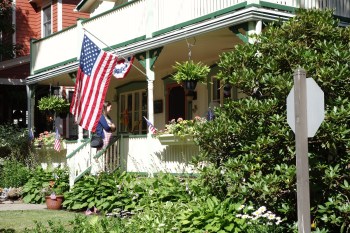 Next morning, it’s up at 7:00 am for the Farmer’s Market, then a spiritual bit, then a visit to the Methodist House (many religions, many houses, used for residents and for small events) for a July 4 lecture about the specific wording of the Declaration of Independence. I intended to stay for just a few minutes, but stayed for an hour and learned a lot about what Thomas Jefferson wrote and what Richard Henry Lee wrote. Half of the people in the audience seemed to know the speaker as a friend. I suspect he was a long-time Chautauqua resident or visitor, and that revealed one more piece of this fascinating puzzle: the people who attend Chautauqua are not just visiting because the lake is pretty in July. They attend because the combination of leisure and learning, family and fellowship, curiosity and creativity is, for nine special weeks every summer, available here and almost nowhere else.

 Much as the 1960s was associated with independent thinking—and free love, for they often come together—so, too, were the 1920s. Before that, in the 1910s, Greenwich Village began to take shape as a neighborhood Bohemia. Today’s hipsters seem to be a pale counterpart, in part because they have money in one pocket and the internet in the other. A century ago, “Bohemians” (a bundle of misnomers generally not associated with the Czech region) “flocked to avant-garde exhibitions and modern dance performances, and bought paintings, lithographs, and photographs, helping the real bohemians pay the rent and get public attention…”




 There was a wonderful innocence about Harry Nilsson in those days. Like
 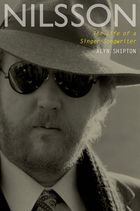 The early days, and the dreadful slide into substance abuse, crappy behavior and, ultimately, death, is told with appropriate accuracy and sensitivity by biographer
 Gosh, I am so tired of hearing the term “selfies.” It’s been named ‘word of the year’ for Oxford University’s Dictionary. You’d think they’d choose something more interesting.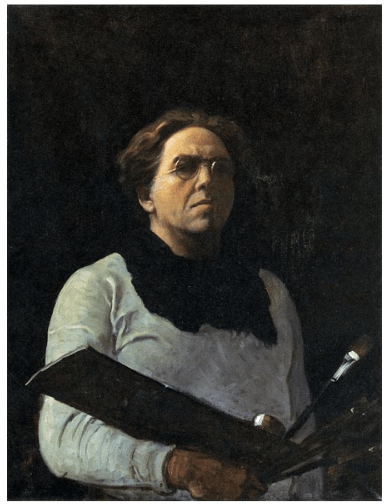


 Mostly, I wanted to thank you for reminding me of the special quality of a handwritten letter written, and the even more special quality of a handwritten letter received. It’s been a while.


