Thanks, Harry

My old desk does an arabesque in the morning when I first arrive.

It’s a pleasure to see, it’s waiting there for me to keep my hopes alive.

Such a comfort to know it’s got no place to go,

It’s always there

It’s the one thing I’ve got, a huge success,

My good old desk.

My old desk never needs a rest

and I’ve never once heard it cry.

I’ve never seen it tease it’s always there to please me

From nine to five.

HarryThere was a wonderful innocence about Harry Nilsson in those days. Like Randy Newman and Van Dyke Parks, he was a singer-songwriter with a great appreciation for the commonplace, a love of old (1920s-1940s) music, and an iconoclastic way of telling a story. The Beatles were crazy about him. I was, too, and among those of a certain age, he was the odd musical hero. He never grew old enough to call his fans by name—as he described the slow fade of a pop star. Instead, he flamed out, but, somehow, Nilsson is not included  in most “rock stars who died too young” compendia.

The place to start is not his best known hit, “Everybody’s Talkin’,” the Fred Neil song that he happened to record because he and his producer liked the tune (it became the opening theme for the film Midnight Cowboy, so it became famous). His novelty song “Coconut” was also a top ten hit, but it, too, was an aberration. “Without You” (you know: “I can’t live if living is without you…”) is better, but not on my list of his best work.

Where to start? Early, but not too early. Set your time machine to 1968, 1969 and 1970. Each year presented a very special album by an extraordinary performer, a storyteller with a wonderful sense of melody working, on two of these albums, in spectacular harmony with the ideal producer for these projects, Rick Jarrard.

I would start with the album called Harry because it contains so many of my favorite Nilsson songs—each one handsomely presented with an elaborate arrangement. “Nobody Cares About the Railroads Anymore” and “Morning Glory Story”—the latter is a dignified portrait of a homeless woman, a topic nobody sang or wrote about back in 1970—make sense on an album with similar stories by Bill Martin, “Fairfax Rag” and “Rainmaker” (you know the story; he tells it especially well). And, there’s a song by Randy Newman, then no better known than Nilsson himself: “Simon Smith and the Amazing Dancing Bear.”

Nilsson’s voice and style was especially well-suited to Randy Newman’s music, and so, the 1970 album was devoted entirely to his work. This is a spectacular pop music milestone, story after story, sensitively and imaginatively told: short stories, really, told with the full power of music and nostalgia. Every song is special, and, in its way, timeless.

The prelude to all of this, an album called Aerial Ballet, is filled with top-notch pop songs that set Nilsson’s bubbly, sensitive, smart style. It’s the album with more familiar songs than the others: “Everybody’s Talkin’” and “One” (a top ten hit for Three Dog Night) among them. It’s great fun, but I like Harry and Nilsson Sings Newman so much that this album takes third position. (In the early 1970s, Nilsson reworked this and an earlier album, including new mixes and some new vocals, to create Aerial Pandemonium Ballet).

If you’re interested in going further, some would claim that Nilsson Schmilson, produced by Richard Perry, is his best. It’s certainly his most commercial, most mainstream (it was produced with that specific intention, and I think it suffers for its success). Better is his salute to the music of the 1940s (mostly) in what turned out to be a career-killer (with a stupid title): A Little Touch of Schmilson in the Night (the link leads to a BBC documentary about the making of the album). This is lovely work, better than most of what Rod Stewart and others have done with similar material, and it’s worth owning. At the time, it was considered wildly narcissistic, part of a larger pattern of disengagement with the realities of the music business, and, sadly, a harbinger of the musician’s disengagement with anything resembling a rational, healthy life.
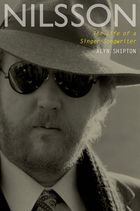
Nilsson bookThe early days, and the dreadful slide into substance abuse, crappy behavior and, ultimately, death, is told with appropriate accuracy and sensitivity by biographer Alyn Shipton. The book is called Nilsson: The Life of a Singer-Songwriter, and it’s difficult for fans of the early days to read and comprehend. Happily, the first half of the book explores the good times: the details of the relationships and creative decisions that led to the artist’s finest work, notes from the recording sessions, a rich history of the relationship between Nilsson and masterful arranger George Tipton, stories about so many songs that are so special to long-time Nilsson fans.

I suspect we all believed that Harry’s lyrics to Mr. Richland’s Favorite Song would come true, that each successive decade would find fewer and fewer of us grooving to Nilsson’s fine work and that, in time, the cult would become smaller and perhaps more intimate with a favorite musician from our youth or college days. It didn’t go down that way. Harry became a giant problem: tremendously talented, proven, light-hearted at his best, bad company at his worst. Later albums are, as a rule, dreadful, sarcastic, and lacking in the wonderful subtlety that made his work so very special.

If you feel the need to explore this work, and to try to make sense of the life that included the early albums and the likes of “you’re breakin’ my heart/you’re tearin’ it apart/so f— you” (which only began the nasty period), several options. One is to try to wrap your head around the awful Nilsson collaboration with John Lennon (who was also going through a bad period); it’s called Pussy Cats. Another is explore Knnillssonn with its strange (and sometimes lovely) production experimentation, and the return of the warmth that once characterized everything the man did. As Douglas Hofstadter might describe it, Harry was a strange loop.

Or, if you just want it all, there is a box set with just about all of his work. Click the link for a fascinating, detailed exploration of the whole 17-disc project.

Nilsson box

The Future: Cities, Not Suburbs, Not Small Towns Either

It makes sense to build dense cities, and use trains to move people out of them for recreation. Cities may be our greatest invention. Apparently, suburbs, are among our worst.

It makes sense to build dense cities, and use trains to move people out of them for recreation. Cities may be our greatest invention. Apparently, suburbs, are among our worst.

Two out of three Americans live in a single-unit building that is not attached to another building. It’s a standalone home. The American Dream is real for so many people, it’s difficult to conceive of a shift in the status quo.

The key concept is “density”—the number of dwelling units per acre. A nice American home is situated on about 1/4 or 1/3 of an acre, even nicer homes are part of acre lots. With that level of density, the only economically viable means of transportation is the car. (Lots of expense, pollution, etc.) To rationalize a bus, we need to up the game to 10-20 dwellings per acre: low-slung apartment buildings. Rail transportation begins to make sense at around 30-40 dwellings per acre, but it really sings when there are 100 or more. How do find enough space for 100 dwellings on a single acre? Don’t think in terms of ground area; instead, think up.

Interesting idea, but that’s not the way America works. Instead of thinking up, we think sprawl. That’s a tough philosophy for the economy and the environment.. At 25 dwellings per acre, the entire population of the world would fit inside the state of Texas.

Density only begins the discussion. Metropolitan areas—including cities and their suburbs—account for 90 percent of the US GDP and 86% of all jobs. The economic output of Chicagoland (city and suburbs) is greater than 42 of the 50 states. But that’s misleading.

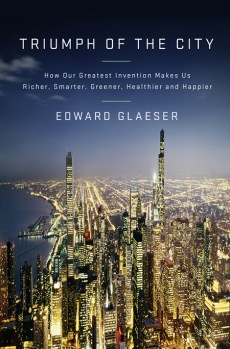
coverbigAccording to the authors of Triumph of the City (Professor Edward Glaeser) and A Country of Cities (Noted Architect Vishaan Chakrabarti), dense cities (New York City) are very, very good ideas, and n0n-dense cities (Los Angeles) and the vast majority of suburbs throughout the world are very, very, very bad ideas. Why?

I like Mr. Chakrabati’s analysis of the self-sustaining economy and ecology of Hong Kong—a city-state where all resources are used for the good of the dense city, one that is surrounded by natural surroundings to be enjoyed by all. He contrasts Hong Kong with Los Angeles, which must contribute its considerable revenues to the state of California, and the U.S. government, leaving this metropolitan area with insufficient resources to, well, be all it can be. The same is true for most cities—they generate tremendous value, but they subsidize the far-less-productive suburbs and rural areas.

artbook_2273_30465543In the view of both authors, what we need to do is perfect our invention of the cities not only for our own good, and for the multitude of productive relationships that result from people living and working near one another, but also for the sake of the planet. Currently, in large part due to cars, suburbs, and inefficient systems, earth’s consumption rate is about 1/3 greater than our capacity. Shift to the American consumption rate—based, largely, upon suburban lifestyles—is over five times greater than our capacity. If When some of the developing economies reach the U.S. consumption rate, we’re more or less doomed (authors love to write this kind of stuff). We’ve all read the stories before: more commuting means less happy marriages, greater obesity rates, and (no surprise) a much higher per-capita rate of gun ownership.

Here, it’s easy to understand the growth of cities and the rest of America in terms of red and blue states.  Many of the largest U.S. metropolitan areas are located in blue states: east of the Mississippi River and north of North Carolina, and along the Pacific Ocean. But the U.S. government and the U.S. economy is not built to support cities. That’s why we spend more than twice as much on highways than air and rail travel—both far kinder to the environment, and in the long run, far more efficient. Instead, we support suburban living. We build more roads to more places, and more cars show up to take advantage of lost costly single family homes just that much farther away from the city center. What’s more, for every one taxpayer who takes advantage of the Mortgage Interest Deduction to achieve the American Dream, three do not—simply, Americans subsidize home ownership in a very significant way.

Should we? According to Mr. Chakrabati, the answer is no. Instead, he suggests that we fund a much more robust, livable, safe, easier urban lifestyle by eventually shunting those funds, and a roughly equal amount raised by a $1 increase in the Federal Excise Tax, to generate $3.5 trillion dollars to improve “economic and social prosperity, environmental sustainability, and equalizing real access to the American dream of home (but not necessarily house) ownership.

A special shout-out to Ryan Lovett who filled many pages of A Country of Cities with clear, direct illustrations, diagrams, charts, graphs, and just a few infographics. The result is an extremely appealing combination of a visual book that’s easy / fun / provocative to browse, and the well-c0nsidered arguments presented in detailed text by the author. At first, I simply enjoyed holding and paging through this elegant book. In time, I came to appreciate the reality of Mr. Chakrabati’s vision in terms I could understand: his SHoP is a top architectural firm responsible for Barclay Center, a multi-use arena that will anchor the future of downtown Brooklyn, NY with (you knew this was coming) a very high-density series of structures with massive amounts of homes, offices and retail, plus open areas that make city life that much more livable.

In fact, Barclay Center is walking distance from an earlier version of urban planning success: Brooklyn Botanic Garden, and the classy old apartment buildings nearby.

Here’s a look at SHoP’s plans for a high-density development surrounding their Barclay Center area in downtown Brooklyn.

Here’s a look at SHoP’s plans for a high-density development surrounding their Barclay Center area in downtown Brooklyn.

This is provocative stuff. And, happily, it’s best presented in the form of a solid $30 hardcover book from a publisher whose work impresses me more each season: ARTBOOK / D.A.P. / Metropolis Books.

In a Word, “Curious”

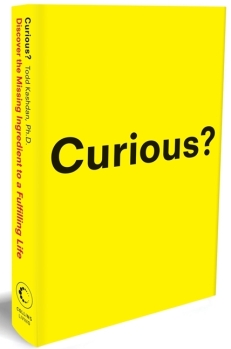
CuriousWhat’s the secret of life? Of course, the answer is in a book with a single word title, Curious? The back cover has nine words, 58 characters: “Embrace uncertainty. Attract love and abundance. Master your life.”

All of this makes me want to write an answer book called “Seriously?” but the author, a clinical psychologist and professor at George Mason University deserves more than the Twtr-obessed publisher allows. His name is Todd Kashdan, and although I suspect curiosity may not be, as the subtitle promises, a way to “Discover the Missing Ingredient to a Fulfilling Life” (shouldn’t that “to” be “in” or “for”?), there’s too much good stuff in this book for me to pass it by.

Mostly, like every creative person, I’m curious about curiosity. I seem to have it in larger doses than most people, and I think I like that about myself. My friends tend to be curious, too, and they tend to value this in themselves. In fact, I enjoyed a long telephone conversation with a friend not six months ago on this very subject—he was analyzing generational differences in the workplace, and thought our generation pursued curiosity with greater energy than the current one.

Of course, Dr. Kashdan touches  school as curiosity-killer (“Do it now, ask questions later. Stay away from strangers. Avoid controversial topics and hot-button issues”), but I think he’s better when he’s positive, and consistent with the thinking of the positive psychology movement in academia, where he plays a part. When describing how and why “Curiosity is about recognizing and reaping the rewards of the uncertain, the unknown and the new…,” he explains that there is a “simple story line for how curiosity is the engine of growth.”

By being curious, we explore.

By exploring, we discover.

When this is satisfying, we are more likely to repeat it.

By repeating it, we develop competence and mastery.

By developing competence and mastery, our knowledge and skills grow.

As our knowledge and skills grow, we stretch who we are and what our life is about.

So “curiosity begets more curiosity.” Fair enough. But that’s just the starting place. When he offers curiosity as the opposite of certainty, and broadens the argument to society’s need for closure, specific answers, one way of looking at the world, his arguments become insights:

Curiosity creates possibilities; the need for certainty narrows them.

Curiosity creates energy; the need for certainty depletes.

Curiosity results in exploration; the need for certainty creates closure.

Curiosity creates movement; the need for certainty is about replaying events.

Curiosity creates relationships; the need for certainty creates defensiveness.

Creativity is about discovery; the need for certainty is about being right.

At first, I didn’t think much of this list, but the more I worked on a new project about knowledge and understanding, the more I realized the value of Dr. Kashdan’s insights.

Photo of the author, Todd Kashdan, by Adam Auel

It’s easy to see how this material can be brought into a wider domain: curiosity results in personal fulfillment, happiness, a healthy mental outlook, a purpose to life, and so on. He encourages openness in the style of so many self-help books, and here’s where my fascination begins to wane, mostly because I’ve read it all before: “When walking outside the house, I will gently guide my attention so I can be intrigued by every bodily movement and whatever sights, sounds and smells are within my range.” I don’t understand why anybody who is taking a walk would fill their ears with music, but that’s because I enjoy listening to the natural world. Does experience open my mind to every possibility? Not sure. I think I’m listening to birdsong, looking at autumn leaves and winter branches, and taking whiffs of honeysuckle when it’s in season. That’s enough for me.

If you find self-help books useful, you might add this one to your library. There are chapters about “The Rewards of Relationships” and “The Anxious Mind and the Curious Spirit,” and, almost inevitably, “Discovering Meaning and Purpose in Life.”

I think curiosity is powerful on its own terms: as an antidote to the routine, a door that opens to creative and divergent thought, as a pathway to learning lots of things. Secret of life? Maybe. I’ll leave that one up to you.

Letter to Simon Garfield (Publisher, please forward.)

Dear Simon;

I trust you will allow me the informality of beginning a letter with your given name, that you will forgive me for requesting a copy of your previous book (“On the Map”) and never managing to write a review. Perhaps in another time, I would have written this letter on paper with a proper pen instead of choosing the more convenient and altogether phony letter-as-blog-post convention in place of the real thing.

Mostly, I wanted to thank you for reminding me of the special quality of a handwritten letter written, and the even more special quality of a handwritten letter received. It’s been a while.

In your most recent book (“To the Letter”), you choose the historical approach. I loved the opening story about items related to classic magic and magicians, and your interest not in the old mechanical tricks, but in the letters that revealed personality and secrets instead. I’m glad you won what you wanted at the auction.

You and I are wired differently, and I suppose that’s the reason I enjoy reading what you write. Your love of ephemeral history makes me want to spend a lazy weekend afternoon wandering London’s small museums and listening to your stories about Virginia Woolf and Henry VIII, then spending another wandering around Massachusetts to dig deeper into the stories you’ve told about Emily Dickinson and Jack Kerouac and their letters. And if your time permitted, maybe we’d wander over to Sagamore Hill to tour Teddy Roosevelt’s house and explore his letters as well. If we could time travel—and certainly, you’ve come as close as any author—I think I’d choose to wait outside of Oscar Wilde’s apartment waiting for him to toss a letter down to the street so that as passer-by might toss it into a letter box.

I don’t suppose I would have written quite the same book you’ve written. Mine would probably be more personal, less historical, more social, less of a museum of stories about letters and letter-writers. And, as you mention early on, email has obliterated the art, form and function of writing letters, and there’s no point in fighting that losing battle.

Perhaps, a contrary view. Letters and emails are quite different from one another. The convenience, speed, distribution and brevity of emails provide powerful reasons why they’ve won out. Letters recall another time, and it’s worth a moment to consider their unique character.

For one thing, a well-written personal letter is, of course, written in one’s own hand. As children, we devoted hours to the now forgotten term, penmanship. Excellence in cursive writing was to be admired, shown to the class as exemplar of superior art, craft and communication. As a child, an exercise in good penmanship was a true workout: intolerant of error because ink offers no delete key, no cut or paste function. As an adult, good penmanship was, and maybe still is, a reflection of good breeding, and, perhaps, an elegance of thought.

Time was spent thinking before writing. A letter was something to be composed. Cheerful, direct, succinct, emotional, candid, personal—these were among the choices, the decisions to be made before placing pen to paper and carefully writing even a single word.

Long letters were neither unusual nor undesirable. Earlier this month, I found a box of old letters in my basement. The long ones were among the most precious, especially those written by loved ones long gone. Here was a piece of their lives, offered directly to me, written in their own hand, on paper they themselves touched, placing in an envelope, posted when they could find the time. In short, the correspondent made a special effort to communicate with me: mother to son, girlfriend to boyfriend, and sometimes, young sister to older brother. Some letters, still in their envelopes, included pictures, or, sometimes, original drawings, and maybe, some doodles in the borders. Most were written a long time ago, and forgotten in a old box in a musty basement, but they surface from time to time, and when they do, I’m happy. I wish I had more of them. Apparently, I wrote a fair number of letters during my days as a college student (bored in anonymous lecture halls, I wrote letters to friends in other schools, and had my fun with silly stories along the way), and later, mostly on Tuesdays when it was my turn to sit at the receptionist’s desk when she was at lunch (which explains why my Tuesday letters were, mostly, written on steno paper). During one summer, when long-distance telephone calls were too expensive to be either long or frequent, my friend Casey and I plotted out an extensive strategy by exchanging letters; he was 400 miles away, and there was no other way to communicate with one another.

Simon, I know that this personal ephemera is not likely to capture the attention of a large audience. I suppose that’s why I’m writing this in a letter, and why you chose not to write about this in a book that provides you and your publisher with funds from the marketplace.

Then again, I suspect this is precisely why you wrote “To the Letter”—to cause at least a few of us to consider, as you mention in your subtitle, “A Celebration of the Lost Art of Letter Writing.” And, once again, I offer a personal aside. I would have added a few words to your subtitle: “and Reading Those Letters” or some such.

The day is ending. We’ve just received a text message from friends who are ready for dinner. I’m campaigning for Peruvian food, but I suspect it will be Thai-Laotian again. If we corresponded regularly, I might clip a recipe to our next correspondence, and you might respond with a take out menu from your favorite Pakistani restaurant. I suspect we won’t. We don’t know one another, so we must maintain our internet anonymity. Besides, my email inbox contains several thousand unopened emails and yours probably contains thrice as many. But it has been fun to read what you’ve written, and to think about writing and reading letters during a cold afternoon. Perhaps, when the time is right, we will correspond, and if the time is ideal, we will do so on paper, pen in hand with the most colorful postage stamps we can find to amuse one another as we open our respective envelopes.

Warmly,

HB

P.S. Writing a letter, the inclusion of links felt disruptive, so I suggest lurkers  visit your website to learn more. That way, they can see both the UK and US book covers in nifty animation (I prefer the UK version, as I often do).

P.P.S. I shall not apologize for writing a letter that runs over a thousand words. (If this a blog post, that would be unacceptably long.)

The Miracles of Mary Whyte

If you can find the time, visit the Facebook page for the Hebron Saint Francis Senior Center located at 2915 Bohicket Road on John’s Island, a ways south of Charleston, SC. It’s an ordinary place, an old church in constant need of loving attention, graveyard over on one side, parking lot on the other. Was about twenty years ago when the watercolorist Mary Whyte wandered in, fresh from Ohio and Pennsylvania, not knowing a soul. Alfreda “recalled their first meeting…

The first time Miss Mary come to the center, we were there sewing and cooking, and in walk this white girl, kind of scraggly an’ all…. Here was this skinny, kind of pitiful white girl comin’ in, not known’ where she was goin’ or what she was looking for, and definitely in need of some love. So the first thing we do is give her a big plate of food. You know, to fatten her up a bit. God know, I’ve been trying to fatten her up for years, but it still not workin’….So I keep feedin’ her and loving’ her because it what she need. It what everybody need.”

Decades later, Mary writes, “This is my dear friend Alfreda in one of her spectacular hats.”

Alfreda Red Hat

Mary Whyte is one of the finest watercolor artists in the world. I’m especially attached to her because she wrote the first book I ever read on the subject, “Watercolors for the Serious Beginner,” and I remember thinking, “how is it possible for an artist, this artist, my first teacher, to coax that kind of humanity from this set of paints?” It seemed impossible. Nearly fifteen years after I read that book, I remain in awe of the technique, but I’m past that. I’m in awe of the dignity, the humanity, the life that Mary Whyte captures time and again.

Whyte’s move to the low country of South Carolina has been beautifully documented. Her early visits to the Hebron Center resulted in more inspiration than most artists experience in a lifetime. She shifted from landscapes and everything else to portraiture, and that made all the difference. Once again borrowing from the archive of her website, here’s one the many paintings of local children—many related in some way to the Hebron ladies—with one of the signature quilts that appear so often, and so lovingly, in Whyte’s work. This one is called “Persimmon” (the one with Alfreda in the hat is called “Red”).

Persimmon - web_08210212One more before I fill-in some more details and tell you about the book. Whyte: “This is Georgeanna, whom I have painted for twenty years and is now almost ninety years old. She lives only a couple of miles from my house. The setting for this painting is her kitchen, where we often spend time visiting.” Two items of note. One, her magnificent handling of steam. Second, the sense of person and place, the warmth, the sense that this woman is someone close to the artist.

sister_heywardArtists grow. I suppose that’s the message that comes across most clearly in a new, altogether wonderful book entitled “More Than a Likeness: The Enduring Art of Mary White.” The book is large format, large enough so that the images are full of life, but smaller than they appear in person (darn! I just did some web research and found out that the Butler Art Museum in Youngstown, Ohio just closed a Whyte exhibit—and I will be there next weekend). I really want to see her work full-sized and in their  glory: to see her work full-size [typically at least two feet on the smallest side] would be a thrill])

Anyway… as I said, artists grow, and it’s fascinating to watch Whyte evolve from her life around the Senior Center to a fuller sense of the Working South, the subject of a book that was featured on CBS Sunday Morning.

Want to see more? There’s a video for her book, Down Bohicket Road, too.

Over time, John’s Island has changed. Tourists become frequent visitors, buy vacation homes, and demand services. Farms become shopping centers. Teenagers, so innocent in her earlier work, deal with different kinds of issues. People get older, and live the way they live. To her great credit, Whyte doesn’t paint an idealized world. She paints what she sees, and tells the contemporary story. From that era, Absolution is one of the highlights. Whyte: “I am always interested in textures, so the idea of painting a model with long hair, a beard and tattoos appealed to me. “Absolution”, refers to our vulnerability as people, and to the seduction of drugs. The shaft of light represents God’s forgiveness, and is also orchestrated as a compositional device to lead the viewer’s eye up and through the painting.”

Absolution

Compare “Absolution” with “Persimmon”—same remarkable artist working in 2010 and, to my delight, 2012. Whyte sees the hard and the soft, and lovingly attends to each of them.
There is so much here to see. And, for me, at least, there is a strong emotional connection to this work. (I don’t feel that way very often, so I figure it’s worth a mention.)
At $75, “More Than a Likeness” is not an inexpensive holiday gift, but it is something special. And as for my missing out on the Butler exhibit, I’m already studying maps and thinking about a drive down to John’s Island to see what Mary Whyte sees, maybe allowing myself some time to draw, but mainly to visit Coleman Fine Art, owned by Whyte and her husband Smith Coleman (a distinguished fine craftsman known for his frames) over on 79 Church Street in Charleston, maybe hit the Blind Tiger, just a few blocks away, for some local crab with “Mitch’s Voodoo Dust” and a side of fried green tomatoes or fried okra, or both. Art, food, and exploring a place like John’s Island with my own eyes. Sounds like a really good long weekend road trip, come spring.

The Future is Ours to Lose

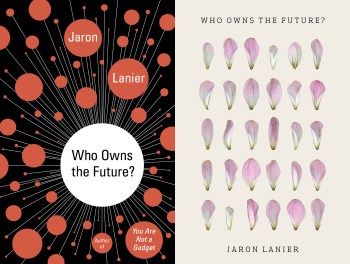
And in exchange for free internet searches, discounts on books and other merchandise, posting pictures of family and friends, and playing games, we’re giving it away. Giving away our means to earn a living. Giving away our privacy and most personal information. Giving away copyright protection, our health care data, our time. Making large companies and internet entrepreneurs wealthy. Waving goodbye to economic opportunities that could, in the mind of non-economist but future thinker Jaron Lanier in a creepily fascinating book called Who Owns the Future. From the book jacket, a clear explanation of a complicated book:

Lanier asserts that the rise of digital networks led our economy into recession and decimated the middle class…In this ambitious and deeply humane book, Lanier charts the path toward a new information economy that will stabilize the middle class and allow it to grow. It is time for ordinary people to be rewarded for what they do and share on the web.”

futureukuscomboCertainly, creative professionals have seen new opportunities, but many jobs have disappeared, crumbled, or become so easy for amateurs to do, there is little perceived need for professional work. Two examples: illustration and another is photography. What about people who drive for a living? Lanier: “A great portion of the global middle classes works behind a wheel. Many have entered middle-class life as a taxi driver or truck driver. It’s hard to imagine a world without commercial drivers. A traditional entry ramp into economic sustenance for fresh arrivals to big cities like New York would be gone. Wave after wave of middle class immigrants drove New York taxis. And I’m trying to imagine the meeting when someone tries to explain to the Teamsters that nothing like their services will ever be needed again.” You see this in the battles between the everyone-can-be-a-cabbie service Uber and the people who actually make their living by moving people.  Soon, cars will move without drivers. Lanier: “Both cabbies and truckers have managed to build up levees…they’ll be able to delay the change…there might be a compromise in which a Teamster or cabbie sits there passively, along for the ride, perhaps to man a failsafe button…the world of work behind the wheel will drain away in a generation.”

Lanier: “What about liberal arts professors at a state college. Some academic will hang on, but the prospects are grim if education is seduced by the Siren song… The future of “free” will beckon. Get educated for free now! But don’t plan on a job as an educator.”

Lanier’s Siren server combines a Siren’s song with a server that collects information, provides appealing benefits, and causes tremendous destruction as it is managed by a wealthy few. The Siren server is portrayed as a monster stomping the life out of everything in its path. Health care? Empathetic robots empowered by Big Blue’s encyclopedic database of knowledge, the processing speed of a digital chess champion, and unbelievably precise motor skills. The list goes on.

So what’s to be done? It’s tough for anyone to survive in the modern world with a “just say no to the Siren servers!” philosophy. So much relies upon credit cards, EZ-Pass, Android, and, yes, Netflix (now my most-used television “channel”). What’s more, there’s the “Pervasive Creepy Conundrums: online security, privacy, and identity.”

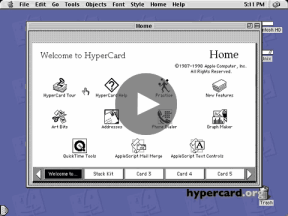
Lanier builds his case for divergence with a disheartening disclaimer: he cannot explain the idea simply. In fact, he can, and somehow, his editor did not delete most of chapters 16-20 because they take too long to set up a very good, very simple idea: two-way links. He appropriately credits an early home computing visionary, Ted Nelson, whose name may be familiar because he was the guy who originated HyperCard, which Ars Technica describes in a wonderful article entitled “25 years of HyperCard—the missing link to the Web.”

hypercard_tutorial_posterLet’s continue down that path: “The foundational idea of humanist computing is that provenance is valuable. Information is people in disguise, and people ought to be paid for value they contribute that can be sent or stored on a digital network.” I agree. For more about why and how I agree, see my recent articles about Google Books.

Simply: “If two-way linking had been in place, a homeowner would have known who had leveraged the mortgage, and a musician would have known who had copied his music.”

Lanier is right: That changes everything!

It’s a complicated fix, a change in the architecture of so many things digital, but it’s worth the shift. Here’s a straightforward example of why: “When you buy a physical book, you can resell it at will…” It is yours to own, sell, repurpose. “You can get the author to sign it, to make it more meaningful to you, and to increase its value.” With an eBook, you have only purchased “tenuous” rights within “someone else’s company store.” And so, “Your decision space is reduced.” It’s just not a fair deal. What’s more, this kind of thinking leads to the kinds of big company, big brother control that makes nobody comfortable (and few people wealth).

Lanier’s theory about “commercial symmetry” places everyone—companies and individuals, governments and other institutions—on a level playing field. Rules apply in both directions. People’s rights are not reduced. There is fair play. I am not required to subsidize ESPN on my cable bill; I don’t watch, and probably will never watch, most of the cable channels that I am required to fund each month. We’re trying to do something like this with health care—patient rights and all of that—but the health care system is not likely to share information about its economics. Students are graded by teachers, but (most of the time), teachers are not graded by students or (much of the time) by their employers or the larger body of taxpayers who fund their salaries, benefits and pensions.

Still, there is that looming question: is the value that we provide to, say, EZ-Pass or Netflix, transferable to real income for individuals who must earn a living. If Netflix discounted its services in exchange the data that we provide, would that result in more or less employment overall? Less, I suspect—but I’m operating within a present-day reality, and if we’ve learned anything from the future’s past, paradigm shifts change all of the rules.

Lanier probably doesn’t have the answers, but he writes in a way that makes you think, and he ignites meaningful conversations like this one. Smart guy, interesting book.

Lanier

Google Books vs. Every Published Author, Part III

(Be sure to read parts one and two.)

The world is changing. As an author and creative person, I want as much intellectual property protection as possible. As a creator, I want as much flexibility as possible.

Here’s the summary of a very significant intellectual property case decided this month by U.S. Circuit Judge Denny Chin:

In my view, Google Books provides significant public benefits. It advances the progress of the arts and sciences, while maintaining respectful consideration for the rights of authors and other creative individuals, and without adversely impacting the rights of copyright holders. It has become an invaluable research tool that permits students, teachers, librarians, and others to more efficiently identify and locate books. It has given scholars the ability, for the first time, to conduct full-text searches of tens of millions of books. It preserves books, in particular out-of-print and old books that have been forgotten in the bowels of libraries, and it gives them new life. It facilitates access to books for print-disabled and remote or underserved populations. It generates new audiences and creates new sources of income for authors and publishers. Indeed, all society benefits.”

On the one hand, Google is providing a substantial public service by unearthing, scanning, and distributing works in the public domain that may otherwise be forgotten. What’s more, they’re placing everything into a searchable database that can be accessed by just about everyone who wants or needs it.

On the other, Google has gone too far by scanning and distributing works that are not in the public domain, but are, instead, owned and controlled by copyright holders. (Most are authors, who typically assign publishing rights to their publishers but retain their copyrights.) Here, in my view (not a lawyer, but an author and a business person), the solution is simple, reasonable, and available. Google must ask permission of copyright holders before freely distributing their work. (Yes, this is cumbersome, but Google is a company whose cleverness is exceeded only by its resources.) Of course, authors could be pro-active in making such grants because they believe, in their sole and reasonable judgment, that their work’s inclusion in the Google Books database would be in the public interest or would benefit the author’s work from a marketing point of view.

According to Joe Crawford of Moorpark, California, you are free: to share (to copy, distribute and transmit the work, and to remix (to adapt the work)  Under the following conditions: attribution – (You must attribute the work in the manner specified by the author or licensor (but not in any way that suggests that they endorse you or your use of the work). Joe established the rules for his copyrighted property. This is reasonable, and it is now done on a massive scale.

According to Joe Crawford of Moorpark, California, you are free: to share (to copy, distribute and transmit the work, and to remix (to adapt the work). Under the following conditions: attribution – (You must attribute the work in the manner specified by the author or licensor (but not in any way that suggests that they endorse you or your use of the work). Joe established the rules for his copyrighted property. This is reasonable, and it is now done on a massive scale.

In fact, Creative Commons has done a lot of good work in this area, making it easy for copyright owners to establish rules with regard to sharing, copying and other uses of their property.

The issue is not whether Google Books should scan and distribute books, and the issue not whether this activity results in a public good. The issue is whether making full digital copies of a book in a public library that is still protected by copyright, and then distributing the digital copy without permission of a copyright holder is, under any reasonable interpretation of the law, more similar to a 21st century card catalog or more similar to copyright infringement on a massive scale.

As an author, I am strongly inclined to vote in favor of copyright protection and a requirement that Google, or any other party, affirmatively secure permission of my intellectual property prior to its distribution.

As a producer and businessperson, I could reconsider that position because the current decision may apply to future projects in some interesting ways. For example, one might contemplate an online system of recommended books that include substantial portions of copyrighted work—full chapters, perhaps, or more—as a kind of public literacy project. Or, one might translate entire works into other languages to provide greater access to those works. In both cases, if the works are scanned into a database so that researchers might use them for educational purposes, no permissions should be necessary.

Let’s take that a step further. There is so much video now available on the internet, and, for the most part, it is very difficult to search within those videos. If you were to create a database of, say, movie scripts or, in a more advanced form, movie dialogue, you might well be able to show the whole movie, perhaps in “snippets” (the term used by Google for its portions of larger works), or, at least, include these movie excerpts in a series of online documentaries that explore, for example, the mythology of the Star Wars films, or the role of animal characters in Disney or Pixar films. If it’s all for the public good, and it’s all part of a searchable database, Judge Chin’s ruling suggests that Fair Use is both a reasonable defense with regard to challenges, and, in a larger sense, that this sort of activity is to be encouraged if it serves a research need, promotes the films, and transforms the ways that people consume these films.

It’s easy to be glib or flippant about the tremendous reach of the judge’s decision, but in the end, this isn’t about books, or Google. It’s about whether creative professionals will be able to earn a living in the future. With each step into a new digital future, that future becomes just that much more murky. In doubt about that? Read this.

Google Book Chronicles vs. Every Published Author, Part II

(Be sure to read parts one and three.)

The statement from Google:

As we have long said., Google Books is in compliance with copyright law and acts like a card catalog for the digital age, giving users the ability to find books to buy or borrow.”

Baseball pitcher Jim Bouton wrote a popular book called Ball Four. The book is out of print, but it is available through Google Books. Jim Bouton is a plaintiff in the case against Google Books because the work was used without his permission.

Baseball pitcher Jim Bouton wrote a popular book called Ball Four. The book is out of print, but it is available through Google Books. Jim Bouton is a plaintiff in the case against Google Books because the work was used without his permission.

And from the Author’s Guild:

Google made unauthorized digital editions of nearly all of the world’s valuable copyright-protected literature and profits from displaying those works…In our view, such mass digitization and exploitation far exceeds the bounds of the fair use defense.”

Of course, the Author’s Guild plans to appeal the decision, but, for now, it stands.

The judgment was written by U.S. Circuit Court Judge Denny Chin, who has been working with Google and the Author’s Guild on the future of Fair Use as it applies to Google’s insistence upon scanning and posting intellectual property without permission of the copyright holder. (Be sure to read yesterday’s post because it sets the stage for this one.)

This wonderfully cluttered bookshop in Tenby, Wales, UK is precisely the sort of mess that Google Books tries to solve. In the bookstore, there is no search, no apparent organization whatsoever (except those lovely Penguin classics in the spinner rack). On Google Books, every word of every book is part of a searchable database. (Photo by Howard Blumenthal, all rights reserved, do not duplicate or distribute without written permission.)

This wonderfully cluttered bookshop in Tenby, Wales, UK is precisely the sort of mess that Google Books tries to solve. In the bookstore, there is no search, no apparent organization whatsoever (except those lovely Penguin classics in the spinner rack). On Google Books, every word of every book is part of a searchable database. (Photo by Howard Blumenthal, all rights reserved, do not duplicate or distribute without written permission.)

Happily, my book, The Creative Professional, has not been violated by Google, but I will borrow from my own work to review the four “prongs” of Fair Use of copyrighted material:

  •  The first is the character of the use. “The focus of this factor is ‘whether the new work merely supersedes the objects of the original creation… or instead adds something new, with a further purpose or different character, altering the first with new expression, meaning, or message; it asks, in other words, whether and to what extent the new work is transformative.’”
  •  The second is the “nature and copyright status of the plaintiff’s work.” A work that is factual receives more protection than a work that is imaginative. Remarkably, an unpublished work is more likely to be protected than a published work.
  •  The third Fair Use test is the amount of material used. Fair Use protection is more likely to be extended when the percentage of the original work used in the new work is comparatively small.
  •  The fourth judgment is an evaluation of market impact. If the Fair Use was allowed, how might this use impact the market for the copyrighted material? If the copyrighted material is not currently in the market, or if its sales are minor and the use was otherwise fair, this factor may lead to judgment in favor of the defendant who claims that no infringement has occurred. However, if the material is not in the market, and sales are minor, but the use, based on the above three factors, was unfair, then discussion of this fourth factor may not enter in the decision at all. This becomes complex; whether you are defendant or plaintiff, you will want a smart lawyer who is well-schooled in the subtle features of Fair Use and copyright law.

Let’s add it all up:

  • Character of the use. Google’s use adds nothing new, except the ability for anybody to read AND COPY any portion of the copyrighted work without paying for it. I can’t argue that this is not, somehow, “transformative” but I can imagine the use of the term mostly in terms of, say, opening the back of an ATM and transforming bank customers into people who can take money freely, as they wish.
  • Nature and copyright status of the plaintiff’s work. It’s factual, and it’s under copyright for a reason. Copyright provides creative people with protection against unauthorized use. (This is a more complicated idea than one would think, so I’ll leave it to the lawyers to elaborate.)
  • The amount of material used. All of it. Every word. Seriously, is this what we really want as a society?
  • An evaluation of market impact. If we define market impact in two ways: sales of books and promotion of the authors for potentially greater market value, I think I can speak as an expert with regard to my own creative work: sales of books have not been affected in any measurable way, and NOT ONE PERSON has ever told me that they bought the book because they first saw it on Google. And I am no more famous than I was on the day before Google entered my life with their interesting theories and practices about Fair Use.

And let’s have a look at what the judge wrote in his decision:

  • Character of the use. “Google’s use of the copyrighted works is highly transformative…Google Books has become an important tool for libraries and librarians and cite-checkers as it helps to identify and find books…Google Books is also transformative in the sense that it has transformed book text into data for purposes of substantive research, including data mining and text mining in new areas, thereby opening up new fields of research. Google Books does not supersede or supplant books because it is not a tool to be used to read books. Instead, it “adds value to the original” and allows for “the creation of new information, new aesthetics, new insights and understandings.”…even assuming Google’s principal motivation is profit, the fact is that Google Books serves several important educational purposes. Accordingly, I conclude that the first factor strongly favors a finding of fair use.
  • Nature and copyright status of the plaintiff’s work. “the vast majority of the books in Google Books are non-fiction. Further, the books at issue are published and available to the public. These considerations favor a finding of fair use.” (Nonpublished works are subject to greater protection.)
  • The amount of material used. “Google scans the full text of books — the entire books — and it copies verbatim expression…Here, as one of the keys to Google Books is its offering of full-text search of books, full-work reproduction is critical to the functioning of Google Books. Significantly, Google limits the amount of text it displays in response to a search.  On balance, I conclude that the third factor weighs slightly against a finding of fair use.
  • An evaluation of market impact. Here, plaintiffs argue that Google Books will negatively impact the market for books and that Google’s scans will serve as a “market replacement” for books… a reasonable factfinder could only find that Google Books enhances the sales of books to the benefit of copyright holders. An important factor in the success of an individual title is whether it is discovered — whether potential readers learn of its existence. Google Books provides a way for authors’ works to become noticed, much like traditional in-store book displays…Google provides convenient links to booksellers to make it easy for a reader to order a book. In this day and age of on-line shopping, there can be no doubt but that Google Books improves books sales. Hence, I conclude that the fourth factor weighs strongly in favor of a finding of fair use.

Clearly, this is a topic that warrants a third article. See you tomorrow.

Google Books vs. Every Published Author, Part I

I have written several books. Perhaps you have purchased one of them. If you did, thank you. As a result of your purchase, I probably collected about $1.25 in royalties. You may have read the book, and perhaps, you lent it to a friend. You may have copied a few pages, or used the book for research, maybe even quoted from my book in your own work. That’s fine with me, and I am sure it would be fine with just about any author.

Of course, I wouldn’t expect you to make copies of the book and distribute it, for free or for a fee, and I certainly wouldn’t expect you to publish some or all of my book’s contents on the web–even if you believed that what you were doing would make the world a better place. I expect that you think about my book in much the same way.

Denny_ChinHowever reasonable, that’s no longer the way things work. Now, it seems, making the world a better place is reason enough to freely distribute copyrighted work without permission of the copyright holder. Here’s the logic and the new law of the land as set forth by U.S. Circuit Court Judge Denny Chin in a case decided this month in favor of Google (which scanned and distributed millions of books, without permission, in the public interest) and the Author’s Guild (which cried foul, lost, plans to appeal to a higher court, and may lose again).
“First, Google Books provides a new and efficient way for readers and researchers to find books. It makes tens of millions of books searchable by words and phrases. It provides a searchable index linking each word in any book to all books in which that word appears.” In short, Google Books completely transforms the use of books, especially in research, and it is currently in use in a great many research institutions.

Second, in addition to being an important reference tool, Google Books greatly promotes a type of research referred to as “data mining” or “text mining.” Google Books permits humanities scholars to analyze massive amounts of data — the literary record created by a collection of tens of millions of books. Researchers can examine word frequencies, syntactic patterns, and thematic markers to consider how literary style has changed over time.” So it’s fair to say that Google Books is a fantastic tool for scholars because it allows them to scan a lot of books quickly, identify and study patterns.

“Third, Google Books expands access to books. In particular, traditionally underserved populations will benefit as they gain knowledge of and access to far more books. Google Books provides print-disabled individuals with the potential to search for books and read them in a format that is compatible with text enlargement software, text-to-speech screen access software, and Braille devices. Digitization facilitates the conversion of books to audio and tactile formats, increasing access for individuals with disabilities. Google Books facilitates the identification and access of materials for remote and underfunded libraries that need to make efficient decisions as to which resources to procure for their own collections or through interlibrary loans.” Unquestionably, placing a lot of books in a gigantic database is very useful for all sorts of reasons and provides tremendous public interest benefits.

“Fourth…Google Books helps to preserve books and give them new life. Older books, many of which are out-of-print books that are falling apart buried in library stacks, are being scanned and saved.” Absolutely right, but “out-0f-print” and “public domain” are not the same thing. Many of my books are currently out-of-print, and I plan to republish some of them because they are my property. Anything that is in the public domain should be rescued for the good of the public. Anything that’s out-of-print, but still protected by copyright, cannot be reasonably treated in the same way.

“Finally, by helping readers and researchers identify books, Google Books benefits authors and publishers. When a user clicks on a search result and is directed to an “About the Book” page, the page will offer links to sellers of the book and/or libraries listing the book as part of their collections.” That’s nice, but let’s consider whether the copyrighted work should be there in the first place.

Somewhere along the way, my books were published, and a public library purchased a copy. We all understand that the library will buy one copy of the book and then distribute that book to any of its cardholders. Neither the publisher nor I, the author, granted the library any kind of right to digitize the book’s contents. Google borrowed my book from the library, scanned its contents (without my permission) and now distributes one book in whole and another in part (without my permission). And because my book is a useful book, a Federal judge has determined that this activity is not only permissible, but in the public interest.

The judge’s justification: the Fair Use doctrine that allows certain uses of copyrighted materials for the public interest. For more about that, be sure read part two (and part three).

The New Jim Crow

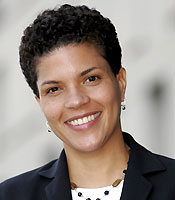
From Ohio State's website: Professor Alexander joined the OSU faculty in 2005. She holds a joint appointment with the Moritz College of Law and the Kirwan Institute for the Study of Race and Ethnicity. Prior to joining the OSU faculty, she was a member of the Stanford Law School faculty, where she served as Director of the Civil Rights Clinic. Professor Alexander has significant experience in the field of civil rights advocacy and litigation. She has litigated civil rights cases in private practice as well as engaged in innovative litigation and advocacy efforts in the non-profit sector. For several years, Professor Alexander served as the Director of the Racial Justice Project for the ACLU of Northern California, which spearheaded a national campaign against racial profiling by law enforcement. While an associate at Saperstein, Goldstein, Demchak & Baller, she specialized in plaintiff-side class action suits alleging race and gender discrimination. Professor Alexander is a graduate of Stanford Law School and Vanderbilt University. Following law school, she clerked for Justice Harry A. Blackmun on the United States Supreme Court, and for Chief Judge Abner Mikva on the United States Court of Appeals for the D.C. Circuit.

From Ohio State’s website: Professor Alexander joined the OSU faculty in 2005. She holds a joint appointment with the Moritz College of Law and the Kirwan Institute for the Study of Race and Ethnicity. Prior to joining the OSU faculty, she was a member of the Stanford Law School faculty, where she served as Director of the Civil Rights Clinic.
Professor Alexander has significant experience in the field of civil rights advocacy and litigation. She has litigated civil rights cases in private practice as well as engaged in innovative litigation and advocacy efforts in the non-profit sector. For several years, Professor Alexander served as the Director of the Racial Justice Project for the ACLU of Northern California, which spearheaded a national campaign against racial profiling by law enforcement. While an associate at Saperstein, Goldstein, Demchak & Baller, she specialized in plaintiff-side class action suits alleging race and gender discrimination.
Professor Alexander is a graduate of Stanford Law School and Vanderbilt University. Following law school, she clerked for Justice Harry A. Blackmun on the United States Supreme Court, and for Chief Judge Abner Mikva on the United States Court of Appeals for the D.C. Circuit.

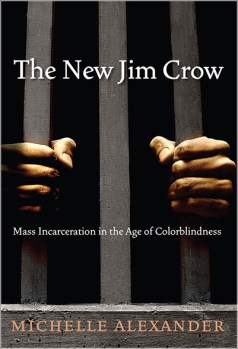
Sometimes, a book is just the thing: a clear explanation running several hundred pages, written by an expert, vetted by other experts, building a powerful case to its logical conclusion. Several years ago, an associate professor at The Ohio State University wrote a book, a history, a manifesto based upon a dangerous idea. Her name is Michelle Alexander and her book, republished a year or so ago with a new forward by Cornel West, is entitled The New Jim Crow. The subtitle just begins to suggest the storyline: “Mass Incarceration in the Age of Colorblindness.”

Often, when I read a nonfiction book, I dog-ear the parts I want to remember. I’ve dog-eared a third of this book. Here’s part of a dog-eared page, written by an American Bar Association task force and quoted by the author:

[The] offender may be sentences to a term of probation, community service and court costs. Unbeknownst to this offender, and perhaps, any other actor in the sentencing process, as a result of his conviction, he may be ineligible for many federally-funded health and welfare benefits, food stamps, public housing, and federal educational assistance. His driver’s license may be automatically suspended, and he may no longer qualify for certain employment and professional licenses. If he is convicted of another crime, he may be subject to imprisonment as a repeat offender. He will not be permitted to enlist in the military, or possess a firearm, or obtain a federal security clearance. If a citizen, he may lose the right to vote; if not [a citizen], he may become immediately deportable.”

On the surface, this may sound like get-tough-on-crime, perhaps stronger than some would like it to be, maybe not so surprising.

New Jim CrowProfessor Alexander’s point becomes clear when this idea is added:

…the system of incarceration operates with stunning efficiency to sweep people of color off the streets, lock them in cages, and then release them into an inferior second-class status.”

For the most part, she explains, incarceration is not due to violent crimes. Instead, mostly, incarceration is due to relatively small amounts of drugs, often found as a result of policies, rules, laws, and Supreme Court judgments that encourage law enforcement to focus their attention on minority (most often, Black) people, even though drug sales and drug use tend to be about equal among all racial and ethnic groups.

It’s one thing to understand the problem as a social issue. It’s another when you “Imagine you are Erma Faye Stewart, a thirty-one year old, single African American mother of two who was arrested as part of a drug sweep in Hearne, Texas. All but one of the people arrested were African American. After a week in jail, you have no one to care for your two small children and are eager to get home. Your court-appointed attorney urges you to plead guilty to a drug distribution charge, saying the prosecutor has offered probation. You refuse, steadfastly proclaiming your innocence. Finally, after almost a month in jail, you decide to plead guilty so you can return home to your children. Unwilling to risk a trial and years of imprisonment, you are sentenced to ten years probation order ordered to pay $1,000 in fines, as well as court and probation costs. You are now also branded a drug felon. You are no eligible for food stamps; you may be discriminated against in employment; you cannot vote for at least twelve years; and you are about to be evicted from public housing. Once homeless, your children will be taken from you and put in foster care.”

Turns out, the  entire sweep was based upon a lie. Eventually, a judge dismissed all cases against the defendants–except those who pled guilty. “You, however, are still a drug felon, homeless, and desperate to regain custody of your children.”

Sure, we see stories like these all the time, mostly on TV, sometimes in the movies, but their truth, and the reasons behind their truth, are disturbing because we (all of us, that is) must face one of two nasty realities:

(1) We are comfortable with the system that we our society has in place, even though it is often severe and places a very high percentage of Black citizens into the system; or

(2) We are comfortable with the system because American continues to support a racial divide with unequal rights, and severe lifetime punishment for a large number of people who live in the United States.

I suppose most people are only vaguely aware of the issue–that was my excuse–but this book removes that defense. The legal system is ferociously complicated. We must be fair but we must also be safe. You know the arguments, but that’s not much of a starting place to make things right.

One positive step is to bring this important topic to a study group. There is a free study guide available for groups willing to engage. Details below:

Drawing from and expanding on the themes of Michelle Alexander’s acclaimed best-seller, The New Jim Crow, this in-depth guide provides a launching pad for groups wishing to engage in deep, meaningful dialogue about race, racism, and structural inequality in the age of mass incarceration.  The Study Guide and Call to Action spans the entirety of The New Jim Crow, engaging the critical questions of how we managed to create, nearly overnight, a penal system unprecedented in world history, and how that system actually functions — as opposed to the way it is advertised.  This important new resource also challenges us to search for and admit the truth about ourselves, our own biases, stereotypes, and misconceptions, and the many ways in which we might actually be part of the problem.


This is one of several video recordings of Dr. Alexander’s speeches. This one was delivered at the Riverside Church in Manhattan. You can find others on this page.