Great App for Ideas; No iPad Version Yet

Although it currently lacks an iPad version, there’s a wonderful software application called Curio 8 that offers a remarkable combination of fully integrated features related to the world of ideas. I discovered it recently, and I’m just beginning to understand how useful Curio 8 can be.

Basically, Curio 8 combines these functions in a single package:

  • Note taking
  • Brainstorming
  • Mind mapping
  • Task management
  • Presentation


It’s a little bit OmniGraffle, a little bit Evernote, with some of the functions of Keynote, but it’s also a drawing program that’s also useful for presentations. Although it’s awkward to describe Curio 8 in terms of other software applications, this particular application more than holds its own in each of these categories (and more).

As in Keynote (Apple’s answer to Microsoft’s PowerPoint, very popular on iPads), you begin by choosing an “Idea Space” (in Keynote lingo, a “theme”). You can then drag documents (PDFs, RTF word processing files, image files; also, web links) into the Curio 8‘s Organizer, and assign properties to each of these items. For example: notes, metadata, color, style, size, color. In addition, as you would with Things or any of the GTD apps (“Getting Things Done,” a fancy to-do list), you can assign filters (“hot”,”under peer review,” etc.) You can also assign the name of an Evernote Notebook or an Evernote Tag because there is deep integration between Curio 8 and Evernote.

That’s only the beginning. Once the Curio 8 “project” is established, you can add any of these and more:

  • Basic shape, styled shape, stencil (all similar to OmniGraffle)
  • A list, such as a to-do list (complete with iCal syncing) or a bulleted list
  • A mind map (similar to XMind or any number of other mapping apps)
  • A table
  • An index card (similar to Corkulus)
  • An screen snapshot (similar to Grab)
  • An audio or video recording

Curio-ScreenThese audio and video recordings must be made live–there’s a built-in recorder. In this version, Curio 8 does not support, say, .mov files, but you can paste the link to a YouTube or Vimeo file (requiring Curio 8 to be used with an internet connection in order to see these files).

But wait! There’s more!! The next set of features allows various sorts of sketching, drawing and painting with a variety of pens and brushes.

You can export the Curio 8 project as a .tiff, .jpeg, .png, .PDF, .html, and for selected items, you can export, for example, a .csv file from a table.

Assets used in one Curio 8 project can be easily accessed for use in another (gee, I wish this was a common feature in Pages and Keynote).

In addition, there’s a bit of scripting that will recall, for example, FileMaker. You can assign an action to a specific asset within a project. Click on a shape and Curio 8 will automatically set up a new email message, or open a URL, or open a specific file.

Curio 8 is the work of a very creative guy named George who lives and works in North Carolina. His company is called Zengobi, and so, you can find out more about Curio 8 by visiting http://www.zengobi.com. In case you’re curious, Zen is, of course, a Japanese sect of Mahayana Buddhism “that aims at enlightenment by direct intuition through meditation” and Goby is a small fish that swims in the shallow waters near North Carolina.

Often, George reports to his users via his blog. On March 13, he boasted about the addition of “the #1 requested mind mapping feature: mind map relationship lines.” On March 4, he explained the difference between a Concept Map and a Mind Map (the latter allows only one parent diagram per child). Lots of detail, all very useful and all wonderfully focused on the customer’s needs.

ScrivenerThis is the joy of working with a small software company: the product is terrific, and the company is highly responsive to customer needs. The same can be said about Literature & Latte, makers of the equally useful Scrivener word processor for authors, academics, screenwriters and playwrights.

The frustration, both for the company and for the user, is the amount of time required to build applications. In both situations, users have been patiently waiting for an essential tool: the tablet version of the software. Both of these programs are feature-rich. They have set a very high standard and they now serve a very specific niche customer base that expects an extraordinary feature set and a supremely reliable product.Typically, a small company is doing all it can to manage a Mac version (Literature & Latte recently released its first Windows version, but Zengobi has not). Add an app, and not just an iPad app, but a fully functional Android app as well, and the resource tug becomes uncomfortable.

And so, Curio 8 users do precisely what Scrivener users have learned to do. Be happy with the Mac-based product and its evolving feature set, and wait, patiently, for the inevitable release of the iPad app. In both cases, it’s coming soon. Even larger companies must take their time with app development–learning a great deal from every iteration. I’ve become a big fan of the OmniGroup products, happily using OmniFocus to manage my daily affairs, but only on the iPad and iPhone. Turns out, those apps are now so good that the older Mac app is so far behind that I don’t really understand how to use it. So what is OmniGroup doing? Redeveloping the Mac app so that it works the same way as their iOS apps.

We’re all learning a lot from this new wave of software application development. And, mostly, we’re discovering that this is all a very new way of thinking. Getting it right takes time.
Masterful Visualizing

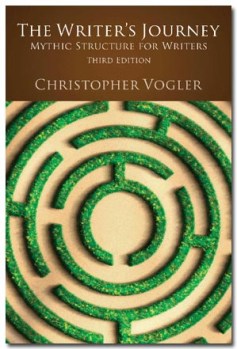
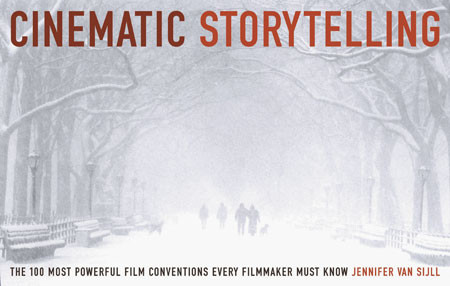
In my last post, I recommended a book entitled The Writer’s Journey: Mythic Structure for Writers by Christopher Vogler. As a companion, I recommend another book from the same publisher, Michael Weise Productions. This one is entitled Cinematic Storytelling: The 100 Most Powerful Film Conventions Every Filmmaker Must Know. It’s written by Jennifer van Sijll. Like The Writer’s Journey, Cinematic Storytelling is useful to the one telling the story, and to the reader or audience member on the receiving end. Why does this book matter? Because we’re rapidly developing into a world of visual storytellers–smartphones and digital cameras in hand–and it would be wonderful if everyone could do their job just that much better.

CInematicStory_website_largeBasically, this book is an encyclopedia of visual storytelling techniques, but it’s fun to browse because every idea is illustrated by frames from a well-known or significant film–and each sequence is presented with the relevant bit of the screenplay along with perceptive commentary from the author.

Some are easily understood by the audience, and as a result, they must be used judiciously by the filmmaker or storyteller: the slow-motion sequence in Martin Scorsese’s Raging Bull; the freeze frame that ends Butch Cassidy and the Sundance Kid; the fast-motion sequence in the French film, Amelie; the famous flashback in the Billy Wilder film, Sunset Boulevard; the visual match cut that transforms a bone into a spaceship in 2001: A Space Odyssey; the long dissolve between young Rose and Old Rose in Titanic.

A specialty lens was used by Orson Welles in Citizen Kane–perhaps the movie most often used as an example to illustrate a variety of techniques. Sometimes, a telephoto is the appropriate storytelling choice, and sometimes, it’s the wide angle. These are not random, on-the-fly choices; instead, they are carefully considered during the storyboard phases of film development.

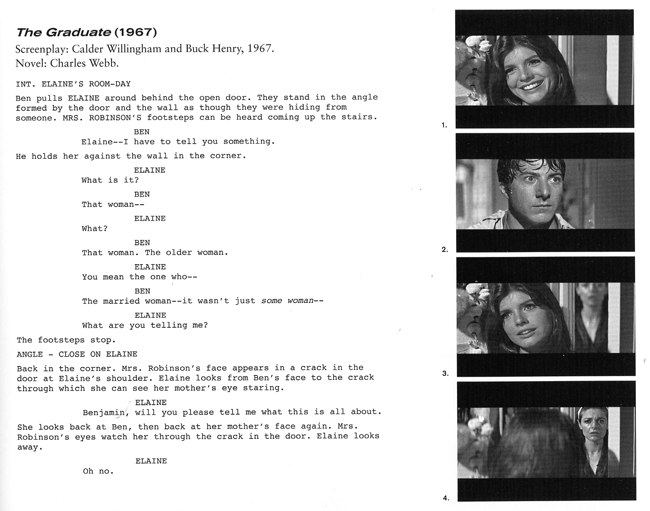
In this entry featuring The Graduate, the author explains the use of a "rack-focus"--here, shifting the focal point from one character to another. The author explains, "Unseen by Elaine, who is still facing Ben, Mrs. Robinson stands in the doorway. Mrs. Robinson is out-of-focus and ghost-like. When Elaine spins around, Mrs. Robinson is pulled into focus, and Elaine is thrown out of focus (Image 4). Every line in Mrs. Robinson's defeated face now shows. After a beat, Mrs. Robinson disappears from the door. When Elaine turns back to Ben, her face remains momentarily blurred, externalizing her confusion. At the moment of recognition, her face is pulled back into focus.

In this entry featuring The Graduate, the author explains the use of a “rack-focus”–here, shifting the focal point from one character to another. The author explains, “Unseen by Elaine, who is still facing Ben, Mrs. Robinson stands in the doorway. Mrs. Robinson is out-of-focus and ghost-like. When Elaine spins around, Mrs. Robinson is pulled into focus, and Elaine is thrown out of focus (Image 4). Every line in Mrs. Robinson’s defeated face now shows. After a beat, Mrs. Robinson disappears from the door. When Elaine turns back to Ben, her face remains momentarily blurred, externalizing her confusion. At the moment of recognition, her face is pulled back into focus.

Selecting a particular point-of-view (POV) can be a critically important aspect of storytelling, as with the below-the-swimmer underwater sequence just before the first swimmer is killed by a shark in JAWS. For which scenes is a low-angle shot most appropriate (character POV for E.T. would be one example), or for which would a high-angle shot be the better creative choice? When does it make sense to use a tracking shot (the camera is mounted on a tripod that glides along tracks; some low-budget achieve similar results by employing a wheelchair)?

Lighting is another variable. In American Beauty, there’s a scene illuminated by candlelight. In E.T., the search is conducted by flashlights and car headlights that illuminate an otherwise dark nighttime landscape.

In Barton Fink, individual shots of props (hotel stationery, an old typewriter) add visual context. Wardrobe is another defining option. So, too, is the use of location as a theme, a concept so masterfully used by director David Lynch in the vaguely creepy Blue Velvet.

It’s not always about what is seen. Sometimes, the scene contains less information, and the story or theme is carried by music or sound effects. Back to Barton Fink for the eerie sense of surreal sound and its ability to paint a picture of each character’s inner world.

Masterful Storytelling

WritersJourney3rddropWe live in remarkable times. Stories are told in every part of the world, and shared with millions of people. Once, this was the domain of the rich and powerful. Today, anybody can tell a story, and share the majesty of their ideas.

Of course, some stories are better than others. There is an art and a craft to all of this, a discipline studied in college programs and in private instruction taught by masters.

One such master is a Hollywood story consultant named Christopher Vogler. Since 1998, Vogler has been the industry expert on a particular, popular type of storytelling and character development. He explains it all in a wonderful book entitled The Writer’s Journey: Mythic Structure for Writers,  now published in its third edition by Michael Weise Productions.

No doubt, you are familiar with the structure of the mythical hero’s journey. You’ve seen it in so many movies. The hero of the story does not begin as a hero. Instead, he or she (more often, he) is an ordinary guy doing ordinary things every day. Then, something happens, and suddenly, he is thrust into an uncomfortable role, reluctant to proceed in anything resembling a heroic journey. Inevitably, the wizened old mentor or the playful talking dog shows up, and the ordinary guy begins to understand that he has no choice, that he must pursue the journey whether or not he wants to do so.

It’s Star WarsThe Wizard of Oz, Sister Act, Big, Raiders of the Lost Ark… you know the routine, but it’s still a story we love to experience, a story we love to tell. It’s the human experience, each time presented anew.

We’re on a mission from God” — Dan Ackroyd and John Landis, screenplay, Blues Brothers

So what’s so special about this book? Well, Vogler has a tidy way of breaking down each of the steps along the journey. For example, after leaving the ordinary world; hearing the call to adventure; refusing the call; meeting with the mentor; encountering tests, enemies and allies; and approaching an innermost cave, the hero is inevitably faced with an ordeal that must be overcome in order to move ahead with the journey. Joseph Campbell, whose book, Hero with A Thousand Faces, covers much of the same territory from a mythological analysis perspective, also arrives, at this point in the journey, at the greatest challenge and the fiercest opponent. So here’s the secret of the ordeal:

Heroes must die so they can be reborn.

To be clear, “the dramatic movement that audiences enjoy more than any other is death and rebirth. In some way, in every story, heroes face death or something like it: their greatest fears, the failure of an enterprise, the end of a relationship, the death of an old personality. Most of the time, they magically survive this death and are literally or symbolically reborn to reap the consequences of having cheated death. They have passed the main test of being a hero.”

Vogler goes on to explain that heroes “don’t just visit death and come home. They return changed, transformed.” So, the ordeal serves as a central core to the story, the place where the variety of story threads begin to tie together in a meaningful way. BUT–the crisis is not the climax of the story. That’s a completely different concept, a part of the story that arrives much later on (near the end, in fact.)

One reason why we love to watch the hero’s journey time and again is because every story is unique. Vogler explains how and why this may be true. Most often, the crisis occurs at the story’s mid-point, which Vogler describes as a tent pole–if it’s too far to one side, the tent sags / the audience’s interest wanes. (He reminds us that our word “crisis” comes from a Greek word meaning “to separate.” Vogler looks at the question of ordeal from many different perspectives, each one a driver that we’ve all experienced in the movies or in good fiction: a crisis of the heart, standing up to a parent, witnessing the death of a loved one, going crazy with emotion, and the list goes on.

If you’re sensing that The Writer’s Journey might be a useful tool for both constructing and de-construcing stories, you’re beginning to understand the value of Volger’s accomplishment. For the writer attempting to tell a story in a way that will ring true for the reader or the audience, this would seem to be an essential tool. For the reader, or the movie fan who wants to better understand the art and craft of storytelling, the deep secrets of the creative team, this book exposes the magic for the trickery that it is, then waves its cape to reveal far deeper magic within. For the English teacher, or professor, in search of a far better way to connect with students who ought to read or write with greater proficiency, here’s the elixir.

Of course, that’s only part of the story: the writing. Next up, from the same publisher: how to tell the visual story to ignite the audience’s imagination.

A Teacher Who Paints Ideas

When a student faces a new subject, there is a certain comfort in structure, process, facts, and the rigorous routine that defines most teaching situations. Teachers find comfort in that structure: first, the basics, then, perhaps, the materials, then, the history followed by waves of increasingly specific information. In theory, it all makes sense. In practice, when faced with the sloppiness of real life, the structure may be exactly what’s not needed because it interferes with the real learning that occurs as a result of experimentation and making glorious mistakes.

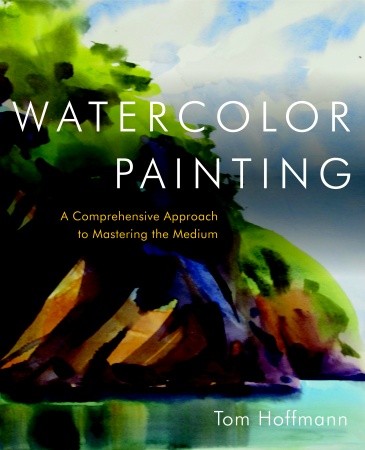
I guess that’s why I had so much trouble understanding what Tom Hoffman was doing. Instead of writing a book that began with materials (in this case, watercolor paints, brushes, papers, and accessories), he begins by admitting that watercolor painting is not easy to do, that it is sloppy, messy, difficult to master, wasteful of expensive paper, and then eschews anything resembling a traditional learning process. Instead, he focuses on the most dangerous of all educational concepts: ideas.

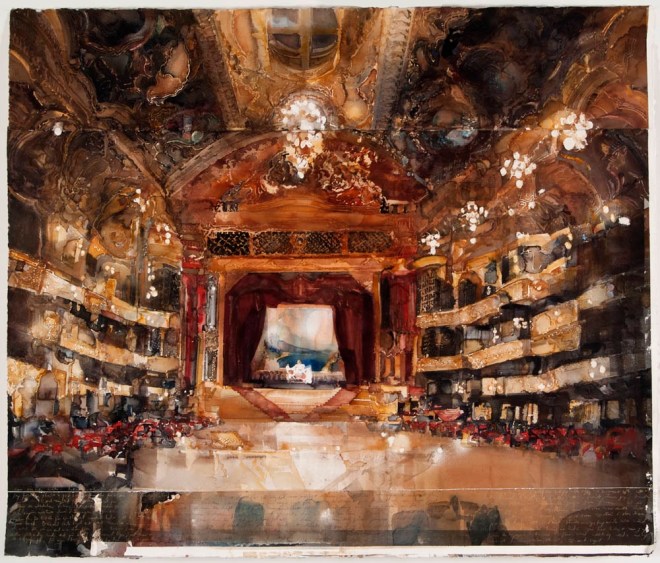
Allow me to begin where he first captured my imagination, with a watercolor painting by an extraordinarily talented artist named Lars Lerin.

operaQuoting Hoffman:

The palette is limited to three colors, and almost all of the edges of the shapes are hard. In the realm of value, however, the artist pulls out all the stops. Never merely black, his deepest darks remain full of color. He limits the lightest lights to just a few stops, making everything else seem to be lit by the low gleam of a lantern in a gilded pattern.

With this glorious visual introduction, he begins where most instruction books ought to begin: by encouraging direct observation, followed by critical thinking (would this make a good painting? what appeals to me, and might also appeal to the person looking at my finished work?) and creative thinking (how can I bring the visual ideas to life in the best possible way?) Hoffman does not begin by focusing on materials. He begins by focusing on the process that every artist shares. This leads to two very helpful essays, one entitled “Knowing Where to Begin” and the other, quite reasonably, “Knowing When to Stop.” In between, he explains the process by examining a very common part of the painting process: thinking through the best way to visualize the shapes and forms and values with just enough detail to pull it all together.

Hoffman Skaftafell

Simplicity in pattern and form, a very effective work by Tom Hoffman.

Step back for a moment. Imagine learning history that way. It’s never about the details. It’s always about the whole form. (But in school curriculum, it’s always about the details. Which we always forget.)

A very colorful Juarez Market in Oaxaca is filled with detail. It’s the centerpiece of a chapter entitled “Knowing What Not to Paint.” This leads to thoughts and illustrations about shape and form, and a key concept: simplicity.

A lovely streetscape by the esteemed watercolorist Alvaro Castagnet show how color and light can be handled in the simplest possible way, and yet, with skill, they can result in a painting that appears to be quite complex. The secret, Hoffman explains, is thinking in layers.

Thinking in layers is an additive technique–place one layer of color, then another–but it requires subtractive thinking to begin. That is, you must look at a scene, observe it carefully, determine which areas can be isolated and painted with a single color wash without interfering with other areas. For example, a red wall might be washed, but the blue roof should not be washed in the same layer–unless you’re seeking purple results.

A market in Puerto Rico, painted by Tom Hoffman, provides an illustration of wide dynamic range (note the darks at the top, the lights in the distance),  layering and simple design for optimum impact.

A market in Puerto Rico, painted by Tom Hoffman, provides an illustration of wide dynamic range (note the darks at the top, the lights in the distance), layering and simple design for optimum impact.

Hoffman also encourages the use of a wide dynamic range: the lightest lights and the darkest darks are what makes a painting come to life. Too often, he explains, the range is almost exclusively in the middle tones, and, as a result, the work lacks energy, contrast, and a compelling reason for anybody to pay much attention. Again, appreciate the metaphor because it applies to so many aspects of life: dark and light, silent and boisterous, and so on.

Final lesson: simplify to the point of abstraction. His most powerful work tends to be simple masses of color, artfully arranged.

The name of the book is Watercolor Painting: A Comprehensive Approach to Mastering the Medium.

Watercolor Hoffman

Steve Wozniak: 1984 Speech

What fun! Here’s Apple co-founder Steve Wozniak speaking about the earliest days of Apple Computer, working with Steve Jobs, and more. It’s a moment in time, a speaking engagement from 1984. He is speaking to the Denver Apple Pi Computer club. Thank you, Vince Patton, for uploading these videos to YouTube for all to see. You can watch the whole speech, in order, here, or just sample some of the best moments on the video clips below.

Attending College, Ended up at Hewlett Packard (including the excitement of obsoleting the slide rule!)

Wozniak and his passion for programming:

College Pranks:

Making the Apple I Computer:

There are more, I think, but this will keep us all busy for a half hour or so.

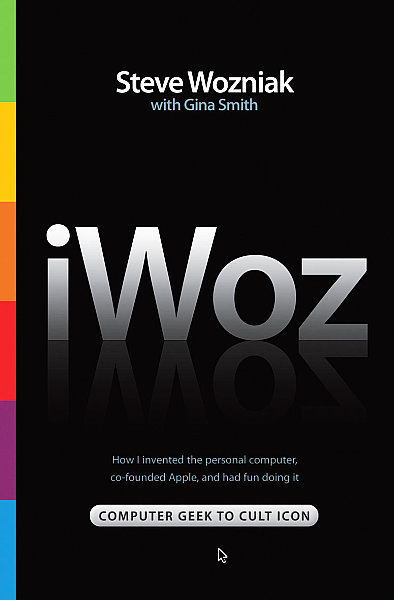
BTW, Wozniak is an articulate, engaging public speaker. The same is true of his work as an author. If you haven’t read his book, iWoz, I wholeheartedly recommend it.

iWoz

A Portable Speaker as Good as Your iPad

Tablets are spectacular inventions, but, as a rule, their internal loudspeakers do a poor job reproducing sound. With tiny loudspeaker drivers, often pointing in any direction except toward your ears, assisted by an amplifier never intended to seriously reproduce music, even the most appealing iPad is so uninterested in music, it contains only a single monaural loudspeaker.

Most people either enjoy the experience as-is, and don’t worry much about fidelity. Or, they use a pair of stereo headphones and enjoy the kind of audio that seems to exist inside the tablet (or phone), but won’t come out without some sort of accessory.

For months, I’ve been seeking a portable speaker for use with a tablet, or a phone, that provides the seemingly impossible combination of small size, convenient weight, sufficient amplification for listening at desk or in a bedroom, and, most important of all, clarity across the dynamic range (that is: nice clear highs, credible mid-tones and, perhaps most difficult in a tiny setup, bass is crisp and well-defined).

FoxL, basic model, front view, now apparently on sale for about $120.

FoxL, basic model, front view, now apparently on sale for about $120.

At a trade show, I found what I was looking for. It comes from a small company called soundmatters and it goes by the name of FoxL. In fact, there are several models.

The core of these devices is a hybrid loudspeaker design that soundmatters calls a “Twoofer,” which combines “tweeter” and ‘woofer.” This design allows a dynamic range that begins as low as 80Hz, or roughly what you would hear from a good tabletop stereo system, and also allows highs in the 20KHz range, which seems fairly commonplace. These speakers fit into a ruggedly constructed (mostly) metal box that is, truly, pocketable. The dimensions: 5.6 inches wide, 2.2 inches high, and 1.4 inches deep. It’s about the size of an eyeglass case. It weighs 9.5 ounces. (By comparison, the popular JAMBOX weighs 12 ounces, and, overall, it’s about 20 percent larger). Does the size matter? For a portable device, sure it does… the smaller (and lighter) the device, the more likely I will take it along in my shoulder bag.

But only if it sounds (very) good.

Right now, I’m listening to a recording by The Lincoln Center Jazz Orchestra led by Wynton Marsalis. The album is called Live in Swing City, and the tune is a complicated arrangement called “Chinoiserie” and it contains some very aggressive performances, lots of solos, deep notes, a barking saxophone, a sweet backup horn section, and a live audience in the background. Not an easy combination for a so-so audio system. The results are excellent–but I am careful to keep the audio level no higher than about 80% on both the iPad and the FoxL (which contains its own amplifier and volume control). The system can play louder, but bits of distortion and harshness make the listening just a bit unpleasant.

For something completely different, I switched to Peter, Paul & Mary, a trio that was always well-recorded, and whose individual voices and harmonies are both distinctive and familiar. The album is See What Tomorrow Brings and the song is “If I Were Free.” Mary is singing lead, and the nuances of her vocal are presented with appropriate warmth, if just the slightest bit lacking in punch. The guitars and the male background vocals sound clear and wonderful. The opening guitar on “Early Morning Rain” and Paul Stookey’s vocal sound ideal, and once again, the vocals are right, too.

The opening drums and other percussion on Vampire Weekend’s “Oxford Comma” grabs the listener with just the right power and clarity. The vocals sound fine. The more frenetic “Walcott” has enough bass and the right drum sound to fill a (very) small room.

“Way Over Yonder in the Minor Key” by Wilco on their Woody Guthrie tribute album, Mermaid Avenue, also sounds right. The vocal is crisp and clear, and when the background vocals kick in, with the additional instrumentation, everything holds together beautifully.

Dawn Upshaw brings her operatic voice to artful arrangements of Weill, Bernstein and other 20th century heroes on her album, I Wish It So. I’m very familiar with her version of Sondheim’s “There Won’t Be Trumpets” because it was one of a half dozen songs I used to test loudspeakers and sound systems for a feature story in Stereophile, a high-end audio magazine. Once again, Upshaw’s nuance in Upshaw’s voice is about right, but again, there’s a small lack of punch.

Presence turns out to be less of an issue for Karan Casey, who brings her pretty Irish voice to the ballad “She Is Like The Sparrow” on her self-titled album, but the low string accompaniment must be played at about 70% to avoid distortion. When the sound level is monitored, and the FoxyL is placed on its soft rubberized mat (supplied), the presentation is rich and quite wonderful.

Concerned about the occasional presence of distortion, I find some songs with distinctive and abundant bass. The little speakers sounded fine on Bonnie Raitt’s “Love Has No Pride,” and when Charlie Haden plays the bass behind James Cotton’s voice and harmonica on “All Walks of Life” from their Deep in the Blues album, the level of distortion was neither obvious nor troublesome. No problem on the Emerson Quartet’s version of various Beethoven String Quartets, either. In fact, they sounded terrific.

All of my listening was done with an iPad2 connected, by a supplied cable (miniplug to miniplug) to the most basic FoxL model ($149). For fifty dollars more, you can buy a Bluetooth model (I’m not a huge fan of Bluetooth for music listening because the sound, inevitably, cuts in and out). Both will run for 12 hours on a single battery charge (charger included). An additional $30 buys a total of 20 hours of battery life and a pretty silver enclosure. You can also charge via USB. My one complaint: a poor design on the back of the device–an easel stand is made of plastic and can be difficult to open.

Visit the website to learn more about an accessory subwoofer (also quite small) that plugs into any FoxL device.

FoxL with its subwoofer.

FoxL with its subwoofer.

Changed Channels: 2011 to 2013

All My ChildrenOn January 5, 1070, the ABC Television Network debuted a new half-hour soap opera series called All My Children. After seven years, the series was sufficiently popular to win an hour-long time slot. It remained on the air until September 23, 2011, cancelled due to changing audience and lifestyle behaviors.

On April 29, 2013, All My Children returns, with stories and many original cast members intact, five days a week, in its original half-hour form, but the series will not be seen on broadcast television. Instead, the series will be shown on Hulu’s website and on iTunes (if you want to watch on a tablet or phone, you must subscribe to Hulu Plus). One further inducement: in addition to All My Children, another long-time ABC daytime staple, One Life to Live, is also returning.

Taken as an isolated incident, the return of soap operas (or, politely, daytime dramas) is interesting news for the advertising and television industries. It’s not an isolated incident. Somehow, sometime between 2011 and 2013, something happened.

In my house, we occasionally watch a network television series at the time that it is being broadcast, but this is no longer routine behavior. Instead, we DVR anything we want to watch. The ease of simply pressing a button to record a program–a button that may be remotely operated by smartphone or tablet–turns out to be a radically new idea, different in both utility and convenience when compared with, say, VHS tapes. Alone, this convenience did not shift our behavior. Video-on-demand is also an interesting idea, but we have not used it as often as we thought we would. So that’s not the big shift.

Mel Brooks, Carl Reiner and Jerry Seinfeld eating corned beef sandwiches at Carl's place.

Mel Brooks, Carl Reiner and Jerry Seinfeld eating corned beef sandwiches in Carl’s living room.

Turns out, the big shift is the apps that are now on my TV, computer, iPad and iPhone. At first, I didn’t really understand the importance of the software. For me, HBO GO was the tipping point. The network offered not only current programs, but complete collections of all of their popular series, essentially for free to anyone subscribing to their cable service. Showtime has done the same with its Showtime Anytime app. Between HBO and Showtime, I have access to enough original programming to keep me busy for a decade. Still, the overall composition of our family’s media diet didn’t change as much as I thought it would. Then again, that was only 2012. By 2013, the shift occurred. The tipping point was a new TV set and one app in particular: Amazon Prime. Why this one? Well, it was kinda-sorta free: we buy enough books to justify the $75 annual “free shipping” charge; with this package, Amazon Prime comes as a bonus. We started by catching up on a whole lotta Twilight Zone episodes, then switched to Arrested Development. When we feel like “just watching TV,” we watch three or four Arrested Development episodes. And if we’re more ambitious, we choose a movie. Or, we fill-in with Jerry Seinfeld’s Comedians in Cars Getting Coffee via the Crackle app (two of the best episodes: the one with Carl Reiner and Mel Brooks, and the one with Ricky Gervais). I haven’t yet seen Crackle’s popular thriller series, Chosen starring Milo (Heroes) Ventimiglia. We haven’t yet bothered with Hulu and we’ve just signed on to Netflix, whose selection of online movies is  embarrassing and not worth the money.

House of CardsWe are not, however, subscribing to Netflix for the movies. Instead, we’re watching its well-publicized entry into the world of high-end television drama: House of Cards with Kevin Spacey. We don’t have much interest in Netflix’s next series, Hemlock Grove, which begins on April 19, because we’re too busy watching West Wing reruns to bother with a werewolf thriller. Netflix has announced a pilot with WGBH for a new children’s series, and will launch its first animated children’s series, made by Dreamworks, based upon its motion picture, Turbo: F.A.S.T. Also from Netflix: a new Ricky Gervais comedy series called Derek seen on TV in the UK on their Channel 4, but here in the U.S., it’s not on TV, it’s on Netflix.

We may, however, sign up for Hulu+, in part because (guilty pleasure) I used to watch All My Children, but mostly because the app/channel (not sure what we’re supposed to call these “not-quite-networks”) is launching four new series, including a promising comedy spoof from the funny Seth (SNL) Meyers, The Awesomes.

On YouTube, you can watch more than forty original episodes of H+ The Digital SeriesThe first episodes ran in August. It’s a sci-fi thriller. Battlestar Gallactica: Blood & Chrome is the prequel to the cult-fave TV series seen on both YouTube and SyFy.

A scene from Tom Hanks' elaborate new Yahoo! Screen animated post-apocalyptic series, Electric City.

A scene from Tom Hanks’ elaborate new Yahoo! Screen animated post-apocalyptic series, Electric City.

On AOL On, On Yahoo! Screen, there’s a spoof of dating reality shows called Burning Lovebut the big news from this online channel is a new Tom Hanks project called Electric City. I’ve been having fun watching Video Game High School, which crosses reality and the cyber world.

Traditional television networks are trying their hand, too. FOX is debuting Short-Com Comedy Hour this summer.

More is on the way. And, I suspect, much of it will be better than average network fare for two reasons. First, creative decisions are being controlled by a smaller executive committee, and producers are being allowed more freedom (that will change, but for now, it’s worth savoring). Second, there’s a lot of talk about “the HBO Model” which assigns greater value to the quality of the property than to a third party relationship (in a typical network’s situation, every decision is affected by the opinion of the sponsor, and again, for this brief shining moment, the focus is on the creative work and not on the needs of the sponsors).

2013. The year that everything changed.

Outsourcing the Human Brain

(Copyright 2006 by Zelphics [Apple Bushel])

(Copyright 2006 by Zelphics [Apple Bushel])

Before we start outsourcing, let’s prepare an inventory and analysis with this concept in mind:

Our intelligence has enabled us to overcome the restrictions of our biological heritage and to change ourselves in the process. We are the only species that does this.”

And, this one:

We are capable of hierarchical thinking, of understanding a structure composed of diverse elements arranged in a pattern, representing that arrangement with a symbol, and then using that symbol as an element in an even more elaborate configuration.”

Simple though it may sound, we may think in terms of not just one apple, but, say, a bushel filled with, say, 130 medium sized apples, enough to fill about 15 apple pies.

We call this vast array of recursively linked ideas knowledge. Only homo sapiens have a knowledge base that itself evolves, grows exponentially, and is passed from one generation to another.

Remember Watson, the computer whose total Jeopardy! score more than doubled the scores of its two expert competitors? He (she, it?) “will read medical literature (essentially all medical journals and leading medical blogs) to become a master diagnostician and medical consultant. Is Watson smart, or simply capable of storing and accessing vast stores of data? Well, that depends upon what you mean by the word “smart.” You see, “the mathematical techniques that have evolved in the field of artificial intelligence (such as those used in Watson and Siri, the iPhone assistant) are mathematically very similar to the methods that biology evolved in the form of the neocortex (from Science Daily: “[the neocortex is part of the brain and] is involved in higher functions such as sensory perception, generation of motor commands, spatial reasoning, conscious thought, and in humans, language.”

Kurzweil bookGenius author Ray Kurzweil has spent a lifetime studying the human brain, and, in particular, the ways in which the brain processes information. You know his work: it is the basis of the speech recognition we now take for granted in Siri, telephone response systems, Dragon, and other systems. No, it’s not perfect. Human speech and language perception are deeply complicated affairs. In his latest book, How to Create a Mind: The Secret of Human Thought Revealed, Kurzweil first deconstructs the operation of the human brain, then considers the processing and storage resources required to replicate at least some of those operations with digital devices available today or likely to be available in the future. At first, this seems like wildly ridiculous thinking. A hundred pages later, it’s just an elaborate math exercise built on a surprisingly rational foundation.

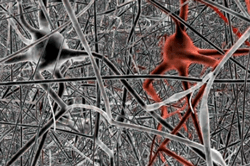
Kurzweil-headshotMuch of Kurzweil’s theory grows from his advanced understanding of pattern recognition, the ways we construct digital processing systems, and the (often similar) ways that the neocortex seems to work (nobody is certain how the brain works, but we are gaining a lot of understanding as result of various biological and neurological mapping projects). A common grid structure seems to be shared by the digital and human brains. A tremendous number of pathways turn or or off, at very fast speeds, in order to enable processing, or thought. There is tremendous redundancy, as evidenced by patients who, after brain damage, are able to relearn but who place the new thinking in different (non-damaged) parts of the neocortex.
Where does all of this fanciful thinking lead? Try this:

When we augment our own neocortex with a synthetic version, we won’t have to worry about how much additional neocortex can physically fit into our bodies and brains as most of it will be in the cloud, like most of the computing we use today.”

What’s more:

In order for a digital neocortex to learn a new skill, it will still require many iterations of education, just as a biological neocortex does today, but once a digital neocortex somewhere and at some time learns something, it can share that knowledge with every other digital neocortex without delay. We can each have our own neocortex extenders in the cloud, just as we have our own private stores of personal data today.”

So the obvious question is: how soon is this going to happen?

2023.

TED-neocortex

Skeptical? Click the image and watch the 2009 TED Talk by Henry Markham. It’s called “A Brain in a Supercomputer.”

In terms of our understanding, this video is already quite old. Kurzweil: “The spatial resolution of noninvasive scanning of the brain is improving at an exponential rate.” In other words, new forms of MRI and diffusion tractography (which traces the pathways of fiber bundles inside the brain) are among the many new tools that scientists are using to map the brain and to understand how it works. In isolation, that’s simply fascinating. Taken in combination with equally ambitious, long-term growth in computer processing and storage, our increasing nuanced understanding of brain science makes increasingly human-like computing processes more and more viable. Hence, Watson on Jeopardy! or if you prefer, Google’s driver-less cars that must navigate through so many real-time decisions and seem to be accomplishing these tasks with greater precision and safety than their human counterparts.

Is the mind a computer? This is an old argument, and although Kurzweil provides both the history and the science / psychology behind all sides of the argument, nobody is certain. The tricky question is defining consciousness, and, by extension, defining just what is meant by a human mind. After considering these questions through the Turing Test, ideas proposed by Roger Penrose (video below), faith and free will, and identity, Kurzweil returns to the more comfortable domain of logic and mathematics, filling the closing chapter with charts that promise the necessary growth in computing power to support a digital brain that will, during the first half of this century, redefine the ways we think (or, our digital accessory brains think) about learning, knowledge and understanding.

Closing out, some thoughts from Penrose, then Kurzweil, both on video:

Donna and The Herd

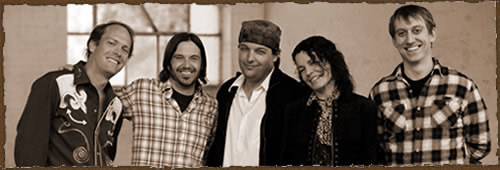
Donna the BuffaloWestern New York turns out to be one of those creative hotbeds that most people don’t know much about. Ever since 1874, summers at Chautauqua have been filled, for a fortunate 100,000 visitors, with recreation, arts, lectures, and spiritual fulfillment. Buffalo, Rochester and Ithaca have long supported outsized music scenes. And then, there’s Donna the Buffalo.

Donna is one of those bands I’ve heard from time to time, but never really discovered. They come from the Finger Lakes region, and they remain the creative core of the annual Finger Lakes Grassroots Festival of Music and Dance in tiny Trumansburg, New York (this year, the festival begins on Thursday, July 18, and I’m hoping to be a part of it). Donna the Buffalo has been playing and recording together for over twenty years. It’s not too late to join the party.

Truth be told, before I started writing this article, I had never completely listened to a Donna the Buffalo album. For the past month or two, I’ve been listening to a half dozen DTB CDs over and over again. They’re terrific. I really like this band. They’re authentic, deeply rooted, and seem to be having a whole lot of fun. They seem to get the commercial thing–this music is neither experimental nor challenging–but they’ve managed to keep their integrity, to stay just to the side of the commercial craziness of the music business.

Tara-NevinsOn every album, there’s a great feel for Americana, healthy doses of country and bluegrass, an old-timey sensibility when it feels right, pure form rock n’ roll, bits of soul and funk. It all comes together with a superior sense of how it all ought to be arranged and presented. What do I like about this music? I guess I like the sound of the two lead vocalists: Tara Nevins with her country style on some tunes, and Jeb Puryear with a folk / rock / rockabilly / country style on others, but that’s just the start. There’s Tara’s fiddle keeping time on “Tomorrow Never Knows,” and Jeb’s pedal steel on “Temporary Misery.” I like the way Kathy Ziegler sounds on backup vocals, a nice complement to Tara’s voice. I like the way the music dips into country music and rock, then goes funky.
The work is really tight–I love it when a band is really tight, really together, hitting every musical idea with perfect timing. Most, but not all, of the work is original, the vast majority written by the band’s lead singers, Nevins and Puryear. They tend to write catchy songs with memorable hooks, and after nearly 200 original compositions for this wonderful group, they know how to make it all work. They do touch base with respected influences: an especially handsome version of “Man of Constant Sorrow” pays homage to Ralph Stanley, for example.

Allow me recommend a few of the albums I’ve especially enjoyed.

PositiveFrictionSo far, I think my favorite is Positive Friction, released in 2000. This is album that I seem to play most often, probably because I enjoy Tara’s vocals, the chorus, and the arrangement, the catchy “No Place Like the Right Time” almost as much as I enjoy one of her other tunes, “Yonder.” The latter is both appealing as a catchy tune and as the kind of earnest social commentary that is so much of Donna the Buffalo’s creative approach. Nice lyrical treatment, too; here’s an example:

The waters led to the promised land

Seeds of  greed washed upon its shore

White footprints in the settling sand

Brought the ways of an ignorant man

Silverlined is a newer album, circa 2008, is a more mature work, more subtle, more varied in its instrumentation and soundscape. Puryear’s “Meant to Be,” for example, reminds me of Emmylou Harris’ work on Red Dirt Girl. “I Don’t Need a Riddle” combines Nevins’ more mature voice with a Cajun accordion and an interesting, vaguely funky rhythm track. The songs roll on, but they seem to be more contemporary, more artful, arranged less to please an audience ready to dance than a single listener enjoying a handsome combination of an interesting arrangement, a plaintive voice, and thoughtful lyrics; “Beauty Within” is a good example with Nevins on lead vocals.

DIGIPAK-4PANEL 1TRAY [Converted]A band that counts its time together in decades ought to encourage some solo work, and that’s precisely the approach here. Right now, I’m enjoying Wood and Stone, a 2011 solo album by Tara Nevins. Here, there’s a healthy amount of straight-ahead country (perhaps bluegrass / old-time / country is a more accurate description), as in “The Wrong Side” with some lovely instrumental breaks. Nice version of “Stars Fell on Alabama,” too. It’s all easy, natural, and a wonderful side journey just close enough to her work with Donna to keep fans happy (I’ll include myself here).

After I wrote all of this, I figured I would check on what others have written about Donna the Buffalo. On Amazon, Alanna Nash wrote this:

Donna the Buffalo–hard to categorize, but easy to love–are meant to be heard live. The six-member group thrives on jams and grooves, blending, bending, and veering from Appalachian country to Cajun, reggae, zydeco, folk, and roots rock often in the same song (check out the nearly 13-minute “Conscious Evolution”).

Intrigued, I kept reading:

Frequently compared to the Grateful Dead, DTB evoke Jerry Garcia and pals, both musically and with their rabid, nomadic fan base (the Herd). But in mixing tribal celebration with spiritual, social, and political issues, the band, which travels the country in a 1960 tour bus, recalls so many other hippie-era ensembles.

Not so sure I agree. DTB reminds me of at least a dozen other bands, but the Dead wouldn’t be high on that list. This doesn’t feel like a California band, not to me, anyway. Instead, I’m hearing a distinctly Appalachian vibe here, probably by way of Nashville, with a mix of lots of other styles I associate with Mississippi, Virginia, and other places on this side of the country.

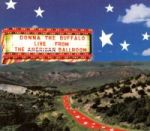
LiveFromTheAmericanBallroomThen again… there’s this live album from 2001, probably a better representation of the band than the individual CDs. It’s a compilation of tour recordings called Live from the American Ballroom. The sixties are alive and well on “Conscious Evolution,” a kind of tribal chant by way of rock n’ roll, world music, Cajun, funk, lots of styles bubbling up to the surface, then fading into the next musical idea. In fact, the whole album is filled with long songs and the kinds of improvisation that filled so many live albums in the 1970s. I think my favorite is “Standing Room Only,” kind of Cajun, kind of a chant, great dance song for a Saturday night.

Those days are gone (but available online and from any well-stocked vinyl-oriented record store), but Donna the Buffalo keeps on going. A few months ago, I wasn’t sure what these guys were all about. Now, I like them enough to recommend them to you. Who knows? Maybe we’ll all meet up in the Finger Lakes in July.

Enjoy.

P.S. Lots of Donna the Buffalo video on You Tube.

Big Ideas Simply Explained

Three subjects that I can never seem to understand as completely as I would like:

  • Philosophy
  • Economics
  • Psychology

Whenever I read a book about any of these subjects, I feel like a student, which means, I am reading because duty requires me to complete the book. The subjects interest me, but too many of the books I have read on these subjects are dreary, slow-moving, too dense with ideas for any reasonable person to sort out and retain their valuable understanding. Pictures help, but many of the ideas held within these disciplines are difficult to illustrate with anything better than wordy diagrams.

A year or so ago, I noticed a series of three books put together by Dorling Kindersley (DK)’s collaborative teams in the UK and India. They’ve got the formula right, and as a result, I have spent the last year happily browsing, and learning, from:

  • The Philosophy Book: Big Ideas Simply Explained
  • The Economics Book: Big Ideas Simply Explained
  • The Psychology Book: Big Ideas Simply Explained

A month or so ago, the same company released The Politics Book: Big Ideas Simply Explained, and at some point, I’ll get to that one, too. Right now, I’m still working my way through the first three volumes (about 1,000 pages total).

Three DK BooksSo what’s so special?

First,there is no single author. The collaborative approach focuses on presentation, clarity and consistency. This is less the work of a brilliant psychology teacher, more like a good old fashioned browse through, say, The World Book Encyclopedia from days of old. The type treatments are bold. There are pull-out quotes. There is color. No single idea runs more than a few pages. Everything is presented in a logical flow. There are boxes filled with biographical details. There is a clear statement of predecessor ideas and influences for each idea, and there is an equally clear statement about those in the future who built upon each idea. There are color pictures and diagrams. It’s tidy, presented for smart adult readers but certainly suitable research material for any school report.

The Philosophy Book is written by four academics and two writers: Will Buckingham is a philosopher and novelist with a special interest in the interplay between philosophy and narrative storytelling. Marcus Weeks is a writer, and author. Clive Hill is an academic focused on intellectualism in the modern world. Douglas Burnham is a philosophy professor and prolific writer on the subject. Peter J. King is a doctor of Philosophy who lectures at Pembroke College, University of Oxford. John Marenborn is a Fellow of Trinity College, Cambridge, UK, whose expertise is medieval philosophy. Taken as a group, they’ve got their philosophical bases covered (each of the books is put together by a team with similar skills). Marcus Weeks is the connection between all three books.

The bright yellow Philosophy book introduces the whole idea in comfortable language:

Philosophy is…a chance simply to wonder what life and the universe are all about…Philosophy is not so much about coming up with the answers to fundamental questions as it is about the process of trying to find out those answers, using reasoning rather than accepting…conventional views or conventional authority.”

So begins an introductory essay that introduces debate and dialogue, existence and knowledge, logic and language, morality, religion, and systems of thought and beliefs. A red color burst is the bridge into a timeline that begins the conversation in 624 B.C.E. And so, early on, we meet Pythagoras, who should be famous for more than his geometric theorem. In 428 B.C.E.–that’s about 2,500 years ago–Pythagorus developed a remarkable idea, that everything in the universe conforms to mathematical rules and ratios, and determined that this was true both of forms and ideas. Pythagorus was the leader of a religious cult, in which he was the Messiah, and his followers thought of his work as revelations. Here was a man for whom reasoning was the secret of the universe. He wrote, or said:

There is geometry in the humming of the strings, there is music in the spacing of the spheres.”

And:

Reason is immortal. All else is mortal.”

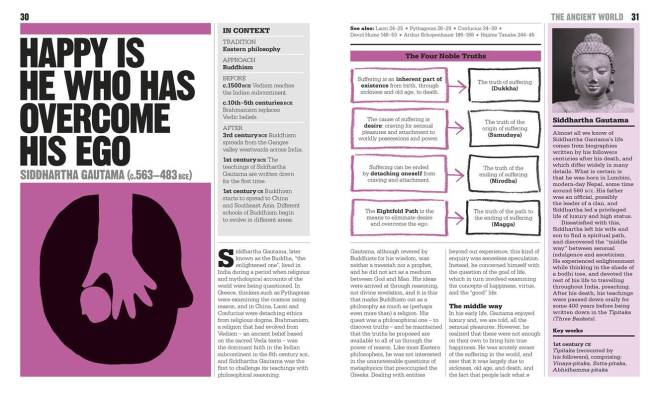
SiddharthaTurn the page and there’s Siddhartha Gautama and Buddhism’s four noble truths, explained in terms that anybody can understand, followed by the Eightfold Path presented in the Dharma Wheel. Siddhartha is covered in four good pages, and then, it’s time for Confucius and his Five Conscious Relationships.

All three of these men–Pythagorus, Siddhartha and Confucius–lived and worked around 500 B.C.E. More or less, they were contemporaries. A century later, philosophy turns to what is later called science, as Democritus and Leucippus come with the idea of atoms and the emptiness of space. (Seemed very early to me, too!) At about the same time, this from Socrates:

The life which is unexamined is not worth living.”

Jumping ahead to the middle of the book, Britain’s David Hume is considering human nature in the mid-1700s, and, in particular, the ways we cobble together facts:

In our reasonings concerning fact, there are all imaginable degrees of assurance. A wise man therefore proportions his beliefs to the evidence.”

Thinking in the present day, Palestinian philosopher Edward Said criticizes imperialism, Australian Peter Singer advocates for animal rights, and Bulgarian-born French philosopher Julia Kristeva questions the relationship between feminism and power. It’s a large field, and with The Philosophy Book, it’s possible for the average person to navigate with greater confidence than before.

The other two books are equally good.

The Economics Book begins with an article about Thomas Aquinas’s thoughts on prices, markets, and morality; the provision of public goods with thoughts by David Hume, whose words from the 1700s certainly resonate today:

Where the riches are engrossed by a few, these must contribute very largely to the supplying of the public necessities.”

Hume is among the few whose ideas appear in more than one of these volumes. And–I just noticed–The Philosophy Book tends to be stories about the people behind the ideas, The Economics Book tends more toward the ideas with less frequent stories about the people behind them (often because economic ideas are credited to multiple sources, I suppose). Making our way through The Age of Reason (“man is a cold, rational calculator;” “the invisible hand of the market brings order”);  on to economic bubbles (beginning with tulip mania in 1640); game theory and John (A Beautiful Mind) Nash; market uncertainty, Asian Tiger economies, the intersection of GDPs and women’s issues, inequality and economic growth, and more. Great book, but a bit slower going than Philosophy.

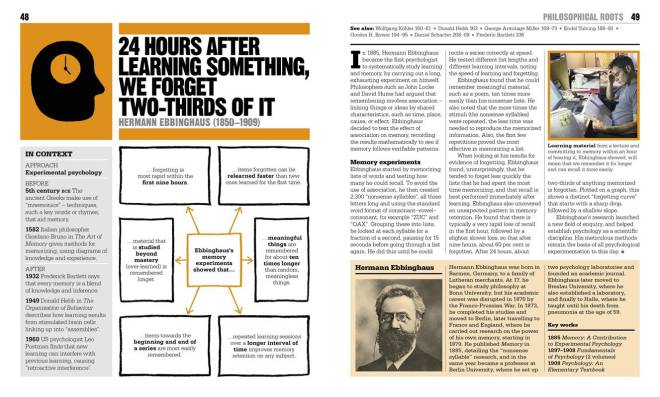
Psych Book SpreadThird in the trilogy is the bright red volume, The Psychology Book. As early as the year 190 in the current era, Galen of Pergamon (in today’s Turkey) is writing about the four temperaments of personality–melancholic, phlegmatic, choleric, and sanguine. Rene Descartes bridges all three topics–Philosophy, Economics and Psychology overlap with one another–with his thinking on the role of the body and the role of the mind as wholly separate entities. We know the name Binet (Alfred Binet) from the world of standardized testing, but the core of his thinking has nothing whatsoever to do with standardized thinking. Instead, he believed that intelligence and ability change over time. In his early testing, Binet intended to capture a helpful snapshot of one specific moment in a person’s development. And so the tour through human (and animal) behavior continues with Pavlov and his dogs, John B. Watson and his use of research to build the fundamentals of advertising, B.F. Skinner’s birds, Solomon Asch’s experiments to uncover the weirdness of social conformity, Stanley Milgram’s creepy experiments in which people inflict pain on others, Jean Piaget on child development, and work on autism by Simon Baron-Cohen (he’s Sacha Baron Cohen’s cousin).

When I was in high school and college,  I was exposed to all of this stuff, but only a small amount remained in my mind. Perhaps that was because I was also trying to read the complete works of Shakespeare, a book a week of modern utopian fiction, The Canterbury Tales, and studying geology at the same time. In high school and college, these topics were just more stuff to plough through. No context, no life experience, no connection to most of the material. Now, as an adult, it’s different. Like everyone I know, and everyone you know, I’m still juggling way too much in an average week, but I can now read this material with a real hope of understanding and retaining the material. Cover to cover, times three, these books will take you a year or two, but… without a test the next morning, you’ll be surprised how interesting philosophy, psychology and economics turn out to be. Just read them in your spare time, and behold (great word, “behold”) the ways in which humans have put it all together over several millennia. It’s a terrific story!