The Art of Inge

Below, a picture of Inge Druckery with her reducing glass. Why a reducing glass, and not, say, a traditional magnifying glass? Because a reducing glass allows the user to step away from the visual work. By stepping away, the artist/designer can see the whole, and the relationship between the many pieces of a visual presentation.
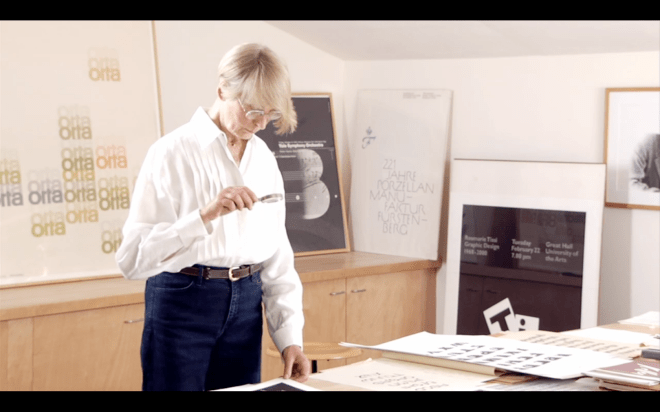
Inge 1Inge Druckery is one of the world’s truly great teachers of type design, and, more generally, she has provided designers of all kinds with tremendous inspiration, especially in the combinations of typography and graphic design that so dominate our world, our screens, our print materials.

And now, Edward Tufte (one of her students) has executive produced a 37-minute film, available free, about Druckery’s life and work. The images are striking in their simple elegance, and there are plenty of them. You can watch the film by visiting Mr. Tufte’s site, or simply clicking on the video at the top of this article. This is a film to watch full-screen, in a quiet room free from distracting glare, without interruption, with a patience and a keen eye. Do so, and you will be rewarded with an experience very much akin to attending an extremely well-crafted art museum exhibition on an extremely interesting topic. Do not hurry. Do this when your time permits. The images and ideas will stay with your afterwards.

What sorts of things are presented? The extremely precise Roman alphabet, the letterforms that are so solidly architectural in their L, E, T, and V forms, and so much in motion in the S, so beautifully balanced as curves meet straight edges in the B and, especially, the tricky R form. Simple explanation, elegant presentation.

Fascinating.

Here’s a progression of the letter R, rendered by hand with a proper broad lettering brush, with each letterform progressing toward an ideal. Here, the most basic of old analog form presages a perfection now commonplace in digital typography. Commonplace, but not common. And in the common hand, perhaps there is greater perfection, more of the Lord’s hand and the human progress toward excellence, than digital allows.


R Progression

Unreasonable

As the year winds down, a call-out to some unreasonable people.

One is called The Unreasonable Institute.

Why We Exist: To create a world in which no one is limited by their circumstances.
Our Mission: To unlock entrepreneurial potential to overcome our world’s greatest challenges.

Three recent college graduates decided to take on the world’s biggest problems–no shortage of idealism here–by causing interactions between promising entrepreneurs with big ideas, mentors, and funders. They do all of this–quite reasonably, I might add–by having everybody work and live together in a big house for several weeks. I’m not sure that “institute” (their term) is the ideal description, but this combination networking fest and dorm experience makes a lot of sense. There are lots of informal interactions between smart, interested, connected people who want to make things happen. I love this idea, and I suspect you will, too.

The second is called Charity: Water.

charity: water is a non-profit organization bringing clean and safe drinking water to people in developing nations.

Two simple ideas here. One is clean water for everyone, everywhere in the world. That’s a tremendous challenge, one that can be solved only on a local level, well-by-well, source-by-source. It’s also a transformative idea: clean water means healthier people, far less time each day caring for the ill; empowerment of women (who, in many places in the world, expend an enormous amount of time at the well or other source, and carrying water home).

20121227-172439.jpg

To play the video, please click on the image.

Both are mentioned here are examples of a new way of thinking about the world’s problems: a small entrepreneurial group with big ideas, unique approaches to management, operations and funding, plenty of attention to details, and, far less reliance upon large organizations to provide solutions. And one more thing: the internet is central to the success of these new conceptions. Be sure to explore Charity: Water’s use of internet mapping for every project, a solid example of things to come.

BTW: while searching for a link, I ran into a Huffington Post story that explains the trend in more detail. It’s definitely worth reading, especially at a time of year when we’re all trying to figure out how to do it even better next week.

Infographic: Public vs. Private Education

A bit of my own daydreaming, poking around on a site that I had already written about, I discovered this tidy infographic. It’s worth a good, long look. And then, some time to ponder.

standard-teacher-730x1825

The Virtues of Daydreaming

From the author of a very good article (see below) about challenging our assumptions about learning:

Among its many benefits, daydreaming has been associated with longer attention span, increased resolve, creativity and even higher IQ.

To which I am tempted to add:

If a creative person does not spend at least a half hour a day, half paying attention to the world, lost in thoughts about what might be, how it might be done, and how everything could change, he or she is not doing what needs to be done. Drifting off, checking out from the “normal,” simply shutting out the real world for a bit… if you don’t do that, how in the world will you accomplish anything useful at all.

Daydream

Now, consider these assumptions:

  1. Playing scary and violent video games help children master their fears in real life
  2. Practical classroom science lab work provides children little learning
  3. Gardening improves children’s desire to learn and boosts their confidence
  4. Teaching kids at a very early age is counterproductive to their learning
  5. Green spaces elevate children’s learning through discovery
  6. Learning is affected by classroom acoustics, artificial learning, and windows
  7. Young children learn about prejudice by instruction, older children by experience
  8. Laughing results in increased memory retention

Now, read the article from InfomED: An online commentary for the education industry.  And allow yourself a good half hour to further explore other terrific articles including “Can We Teach Compassion?” (an infographic); “Facilitating Collaborative Learning: 20 Things You Need to Know from the Pros” and “The Tyranny of Homework…”

It’s a Clean Machine

Spending too much time in the dusty bins of used record stores, I often buy “perfectly good” LPs for less than $5. It’s a bargain: terrific old Leonard Bernstein (or, if you prefer, Jethro Tull or Blondie) recordings for far less than their CD equivalents would cost, and far more fun than their digital file equivalents.

The Spin-Clean is a cost-effective ($79) way to bathe a vinyl record.

The Spin-Clean is a cost-effective ($79) way to bathe a vinyl record. Click on the picture for more infromation.

But old records are often dirty. And they’re not always easy to wash. For one thing, you don’t want to wet the paper labels (one on each side), so submersion is out of the question. This leaves the listener in the decidedly odd position of either dipping the vertical LP and spinning it in a trough, or wiping it ’round, which is both awkward and potentially damaging.

So what’s a listener to do?

Buy a cleaning machine.

There are several kinds. One involves a bin, and looks kinda awkward. Most people use a rectangular box with a vacuum cleaner inside (seriously!). In this category, the long-time industry leader is a company that I recall from decades ago: Nitty Gritty.

Nitty Gritty 1

The Nitty Gritty 1.0 is the lowest priced product in the company’s line. It contains a vacuum cleaner.

You’re looking at the least expensive Nitty Gritty machine, the Model 1.0. A quick tour helps to explain what this cleaning machine does, and suggests the options available on the more expensive models.

On the left, the low cylinder is, in fact, the top half of a sandwich. Lift the wooden part and you’ll find that it’s the top pad, and that the bottom pad is on the machine. Place the vinyl record in-between, and the pads cover the top and bottom labels. The rest of the record is exposed. And that takes us to the slot in the middle of the machine. It’s covered in velvet, because this is the place where the vinyl is exposed to a powerful vacuum cleaner that sits just below the slot. With this model, you hand-turn the LP by finger-control (there’s a slight indent in the top pad, just about visible in the photo). The remaining items are a wet solution (see below) and a small brush. And, over on the far right, there’s an on-off switch. For more on how it works, click here.

Does it work? Yes, the system works really well. A record that’s dusty will be cleaned, and much of the surface noise will disappear. Results are much improved with the application of the Pure 2 solution; 16 ounces will keep most listeners going for a year or two.

The Nitty Gritty products are well-made, and so, they’re not inexpensive. Budget $500 plus shipping and you’ll be fine with an oak-grained model or something equally attractive. For twice the price, the record turns automatically and the fluid is dispensed by the machine, not by hand. The product line is explained on Nitty Gritty’s website.

Is it worth the money? I guess that question can only be answered “yes” by someone who (a) frequently listens to vinyl; (b) believes that a $500 turntable is in the inexpensive / affordable range, and (c) has invested in a full-scale, grown-up stereo system. If you’re among those people, this would seem to be an essential accessory in an analog world, one that’s often overlooked, in part, because few people seem to know that such a contraption exists. It does, and for serious listeners, it’s a good investment.

For even more information, watch this video from someone who cares deeply, and knows a lot, about keeping records clean.

Eating One’s Way Through the British Isles

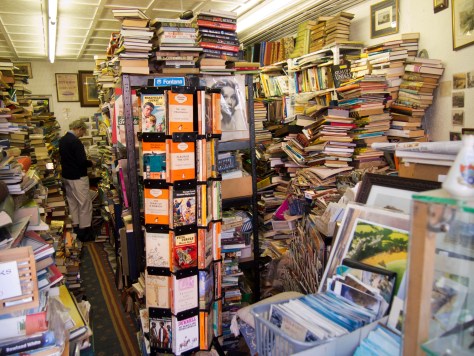
When I turned to page one, I knew I was reading the right book. There’s a half page photo of Plantaneget, a terrific seafood restaurant that hugs the hillside in the old Welsh fishing town of Tenby–the one with my very favorite cluttered bookstore just across the way. How can you not love a bookstore that looks like this one?

Bookstore in Tenby

I digress.

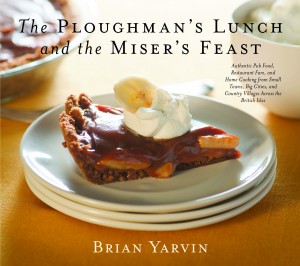
PloughmansLunchCover9781558324138-300x266But I do love wandering around the UK. And when I’m not wandering, on say, a cold winter’s day here in the US, it’s fun to find a book that causes me to think about my next trip. This morning, I enjoyed a wonderful book about British, Welsh, Irish and Scottish food entitled The Ploughman’s Lunch and the Miser’s Feast. It comes with the inconveniently long subtitle, Authentic Pub Food, Restaurant Fare, and Home Cooking from Small Towns, Big Cities and Country Villages Across the British Isles. The title accurately describes the book’s contents, but fails to mention that there are lavish (and luscious) photographs, and lots of recipes, too.

Of course, the names are fun. Let’s begin with breakfast. Scotch Woodcock contains no game; it’s a seasoned approach to scrambled eggs. Jugged Kippers is a herring dish, popular in the north, full of sea-driven flavor, strong for breakfast in a place where the extra nutritional kick in the morning is a good thing.

There’s tea throughout the day, and a nice article about why and how it has become so important to the day.

And there’s a thorough explanation of the ploughman’s lunch, perfectly served with artisanal cheddar cheese, a good thick slice of rare roast beef (often, from last night’s dinner), mixed greens, chutney, and a mini-baguette. Pickled onions are nice, too.

I never acquired a taste for the go-anywhere, anytime Scotch Eggs, a hard-boiled egg coated in sausage and crumbs, and often, carried for lunch away from home.

Author Brian Yarvin and I share something in common: we will travel for food. He, to Stoke-on-Trent in the county of Staffordshire for freshly made oatcakes. These are made on the grill, often purchased by the dozen for use at home, or enjoyed one-at-a-time, filled with, say, cheese and mushroom (Yarvin’s favorite). There’s a distinctly local specialty, but you’ll find various small “cakes” throughout the islands.

Scottish Oatcakes from Brian's  book, "The Ploughman's Lunch and the Miser's Feast"  (Use allowed for book promotions and reviews only.)Author Brian Yarvin is also a superior food photographer. Here's a look at a Curried Mutton Turnover. There's lots more to see--mostly Asian--by clicking on the image.

Scottish Oatcakes from Brian’s book, “The Ploughman’s Lunch and the Miser’s Feast” (Use allowed for book promotions and reviews only.)
Author Brian Yarvin is also a superior food photographer. Here’s a look at a Curried Mutton Turnover. There’s lots more to see–mostly Asian–by clicking on the image.

Cock-a-leekie is another of those wonderful Scottish names, this time assigned to a soup that contains, rather obviously, chicken and leek, and not very obviously, prune, too. The prune recalls a history when dried fruits were quite the delicacy, exotic and expressive of a higher station. Cullen Skink is another great name: it’s potato soup with smoked haddock… spectacular!

Beef Wellington suggests a dish that we made up here, like Chow Mein, but it is, in fact, quite British, and every bit as delicious as it was two decades ago (the last time I had one). Basically, it’s a good piece of beef wrapped in mushrooms and then in puff pastry. Old-school, but terrific.

There’s a nice bit about how to choose the best of fish-n-chips shops, or, in the local lingo, a chip shop. If you see a sign for “fish tea,” that’s a good thing–the term resonates with the locals (who, presumably, know both their fish and their tea). If the menu lists only fish, chips, peas, and tea, that’s a good, thing, too–it suggests focus. It’s not good if the same place lists burgers or kabobs. Anything suggesting “Best in Britain” without appropriate documentation posted in the window. Nix on pre-fried fish in the window, and pre-battered fish, too. Extra points for using local fish (nothing in Britain is very far from the sea).

Also, a useful note regarding bacon. What we call bacon, they call streaked bacon. What they call bacon is a boneless pork chop, sliced thin and fried.

What’s a faggot? It’s a meatball, heavy on the liver. Just so you know. One the next page: Lamb’s Tongue (with Raisin Sauce).

Brian Yarvin

Mr. Yarvin

What’s the most popular food in Britain? Probably Chicken Korma, the lead player in an extensive Indian cuisine that’s found just about everywhere. Nice coverage of various Indian dishes here, resplendent in their bright colours.

When in Britian, I like my pies. Set me in front of a menu with, say, Chicken, Ham and Mushroom Pie, and a local ale, and I’m a happy traveler. Leek Pie, Shepherd’s Pie, Fish Pie with Mashed Potato Crust, all good with me. Not so much for the Steak and Kidney Pie, which is made not with Kidney Beans, but instead, with the kidney of a lamb (tubes removed). No thank you. Yes to Cornish Pasties, essentially a local take on an empañada. And a definite yes to Yorkshire Pudding, which is a pudding in the British sense, which means, well, I’m not sure how the British use the term because it seems to apply to most desserts, of which Yorkshire is not one.

The term Flapjacks was a surprise to me; I picked up a pair at a train station for a quick snack. Turns out, they’re similar to granola bars.

At a tea shop in Cardiff, I tried my first (and probably, my freshest) Clotted Cream. It sounds a bit unappealing, but it is, in fact, it’s a bit sweet, a bit thick, and a perfect accompaniment to, say, a scone.

Other terms I learned… Perry is a pear cider (excellent at the small stand in the local market just next to the West Canterbury train station)… Fairy Cake is, more or less, our cupcake… Bap is something like a cross between a hamburger roll and sandwich roll… and Chocolate Vermicelli is our Chocolate Sprinkles.

What fun! Get the book. Then, go!

Amazon: The Sitcom(s)

Amazon PrimeWhat’s the difference between a bookstore and TV channel? Sounds like a riddle for a time traveler. Little more than a decade ago, Amazon started to pulverize the book business. Now, just about anybody with a computer or a mobile device (that would be, just about everybody) thinks about Amazon as the first stop for books. And music. And just about every other common retail item.

And now, Amazon is beginning its assault on (not sure whether to call it television, but let’s go with television for now). Here come the first six sitcoms from Amazon Studios, all intended to be shown, free, to Amazon Prime members (who get free shipping and other benefits from Amazon). These programs will be part of a rapidly growing (and pretty darned good) collection of available programming already in place. For example, Amazon Prime viewers can watch EVERY episode of Twilight Zone, Arrested Development, and other interesting TV series from the past, as well as a bunch of good moves (last night, we watched Good Night, And Good Luck). As Amazon Prime members, we keep forgetting that we pay Netflix money, too.

So, what are the series? List below. Most of them appear to be promising: the creative teams are experienced, and the concepts are less lowest-common-denominator than we usually see on TV. One new concept from Garry Trudeau that sounds promising. And I sure hope that The Onion does a better job with television this time around (past attempt: not so good).

The complete list comes from the story in Tech Crunch.

Alpha House – Alpha House was written by Academy Award nominee and Pulitzer-Prize winner Garry Trudeau (Doonesbury, Tanner ’88). Alpha House follows four senators who live together in a rented house in Washington DC.

Browsers – Written by 12-time Emmy-winning comedy writer David Javerbaum (The Daily Show) and to be directed by Don Scardino (30 Rock), Browsers is a musical comedy set in contemporary Manhattan that follows four young people as they start their first jobs at a news website.

Dark Minions – Written by Big Bang Theory co-stars Kevin Sussman and John Ross Bowie, Dark Minions is an animated workplace series about two slackers just trying to make a paycheck working an intergalactic warship. The pilot will be produced by Principato-Young (Reno 911).

The Onion Presents: The News – The Onion Presents: The News is a smart, fast-paced scripted comedy set behind the scenes of The Onion News Network that shows just how far journalists will go to stay at the top of their game. The Onion Presents: The News is from The Onion’s Will Graham & Dan Mirk (The Onion News Network, The Onion Sportsdome).

Supanatural – Supanatural is an animated comedy series about two outspoken divas who are humanity’s last line of defense against the supernatural, when they’re not working at the mall. The series, written by Lily Sparks, Price Peterson and Ryan Sandoval, will be produced by Jason Micallef (Butter) and Kristen Schaal (The Daily Show).

Those Who Can’t – Written by Andrew Orvedahl, Adam Cayton-Holland and Benjamin Roy (Grawlix), who were discovered through Amazon Studios online open door process, Those Who Can’t is a comedy about three juvenile, misfit teachers who are just as immature, if not more so, than the students they teach.

Just in case you missed it, this blog presents a useful introduction to one of the best TV series of all time.

Just in case you missed it, this blog presents a useful introduction to one of the best TV series of all time. To visit the blog, click on the image.

All I Want for Christmas (Next Year) is My Apple TV

I want what you want: a new TV with the smart design and feature set that ties into the rest of my Apple gear. I want to be able to use Mail and Safari, Pages and Keynote, YouTube and Dropbox, and I want it all on a 45-inch screen that I can operate with an iPhone or iPad. I want to use my Apple TV for FaceTime with friends and family–a telephone that is also my TV screen. I want apps that work across TV, phone and tablet platforms, and more apps designed for the TV. I want a lot of stuff… but I haven’t thought about this nearly as much, or in as much detail, as Jeremy Allaire, the CEO of BrightCove, a forward-thinking cloud-based software provider. Below, a sample screen from a wonderful guest article on All Things Digital by Allaire, followed by the link to his article. Have fun!

8a-apple.com-tech-specsHave a look at the article “All I Want for Christmas is My Apple TV” here.

Playing, Studying and Designing Games

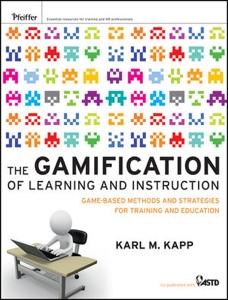
20121209-124333.jpgI’ve been searching for a book like this one for a while. A comprehensive overview of game play, academic research, application of games in all sorts of learning situations, lots of ideas and examples written in a fast-paced format filled with examples, illustrations and recommendations for further investigation. Give Bloomsburg University professor Karl M. Kapp the full one- thousand points for a terrific, accessible, smart book, but deduct a few points from the publisher’s total because the appealing title, The Gamification of Learning and Instruction isn’t really what this book is about…mostly, Kapp is writing about game design and not gamification.

What’s the difference? Well, that’s precisely the kind of issue that the professor addresses. Turns out, the distinction matters.

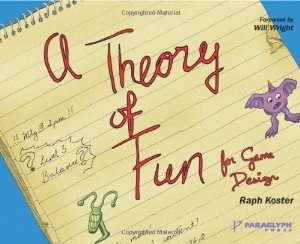
I like this definition of a game, provided by Raph Koster in a Theory of Fun and quoted by Kapp;

20121209-152224.jpg

a game is a system in which players engage in an abstract challenge, defined by rules, that results in a quantifiable outcome often soliciting an emotional reaction.

Kapp attempts to define gamification as:

…using game-based mechanics, aesthetics, and game thinking to engage people, motivate action, promote learning, and solve problems.

In short, gamification seems to be game design with a pro-social purpose.

Certainly, the book is filled with examples of purpose-built games for use in elementary school classrooms, training for firefighters, process improvement instruction, road safety, medical operations, and so on.

Most of the book is about game design, and associated psychology. Some examples:

When designing to teach high-level skills and high-order thinking, as applied to teaching leadership talent, it’s important to focus on ultra-quick decision making, the split-second shifts that a leader must make when considering and sometimes over-riding consensus, the encouragement of risk-taking for greater success, and thinking about leadership not as a role but as a task that can be passed among team members as the situation requires. The overarching idea here is “game thinking” – shorthand for an immersive environment in which real-life is reshaped to emphasize specific issues and de-emphasize others.

20121209-152426.jpg

I appreciated Kapp’s recap of Man, Play, and Games by the French philosopher, Roger Caillois. It was Caillois who identified for types of games: Agôn (competition), Alea (chance), Mimicary (simulation, role play) and Ilinx (state of dizziness and disorder). The last of these, Ilinx, is “the pursuit of vertigo, and trying to destroy the stability of perception”–children spinning around, and mountain climbing are examples.

There is a rundown on studies by serious researchers that suggest a string connection between games and learning, most with small sample sizes and narrow perspectives. To a greater extent than we may wish to admit, the connections between games, intent and measurement are young. We’re all learning what all of this means, and, in a world where digital engagement can be so closely aligned with learning, what it’s all going to mean as schools, K-12 education, and adult learning take their rightful place in the 21st century.

Welcome to Silicon Alley (Hollywood 3.0)


Aerial_Hollywood_SignThe next big thing has already begun… on Silicon Beach. If the term is unfamiliar, think in terms of a third generation’s reinvention of Hollywood (with a far larger SoCal geographic area)–first came movies, then TV, now Internet. This fast-growing community makes use of the (hungry) local creative community, welcomes investment from 20th century moguls, and offers instruction and consulting to old school Hollywood studios.

Read all about in this article, published in Variety just before Thanksgiving.