Moyers to Public TV: Reinvent Yourself!

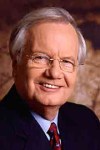
These are some of my favorite excerpts from an inspiring speech by one of public television’s long-term heroes, Bill Moyers. He delivered the speech in November, 2010 at a gathering of public television programming executives…
“The core problem is that we still don’t have an expansive national vision of what we’re about, where we want to go and what we want to become. Until we are able to say clearly and comprehensively what it is we really want to do, how much it will cost, and how we intend to get there, we can’t blame Congress, the White House or even the foundations for not supporting us more fully.

…There’s a huge vacuum between the [public television] system, nationally and locally, and the big foundations and no one has yet been inspired or capable enough to link the two at the level of a consensus national plan.

There are always people who remain afraid of change or an unknown process, fearful of where it might lead.  But by contrast, the British and Canadians go through periodic charter reviews that invoke a national conversation; there’s a culture of discussion and planning for public media in those nations that help them survive even the worst assaults from detractors or vested interests. This could be a reason that public support for public media in nations like the U.K. exceeds $80 per capita, while we’re still limping along on $1.49 per capita.

…In the meantime, I’m here to tell you that even within the fiscal crisis public television currently faces, we have an opportunity to serve the public — to renew our bond to our communities.

You may not have money for in-depth documentaries or other high-end productions but you have cameras, microphones, studios and the trust of the community. You can be the ombudsman for the public within your reach, provide the venue for forums, teach-ins, town meetings, and debates over the issues that matter to people where they live, telecast in an atmosphere of openness and clarity without the mean and mindless rhetoric or cant that are so triumphant today. Civic engagement is the lifeblood of democracy and the bedrock of its legitimacy. No media can nurture, foster, and empower it the way we can.

…Meanwhile, let me offer just a few other ideas for you to consider:  Take a whole evening of primetime and give it to a forum for the fight in your neighborhoods over charter schools. Do the same for other distressed public institutions — your libraries, for example.

Or how about one week inviting as many social workers as you can get into your studio and asking them to share what they see every day — how people are coping each day with these worst hard times?  Do a series of workshops on Occupy Wall Street, pro and con.  Out there in Iowa, find the lady carrying the placard I saw last weekend on television that read: “I couldn’t afford to buy a politician so I bought this sign.” Bring her into the studio with her local member of Congress — have them talk frankly to each other about their different perceptions of money in politics. Do an evening of primetime on the fight going on right now in your state over redistricting — gerrymandering — the outcome will influence your state’s position and power for the next 10 years. Get folks aware and involved. If you don’t, who will? Certainly not the commercial stations in your market, that’s for sure.

…since David H. Koch of Koch Industries is on the board of both WGBH and WNET, I’d ask him to round up his billionaire buddies — and in a nonpartisan spirit reach out to civic-minded progressive billionaires like George Soros — and together create an independent, fully endowed, self-governing production center (free of any partisan strings or influence) for American drama that would bring our epic history and culture to the screen just like we’ve brought over the Brits’ Downton Abbey, make room for Jefferson’s Monticello! Now, there’s an Upstairs Downstairs story the public would make a pledge to see.

…What we need is a makeover of our own — a rebirth, yes, of vision, imagination, and creativity, but above all a structure and scheme for the 2lst century, one that uses the resources that the digital platform provides to realize the goals of our founders: diversity, public access, civic discourse, experimentation, a welcoming place for independent spirits.

The whole speech–including his idea for public television’s equivalent of a constitutional convention– can be found here:
http://www.current.org/pb/pb1122moyers-remarks.html

Fellini on the bed

The room is almost completely dark. There is a single light source on this night of the October power outtage. It is Fellini’s 8 1/2 on an iPad screen. The images are sharp, contrasty, perfectly photographed in wonderful black-and-white. And, it sounds pretty good, too.

I love my iPad, but the sound is just awful. A dozen manufacturers now sell portable Bluetooth speakers. Some of these speakers are reasonably priced and sound good, too–but most are either over $100 or not worth the cost because they lack clarity, bass, punch, whatever. Forget about the Bluetooth part–it doesn’t work properly, it’s a technology that is far inferior to something much simpler: a $10 cable with one end that plugs into the speakers and the other end into the iPad. That combination is reliable enough to watch Fellini’s 8 1/2 with no interruption, and no Rice Krispies crinkling that is common among Bluetooth devices of all sorts, my little phone earpiece among them.

I’d love to tell you that I have secret source for the best sound at the best price. In fact, I found my speaker by making a friend of a salesperson at a local Best Buy store. As some of the salespeople are wont to do–provided there is no manager nearby–my guy opened several packages and allowed me to listen to several devices.

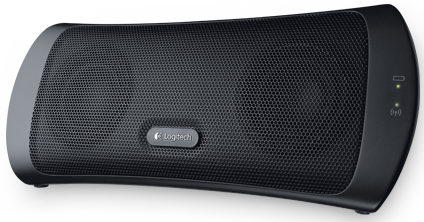
My favorite–still a favorite several months later, in fact–was the Logitech Wireless USB Speaker, which I use as neither a wireless device nor a USB device.  It costs about $70, and comes with a carrying case. I leave it in my car’s trunk so that anywhere I go, it’s available. I’ve used it to entertain a group of people watching video from a computer screen (the computer’s speakers were crappy), and another group of people attempting to watch a projected image during an office presentation (the projector’s speakers were inadequate). During the summer, when I write on my porch on warm days, the speaker provides the background music. And on a dark and stormy night, it provides a clear, crisp, well-articulated soundtrack with a reasonable amount of bass.

I was less enthusiastic about the more expensive Jawbone Jambox, which costs twice as much and tends toward the boomy approach to bass. When I was shopping earlier this summer, there were few choices. Now, there are more. But I think I’ve found a good one, and I recommend it wholeheartedly.

Google’s Eric Schmidt’s McTaggart Lecture

http://www.guardian.co.uk/media/interactive/2011/aug/26/eric-schmidt-mactaggart-lecture?INTCMP=ILCNETTXT3487

That’s the link to an extraordinary speech by Google executive Eric Schmidt. He paints a clear picture of Google’s convergence plans for/with television.

And/or read the speech’s text here: http://www.guardian.co.uk/media/interactive/2011/aug/26/eric-schmidt-mactaggart-lecture-full-text

Paco de Lucia – One Summer Night…

Paco de Lucia was born Francisco Sánchez Gómez in 1947 in Algeciras, a southern port city in Spain. He learned the guitar from his father, his brother, and family friend Niño de Ricardo, a virtuoso. By age 7, de Lucia was playing flamenco guitar; by 12, he was recording. Before his teen years, he had won several guitar competitions. By 13, de Lucia was touring internationally with José Greco’s flamenco show. He started composing and playing backup for various Spanish singers, notably the great Gypsy singer (or cantador) Camarón de la Isla, with whom de Lucia worked from the late 1960s until the early 1990s. In addition to leading his own group, de Lucia has collaborated on projects with John McLaughlin, Chick Corea, Al di Meola, and even Placido Domingo. De Lucia is widely regarded as the finest living flamenco guitarist—and one of several musicians who has modernized the classic Spanish form.

Here’s the thrilling, no-holds-barred, blazing-guitar, high-energy concert recording that caused many rock fans to pay attention to a flamenco guitar player. Recorded by de Lucía’s Sextet in 1983, it’s terrific ensemble work with de Algeciras, a flutist named Jorge Pardo, and an equally facile percussionist, Rubem Dantas. John McLaughlin composed a pretty intro to “Alta Mar,” and “Chiquito” is dedicated to Chick Corea; listen for strong 1980s jazz/fusion influences in de Lucía’s interplay with electric bassist Carlos Benavent, and the flute and guitar arrangement that begins “Gitanos Andaluces.” But it all comes back to de Lucía’s straight flamenco.

http://www.amazon.com/Live-Summer-Night-Paco-Lucia/dp/B0000046UR

Maria Bethânia – As Cancões Que Você Fez Pra Mim

Maria Bethânia is the sister of top Brazilian singer-songwriter Caetano Veloso. Born in 1946 in the interior region of Bahia, Brazil’s northeastern state, she’d planned to become an actress. In 1963, Bethânia and her brother moved to the nearby state capital city of Salvador, where she impressed audiences singing in a musical (written by her brother). Bethânia has been a professional singer ever since. While in Salvador, she and her brother became friendly with Gilberto Gil and Gal Costa, and the four led a significant cultural movement called Tropicálismo that changed Brazilian music and art. It was so radical that Veloso and Gil were exiled, but Bethânia and Costa kept the movement alive in Brazil. Bethânia is a dramatic singer whose versatility is matched by her desire to experiment with a wide variety of songs and genres, and a willingness to introduce works by up-and-coming songwriters.

This 1993 album was recorded twice. One version was recorded with Portugese lyrics (as above). The other, called Las Canciones Que Hiciste Para Mi (Philips 518-787), is in Spanish. Both are majestic. Each is a collection of 11 songs written by Roberto and Erasmo Carlos and sung with a small combo backed by an enormous string section (magnificently arranged by Graham Preskett). Bethânia’s powerful, dramatic interpretations are affecting on both the Portuguese and Spanish versions, but her passion breathes life into the Portuguese versions of “Fera Ferida,” “Palavras,” and “Eu Preciso de Você.” Analog recording, but sounds better than most digital discs.

Philips 518-214

Available only as an import, but worth the price: http://www.amazon.com/Cancoes-Que-Voce-Fez-Pra/dp/B0000015TF

Power of the Press

http://www.huffingtonpost.com/2011/09/11/911-september-11-newspapers_n_957297.html

Admittedly, I am writing and you are reading on a device that is rapidly destroying print media.

Still, it’s worth the time to browse the ways that today’s remembrance was visually presented on newspaper front pages in US cities and throughout the world. There are so many lessons here: about journalistic priorities, visual communication, heart and soul, and more.

No other medium can do this.

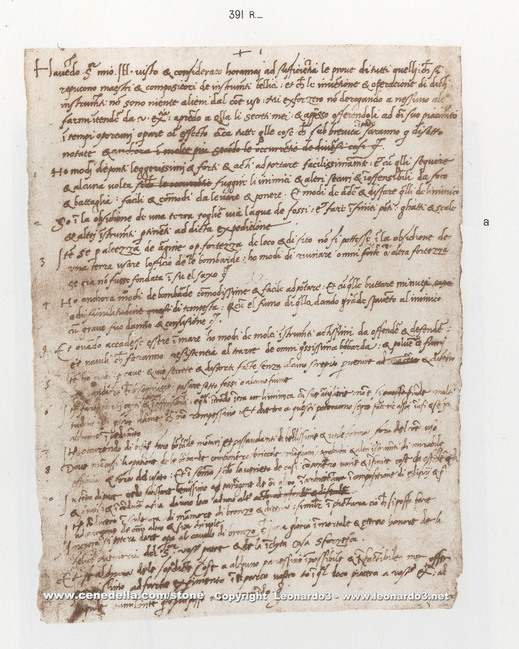
Resume: DaVinci (no kidding!)

The iconic creative professional and proto-technologist looking for work. Comes complete with English translation and modern commentary:

From The Ladders.com, “the translation of this letter is quite remarkable:

“Most Illustrious Lord, Having now sufficiently considered the specimens of all those who proclaim themselves skilled contrivers of instruments of war, and that the invention and operation of the said instruments are nothing different from those in common use: I shall endeavor, without prejudice to any one else, to explain myself to your Excellency, showing your Lordship my secret, and then offering them to your best pleasure and approbation to work with effect at opportune moments on all those things which, in part, shall be briefly noted below.

1. I have a sort of extremely light and strong bridges, adapted to be most easily carried, and with them you may pursue, and at any time flee from the enemy; and others, secure and indestructible by fire and battle, easy and convenient to lift and place. Also methods of burning and destroying those of the enemy.

2. I know how, when a place is besieged, to take the water out of the trenches, and make endless variety of bridges, and covered ways and ladders, and other machines pertaining to such expeditions.

3. If, by reason of the height of the banks, or the strength of the place and its position, it is impossible, when besieging a place, to avail oneself of the plan of bombardment, I have methods for destroying every rock or other fortress, even if it were founded on a rock, etc.

4. Again, I have kinds of mortars; most convenient and easy to carry; and with these I can fling small stones almost resembling a storm; and with the smoke of these cause great terror to the enemy, to his great detriment and confusion.

5. And if the fight should be at sea I have kinds of many machines most efficient for offense and defense; and vessels which will resist the attack of the largest guns and powder and fumes.

6. I have means by secret and tortuous mines and ways, made without noise, to reach a designated spot, even if it were needed to pass under a trench or a river.

7. I will make covered chariots, safe and unattackable, which, entering among the enemy with their artillery, there is no body of men so great but they would break them. And behind these, infantry could follow quite unhurt and without any hindrance.

8. In case of need I will make big guns, mortars, and light ordnance of fine and useful forms, out of the common type.

9. Where the operation of bombardment might fail, I would contrive catapults, mangonels, trabocchi, and other machines of marvellous efficacy and not in common use. And in short, according to the variety of cases, I can contrive various and endless means of offense and defense.

10. In times of peace I believe I can give perfect satisfaction and to the equal of any other in architecture and the composition of buildings public and private; and in guiding water from one place to another.

11. I can carry out sculpture in marble, bronze, or clay, and also I can do in painting whatever may be done, as well as any other, be he who he may.

Again, the bronze horse may be taken in hand, which is to be to the immortal glory and eternal honor of the prince your father of happy memory, and of the illustrious house of Sforza.

And if any of the above-named things seem to anyone to be impossible or not feasible, I am most ready to make the experiment in your park, or in whatever place may please your Excellency – to whom I comment myself with the utmost humility, etc.”

Maine School District to Buy Kindergarteners iPads

Here it comes. The first kindergarten class gets iPads. Watch how quickly the others come online–and how quickly school gets the same treatment as, say, photographic film or CDs or any of the other stuff that’s been digitized. Story in video form below, or, if you prefer, actual words written on the screen by PCMag.

http://www.pcmag.com/article2/0,2817,2383362,00.asp

The next small thing: mobile TV

A very simple idea: add a tuner and a TV antenna to your portable device, and you can watch TV anytime, anywhere. No Internet, no cell phone service needed. However–your local TV broadcast television station must package mobile digital television (mDTV) channels. There will be dozens these channels–not thousands–some free, some fee. Tests in DC and other markets indicate that consumers love to watch mid-day newscasts and entertainment news–the heaviest viewing is daytime when folks are away from home.

Relaxing with a (legal?) cocktail

It’s taken more than a week to set up the iPad. Some unexpected issues:

1. Poking around the App Store absorbed most of my free time. I didn’t think much about the iPad as a kind of ultimate seductive shopping device, but that’s what it turns out to be.

2. I found myself learning more about video files and video file formats than I want to know. Audio and music files were easy; video files required study, questions to friends, a visit to the Apple Store to talk to a Genius, and a few hours of research. I believe I am using HandBrake in a legal way, but I’m unsure why there is no similar commercial product (for legal use).

3. From a work perspective, moving files back-and-forth between the apps and the cloud is cumbersome (and proved difficult to figure out–until I visited the Apple Store’s Genius).

4. Even with Apple’s Smart Cover, you need a case to protect the whole iPad. There are a lot of cases available–and a lot of articles about cases, sleeves, and all sorts of stuff. Almost none of it exists at any local Best Buy, Staples, Apple Store, etc. I found my case here: http://sfbags.com/products/ipad-cases/ipad-cases.php

Apparently, the devices are still difficult to find–supposedly because demand is exceeding supply by about 500% (again, my source is my Genius). Imagine that–and try to come up with ANY other product where this kind of shortage exists. (Comments welcome.)

Now that this little obsession is settling down, I’m back to issues.