Learning from History

From The New York Times (photo by Tim Gruber for The New York Times), a picture of eBureau headquarters in St. Cloud, Minnesota. You provide the data, and they provide your profile to increasingly savvy marketers. But that’s only part of the story.

On Thursday night, Paul and I had dinner. We split the bill. I charged. He paid me the difference in cash. On Friday night, some neighborhood friends went out to dinner, and I used Paul’s cash to pay our share. On Saturday, I couldn’t resist a 50%-off-everything sale at a local record store, and charged about $40 for about twenty great old LPs. Last week, we went on vacation, and like good Americans, we enjoyed the convenience of our credit cards.

Along the way, apart from the two cash transactions, we generated a cluster of data, enough to build a profile of recent activities. Add the detailed list of supermarket purchases, online book purchases, and EZ-Pass comings-and-goings, and our data stream is sufficient for any reasonably competent marketer to do their online stuff. Add Google’s record of our online searches, Verizon’s record of every TV program we watch, and the picture becomes more complete.

Does Verizon need to know what I watch? Do they need to keep a record of every minute detail of my channel flipping? Is there, somewhere, a complete lifetime record of every subscriber’s viewing history. If there is, shouldn’t I know that? If there’s not, shouldn’t I know that, too? And shouldn’t there be some sort of understanding between me and Verizon about the data that they do and do not collect, and how it might be used? And shouldn’t I understand every word of that agreement?

In theory, each private transaction resides between me and an independent vendor. I choose my vendors with some care, and I am comfortable with the idea that they will use my past purchase history to present me with new marketing offers. If, for example, EZ-Pass notices that I commute on the same routes regularly, I am interested in a discount program for commuters.

My interest ends, rather abruptly, when one vendor provides data to another without my express written permission. In most cases, I would NOT grant that permission. I suspect your personal policy would be the same as mine.

Access to data about my every purchase: useful. Sharing that data with marketers willing to pay for access: priceless.

There is, however, one stupendous soft spot in my argument. I use a credit card. And, I suppose, in some version of logical argument, my transactions with VISA, MasterCard and their affiliated banks, provides some level of permission to share data about my purchases with marketers. I think this is an over-reach, and, increasingly, I believe that my transactions with these companies ought to be private, released, perhaps, only when my creditworthiness is open to question when purchasing, say, a new couch, and I expressly offer my permission, in any extremely limited way, specifically for that transaction. (Of course, this, too, introduces complexity because my creditworthiness cannot be evaluated without a gateway to lots more of my data.)

This morning’s New York Times tells the story of eBureau, one of several companies that tracks my combined purchases and provides a profile (a score, actually) to companies with an interest in selling me something, most often online. In the case of eBureau, the game is not only determining an individual’s credit score, but also the individual’s value to an individual marketer based upon past purchase patterns, zip code, income level, and more. In essence, eBureau advances the concept of a lead qualification to a massive scale. Buried in the article are concerns about privacy, secrecy (the scores are not available to the affected consumers, only to eBureau’s clients), and extension of the concept to other forms of marketing. What’s more, e-scores are likely to widen the digital divide, offering better deals to those with certain profiles, and so on.

On the side of the people: a very overworked PIRG organization battling on so many fronts.

In the NY Times article, The US Public Interest Group and the Federal Trade Commission both express specific concerns about new digital scoring and the inadequacy of current law to define appropriate practices, but the related issues are rapidly emerging with tremendous velocity, depth, and complexity.

Where does this lead? I think it ought to lead to some serious discussions about consumer protection in the digital age. We’re way behind on the development of law in this space, and, quite reasonably, marketers and opportunists are taking good advantage of the lag, and establishing precedents that will be difficult to challenge or disassemble in the future.


Nielsen: Connected TV on the Rise

Watch Pat McDonough, SVP Insights and Analysis at Nielsen. She knows a lot–perhaps more than any other human being–about how and why Americans watch television.

Americans spend more time watching video than we do working.

We continue to average about 155 hours of total viewing (all screens and devices) per month–over 4 hours per day, every day.

94% of video is watched on–what else–a traditional TV screen. YES BUT–in 2008, 99.4 percent was on TV, and less than four years later, in Q1 2012, we’re seeing 3 percent online plus 3 percent more on mobile devices–that is, (more than) 6 percent of viewing is online or mobile. By next year, my guess would be 10 percent of viewing not on TV, but on other devices. And it’s accelerating.

Nearly half of American households use a DVR. That’s up by nearly 80% over the most recent five year period. Three quarters of us have a high-definition set.

Half of us own a smart phone. Two thirds of American Asians own a smart phone.  More than two thirds of people 25-34 own a smart phone.

Internet TV is not yet popular, but penetration has grown to about 10 percent.

The Key to Fun and Learning

For many years, scholars have debated the aesthetics of film (or, with greater pretense, “cinema”) and the mass culture associated with television (or, with less pretense, “TV” or “the idiot box”). Videogames make for more interesting study because they combine the sound and images with the 21st century version of interactivity. Stories aren’t watched–they’re played. Characters aren’t observed–they’re enacted by the participant. It’s rich stuff.

So here’s my new hero, Constance Steinkuehler, a University of Wisconsin assistant professor who studies the intersection between videogames, science and cognition. Currently she’s on a leave of absence, working at the White House in the Office of Science and Technology Policy. I first encountered Ms. Steinkuehler while listening to NPR’s Tell Me More in April. Then, I found a video, and I realized how much I/we could learn from her.

So I took all of our plans and I threw them out the window. Structured stuff? Not going to work…If I talk at them, they are not going to listen to me. So, we’re just going to do this weird, radical thing. We’re just going to…play next to them. When an interest comes up, we’ll be like, well, you know, the place to read more about that would be “x”…Once we turned it around to a ‘follow their interests’ kind of a model, everything shifted. And it worked.

She’s talking about how learning works. And she’s using videogames as the basis for that learning. Among teen boys who were part of her project, chosen because they did not do well in school. She paid attention to the ways in which they preferred to learn, and here’s what happened:

So for example, we had a reader who was in tenth grade who read at the sixth grade level. [He was not] doing well in school. I handed him a fifteenth grade level text (from the game) and he was reading it with absolutely fine comprehension, 94, maybe 96% accuracy…”

Why?

When they choose the text, when they actually care about it, they actually fix their own comprehension problems…”

These quotes are lifts from the video below.

Steinkuehler is not the only academic who is thinking deeply about videogames and learning. This page does a good job in providing an overview of the videogame industry, and includes several videos that will stimulate your thinking about what games mean and why they are important. (The embedded TED talk is quite good because it covers bits about the industry and bits about game design.)

In this field, one original source of light is James Paul Gee, who explains, simply, that every videogame is a set of problems to be solved in order to win. His excellent book, What video games have to teach us about learning and literacy, is an excellent place to begin thinking seriously about videogames. So, too, is this introductory video:

Carnegie Mellon’s Jesse Schell will take your thinking further. He’s a game designer, an author, and someone who is thinking about games and learning in very exciting new ways. You may have seen Jesse’s TED talk, but you may not have seen his TEDx talk which is, ultimately, about how games (by design) encourage collaboration and shared learning styles, and how well-designed games respect the learner in ways that school often does not.

BTW: Score yourself 100 extra points if you recognized this article’s title, “The Key to Fun and Learning” as the tagline that appeared on most Milton Bradley board games. Double your score if you recognized the bearded man as Milton himself, a pioneer in games that were fun and also provided a learning experience. Triple your score if you knew that Mr. Bradley started out by making game and puzzle kits for Civil War soldiers to occupy their time in camp (remember, those guys were, mostly, teenagers.)

Good Old USA vs. the 21st Century

They are: Destination America, and Veria Living. They come to the screen with very different stories, and two very different world views. I’m finding myself watching both of these channels with interest.

I suppose I ought to start with Destination America, and, inevitably, a new series called United States of Food. I caught the episode called United States of Steak (don’t worry, more episodes are on the way: bacon, and burgers among them). The beefy Todd Fisher gets his Guy Fiere on, but focuses on the excellent prime rib served at Boston’s Durgin Park, the superior chicken-fried steak found in Texas, and a Brooklyn classic t-bone from Peter Luger.

You may recall the well-intentioned Planet Green from Discovery Networks. That’s gone now. Destination America is its replacement. So what else besides beef? A series called Super Duper Thrill Rides, another called Fast Food Mania, and a modern day gold rush called Ghost Town Gold. There are shows about crop circles and Vegas gambling, Area 51 and Sasquatch, UFOs and national parks. As easy rolling brainless television goes, it’s fun.

(Isn’t it weird that cable channels are replaced as if they were TV shows? I know it makes business sense, but everything seems so darned flimsy.)

The other new network (well, new to me, anyway) is called Veria Living. In sharp contrast with Destination America’s approach, this is a channel devoted to healthy living and wellness. It’s based in New York City, but the money and the distribution power are the result of a growing media industry in India. Zee Networks is one of India’s largest media brands; slowly but surely, Zee has been increasing its presence in the US, and elsewhere in the “Indian diaspora.”

The first show I watched on Veria was Good Food America with Nathan Lyon. Other shows are about fitness, healing, yoga, and other good stuff. I especially enjoyed watching Nathan Leroy (yes, two different Nathans host different series) on Under the Sun, visiting Tuscany for an organic lunch (all local ingredients eaten on the patio of a rustic/elegant home that the local couple had built on their own). I’ve watched him, with some jealousy, enjoying organic strawberries in Finland… and you can, too. Veria’s viewers are enjoying a $200+ million investment in original programming, all of it celebrating a healthy, joy-filled lifestyle.

Does Discovery’s loss of interest in Planet Green and Discovery Health suggest likely failure for Veria Living? Is Veria Living’s internationalist approach likely to succeed and change people’s lives for the better, or will Veria Living learn the lesson that so many cable networks (A&E, History, Bravo, etc.) have learned, that downmarket is the only road to success? And, perhaps most important, after Todd Fisher travels on behalf of steak, burgers and bacon, where will he go next?

Soundbar vs. Surround

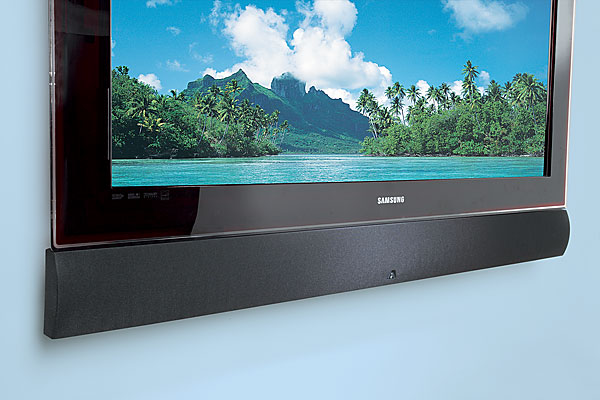
From the Crutchfield site (the image is your link), a look at an Artisan soundbar mounted just below a Samsung flat screen TV set. Although visually appealing, inexpensive and easy to install, soundbars don’t always play well with TV sets. What’s more their sound quality is outdistanced by even a modest surround sound system.

Roughly 4 out of 5 American households now watch television on a flat screen. A smaller number have made their new TV sets part of a full-scale home theater with a proper surround sound audio system. If you haven’t yet taken the plunge (many people do not, mostly because of the wiring and additional equipment required), consider a soundbar.

What’s a soundbar? It’s a long, slender box that’s meant to be placed, or mounted, several inches above or below your flat screen TV. Inside the box, you’ll find at least three loudspeakers: one on the left, one on the right, and one in the center. These easy-to-install setup effectively replaces the older idea of three standalone boxes (one for the left stereo channel, one for the right, one for the center audio channel used in a surround sound setup). Packaged as a single unit, the soundbar is less cumbersome, requires less space, and fits into any flat screen setup.

A typical setup is best enjoyed with at least three additional loudspeakers: a sub-woofer (to emphasize the sounds heard in the lowest portion of the audible spectrum), and a pair of rear speakers (to provide the same 3-D effect that you hear in movie theaters).

Polk Audio’s SurroundBar  (several hundred dollars) is not typical. Patented technology provides the 3-D effect without the addition of rear speakers. Yamaha’s more costly (nearly $2,000) solution, the YSP-5100,  does the job with more sophisticated technology to provide even better sound.

Many soundbars offer a wireless connection to a nearby sub-woofer. (Personally, I prefer wires because they’re easily hidden and more reliable).

It’s all a fine idea, at least in theory. In practice, the concept is new and often tricky in a real world setup. Most TV sets are not yet designed to work with a soundbar so there are conflicts and problems associated with volume adjustments and the visual feedback that a typical on-screen volume control provides. CNET reports other issues that should be familiar to you before your purchase a soundbar.

Seems to me, the soundbar falls into the category of “good idea, but it needs work.” Personally, I prefer the superior sound and slightly more complicated setup of a small surround sound setup. One small loudspeaker left and right, one in the center, and you’ve spent about $300 comparable to a typical soundbar, but the stereo separation will be far better, and the hassles will be fewer. You can buy a decent stereo surround sound receiver for under $200. (If these prices are high, you can buy good stuff used at Audiogon or from similar sources. A subwoofer can be purchased at reasonable prices, too, and used gear in this category is often a safe bet.

Guest Article: Legal Developments / Over-The-Top TV

Aereo’s marketing materials. The service is now launching in the New York City area.

With Aereo now in launch mode, this unconventional service (based upon thousands of tiny television antenna–each smaller than a dime), the television industry is facing some interesting questions about even its most basic operating assumptions.

As a result of reader interest in the blog post “I Want to Watch TV on My iPad,” here’s a legal view of the Aereo situation.This material is used with permission of the law firm Drinker, Biddle & Reath, and it originally appeared in the firm’s Antenna newsletter as “Legal Developments Affecting Over-the-Top TV.” The article was written by DBR communications attorney Howard Liberman and and his associate, Jennifer T. Criss.

—–

The past several weeks have seen important developments regarding “over-the-top” television. More and more consumers are moving away from traditional means of watching television and are embracing services that provide access to television programming directly on computers, tablets, and mobile devices. While some services such as Hulu distribute copyrighted content with permission of copyright owners, other over-the-top services are providing access to copyrighted content without obtaining copyright licenses or paying retransmission fees to TV stations.

One such over-the-top service, Aereo, provides the signals of local broadcast stations to subscribers who “rent” one of thousands of miniature antennas located in Aereo’s facility, for a monthly fee. In March, numerous television broadcasters, including ABC, CBS, NBC, Fox, and PBS. brought suit against Aereo for copyright infringement. While local stations would ordinarily be available for free to any household with an antenna, today most consumers receive access to local stations through subscriptions with cable or satellite providers. The broadcast companies argue that Aereo, which is backed by Barry Diller, is infringing copyrighted material by allowing its users to access live broadcasts over the Internet. Aereo asserts that it is simply providing access to programming that consumers are able to receive for free by allowing consumers to rent its miniature antennas either on a recurring or a per-program basis.

On July 11,2012, Judge Alison J. Nathan of the U.S. District Court for the Southern District ofNew York ruled that Aereo can continue providing services to its subscribers while the case moves through the courts. Judge Nathan concluded that Aereo does not retransmit broadcast channels to its customers because the company provides an individual miniature antenna for each customer rather than offering access to a single, large antenna that transmits signals to all Aereo subscribers. The court disagreed with the television broadcasters’ claim that they would be irreparably harmed and lose numerous customers should Aereo continue its activity until a final ruling in the case.

For now, Aereo operates only in New York City. But Aereo is planning to expand into additional U.S. markets. Thus, it is important for all TV broadcasters to be aware of developments in this litigation. In the meantime, the FCC is considering what constitutes a “channel” within its definition of “multichannel video programming distributor” (“MVPD”). The FCC is questioning whether Internet-based services such as Aereo and Hulu should be considered MVPDs if they distribute more than one broadcast or cable television channel. Including these services as MVPDs could mean that television stations could seek retransmission consent payments for the delivery of their signals by these systems.

As the Aereo case and the FCC proceeding move forward, it is clear that consumer access to television is rapidly changing. With companies such as Google, Apple and Sony considering offering video channels directly to subscribers via the Internet and going “over the top” of cable and satellite providers, defining what constitutes a “retransmission” and what service qualifies as an MVPD is critical to shaping the next decade of television viewing. Today’s viewers don’t just want their MTV; they want their MTV available inexpensively, 24-7, and on their computers, tablets and smartphones. These two proceedings – the Aereo litigation and the

FCC’s effort to re-define “MVPD” – will have a major impact on the future of over-the-air broadcast television.

This issue also has the attention of Congress. Hearings have been held in both the House and the Senate in recent weeks, as lobbyists and trade associations are gearing up for the introduction of legislation — perhaps this year – to make substantial revisions in U.S. communications laws for the first time since the passage of the landmark 1996 Act. We will monitor all these proceedings and provide updates in future issues.

Reruns!

Hey, it’s summer, it’s hot, and there are several early articles that appeared before most people knew this blog existed.

So, allow me to recommend three interesting posts that you may have missed:

The first is entitled The Ultimate Road Trip. It’s about the astonishing story of the interstate highway system–a system that is now beginning its old age, with not much attention to its replacement.

The second is about Boxie, a fascinating (and friendly and cute) MIT robot.

The third is about the cost of educating America’s children, one by one.

I hope you enjoy reading as much as I enjoyed writing!

Best,

HB

Next-Generation Camcorder

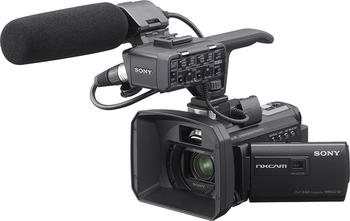
Just when you thought you’d need only your cell phone to shoot video, Sony introduces two new ideas that may change the game a bit: a gyro-stablized lens and a built-in projector. Have a look at the new, remarkably small Sony HXR-NX30, a $2,000 camcorder just arrived from the future.

Weighing about two pounds and stretching to a foot with battery attached, this small HD camcorder solves a constant problem for journalists and other hand-held videographers: the gyro system is, essentially, a built-in Steadycam-like feature. Without the extended balance mechanisms. Small enough to tuck into a medium-sized shoulder bag.

The built-in project is fairly modest, more useful for screening the days’ work on a hotel wall than for a public screening. Still, the projected images can be as large as about three feet (diagonally), and if they aren’t beautiful HD quality, they are far, far better than the images you’d be watching on the built-in 3-inch LCD screen.

Although the results are suitable for professional purposes, this is, in essence, a prosumer camcorder. It’s nice to see nearly 100GB of built-in memory (which goes quickly when shooting in HD), and it uses SD cards. There are XLR connectors for professional microphones, and a decent amount of control for just about every application. And there are a gaggle of other useful features, all common in this price category.

The news here is the built-in stabilization. Many will purchase this camera for that feature alone. And, hopefully, we’ll see lots of cameras with a similar feature–it should become standard in two or three years.

The Mind of Howard Gardner

From his Harvard bio, one of my personal heroes. Few academics have captured my imagination, and affected my thinking, as consistently or as deeply as Howard Gardner.

Harvard Professor Howard Gardner has written more than a dozen books with the word “mind” in the title. Few researchers have spend so much of their professional careers thinking about how our minds work, whether our minds might be better trained, and whether our minds can be put to better use. He’s a brilliant thinker, and I have thoroughly enjoyed reading his evolving work over these past few decades.

Earlier this year, with co-author Emma Laskin, Gardner republished Leading Minds: An Anatomy of Leadership with a new introduction, and that led me to the slimmer 5 Minds for the Future, a slim book that captures his evolving philosophy in a succinct, deeply meaningful way.

From the start, Gardner’s 5 Minds for the Future is more contemporary, acknowledging the tangentially  overlapping work of Daniel Pink, Stephen Colbert (“truthyness“)  and the enormous changes brought about by globalization. Gardner is famous for his theories about multiple intelligences (“M.I.” these days), but M.I. is not what this book is about. Instead, Gardner presents his case as a progression from basic to higher-level thinking, and his hope that we will climb the evolutionary ladder as a collective enterprise.

He begins by revisiting one of his favorite themes, the disciplined mind (which provided both title and subject matter for his 1999 book). Here, the goal is mastery, which requires a minimum of a decade’s intense participation, a thorough examination of all relevant ideas and approaches, deep study to understand both the facts and the underlying fundamentals, and interdisciplinary connections. This is serious work, and it must be accomplished despite the sometimes crazy ways that schools think about learning, and the equally crazy ways that the workplace may value or advance those with growing expertise. The disciplined mind does not simply accept what has been written or taught. Instead, the disciplined mind challenges assumptions, and digs deep so that it may apply intelligence when conventional thinking does not produce valuable results. No surprise that Gardner is deeply critical of those who invest less than a decade in any serious endeavor, or those who fake it in other ways.

Next up the ladder is the synthesizing mind which accomplishes its work by organizing, classifying, expanding its base of knowledge by borrowing from related (and unrelated) fields. Placing ideas into categories is an important step up the ladder because the process requires both (a) a full understanding of  specific disciplines and how they relate to one another, and (b) the means to convey these ideas to others. And so, Gardner views the Bible (a collection of moral stories), Charles Darwin’s theories, Picasso’s Guernica, and Michael Porter’s writings about strategy as related endeavors. At first, this seems to be a stretch. Then again, each of these are bold combinations of ideas based upon a complete understanding of a domain–(a) above–conveyed in a way that connects people to the synthesized ideas (b).

You may know Mihaly Csikszentmihalyi as the author of the excellent book FLOW, but his best work may be a book simply entitled CREATIVITY.

Then, there’s the creating mind. At this stage, the progression begins to make a lot of sense. Novel approaches are not based upon random ideas that may or may not work. Instead, the creating mind grows from deep study of a specific domain in a disciplined manner, followed by various attempts to organize that knowledge in ways that propel an argument forward. At a certain point, the argument has been advanced, and the opportunity for new thinking presents itself. Many creative professionals are required to advance new ideas without the requisite discipline, and so, our society generates lots of ephemeral stuff. In the creative space, Gardner’s thinking has been affected by Mihaly Csikszentmihalyi, who believes:

creativity only occurs when–and only when–an individual or group product is recognized by the relevant field as innovative, and, sooner or later, exerts a genuine, detectible influence on subsequent work in that domain.”

I would argue that the respectful mind ought to precede the disciplined mind as the ladder’s first rung, and Gardner provides ample evidence to support my argument. For one thing, the respectful mind is the only one of Gardner’s five minds that can be nurtured beginning at birth. What’s more, the ability to “understand and work effectively with peers, teachers and staff” would seem to be a prerequisite for any disciplined approach to learning and personal development. The whole chapter is nicely encapsulated by a sentence from renowned preschool teacher Vivian Paley:

You can’t say ‘you can’t play.'”

A decade ago, Gardner, Csikszentmihalyi, and William Damon wrote a book called Good Work, and this effort has expanded into The Good Work Project. Central to this effort is the ethical mind, which carries a meaning well beyond the ethical treatment of others. Here, we begin to touch upon the idea of professional or societal calling, and one’s role within a profession or domain. It begins with doing the best work possible–that is, the work of the highest quality, as well as work of redeeming social value–but it’s not just the work itself, it’s the way that you apply yourself to the job at hand. Here, Gardner covers the diligent newcomer, the mid-life worker who continues to pursue excellence every day, the older mentor or trustee whose role is to encourage others to build beyond what has already been accomplished.

In less than 200 pages, Gardner accomplishes a great deal. If time permits you to read only two Gardner books, I would start with Frames of Mind, which explains his theory about multiple intelligences, then jump to 5 Minds for the Future. After these two, you’ll probably want more. His book about leadership, mentioned above and discussed below, is certainly worthwhile. And Good Work will fill your head with wonderful ideas and inspiration for all you could do to help make the world a better place.

BTW: If you want to watch Gardner discuss 5 Minds for the Future, you’ll find his 45-minute video here.

As for Leading Minds, it’s an extraordinary book, a collection of analytical biographies written as parts of a whole, a cognitive view of leaders and leadership. He examines leaders by taking part their fundamental identity story: who they are, how their domain and influence grew, how and why they succeeded, how and why they were unable to accomplish their ultimate goals. This is not a book whose core ideas can be reduced to a few bullet points. Instead, it’s a few hundred pages of reflection on the nature of leadership shown through the examples of Albert Einstein, Mahatma Gandhi, Martin Luther King, Jr., Alfred P. Sloan, Eleanor Roosevelt, and a half dozen other 20th century figures. The significance of some names is fading; it was disappointing to find that this revised edition of a 1995 work did not include anyone who made his or her mark in the 21st century.

Outta Here! – A Friendly How-to Guide

With good cell phone service and a robust Internet connection, we’d like to think we can live, and work, pretty much anywhere. True enough, if the term is days, weeks or months, but what about years? What about (gasp!) forever?

Why leave? You’ll find lots of good reasons (good stories, too) in the newly revised second edition of Getting Out: Your Guide to Leaving America by Mark Ehrman:

The US had become unbearable after 9/11…We purchased 1.25 acres of land about 20 minutes south of Oaxaca…There is nothing like living, immersing oneself entirely, in another country, culture, language, etc.” — Cara Smiley, 40

I have been leaving the US all my life–starting with study abroad and then the Peace Corps…” — Kerry Kittel, age 49

Life here in Copenhagen is just so much more livable than any place I’ve experienced in the US. I take a train and boat to work. I ride my bicycle to buy groceries…” — Bill Agee, 50

You might think of this as the ultimate traveler’s book (no tourists allowed). Pages of (fascinating) personal stories are followed by advice about visas, second passports, and citizenship. There are many ways to gain citizenship, or at least, residency… marry in, play your ethnic race card, buy your way in, teach English, etc.

Fantasizing about where you might go…and stay? If you’re looking for the world’s highest rate of Internet penetration, try Greenland, Iceland, Norway, or Finland. Best infrastructure? Switzerland, Hong King, Singapore, France, Iceland, or Sweden. Fastest Internet? South Korea. Safest? Germany, or Canada. Growing job market? China, India, Taiwan. Best place to start a new business? New Zealand, Australia or Canada.

Need a more in-depth analysis? That’s the second half of the book. Sixty-one countries, each considered in terms of governance, Internet, healthcare, working there, taxes, women’s issues, life expectancy, moving there, and more.

If i was among the 300,000 who left home, where would I like to go? In fact, I would love to spend a month, maybe several, in every one of those sixty countries–but I suppose that answer evades the question. If I had to choose today, my starter list would probably include:

  • Bahamas
  • Canada
  • Denmark
  • France
  • Italy
  • Japan
  • Sweden
  • United Kingdom

Where would you go? And stay?

—–

And, from the same publisher, the real dirt on living in the country. The book is called (of course!) Get Your Pitchfork On!