Five Rules for Happiness

20121111-225133.jpgRayChambers is the first link in the chain. Ray has been an inspiring force in New Jersey generally, and in Newark, specifically. (I’ve seen it first hand, both at the New Jersey Peace Education Summit and in the midst of a New Jersey Network gala).

For LinkedIn CEO Jeff Weiner, Ray has been a mentor, and man who passed on five rules for happiness that Weiner now passes along in today’s New York Times.

  1. Live in the moment.
  2.  It’s better to be loving than to be right.
  3. Be a spectator to your own thoughts, especially when you become emotional.
  4. Be grateful for at least one thing every day.
  5. Every chance you get, help others.
20121111-225216.jpg

Peter DaSilva for The New York Times

When Weiner speaks with students, he adds thoughtful consideration of his own:. He asks students, “Looking back on your own career, what do you want to say you accomplished?” If a student cannot answer quickly and easily, Weiner strongly encourages a thought process leading to an answer.

He adds more advice. His own: “surround yourself with amazing people.” And from MIT Media Lab leader Joi Ito: “maintain a childlike sense of wonder throughout your entire life.”

And, finally, from Einstein: “There are only two ways to live your life. One is as though nothing is a miracle. The other is as though everything is a miracle.”

I prefer the latter. And if you’ve read this far, I suspect that you do, too.

Read the article. It’s a good one.

An Antidote for Pizza

I steer clear of the gummy crap that’s delivered in pizza boxes from the chain stores. No Pizza Hut for me; the ingredients, the preparation, the lack of loving care, all are good reasons to buy pizza elsewhere.

More often than not, the local pizza shop is only a bit better. The dough is rarely fresh, the mozzarella is pre-shredded and made weeks or mints before it becomes a pizza topping. The sauce may or may not come out of a can, but it’s exceedingly rare to find an actual tomato anywhere in a pizzeria. Some pizza places make some of their own stuff, and add some love. Certainly, there are some of NYC pizza places where it all comes together nicely, but they are the exception.

So, what do I want? I want what DiMeo Brothers does. It’s worth a trip to (of all places) Wilmington, Delaware (an hour from Philly) to taste the fresh cheese, the fresh dough, the fresh sauce. This particular pizza restaurant imports ingredients from Italy. Even the water used in dough. Baked in a perfect brick oven, the pizza is sublime–and only vaguely resembles the round, flat, gutless things that Pizza Hut / Papa John / Domino are selling.

Too far away from Wilmington (or their new place in Philadelphia’s Andorra neighborhood) to make a go of it? There are options. One is a book.

20121110-224811.jpgThe book–My Pizza, written by a baker named Jim Lahey–promises a “no-knead way to make spectacular pizza at home”. The book is filled with wonderful photographs of equally wonderful pizzas. No surprise that they look, and taste, as good as the best of DiMeo’s. Fresh ingredients and loving preparation are everything.

You begin with a pizza stone. Three-quarters thick is best because it retains heat more efficiently than the more common half-inch consumer model; visit a restaurant supply shop if you can’t easily find one online. A pizza “peel”–the paddle–is essential, but the long ones used in pro kitchens may be too long for yours, and a smaller one will be fine.

Leahy is okay with conventional flour but extremely picky about the olive oil. The best comes from Chile. The freshest cheese, the finest available tomatoes, these are critical.

Ovens are tricky. They need to reach high heat. Buy the book, read the chapter, because this part is a little complicated. You can do it–make great pizza in your own kitchen–but take care to do the work properly to avoid incident.

Next chapters: how to make the dough, then the tomato sauce, both from scratch. This is not a quick job. This is a messy job, gloriously so. But then here’s that first tomato pie–your freshly made dough, your freshly made tomato sauce, a touch of fin sea salt, and a drizzle of your best olive oil. Three (!) minutes later, maybe five if you let it cool, you’re eating the best pizza of your young life. A week later, you’re completely addicted to your own variation on Leahy’s veal meatball pie, one of a few dozen specialty pies in this handsome cookbook.

Frozen pizza? Domino? Fuhgeddaboudit. Go buy the book and make your own.

Provocative Economics from C. Christensen

Excellent article in last Sunday’s NY Times by Clayton Christensen.

Christensen is a Harvard professor who studies innovation, and has written several superb books about how and why it works. His theories turn on a key concept: there are several types of innovation, most notably innovation that sustains and incrementally improves a current situation, and innovation that disrupts, changes the rules.

In this article, he expands his thinking to explain why and how capital can and must be freed to fund an emerging new economy.

BTW: C.C. writes an excellent blog.

The picture comes from Harvard Business School. Whether he is or is not the “top” guy, he’s certain high on my list.

Go read the article. Totally worth your time.

Media Shift / Cutting the Cable

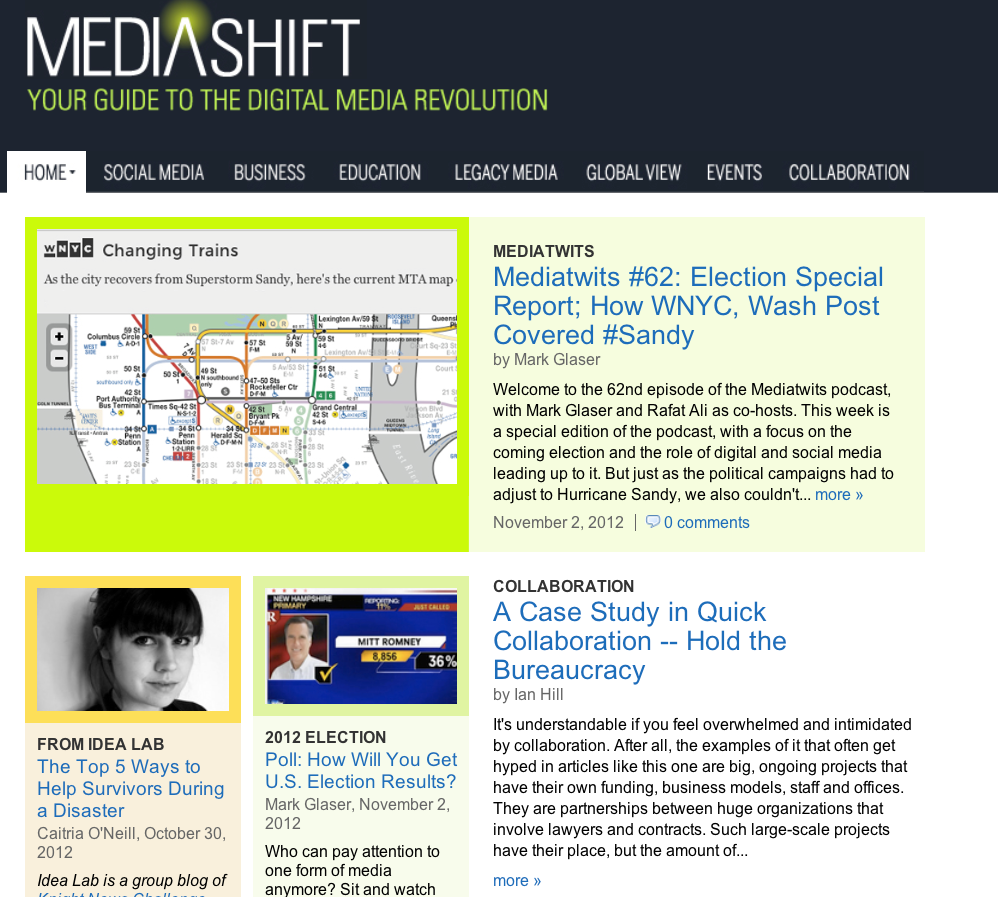
Although I am probably late to the game, I just discovered two very useful tools. The first is a blog post and the second is the blog itself.

Blog post: 2012 Guide to Cutting the Cable

Blog: Media Shift

One at a time:

The article explains the available hardware and software, then provides several case studies of users who have cut the cable, and ends with a very useful list of other articles on the subject.

The blog is stupendous. Here’s local, national and international news and commentary on shifts in just about every modern media industry. The coverage gets down to the hyper-local level, and also offers an extremely wide view of, say, the recent announcement of a merger between two of U.S. publishing’s giants: Penguin and Random House (the latter wins). That article, and this blog, does what so few do: it provides context. So the article about book publishers looks not only at consolidation’s impact on publishing, but also compares the situation with consolidation in the music industry.

Kudos to PBS for this lesser-known project. I now plan to read Media Shift every day.

Tech Changes Education

The Schoology logo connects classroom management, online learning and social networking.

Late in October, just before the storms, Forbes ran a useful summary of several trends that promise to reshape classroom education. It was swritten by Jeremy Friedmanthe CEO of Schoology, a company that makes software for the classroom.

No surprise that the key trends emphasize individualized learning based upon technology. Certainly, the ubiquity of cloud computing encourages document sharing, and collaboration regardless of each individual student’s location. “The 2012 Horizon Report, which provides insights into education technology trends, predicts that collaborative environments are about one year away from mainstream adoption.” That seems ambitious to me, but I’m sure that the most advanced, well-funded, tech-enabled schools will begin to make this statement true.

Given the realities of most schools, the idea of cross-platform integration may seem like an impossible dream, but vendors are beginning to work together to unify their approaches to digital learning. Forbes believes more strongly in this future than I do, or, perhaps, than most teachers probably do.

It’s now nearly impossible to imagine a classroom without mobile technology, but again, imagination is ahead of reality. Certainly, “(Mobile apps) are abundant, inexpensive and easily accessible…” but the question is not the apps, it’s the devices. A new movement toward BYOD (“Bring Your Own Device,” of course) is gaining traction. In itself, this is remarkable: just two years ago, many teachers, principals and administrators were doing everything they could to keep Twitter, Facebook, Tumblr and other “distractions” away from the classroom. Still, the levels of coordination present major challenges: Apple, Android or Windows? Curriculum at the national, state, district, school, classroom, or individual level? For all students, advanced students, average students, challenged students? Apps are easier to develop and produce than traditional software, but it’s not the software engineering that’s the issue, it’s what it does, and how what it does fits into any sort of master plan.

This raises the issue of adaptive learning, a domain that is already being addressed by at least one company: Knewton “responds in real time to the activity of each user on the system and adjusts to provide the most relevant content…” What’s more: “Knewton is able to capture every move a student makes – scores, speed, accuracy, delays, keystrokes, click-streams and drop-offs. The platform collects this data and the software adapts to challenge and persuade the user to learn based on his/her individual style. Pretty amazing stuff!

The buzz idea of the year seems to be gamification–that is, just about everything becomes a kind of game. At first, this seems to be a frivolous undertaking, but you need to think more broadly about games and how they work. A good game is a simulation of life, a design for activity within bounded rules. In this regard, games are a simplification, a reduction of real life situations that allow learners to focus on specific learning objectives. And, these learning objectives are readily scored, and, under the best of circumstances, presented in a way that connects learning and fun.

There’s funding behind this approach: “Game-based learning is even one of the priorities of the Bill & Melinda Gates Foundation, which earlier this year helped launch the Games, Learning and Assessment (GLASS) Lab. According to the organization, GLASS Lab is “based on the understanding that digital games and simulations can support student learning by providing immediate feedback for students, teachers and parents on students’ progress toward established learning goals”” The article describes even more funding from the game maker Electronic Arts, and the Entertainment Software Association, and, also, from the MacArthur Foundation. The non-profit at the center of all of this: Institute of Play. I looked at their website. I need to visit. Soon.

Hurricane Hackers – A New Way to Help, or Be Helped

“Hola! Welcome to #HurricaneHackers: a shared space for gathering information and organizing tech+social projects related to Hurricane Sandy.”

“Dear Civic Media fans —

If you’re in a safe, powered, Internet’d place, here’s a great opportunity to contribute to realtime and future work around Hurricane Sandy…

http://bit.ly/hurricanehackers-gdoc

Civic’s “Hurricane Hackers” is collecting ideas and datasets to create tools related to the storm…and already building tools with them. Everything is welcome. Well-developed projects already include a dynamic timeline, a map of livestreams, and an incredible set of hurricane-related resources — both historical and for Sandy.” (from their introductory email)

This pop-up site may become a very useful tool in the next 24-72 hours. It’s a contributory document, a group collaboration to gather relevant links and guidance. The organization behind the project is the Center for Civic Media at the MIT Media Lab. Find it here.


It’s best explained by example. Below, some excerpts (1045AM eastern time on Monday):

—–

Project Brainstorming:

What might we make? Add your own idea, or +1 those you like.

Ways to help

  • SandBag.it: a map of places that need sandbagging, and a way for people to sign up to help sandbag at particular locations.
  • AfterSandy Benefit Parties: when Sandy’s over, have people hold house parties as benefits for people who lose something. Start organizing these early, while there’s lots of attention. Maybe just use MeetUp to do this.
  • CrashPads? Matching people with spare rooms with people who need them?

Sandy Impacts

Apologies for the sometimes-ugly formatting. Cut-and-paste is not always perfect.

More later. Be safe.

Bird’s Eye View of the Storm

For as long as our east coast power holds out, I plan to keep a weather eye on the storm by visiting NASA’s phenomenal multimedia site. You’re looking at a view of the storm from the International Space Station.

Here’s an equally fascinating video, also from the Space Station. Look below, and you’ll notice some space station hardware on the upper left.

For me, all of this started when I discovered Samir’s Twitter feed and this stunning image:

The clarity of these images, and the fact that they exist at all, seems like a miracle.

Be safe, one and all.

HB

PS – Back here on earth, here’s a visual diary.

Debates Are Ridiculous; Let’s Move On

Associated Press/Pool-Win McNamee – Republican presidential nominee Mitt Romney and President Barack Obama answer a question during the third presidential debate at Lynn University, Monday, Oct. 22, 2012, in Boca Raton, Fla. (AP Photo/Pool-Win McNamee)

A half century ago, the idea of televising a debate between two Presidential candidates was breakthrough thinking. Beginning in 2016, I think we can use our new and emerging media to do a better job, and, presumably, to choose our new leader with greater insight, wisdom, and knowledge.

Let’s begin with some pre-reading materials. During the primary process, each candidate for president should be required to complete and submit a job application. The application should require work history, evidence of compliance with laws (for example, age and place of birth), and so on. Prior to each party’s national convention, each candidate should be required to clearly present his or her platform, in detail, by category, complete with data and factual references (given the dynamic nature of our economy and such, each candidate may revise this document at pre-appointed intervals). Then, each candidate should be required to present the platform by speaking directly to the American public, on television, without interruption. If we’re clever, I’m sure we can come up with a web-based extension of the written and televised presentation. With this mechanism in place, I can easily research where each candidate stands on, say, Syria, or health care. Of course, the people ought to have some digital means of asking questions, and the candidates should provide some reasonable means of answering their questions.

Next up, let’s change our rules regarding the use of television advertising. Whether by law or by policy, candidates should be required to use their commercial airtime to explain their own views, and not to criticize or attack the other candidate (this higher standard should be applied to all elections, at least on television commercials where stations often set policies with regard to acceptable material).

With all of that in place, let’s rethink the debate. Running a grudge match is a waste of everybody’s time, and so is allowing candidates to drift from the questions to their own message points. Candidates are welcome to speechify, but that’s not the purpose of the debates. Instead, I would either eliminate the debates and replace them with one-on-one conversations with everyday people and vetted journalists, or reformat them entirely. Last night’s Bob Schieffer format stopped the candidates from moving around and nearly slugging one another. That’s a start. A quiet, reasoned conversation; mostly, closeups of each candidate so we can study their faces; a journalist who asks the questions and is not overwhelmed by the power of candidates to disobey the rules–this format provides a better opportunity to study the candidates and their presentations. And let’s not call it a debate, or think of it as debate, because we should discourage the unseemly role modeling by potential leaders of the free world. There should be no winner or loser. Instead, the debate ought to be a skillfully moderated conversation by people, each of who believes that he or she can successfully lead the nation and play a very significant role on the world stage. That’s enough for me.

But there’s a piece missing: verification of facts. I’m not very interested in what the network’s commentators have to say about who “won” because the debate should not be reduced to such simple-minded thinking. Instead, immediately following the debate, I’d like to see an intelligent, compelling presentation of what each candidate said, and whether it was factually correct, kinda hazy, or utter nonsense. If the candidates understood that they would be immediately followed by an independent fact-check seen on TV, they would be more likely to curb their fanciful interpretations of fact.

Do we need to see two presidential candidates “go at it” as if they were wrestlers? I think we can do a lot better, and I know we possess the tools and the need to approach the whole intersection between presidential candidates and media. But do we possess the will to shift the entire election process into the 21st century?

Digital Warfare

20121012-224426.jpg

Michael Reynolds/European Pressphoto Agency (NY Times)

Today’s New York Times included an article that may turn some digital heads. The next threat may not involve guns and bombs, but stealthy data intended to destroy telecommunications and other essential infrastructure. This ultimate hack is especially nasty because it is so difficult to detect, faceless, instantaneous, and associated with many so many potential points of failure.

As Defense Secretary Leon Panetta attempts to change minds and law, it’s worth your time to (a) stop dreaming of the new iPad Mini for a moment, and (b) consider the ways in which we could and should defend against 21st century cyberwar. Sounds like a science fiction novel, I’m sure, but this is becoming a powerful, significant nightmare scenario.

Innovation versus Institutions

Innovating from inside of an organization is stunning in its difficulty, frustration, and often, it’s difficult to understand why even the simplest of ideas meets with such a high level of friction and sluggish progress. Again, I’ll thank NYU Professor Clay Shirky for his book, Here Comes Everybody, for some sparks that led to this article.

You may recall that my previous post dealt with the connections between the individuals who form a group or a network of groups. Within an organization, those connections are weighted, in part by company hierarchy, in part by control over resources, and in part on the history and fluidity of past relationships. In other words, connections within an organization are often complicated by internal and external factors. And, of course, not every relationship is equally valued. Some connections are stronger than others. You might recall the old 80/20 rule, for example, in which 80 percent of the work is done by 20 percent of the people.

Well, it turns out that the 80/20 rule doesn’t much apply to innovation, or to community interactions. If you look closely at Wikipedia–easily the largest informal group enterprise we’ve ever generated as humans–“fewer than two percent of Wikipedia users every contribute, yet that is enough to create profound value for millions of users. Wikipedia would not be possible if there were concern for inequality.” With a publish-then-filter model now overtaking the older, highly institutionalized model of research-write-edit-rewrite-publish, much more gets written, and errors are corrected along the way, particularly in articles that matter. (Those that don’t much matter are rarely accessed, and so, rarely corrected.) So we have a small number of people–nowhere near 20 percent of the total Wikipedia user base–contributing large amounts for an operation that is a nonprofit, not a business.

It’s here that the divergence becomes interesting. Imagine a business taking on the writing of the world’s largest encyclopedia, one that is never quite published, but always exists in draft form. Companies just don’t work that way–they have processes, standards, and overhead, project management, deliverables, and the entire structure of jobs and careers relies, mostly, upon incremental improvements to the status quo. Very large projects are within the reach of larger institutions, but the process of planning, developing, politicking, funding, hiring and moving people…none of it is simple, and there are ample opportunities for slowdowns, moving off track, shifting priorities, and so much more. That’s how institutions work: they perfect processes over time, but they struggle with entirely new endeavors because the status quo makes so much more sense than the risky new proposition. Massive shifts in thinking are not easy to absorb. Large-scale systemic change does not make sense.

There are fewer than 100 copies of the EB print edition still available (but none in this binding). If you want one, click on this link now (don’t wait!).

Except, of course, that significant, often large-scale, systemic change is becoming a new normal. There is no more Encyclopaedia Britannica in print, no more Tower Records stores, no more Kodak film (well, almost none), no more barriers to global video distribution, no reason why a clever sentence or article can’t be seen by millions of people just an instant after the draft is complete.

So status quo is part of the reason why institutions and innovation aren’t always BFF. But there’s another component, equally important: freedom to fail. When an institution fails, it risks funding, loss of customers, and shifts in leadership. When innovators fail, they may cry in their beer on Friday night, but on Monday morning, they’re back at work, having learned from the flop. No shareholder worries, no customer loss (okay, maybe a little), and in the end, probably more valuable learning than systemic damage. So institutions do all they can to avoid failure, and often, this means extracting the heart of a project or venture, or obfuscating, or demanding more analysis, or some other status quo maneuver. And individuals who are part of, for example, an open source community, correct the errors and move on without substantial loss of momentum (because the primary reason for that community’s existence is to DO things and to avoid NOT DOING things). In this shifted paradigm, the institution struggles to make substantive progress, knowing that the less encumbered other may well cause the death of their venture.

Shirky: “Open source is a profound threat, not because the open source ecosystem is out-succeeding commercial efforts but because it is out-failing them. Because the open source ecosystem, and by extension open systems generally, rely upon peer production, the work on these systems can be considerably more experimental, at considerably less cost, than any firm can afford. Why? The most important reasons are that open systems lower the cost of failure, they do not create biases in favor of predictable but substandard outcomes, and they make it simpler to integrate the contributions of people who contribute only a single idea. The overall effect of failure is its likelihood times its cost. Most organizations attempt to reduce the effect of failure by reducing its likelihood…(making safe choices). Open source doesn’t reduce the likelihood of failure, it reduces the cost of failure; it essentially gets its failure for free…cheap failure, valuable as it is, is also a key part of a more complex advantage: the exploration of multiple possibilities.”

What now? If you haven’t yet read Clay Shirky’s Here Comes Everybody, do it now. If you’ve already done that, you may take the rest of week off. Here he is at Harvard’s Berkman Center for Internet and Society talking about his work….