The Incomplete Turkey

No big surprise here: the number of viewers has remained constant for the past twenty years. Between 25 and 30 million people watch Macy’s Parade each year. Since there are just short of 300 million Americans, 1 in 10 Americans watches the Parade–9 out of 10 do not. This is a Great American Tradition, so I figured the numbers would be much higher. By comparison, last year’s Super Bowl (XLV) was the highest rated of all time–with 111 million viewers–more than 1 in 3 Americans.

For the whole Nielsen story, click here.

But wait! — Thats’ not the whole story! The oldest turkey feather in Nielsen’s graphic was 1991. What happened before 1991?

Turns out, the first parade coverage dates back to 1939, but that was experimental coverage by a then-experimental medium. In 1955, NBC started covering the parade (Nielsen’s turkey is missing 31 feathers, plus 2011).

I will contact Nielsen to solve the mystery of the missing feathers. Meantime, have a look at the small orange type just below Nielsen’s title (“Sum of Networks [NBC & CBS]…”) Turns out, the parade is a public event, so NBC’s rights have never been exclusive. CBS covers the parade without paying for rights. Over on ABC, there’s the Philadelphia parade, which has been on the air, locally, since 1966–it is also broadcast nationally, and claims bragging rights to the whole idea. It was Gimbels that invented the Thanksgiving Parade in 1920–before Macy’s glommed onto the idea four years later.

Siri, meet the family

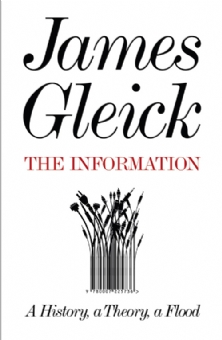
The UK cover is more interesting than the US cover, which is, somewhat appropriately, covered with the repeated words "The Information."

James Gleick nearly won a Pulitzer Prize for a biography about Isaac Newton, and another about Richard Feynmann, a colorful physicist who pioneered nanotechnology and quantum mechanics. His best selling book (more than a million copies sold) is the step-by-step, scientist-by-scientist, idea-by idea story of chaos theory entitled Chaos: Making a New Science.

Gleick’s 2011 book is called The Information. it begins with the European discovery of African talking drums in the 1840s, a percussive idea he eventually connects to Samuel Morse’s dots-and-dashes telegraph code, and, we’re off on a long tale not unlike the best of James Burke’s TV series, Connections. Gleick takes us through the development of letters and alphabets, numbers and mathematics, numerical tables and algorithms, dictionaries and encyclopedias. These stories, and their many tangents, set us up for Charles Babbage whose boredom with the Cambridge curriculum in mathematics leads to an early, impossible-to-build, 25,000 piece machine, awesome in its analog, mechanical, Victorian design. This, then, leads to the further develop of the telegraph, now caught up in a new conception called a “network” that connected much of France, for example.

By the early 20th century, MIT becomes one of several institutions concerned with the training of electrical engineers–then, a new discipline–and with it, machinery to solve second-order differential equations (“rates of change within rates of change: from position to velocity to acceleration”). This, plus the logic associated with relay switches in telegraph networks, provides MIT graduate student Claude Shannon with his thesis idea: connecting electricity with logical interactions in a network. Shannon’s path leads to Bell Labs, where he works on the “transmission of intelligence.” By 1936, a 22-year old Cambridge graduate named Alan Turing had begun thinking about a machine that could compute.

Well, that’s about half the book. Now, things become more complex, harder to follow, dull for all but the most interested reader. The interweaving connects DNA and memes (and, inevitably, memetics, which is the study of memes), cybernetics and randomness, quantification of information, and Jorge Luis Borges’ 1941 conception of an ultimate library with “all books, in all languages, books of apology and prophecy, the gospel and commentary on that gospel, and commentary upon the commentary upon the gospel…”

Eventually we obsolete CD-ROMs (too much information, too little space), and create Wikipedia and the whole of the Internet. In the global googleplex, the term “information overload” becomes inadequate. And yet, Gleick promises, it is not the quantity that matters, it is the meaning that matters. After 420 pages of historical text, I’m still wondering what it all means–and whether the purpose is mere conveyance as opposed to deeper meaning or its hopeful result, understanding.

Yikes!

Picture from Bureau of Labor Statistics job outlook for teachers. Their caption: "Teachers play an important role in fostering the intellectual and social development of children." http://www.bls.gov/oco/ocos318.htm

The next industry that could be decimated by technology: teaching.

Will Richardson thinks, writes and teaches others about the use of technology in education. In this blog posting, Will responds to a rosy Wall Street Journal article about the online learning business.

The ‘yikes’ part: “In Idaho, Alan Dunn, superintendent of the Sugar-Salem School District, says that he may cut entire departments and outsource their courses to online providers. “It’s not ideal,” he says. “But Idaho is in a budget crisis, and this is a creative solution.”

Please read Will’s post.

FOLLOWUP: When I spoke with my father about Will’s post, he told me an interesting story about two of his teachers. I suggested that he write the story as a brief essay, and submit it to Will. He did, and Will published it.

Extremely Long Player

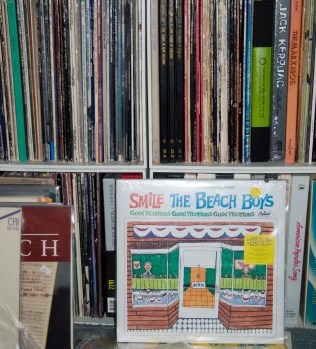
1980s: I’m buying lots of LPs.

1990s: I’m buying lots of CDs.

2000s: I’m downloading lots of music files.

2010s: I’m buying lots of LPs.

What’s going on? As record companies contemplate the end of CD production, LPs are gaining popularity. TIME magazine caught the trend early, but failed to mention activity in vast used LP stores (separate blog post, in the works).

For newcomers, or those whose memory was fogged by digital d-rays, here’s what you need to know…

You need a turntable, a tone arm, a cartridge, a stylus, some cables, a phono per-amp, an amplifier, more cables, and loudspeakers. Back in the day, all of this stuff was combined in a “record player.”

Here in 2011-12, it’s more complicated–and that’s without the USB connection to your computer.

One popular, convenient choice is Audio-Technica’s PL-120, available for about $300. It includes everything you need except the amp and speakers. And, you can connect it to your computer to create digital versions of your LPs.

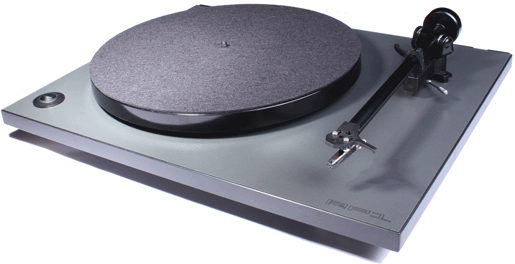
Rega's RP1 Turntable, an audiophile choice.

If you’re willing to invest more money for better sound, the audiophile choice is Rega’s RP-1, which includes a superior tone arm, a better drive system (to spin the platter) and other features that contribute to a cleaner, more focused presentation. The cartridge (which typically includes the stylus) is an accessory–each cartridge design possesses unique sonic characteristics–is a separate purchase. Rega’s RP1 accessory kit costs an additional $200, and includes Rega’s Bias 2 cartridge and several useful accessories.

Audio-Technica's all-in-one, lower-priced USB turntable.

Better would be another favorite cartridge, Audio-Technica’s ML-440. With turntable, tone arm and cartridge in place, you need a phono preamp. At about $150, one good choice is Music Hall’s PA 1.2. I leave the choice of amplifier and loudspeakers to you–the old system stored in your basement or found in a good used stereo shop will be just fine. Audiogon.com is an online store specializing in audiophile equipment, but a local dealer may provide both friendly advice and a place to listen before you buy.

How about a used turntable? Maybe from a reliable high-end dealer, but not from some random eBay source. Used cartridge? I wouldn’t do that. Instead, I would opt for the all-in-one Audio-Technica PL-120. But first, learn from:

Jerry Raskin’s Needle Doctor, which sells all sorts of cool stuff, not just needles!

Audio Advisor

Music Direct

1 in 25 Work as Creative Pros

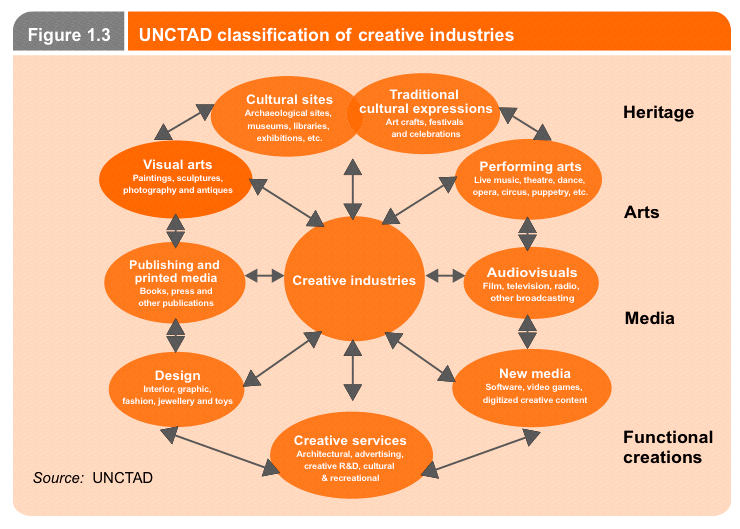
Above, an elegant way to think about the global creative economy, as presented in a 400+ page United Nations report.

1 in 25 people–that’s the revised figure for 2010–work in creative industries in the U.S. More than doctors, lawyers, even accountants. Industry sectors above, details below.

In the United States, roughly 150 million people work full-time. Six million of us work in creative professions. We’re writers and performers; musicians and visual artists; marketers and strategists; architects and specialists who invent, improve, or bring ideas to life. In total, more people work as creative professionals in the U.S. than doctors (700,000), lawyers (800,000), accountants (1,300,000), and engineers (1,600,000) combined. The number of creative professionals exceeds the number of teachers (3,500,000 teachers pre-K through high school, plus 1,700,000 more who teach in colleges and universities).

Our output–which provides employment for lawyers, accountants, executives, retailers, and many others–is responsible for more than ten percent of the U.S. Gross Domestic Product.

A reasonable global workforce estimate would exceed 10 million creative professionals. Nations with significant creative economies include Germany, the United Kingdom, France, Italy, the Netherlands, Ireland, Japan, China, India, Canada, Australia, and, among countries with developing industries, Mexico, Thailand, Indonesia, Argentina, Singapore, and Chile. According to the United Nations Creative Economy 2008 report, the export value of creative in 2005 was over $300 billion, or about 2-3% of the global economy. (Yes, I am reviewing the 423 pages of the 2010 report to update these figures–overall, trends are up).

The long list of creative industries was nicely summarized in the 2008 U.N. report, presented at a United Nations Conference on Trade and Development. The orange version, above, makes it all that much more clear.

Within each of these clusters, the professional model is similar. Projects are developed, produced, and distributed. Mostly, revenues are generated through direct transactions with individual consumers (movie admissions; DVDs; iTunes downloads;physical goods such as jewelry), sometimes through subscriptions; or by advertising to consumers who receive goods and services by paying only a modest transaction fee (magazine subscriptions), or no fee at all (most internet sites; broadcast radio and TV).

You can download the 2010 UN report here. (Yes, I will update my 2008 numbers when time permits.)

“Absolutely, extraordinarily bad”

That’s how innerfidelity.com editor-in-chief Tyll Hertsens described the sound quality of  Beats by Dr. Dre headphones on the front page of this morning’s NY Times Business section (link below).

Yeah, they’re very heavy on the bass. And they’re best for music where bass drives the musical experience. And sometimes, if you listen loud, there’s distortion. On the other hand, Beats are fashion statement, and people wear them not only to listen, but to be seen listening.

Headphones as pictured (from the company website): $349. That’s a lot of money for a pair of headphones. Industry observers are impressed by the team of Dr. Dre and Monster Cable because they’ve opened a new market where price sensitivity matters less than lifestyle choices.

By comparison, a pair of AKG K240 Professional Studio Headphones cost $199.

If you have a pair of Beats, or manage to try a pair in a store, share your impressions.

http://beatsbydre.com/Default.aspx

http://www.nytimes.com/2011/11/20/business/beats-headphones-expand-dr-dres-business-world.html?partner=yahoofinance

http://www.innerfidelity.com/

Smaller than I thought

Just out of curiosity, I decided to explore the list of top U.S. newspapers by circulation.

Some things that I found interesting:

1. The top newspaper in the USA is not a general interest paper. It’s the Wall Street Journal, with a circulation of about 2 million.

2. The second largest paper is USA Today, and the third is The New York Times.

3. The daily circulation of The New York Times roughly equals the population of Rhode Island–just about 1 million people. On Sundays, the Times circulation equals the number of people in Idaho (1.3 million). And the NY Times is the biggest local paper in the USA.

4. Other big papers in the USA include The Washington Post, The Daily News (NYC), Chicago Tribune, and Chicago Sun-Times. Each is around the half million mark–roughly, the population of  our least-populous state, Wyoming.

Before this end-of-journalism web madness began, daily New York Times circulation was about 1.1 million in 1998. Not much of a change from today’s 1 million. In 1990–years before the internet’s introduction–The Daily News peaked around 2.3 million per day, but by 1990, circulation was down to 1.2 million, and now, it’s about half that amount. Based upon various conflicting, but helpful, sources, I believe newspaper circulation is down by around 1/3 since 1990–but that’s two decades ago, certainly plenty of time to reinvent an industry. In Chicago, that means 1 in 9 households gets a paper (either Sun-Times or Trib) every weekday. I’m curious whether that number was, say, 1 in 5 around 1960, or maybe even 1 in 3 around 1940. I’ll do some research on those details, and get back to you.

Regardless of the specific numbers, the trends are no secret. It’s clear that the music and newspaper industries made their technology decisions late in the game, limiting their options, struggling with their status quo for too long, allowing competitors to dominate. And, it’s pretty clear that the internet is a better way to deliver news than, say, newsboys standing on street corners. I wonder whether we still need print editions. And I wonder just how much energy, and paper, we spend printing, trucking and recycling millions of newspapers every day of the week. And on Sundays.

Moyers to Public TV: Reinvent Yourself!

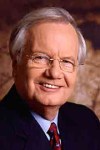
These are some of my favorite excerpts from an inspiring speech by one of public television’s long-term heroes, Bill Moyers. He delivered the speech in November, 2010 at a gathering of public television programming executives…

“The core problem is that we still don’t have an expansive national vision of what we’re about, where we want to go and what we want to become. Until we are able to say clearly and comprehensively what it is we really want to do, how much it will cost, and how we intend to get there, we can’t blame Congress, the White House or even the foundations for not supporting us more fully.

…There’s a huge vacuum between the [public television] system, nationally and locally, and the big foundations and no one has yet been inspired or capable enough to link the two at the level of a consensus national plan.

There are always people who remain afraid of change or an unknown process, fearful of where it might lead.  But by contrast, the British and Canadians go through periodic charter reviews that invoke a national conversation; there’s a culture of discussion and planning for public media in those nations that help them survive even the worst assaults from detractors or vested interests. This could be a reason that public support for public media in nations like the U.K. exceeds $80 per capita, while we’re still limping along on $1.49 per capita.

…In the meantime, I’m here to tell you that even within the fiscal crisis public television currently faces, we have an opportunity to serve the public — to renew our bond to our communities.

You may not have money for in-depth documentaries or other high-end productions but you have cameras, microphones, studios and the trust of the community. You can be the ombudsman for the public within your reach, provide the venue for forums, teach-ins, town meetings, and debates over the issues that matter to people where they live, telecast in an atmosphere of openness and clarity without the mean and mindless rhetoric or cant that are so triumphant today. Civic engagement is the lifeblood of democracy and the bedrock of its legitimacy. No media can nurture, foster, and empower it the way we can.

…Meanwhile, let me offer just a few other ideas for you to consider:  Take a whole evening of primetime and give it to a forum for the fight in your neighborhoods over charter schools. Do the same for other distressed public institutions — your libraries, for example.

Or how about one week inviting as many social workers as you can get into your studio and asking them to share what they see every day — how people are coping each day with these worst hard times?  Do a series of workshops on Occupy Wall Street, pro and con.  Out there in Iowa, find the lady carrying the placard I saw last weekend on television that read: “I couldn’t afford to buy a politician so I bought this sign.” Bring her into the studio with her local member of Congress — have them talk frankly to each other about their different perceptions of money in politics. Do an evening of primetime on the fight going on right now in your state over redistricting — gerrymandering — the outcome will influence your state’s position and power for the next 10 years. Get folks aware and involved. If you don’t, who will? Certainly not the commercial stations in your market, that’s for sure.

…since David H. Koch of Koch Industries is on the board of both WGBH and WNET, I’d ask him to round up his billionaire buddies — and in a nonpartisan spirit reach out to civic-minded progressive billionaires like George Soros — and together create an independent, fully endowed, self-governing production center (free of any partisan strings or influence) for American drama that would bring our epic history and culture to the screen just like we’ve brought over the Brits’ Downton Abbey, make room for Jefferson’s Monticello! Now, there’s an Upstairs Downstairs story the public would make a pledge to see.

…What we need is a makeover of our own — a rebirth, yes, of vision, imagination, and creativity, but above all a structure and scheme for the 2lst century, one that uses the resources that the digital platform provides to realize the goals of our founders: diversity, public access, civic discourse, experimentation, a welcoming place for independent spirits.

The whole speech–including his idea for public television’s equivalent of a constitutional convention– can be found here:

http://www.current.org/pb/pb1122moyers-remarks.html

Google’s Eric Schmidt’s McTaggart Lecture

http://www.guardian.co.uk/media/interactive/2011/aug/26/eric-schmidt-mactaggart-lecture?INTCMP=ILCNETTXT3487

That’s the link to an extraordinary speech by Google executive Eric Schmidt. He paints a clear picture of Google’s convergence plans for/with television.

And/or read the speech’s text here: http://www.guardian.co.uk/media/interactive/2011/aug/26/eric-schmidt-mactaggart-lecture-full-text

Power of the Press

http://www.huffingtonpost.com/2011/09/11/911-september-11-newspapers_n_957297.html

Admittedly, I am writing and you are reading on a device that is rapidly destroying print media.

Still, it’s worth the time to browse the ways that today’s remembrance was visually presented on newspaper front pages in US cities and throughout the world. There are so many lessons here: about journalistic priorities, visual communication, heart and soul, and more.

No other medium can do this.