Pastrami…on the road

(Hey! Don’t start here!! Start with the first part of this article.

When we last met, we discussed the excellence of the pastrami sandwich available at Manhattan’s Second Avenue Deli and Katz’s. If you’ve let a week go by without one of their sandwiches, there’s still time to correct the error of your ways.

Once a familiar sign throughout the five boroughs (okay, maybe not Staten Island), the kosher delicatessen is becoming an endangered species. (Those three Hebrew letters, read from right to left, spell the word Kosher, but some also feature non-Kosher foods on the menu.)

With David Sax as our guide (see his book, Save the Deli), we first travel to the Bronx for “hush puppies”–little hot dogs wrapped in potato–at Liebman’s, which carries a full New York deli menu, and continues a generation-old tradition. It’s a neighborhood place, worth the easy trip from Manhattan. Then, not so far from Yankee Stadium, there’s Loeser’s, a comfy old fashioned place that David describes in his blog. In Queens, the queen is Ben’s (with restaurants on Long Island and Manhattan), but neighborhood places like Buddy’s remain.

Knishes from Knish Nosh in Queens (and now, in Manhattan, too!). They don’t get much better than this.

While in Queens, there is one place where you must eat. It’s called Knish Nosh (for the uninitiated: a Knish [KUH-nish] is a large baked dumpling, and Nosh is casual eating, nibbling–the noun form would be a nosh, and the verb form, noshing). Few may disagree, but this is probably the place to buy the best knishes in New York City (maybe even the world). Potato or kasha would be the purist’s choice, but mushroom, mushroom/carrot, sweet potato, and spinach would also score on a top knishes list. And–who knew?–there are now Knish Nosh outposts near Central Park and 106 Street, near CitiField (where the NY Mets play) around Flushing Meadow Park, and in Florida, too.

In Brooklyn, where there may have been as many kosher delis as churches, choices are few, but the few choices are good ones. There’s Adelman’s, a throwback to the era when Brooklyn might have been the center of the world, and here’s a rundown on the others–with pix of tasty sandwiches.

A good home-cured corned beef sandwich served in Newark, NJ at the long-running Hobby’s.

Across the Hudson, Hobby’s Deli is all that remains of a once-grand tradition in downtown Newark. It’s favored by the city’s power elite, quite the place to meet friends and business associates while enjoying a corned beef or pastrami sandwich. In northern New Jersey, it’s Eppes Essen in Livingston, and others celebrating the old style, often with a more generalized deli menu alongside the kosher favorites. Outside of NYC and its suburbs, demand is lower, so options are few. Philadelphia has Famous 4th Street, and Baltimore, Attman’s, where you can enjoy a terrific sandwich and then wander by the Inner Harbor or Fell’s Point, both nearby.

Old-style delis are famous for pastrami and corned beef, chicken soup and kneidlach (matzo balls), but there’s nothing quite like a kosher hot dog. In fact, there’s a wonderful category of Jewish sausages–frankfurters, “specials” (fat hot dogs), Kosher bologna, Kosher salami (soft or, for connoisseurs, the garlicky hard version). Here’s Nate N’ Al’s take on the simple dog.

For old-style New York City deli, however, you’ll need to follow the Jews to southern California. Nate n’ Al’s is the Beverly Hills institution–the place where Larry King and half of the entertainment industry seem to gather on a regular basis. The sandwiches are worth the trip (for years, my NYC-LA routine required lunch at Nate n’ Al’s immediately after landing at LAX). Here, the sandwiches are special, but it’s the chicken soup that reminds everyone of their bubba (translation from the Yiddish = grandma). Sax calls it “some of the finest chicken soup known to man–a wide bowl of silky broth dominated by a single, almost meaty matzo ball.” He also recommends the kishke (KISH-kuh) at Brent’s–a once-standard, now hard-to-find slice of Jewish sausage made by stuffing a cow’s intestine with matzo meal and schmalz (chicken fat); remember, all of this is based upon peasant food! (In fact, kishke is delicious, but only when freshly prepared; the frozen alternative is just awful.) One LA old-school favorite is found downtown, near the La Brea Tar Pits (no, it’s not that old): Langer’s. Here, it’s all about the perfect pastrami sandwich. Again, Sax:

How do you describe the taste of a perfect pastrami sandwich?…The specific flavor profile–at once peppery, smelling of the sea, and hinting of butterscotch–would sound contradictory and confusing. Any turn of phrase or illustrative metaphor–how the peppercorns and salt and sugars dazzled my taste buds like a Chinese New Year’s fireworks show going off in my mouth00would never measure up to the real thing. It is simply legendary…”

So it’s off to Las Vegas, where the casino outposts of the Carnegie and Stage Delis smell as sweet but taste nowhere near as good as the NY originals, and then, down the road to nearby Henderson, where New Jersey’s Michael Weiss takes the craft seriously, and “pickled his own corned beef and tongues, cured and smoked his own pastrami, and baked his own bread and pastry,” according to Sax. The result is deli magic. Deli done right. Worth a trip just to rediscover the roots of this fading cuisine. Houston is home to “a traditionalist succeeding jun a modern market”, Kenny and Ziggy’s, where “the giant noodle kugel [pudding] had the consistency of a soufflé.” Watch them on Food Network.

Outside the U.S., three delis belong on every foodie’s bucket list.

The first is Schwartz’s in Montreal, where the smoked meat sandwich more or less combines all that is sacred about corned beef and pastrami. Here, the spectacular sandwich begins as “raw brisket from Alberta” which is then “rubbed with a mixture of coarse salt, cracked peppercorns, and Schwartz’s special spice mix, which involves much less sugar than a New York style pastrami, with more pepper and fewer aromatic spices. Briskets are then cured in plastic barrels for a…week…ready to enter the smokehouse…stained with burnt fat and old spices…[where they] smoke for five to seven hours…” (While in Montreal, be sure to sample the uniquely sweet, smallish, delicious bagels from St. Viateur.

The second must-visit is to B&K Salt Beef Bar, home to “stupendous” chopped liver (made from ox, not chicken, as is the US tradition), followed by a sandwich of either hand-cut tongue or salted beef, cured for a remarkable two-and-a-half weeks. Both are made with good Scotch beef, and that makes all the difference.

The third diverges from the peasant food history. It’s located in Antwerp’s diamond district. Hoffy’s treats delicatessen as fine food, with small portion sizes (take that, Carnegie Deli!). Start with the pickles, which are always difficult to get right. In New York delis, the brine must contain the right balance of salt, dill, garlic, and other herbs and spices–otherwise, they just don’t taste like sour pickles or, with a different recipe, half-sours. Here at Hoffy’s, the focus is on the garlic, and the flavor soars. Meats are lean (never the case in a New York deli), extremely tender (similar to NY deli), and according to Sax, the best is the veal–a meat not often associated with NY deli–“creamy pink and tasted almost sweet.” Portions are small, and elegant: bite-sized portions of stuffed cabbage, gefilte fish, chopped liver, and apple kugel.

There are so many Jewish specialities, so many variations, such unique flavors and delicacies, each wrapped in years of tradition. Blintzes and lox, the bialy and the plateful of rugeluch; the mushroom barley soup and latkes. But the tradition is fading. The people who opened the delis came from an Eastern Europe that no longer exists. There will be no more Jews with the old traditions emigrating from Poland or Lithuania or the Ukraine. They’re gone. There are fewer Jewish neighborhoods to support the delis–the people who used to live, in great (but poor) communities, in Brooklyn or lower Manhattan now live with everybody else. The small delis can no longer support themselves–except in areas where the tradition lives strong, as it does, largely due to the Jewish show business community, in Los Angeles. And yet, this is a cuisine worth nurturing, worth embracing. How? I guess that’s why Sax calls his book Save the Deli! Without a concerted effort, the few remaining delis will be gone, and with them, a great cuisine may vanish, or, perhaps worse, may be reduced to Nathan’s hot dogs, Einstein’s bagels, and the occasional frozen knish.

Long may it wave! A corned beef sandwich from Attman’s in Baltimore, founded 1915. Will they survive the next 100 years?

The Google of Its Day

No, it’s not easy to detect the precise moment when the trouble began, when the world began to change, when everything that worked for a century suddenly stopped working. There are theories, and books written, and somehow, the old ways seem distant, and inconceivable in their naiveté. And there are new ideas, new companies, new ways of thinking and connecting that don’t much resemble the old. But one thing is clear: everything else may change, but in my world, in your job, in our town, everything is going to be just fine if we just cut some costs, say the magic words “social networking” three times daily, and reinforce one another’s thinking about the value of maintaining the status quo.

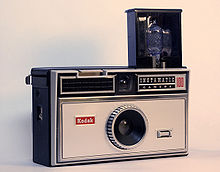
I keep thinking about Kodak. George Eastman was 24 years old when he (and other hobbyists) figured they could build an industry by making photography easier. From 1878 until 1883, he opened a factory, and by 1888, he was selling shares. He struggles to find a market in the US, finds one in Europe, brings it all back home, and by 1900, Kodak is the hot start-up company. It sells cameras for $1 and rolls of film for 15 cents. By 1907, Kodak employs 5,000 people (about the number it employs today). By 1914, Kodak builds a skyscraper. By 1924, George Eastman gives half of his $75 million (in today’s dollars, $2 billion) fortune to charitable causes–including $12 million in start-up funds for what becomes MIT. In 1932, at age 77, Eastman kills himself (the suicide note read: “Why wait?”). Still, Kodak kept on growing: in 1935, Kodak introduced Kodachrome color slide film, in and jumping ahead to 1962, Kodak sales exceeded $1 billion, and the company was heavily invested in future technologies, a strategy employed well into the 2000s, when the company was an early leader in digital photography at all levels, from medical imaging to consumer cameras.

Kodak was the Google of its day. — The Economist (see history or official Kodak history)

Today, Kodak is almost non-existent. Nearly gone. After closing its factories, leaving the camera business and nowadays, selling off its patents, a century’s success is fading like the (Polaroid) snapshot in Back to the Future 2.

Why did Kodak fail? Some theories:

Kodak did not fail because it missed the digital age. It actually invented the first digital camera in 1975. However, instead of marketing the new technology, the company held back for fear of hurting its lucrative film business, even after digital products were reshaping the market. — Forbes.

And then there are companies like Kodak — which saw the future and simply couldn’t figure out what to do. Kodak’s Chapter 11 bankruptcy filing on January 19 culminates the company’s 30-year slide from innovation giant to aging behemoth crippled by its own legacy. — Knowledge@Wharton

The company might have been able to innovate more quickly on the digital front if it had set up a separate lab in Silicon Valley, then allowed it to grow independently and tap into the area’s tech culture and expertise.” — Knowledge@Wharton

And what should Kodak have done?

— Enter the cell phone business? It tried this a bit. Didn’t work.

— Recognize that it was really in the memory business and diversify into storage? Nice try.

— Increase its R&D? Kodak did that, spending most of the money on improving film technology.

— Diversify into healthcare? It did that too. Didn’t work.

— Spin off its chemical business? It did that, generating some cash. But small potatoes.

— Integrate backwards into semiconductors? Way out of its competency.

In the end, Kodak (now on the brink of bankruptcy) was a well run company that failed. It was an early technology company, and it never lost its technology roots. It then became a marketing behemoth and a superb consumer company. It then morphed into a financially run enterprise and it did that well–until it failed. — Information Week

And what does this mean for the rest of us?

That’s a question I want to explore in future blog articles. Clearly, the digital revolution in motion, gaining considerable momentum as the spookiness of the dot.com bubble fades from memory. I would imagine that schools and education will be the next frontier, the next “it can’t happen here” that will be utterly transformed, but there are significant political and economic class issues driving the status quo. I wonder whether the top ranks of the Fortune 500 will continue to be dominated by companies associated with cars and fuel in thirty years (remember: thirty years ago, Kodak was still hot stuff). We’re been seeing tremendous technology-driven changes in health care, and now, with new rules and an increasingly stable economy, and the dreadful statistics about health care needs of aging baby boomers, the opportunities in this area seem rich, particularly in the digital space (tele-medicine,  patient education, digital tracking of patience care, etc.)

Infographic: US Education Spending vs. Results

Doing some research, I came upon this colorful infographic that compares educational investment and results in a dozen different countries. No big surprises, but it’s easy to follow. It’s clear that Mexico spends a very small amount per student and achieves only modest results, and it makes sense to see France in the middle of per-capita spending and also in the middle of the results. Clearly, the US and the UK are out of whack–spending is high, but their results are middling. Why the mismatch? And why is the US’s purple circle so much larger than any other circle? Population accounts for only part of the reason why.

U.S. Education versus the World via Master of Arts in Teaching at USC
Via: MAT@USC | Master’s of Arts in Teaching

Avoiding Long-Term Commitment: The New Job Market

I was surprised to learn that most college presidents last about six years before moving on. A friend, who consults in the space, explained, “in many institutions, it’s just an impossible job.” Browsing through my LinkedIn connections, my first connection (his last name begins with “A”) is Len, a PR guy. Len has occupied nine different jobs since 1986; his longest stint was 6 years, and in today’s marketplace, that seems to be both (a) rare and (b) a long time. The February, 2012 issue of Fast Company ran an article entitled “The Four-Year Career” and declared “career planning” to be “an oxymoron.” The article points out that the average U.S. worker’s median level of job longevity is just 4.4 years.

The job market can be enormously frustrating, but deep down, most people understand that the economy is shifting–and that companies require employees for a period of years, not decades. In five years, Facebook has increased its her base from 10 million to 800 million; the first million Palm Pilots sold out in 18 months, and the first million iPhone 4s units sold in 24 hours; eBooks accounted for 1% of consumer trade books sold in 2008, and now, the number is over 20%. As the pace of change accelerates, the need for the same employees in the same seats evaporates. And, to counterbalance, as the pace of change quickens, the reasons why an employee would want to remain in the same seat for, say, five years, become less compelling for individuals in pursuit of active, productive careers.

But wait! There are at least two more pieces to the puzzle.

Cheryl Edmonds, featured in the Fast Company article about Four-Year Careers. To read the article, click on Cheryl’s picture.

The first is career switching. Not job swapping, but wholesale shifts in careers. Returning to the Fast Company article, Here’s Cheryl Edmonds, age 61, who shifts from engineering (1977) to a retail art business (1988) to corporate marketing at HP (1995), then heads to China to teach English (2009) before landing a fellowship with Metropolitan Family Services in Portland, OR (2011) in hopes of finding a new career in the nonprofit sector. Whether the person is 30 or 60, we’re seeing lots of these stories–people navigating the career marketplace as they might choose their next dog (whose longevity is likely to be longer than any current job), or vacation.

The second missing puzzle piece is formal education. Old thinking: go to college, train for a career, get a job, go up the ladder. Now, not so much, certainly not for a large population of liberal arts majors, and nowadays, even law school graduates are encountering a much-changed market for their trained brains. How to provide a proper college education for the likes of Cheryl, above? Marketing major? Engineering major? Liberal arts major? Get a degree, work for a few years, get another? I know a young woman whose college debt exceeded $100K, paid off half of it by taking a corporate job in supply chain management (thrilling!), hated it, sold real estate for a minute-and-a-half, then ended up in nursing school where she picked up a new $50K in debt to add to the unpaid $50K from her first degree. So here’s a system that’s not working very well at all.

On the positive side, all of this tumult leads to a far higher degree of personal control over one’s life than ever before. It also leads to a way of thinking that is counterintuitive for many Americans–if you are going to enjoy this degree of control, you need to think differently about your financial expectations, and about the management of your money. Multiple jobs in a single industry–you can expect to earn more money with every step up the ladder. Multiple careers–you will experience lateral steps, and you may earn less money in the next job, perhaps for a while, perhaps for a long time. (Freedom is not free.) For the entrepreneurs and business wizards among us, the constant jumps present fabulous opportunities to build wealth. For those who do not want their lives to be dominated by work, for whom a 40 hour week is more than enough, the less-fluid government and nonprofit sectors may be better places to work, but even employers are beginning to think twice about the ways they have operated for so long.

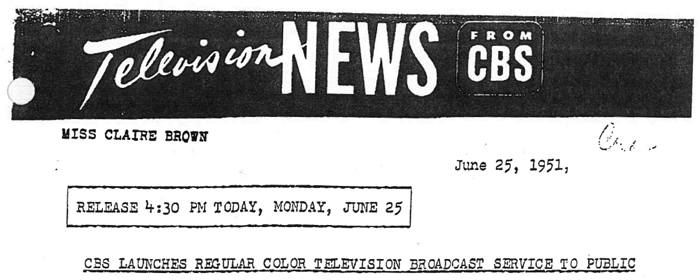
FROM: Miss Claire Brown, 6/25/1951……RE: Color TV

History marked time for one memorable hour today, and within its span, the promise of the greatest of all the miracles of mass communication became a reality.

At 4:30 PM, Eastern Daylight Time, color television’s triumphal entry into the public domain was emblazoned officiallyacross the log of man’s progress. In the 60 minutes that followed, this newest ,miracle among the electronic marvels was born.

Premiere, the Columbia Broadcasting System’s widely heralded full hour of star-studded entertainment, featuring Arthur Godfrey, Ed Sullivan, Faye Emerson, Garry Moore, Sam Levenson, Patty Painter, Robert Alda and Isabel Bigley, the New York City Ballet, the Bil Baird Marionettes, and Archie Bleyer’s Orchestra, took its place in history as the first commercial color television broadcast to the public. Brief addresses by Wayne Coy, Chairman of the Federal Communications Commission, William S. Paley, Board Chairman of the Columbia Broadcasting System; and CBS President Frank Stanton signalized, in a dedicatory vein, the start of regular color television broadcast service to the public by the CBS-TV Network.

The history-making broadcast was carried in New York by WCBS-TV, as well as by CBS-TV Network stations in Boston, Philadelphia, Baltimore and Washington, D.C., the color signals going out over the stations’ regular transmitters and on their regular channels.

Originating in CBS-TV’s Studio 57, at 109th Street and Fifth Avenue, New York, the color program was transmitted from Studio 57 by coaxial cable to CBS-TV’s Master Control in the Grand Central Building, New York, and carried from there by telephone cables to the WCBS-TV transmitter and by cable to the network. Thousands of the public, as wellas public and industry leaders and members of the press, saw the color inaugural in the five cities carrying Premiere. Many of the public who had completed home made conversions of their black-and-white sets also wereable to see the historic broadcast in color in their homes. Typical were the two junior high school youngsters in Newark who last week revealed they had been watching CBS color television transmissions for the past 18 months.

In New York, Mrs. Eleanor Roosevelt and Bernard Baruch were among the dignitaries and newspapermen who watched the inaugural on color receivers installed at CBS headquarters. There were also several showings in New York by dealers who are making color television eqUipment which they soon will have ready for the public. Among these were Colortone Inc., which had more than 400 dealers watching the inaugural on sets installed in its downtown headquarters, and Muntz-TV, which showed its new companion-piece in action to the public at its Queens headquarters.

In Boston, the public watched the program on a receiver set up in the Jordan Marsh Department Store, first store in the country to order color television equipment florstore use; Boston public leaders the press viewed the broadcast on CBS-Columbia sets installed in the Hotel Somerset’s Grand Ballroom.

The Philadelphia public saw the color show on a set installed in the lobby of WCAU, CBS affiliate, with clients, public leaders are press watching the program on another color set in the WCAU Auditorium. Baltimoreans viewed the show on sets installed by WMAR-TV in the lobbies of the new Sun Building and the old Sun Building. In Washington, D. C., WTOP-TV had sets in the Warner Building and at its transmitter at 40th and Brandwyne. In addition top government officials viewed the color inaugural on a set in the Hotel Carleton.

The Premiere broadcast was a breathtaking spectacle. His famous red hair and freckles lent an added brilliance to the wit and charm ofArthur Godfrey as he sang and quipped; a  bronzed Ed Sullivan greeted a new audience in a. setting vibrant with full, natural color; Faye Emerson was hostess. On still another stage that brought to viewers all the richness of paintings from the Metropolitan Museum of Art and ·the Museum of Modern Art; and members or the New York City Ballet “were ecstatically colorful in Maurice Ravel’s “La Valse,” staged by Sol Hurok with choreography especially for television by George Balanchine.

“Photo Credit: Ralph Morse / Time & Life Pictures / Getty Images”
“Licensed by Getty Images to Ed Reitan” – (photographed off the screen)
George Balanchine Ballet from “Premiere”
The first commercial CBS Color Television System Colorcast
June 25, 1951

Garry Moore and Sam Levenson added a note of comedy mixed with philosophy, against a setting as vivid as their artistry; Robert Alda and Isabel Bigley of the smash Broadway musical Guys and Dolls sang a duet; the Bil Baird Marionettes cavorted in a riot of hues; and “Miss Color Television” herself, Patty Painter, a. veteran of more than 1,000 CBS color demonstrations and transmissions, brought to life the full, rich, rich colors of the commercial products introduced by the new medium’s pioneer advertisers.

Sixteen national advertisers participated in the epoch-making inaugural, constituting what is believed to be the largest such group ever to sponsor collectively a single network broadcast. The pioneering advertisers were General Mills, Lincoln-Mercury Division of the Ford Motor Company, Longines-Wittnauer Watch Company Inc., Pabst Blue Ribbon Beer, William Wrigley Jr. Company, Revlon,Thomas J. Lipton Inc” National Biscuit Company, Toni Home Permanent, Monarch Finer Foods, Procter &Gamble Company, Standard Brands Inc., Quaker Oats Company, Best Foods Inc., Pepsi-Cola Company and Liggett & Myers Tobacco Company.

Fred Rickey, executive producer for color at CBS, produced Premiere and shared directorial duties with Frances Buss, under the over-all supervision of Jerry Danzig, CBS color program supervisor. Set designers were Paul Sylbert and Michael Baronoff.

The launching of CBS’ regular color television broadcast service to the public was accomplished merely by the addition of the three color cameras, plus monitors and associated control room equipment, to black-and-white studio facilities already existing before the inaugural program in Studio 57, which was chosen for the color broadcast simply because it had suitable time availabilities.

So effortless was the inauguration or regular color television service that the necessary technical work and installations in the studio were made in a 12hour period, between 10:00 PM last Wednesday, and 10:00 AM, the following morning, when rehearsals for the first commercial color telecast started.

A cue, thrown this afternoon from the control room of CBS·TV’s Studio 57 to technical personnel on the studio flooritself, opened the color Premiere. A still life picture of an orchid and a book was transmitted to waiting thousands, and the curtain was raised on history’s first commercial color television broadcast.

Today’s inaugural broadcast, establishing regular color television service to the public by CBS-TV, will be followed by daily morning and afternoon network-programs, commercial and sustaining, beginning tomorrow. A pattern of gradual expansion will be carried out, with a color schedule of approximately 20 hours a week expected by fall.

First of the regularly scheduled color programs, which will have its premiere tomorrow (Tuesday, June 26), is titled The World Is Yours! and features Ivan T. Sanderson, noted naturalist. The five-times-weekly show (CBS.Color TV, 4:30-5::OO PM, EDT. Mon. thru Fri.), “starring the earth’s natural treasures,” will be sponsored in its initial telecast by General Mills. Frances Buss will direct the CBS production, in cooperation with Ivan Sanderson Productions Inc. The World Is Yours! will present the wonders of the animal, vegetable and mineral worlds as “a sort of intellectual vaudeville show, informal in manner and functioning without benefit of script, featuring Ivan Sanderson and his “friends, II who comprise a bewildering array of nature’s creatures, including distinguished representatives of the human species. A frequent Visitor and featured participant will be Patty Painter, “Miss Color Television.”

Second or the regularly scheduled color programs, Modern Homemakers,” will make its bow before the color television audience, as a five-a-week series, on Wed., June 22 (CBS-Color.TV, 10:30-11 AM, EDT Mon. thru Fri,).

A cookery and homemaking program conducted by culinary expert Edalene Stohr, Modern Homemakers will specialize in menu-planning, food preparation, and demonstrating the eye-appeal of well-prepared foods, with emphasis on other facets of homemaking as well.

Opening of regular color broadcasting acted as an additional spur to the public to order color equipment from television dealers. Manufacturers or color TV adapters and converters reported they are receiving thousands of calls for such equipment. Typical was Arnold H. Klein, Vice President of Colortone Inc., who said his company was turning its full facilities over to the production of adapters, and that he expected to have 3,000 units in the hands of distributors by the weekend. He said he had received calls for more than 5,000 sample units from leading department stores and distributors from all over the country.

More info. A complete rundown on color TV’s early history. And, a review.

Big Empty Boxes

Just in case you missed it, Slate published an interesting article about a new Amazon strategy that could turn the remaining big box stores into empty boxes. After a decade of placing warehouses in far-off places, Amazon is investing more than $1 billion in warehouses near large population centers, near New York City, Philadelphia, Washington DC, with up to ten warehouses in California, and more. With warehouses so close to large numbers of customers, Amazon will likely offer next day delivery for very low prices, and, perhaps most intriguing, delivery within just a few hours of online purchase. That’s the part that makes me wonder about the future of visiting, say, Staples or Best Buy, or, for that matter, my local supermarket. The term “complete domination of the retail industry” comes to mind.

Sure, it’s the natural evolution of business. The local hardware store is eliminated by Home Depot, and a few decades later, Home Depot is eliminated by an online service that requires no retail presence at all. Yes, it’s dismaying to see empty retail stores. And yes, it’s pretty cool to see the iPad that you ordered at 11AM in your mailbox at 4PM the same day. It’s consolidation. It’s progress. And along the way, we eliminate some local jobs, become cozier with a 24/7 consuming lifestyle, and lose just a bit of social interaction. I don’t know if any of this is good or bad or something else entirely, but I’m pretty sure we all ought to be discussing these ideas and what they mean. There’s something distinctly creepy about just having things happen to us, to lose little bits of our towns and our stores to a high-efficiency corporation reliant upon new forms of robots to do the pick-and-pack. In time, I suspect deliveries will be made not by men and women wearing UPS uniforms, but logistical robots who drive better, don’t get lost, and know what time you’re scheduled to be home so the delivery can be made “in person.”

Gigapixel Images (Updated)

Consider this: your new-ish digital camera shoots images containing roughly 10 megapixels. That’s old news. All of the cool people are shooting images with 100 times as much resolution. Images with 1,000 megapixels!

Of course, these images are huge. Too large to print. But not too large to view on the web it’s difficult to take in the stunning clarity of the whole image, but it is fun to pick any part of the gigantic image and appreciate the clarity.

There are digital gigapixel panoramas, and digital gigapixel macro (close-up) images. But before you even consider making one yourself, you need to develop a plan and a process. think

in terms of shooting a series of panoramic images where the top, left, bottom and right sides must be perfected aligned with the image above, below and to each side. It can be done, but most tripod heads are not designed with this precision requirement. To do the job in the best possible way, take a look at the GigaPan EPIC Pro, a programmable mount.

Good video tutorials here.

If you’re interested in learning more, one very good source is the spring 2012 issue of a terrific new international photography magazine called c’t Digital Photography. Click here for access for past issues.

Here’s the world’s largest indoor image. Click to see the image the 360 cities site, where you can explore the Strahov Library in astonishing detail.

UPDATE: A team at Duke University posted a letter to Nature magazine. In a story published by DPReview, a theoretical design exists for a 960 megapixel camera that’s small enough to be used in the field. As they’ve imagined the new AWARE-2 camera, their work led to a design that arranges a series of cameras in a hemispherical arrangement, pointing at a single, spherical lens that the team have dubbed the ‘gigagon.’ The use of a single lens avoids the cost and complexity of having specialist optics on each sub-camera, while the curved design scales more easily than a flat array of cameras. The team believes this approach would continue to work for up to 50GP cameras.

From DPReview: “A diagram showing the hemispherical arrangement of the sub-cameras, and their relationship to the ‘Gigagon’ main lens (top right).”

Success! Good Health! Longevity! Fabulous Children!

You can do it! You’ll need a college degree and you’ll need to move to a place where 21st century America’s promise shines. Seattle, the SF Bay Area, New York City,

Boston, and the ring around Washington, DC.–those are the places where innovation is held in high esteem and is most likely to be funded so that new companies can be born, grow, and change the economic picture for employees, shareholders, and those smart enough to live nearby.

These are the places where venture capitalists fund big opportunities, and if a company seems promising, a VC will often require a move to, say, Silicon Valley, or not to fund the company at all. The “thickness” of the job opportunities in the Silicon Valley (and a very small number of other places), and the thickness of people with the necessary skills to suit those needs, not only attracts the best (and highest paid) people to these centers, where their high incomes tend to generate more jobs for the local economy (usually with salaries that are higher than even unskilled high school dropouts will find at home). If you’re an attorney, you’ll make as much as 30-40% more if you work in these areas than in an old rust belt city. The same is true for cab drivers and hair stylists.

Much has been made of Google’s employee perks; they won’t play in Hartford or Indianapolis, but neither of those places, nor most other American cities, see the kinds of financial results and spillover effects in the community enjoyed by the area around San Francisco. This is becoming the area that drives the American 21st century. And it’s very difficult for other cities to get into the game.

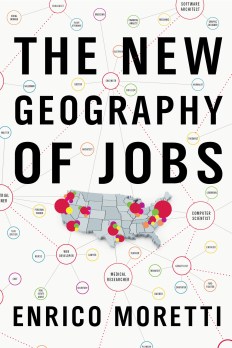
Author and UC Berkeley Professor Enrico Moretti has just published a book that presents a compelling picture of the much-changed US economy. The title of the book, The New Geography of Jobs, undersells the concept. Yes, if you can, you should move to any of these places, where you will make more money than you will at home–regardless of whether you are a high school dropout or a Ph.D. You will probably live longer, remain healthier, provide a better path for your children, live in a nicer home, have smarter friends, smoke less, drive a nicer car, you name it… the American dream lives large in San Diego, but in Detroit or Flint, Michigan, it’s gone and it’s not likely to return any time soon.

Average male lifespan in Fairfax, VA is 81 years. In nearby Baltimore, it’s just 66.

That’s a fifteen year difference. This statistic tracks with education attained, poverty level, divorce rates, voter turnout (and its cousin, political clout), lots more.

Want to remain employed? Graduate from college.

Nationwide unemployment rates: about 6-10% for high school only, 10-14% for incomplete high school, 3-4% for college graduates.

College degrees matter…far more than you might think. In Boston, with 47% of its population holding college degrees, for example, the average college graduate earns $75k and the average high school graduate earns $62,000. By comparison, Vineland NJ–just outside Philadelphia in South Jersey, has just 13% college graduates, and a college graduate earns an average of $58,000, with high school graduates at $38,000. Yes, it costs less to live in Vineland, but over a lifetime, people who live in Vineland are leaving hundreds of thousands of dollars on the table, perhaps as much as a half million dollars over a lifetime.

Real cost of college, including sacrificed employment: $102,000. At age fifty, average college graduate earns $80,000, but average high school graduate earns $30,000.

If a 17-year old goes to college, he or she will earn more than a million dollars lifetime. If not, it’s less than a half million.

What’s more, 97% of college educated moms are married at delivery, compared with 72% of high school-only grads. Just 2% of college-educated moms smoked during pregnancy compared with 17% with a high school education and 34% of drop-out moms. Fewer premature babies, fewer babies with subsequent health issues. Almost half of college graduates move out of their birth states by age 30. By comparison: 27 percent of high school dropouts and 17 percent of high school dropouts. The market for college graduates is more national; the market for non-grads is more local.

Caught in the middle? The best thing you can do is hang out with people who are pushing their way up the productivity curve. That is, MOVE! Leave the town where things aren’t happening, and take a job, almost any job with growth potential, in a place with high potential.

While the arguments about fencing lower-income immigrants out persist, most people earning graduate degrees today are immigrants. And a high percentage of people who start significant new businesses, funded by venture capital, are first generation Americans.

Today, an immigrant is significantly more likely to have an advanced degree than a student born in the US.

Foreign born workers account for 15% of the US labor force, but  half of US doctorate degrees are earned by immigrants. Immigrants are 30% more likely to start a business. Since 1990, they have accounted for 1in 4 venture backed companies. When they start a new business, they generate high-value jobs, which brings more money into the community (not any community, only the ones with a thick high-skill / high value workforce and a thick range of desirable jobs), and the people who fill these jobs generate more jobs in the retail and services sector, jobs that pay more in the high value areas than they do at home.

A century ago, investment money went to Detroit for its car industry, and to the midwest for productive factories. That era is ending. Innovation in the health sciences, technology, software, internet, mobile, and other fields is the driver of American productivity–but not everywhere. Clusters attract the best and the brightest from metros without the necessary thickness, leaving lesser places with fewer people who can make big things happen.

There is so much more here (sorry for the long blog post, but this is a very powerful book). We need to generate more college graduates, especially more men, and especially more people with STEM expertise (science, technology, engineering, math). We need to do a far better job in educating and creating opportunity (including opportunity for mobility) among those with fewer advantages. We’ve got a lot of work to do. First step: read the book!

A Book about Books

“I am an invisible man.”

“We were around Barstow on the edge of the desert when the drugs began to take hold.”

“On a sticky August evening two weeks before her due date, Ashima Ganguli stands in the kitchen of a Central Square apartment, combining Rice Krispies and Planters peanuts and chopped red onion in a bowl.”

So begins three contemporary books: Ralph Ellison’s Invisible Man (1952), Hunter S. Thompson’s Fear and Loathing in Las Vegas (1971), and Jhumpa Lahiri’s The Namesake (2003). One is about African Americans, another is about the counter culture, and the third opens with a view of new Americans, attempting to recreate a dish she recalled from her native India. Our tastes change with the times–only sixty years separate Ellison from Obama.

With so many words propelled at us each day, so many stories on so many media, there’s not much opportunity to consider the big picture, to develop a sense of the stories we are telling one another. I suspect that’s what caused English Professor Kevin Hayes to write A Journey Through American Literature (Oxford University Press).

In Hayes’s world, the word “literature” embraces poetry, travel writing, autobiography, and fiction. Whether Benjamin Franklin or Stephen Crane, Eugene O’Neill or T. Coraghessan Boyle, his examples consider the broad sweep of 250 years. His definition of literature includes bits of Seinfeld and The Simpsons, and acknowledges films as literature, too.

Skateboarding through media theory and aesthetics, Smithsonian American Art Museum is acknowledging videogames as art this summer. And I’m certain that every word in write in this blog, and every word you write in your email rants, will stand the test of time as great literature, too.

Yes, there is interesting, substantial work being done in all corners of art and media. Often, the work goes unnoticed, or receives a flash of publicity for fifteen seconds. It’s just too easy to forget about the good stuff until somebody says, or writes, “hey, this is worth a look!”

This summer, for me, Hayes is that somebody. Here’s a starter checklist:

  • Walden by Henry David Thoreau
  • The Adventures of Huckleberry Finn by Mark Twain
  • Their Eyes Were Watching God by Zora Neale Hurston
  • The Iceman Cometh by Eugene O’Neill
  • The Invisible Man by J.D. Salinger
  • Travels with Charley by John Steinbeck
  • Beneath the Underdog by Charles Mingus
  • China Men by Maxine Hong Kingston
  • The House on Mango Street by Sandra Cisneros

Yes, Hayes is an English professor. No, I will not write a term paper, nor will I abide by any deadline. This time, I’m not reading for the professor or the course or the grade. I’m reading for myself. And I plan to read these books not on a screen, but through the ancient technology of ink on paper. Some, I will buy in a used bookstore, some I will buy from the NEW bookstore that just opened not a mile from my home, some I will borrow, at no charge, from a good local public library.

Welcome to summer!

Go-Anywhere Hard Drives + MacAir Storage Ideas

This year, one of my projects has been a documentary about my father. I shot the documentary with an professional HD camera, edited in Adobe Premiere Pro on an iMac, and found myself in a mess of troubles. Then, I learned that serious editing requires an external hard drive. I’ve become a fan of these small devices, in part because they speed up the process and reduce crashes, and in part, because it’s easy to tote the whole project from one computer (at my home) to another (in my office, an hour away). When files are especially large, it’s helpful to bypass digital transfer via ftp and the like, and simply ship the entire drive from one place to another.

Mostly, I’ve been using  GoFlex Pro drives from Seagate. All of the images, video, and audio files that I recorded in the UK in May are now on a 750GB drive that costs about $125. It’s about 3 inches by 5 inches by a half-inch thick, and weighs about a third of a pound. At 7200RPM, it’s fast. It comes with a removable cable adapter, so you can use it as a FireWire 800 drive (for video editing), or as a USB 2.0 drive (offering about half the data transfer speed of FireWire 800, but useful because not every computer includes a FireWire 800 jack). Facing the future, you can buy a Thunderbolt adapter, which allows a connection that’s a dozen times faster than FireWire 800. The flexibility may be useful, but the cost is high: a $90 adapter for a drive that costs $125. (Note that Thunderbolt portable drives are not yet available, and that Thunderbolt desktop drives are still quite costly.) In any case, this drive is designed for use by either a Mac or a Windows computer.

If you haven’t explored portable external drives in a while, you’re likely to be surprised by their appealing combination of small size, light weight, high capacity, speed, and reasonable price. Some even come in colors (not sure why this is important, but it is a trend worth noting). Whether you’re buying for back-up, for convenience (no need to bring your laptop; just bring the drive), or for special projects, they’re worth a look.

What’s more, if you’ve got your eye on one of those new MacBook Air models, the portable drive adds a lot of storage without requiring a large investment in dollars or weight. Buy an 11-inch with just 64GB internal storage for $999 from Apple, then spend about $125 more to increase your available storage by 750GB (with USB 2.0, you’ll be transferring at a half a gig per second, not speedy, but certainly acceptable for most uses). Better yet, spend $225 for 10 GB per second Thunderbolt speed–Thunderbolt is now standard on every Air. By comparison, you may beef up storage with a 64GB or 128GB SD card, but transfer speed is under 100MB per second, a whole lot slower than other options. Below, left-side and right-side views of the new Air, showing both USB 3.0 and Thunderbolt connectors.