Big Ideas Simply Explained

Three subjects that I can never seem to understand as completely as I would like:

  • Philosophy
  • Economics
  • Psychology

Whenever I read a book about any of these subjects, I feel like a student, which means, I am reading because duty requires me to complete the book. The subjects interest me, but too many of the books I have read on these subjects are dreary, slow-moving, too dense with ideas for any reasonable person to sort out and retain their valuable understanding. Pictures help, but many of the ideas held within these disciplines are difficult to illustrate with anything better than wordy diagrams.

A year or so ago, I noticed a series of three books put together by Dorling Kindersley (DK)’s collaborative teams in the UK and India. They’ve got the formula right, and as a result, I have spent the last year happily browsing, and learning, from:

  • The Philosophy Book: Big Ideas Simply Explained
  • The Economics Book: Big Ideas Simply Explained
  • The Psychology Book: Big Ideas Simply Explained

A month or so ago, the same company released The Politics Book: Big Ideas Simply Explained, and at some point, I’ll get to that one, too. Right now, I’m still working my way through the first three volumes (about 1,000 pages total).

Three DK BooksSo what’s so special?

First,there is no single author. The collaborative approach focuses on presentation, clarity and consistency. This is less the work of a brilliant psychology teacher, more like a good old fashioned browse through, say, The World Book Encyclopedia from days of old. The type treatments are bold. There are pull-out quotes. There is color. No single idea runs more than a few pages. Everything is presented in a logical flow. There are boxes filled with biographical details. There is a clear statement of predecessor ideas and influences for each idea, and there is an equally clear statement about those in the future who built upon each idea. There are color pictures and diagrams. It’s tidy, presented for smart adult readers but certainly suitable research material for any school report.

The Philosophy Book is written by four academics and two writers: Will Buckingham is a philosopher and novelist with a special interest in the interplay between philosophy and narrative storytelling. Marcus Weeks is a writer, and author. Clive Hill is an academic focused on intellectualism in the modern world. Douglas Burnham is a philosophy professor and prolific writer on the subject. Peter J. King is a doctor of Philosophy who lectures at Pembroke College, University of Oxford. John Marenborn is a Fellow of Trinity College, Cambridge, UK, whose expertise is medieval philosophy. Taken as a group, they’ve got their philosophical bases covered (each of the books is put together by a team with similar skills). Marcus Weeks is the connection between all three books.

The bright yellow Philosophy book introduces the whole idea in comfortable language:

Philosophy is…a chance simply to wonder what life and the universe are all about…Philosophy is not so much about coming up with the answers to fundamental questions as it is about the process of trying to find out those answers, using reasoning rather than accepting…conventional views or conventional authority.”

So begins an introductory essay that introduces debate and dialogue, existence and knowledge, logic and language, morality, religion, and systems of thought and beliefs. A red color burst is the bridge into a timeline that begins the conversation in 624 B.C.E. And so, early on, we meet Pythagoras, who should be famous for more than his geometric theorem. In 428 B.C.E.–that’s about 2,500 years ago–Pythagorus developed a remarkable idea, that everything in the universe conforms to mathematical rules and ratios, and determined that this was true both of forms and ideas. Pythagorus was the leader of a religious cult, in which he was the Messiah, and his followers thought of his work as revelations. Here was a man for whom reasoning was the secret of the universe. He wrote, or said:

There is geometry in the humming of the strings, there is music in the spacing of the spheres.”

And:

Reason is immortal. All else is mortal.”
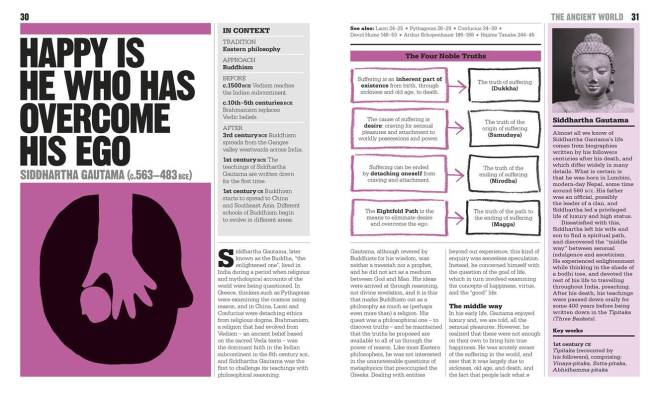
SiddharthaTurn the page and there’s Siddhartha Gautama and Buddhism’s four noble truths, explained in terms that anybody can understand, followed by the Eightfold Path presented in the Dharma Wheel. Siddhartha is covered in four good pages, and then, it’s time for Confucius and his Five Conscious Relationships.

All three of these men–Pythagorus, Siddhartha and Confucius–lived and worked around 500 B.C.E. More or less, they were contemporaries. A century later, philosophy turns to what is later called science, as Democritus and Leucippus come with the idea of atoms and the emptiness of space. (Seemed very early to me, too!) At about the same time, this from Socrates:

The life which is unexamined is not worth living.”

Jumping ahead to the middle of the book, Britain’s David Hume is considering human nature in the mid-1700s, and, in particular, the ways we cobble together facts:

In our reasonings concerning fact, there are all imaginable degrees of assurance. A wise man therefore proportions his beliefs to the evidence.”

Thinking in the present day, Palestinian philosopher Edward Said criticizes imperialism, Australian Peter Singer advocates for animal rights, and Bulgarian-born French philosopher Julia Kristeva questions the relationship between feminism and power. It’s a large field, and with The Philosophy Book, it’s possible for the average person to navigate with greater confidence than before.

The other two books are equally good.

The Economics Book begins with an article about Thomas Aquinas’s thoughts on prices, markets, and morality; the provision of public goods with thoughts by David Hume, whose words from the 1700s certainly resonate today:

Where the riches are engrossed by a few, these must contribute very largely to the supplying of the public necessities.”

Hume is among the few whose ideas appear in more than one of these volumes. And–I just noticed–The Philosophy Book tends to be stories about the people behind the ideas, The Economics Book tends more toward the ideas with less frequent stories about the people behind them (often because economic ideas are credited to multiple sources, I suppose). Making our way through The Age of Reason (“man is a cold, rational calculator;” “the invisible hand of the market brings order”);  on to economic bubbles (beginning with tulip mania in 1640); game theory and John (A Beautiful Mind) Nash; market uncertainty, Asian Tiger economies, the intersection of GDPs and women’s issues, inequality and economic growth, and more. Great book, but a bit slower going than Philosophy.
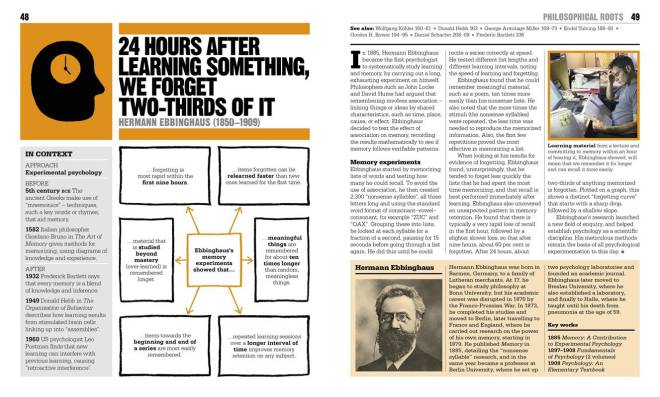
Psych Book SpreadThird in the trilogy is the bright red volume, The Psychology Book. As early as the year 190 in the current era, Galen of Pergamon (in today’s Turkey) is writing about the four temperaments of personality–melancholic, phlegmatic, choleric, and sanguine. Rene Descartes bridges all three topics–Philosophy, Economics and Psychology overlap with one another–with his thinking on the role of the body and the role of the mind as wholly separate entities. We know the name Binet (Alfred Binet) from the world of standardized testing, but the core of his thinking has nothing whatsoever to do with standardized thinking. Instead, he believed that intelligence and ability change over time. In his early testing, Binet intended to capture a helpful snapshot of one specific moment in a person’s development. And so the tour through human (and animal) behavior continues with Pavlov and his dogs, John B. Watson and his use of research to build the fundamentals of advertising, B.F. Skinner’s birds, Solomon Asch’s experiments to uncover the weirdness of social conformity, Stanley Milgram’s creepy experiments in which people inflict pain on others, Jean Piaget on child development, and work on autism by Simon Baron-Cohen (he’s Sacha Baron Cohen’s cousin).

When I was in high school and college,  I was exposed to all of this stuff, but only a small amount remained in my mind. Perhaps that was because I was also trying to read the complete works of Shakespeare, a book a week of modern utopian fiction, The Canterbury Tales, and studying geology at the same time. In high school and college, these topics were just more stuff to plough through. No context, no life experience, no connection to most of the material. Now, as an adult, it’s different. Like everyone I know, and everyone you know, I’m still juggling way too much in an average week, but I can now read this material with a real hope of understanding and retaining the material. Cover to cover, times three, these books will take you a year or two, but… without a test the next morning, you’ll be surprised how interesting philosophy, psychology and economics turn out to be. Just read them in your spare time, and behold (great word, “behold”) the ways in which humans have put it all together over several millennia. It’s a terrific story!

What We Don’t Know About Distracted Driving

DistractedDriverEvery day, about ten American die and about ten more are injured in motor vehicle crashes involving a distracted driver.
Sending or receiving a text message takes your eyes off the road for an average of just less than five seconds. If you’re driving 55 mph, in 5 seconds, you will drive the length of a football field. (Yikes.)

In 2011, we sent nearly 200 billion (!) text messages, twice the number of texts we sent in 2009. But the number of deaths and injuries remained stable. That made me wonder what we know about digital devices and driver safety.

Preliminary web research uncovered dozens of articles published around 2009-2010, but not much material that was more recent. At the time, there was great concern about the most at-risk groups (mostly, 18-24), and cries for additional research, including scientific research of all sorts. And that got me to thinking.

In theory, I suppose it’s best to drive without any distraction whatsoever. In practice, commuting is often a boring routine, so we listen to the radio, or, if we’re sharing the drive, we chat with another passenger, and if we’re on a long trip, it’s always easier with at least one passenger. Are these distractions positive (keeping the driver alert, awake and interested), helpful (second pair of eyes), or negative (any distraction is a problem)? That’s probably the first question we ought to answer. Inevitably, the answer will include a large grey “it depends” zone–if the other passenger is offering light conversation, it’s not much of a distraction, but an argumentative or boring passenger might add to tension or drowsiness.

Related question: does radio listening affect driver safety? It’s difficult to imagine a long drive without a radio companion. Half of all U.S. radio listening is done in a vehicle. Sirius/XM has built a business by providing a large number of radio program services to truckers and noncommercial drivers. Some radio programs are very engaging–political programs can really raise the level of listener emotion–and it’s fun to turn the radio up loud and sing along to some dreadful 1980s pop tune. How would we measure the level of distraction associated with radio, or CDs, or recorded books? A really good book, presented by a really good actor, can captivate the imagination. On a long drive, that’s heaven. But is it safe? Is a great book with fabulous characters more dangerous than a book with a weak story?

For the moment, let’s put aside the goofy “I probably shouldn’t do this while I am driving” behaviors that include applying makeup, drinking hot coffee, pawing through a grocery bag in the back seat while driving 60 mph, turning around to tell little Timmy to stop pulling little Kimmy’s hair, and all that.

Instead, let’s turn to digital communications devices. And let’s start with the telephone.

First question: is it more dangerous to talk (not dial, not set up a conference call, but just talk) any more distracting or dangerous than talking to a passenger in the seat next to the driver?

Second question: why have manufacturers made it so difficult to talk on the phone in the car? My car has a bluetooth setup so I can talk and listen to phone calls through my car’s sound system. Great idea, but the system doesn’t work because the car manufacturer refuses to update the firmware. BlueAnt offers a portable speaker that attaches to the visor, an adequate solution that should, in this day and age, be built into every automobile. With voice-controlled dialing.

Shifting the focus to the cell phone makers, they should be taken to task for not establishing standards for voice calling, and for not establishing features that make in-car use easy and safe. Simply: every car should include a standardized port in which the place can be safely and securely placed. The port should include power and connectivity to the car’s sound system. There should be NO access to the phone’s keypad while the car is in motion. This requires a superior in-car voice dialing system, either from the phone or from the car’s digital systems. Not a giant technological challenge.

What about email and texting and web surfing and Angry Birds? Not while you’re driving. Not at all. When the car is stopped (stopped = the engine is off), sure. Otherwise, these activities should be unavailable.

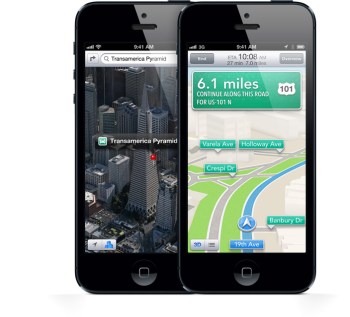
Apple MapsOne gotcha: maps. A voice navigation system is helpful, but the map really needs to be available in visual form. Should the driver be looking at that map while driving? Absolutely not. Eyes on the road, please! We’ve become addicted to our GPS systems, but we need to think about this system in a more rational way. Voice systems are probably the answer, but they need to become more reliable. Printed map directions are helpful, but they should not be used while the vehicle is in motion. A heads-up display (map projected on the driver’s windshield) may be a promising solution, but we need more scientific testing to determine whether a driver can both navigate the real world and study a map simultaneously. My brain cannot do both at the same time. I cannot multitask while in motion–I need to stop the car, study the map, try to remember what the map told me, and then drive the car. Some evolution is in store: both for humans interacting with digital maps and digital maps becoming more useful to humans in motion.

What’s missing? Video, for one thing. We’ve been smart enough to keep the video player pointed toward the back seat passengers, but radio control, map navigation, and other kinda-sorta-video is making its way into the driver’s field of view. It won’t be long before on-screen navigation is sponsored, and, here and there, the driver might be exposed to a video commercial. And it’s certainly tempting for McDonald’s to play a commercial around dinner time, especially when a driver is about to pass a McD’s installation.

And what about emergencies? You’re driving 65 mph and you absolutely must call or text somebody RIGHT NOW. I’m trying to imagine a situation. There’s a drunk driver in front of you (oh, no, wait, I think she’s just texting). Your car is heading for a bridge that used to be there but is now a Wile E. Coyote cliff. Stuff happens, and sometimes, you need to make that call. One solution: save the number 9 on your autodial for 9-1-1. Seems to me, the likelihood that you will be in a situation where (a) there is an emergency that requires an in-motion call, (b) that is not the sort of thing where 9-1-1 is the call to make; (c) there is no passenger in the car to make the call; and (d) you cannot pull off the road and stop to make the call is fairly small.

So, where does that leave us? I’d like some answers and I’d like some changes. First the answers:

1. Will the US Department of Transportation please fund annual research and an annual report to the American people about distracted driving. Which distractions are most dangerous (by the numbers)? Which are less so? What are USDOT’s specific recommendations to consumers, and specific agenda items for legislative change (at the Federal or State level) to ensure our safety? If in-motion telephone use is truly unsafe, we should pass legislation and enable enforcement to prevent the use. If in-motion telephone use is safe, but the use of one or two hands to operate these phones while the car is in motion is not safe, then manufacturers should be required to offer a standard solution that always works properly.

2. Will the car manufacturers please take responsibility for reliable, flexible systems for the safe in in-motion use of telephones (not texting and other uses) in cars? I’d like to see an annual report to consumers that addresses release dates for industry-wide standards, and, subsequently, annual upgrades so that every phone works in every vehicle. Yes, we may need some legislative help on this one.

3. Will the phone manufacturers please take responsibility for reliable, flexible systems for the safe in-motion use of telephones (not texting and other uses) in cars? Once again, an annual report should be required by any manufacturer selling telephones in the US.

Changes:

1. As consumers, we should fully understand the product and human safety issues related to phones in moving vehicles. We should demand real answers to these questions from our state and Federal agencies and from our lawmakers–and not just once, because cars and phones and consumer behaviors keep changing. What is and is not safe? We should know.

2. Unless we are certain, or reasonably certain, that hands-free telephone conversations are truly unsafe, more unsafe than, say, listening to the radio or talking to a passenger, both the phone makers and the car makers should be required to provide safe, reliable communications systems in moving vehicles.

3. We should establish reasonable industry review processes for a rapidly-changing digital environment.

You Know, A Lot Can Happen In A Century

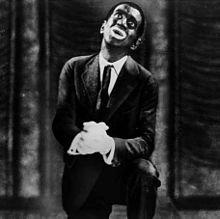
In his time, Al Jolson was a superstar. We've managed to get past the need for blackface, and although it keeps changing, showbiz marches on.

In his time, Al Jolson was a superstar. Thankfully, we’ve managed to get past the need for blackface. Show business keeps changing, adapting to times and tastes. And until recently, there was one place to read about these changes, day after day, year after year. Now, that’s changing, too. How? Read on. (You ain’t heard nothin’ yet!)

Today, we’re digital. We live in modern times. These times, we believe, are so new, so unique, that they have no historical precedent. The mythology is tempting, but that’s because the history is just beyond the edge of our ken. We focus on the new. We forget what happened before. Until, of course, we’re reminded of our history as the result of a really good documentary, or a really good book.

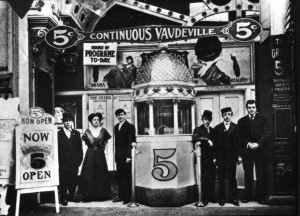
vaudeville theatre

A hundred years ago, minstrel shows were just beginning to lose their luster, but it was unclear whether theater audiences would eventually prefer skating rinks, a vaudeville industry based upon national tours (new, in 1906), or bawdy burlesque as a the most popular ways to spend leisure time. Movies were just starting out with an industry of tiny, dubious start-ups and few places where they could be seen by anyone. Live theater was the popular entertainment; actors traveled from one city to another to perform in popular plays, just as they had since the time of John Wilkes Booth. It was a confusing time… The Great War was just beginning and the large theater lobbies were as useful as recruiting stations as they were for pre-performance gatherings. After the war, everything seemed to coalesce. Charlie Chaplin, who had debuted in a US theater in 1910, was sufficiently powerful by 1918 to join forces with movie stars Douglas Fairbanks, Mary Pickford, and director D.W. Griffith to form United Artists. Then as now, everything happened quickly.

Prior to the 1920s, just about all entertainment was live. The movies were beginning to change that, and as the decade began, a new idea called radio was began as a kind of experiment, it’s post-military use future not yet clear. The year 1920 was one of vaudeville’s best ever. By 1925, radio was becoming popular, but its business model was entirely unclear. From a July 1925 article:

the broadcasters and radio manufacturers continue to tell Department of Commerce officials that no broadcasting station in the country is making money.

Paramount theaterParamount studioBy 1930, 40 percent of US households owned a radio, and by 1940, radio’s penetration was more than 80 percent. By 1930, there was a bona fide motion picture industry with large studios (Fox, Paramount, Loew’s/MGM, RKO and Warner), each with an elaborate distribution network of theaters throughout the country and a distribution infrastructure to service the nation and parts of the world. At the same time, the new NBC and its lesser rival CBS had built a similar structure for radio broadcasting. This structure supported the next level of development: a star system. Lon Chaney, Al Jolson, Fatty Arbuckle, Theda Bara, Duke Ellington, James Cagney, Fred and Adele Astaire, so many others became household names.

The industry grew. There were cartoons from Warner Bros, and Disney, comedy shorts from Hal Roach (Our Gang, Laurel and Hardy), child stars including Shirley Temple, and within a decade, major long-term successes including Gone with the Wind and The Wizard of Oz. There was Mussolini, Hitler, FDR, the Roaring Twenties followed by the Great Depression.

Variety bookVariety covered it all. This small, speciality newspaper, a trade rag, was always at the center of it all. When anything happened in or near show biz, Variety told the world. Everybody in “the business” read it, and to be mentioned in it was a clear indication of career success (I was in it, at lease once, and I still have the clipping).

This week, Variety announced that it would cease publishing its daily edition (the weekly remains in print, at least for the foreseeable future). This is not simply a cost cutting measure. Variety, once the trendiest of publications, has been badly beaten in the online entertainment journalism game, and some industry insiders question its survival as a 21st century brand.

Given its illustrious past, I suspect Variety has more fight in it than pundits allow. If you have any doubt, you must spend some time with a book about Variety’s history published by Rizzoli in a tidy coffee table format. The book is entitled Variety: An Illustrated History of the World from the Modt Important Magazine in Hollywood. The last headline in this volume: “Comcast buys 51% of NBC Universal.” I think it’s interesting to note that neither Comcast nor NBC nor Universal existed when Variety’s story began, and even more interesting to consider just how much has happened over the span of a single century. (Parallels with today’s innovative world are particularly fascinating).

Okay, why not? Here’s one of my favorite Variety headlines. This one was on the front page on July 12, 1950:

VIDEO NOW VAUDE’S VILLAIN
Acts and Agents Fear TV Inroads

Can’t help but wonder about a headline that could be written for July, 2050:

WEB, VID DEAD
TV and internet replaced by…

Digital Hollywood (in NYC)

Summit300x250Digital Hollywood is an ongoing series of media industry conferences held, mostly, in Los Angeles, New York, and Las Vegas. Generally, the conferences focus on media, advertising, programming, consumer behavior, financing of new media, technical platforms and marketing. I have spoken at several of these conferences. This week, in Manhattan, I attended the 2013 Media Summit (their tenth anniversary, by the way). I listened to perhaps a dozen panels populated by industry insiders. And learned.

OreoI learned about the relationship between Oreo cookies and social networking. As ridiculous conversations go, this is sublime. The argument in favor of social networking for cookies goes back to the old arguments about the ultimate value of brand awareness, which remains exceedingly difficult to measure. Still, the hipster panel insisted that there is a new of thinking required here (suspend disbelief). The terminology has revolved, but the arguments echo dot.com marketing strategies circa 1999. Still, the idea of an entire brand team approving Tweets in real time at, say, the Super Bowl, is an image worth remembering. Why? Because marketing teams are no so complicated, and for large brands, so scattered among specialist agencies and specialized departments within larger agencies, with so many complicated political games, consensus has become difficult to achieve. In the brand marketing universe, there is great importance placed on 21st century marketing, doing incredibly cool stuff, and keeping/gaining clients through innovation. Ask the average person whether any of this affected their decision to buy a pack of Oreos, or to eat an Oreo, and it’s unlikely that they would make a connection between the cookie and any of these campaigns.

At another session, I learned about the industry’s high hopes for the new MPEG-DASH format.

The term KPI (Key Performance Indicators) was probably most-often-uttered. In a consumer marketing environment whose changes are both difficult to measure (too much data, too many variables), agencies and corporate marketers are trying to figure out which indicators actually matter. CPM (Cost per Thousand, a long-standing audience measure that is common currency among agencies and media) is losing favor. One might measure brand impact, but there is little agreement about how this can or should be done with any degree of standardization. Nielsen is not well respected; there was consensus that this method of sampling was silly. If I correctly recall, a comparison was drawn as follows: instead of using supermarket cash register data to measure the store’s activity, the Nielsen approach is more similar to asking one in twelve individual shoppers what they purchased.

Verizon Media Server. For more, click on the pic to go to The Verge.

Verizon Media Server. For more, click on the pic to go to The Verge.

I found conversations about large tech companies and their platform strategies to be especially interesting. Verizon’s panelist complained about their high costs of set top boxes, and told attendees about a new Verizon Media Server that would serve all sorts of client devices throughout the house. If I understand this strategy correctly, Verizon wants to charge a monthly fee for Internet and program services, for the connection between home and outside network, and for a single box in each subscriber household. Microsoft claims that half of XBox use is non-videogame, so it is now thinking in terms of program service subscriptions (not unlike Verizon), and producing its own programming (like Netflx and Amazon). Much smaller Boxee is thinking in terms of a cloud-based DVR not only for television programs, but for all types of audio-video media.

One fascinating idea: will consumers control their own data? For example, when I use E-ZPass, or when you browse Amazon or search Google, or watch a VOD or DVR file, where does this data go, where is it stored, and what permission is required for access? Maybe I want all of my data stored by, say, the American Red Cross, which may, in some wildly imaginative future, repackage and resell the donated data in accordance with personal donor’s wishes?

Another: the role of intellectual propery attorneys who must, due to the nature of their profession, remain in a 20th century approach that transforms copyrights into cash, and blocks unauthorized access or use with vigorous enforcement. I mentioned the phrase Creative Commons as part of a question, and only one person in the room of one hundred seemed to understand what was meant by the forward-thinking term. Still, the attorney panel was brilliant in their discussion of negotiation strategies:

  • Start with a phone conversation, do not rely upon emails. Establish a personal relationship based upon humor, warmth, personal connections.
  • Today, there are so many people, projects, companies – slow down, think about partners, need to educate the other side, develop an understanding of everybody’s strengths.
  • Take ego out of the equation.
  • Do not hold grudges, and do not allow yourself to assume anything resembling a victim mentality.
  • Do not make it personal.
  • In television and Internet video, the buyer’s creative team establishes deliverables based upon their own set of standards, but these people do not negotiate the deals. Instead, this work is done by a business affairs team that is closely aligned with the finance department. Be careful about allowing business affairs or finance to control the conversation. If they push too hard–as they often do because they are paid to control their company’s interests–then the creative team will not get the project they ordered, and the producer will, inevitably, be blamed. if the conversation shifts into an unacceptable zine, do not hesitate to suggest that the business affairs staff bring in the creative staff to reset expectations, and, perhaps better yet, off to do so yourself. often, the business affairs response to this awkward request will be: “no, we will deal with this internally,” and then, well, every situation is different.
  • Be very careful about “this is a deal breaker” or drawing a line in the sand.
  • No two deals are ever the same, even if the same people are involved.
  • Moving to yet another panel, I liked the term “Selective Consumption.” Roughly, it seems to mean a a presorted, highly personalized, behavior-based list of currently aailable media assets that miraculously (digitally, enabled by artificial intelligence and algorithms) anticipates each individual consumer need of the nanosecond.

Other interesting ideas and notes:

  • When designing a multi platform, transmedia approach, it’s easy to develop a visual identity on your own platforms but quite difficult to manage this level of control over third party platforms (because each has its own unique technical and design standards and its own strategic agenda).
  • The industry has made something of a mess in the consumer household where multiple boxes, screen interfaces, access codes, remote controls, and a lack of standardization now results in considerable frustration and “we’re not responsible, go talk to those people over there” interoperability problems. Not much progress in this area; in fact, things will probably get a lot worse before the industry gets ahead of the problem.
  • An interesting discussion about “who is the voice of the brand?” Is it the Chief Marketing Officer, the senior agency account person, or the twenty something with her hand on the Twitter keyboard? Plans are made months in advance and approve queues are common practice, but real time communication via social networks seems to subvert these plans. Lots of damage can be done, and so quickly! Then again, there is the urgency of timely messages about (or by) Oreo cookies.
  • About 30 percent of Verizon FiOS use is non-TV. People are shifting, rapidly, to tablets and away from TV for their PRIMARY video viewing experience. That seems significant.

Big Data, Bigger Ideas

face pic human face

Every animate and inanimate object on earth will soon be generating data, including our homes, our cars, and yes, even our bodies”— Anthony D. Williams on the back of a big book entitled The Human Face of Big Data

From the dawn of civilization until 2003, humankind generated give exabytes of data. Now, we produce five exabytes every two days.” — Eric Schmidt, Executive Chairman, Google

The average person today processes more data in a single day than a person in the 1500s did in an entire lifetime.

Big Data is much more than big data. It’s also the ability to extract meaning: to sort through masses of numbers and find the hidden pattern, the unexpected correlation, th surprising connection. That ability is growing at astonishing speed, it won’t be long before Amazon’s ability to dazzle customers by suggesting just the right book will seem as quaint as our ancestors’s amazement at horseless carriages.– Dan Gardner, from the book’s introduction

human face big dataClearly, big data is a massive idea. Let’s see if we can’t break it down, if not by components, then, at least, by illustrations of classes and contexts.

The connection between data collection and pattern recognition is not new. In fact, we know the earliest example, which still exists, in book form, in a small, private Library of Human Imagination in Ridgefield, Connecticut. The book is called Bills of Mortality, and it records the weekly causes of death for London in 1664. This data was used to study the geographic (block-by-block) growth of the plague, and to take measures to prevent its future growth.

Two hundred gigabytes per day may not seem like much data, not in the days when you can buy a terabyte drive from Staples for a hundred bucks or so, but collect that much data day and day out, for a few years, and the warehouse becomes a busy place. That’s what MIT Media Lab’s Seb Roy did to learn how his newborn son learned language. The work was done at home with eleven cameras and fourteen microphones recording the child’s every move, every sound. The recording part of the project is over–their son is now seven years old–but analysis of “unexpected connections between the routines of everyday life and how one child learned his first words” continues as a research project.

On the other end of the age scale, there’s Magic Carpet, now in prototype. The carpet contains sensors and accelerometers. When installed in the home of, say, a senior, the carpet observes, records, and learns the person’s typical routine, which it uses as a baseline for further analysis. Then, “the system checks constantly for sudden (or gradual) abnormalities. If Mom is moving more slowly than usual, or it’s 11 a.m., And her bedroom door still hasn’t opened, the system sends an alert to a family member or physician.”

Often, big data intersects with some sort of mapping project. Camden, New Jersey’s Doctor Jeffrey Brenner “built a map linking hospital claims to patient addresses. He analyzed patterns of data, and the result took him by complete surprise: just one percent of patients, about 1,000 people, accounted for 30 percent of hospital bills because these patients were showing up in the hospital time after time…a microcosm for what’s going on in the whole country (in) emergency room visits and hospital admissions…” Subsequently, he established the Camden Coalition of Healthcare Providers to help address this “costly dysfunction.” He collected the data, analyzed it, then brought out meaningful change at a local level.

One of the many superb photographs depicting the intersection between human life and technology use. The book was put together by Rick Smolan, an extraordinary photographer, curator and compiler whose past work includes A Day in the The Life of America and other books in that series.

One of the many superb photographs depicting the intersection between human life and technology use. The book was put together by Rick Smolan, an extraordinary photographer, curator and compiler whose past work includes A Day in the The Life of America and other books in that series.

Yes, there’s a very scary dark side. Bad people could turn off 60,000 pacemakers via their Internet connections. A real time, technology enabled 2008 terrorist attack in Mumbai killed 172 people and injured 300 more thanks to Blackberries, night vision goggles, satellite phones and other devices.

If you control the code, you control the world. There has not been an operating system or a technology that has not been hacked.

Fortunately, the good guys have tools on their side, too. The $40 million Domain Awareness System in Manhattan includes “an array of 3,000 cameras known as ‘The Ring of Steel” that monitor lower and midtown Manhattan as well as license plate readers, radiation detectors, relevant 911 calls, arrest records, related crimes, and vast files on characteristics such as tattoos, body marks, teeth, and even limps. They can also track a suspicious vehicle through time to the many locations where it has been over previous days and weeks.”

Google’s self-driving car is safer than a human-controlled vehicle because the digital car can access and process far more information more quickly than today’s humans.

By 2020, China will complete Compass/Beidou-2. This advanced navigation system will outperform the current (and decades old) GPS system. Greater precision will be used for public safety (emergency response, for example), commercial use (fishing, automotive), and, inevitably, for far more productive war.

Data can mean the difference between life death when the weather turns ugly. Thousands of lives are saved each year by weather earnings in wealthier countries. Yet thousands of lives are lost in poor ones when monsoons, tornadoes and other storms strike with little public warning, an intensifying threat as the planet warms,,,

If you’ve ever wondered what Amazon’s true business is, or why it uses the name of a gigantic river, the answer is big data. Ultimately, Amazon intends to become a public utility for computing services. Take a careful look at Amazon Prime and you will see a prototype. The streaming side of PBS and Netflix are among the enterprises enabled by Amazon’s big data operations.

For FedEx, “the information about the package is as important as the package itself.”

human face big data movementsWhether its eliminating malaria or making art, text messaging for blood donors or tracking asteroids, the future will be defined by the collection, analysis and use of big data. It will shape our individual knowledge about our own bodies, our children’s growth and our parents’ health, our collective tendencies for public good, safety, and bad behavior. It will be embedded in robots and intelligent systems that may, soon, control aspects of life that we once considered wholly human endeavors. It is a change of epic proportions and yet, most of us are unaware of its importance.

The book, The Human Face of Big Data, along with its related website and app, provide a useful gateway into this brave new world.

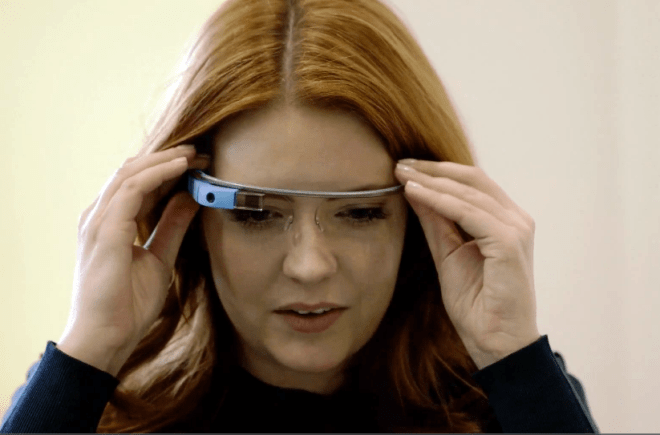
Google Glass: “technology closer to your senses”

Google Glass

You’re looking at a new invention that may revolutionize our interaction with digital devices.

Connecting devices to the body, or, at least, wrapping devices around parts of the body, will be the next big thing. Apple is developing a watch that cuffs the wrist and provides information via a curved glass display. Google is going further.

A wonderful story published in The Verge provides lots of interesting insight, for this is not simply a product concept, but a potential shift in the ways that we think about interaction between humans and between humans and machines. Here’s an excerpt:

Human beings have developed a new problem since the advent of the iPhone and the following mobile revolution: no one is paying attention to anything they’re actually doing. Everyone seems to be looking down at something or through something. Those perfect moments watching your favorite band play or your kid’s recital are either being captured via the lens of a device that sits between you and the actual experience, or being interrupted by constant notifications. Pings from the outside world, breaking into what used to be whole, personal moments.

Steve goes on. “We wondered, what if we brought technology closer to your senses? Would that allow you to more quickly get information and connect with other people but do so in a way — with a design — that gets out of your way when you’re not interacting with technology? That’s sort of what led us to Glass.” I can’t stop looking at the lens above his right eye. “It’s a new wearable technology. It’s a very ambitious way to tackle this problem, but that’s really sort of the underpinning of why we worked on Glass.”

I encourage you to go to The Verge report, watch the video (which is on the page), and start thinking differently about a future that may arrive as soon as 2014.

Amazon: Any Thing, Any Where, Any Time

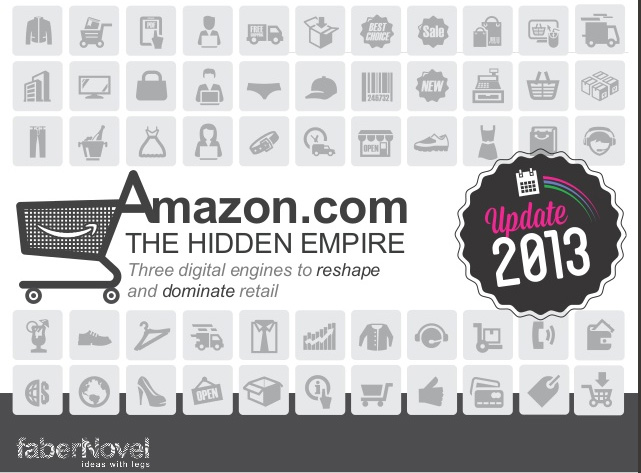
Amazon-HiddenEmpireFaberNovel is a website filled with interesting, well, I’m not sure what to call these packages of visual information. They’re kinda sorta PowerPoint presentations, but they feel more like a new kind of business book.

Originally, I was going to tell you that there’s a good (updated 2013) story of how Amazon is taking over the world. The presentation, above, tells a compelling tale about how the e-commerce giant has grown, offering considerable detail on the business side, and lots of insight about Amazon’s likely future.

As I went through the 84 slides, I became curious about who was telling the story, and became interested in FaberNovel, the publisher who offers this material under a Creative Commons license. As I browsed, I found an All About Google FaberNovel, too. And another about Google, Facebook, HTML5, the list is both impressive and multi-lingual (that is, presentations are available in multiple languages).

The stories are well-told, simply illustrated, and rely upon diagrams and other simple PowerPoint graphic techniques (nobody will be impressed by the visuals, but the stories are good; Edward Tufte’s magic wand would greatly benefit this material).

I’d start with the Amazon story because it contains so many “oh, that’s why!” or “that’s how, that’s a really good idea” or “what an awesome story of business strategy.” moments. Some of it is likely to be familiar, but it’s unlikely that most people have connected the dots. Sure, 84 pages may seem like a lot, but it’s not more than a half-hour of your life, unless you’re a serious student of e-commerce business.

Interesting discovery.

Film with Feeling

Alex Kirke is a director with a keen interest in the cinematic experience, and, as it turns out, an equally keen interest in the measurement of biophysical responses to storytelling. Inevitably, this led Mr. Kirke to the development of software that would read sensors attached to the bodies of audience members. The sensors provide real-time feedback on muscle tension, perspiration, heart rate, and brain wave activity. As the software collects the data, it compiles the results, and, in accordance with the director’s wishes, the film automatically branches from one audio-visual file to another.

By using this technology, a director can amplify or dial-down emotional impact, shorten or lengthen the story, cut to another sequence entirely, and so on. Of course, all of the branching must be worked out before production begins because each sequence must be produced, edited, and integrated into the file management system.

Says one of the actresses:

It will be quite interesting to know, so well, how the audience reacts. The ending they choose reflects their reactions.

Not just the ending, of course. Anywhere in the film, the story can change course. So, too, can the soundtrack. Or any visual or visuals. In theory, there may be a large number of branches (for the professional, this becomes an obsessive, difficult way to tell a story, but it’s interesting to consider the possibilities). And, in theory, the sensors could be connected to the seats or the armrests throughout the theater, but that’s all in the future.

For the present, do watch the video. It’s rough, more of a professorial demonstration that any sort of slick production, and, if time permits, have a look at Mr. Kirke’s blog, too. There, he covers an interesting range of technical innovations related to entertainment and storytelling.

Peacock in the Coal Mine

Josef Adalian wrote a very provocative article about NBC and the network prime time model in his Vulture column for New York magazine. Based upon both prime time flops and shifts in audience attention, he wonders whether the network model is still viable, and if so, how much longer it will survive.
It was far easier to climb out of the Nielsen basement when there was just a handful of legitimate competitors. Now NBC is fighting for eyeballs at a time when millions of viewers don’t even watch TV on TV.
You can buy the "NBC Stress Toy" from the NBC Universal Store.

You can buy the “NBC Stress Toy” from the NBC Universal Store. Just click on the image.

Adalian presents a case that’s based upon three key factors: (a) NBC is performing very poorly throughout its prime time schedule, (b) temporary short-term solutions have masked the truth for several years and (c) the media environment no longer allows the kinds of turnarounds that ABC, for example, achieved when LOST, Desperate Housewives and Grey’s Anatomy all caught fire after the responsible programmers were long gone. With all of the noise from so many media outlets, Adalian discounts even the potential of star vehicles and the old tentpole strategy (Cosby and Seinfeld, for example).

He’s close to the industry, and perhaps, a bit too close. He analyzes the moves of senior executives in an industry where those moves often defy logic and reason. And, he makes it clear, this is not really an article about NBC, but about the future of prime time network television on all of the broadcast networks:
Networks can pretend all they want that the broadcast model isn’t broken, but denial didn’t forestall the end of big record-store chains, and it didn’t save Borders Books or Hostess. Five or ten years from now, there’s a good chance we’ll recognize NBC as the Peacock in the coal mine.

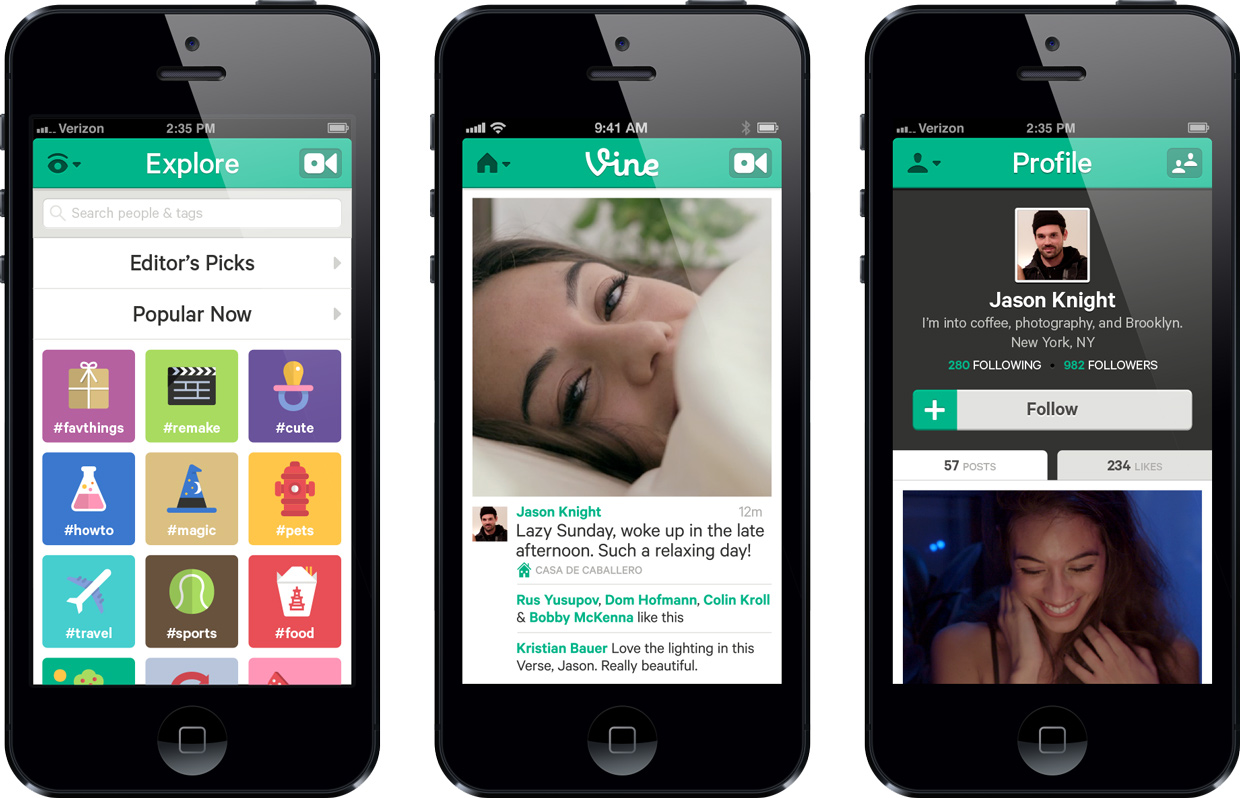
Mashup: Twitter, YouTube, Flickr, Tumblr = Vine

design02

What the world needs is… looping videos.

  • Norman, the Scooter Dog
  • A quick scream-filled ride downhill on a roller coaster
  • Laundry flapping in the breeze on a windy, cloudy day
  • A car covered in snow, with snow removed in a stop-action sequence
  • A banana being sliced
  • A little boy and a little girl, holding hands as they ride in an open-top train
  • A cartoon sketch of an elephant head shaking from side to side
  • Scenes from Chinese New Year in NYC
  • A teenage girl making funny faces
  • Hot air balloons in flight
  • A girl washing her face and brushing her teeth
  • A paper clip that unbends itself into a heart
  • A guy riding a bicycle and ringing a bell

So here’s Vine, now being used for local coverage of street news, brief documentation of automobile rides and walks on the beach, a great many people posing for the camera and sticking out their tongues (each in his or her own Vine video), producers whose stop-motion animation desperately needs a tripod, (inevitably) porn (find it on your own; there’s enough of it to require warnings and generate complaints).

Will it succeed? Well, Vine has been live for just two weeks, so it’s early days. But the company has already been acquired by a larger one that is likely to affect its prospects. Vine has been purchased by Twitter.