Did you hear what I said?

Here’s what I want from a Bluetooth headset: (a) you can hear me, (b) I can hear you, and (c) hassle-free phone pairing. For those of us who rely upon these devices, it’s tough to find happiness. And, it’s difficult to comprehend the experience of the other person on the line, the one who is supposedly listening to the conversation. It’s on item (a) that many headsets fall below expectations, but unless you ask, you have no way of knowing what the other person is (not) hearing.

I decided to experiment with two of the most highly-rated  Bluetooth devices.

Blue Ant's Q2 looks great in any color. It's small, well-designed, and sounded good to me.

Sure enough, I fell in love with its small size and wonderful incoming sound quality of the nifty Blue Ant Q2. Pairing with my iPhone: easy. Noise cancellation: in theory, great, in practice, not so great (even a gentle breeze was a problem). Fit and style: terrific; the device just hooks over the ear and looks sleek. Little button to press when making or receiving a call: sometimes, a bit hard to find, but okay with practice. Several voice control features added to a positive experience: terrific! I can ask the phone, “am I connected?” or to “redial” or to repeat all available menu commands. Finally, here’s a smart device that sounds good, looks good, and works properly. Or so  my great expectations imagined.

When I started asking people how I sounded, the comments were, at best, noncommittal and often, negative. Most often, I was told that the sound was “a little weak” and that they were hearing “some but not all of the words” and that they heard “a lot of background noise.” The more negative comments I heard, the more I experimented–trying different locations, different phones, interior, exterior, quiet, slightly breezy, in cars and trains, out walking the dog, etc. No change in the comments I received.

Since I could hear the other person so clearly, at first, I questioned the other person’s phone system, ears, sanity, whether they were using an inadequate phone or earpiece on their end, and so on. More than a month’s calls led me to the sad conclusion: although I could hear the other person, they could not hear me, not clearly, and, often, not completely.

So, I continued my Goldilocks routine by returning to an headset I had used before with some complaints. I liked the clunky big-battery-behind-the-ear, big-boom-microphone Plantronics PRO when I owned a previous model, but the incoming volume was unacceptably low. For most of February, I’ve been using the newer PRO HD, and found two improvements much to my liking. The first improvement is a better incoming sound system: every call is loud enough, and every call is clear. The second: I like the sensor that tells the headset when it is actually on my ear (if it’s not on my ear, it won’t take the call; if it is on my ear, it will answer calls automatically without requiring me to press a button).
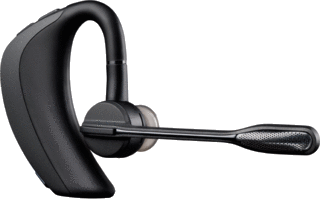
Of course, the big test is not what I can hear, but what you can hear when you call me. I was really hoping for good results on that score–and sure enough, the PRO HD came through. Several people asked me whether I was actually on a headset because the sound was so clear. So far, not one person has complained about sound quality. For me, that’s extraordinary; I’ve been hearing complaints about my Bluetooth headsets for years.

Wind noise? Yeah, that’s still there. Better than the Blue Ant Q2, but a breezy day is a problem for an exposed microphone. On the Pro HD, the boom microphone is long and large enough to accept the equivalent of the wind muffle that location video shooters use–a soft furry condom to catch the wind–maybe that teeny accessory is on its way? And while we’re on the topic of accessories, even the PRO HD is really small, and really easy to lose. I sure wish Plantronics would develop some sort of carry-everywhere accessory to minimize the loss of its $100 device (so far, I’ve lost two of them).

This blog post is already on the long side. I’ll review Blue Ant’s Q4 speakerphone in a separate article.

Links:
Blue Ant Q2

Plantronics PRO HD

A Go-Everywhere iPad/Android Keyboard

Competing against nothing is not easy. Every iPad and every Android tablet comes with an on-screen keyboard that costs nothing and weighs nothing. In fact, I am using one right now. It’s fine for short documents with no formatting, but I prefer a proper keyboard for longer writing sessions.

I use the Apple wireless keyboard that came with my iMac (I use a wired keyboard on my desk, so this one was a spare. I invested in a durable slipcase from www.sfbags.comfor $29. and I carry an extra pair of AA batteries, just in case the Bluetooth eats too much power. Mostly, it works as well as any Bluetooth device. It’s a bit taller than the iPad, but then, it is a full-sized computer keyboard. Weight of keyboard, case and two sets of batteries: one pound. I do not carry it everywhere.

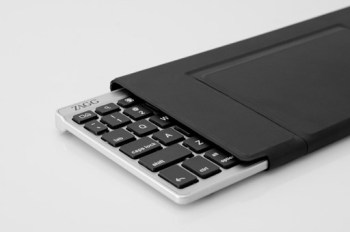
The new ZAGGKeys FLEX is about 3/4 as long as the Apple keyboard, so the keys are closer together. It weighs about 3/4 of a pound, but it is much more compact. Power is provided via USB, not AA cells. Special buttons on the keyboard are used for undo, cut, paste, and search. The keyboard easily switches from Apple to Android mode. One button pairs the keyboard to either device.

The niftiest part is the stand that doubles as the case. It’s lightweight and very stable–more firm that Apple’s magnetic iPad cover.

The keyboard is a little clunky and a little noisy–convenient but Apple’s keyboard is both elegant and silent.

Cost: Apple wireless keyboard ($69) + SF bags slipcase ($29) + a year’s batteries = $100.

Cost: ZAGGKeys FLEX: about $80.

At the recent Consumer Electronics Show, there were dozens of iPad accessory-makers on the show floor. I like ZAGG–they seem to come up with clever solutions. Here, they’ve got a good idea, but $20 and a quarter pound are not enough to overcome the significant quality advantage of the Apple / SF Bags solution.

Bend Me, Shape Me, See Right Through Me

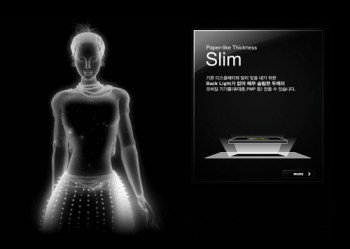
This falls into the category of “totally amazing stuff.” You’re looking at one of several Samsung screens that will probably be available sometime in 2012. Yes, that’s a cell phone. Apparently, Samsung (which is turning itself into an awesome company on the display side, BTW) is working with Nokia to bring this concept to life, and to market, and to change everybody’s notions of what a phone, and a display, can be.

Initially, Samsung’s new screens will be introduced in Nokia phones.  Soon after, there will be tablets that are not only flexible, but see-through. Imagine looking through a map, with interactive directions, and directly in front of you at the same time. (Certainly, there will be heads-up displays used in automobiles for just that purpose, but maybe that comes a bit later on.)

The technology is called “flexible AMOLED.”

Interesting? This is just one of many mind-blowing moments in Samsung’s (Japanese-language) video. And, if you want more insight, check out this article in the London Daily Mail.

Even more interesting a thoroughly conceptual video from Samsung which illuminates the company’s view of their future. (It may take a moment to load.)

Bagging It

This was the year I bought an iPad and my wife bought a Kindle. Then, we went shopping, each of us in search of a slim, durable, protective case. Function matters more than fashion. Each device would require a snug fit. I needed something weather-resistant because I planned to carry the iPad to meetings, with or without an outer bag or case. To save on shipping, we tried to find one company to serve our needs.

After visiting a handful of retail stores, we visited a dozen websites. We found a great little company called SF Bags. We were impressed by Gary, the owner, who appeared in videos to explain each of his products. There were eight entirely unique iPad solutions, and the same number of Kindle solutions. Mostly, they were the same designs, each customized for the iPad, Kindle, the 11-inch Mac Air, the 13-inch Mac Air, and a lot of other portable devices, including videogames and digital cameras.

For her Kindle, my wife decided upon the red Slip Case for Kindle; there were five other color options. It cost $27.

I chose the Ultimate Sleeve Case for iPad2 in the vertical format (horizontal is pictured) with checkered “lead iridium” ($55) instead of brown leather trim ($60). I was smart enough to order it with small d-rungs, but not smart enough to order the Suspension Strap Mini ($22) or the Vertical Mini-Pouch ($25) first time around. now, use the three items together, in place of a backpack or shoulder bag, as a slim kit for iPad2, wallet, iPhone, earpiece, keys and a small pad and pen.

I also picked up a protective case for my wireless Bluetooth keyboard.

SF Bags offers a remarkable selection of well-designed, well-made solutions for lots of portable products. Their designs include well-thought-out features like slash pockets in just the right places, small inside pockets that snuggly protect iPhones and other devices, and other features that speak to the intelligence of their planning and product development. SF Bags seems to be meticulous In its manufacturing and quality control. (Isn’t it great when a small company exceeds expectations?)

My wife is happy with her Kindle slip case. I bought my iPad kit for function, but often find myself answering questions about where I found my bag. Now, you know.

Here's the horizontal bag with the mini-pouch attached. The inside of the pouch is lined with soft neoprene.

“Absolutely, extraordinarily bad”

That’s how innerfidelity.com editor-in-chief Tyll Hertsens described the sound quality of  Beats by Dr. Dre headphones on the front page of this morning’s NY Times Business section (link below).

Yeah, they’re very heavy on the bass. And they’re best for music where bass drives the musical experience. And sometimes, if you listen loud, there’s distortion. On the other hand, Beats are fashion statement, and people wear them not only to listen, but to be seen listening.

Headphones as pictured (from the company website): $349. That’s a lot of money for a pair of headphones. Industry observers are impressed by the team of Dr. Dre and Monster Cable because they’ve opened a new market where price sensitivity matters less than lifestyle choices.

By comparison, a pair of AKG K240 Professional Studio Headphones cost $199.

If you have a pair of Beats, or manage to try a pair in a store, share your impressions.

http://beatsbydre.com/Default.aspx

http://www.nytimes.com/2011/11/20/business/beats-headphones-expand-dr-dres-business-world.html?partner=yahoofinance

http://www.innerfidelity.com/

Fellini on the bed

The room is almost completely dark. There is a single light source on this night of the October power outtage. It is Fellini’s 8 1/2 on an iPad screen. The images are sharp, contrasty, perfectly photographed in wonderful black-and-white. And, it sounds pretty good, too.

I love my iPad, but the sound is just awful. A dozen manufacturers now sell portable Bluetooth speakers. Some of these speakers are reasonably priced and sound good, too–but most are either over $100 or not worth the cost because they lack clarity, bass, punch, whatever. Forget about the Bluetooth part–it doesn’t work properly, it’s a technology that is far inferior to something much simpler: a $10 cable with one end that plugs into the speakers and the other end into the iPad. That combination is reliable enough to watch Fellini’s 8 1/2 with no interruption, and no Rice Krispies crinkling that is common among Bluetooth devices of all sorts, my little phone earpiece among them.

I’d love to tell you that I have secret source for the best sound at the best price. In fact, I found my speaker by making a friend of a salesperson at a local Best Buy store. As some of the salespeople are wont to do–provided there is no manager nearby–my guy opened several packages and allowed me to listen to several devices.

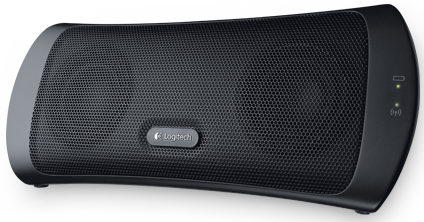
My favorite–still a favorite several months later, in fact–was the Logitech Wireless USB Speaker, which I use as neither a wireless device nor a USB device.  It costs about $70, and comes with a carrying case. I leave it in my car’s trunk so that anywhere I go, it’s available. I’ve used it to entertain a group of people watching video from a computer screen (the computer’s speakers were crappy), and another group of people attempting to watch a projected image during an office presentation (the projector’s speakers were inadequate). During the summer, when I write on my porch on warm days, the speaker provides the background music. And on a dark and stormy night, it provides a clear, crisp, well-articulated soundtrack with a reasonable amount of bass.

I was less enthusiastic about the more expensive Jawbone Jambox, which costs twice as much and tends toward the boomy approach to bass. When I was shopping earlier this summer, there were few choices. Now, there are more. But I think I’ve found a good one, and I recommend it wholeheartedly.

Maine School District to Buy Kindergarteners iPads

Here it comes. The first kindergarten class gets iPads. Watch how quickly the others come online–and how quickly school gets the same treatment as, say, photographic film or CDs or any of the other stuff that’s been digitized. Story in video form below, or, if you prefer, actual words written on the screen by PCMag.

http://www.pcmag.com/article2/0,2817,2383362,00.asp

The next small thing: mobile TV

A very simple idea: add a tuner and a TV antenna to your portable device, and you can watch TV anytime, anywhere. No Internet, no cell phone service needed. However–your local TV broadcast television station must package mobile digital television (mDTV) channels. There will be dozens these channels–not thousands–some free, some fee. Tests in DC and other markets indicate that consumers love to watch mid-day newscasts and entertainment news–the heaviest viewing is daytime when folks are away from home.

Relaxing with a (legal?) cocktail

It’s taken more than a week to set up the iPad. Some unexpected issues:

1. Poking around the App Store absorbed most of my free time. I didn’t think much about the iPad as a kind of ultimate seductive shopping device, but that’s what it turns out to be.

2. I found myself learning more about video files and video file formats than I want to know. Audio and music files were easy; video files required study, questions to friends, a visit to the Apple Store to talk to a Genius, and a few hours of research. I believe I am using HandBrake in a legal way, but I’m unsure why there is no similar commercial product (for legal use).

3. From a work perspective, moving files back-and-forth between the apps and the cloud is cumbersome (and proved difficult to figure out–until I visited the Apple Store’s Genius).

4. Even with Apple’s Smart Cover, you need a case to protect the whole iPad. There are a lot of cases available–and a lot of articles about cases, sleeves, and all sorts of stuff. Almost none of it exists at any local Best Buy, Staples, Apple Store, etc. I found my case here: http://sfbags.com/products/ipad-cases/ipad-cases.php

Apparently, the devices are still difficult to find–supposedly because demand is exceeding supply by about 500% (again, my source is my Genius). Imagine that–and try to come up with ANY other product where this kind of shortage exists. (Comments welcome.)

Now that this little obsession is settling down, I’m back to issues.

iPad for Me! (1 of 18 available!)


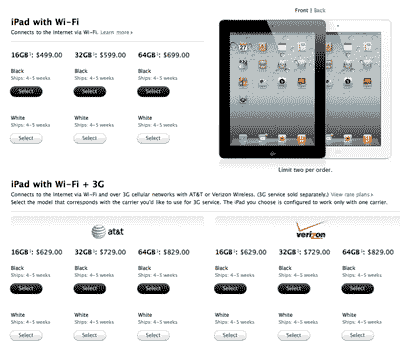
I was hoping I would get lucky at one of my two local, independently-owned Apple dealers–until I learned of their situation. There are now EIGHTEEN iPad SKUS available in the U.S., and only four of them met my needs (AT&T, 32 or 64GB, in white or black). Most small retailers receive relatively small quantities–so my local stores told me, quite honestly, that I could be waiting a very long time for any of the models I wanted to show up at their particular store. (I can’t imagine why they chose this particular product launch to double the SKU count by adding white–adding even more confusion for smaller retailers and for consumers.)

Without driving myself crazy, I stopped by every Apple Store, Target and Best Buy within reasonable walking or driving distance– usually on the way home from appointments.

And, sure enough, I found TEN iPads today, locked in a cage at my nearby Best Buy store. At first, the salesperson told me that they were all Verizon models, but he actually found me in the store to tell me that he had made a mistake, that they were, in fact, all AT&T models, all 64GB models, all black. If I had wanted any of the 17 other available options, I would have left the store unhappy.

Very strange. Perhaps we’ll all learn more about the strategy soon. Right now, it seems just plain goofy.