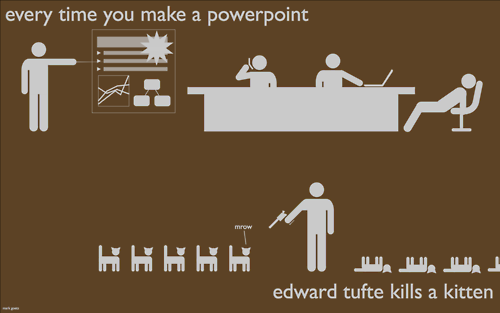
Edward Tufte Kills Two More Kittens

Last night, I was one of two keynote speakers for an innovation event. As a speaker, I’m supposed to be the teacher. Three people in the audience were fast asleep. I am their grateful student.

I spoke for over a half hour. I’m pretty sure we should pass a law, or perhaps, a constitutional amendment, that assures no speech will ever run longer than 20 minutes.

I structured my speech with over 100 clever little slides (I used Keynote, which is cooler than PowerPoint). Every visual cue was carefully tied to specific words in my written script. So I paid more attention to the script and the visuals than I did to the audience. Occasional ad-libs only made the speech longer.

The gentleman who preceded me, a college president, used Prezi. What a cool visual presentation! I remember almost nothing he said. (Too busy looking at the cool imagery.)

So here’s a digital insider take on speeches, the morning after. Just talk to the audience. Tell them what you know. Allow yourself one index card with three key points.

Anybody in the audience who want to see the charts, graphs, photos, etc., tell them to visit your website or blog. In that environment, they can study the visuals in their own time, not in a crowded auditorium. When they hear hear you talk about an important idea, they can visit your website for more information.

Which is to say: speeches are terrific for revving up the audience and introducing new ideas, but they are not very useful for detailed presentation of ideas. Websites are not a good way to rev up the audience and introduce new ideas–there is no personal touch, except, sometimes, with an extraordinary video–but for details and the day-by-day updates, they’re terrific.

I trust the guys in the back row slept well. Last night, they were the most powerful teachers in the room.

For more on Tufte/kittens:

Tufte Kitten Kill Count

Intro to Tufte:

The Visual Display of Quantitative Information

Save the Country!

In our hearts, we know what’s wrong, and we know that it’s not about Democrats or Republicans. It’s about the money that flows into political campaigns, the revolving door between industry and agencies that should be regulating without industry influence, the political bashing that obscures the real issues, the real reasons why our food is unsafe, our cellphones were never properly tested to assure that they do not produce cancer, why our financial system collapsed, why the jobs went away and people lost their houses while the big banks and the big car companies somehow made out okay.

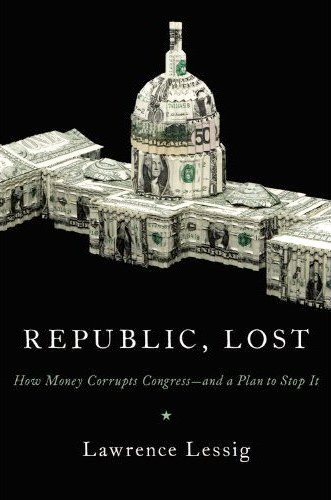
Sometimes, it takes a smart professor to parse the issues, and present them in a way that makes logical sense. Here, the professor is Lawrence Lessig, well-known for his work in the synchronization of copyright issues with the realities of new technologies. Lessig has shifted focus. In his new book, Republic, Lost, Lessig explains how and why we have accomplished the decimation of our democracy, and what we ought to do about it. This is not a book about politics. Instead, it’s a book about economics, foolish decisions, and fundamental thinking about what a country ought to do, ought to be.

The fundamental problem is relatively simple. Special interest groups, including big companies, big industries, unions, and others with vast money to spend, now control the agenda, and the decisions, made by our legislators. This is accomplished by funding political campaigns that now cost so much money, candidates are unable to raise the funds in any other way. Money is distributed not as bribes, but within a “gift economy,” in which lobbyists control the flow of funds, favors, and even the words in legislation that few legislators ever manage to read before voting. The size of this gift economy is spectacular in its size and influence, resulting in a sustained distraction for even the best-intentioned legislators whose time and decision-making processes are, according to Lessig, dominated by this system.

Where Lessig is clear about what the problem is, why and how it has gobbled up our representative form of government, and how much money is involved, he is less wonderful when it comes to solutions (which is to say, Lessig is clear thinking and often quite brilliant in his assessment of the current situation, but even his big brain struggles with what the heck we should do now). Still, he does present several seemingly sensible ideas.

Of course, the first solution is the simplest: let’s eliminate large contributions, and instead, share the burden with many small contributions. (In this regard, Obama had the right idea.) The Grant and Franklin project would allow each person in the U.S. to contribute $50 (Grant) of their Federal taxes plus $100 (Franklin) more to one or more individual candidates, or to their favorite political party. No more PAC or political party funding–candidates can receive a maximum of $150 per person. Here’s the kicker: for candidates, this would be voluntary. That is, each individual candidate would decide to follow the Grant and Franklin path–and those who do not, well, the American people would know who they are. Lessig: “If a substantial number of candidates opted into this system, then no one could believe that money was buying results.”

Then, the “clever lawyer” part of Lessig kicks in with an idea that’s intriguing, if not altogether practical (why should we rely upon practical ideas?–this is nation built by dreamers!). Lessig again: “Here’s a quiz. What’s required to be elected to the House of Representatives? You’d think that one requirement is that you be a resident of the district from which you’re to be elected. All the Constitution requires is that at the time fo the election, you be ‘an inhabitant of that State in which you shall be chosen'” And with that, Lessig is off and running…

Why not, he asks, run one candidate in several districts with a flash of anarchy in his or her midst. The only reason he or she is running is to force the other candidate to “publicly commit” to the Grant and Franklin approach. And for those candidates who do manage to get elected (inevitably, some will), he or she commits to: holding the government hostage until Congress enacts a program to remove the fundamental corruption that is now the rule in our government, and once that program is enacted, he or she will resign from office.

Lessig goes further: he wants a constitutional amendment.  Here, he enters a deeply analytical, harshly critical approach to his own idea, using his legal powers to define a path that could make an amendment possible. And, he reckons, some rich and powerful people are likely to come along for the ride.

He’s better on describing the cause and current situation than he is on prescribing the proper solution, but it’s unreasonable to expect one person, however smart, well-educated and clever, to define a plan to rebuild the republic. But he has taken the first step: he has clearly detailed the current situation and analyzed it in ways that break through any specific political dogma or belief system or party affiliation. And I know that his thinking has affected my thinking, and, presumably, some tens of thousands of other people’s thinking, and that’s a start.

So here’s the question from my side: I buy the analysis, and I want to be part of the solution. My starting place follows Lessig’s suggestion: I need to spend some time visiting a few websites, and figure out how I might insert myself into the process. His suggested websites:

Call a Convention

Public Citizen

Voters First Pledge

Fund for the Republic

Rootstrikers

BTW: The publisher is Twelve Publishers. It’s an imprint of Hachette, a larger publisher, but Twelve is delivering on a small, powerful idea: publish a dozen important books each year.  And make them count. I like their approach enough to include it here:

  1. Each book will enliven the national conversation.
  2. Each book will be singular in voice, authority, or subject matter.
  3. Each book will be carefully edited, designed, and produced.
  4. Each book will have a month-long launch in which it is the imprint’s sole focus.
  5. Each book will be nationally advertised.
  6. Each book will have a national publicity campaign.
  7. Each book will have a digital strategy.
  8. Each book will be worthy of the attention of discerning book reviewers.
  9. Each book will have the potential to sell at least 50,000 copies in its lifetime.
  10. Each book will be marketed and distributed by the Hachette Book Group, the company with the best hit ratio in the American publishing business.
  11. Each book will be promoted well into its paperback life.
  12. Each book will matter.

On his way in, Mr. Elbaz meets Mr. Smelie, on his way out

Gil Elbaz’s new company plans to collect, organize and distribute every fact on the face of the earth (and, presumably, above and below it). His company was featured on the front page of today’s New York Times Sunday Business Section.

The sum of human knowledge from a hundred years ago.

Colin Macfarquhar’s old company dates back to about 1770, when Colin and partner Andrew Bell hired William Smelie to put together the first edition of the Encyclopaedia Britannica. Smelie was 28 years old at the time, and he managed to produce, with collaborators, over 2,500 pages in three volumes. This month, after 15 editions, and all sorts of contortionist moves to contain and present an increasing vast store of information, the old EB gave up. No more editions. They’re done. After more than 200 years of successful publication of facts in books, the task became overwhelming as the publication business was overwhelmed by the crowd sourced newcomer, not yet a decade old, called Wikipedia. And the old Britannica ceased publication.

‘Tis a sad day, I suppose, but neither the Encyclopedia Britannica, nor the World Book Encyclopedia (which was always easier to read and more enjoyable to browse because of its reliance upon pictures), nor Colliers or the others, were superior reference tools.

From the NY Timesarticle about the EB’s demise:

William Smelie was responsible for the first Encyclopaedia Britannica, a stunning accomplishment that lasted centuries, but never overcame the digital revolution.

(In) one widely publicized study, published in 2005 by Nature, called into question Britannica’s presumed accuracy advantage over Wikipedia. The study said that out of 42 competing entries, Wikipedia made an average of four errors in each article, and Britannica three. Britannica responded with a lengthy rebuttal saying the study was error-laden and “completely without merit.”

Early in my career, I wrote and researched questions for television game shows, where a contestant’s knowledge (and memory) of facts could be converted into thousands of dollars. We kept several encyclopedias in the office. Each one had a pad above it, where writers and researchers made note of errors. Each pad was dozens of pages long. There were lots and lots of mistakes, some stunning in their stupidity: Paris was the capital of Egypt, that sort of thing, resulting from too many pages being pushed through a manual system at speeds that made sense only to a publisher.

Gil Elbaz, founder of Factual.

Factual’s plan, outlined in a big orange room with a few tables and walled with whiteboards, is to build the world’s chief reference point for thousands of interconnected supercomputing clouds.” Based upon the NY Times article, it would be fair to assume that Factual and EB are looking at information differently–both in terms of process and scale:

Geared to both big companies and smaller software developers, it includes available government data, terabytes of corporate data and information on 60 million places in 50 countries, each described by 17 to 40 attributes. Factual knows more than 800,000 restaurants in 30 different ways, including location, ownership and ratings by diners and health boards. It also contains information on half a billion Web pages, a list of America’s high schools and data on the offices, specialties and insurance preferences of 1.8 million United States health care professionals. There are also listings of 14,000 wine grape varietals, of military aircraft accidents from 1950 to 1974, and of body masses of major celebrities.

There is reason to be confident in Mr. Elbaz’s vision and ability to execute: his prior company, “Applied Semantics software quickly scanned thousands of Web pages for their meaning. By parsing content, it could tell businesses what kind of ads would work well on a particular page. It had 45 employees and was profitable when Google acquired it in 2003 for $102 million in cash and pre-I.P.O. stock.”

So, say goodbye to yet another long-standing institution, acknowledge the intermediary step that caused the change, and welcome yet another new way of thinking enabled by the massive technology shifts that we’ve experienced in our recent lifetimes. Gee, this is moving along quickly!…

Food: The Meta-layer

Past few months, everybody’s talking about the meta-layer. We don’t just watch TV. We add a meta-layer, tweeting about the Academy Awards, commenting on comments–ideas piled on ideas. We’re learning to comment on everything, with or without the requisite knowledge of the facts involved, rarely with the research needed to form a coherent opinion.

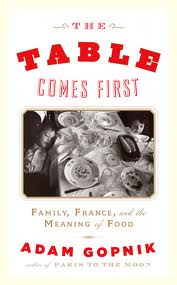
Not so with Mr. Gopnik, whose past stories about his young family’s life in Paris (Paris to the Moon) and their return to Manhattan (Through the Children’s Gate) are among my most-recommended books, and whose 2011 book, The Table Comes First: Family, France, and the Meaning of Food has provided several months of nourishing food for thought, or thoughts about food, probably some of each.

Where did restaurants come from? Who came up with the idea of not just eating outside the home, but dining there? (Long answer, begins around the French revolution). Quite rightly, he compares the restaurant customer to an aristocrat, accustomed to being served (and served beautifully). Gopnik delights in grazing through the thoughts of Brillat-Savarin and Grimod–two early, influential writers about food and dining–but I like the bit that he found in Robert Frost best:

“Home is a place where, when you have to go there, they have to take you in. A restaurant is a place where, when you go there, they not only have to take you in but act as though they were glad to see you. In cities of strangers, this pretense can be very dear.”

This is a book in which New Yorker writer Adam Gopnik thinks about food, and thinks about how others think, and have thought, about food. He goes deep, with some chapters so mired in philosophy or history that they eventually become indigestible. Fortunately, these are exceptions. And when the going becomes thick, he pauses for to write an email to Elizabeth Pennell, who wrote with intelligence and wisdom about food about a century ago; these chatty emails cover the true benefits of cinnamon, the best ways to cook lamb, the extraordinary use of hot air in the hard-to-find and hard-to-cook pommel soufflés, his dog Butterscotch’s love for steak, and other lighthearted stuff.

Adam Gopnik is a regular contributor to The New Yorker.

This is not a book to read over a single meal. It is, instead, book to be savored, bit by bit, over several months. There is simply too much information, too many glimpses and meta ideas, too much richness and provocation and serious research, to be enjoyed quickly. It is slow food for the brain–imagine that, in an era of emails and tweets–much of it about topics I’ve never really thought much about.

For example, Gopnik compares “cook it at home” recipe books that restaurants sell with the home game version of, say, Hollywood Squares. Certainly, there is a resemblance, but the resources and the spicing are entirely different, and so is the experience. He tells a long and funny/odd story about his search for a live chicken that can be purchased, cooked, and eaten within the bounds of New York City, and another about the cleverness of farming tilapia to feed large urban populations, then adds the zesty meta-layer, invoking Adam Smith and the total cost associated with what he believes to be a current fad for localism. And so:

“If Kenyan greens take less total energy than Plattsburgh tomatoes, then we should revel in them no matter how far they have to travel.”

And so it goes, through questions about whether we really can taste the differences between wines (or whether the situation and the artifice overpower the actual human capacity for taste), the imperfection of memory as it applies to the fancy French restaurants of 20th century Manhattan, why sugar was used mostly to flavor tea in England but became the impetus for the pasty industry in France, the various ethical arguments for and against the slaughter of animals for human consumption, and so much more.

As with his own food choices–today, spicy beans and rice, tomorrow, a complicated and challenging attempt at a classic French dish from a century ago–some sections are rich with friendly storytelling and some are thick with pretense, serious thinking, and historical reconsiderations. Unlike Twitter, you need not absorb every idea in an instant. There is time enough to consider the meta-layer, to appreciate the fine writing that has long been Gopnik’s strong suit, time enough to think about what Gopnik has said about what others have said and done, and perchance, to learn something about their ideas by reading Brillat-Savarin in the original (on my list, but not for this year).

I’m investing $165K in the child who lives next door

In the U.S., 76 million students are currently enrolled in pre-K through graduate school. About 55 million students are in pre-K, elementary, junior high, or high school, and about 20 million more are enrolled in community colleges, four year colleges and universities, and graduate programs.

The cost of a pre-K through 12th grade education: $650 billion for 55 million people, or about $12,000 per student per year. Figure a total investment of $165,000 per student for the entire pre-K through high school run. In fact, nearly nine out of ten adults finish high school (most by 18, some later).

Add four years of college, and the total per-student investment exceeds $200,000. As it turns out, that’s the investment made by or for about one in three American adults.

Here’s another way to think about it. You’re in a room with ten people. One of those people never finished high school. Six finished high school, but not college. Three finished college. This is America:

“Between 2000 and 2010, the percentage of the adult population 25 years of age and over who had completed high school rose from 84 to 87%, and the percentage of adults with a bachelor’s degree increased from 26% to 30%.”

Researchers argue about whether the precise high school drop-out rate is closer to 12% or 33%–a very wide range–but 25% is comfortably in-between, hence the “one-in-four” assumption. For minority students, the drop-out rate is somewhere between 50% (yikes!) and 85%, so one-in-three seems to be a reasonable starting point for any discussion. This is an enormous problem. High school drop-outs earn far less than graduates, and often disrupt families and communities because their options are comparatively narrow.

Is there reason to be concerned about one in three Americans graduating from college?

As part of its College Completion agenda, The College Board reports the number of 25-34 year olds with an Associate Degree, or better, in various countries. The results are a bit surprising: there are four countries with over 50% rates, Korea, Canada, the Russian Federation (!), and Japan. There are eleven countries with rates higher than the U.S.; at about 41%, we’re comparable with Israel, France, and Sweden, and (again surprising), far ahead of Germany (24%). Expand the view from 25-35 to 25-64, and the results change a lot: the U.S. is fourth on the list with only Russia above the 50% mark–so it’s reasonable to assume that Korea, Canada and Japan have made great strides during the past few years, but the U.S. has not. Dig deeper and the reasons become clear: the white population seems to be twice as likely to hold a degree than the Latino population, which is growing quickly in the U.S.

Dig deeper and the situation becomes even more complicated.

So, what have I learned in my late night exploration of educational statistics?

1. Assuming our economy can provide the necessary jobs, we should probably set a 50% goal for college graduation. Assuming current trends continue, we will reach that figure within the next 10 or 20 years.

2. Unlike others, I don’t feel that the U.S. must lead in every category. We’re within a reasonable range among comparable nations, and that’s a good starting point.

3. The high school drop-out rate is alarming, both for the individuals involved and for the development of our society. The reasons why we don’t achieve a high school graduation rate are many: inadequate schools, old-fashioned ideas, insufficient budgets, inadequate family and community support for families, poor preparation in key skills necessary for high school success, peer pressure involving gangs, guns, violence, drugs, limited options, and so on.

No, this post does not end with a solid solution or even a rational recommendation. I’m just taking notes on stats that seem important, and devoting part of my day to understanding the bounds of the issue. I hope you will, too.

Notes:

High school rates: http://voxeu.org/index.php?q=node/930

History of pre-K through grade 12 enrollment, plus higher education: http://nces.ed.gov/programs/digest/d10/tables/dt10_003.asp?referrer=report

Lots more good stuff here (the source of the quote, too): http://nces.ed.gov/programs/digest/d10/

As always, Wikipedia offers abundant information, this time with lots of charts and graphs: http://en.wikipedia.org/wiki/Educational_attainment_in_the_United_States

College Board stats from: Organisation for Economic Co-operation and Development, 2010

Know What? Why?

New York Times illustration by Viktor Koen

Here’s an article by former Harvard President Lawrence Summers. It was tucked into the Education Life section of the January 22, 2012 issue, so you may have missed it.

http://www.nytimes.com/2012/01/22/education/edlife/the-21st-century-education.html?pagewanted=all

Summers is attempting to change the debate. Some key ideas:

1. Getting information is now the easy part. Twenty-first century education ought to be about processing and contextualizing information.

2. Processing and contextualizing leads to collaboration.

3. New technology allows the best teachers to be connected to every student. Everything else seems to be clutter.

4. Despite best efforts on the interactive side, most learning is passive: watch, listen, learn. Active learning is the future, but we’re just beginning to understand how and why.

5. Learn a language. Travel the world. Be global.

6. Education must shift from information dissemination to analysis.

Although he’s on the elitist side, the ideas make sense. The complete article isn’t long, but it does present ideas worth pondering.

Meet Boxie


Boxie is a friendly little robot who lives and works at MIT Media Lab. He’s a busy little guy, and his story may change your perceptions of robots in our future.

Boxie Labcast

Siri, meet the family

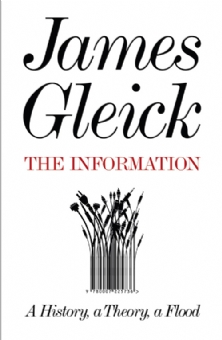
The UK cover is more interesting than the US cover, which is, somewhat appropriately, covered with the repeated words "The Information."

James Gleick nearly won a Pulitzer Prize for a biography about Isaac Newton, and another about Richard Feynmann, a colorful physicist who pioneered nanotechnology and quantum mechanics. His best selling book (more than a million copies sold) is the step-by-step, scientist-by-scientist, idea-by idea story of chaos theory entitled Chaos: Making a New Science.

Gleick’s 2011 book is called The Information. it begins with the European discovery of African talking drums in the 1840s, a percussive idea he eventually connects to Samuel Morse’s dots-and-dashes telegraph code, and, we’re off on a long tale not unlike the best of James Burke’s TV series, Connections. Gleick takes us through the development of letters and alphabets, numbers and mathematics, numerical tables and algorithms, dictionaries and encyclopedias. These stories, and their many tangents, set us up for Charles Babbage whose boredom with the Cambridge curriculum in mathematics leads to an early, impossible-to-build, 25,000 piece machine, awesome in its analog, mechanical, Victorian design. This, then, leads to the further develop of the telegraph, now caught up in a new conception called a “network” that connected much of France, for example.

By the early 20th century, MIT becomes one of several institutions concerned with the training of electrical engineers–then, a new discipline–and with it, machinery to solve second-order differential equations (“rates of change within rates of change: from position to velocity to acceleration”). This, plus the logic associated with relay switches in telegraph networks, provides MIT graduate student Claude Shannon with his thesis idea: connecting electricity with logical interactions in a network. Shannon’s path leads to Bell Labs, where he works on the “transmission of intelligence.” By 1936, a 22-year old Cambridge graduate named Alan Turing had begun thinking about a machine that could compute.

Well, that’s about half the book. Now, things become more complex, harder to follow, dull for all but the most interested reader. The interweaving connects DNA and memes (and, inevitably, memetics, which is the study of memes), cybernetics and randomness, quantification of information, and Jorge Luis Borges’ 1941 conception of an ultimate library with “all books, in all languages, books of apology and prophecy, the gospel and commentary on that gospel, and commentary upon the commentary upon the gospel…”

Eventually we obsolete CD-ROMs (too much information, too little space), and create Wikipedia and the whole of the Internet. In the global googleplex, the term “information overload” becomes inadequate. And yet, Gleick promises, it is not the quantity that matters, it is the meaning that matters. After 420 pages of historical text, I’m still wondering what it all means–and whether the purpose is mere conveyance as opposed to deeper meaning or its hopeful result, understanding.

Yikes!

Picture from Bureau of Labor Statistics job outlook for teachers. Their caption: "Teachers play an important role in fostering the intellectual and social development of children." http://www.bls.gov/oco/ocos318.htm

The next industry that could be decimated by technology: teaching.

Will Richardson thinks, writes and teaches others about the use of technology in education. In this blog posting, Will responds to a rosy Wall Street Journal article about the online learning business.

The ‘yikes’ part: “In Idaho, Alan Dunn, superintendent of the Sugar-Salem School District, says that he may cut entire departments and outsource their courses to online providers. “It’s not ideal,” he says. “But Idaho is in a budget crisis, and this is a creative solution.”

Please read Will’s post.

FOLLOWUP: When I spoke with my father about Will’s post, he told me an interesting story about two of his teachers. I suggested that he write the story as a brief essay, and submit it to Will. He did, and Will published it.

1 in 25 Work as Creative Pros

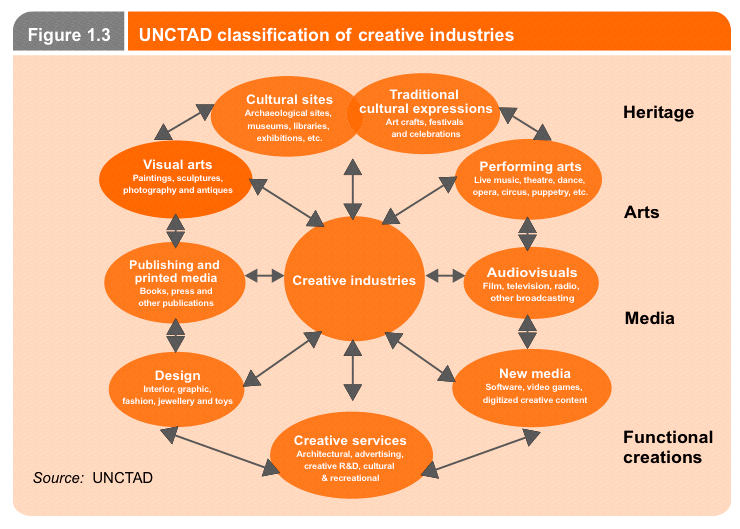
Above, an elegant way to think about the global creative economy, as presented in a 400+ page United Nations report.

1 in 25 people–that’s the revised figure for 2010–work in creative industries in the U.S. More than doctors, lawyers, even accountants. Industry sectors above, details below.

In the United States, roughly 150 million people work full-time. Six million of us work in creative professions. We’re writers and performers; musicians and visual artists; marketers and strategists; architects and specialists who invent, improve, or bring ideas to life. In total, more people work as creative professionals in the U.S. than doctors (700,000), lawyers (800,000), accountants (1,300,000), and engineers (1,600,000) combined. The number of creative professionals exceeds the number of teachers (3,500,000 teachers pre-K through high school, plus 1,700,000 more who teach in colleges and universities).

Our output–which provides employment for lawyers, accountants, executives, retailers, and many others–is responsible for more than ten percent of the U.S. Gross Domestic Product.

A reasonable global workforce estimate would exceed 10 million creative professionals. Nations with significant creative economies include Germany, the United Kingdom, France, Italy, the Netherlands, Ireland, Japan, China, India, Canada, Australia, and, among countries with developing industries, Mexico, Thailand, Indonesia, Argentina, Singapore, and Chile. According to the United Nations Creative Economy 2008 report, the export value of creative in 2005 was over $300 billion, or about 2-3% of the global economy. (Yes, I am reviewing the 423 pages of the 2010 report to update these figures–overall, trends are up).

The long list of creative industries was nicely summarized in the 2008 U.N. report, presented at a United Nations Conference on Trade and Development. The orange version, above, makes it all that much more clear.

Within each of these clusters, the professional model is similar. Projects are developed, produced, and distributed. Mostly, revenues are generated through direct transactions with individual consumers (movie admissions; DVDs; iTunes downloads;physical goods such as jewelry), sometimes through subscriptions; or by advertising to consumers who receive goods and services by paying only a modest transaction fee (magazine subscriptions), or no fee at all (most internet sites; broadcast radio and TV).

You can download the 2010 UN report here. (Yes, I will update my 2008 numbers when time permits.)