While exploring TED, and puppetry, I came upon this TED Talk by the creators of Joey. the horse you’ll recognize from the theatrical production, “War Horse”. Their creative process is fascinating.
Best in Class
January 23, 2013 by Leave a Comment
I guess I ought to begin with the obvious question: what is common thread that connects Louis Armstrong, Bob Dylan, Johnny Cash, Michael Jackson, Bruce Springsteen, Barbra Streisand, Frank Sinatra, Leonard Bernstein, Aaron Copland, Adele, and Beyoncé?
The answer is Columbia Records. Founded in 1888, it’s probably the oldest record label. Along with sister labels Epic, Okeh, and a few others–set the standard for the U.S. recording industry for half of the 20th century. This story, now in book form by Princeton history professor Sean Wilentz, is, well, epic. The book is called 360 Sound: The Columbia Records Story (the term “360 Sound” refers to a tagline associated with Columbia’s stereo LPs).

“(I Ain’t Got) Nobody” was one of the many songs that made Bert Williams famous. He was among the first non-white stars in the United States.
After some novelty acts, Columbia establishes a firm footing with vaudeville superstar Al Jolson; the great singer and comedian who later starred in the Ziegfield Follies, Bert Williams, and one of the fathers of country music, Emmett Miller. A short time later, John Philip Sousa joined the label (at the time, his full band could not be recorded due to early microphones, so the sound was thinner than it was in live performances). Add W.C. Handy, and an equally impressive range of classical performers.
Columbia became a major force in “race records,” recognizing, early on, White consumer interest in Black performers. From this era came Bessie Smith, Louis Armstrong, Duke Ellington and artists that those familiar with the genres continue to buy: Blind Willie Johnson, for example. There was country (and western) music, too: Gene Autry, Bob Wills, Roy Acuff. Next came jazz pianist Art Tatum, Cab Calloway, and Count Basie. And Benny Goodman and Bing Crosby. And gospel music: The Golden Gate Quartet, Mahalia Jackson. And that’s all before the organization really found its way.
(As I said, this is an astonishing story. It’s wave after wave of the superb artists in every genre, all working, at one time or another, for the same label, or cluster of labels.)
So here comes the 1950s with Tony Bennett, Leonard Bernstein, West Side Story, My Fair Lady, South Pacific, Glenn Gould, Doris Day, Rosemary Clooney… and almost no rock n’ roll. Mitch Miller–a company executive and in his own right, a very popular recording artist as a leader of a singing group–was against the whole idea. Still, they were strong in every other genre–classical in particular, and jazz. It was here that Miles Davis recorded most of his best work, with Thelonious Monk, Dave Brubeck, and so many others. Unfortunately, although quite classy, there wasn’t much profit in classical, jazz or (most) Broadway recordings. Country was better: Flatt and Scruggs, Lefty Frizell, The Stanley Brothers, and eventually, Johnny Cash.
Along the way, there’s some tasty back-and-forth between Columbia and its long-time arch-rival (in just about every musical category), RCA Victor (which, in its golden age, was owned by RCA, which owned NBC to Columbia’s CBS). The two companies do their best to mess with the other, stealing artists, introducing competing record formats (the LP came from Columbia and the 45 came from RCA).
For a while longer, they stick with easy choices, and steer clear of the growing revolution: they sign Barbra Streisand, Andy Williams, Johnny Mathis (who sells an insane number of records), and Robert Goulet.
 And then, it happens. They sign Bob Dylan. Everything begins to change. Simon & Garfunkel come next. Suddenly, the cool jazz label, the reliable country label, the powerhouse classical label, becomes the unbelievably great rock label. The Byrds are covering Dylan songs and selling lots of Byrds and Dylan records. Donovan is signed to Epic, and debuts with a hit (“Sunshine Superman”). There’s a new executive in charge (much of the whole story is told through the eras of individual executives). His name is Clive Davis, and now, Columbia is the place to hear Janis Joplin and Santana, Sly and the Family Stone, Leonard Cohen, Blood Sweat & Tears, and Chicago. They sign Earth Wind and Fire; Johnny Cash records an album at Folsom Prison; Monk and Miles are selling lots of jazz, with Miles into fusion, and appealing to rock audiences. And then, by the mid-1970s, there’s another wave of newcomers: Billy Joel, Aerosmith, and Bruce Springsteen. A great story is becoming better and better.
And then, another wave, this time bringing Willie Nelson to the company and making him a star. The jazz story continues to heat up with Weather Report, Herbie Hancock, and a newcomer from the young lions of jazz, Wynton Marsalis. On the classical side, Yo-Yo Ma is becoming a star.
All of this is one company, basically one record label. Of course, the story continues through hip-hop, Ricky Martin, an aging Bob Dylan, Michael Bolton and Lauryn Hill, Destiny’s Child and John Mayer. Chris Botti and Joshua Bell.
Yes, they’ve been bought and sold, multiple times (now owned by Sony). For me, the best part of the journey (oh yes, Journey was one of theirs, too), the best part of this coffee table book, is the era that picks up in the early 1950s and winds down about twenty years later. That’s when CBS was a very special place, in part because Columbia was just about the coolest record label around. It’s a good story, fun because of the memories, remarkable because of the achievement. And, I think, the best way to experience the era is on the vinyl records that Columbia invented, most of them now available, used, for about $5 at just about any good used record store.

So, I’ve been thinking about other labels with equally rich histories. The Warner Music Group includes Atlantic, Elektra, Nonesuch, and Warner Bros. Records. Historically, Atlantic’s strengths have been R&B and rock; Elektra’s have been folk and rock; Nonesuch has evolved into something like a (smaller) modern day Columbia Records with interesting artists, Broadway, classical, and international; Warner Bros. is, more or less, a popular music label. The crazy history of the labels that became Sony Music now encompasses Columbia’s long-time competitor RCA (Victor) as well as the Columbia labels; in just about every category, from Broadway to classical to country, RCA and Columbia were head-to-head, and although I want to write that Columbia did it just that much better on the rock and pop side, I’m reminded of the Jefferson Airplane (less so, the Starship), John Denver and others from the heyday (none were Dylan or Miles Davis–so maybe Columbia did do it better). In classical music, the labels now assembled under the current Decca Label Group, now part of Universal, include London/Decca and Deutsche Grammophon, but neither attempted the breadth of genres associated with Columbia. Similarly, the likes of Verve, A&M, and other Universal labels, lacked the grand ambition (and, probably, the monies available from CBS). EMI’s story is more complicated, and although its U.S. division, Capitol Records, released many pop and rock records, and some Broadway, it never established the breadth of material available from Columbia.
So, in terms of wide-ranging, deep-repetoire, and long history, it’s Columbia Records and its best competitor, RCA (Victor), but I urge you to have a look at all that Nonesuch has done, too.
A Bridge Called Feinstein
January 22, 2013 by 1 Comment
Nearly a century has passed, but the music lingers, and, I hope it always will. “Someone to Watch Over Me” is an absolutely lovely song. It was written 13 years short of 100 years ago, in 1926, for a Broadway show called “Oh, Kay,” a musical about bootleggers, an idea that seems no less distant. By any measure, “Someone to Watch Over Me” is an old song. And yet, the list of singers who have performed it make me question that 1926 date: Keith Jarrett, Barbra Streisand, Willie Nelson, Bennie Wallace (in fact, I bought the album last month, and “Someone” is the title track), Elton John, Sinéad O’Connor, Susan Boyle, Marcus Roberts…the list goes on.
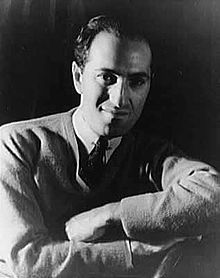 When he wrote the music for “Oh, Kay,” George Gershwin was 28 years old, That was seven years after his first hit song, “Swanee,” sung by the era’s superstar, Al Jolson, and if not quite the standard it was for half of the 20th century, it remains a classic. The same year that he first recorded another song that has run the better part of century, “Fascinatin’ Rhythm” with another pair of very famous stars, Fred and his sister/partner Adele Astaire. By that time, Gershwin had already composed, and become justly famous for, a more serious work commissioned by bandleader Paul Whiteman called “Rhapsody in Blue,” written in a form that wasn’t quite classical, wasn’t quite jazz, and wasn’t quite what we would now call pops. Still to come was Porgy and Bess, Hollywood, and in 1937, at age 38, the brain tumor that ended his life. By that time, George Gershwin was a national treasure.
Time passed. There was a war, then significant changes in the nation’s culture. The old songs, well, they didn’t matter so much any more. Sure, they were played on the radio, but newer forms of entertainment eclipsed many of the first half century’s great success stories.
And that’s why, when most people met a teenager who was crazy for the old songwriters and the old 78 rpm records, they didn’t make much of his hobby. In time, the collection required serious shelving (78s are quite heavy, and quite fragile), and the collector was learning the names of the composers who wrote those songs. Eventually, he made his way to Los Angeles, where he haunted the used record stores in hopes of finding treasures. He found a collection of records by Oscar Levant, a Gershwin friend, which led to Levant’s surviving spouse, which led to a dream job.
Ira Gershwin was looking for a new secretary–his long-time helpmate was dying–and our young hero got the job. He astonished the aging lyricist with his encyclopaedic knowledge of the music of the 1920s and 1930s (and 1940s, for that matter), and his astonishing depth of detail about all things Gershwin. And that’s how Michael Feinstein, born September 7, 1956 became the world’s greatest expert on Ira Gershwin, born December 6, 1896 (and on his brother, George, born two years later, in 1898). But Michael Feinstein had just begun.
 By the mid-1980s, Michael Feinstein was recording these songs, breathing new life (and a great deal of love) into the old records. And, because he had researched, catalogued and organized the entire Gershwin library, his work combined the verve of a dedicated performer with the wisdom of an academic. This led to recordings of music by Irving Berlin, then more Gershwin and more by other songwriters (sometimes, singing alongside them). In short, Michael Feinstein built a bridge from gentlemen songwriters born at the turn of the last century, and generated enough excitement to build a career for himself, energize any number of other performers to pay attention to this music, and then, he opened a cabaret so that the music could be heard live.
And then, he wrote a book about all of this, about his adventures in with the Gershwins, his love affair with the music, the history of the era and why it resonates today, and lots more. The book includes a CD filled with a dozen tracks, some rare, all interesting. It’s there to make absolutely certain that everybody who owns the book will have the opportunity to enjoy the music.
One small warning: Mr. Feinstein is not lacking in enthusiasm, and he is not lacking in detail. This coffee-table book is also a longish read, perhaps something to be enjoyed by reading a chapter every once in a while rather than reading it all through, in a single sitting, as if it was a novel or a traditional biography. It’s more than that, and so, it’s got an unusual title: The Gershwins and Me: A Personal History in Twelve Songs.

Imagine the Possibilities
January 17, 2013 by Leave a Comment
From the innovation consulting firm Idea Champions, Fifty Awesome Quotes on Possibility:
1. “Start by doing what’s necessary; then do what’s possible; and suddenly you are doing the impossible.” – St. Francis of Assisi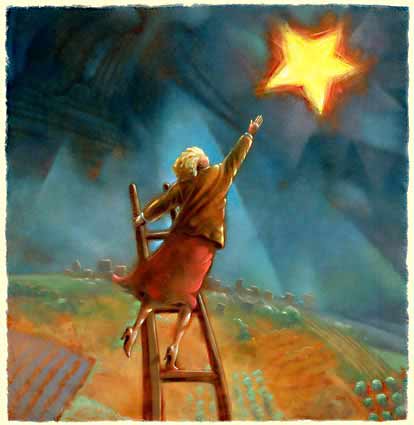
2. “Sometimes I’ve believed as many as six impossible things before breakfast.” – Lewis Carroll
3. “The Wright brother flew right through the smoke screen of impossibility.” – Charles Kettering
4. “In order to attain the impossible, one must attempt the absurd.” – Miguel de Cervantes
5. “The secret of life is to have a task, something you devote your entire life to, something you bring everything to, every minute of the day for the rest of your life. And the most important thing is, it must be something you cannot possibly do.” – Henry Moore
6. “It’s kind of fun to do the impossible!” – Walt Disney
7. “I am where I am because I believe in all possibilities.” – Whoopi Goldberg
8. “What is now proved, was once only imagined.” – William Blake
9. “Truth is stranger than fiction, but it is because fiction is obliged to stick to possibilities. Truth isn’t.” – Mark Twain
10. “The limits of the possible can only be defined by going beyond them into the impossible.” – Arthur C. Clarke
11. “Never tell a young person that anything cannot be done. God may have been waiting centuries for someone ignorant enough of the impossible to do that very thing.” – John Andrew Holmes
12. “God created a number of possibilities in case some of his prototypes failed. That is the meaning of evolution.” – Graham Greene
13. “Whether you believe you can or not, you’re right.” – Henry Ford
14. “Most people are not really free. They are confined by the niche in the world that they carve out for themselves. They limit themselves to fewer possibilities by the narrowness of their vision.” – V.S. Naipaul
15. “I don’t regret a single excess of my responsive youth. I only regret, in my chilled age, certain occasions and possibilities I didn’t embrace.” – Henry James
16. “In the beginner’s mind there are many possibilities, in the expert’s mind there are few.” – Shunryu Suzuki
17. “The future belongs to those who see possibilities before they become obvious.” – John Sculley
18. “One’s only rival is one’s own potentialities. One’s only failure is failing to live up to one’s own possibilities. In this sense, every man can be a king, and must therefore be treated like a king.” – Abraham Maslow
19. “The possibilities are numerous once we decide to act and not react.” – George Bernard Shaw
20. “We all have possibilities we don’t know about. We can do things we don’t even dream we can do.” – Dale Carnegie
21. “An optimist expects his dreams to come true; a pessimist expects his nightmares to.” – Laurence J. Peter
22. “When nothing is sure, everything is possible.” – Margaret Drabble
23. “Imagination is more important than knowledge. For knowledge is limited to all we now know and understand, while imagination embraces the entire world, and all there ever will be to know and understand.” – Albert Einstein
24. “I am neither an optimist nor pessimist, but a possibilist.” – Max Lerner
25. “If I were to wish for anything, I should not wish for wealth and power, but for the passionate sense of the potential, for the eye which, ever young and ardent, sees the possible. Pleasure disappoints, possibility never. And what wine is so sparkling, what so fragrant, what so intoxicating, as possibility!” – Soren Kierkegaard
26. “All things are possible until they are proved impossible. Even the impossible may only be so, as of now.” – Pearl S. Buck
27. “Until you’re ready to look foolish, you’ll never have the possibility of being great.” – Cher
28. “This has always been a motto of mine: Attempt the impossible in order to improve your work.” – Bette Davis
29. “You and I are essentially infinite choice-makers. In every moment of our existence, we are in that field of all possibilities where we have access to an infinity of choices.” – Deepak Chopra
30. “Some people see things as they are and say ‘Why?’ I dream of things that never were and say ‘Why not?'” – George Bernard Shaw
31. “The thing the sixties did was to show us the possibilities and the responsibility that we all had. It wasn’t the answer. It just gave us a glimpse of the possibility.” – John Lennon
32. “I love those who yearn for the impossible.” – Goethe
33. “Every man is an impossibility until he is born.” – Ralph Waldo Emerson
34. “If you can’t, you must. If you must, you can.” – Tony Robbins
35. “A likely impossibility is always preferable to an unconvincing possibility.” – Aristotle
36. “If someone says can’t, that shows you what to do.” – John Cage
37. “You must do the thing you think you cannot do.” – Eleanor Roosevelt
38. “Apparently there is nothing that cannot happen today.” – Mark Twain
39. “Most of the things worth doing in the world had been declared impossible before they were done.” – Louis D. Brandeis
40. “The possible’s slow fuse is lit by the imagination.” – Emily Dickinson
41. “I am always doing that which I cannot do, in order that I may learn how to do it.” – Pablo Picasso
42. “If we all did the things we are capable of doing, we would literally astound ourselves.” – Thomas Edison
43. “Shoot for the moon. Even if you miss, you’ll land among the stars.” – Les Brown
44. If one advances confidently in the direction of his dreams, and endeavors to live the life which he has imagined, he will meet with a success unexpected in common hours.” – Henry David Thoreau
45. “Everything you can imagine in real.” – Picasso
46. “Everything that is done in the world is done by hope.” – Martin Luther
47. “Dream as if you’ll live forever. Live as if you’ll die today.” – James Dean
48. “I don’t dream at night, I dream all day. I dream for a living.”
– Steven Spielberg
49. “The shell must break before the bird can fly.” – Alfred Tennyson
50. “If not you, who? If not now, when?” – Rabbi Hillel
Snow Fall: Two Ways to Tell a Story
January 13, 2013 by Leave a Comment
Several weeks ago, in the midst of a busy holiday season, The New York Times attempted to understand its future by telling the story of an avalanche. The story requires about a half hour of your time, and it is best experienced in a quiet room with a reasonably large screen.

The place to begin is with the text-ish story, the one that requires a lot of on-screen reading, the one that includes various animated maps that show just where, how, and why the avalanche happened. Short videos (each one about a minute long) illustrate the story, and bring the people in the story to life. There are audio files of the emergency calls to Ski Patrol. There are slide shows that help us to understand the life of each skier. The writing is strong and skillful. The whole presentation is an impressive demonstration of how we might experience news and features in the rapidly-advancing future.
It feels like an experiment. The writing is long, more like a NY Times Magazine story than a web story. I felt myself drawn into the story and its environment, and found myself pressing the “volume up” buttons on my keyboard in expectation of some sort of soundtrack to accompany the reading of the text. Short videos satisfied some of the craving for additional stimulation; they were nicely integrated into the flow of the story and the text presentation. The slide shows that introduce each character are a more awkward fit because they require the reader to leave the chronology of the intense storyline–which is told, mostly, in shades of grey–and to consider each character’s past life–which is told, mostly, in vivid digital color. The visual shift is jarring, made worse by the inclusion of completely irrelevant advertisements that are large enough to disrupt the entire experience (for this type of storytelling, I think I’d prefer a micropayment or subscription model, but I wouldn’t mind seeing an opening, mid-break and closing sponsorship presentation).
After I read, looked at the pictures, followed the maps, watched the short videos, and so on, I felt that I understood what happened at Tunnel Creek.
And then, I watched the 11-minute video documentary that told the whole story. I was struck by how much more effectively the documentary told the same story. The story was tight, the characters were crisply defined, the maps and visuals made more sense because they were narrated, the pace was brisk, the emotions were sharp and devastating. Less was a whole lot more. The documentary made the print-pictures-video-maps presentation feel like a bunch of reporters’ notes and script drafts. I felt certain that the doc had been produced by another team, but no, it had been made by the same New York Times staff.
And all of that confused me. I love to read (less so on the screen, moreso from paper), and I was very impressed by the quality of storytelling in the multimedia format. But after watching the documentary, I found myself wondering whether we’re making too much of this transmedia idea, and whether a well-produced audio-video presentation might provide a more reasonable multimedia future.
Sure, this is just one example, and an early one at that. I’m anxious to see what Atavist has online, and will write about their multimedia storytelling in the next few weeks.
In the meantime, do take the take to explore the NY Times presentations. They’re well worth your time and attention.
My Website Doesn’t Look So Good (on my mobile phone)
January 9, 2013 by Leave a Comment
You’ve got a perfectly good website, looks great on any computer. The only problem: fewer and fewer people are seeing your website on a computer. More and more, it’s the way that the website looks on a mobile device that matters. Oh, sorry, one more problem: there are at least a dozen different mobile devices, and your website will not look the same on any two of them. Some text wraps, some does not. Some graphics are shown, others are cut-off. What a mess?
Check out the images below, and click on any of them to see a more complete picture with even more devices. Try it with your website, and then, either find a pre-made solution (WordPress offers one for blogs, for example), or start thinking about a secondary website design for your business, etc.
Every week, it’s a brave new world.

Chopping Down the Tree of Knowledge
January 2, 2013 by Leave a Comment
So, during the past few weeks, I’ve been thinking a lot about the visual mapping of ideas.
Scott McCloud suggested that I have a look at the animation being done by Cognitive Media. You’ve probably see their work. I especially enjoy their lectures, often associated with TED-Ed, and their RSA work.
Back to mapping. I’ve been struggling with the tree of knowledge–and its modern equivalent, the mind maps now found in so many places on the internet and in classrooms. This means of structuring information provides the basis for the often-awkward corporate organization chart, now as often undermined by concepts of matrix reporting (you report to me, but we both also report to a lot of other people, kinda, sorta). I’m experimenting with several mind mapping programs, and one (Curio) is especially promising. That’s coming in a later post.
A few years ago, I worked with some folks from Wharton on a new approach to organizational design in which everybody is responsible to everybody else. I liked the idea because (a) I thought it represented what happens in a modern organization with greater precision, and (b) it represented the kind of productive, modern place I wanted to work. The design was a simple circle with about 100 points–and every point was connected to every other point. The concept: simple. The illustration: ridiculously complicated and difficult to understand.
So back to Cognitive Media. They’ve produced a nifty cartoon that helped me to understand the inadequacies of the tree-based design, the plusses and minuses of the network design, and the need for a universal design.
Watch it:
The Art of Inge
December 28, 2012 by Leave a Comment
Below, a picture of Inge Druckery with her reducing glass. Why a reducing glass, and not, say, a traditional magnifying glass? Because a reducing glass allows the user to step away from the visual work. By stepping away, the artist/designer can see the whole, and the relationship between the many pieces of a visual presentation.
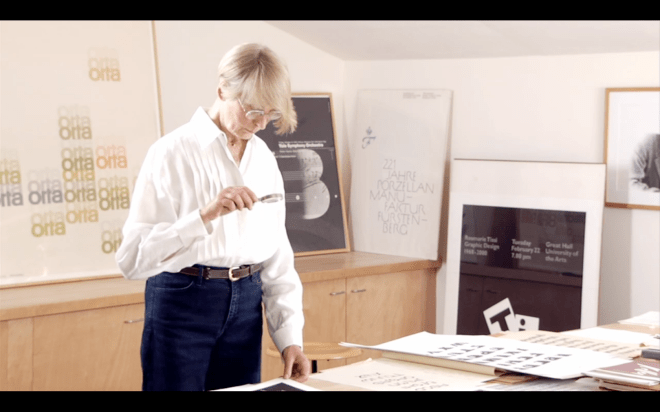 Inge Druckery is one of the world’s truly great teachers of type design, and, more generally, she has provided designers of all kinds with tremendous inspiration, especially in the combinations of typography and graphic design that so dominate our world, our screens, our print materials.
And now, Edward Tufte (one of her students) has executive produced a 37-minute film, available free, about Druckery’s life and work. The images are striking in their simple elegance, and there are plenty of them. You can watch the film by visiting Mr. Tufte’s site, or simply clicking on the video at the top of this article. This is a film to watch full-screen, in a quiet room free from distracting glare, without interruption, with a patience and a keen eye. Do so, and you will be rewarded with an experience very much akin to attending an extremely well-crafted art museum exhibition on an extremely interesting topic. Do not hurry. Do this when your time permits. The images and ideas will stay with your afterwards.
What sorts of things are presented? The extremely precise Roman alphabet, the letterforms that are so solidly architectural in their L, E, T, and V forms, and so much in motion in the S, so beautifully balanced as curves meet straight edges in the B and, especially, the tricky R form. Simple explanation, elegant presentation.
Fascinating.
Here’s a progression of the letter R, rendered by hand with a proper broad lettering brush, with each letterform progressing toward an ideal. Here, the most basic of old analog form presages a perfection now commonplace in digital typography. Commonplace, but not common. And in the common hand, perhaps there is greater perfection, more of the Lord’s hand and the human progress toward excellence, than digital allows.

Unreasonable
December 27, 2012 by Leave a Comment
As the year winds down, a call-out to some unreasonable people.
One is called The Unreasonable Institute.
Why We Exist: To create a world in which no one is limited by their circumstances.
Our Mission: To unlock entrepreneurial potential to overcome our world’s greatest challenges.
Three recent college graduates decided to take on the world’s biggest problems–no shortage of idealism here–by causing interactions between promising entrepreneurs with big ideas, mentors, and funders. They do all of this–quite reasonably, I might add–by having everybody work and live together in a big house for several weeks. I’m not sure that “institute” (their term) is the ideal description, but this combination networking fest and dorm experience makes a lot of sense. There are lots of informal interactions between smart, interested, connected people who want to make things happen. I love this idea, and I suspect you will, too.
The second is called Charity: Water.
charity: water is a non-profit organization bringing clean and safe drinking water to people in developing nations.
Two simple ideas here. One is clean water for everyone, everywhere in the world. That’s a tremendous challenge, one that can be solved only on a local level, well-by-well, source-by-source. It’s also a transformative idea: clean water means healthier people, far less time each day caring for the ill; empowerment of women (who, in many places in the world, expend an enormous amount of time at the well or other source, and carrying water home).

To play the video, please click on the image.
Both are mentioned here are examples of a new way of thinking about the world’s problems: a small entrepreneurial group with big ideas, unique approaches to management, operations and funding, plenty of attention to details, and, far less reliance upon large organizations to provide solutions. And one more thing: the internet is central to the success of these new conceptions. Be sure to explore Charity: Water’s use of internet mapping for every project, a solid example of things to come.
BTW: while searching for a link, I ran into a Huffington Post story that explains the trend in more detail. It’s definitely worth reading, especially at a time of year when we’re all trying to figure out how to do it even better next week.
The Virtues of Daydreaming
December 27, 2012 by Leave a Comment
From the author of a very good article (see below) about challenging our assumptions about learning:
Among its many benefits, daydreaming has been associated with longer attention span, increased resolve, creativity and even higher IQ.
To which I am tempted to add:
If a creative person does not spend at least a half hour a day, half paying attention to the world, lost in thoughts about what might be, how it might be done, and how everything could change, he or she is not doing what needs to be done. Drifting off, checking out from the “normal,” simply shutting out the real world for a bit… if you don’t do that, how in the world will you accomplish anything useful at all.

Now, consider these assumptions:
- Playing scary and violent video games help children master their fears in real life
- Practical classroom science lab work provides children little learning
- Gardening improves children’s desire to learn and boosts their confidence
- Teaching kids at a very early age is counterproductive to their learning
- Green spaces elevate children’s learning through discovery
- Learning is affected by classroom acoustics, artificial learning, and windows
- Young children learn about prejudice by instruction, older children by experience
- Laughing results in increased memory retention
Now, read the article from InfomED: An online commentary for the education industry. And allow yourself a good half hour to further explore other terrific articles including “Can We Teach Compassion?” (an infographic); “Facilitating Collaborative Learning: 20 Things You Need to Know from the Pros” and “The Tyranny of Homework…”

 Digital Insider