The Nuremberg Chronicle

Or, more or less, the Wikipedia of 1493, the year Columbus first visited the Western Hemisphere.
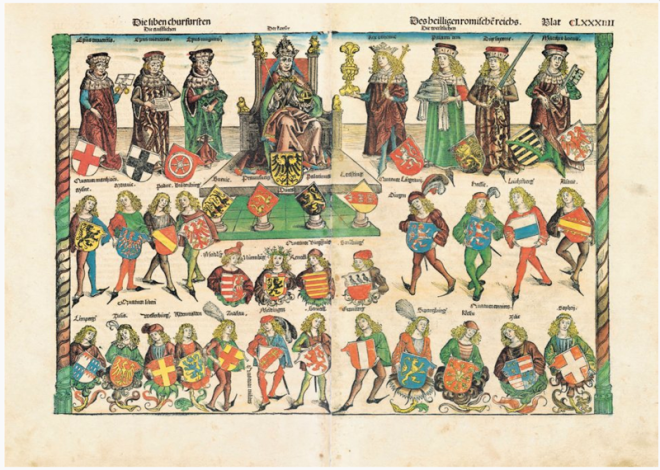
Nuremberg3It’s a big, old book, the kind of illustrated, illuminated, hand-lettered book that I would never expected to see in my own home. But here it is, nearly 2 inches thick, reproduced by the always-intrepid Taschen publishing company. As you can see, it’s quite a beautiful old book, with colorful illustrations of kings and townscapes on every page. Looking carefully, I can make out a page about Florencia, also known as Florenz, today’s Florence, Italy, and on another page, the now-German town of Wurtzburg. There’s Rom, or Roma, with its bridges and towers, and the formidable city gates. Here’s a stylist family tree, but the old lettering is difficult for me to understand. A book like this might occupy a few minutes in a museum, and then, I’d move on. But to have it in my hands, well, that’s another thing. Its age demands respect, and time to study, not to peruse but to study, every page, slowly and with a sense of insight and discovery.
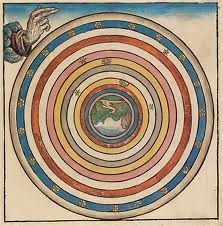
imagesFortunately, the cardboard slipcase includes not only the main volume, but a large-format color paperback book entitled The Book of Chronicles. In essence, it’s a guidebook, written in English, nicely illustrated, and it helps to make sense of the larger volume.  It begins,

The handwritten layout for Hartmann Schedel’s Weltchronik, or Chronicle of the World, widely known as the Nuremberg Chronicle, has survived in the municipal library of Nuremberg… This chronicle is structured as follows: the First Age from Creation to the Deluge; the Second Age from the Deluge to the Birth of Abraham; the Third Age from the Birth of Abraham to the Kingdom of David; the Fourth Age from the beginning of the Kingdom of David to the Babylonian Captivity; the Sixth (and longest) Age from the Birth of Christ to the present day. A brief Seventh Age follows, reporting from the coming of the Antichrist at the end of the world and predicting the Last Judgement. This is followed, somewhat unsystematically, by descriptions of various towns…digressions on the subject of natural catastrophes, wars, reports on the founding of cities…biblical stories.”

The work was put together at the pleasure of several benefactors, financial backers who are credited. (Their names and stories are explained in the paperback, but none will be familiar to contemporary readers.) One familiar name is the artist Albrecht Dürer, whose sketches may have been the basis for the many woodcuts found in the Chronicle.

Approximately 2,000 copies were published, and about half went unsold. Many of the copies were sold by booksellers–nice to know that there were booksellers around 1500, sad to think that there may be none within our lifetimes. Books were sold sold by banking and trading houses, and their clients. Academics also sold books as a means to earn some extra money. Many books were sold in and near Nuremberg, but they were also sold in Milan, Florence, Geneva, Venice, Lyon, and Paris. The majority of the books were published in Latin, but some were published in German. It surprises me that we know so much about the publishing and marketing of a book that was current more than 500 years ago.

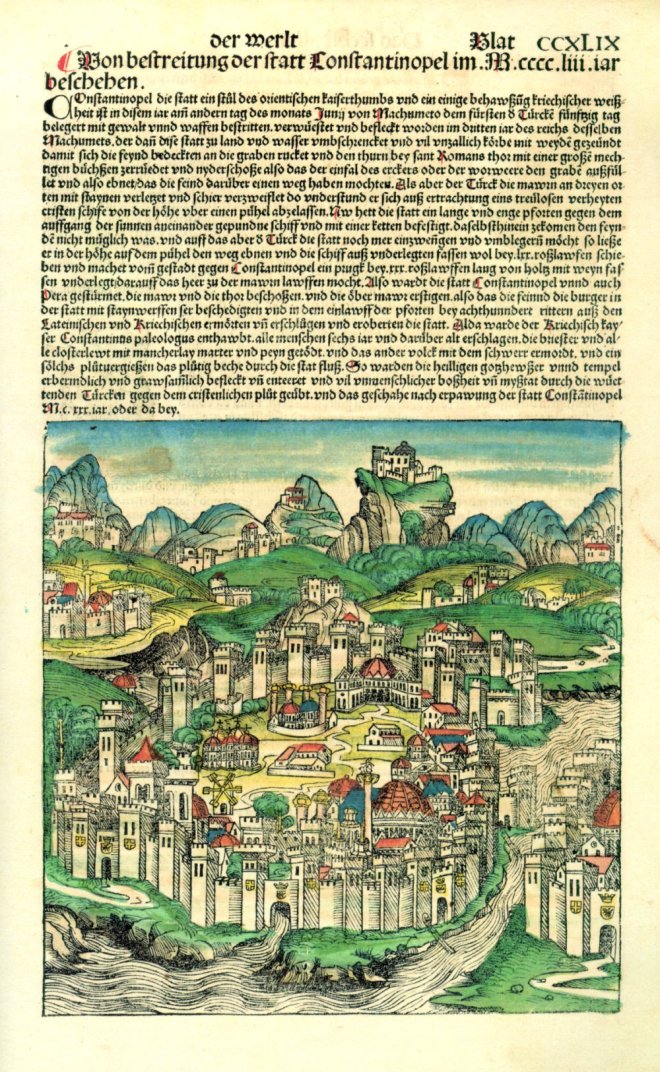
Here’s the scoop on Constantinople, circa 1493:
Schedel_konstantinopel

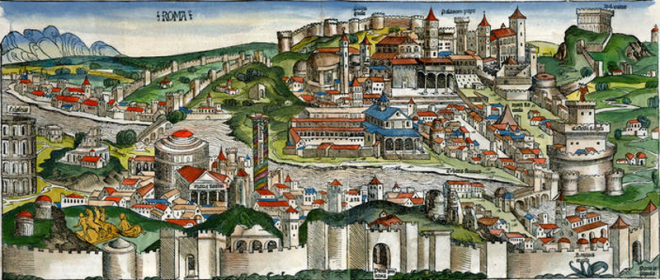
Here’s a look at Rome, slightly improved through digital technology:
Rome

Here’s what you’re seeing: “On the left we can see the huge Coliseum. To its right are the ruins of the Theater of Marcellus and Santa Maria Rotunda, formerly the Pantheon, the best-preserved of all Rome’s ancient buildings (27 BC), rededicated under Pope Bonafacio IV (AD 609) to Mary and all the martyrs. In the foreground, we see the Aurelian Wall with various city gates. From left to right, they are Porto Quirinale, the Porta Pinciana, and the Porta del Popolo, which was the first church visited by pilgrims arriving from the north and Germany. Just behind it is the bridge of St. Angelo which leads across the Tiber to the Castellum S. Angeli. From there, the pilgrim can continue straight ahead to the Vatican or left to the (old) St. Peter’s. At the top of the picture, in the middle of the Vatican walls and to the far right of the papal residence, is the Villa del Belvedere, built under Pope Innocent VIII (1484-1492).

Page after page, I kept wondering how I might touch the page and magically transform the old Latin or German text into words I could read. Odd to be wondering why a half-millenium old book won’t behave like an iPad, but that’s the way we’re now thinking about the world. Perhaps that’s progress.

Never Thought About It That Way Before…

brochure1-mBirthday: August 4, 1961

Statehood: August 21, 1959

The first is the birthdate of the current President of the United States. The second is the date that Hawaii was transformed, by law, from a U.S. Territory to a U.S. State. The two dates are separated by two years, and just about two weeks. If Mr. Obama had been born on, say, August 20, 1959, he could not become  President.

On October 5, 2004, a Yale Law Professor named Akhil Reed Amar testified before the United States Senate. At the time, the Senate was exploring the reasons why, in today’s world, an immigrant was not allowed to become President. Professor Amar knows a great deal about the U.S. Constitution. He points out, “the Founders did exclude…immigrants from the Presidency. But they did so because some at the time feared that a scheming foreign earl or duke might cross the Atlantic with a huge retinue of loyalists and a boatload of European gold, and then try to bully or bribe his way into the Presidency…In a young America, when a fledgling New World democracy was struggling to establish itself alongside an Old World dominated by monarchy and aristocracy, this ban on foreign-born presidents made a lot more sense than it does in the twenty-first century.”

He goes on to explain that seven of the Constitution’s thirty-nine signers were immigrants; that three of the first ten Supreme Court justices were foreign-born; and that similar statistics applied to other key government figures. What’s more, the Constitution was approved by an enormous number of people who were not born here; the same is true of nearly all of the Constitution’s amendments. People who serve on juries, people who vote, people who want to run for Governor of any state…all of these people may be foreign-born. But not the U.S. President.

It took me a bit to get past my emotional responses to Amar’s arguments, but after reading nearly 1,000 pages of his analysis and provocative investigations, my mind is now becoming accustomed to the kind of workout that a law professor can provide.

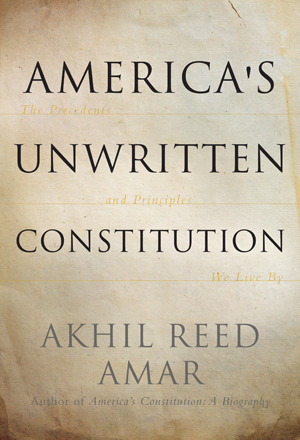
amar_akhilI started reading Amar’s book, American’s Unwritten Constitution: The Precedents and Principles We Live By last spring, but quickly realized that the book would make a lot more sense if I first read America’s Constitution: A Biography. The first book explains how the Constitution came together, and how its ideas have been interpreted, applied, shifted, calcified, de-calcified, respected, and transformed. The second book is more provocative; it requires the reader to consider his or her place, the decisions that we make within and beside the Constitution, the responsibilities that we accept as, for examples, voters and jurors.

The word juror, for example, is derived from the French and Latin words for “swear.” Not what I would have thought, but then, Amar shines the light on the concept of swearing an oath. What does the oath promise. In essence, we take an oath to use our conscience effectively. That is, we are swearing that we will, to the best of our ability, exercise a reasonable, moral, ethical judgment based upon the information provided to the jury. Which is to say, “when a juror is not told what punishments she is actually voting to inflict, and not told that she has a legal right to just say no and a legal duty to consult her conscience, then the moral foundations of the entire system begin to crumble.”

He goes on–these are long books, best appreciated over an entire summer of quiet nights–“Current practice…all too often instrumentalizes and infantalizes jurors by disrespecting or derailing their moral judgment. When a juror finds a man guilty of having shoplifted a baseball glove and only later finds out from a local newspaper or lawyerly acquaintance that what she really voted for was in the jury room was to send this poor soul to prison for life (and at taxpayer expense), she is apt to feel ill-used–as is the defendant, of course.

I think I’ve dog-eared the bottom corners of perhaps fifty pages–each containing a notable idea that I want to think about, learn more about.

Professor Amar, loose and having a good time as a guest on The Colbert Report last January.

Professor Amar, loose and having a good time as a guest on The Colbert Report last January.

In the second book, much is made about the Northwest Ordinance, a subject I vaguely remember from seventh grade, and perhaps, tenth grade in slightly greater detail. The key idea–and you’ll see why this phrase was so important in a moment–the key phrase in that document was “There shall be neither slavery nor involuntary servitude in the said territory, otherwise than in the punishment of crimes whereof the party shall have been duly convicted.” No slavery in what would become the states of Ohio, Michigan, Illinois, Wisconsin and Minnesota. Amar points out, “(these states) formed the backbone of the Republican Party. Men from these places filled the Union Army at every level, from Grant and Sherman on down. Without these northwesterners, there would have been no President Lincoln, no Civil War victory, and no Abolition Amendment… Residents of this region arrived there from many different places (especially from the free states, of course), and inclined toward a distinctly nationalist worldview. Whereas nineteenth-century Virginians like Robert E. Lee gave pride of place to their home state (which had pre-existed the Union by more than a century…), northwesterners tended to see themselves as Americans first and state residents second. America had chronologically preceded the states they now called home.”

I kept finding myself thinking, “gee, I never thought about it that way.” I suppose that’s why, through all of the details of Supreme Court cases, nuances of amendment wording, minute details about the judicial process, I stuck with it. I have fifteen pages remaining. I will finish my summer’s reading before I fall asleep tonight. This summer, Professor Amar taught me a lot. And based upon the dog-ears, I’m not going to finish with these ideas for a long while.

As it should be.

Amar-Americas_UnwrittenHORIZ

Famous People from China

Ma_Yuan_-_Water_Album_-_Clouds_Rising_from_the_Green_SeaYeah, well, my list isn’t very long, either.  Easy enough to list Mao, Chang Kai-Shek, Chao en-Lai, maybe the classical pianist Lang Lang, and the basketball player Yao Ming. Maybe Jet Li, who is probably from Hong Kong (I checked; he is from Hong Kong).

Here’s one of the most powerful, significant, nations, one with enormous history, and I can’t name a half dozen important people from the whole country! (Genghis Khan? Kublai Khan?) I found a pop culture site and found out that Audrey Meadows, from TV’s The Honeymooners, was born in China. I also left out the architect I.M. Pei, who was born in Shanghai. Still, my list is so embarrassing, I figured I ought to know more. So I found a book about important people from China. Appropriately, it’s called Chinese Lives, and it begins, as it should, with a map of China’s many provinces, only half of which I knew by name (Hangxi, Anhui, Shaanxi, and Gansu were among the unfamiliar ones).

I wasn’t sure whether Confucius was a real person, so I never added him to my list, but there he is on page 22, a real person born in 551 BCE, just over 2500 years ago. He was a teacher, and a government minister, eventually becoming an acting Prime Minister. Apparently, he did not play the political game very well; he was exiled, and that allowed him to do his best work, in texts that he edited after he turned 67 years old. The ideas that he wrote, compiled and edited became the philosophical basis for a particular sort of Chinese education, the kind that led to government jobs. Lots of emphasis on “unwavering loyalty to the lord” in a “harmonious society.”

Mo Zi was born around the time that Confucius died. Mo Zi was an philosopher who toured China spreading his ideas of an “egalitarian society based upon devotion to the common good.” He was strongly anti-war, and in favor of universal love.

I especially enjoyed the story of King Wuling of the Zhoa, whose reign began around 325 BCE. The King had a problem, though. According to tradition, his military force dressed in long robes, and traveled into battle on chariot. By 307 BCE, his men were being routinely beaten by the barbarians who traveled not by chariot, but by riding directly upon the horses’ backs. The robes were a problem. King Wuling’s contribution: he convinced the Chinese troops to abandon their traditional gowns and instead dress like the barbarians–in trousers, with boots.

The book is filled with statesmen associated with dynasties whose names are vaguely familiar (I really should read a good book about the whole history of China), more philosophers, a slave who became emperor, military leaders, and more of the stuff I expected to see here.

And then, a familiar name and an unfamiliar one: Li Bari (familiar, also known as Li Po) and Du Fu (not). Both were Chinese poets around 700 or so. Here’s Li Po goofing on Du Fu in a poem:

I ran into Du Fu by a Rice Grain Mountain

In a bamboo hat with the sun at high noon

Hasn’t he got awfully thin since our parting?

It must be struggle of writing his poems.

I keep checking these dates because they are so far outside of the sphere of U.S. consciousness. Su Dongpo was a poet born in 1037, more than 700 years before anybody had an inkling that the United States would exist. He was a painter, too, and a good cook whose recipes survive (Dongpo-style pork remains a Chinese delicacy.) Here’s part of his poem, “Time ‘Immortal’ by the River:’

I drank at night on East Slope, sobered up, got drunk again.

When I came home it was some time past midnight

The houseboy was already snoring like thunder.

I pounded on the gate and got no response.

Then leaned on my staff and listened to the river noises.

A drunk dude sneaking into his house, screwed up again. Things don’t change much, I guess.

Ma Yuan was a court painter. He lived from about 1190 to 1225. If you search for his name (also called Qinshan), you’ll find a lot of wonderful images. The painting at the top of this article was painted by Ma Yuan.

timthumb.phpThere are good stories about emperor Kublai Khan, and the beginning of Chinese drama as initiated by Guan Hanqing. You may know Zheng He, an admiral who led a large fleet to Africa and other far away places a few decades before Christopher Columbus was toilet-trained (I wonder whether there were toilets in Genoa in the 1450s?) Rumors about Zheng He discovering the American mainland are, apparently, quite wrong, the work of someone who mistranslated Chinese historical documents.

There are eunuchs (Zheng He was one, in fact), bandits, rebel leaders, generals and writers who specialize in ghost stories, emperors and national heroes whose names you’ve probably never heard before (they were certainly new to me). There’s Cao Zueqin, “China’s greatest novelist” who died just before the American Revolution and Lu Xun, “Greatest Chinese writer of the 20th century”–a whole culture to explore.

Imagine someone in China first encountering the stories of George Washington, Abraham Lincoln, Louis Armstrong, Robert E. Lee, Billie Holiday, George Gershwin, Walt Disney, Norman Rockwell, and Bob Dylan–never having heard any of these names before, finding a book called American Lives.

Next Spring, Near Paris

Start saving your money. Next May, go to Paris. Leave early on the morning–there’s an 820AM from Paris’s Saint-Lazare Station to Vernon, and then, there’s the taxi. The train arrives at 9:05AM at Vernon, and the cab will get you to the front entrance of Monet’s home and gardens by about 9:15AM. You want to arrive early, perhaps catch the mist rising from the water garden, perhaps take a few pictures or just gaze before the crowds populate every view. (Get there earlier, if you can; it’s always best to arrive first-in-line here.)

Sigh.

Summer is ending. There is autumn color: the purples and luminous yellows, the garish reds and the beginnings of orange trees reflected in the water. But there is nothing like spring.

In 1883, Claude Monet settled in Giverny, a village fifty miles outside paris. He rented a house with an orchard, the future Clos Normand, the flower garden at the front of the house that broke with the traditional idea of a pleasure garden.

9781419709609So begins the tale, told mostly in large, vivacious images, of Claude Monet’s extraordinary gardens (and home), told with love and with style through Jean-Pierre Gilson’s photographs, with text by Dominique Lobstein. Published by Abrams–one of the best in the world at this type of book, the visual tour begins, as it should , in the purple haze and tangled wisteria branches hanging over the famous Japanese bridge. The photograph is subdued; there are no bright colors yet. On the next two-page spread, there are brightly–colored bushes and their quiet reflections, house peeking out of the background behind some trees. Flip to the next of these several two-page spreads and it’s a riot of roses, glowing in the sun, red, pink, nearly white, braced by green leaves so dark and sometimes so nearly translucent, bold as can be. The text begins.

And on the next spread, so does spring. After the prelude, spring commences with a field of pink tulips, clean green fences and stair rails, dark green-blue leaves, and the stunning-but-simple house with its own pink facade and blue-green shutters. The effect is stunning, as if in a painting–and here, that’s precisely the effect that the master painter intended. To be at Giverny is to live inside a Monet painting, at least for a morning.

It’s not all cluttered with noisy flowers and oh-so-subtle impressionist gardening. “Monet wanted a garden that could ‘breathe’ with flowers, bushes and an open vista…” so he removed the many trees from the old orchard, and replaced them with Japanese cherry trees that yield, at least for a brief time in the spring, lighter-than-air blossoms, punctuated, here and there, as in any number of his paintings, with spots of bright color; here, red and purple tulips.

I wish I knew the name of every flower (and I wish the author’s captions included this information!). The phenomenal two-page spread showing yellow towers of flowers two stories high, dappled with pink-and-purple irises, golden yellow somethings (frustrated…), and it’s followed by several more. (I want to it to be spring today, and I want to go to Giverny tomorrow.)

And then, when your head is beginning to explode because Monet was such a genius, there’s a pair of small green rowboats, a field of happy daffodils, and in the distance, the Japanese bridge that he painted so often. Here, with a less exhausting spectrum, it’s possible to rest and reflect, and observe. The yellowy green of the locust leaves in contrast with the deep green of the background trees–with just a hint of small violet flowers to set the counterpoint.

The flighty, wavy petals of mauve tulips surprise me every time I see them. Here, they’re pictured with the famous lily pad pond in the fuzzy distance, and the sharp, sun-dappled orange wallflowers in the foreground. Another two-page spread, one of my favorite two-page spreads in the book.

Just checking–I’m not even half way through the book. Some surreal lily pad images–two look as though they were made for a science fiction film, but they are real–and then, with a page turn, there are paths of dry ochre leaves on the ground, paths with strong color of fall, not spring. The quiet beauty of barren trees and cool skies, the yellowing willow and golden hour light, it’s bittersweet. Moreso because the last set of images show the house with shutters now closed tight.

But then, we get to go inside. A row of old copper pans artfully hung in front of a blue-and-turquoise tiled wall with cabinets. A yellow dining room whose walls are filled with Japanese prints (Monet collected them, and they are a highlight of every Giverny tour, but few people spend the time to look at them as closely as the artist once did). It’s a classy old country home, less formal than most. And then, there’s a small staircase leading down to a room with Persian carpets on the floor and a whole lot of miscellaneous Monet paintings almost haphazardly scattered on the walls. It’s his studio.

The book closes with snow. Which means spring is coming again. Soon.

Small Atlases Make Intriguing Gifts

Sometimes, it’s difficult to understand an idea without seeing a picture. I suppose that’s one of the reasons why I like the idea–if not always the execution–of infographics.  Give me a good map with abundant legend, little boxes with big information, arrows to guide me, and I’m more like to understand a complicated idea. The book publisher Dorling-Kindersley, also known DK, has developed a brilliant style based upon the visual display of encyclopedia information (you know their Eyewitness Travel Guides, for example).

Given sufficient free time, I’ll wonder about just about anything. One thing thing I’ve always wondered about is how mankind managed to populate every corner of the earth. Think about it–a small population in central east Africa with extremely limited resources, no meaningful transportation, little protection from the elements or from one another, somehow ended up in Siberia, South America, even Australia. How? Well, mostly, they walked. (Along the way, they struggled to invent the needle so that they could sew animal skins together, astonishing tech in their time).

You can learn a lot about the world by studying migration maps. For example, just about everybody knows that a large portion of the U.S.’s black population came from Africa. Now Africa’s a big place. Where did they come from, exactly? Yeah, well, I had no idea until I checked a map in People on the Move: An Atlas of Migration by Russell King. There were two main “collection points”–one was Luanda, still the largest city in Angola (many of those slaves were controlled by Portuguese interests, so they ended up either in Brazil or the U.S.). Slaves leaving from Accra and El Mina (or, Elmina) mostly traveled to Brazil, Virginia or Louisiana. Some African slaves ended up in Portugal, too. The British, French and Dutch colonial slaves more often traveled to the Caribbean Islands.And that’s just part of the story: lots of African slaves were sent along Arab trade routes and up into Turkey–a much earlier system of human trade based upon ancient tradition.

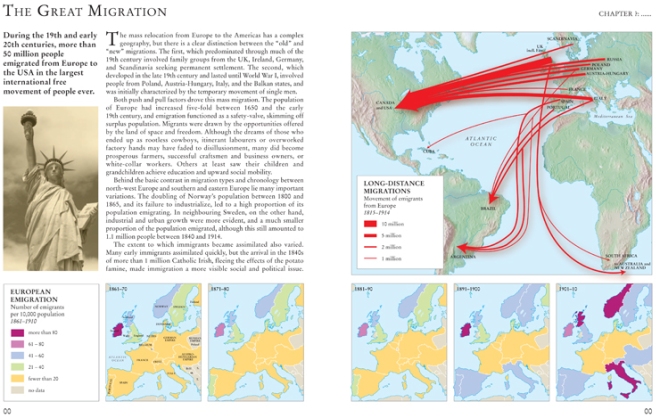
MIGRATION_GreatSo that’s one migration. There’s another 13.5 million people moving during the period 1815-1915. Those people are moving, mostly, from Europe to America. Lots from Ireland, England, Scandinavia, and later, Spain, Italy, and eastern Europe–the peopling of America.
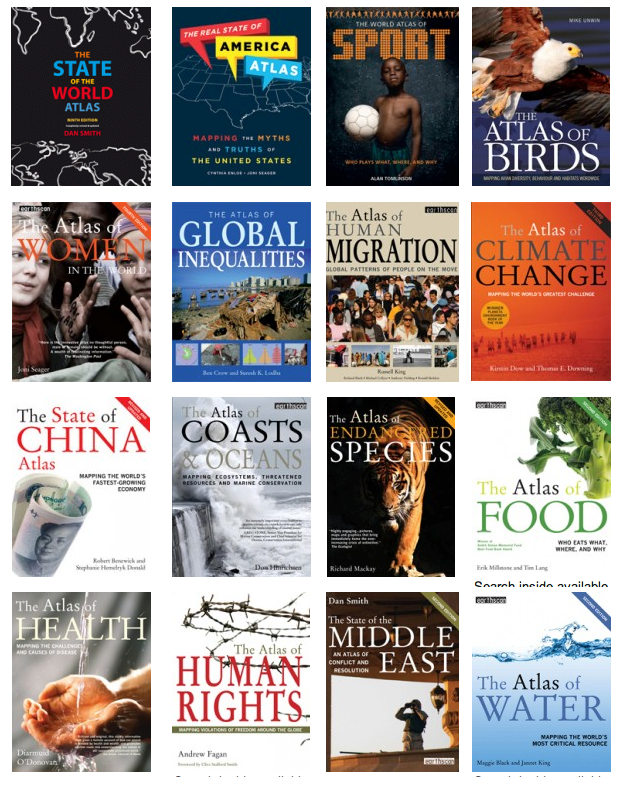
Migration is still a robust human endeavor. The oil boom in the Persian Gulf has been a magnet for several million people (the population of the United Arab Emirates [capital city: Dubai] has increased from 180,000 in 1966 to 4.4 million four decades later, with most of the new people foreign nationals). Lots of movement in the USA, too, first from to the west, then from the south, then from the rust belt to the south. People migrate for marriage, careers, college studies, so many reasons. Never really thought much about it, but this book has been fascinating.

And it’s part of a series. All are published in the U.S. by the University of California Press, but they’re made by Myriad Editions and they’re available from other publishers in other languages in other parts of the world.

I first encountered the series through The Atlas of Global Inequalities by Ben Crow and Suresh K. Lodha. If you’re fascinated by headlines like “2% of adults possess more than 50% of all global wealth” and “50% of people possess only 1% of all global wealth,” this book is your next birthday present. The authors go very deep into graphing of statistical information, lavish in their use of shapes and colors to clarify confusing points, so this book requires, and rewards, quiet and attentive reading. The relationship between life expectancy and household income is striking–live long and prosper in New Zealand or Iceland, or live a few less years but live somewhat richer in the U.S.A, Norway, or Luxembourg. Life expectancy in Africa is 54 years, but in North America, the average is 79 years. Children born in central Africa are likely to live only half as long as children in western Europe.

There is, in fact, a wide range of topics covered in this series. I’ve been through these two, plus a more challenging topic, The Atlas of Human Rights, which tracks, mostly, violations of freedom.

Myriad-BooksOf course, I want to browse every page of every one of these 100+ page mini-atlases. I suppose The Real State of America and The State of the World ought to be the next ones that occupy a quiet afternoon, but The Atlas of  Water  and The Atlas of Food are no less intriguing.

Closing out this article, here’s an spread from The State of the World Atlas:

Obesity-Burger

Touched by an Eagle

I was quite taken with Ellen Eagle’s new book, Pastel Painting Atelier.  It’s a classy book, hardcover and quite beautiful, as this atelier series tends to be. Unlike most books about art, unlike most books written for creative people, this one provides several hours of quiet time with the artist at work in her studio, in her mind, with her eyes, with her hands.  She sees beauty in the tiniest of details: the curve of the silhouette of a woman’s face, the arrangement of the old pipes beneath the even older sink in the corner of a Manhattan studio, the private thoughts that take shape in a best friend’s eyes.

Here and there, the book is an instructional work for artists who wish to perfect their pastel technique, but that’s a small part of the whole. (In fact, the obligatory step-by-step demonstrations that end the book are its least essential part). The best parts are small comments that accompany the many sensitive images, often of women who might, in a glance, be dismissed as ordinary. Eagle describes her model, Mei-Chiao, as follows: “the inward gesture of the head to the chest was beautiful to me, and the backward pull of the shoulders is balanced by the triangular opening blouse neckline.” Minor details become a beautiful painting. Same girl, different painting, one that I found by exploring Ellen Eagle’s portrait website, an endeavor I recommend when you have the time to look carefully…

Ellen_Eagle052

The artist’s use of line and color is quite masterful, and throughout the book, it’s easy to get lost in page after page of exquisite, often subtle, portraits. She has a knack for capturing women especially well, almost as if she is drawing and painting their minds as well as their fine features. One of my favorites is below, also taken from her website. She describes the painting below as follows: “In Roseangela’s flesh, I saw warm yellow-greens co-mingling with touches of cool violets and pinks. The planes that faced the light contained color pinks, blues, and greys. Warm tones ran throughout the flesh. Warm, dark burnt sienna defined the depths of her eye sockets. Where the orange dress caught the light, the colors took on a cool temperature. The weight of her clasped hands pulled the dress inward, causing a slight angle away from the light, and the cooler tones gave way to warmer ones.” It’s almost as if she’s writing a poem with colors.

018ee39

This is a gentle book, an inspirational one with the promise of some instruction for the visual artist, but you need not be an artist to see what she sees, and to enjoy the way that Ms. Eagle perceives and so lovingly sees the world.

Here’s the cove. The image on the cover is another favorite. The artist was especially taken with the pose struck by the model. Be sure to visit  Eagle’s website to see the uncropped version.

book

Digital Yiddish

Yiddish-Book-Center

(Photos by Howard Blumenthal)

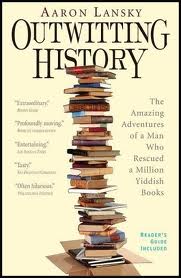
Last week, we spent some time in central Massachusetts–we wanted to buy t-shirts at Hampshire College, and maybe a few children’s books at the Eric Carle Museum of Picture Book Art. We’ve traveled in this area before. Although we’d noticed the shetl-style architecture of the Yiddish Book Center on the same campus, we never visited. It was a picture-perfect summer day in New England, and the last thing I wanted to do was spend any time indoors, but I inside “just for a few minutes.” I could have spent all day. In fact, I spent the next two days reading Outwitting History, written by Outwitting Historythe center’s founder and leader, Aaron Lansky. The book’s subtitle provides only a glimpse of what Lansky, and the Center, has accomplished, and will do: ‘The Amazing Adventures of a Man Who Rescued a Million Jewish Books.’

Much of the book is devoted to Lansky, his friends, co-workers, and friends collecting the inheritance–the books collected by Jews who had brought their culture from Eastern Europe, and other places, often overcoming obstacles before they landed in their small apartment in Brooklyn, the Bronx or New Jersey. Getting to know these people one by one, Lansky would load his rented truck with shopping bags and cartons of books, often from people whose next step was a retirement home. Just about every visit came with an obligatory range of dishes “cooked special for you” so “you shouldn’t be hungry.” In a typical spread, there would be onion bagels and lox, kasha varnishkes, potato latkes, and lokshn kugl (noodle pudding), plus herring, chopped liver, and other traditional dishes. And conversation. Lots of lots of stories, one about every book, the times, the culture, the memories. In time, Lansky learned to travel as one of a team of three people: “two do do the shlepping and the third to be the Designated Eater. the latter was the really hard job. While the others carried boxes, you had to sit with the host at the kitchen table, listening to stories, sipping endless glasses of tea, and valiently working your way through a week’s worth of dishes cooked ‘special’ just for you…”

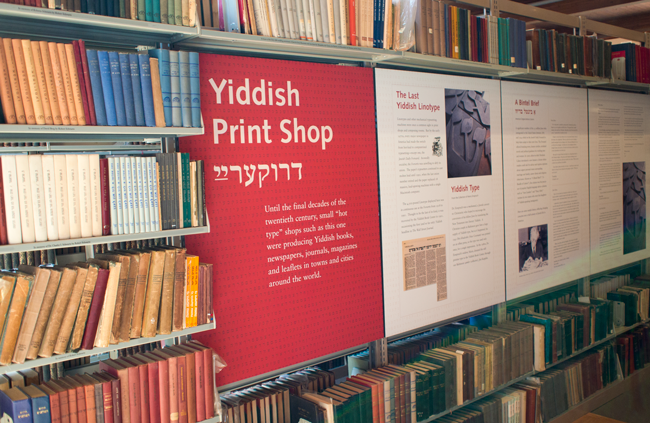
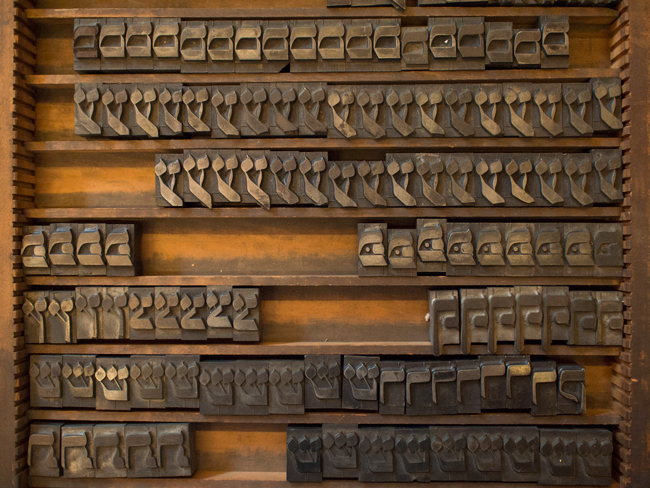
Over two decades or so, Lansky and his colleagues accomplished the impossible–they collected a million copies of Yiddish books. The best ones are now safer than they have ever been; they’re housed in a carved-out mountain that was built as a military facility (remarkably, it’s less than a mile from their Hadley, Massachusetts headquarters). The Center has supplied about 500 university and research libraries with Yiddish book collections (before the Center, only six such collections existed anywhere in North America). If you’re in the area–between Amherst and Northampton, Massachusetts–you can look at any of thousands of books, and you can buy most of them (there are more than enough extra copies around). Some titles are Yiddish translations of popular works by Shakespeare, Hemingway, Poe, Dickinson, and other popular writers. Many are original Yiddish works of fiction, plays, poetry, history books, cookbooks, children’s books, and more. And if you can’t make your way to Massachusetts, you can visit the Steven Spielberg Digital Yiddish Library, an online collection of more than 10,000 Yiddish titles, with each book page scanned (most of the original books were published on pulp paper, and some tend to disintegrate with each page turn, so digital technology saved the day).

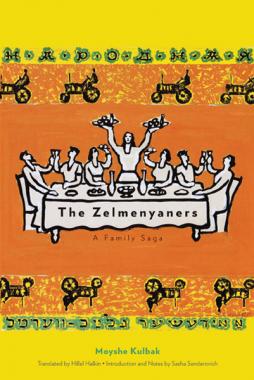
New Yiddish Library's most recent title: Moshe Kulbak's The Zelmenyaners, translated by Hillel Halkin. One of the great comic novels of the twentieth century, The Zelmenyaners describes the travails of a Jewish family in Minsk that is torn asunder by the new Soviet reality.

New Yiddish Library’s most recent title: Moshe Kulbak’s The Zelmenyaners, translated by Hillel Halkin. One of the great comic novels of the twentieth century, The Zelmenyaners describes the travails of a Jewish family in Minsk that is torn asunder by the new Soviet reality.

There is, of course, one problem. The books are written in Yiddish, and must be read in the original language. The Center has a deal with Yale University Press, and some titles are now available in English translation, in book form. More are on the way, but this solution is a minor one.

The major one, of course, is that role of Yiddish has changed, and the people who knew, know, and can claim literacy in Yiddish has been greatly diminished. At one time, more than eleven million people spoke, read, and communicated in Yiddish. That time was 1939, a year before the devastation by the Nazis, and a decade before the the shift into modern times, suburbia, and beginning the end of the old Jewish neighborhoods that once defined so much of New York City, Philadelphia, Baltimore, Boston, Chicago, and other cities where Yiddish was common currency.

When Lansky was a graduate student in search of a few Yiddish books for graduate school, when he traveled by truck to collect books from crumbling old publishing warehouses and Jewish community centers in the neighborhoods where many Jews once lived, his focus was saving books. Now, the agenda for the Center is even more compelling: books continue to arrive, but the people who can translate them, with appropriate cultural context, are few. It’s one thing to translate the words, quite another to present the story in ways that are both true to the original sensibility and sufficiently interesting to contemporary readers. Yiddish was always a people’s language, informal and spoken at home, never the official language of state affairs or religious ceremonies. As Lansky points out, time and again, all of his scholarship, all of the scholarship gathered by his many friends and associates, all of it pales in comparison with the ninety-year-old man who is sitting in his small Newark apartment, sharing tea and Entenmann’s crumb cake, shopping bag full of books at his side, ready to part with his lifetime of favorite Yiddish novels, books he loves because they were so much a part of his life.

His books are safe now. They will be treated with loving care. They will find a new home. Some will be translated into English so that even those of us who cannot read Yiddish can understand the basics of what they have to say. The work will be done by human translators, and in time, perhaps, by digital translators, too. The love, the sense of what the world was like, the passion, the feeling for the characters and situations created by the great Yiddish writers, poets, playwrights, stage performers, radio performers, singers, these will be more difficult to capture and store inside a mountain in Massachusetts.

yiddish-book-shelvesAt the very least, Lansky, his friends, his co-conspirators, the Center’s network of scholars and friends and donors, the network of zammlers (two hundred people who collect books worldwide for the Center) have taken the first step. We now have the books, and nobody is going to take them away from us. And they’ve taken the second step: the books are now available, through various re-disribution schemes, to people everywhere. The third step is the mind-bender. How to republish the works, maintaining the integrity and magic of their original words and ideas in a world where (a) the whole book publishing industry is trying to figure out its digital future and path to thrival (my made-up word that goes beyond survival into thriving); (b) few people read Yiddish; (c) Yiddish culture is becoming  historical fact rather than a cultural reality; and (d) as interested as I may be, I don’t think I have every read a single Yiddish book, and apart from Sholom Alechem (whose work was the basis for Fiddler on the Roof), I don’t think I can name a single Yiddish author.

That will change, of course. Shame on me for missing this part of my cultural education.

Thank you, Norman Temmelman of Atlantic City, Sorell Skolnik of the Mohegan Colony, Mr. Kupferstein, Marjorie Guthrie (Woody’s wife), and Sam and Leah Ostroff, for helping Aaron Lansky. And thank you, Mr. Lansky for opening the door for me. As I read the books, I will pass them along to friends, to my father and my sons, and attempt, in my small way, to be a link in the chain. I suspect there is a Yiddish proverb beneath all of this, or, at least, a few Yiddish words to describe what’s on my mind, but those words are lost to me. Perhaps I will find a few of them along the way.

yiddish-type

Unitasking

With an iPhone in one pocket and an iPad in another, my shoulder bag allows me to work pretty much anywhere. I work in the car (Bluetooth headphone when I’m driving; iPad when my wife drives). I grab a free half-hour and knock items off my OmniFocus master task management system, which syncs, completely and reliably, the lists on my iPhone, iPad, and iMac. I read a lot of books and articles. I suppose my life runs toward busier-than-average. After a vacation week without email, and the use of iPad only to homebrew detours around nasty interstate backups, I’ve given some thought to the clear benefit of unitasking.

My auto-correct just underlined the word “unitasking” because the computer did not recognize it. I checked with Merriam Webster; my search for “unitasking” returned “the word you’ve entered is not in the dictionary.” When I checked “multitasking,” the first sense read: “the concurrent performance of several jobs by a computer” and the second read, “the performance of multiple tasks at one time.”

Google Search: "multitask" returned these and many other images.

Google Search: “multitask” returned these and many other images.

Of course, computers and humans multitask all the time. Computers run multiple operations at high speeds, some simultaneously, some sequentially. As I write, I run my fingers along the keys and press buttons at surprisingly high speeds; I read what I am writing on the screen; and I think ahead to the next few words, and further out, to the next setup for the next idea; I am aware of grammar, clarity, flow and word choices; and I make corrections and adjustments along the way. As I write, I am also aware of the total word count, keeping my statements brief because I am writing for the internet (so far so good–my current word count is 279).

To ease the writing process, I listen to music. For six dollars, I recently purchased a 6-LP box of Bach Cantatas on the excellent Archiv label, and I am becoming familiar with them by playing the music in the background as I write. I do not find this distracting, but the moment the telephone rings when I’m in mid-thought, I become instantly grouchy.

I wonder why.

When I write, I focus on the writing, but writing is not a continuous process as, for example, hiking a mountain might be. I write for a few seconds, perhaps cast a phrase, then pause, listen to the soprano or the horns for a moment, then write a few sentences in burst of energy, then pause again to collect thoughts. I am thinking sequentially, not requiring my brain or body to do several things at one time. So far, this morning, the scheme seems to be working (441 words so far).

Do I multitask?

You betcha, but not when I write because writing requires so much of my focused attention.

Just before vacation, I attended a meeting with two dozen other people, all seated for discussion around a large rectangular hotel conference room in a Chicago airport hotel. Most of the participants were CEOs or people with similar responsibilities. From time to time, half of the people in the room were sufficiently engaged in the discussion to lift their eyes from their iPads (few used computers; most used iPads). Most of the time, just a few people were deeply engaged. Part of the problem: the meeting was similar to the meeting held last summer in the same location discussing the same topics. If there’s low engagement, then the active brain fills-in with activities promising higher degrees of engagement, and the iPad provides an irresistible alternative to real life. Of course, if more of the people looked up from their iPads and engaged in the conversation not-quite-happening in the room where they are seated, it might well be worthy of more of everyone’s attention. This raises the stakes for those who plan such meetings–if the meeting does not offer sufficient nourishment, minds drift.

Once again, that makes me wonder about the value of multitasking. Each of spent a good $1,000 to meet in Chicago, to discuss matters of importance in the company of one another. During the few times when the whole group was fully engaged, the engagement was not the result of multitasking. Instead, there was a single topic presented, and a single, well-managed discussion. In short, we engaged in a unitasking activity.

One final though before we all drift back into our bloated to-do lists. On vacation, I like to read a good story, well-crafted fiction by an author who really knows how to write. This time, I tried Jeffrey Lent’s A Peculiar Grace. Reading in the car, in the hotel room late into the night, whenever a good half hour’s free time presented itself, I found myself thinking about the characters, the story, the setting, the overall feeling of the book, even when I was not reading it. This was accomplished, of course, by the unitasking that a good book demands and deserves.

So why isn’t unitasking in the dictionary? And what do we need to do in order to bring this word into common use, and this way of thinking into common practice?

Thanks, Bill!

GinLane

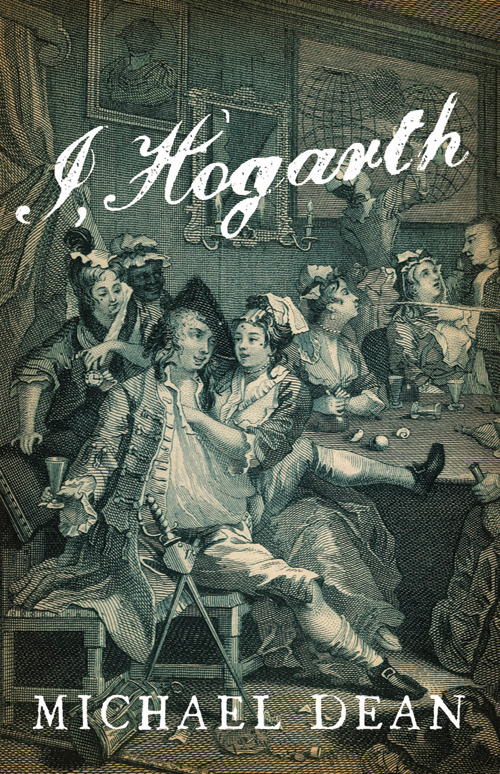
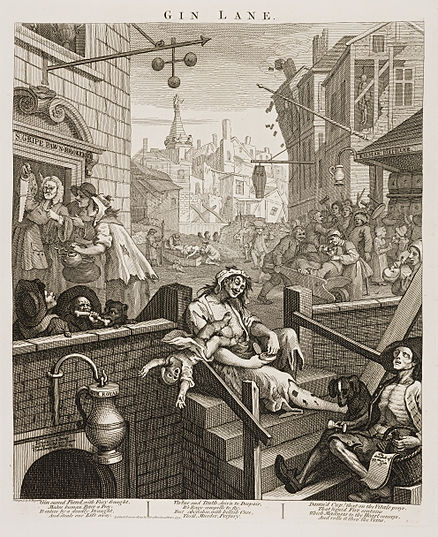
Hogarth worked out every minute detail of even image: the angle of the robe behind the gin-soaked mother so that the eye is draw directly to her head; the leering muncher of the large bone, the position of the pawnbroker’s sign above their heads as a kind of upside down religious symbol; the distant grey of the growing city in which these denizens would never take part; so much more. That was the painter, and illustrator, William Hogarth’s intent: to tell remarkable, compelling stories through a series of images sold in a subscription series. His work was widely pirated.

If Bill Hogarth’s father, Richard, was alive today, he’d probably be writing a blog, cleaning up Wikipedia articles, and spending far too much time watching TED Talks. He was always busy writing what he hoped would be a popular play or a textbook for schoolchildren. As a boy, Bill tagged along with his father as he made the rounds from one coffee house to another, for that’s where the printers tended to meet their clients, customers, and friends. In a word, coffee houses in 1700s London were places to network. In time, Richard Hogarth managed to sell of his manuscripts to a a London printer named Curll; it would become a book that would “bring joy to learning through the playing of games” enabling (a then-radical) idea of learning without the direct assistance of a teacher. With tears of joy in his eyes, Richard Hogarth signed the publishing contract, and that, as would be inevitable in a story of this sort, was his undoing. When Curll demanded money to pay printing costs, Hogarth could not pay the bill, could not fulfill the requirements of a contract that he clearly did not understand. Richard Hogarth was placed in debtor’s prison, a nasty place where bribery could, at least, secure better living quarters for the fledgling author and his small family.

Son William was fortunate to secure an apprenticeship with an engraver, made some contacts, eventually earned some money, and became quite popular as both a painter and a storyteller. His prints, including the one pictured at the top of this article, were published in series, offered by subscription. The originals made money, but they were often copied (pirated) by unscrupulous printers throughout London. As he worked his way up London’s economic and social ladder, William Hogarth became a very popular painter, busy with commissions until the very last years of his long career. Battling syphilis (a very common theme in stories of this era), frequently lusting after young women (especially in his younger years), Hogarth often considered the fate of his father, and devoted much of his life to steering clear of any such problems.

Benefitting from his upscale connections, Hogarth began to pursue a new law, one that would protect creative people from piracy.  At the time, this was extraordinary; in London, and elsewhere, piracy was simply part of the system. Nobody much questioned the many illegal copies of an artist’s work. Printers published whatever they wanted to publish.  Standard business practices were uncommon. An artist who fought the system ran the risk of speaking truth to power, and could well end up in debtor’s prison, or worse (that is,  murders under dark bridges were extremely common at the time).

Hogarth had been painting, on commission, for a Select Committee of Parliament as they investigated gaols (now: “jails”). Hogarth painted the deliberations of the committee, made a friend of Sir Archibald Grant of Monymusk. In time, Hogarth visited the influential man in his home, and over tea and gooseberry tarts, they considered a plan. There was an act of Parliament from Queen Anne’s time that protected writers, so Sir Archibald, in his strong Scots accent, thought aloud:

The connection to the other Act is gud. They like laws that build on other laws.”

Sir Archibald wrote letters to several important people in Parliament. Hogarth hoped that James Oglethorpe would be one of them, but his London home was boarded-up. Sir Archibald explained that Oglethorpe was in the colonies, founding a new one called Georgia. A short time later, Oglethorpe returned, and Hogarth gained his support:

Of course, I’ll support you. The book trade is run by scoundrels and idle incompetents. Always has been, always will be. But we’ll fire a few shots at them, eh, Hogarth?…Show me where to sign!”

Hogarth’s Law eventually passed and became law. Of course, his very next set of prints were his poorest sellers to date–he probably made more money on the previous subscription series, even with the piracy. And then, of course, there was the matter of enforcement of the new law–uneven because there was no system to police the bookseller’s constant practices. Still, times did change, and we benefit from Mr. Hogarth’s good work today.

So: the next time you’re in London, make your way to Leicester Square (Leicester Fields in his day), and take note of the statue of the man who made the world safe for creative professionals.

And, if the story intrigues you, pick up a copy of a lovely novelization of his life entitled I, Hogarth by Michael Dean, from which this article is derived. There is much more to Hogarth’s story–a lusty one, in parts–intentionally reminiscent, in its way, of early British novels that were developing at the same time Bill Hogarth was telling his stories in pictures.

I-Hogarth-1-copy

Welcome to the Times Machine

It’s taken a decade or so, but newspapers are finally beginning to get the hang of this new media thing.

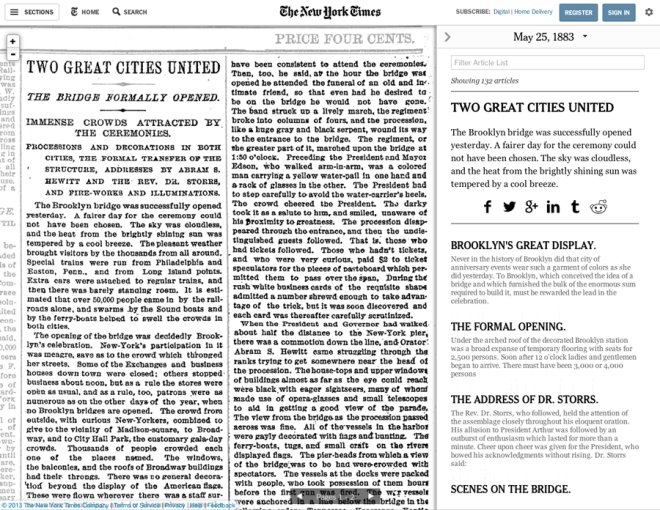
Among the most impressive new offerings: The New York Times Machine, an online experience that allowed me, in an instant, to read a story, originally published on May 25, 1883, entitled: “Two Great Cities United: Bridge Formally Opens.” From the text:

The Brooklyn Bridge was successfully opened yesterday. A fairer day for the ceremony could not have been chosen.”

Train service was extended from Easton, PA, Long Island, and other just-far-enough-away places. The service was decidedly a Brooklyn celebration. The people in New-York (at the time, the hyphen was still in common use) were less ecstatic, but showed up in the tens of thousands to join the celebration.

I know all of this because I am reading the actual printed page of the newspaper, the story in its original font, in its original presentation. I can see what happened on that day by reading other stories. There was an uprising of Italian railroad workers in Philadelphia who demanded their pay before they went back to work. The French government is having trouble with their colonial subjects in Madagascar who seem willing to “fight to the death” for their rights (The New York Times is remarkably even-handed in telling this story.) General Grant arrived in Chicago, and will leave for Galena tomorrow (in fact, that was the whole story).

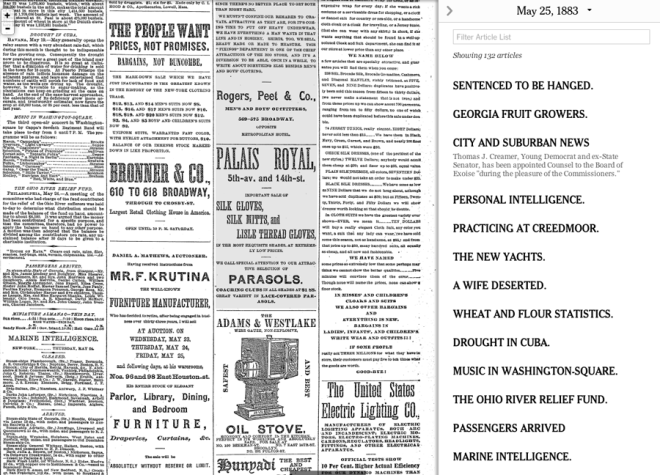
The interface is simple, and well-designed. On the left, which occupies about 3/4 of the screen, there is simply a picture of the newspaper. Click on a story, and it becomes large enough to read. (No way to copy contents just yet, but I hope that will be part of a future release.) On the right is a search window and a list of search results, each with a headline. Some stories are presented with a brief summary. Every story can be forwarded by Facebook, Twitter, Reddit, Google+, and more (this feature doesn’t work just yet, but it will soon).

After writing this initial draft of this article, I decided to explore some more. The Sunday New York Times for July 20, 1969 is filled with fascinating advertisements. I found a real zebra rug offered for just $195, marked down from $395, from Hunting World (“the sought-after high-contrast skins with the darkest stripes and the whitest backgrounds”). And now, the news… A judge in New Jersey determined that the conflict in Vietnam was, legally, a war. TV writer Jack Gould explained how television signals were transmitted from the moon. Bobby Seale led a Black Panther rally with about 3,000 people; most of them were white, and they shouted, repeatedly, “power to the people” while thrusting their fists into the air. Son House, Sleepy John Estes, Brownie McGhee, and Yank Ranchel were among the performers at the Newport Folk Festival (I wish I had been there!). Elsewhere in New England, last night, Ted Kennedy’s car ran off a bridge in Edgartown, Massachusetts, and the yet-unnamed female passenger was killed.  Ted Williams was managing the Washington Senators, host of that year’s baseball All-Star Game, celebrating the 100th anniversary of professional league play. And, the Pope, still watching black-and-white TV, arranged for a color set so that he could watch today’s Apollo moon landing. It is SO cool to see these original stories in their original form. This particular edition included over 450 stories–plus a whole lot of interesting (and not so interesting) advertisements, mostly from department stores.

The current version is a prototype (Beta version), so the range of dates and stories is very limited. Still, it’s fascinating to see what The New York Times Machine will be–and soon.

Below, a sample image. It’s far easier to read the real thing (just click here).

NYTimesMachine NYTimesMachine2