Teach Your Children Well

Madeline Levine, Ph.D. is a California psychologist, a woman who understands child development with refreshing clarity. Her candor may upset parents and children whose focus is abundant personal accomplishment. Her priorities reside elsewhere.

For example, she addresses the vitality of self-esteem as the positive result of a child’s own decisions and accomplishments. In opposition, she expresses grave concern about the distortion of self-esteem as narcissism, self-indulgence and materialism, which results in a higher level of distortion related to entitlement, grade inflation, and sad misconceptions about self-worth.

She takes on present day insanity: “…the kind of overblown panic I am seeing today has its roots in an extraordinary marketing campaign designed to convert normal parental concern into frenzied anxiety about what it will take to be successful in the twenty-first-century global economy.” she continues: “We have been sold a bill of goods and that bill of goods has clouded our common sense and judgement.”

And here’s the core idea of her book:

Here’s the reality: kids who are pressured, sleep-deprived, and overly focused on by parents convinced that without significant oversight and intervention, their children are not likely to be successful, [and] are at high risk for emotional, psychological and academic problems.”

Inexplicable trends tied to seemingly boundless cheating, stress behaviors including substance abuse and cutting, family ties stretched beyond their limits, the overwhelmed, overworked, consistently unhappy patterns now commonplace… They all make sense when explained in context. It’s time to stop this madness.

So begins a refreshing 21st century course in child development that acknowledges, incorporates and often celebrates technology, learning differences, and natural processes that hyperactive parental meddling are not likely to overcome. Teach Your Children Well: Parenting for Authentic Success is a brilliant book, essential in the ways that What to Expect When You’re Expecting has become for the first years of life.

It’s all about helping children to find and nurture friendships; to encourage them to maintain the connection between learning and fun; assisting in the construction of self-identity; and practical specifics about, for example, the healthy benefits of sufficient sleep. Often, Dr. Levine’s sane advice makes sense not only for children and teens, but for adults, too. Her advice regarding good sleep habits:

– Consistent bedtime
– A quiet half-hour ritual prior to bedtime, with dimmed lights
– No caffeinated drinks in the afternoon or evening
– No digital device use before bedtime
– Absolutely no social networking before bed

Dr. Levine insists upon appropriate roles for children and for parents, appropriate relationships that may differ from the daily realities in your home or in the households of relatives, neighbors or friends. She’s clear on the ways in which technology can, should, and ought not be part of the picture. And even though you, me and our kids rely upon our modern tools, she makes it clear that neither these tools nor the social interaction nor the increased productivity are worth much…certainly not nearly as much as the direct, moment-to-moment personal interactions that matter so much more than anything else in the world.

Gee, I really like this book. It’s the kind of book I want all of my friends to read, that I want every parent and student to read. Given that her previous book was reprinted some seventeen times, maybe everyone will.

And on this Rosh Hashanah evening, I can think of no better way to begin a new year than to recommend a book by an caring author who is making a difference. L’shana tovah.


Posted in an independent bookstore

One of New Hampshire’s three Toadstool Bookshop outlets. They’re located in Peterborough, Keene, and Milford. If you’re in the neighborhood, be sure to visit the one in Keene, and then grab a beer and a burger (and gigantic onion rings) at Elm City Brewery, located in the same large ex-factory as NH’s best bookstore. With ebooks, there’s concern for the survival of even this fittest of independent booksellers.

“PLEASE THINK TWICE BEFORE YOU BUY A KINDLE

We are very grateful to all of those of you who have said you would like to support us by purchasing your e-books through us. This will become extremely important to us as more and more people begin using e-readers. We ask that you please bear in mind that only certain types of readers are compatible with our website. Fortunately, most of the common ones are. These include the iPad, Nook, Sony, and Kobo. However, the Kindle is not compatible.

Amazon has chosen to force Kindle users o make their e-book purchases only through their website.

Please think twice before getting one for yourself or for a gift. The future of independent bookstores such as our depends upon every sale, the physical book and the e-book. None will exist without the support of loyal book buyers such as yourself. Thank you so much for thinking about us, and be assured our love remains [for] the real book, there for your browsing in a real bookstore.

(Kindle Fire update: With Amazon’s new Kindle Fire tablet, it is possible to sideload an Android app that make it possible to purchase and read ebooks from the website of independent booksellers such as ours. But you do have to do this outside the Amazon App store. This will not work with the original Kindles. B&N’s new tablet Nook also requires a sideloaded app.”

Some other thoughts about Amazon and its relationship to independent booksellers:

Slate: Don’t Support Your Local Bookseller

Harvard Business Review: Amazon Should Partner with Independent Booksellers

Huffington Post / Poetry Foundation: Independent Booksellers: How to Compete with Amazon

and the most comprehensive and thoughtful view, written for The Nation: The Amazon Effect

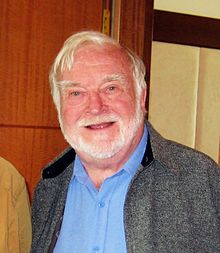
The Mind of Howard Gardner

From his Harvard bio, one of my personal heroes. Few academics have captured my imagination, and affected my thinking, as consistently or as deeply as Howard Gardner.

Harvard Professor Howard Gardner has written more than a dozen books with the word “mind” in the title. Few researchers have spend so much of their professional careers thinking about how our minds work, whether our minds might be better trained, and whether our minds can be put to better use. He’s a brilliant thinker, and I have thoroughly enjoyed reading his evolving work over these past few decades.

Earlier this year, with co-author Emma Laskin, Gardner republished Leading Minds: An Anatomy of Leadership with a new introduction, and that led me to the slimmer 5 Minds for the Future, a slim book that captures his evolving philosophy in a succinct, deeply meaningful way.

From the start, Gardner’s 5 Minds for the Future is more contemporary, acknowledging the tangentially  overlapping work of Daniel Pink, Stephen Colbert (“truthyness“)  and the enormous changes brought about by globalization. Gardner is famous for his theories about multiple intelligences (“M.I.” these days), but M.I. is not what this book is about. Instead, Gardner presents his case as a progression from basic to higher-level thinking, and his hope that we will climb the evolutionary ladder as a collective enterprise.

He begins by revisiting one of his favorite themes, the disciplined mind (which provided both title and subject matter for his 1999 book). Here, the goal is mastery, which requires a minimum of a decade’s intense participation, a thorough examination of all relevant ideas and approaches, deep study to understand both the facts and the underlying fundamentals, and interdisciplinary connections. This is serious work, and it must be accomplished despite the sometimes crazy ways that schools think about learning, and the equally crazy ways that the workplace may value or advance those with growing expertise. The disciplined mind does not simply accept what has been written or taught. Instead, the disciplined mind challenges assumptions, and digs deep so that it may apply intelligence when conventional thinking does not produce valuable results. No surprise that Gardner is deeply critical of those who invest less than a decade in any serious endeavor, or those who fake it in other ways.

Next up the ladder is the synthesizing mind which accomplishes its work by organizing, classifying, expanding its base of knowledge by borrowing from related (and unrelated) fields. Placing ideas into categories is an important step up the ladder because the process requires both (a) a full understanding of  specific disciplines and how they relate to one another, and (b) the means to convey these ideas to others. And so, Gardner views the Bible (a collection of moral stories), Charles Darwin’s theories, Picasso’s Guernica, and Michael Porter’s writings about strategy as related endeavors. At first, this seems to be a stretch. Then again, each of these are bold combinations of ideas based upon a complete understanding of a domain–(a) above–conveyed in a way that connects people to the synthesized ideas (b).

You may know Mihaly Csikszentmihalyi as the author of the excellent book FLOW, but his best work may be a book simply entitled CREATIVITY.

Then, there’s the creating mind. At this stage, the progression begins to make a lot of sense. Novel approaches are not based upon random ideas that may or may not work. Instead, the creating mind grows from deep study of a specific domain in a disciplined manner, followed by various attempts to organize that knowledge in ways that propel an argument forward. At a certain point, the argument has been advanced, and the opportunity for new thinking presents itself. Many creative professionals are required to advance new ideas without the requisite discipline, and so, our society generates lots of ephemeral stuff. In the creative space, Gardner’s thinking has been affected by Mihaly Csikszentmihalyi, who believes:

creativity only occurs when–and only when–an individual or group product is recognized by the relevant field as innovative, and, sooner or later, exerts a genuine, detectible influence on subsequent work in that domain.”

I would argue that the respectful mind ought to precede the disciplined mind as the ladder’s first rung, and Gardner provides ample evidence to support my argument. For one thing, the respectful mind is the only one of Gardner’s five minds that can be nurtured beginning at birth. What’s more, the ability to “understand and work effectively with peers, teachers and staff” would seem to be a prerequisite for any disciplined approach to learning and personal development. The whole chapter is nicely encapsulated by a sentence from renowned preschool teacher Vivian Paley:

You can’t say ‘you can’t play.'”

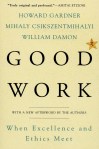
A decade ago, Gardner, Csikszentmihalyi, and William Damon wrote a book called Good Work, and this effort has expanded into The Good Work Project. Central to this effort is the ethical mind, which carries a meaning well beyond the ethical treatment of others. Here, we begin to touch upon the idea of professional or societal calling, and one’s role within a profession or domain. It begins with doing the best work possible–that is, the work of the highest quality, as well as work of redeeming social value–but it’s not just the work itself, it’s the way that you apply yourself to the job at hand. Here, Gardner covers the diligent newcomer, the mid-life worker who continues to pursue excellence every day, the older mentor or trustee whose role is to encourage others to build beyond what has already been accomplished.

In less than 200 pages, Gardner accomplishes a great deal. If time permits you to read only two Gardner books, I would start with Frames of Mind, which explains his theory about multiple intelligences, then jump to 5 Minds for the Future. After these two, you’ll probably want more. His book about leadership, mentioned above and discussed below, is certainly worthwhile. And Good Work will fill your head with wonderful ideas and inspiration for all you could do to help make the world a better place.

BTW: If you want to watch Gardner discuss 5 Minds for the Future, you’ll find his 45-minute video here.

As for Leading Minds, it’s an extraordinary book, a collection of analytical biographies written as parts of a whole, a cognitive view of leaders and leadership. He examines leaders by taking part their fundamental identity story: who they are, how their domain and influence grew, how and why they succeeded, how and why they were unable to accomplish their ultimate goals. This is not a book whose core ideas can be reduced to a few bullet points. Instead, it’s a few hundred pages of reflection on the nature of leadership shown through the examples of Albert Einstein, Mahatma Gandhi, Martin Luther King, Jr., Alfred P. Sloan, Eleanor Roosevelt, and a half dozen other 20th century figures. The significance of some names is fading; it was disappointing to find that this revised edition of a 1995 work did not include anyone who made his or her mark in the 21st century.

Outta Here! – A Friendly How-to Guide

With good cell phone service and a robust Internet connection, we’d like to think we can live, and work, pretty much anywhere. True enough, if the term is days, weeks or months, but what about years? What about (gasp!) forever?

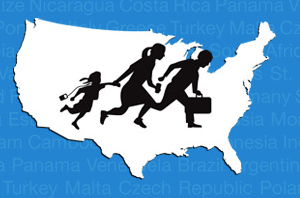
Why leave? You’ll find lots of good reasons (good stories, too) in the newly revised second edition of Getting Out: Your Guide to Leaving America by Mark Ehrman:

The US had become unbearable after 9/11…We purchased 1.25 acres of land about 20 minutes south of Oaxaca…There is nothing like living, immersing oneself entirely, in another country, culture, language, etc.” — Cara Smiley, 40

I have been leaving the US all my life–starting with study abroad and then the Peace Corps…” — Kerry Kittel, age 49

Life here in Copenhagen is just so much more livable than any place I’ve experienced in the US. I take a train and boat to work. I ride my bicycle to buy groceries…” — Bill Agee, 50

You might think of this as the ultimate traveler’s book (no tourists allowed). Pages of (fascinating) personal stories are followed by advice about visas, second passports, and citizenship. There are many ways to gain citizenship, or at least, residency… marry in, play your ethnic race card, buy your way in, teach English, etc.

Fantasizing about where you might go…and stay? If you’re looking for the world’s highest rate of Internet penetration, try Greenland, Iceland, Norway, or Finland. Best infrastructure? Switzerland, Hong King, Singapore, France, Iceland, or Sweden. Fastest Internet? South Korea. Safest? Germany, or Canada. Growing job market? China, India, Taiwan. Best place to start a new business? New Zealand, Australia or Canada.

Need a more in-depth analysis? That’s the second half of the book. Sixty-one countries, each considered in terms of governance, Internet, healthcare, working there, taxes, women’s issues, life expectancy, moving there, and more.

If i was among the 300,000 who left home, where would I like to go? In fact, I would love to spend a month, maybe several, in every one of those sixty countries–but I suppose that answer evades the question. If I had to choose today, my starter list would probably include:

  • Bahamas
  • Canada
  • Denmark
  • France
  • Italy
  • Japan
  • Sweden
  • United Kingdom

Where would you go? And stay?

—–

And, from the same publisher, the real dirt on living in the country. The book is called (of course!) Get Your Pitchfork On!

Brooke’s Illustrated Guide to Media Theory

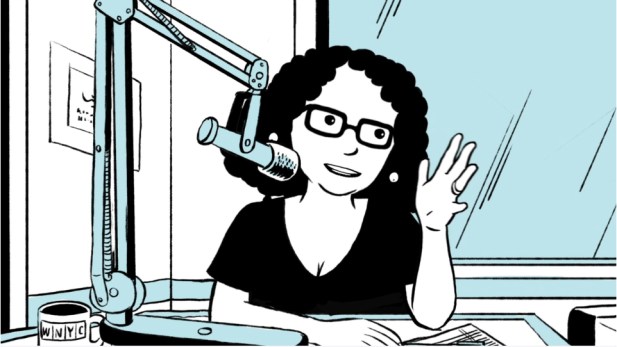
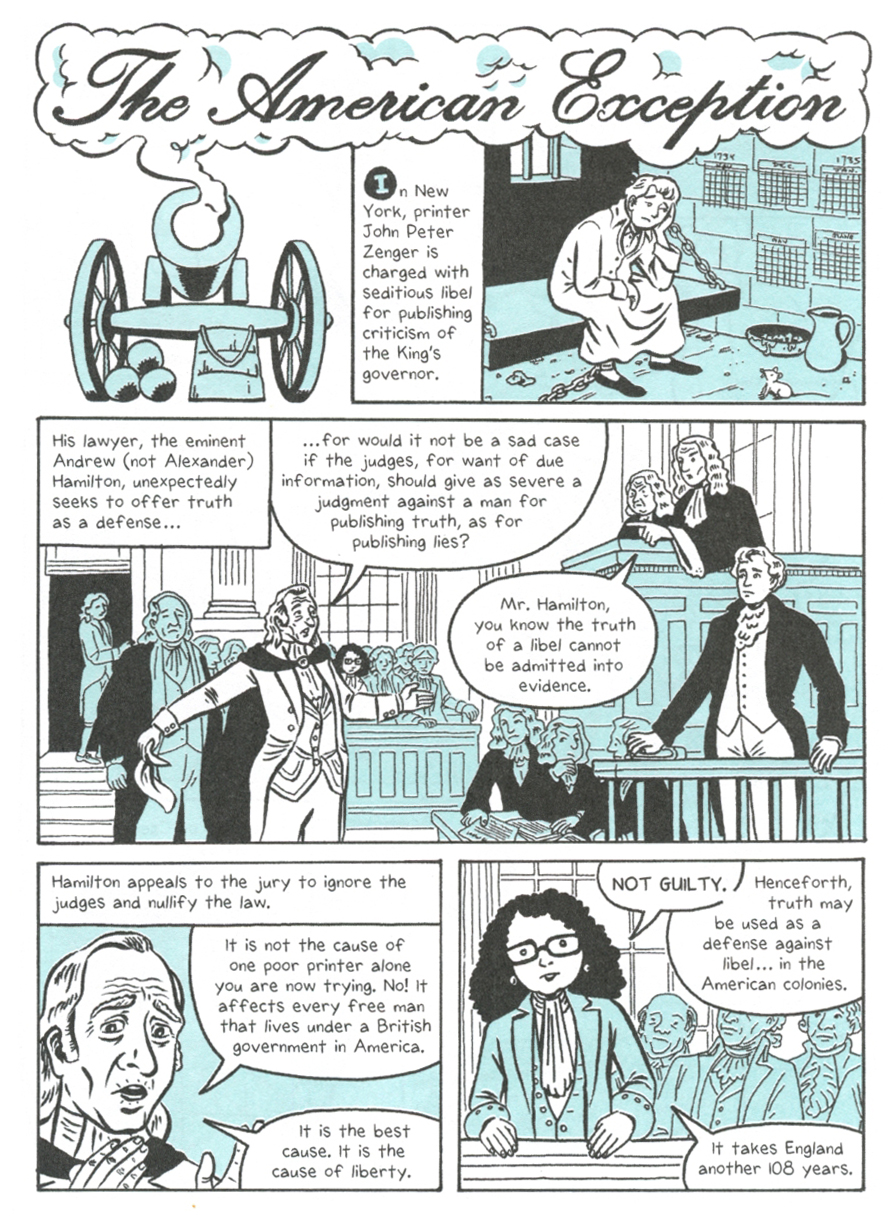
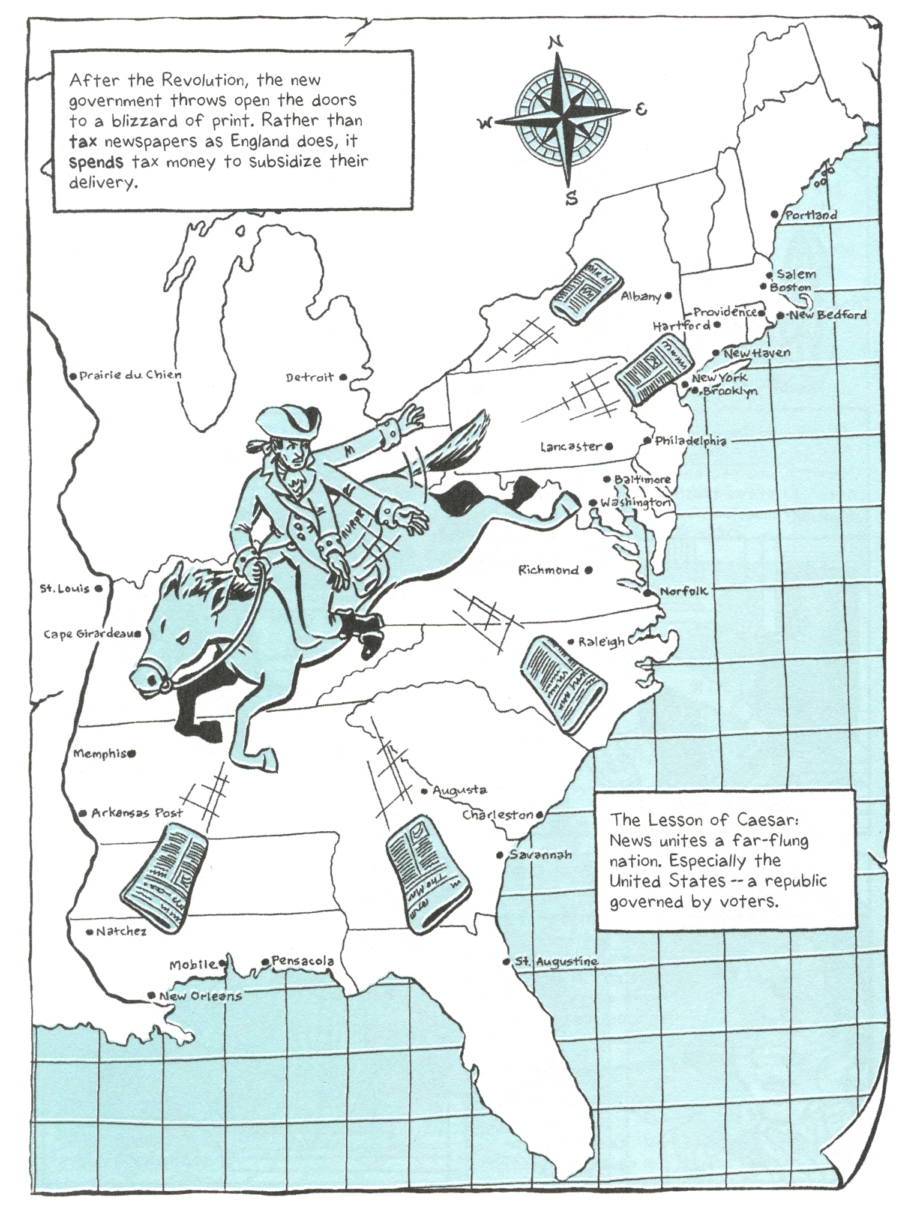
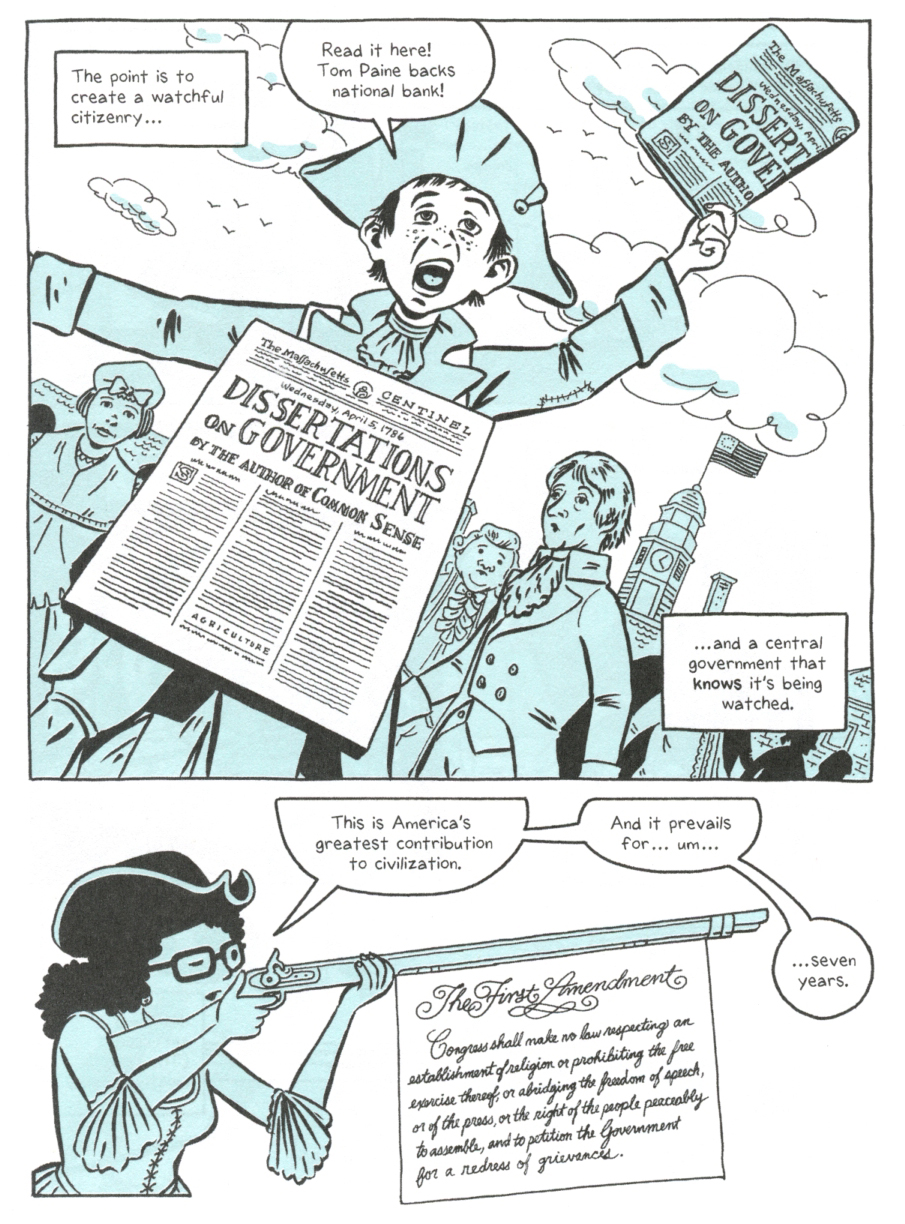
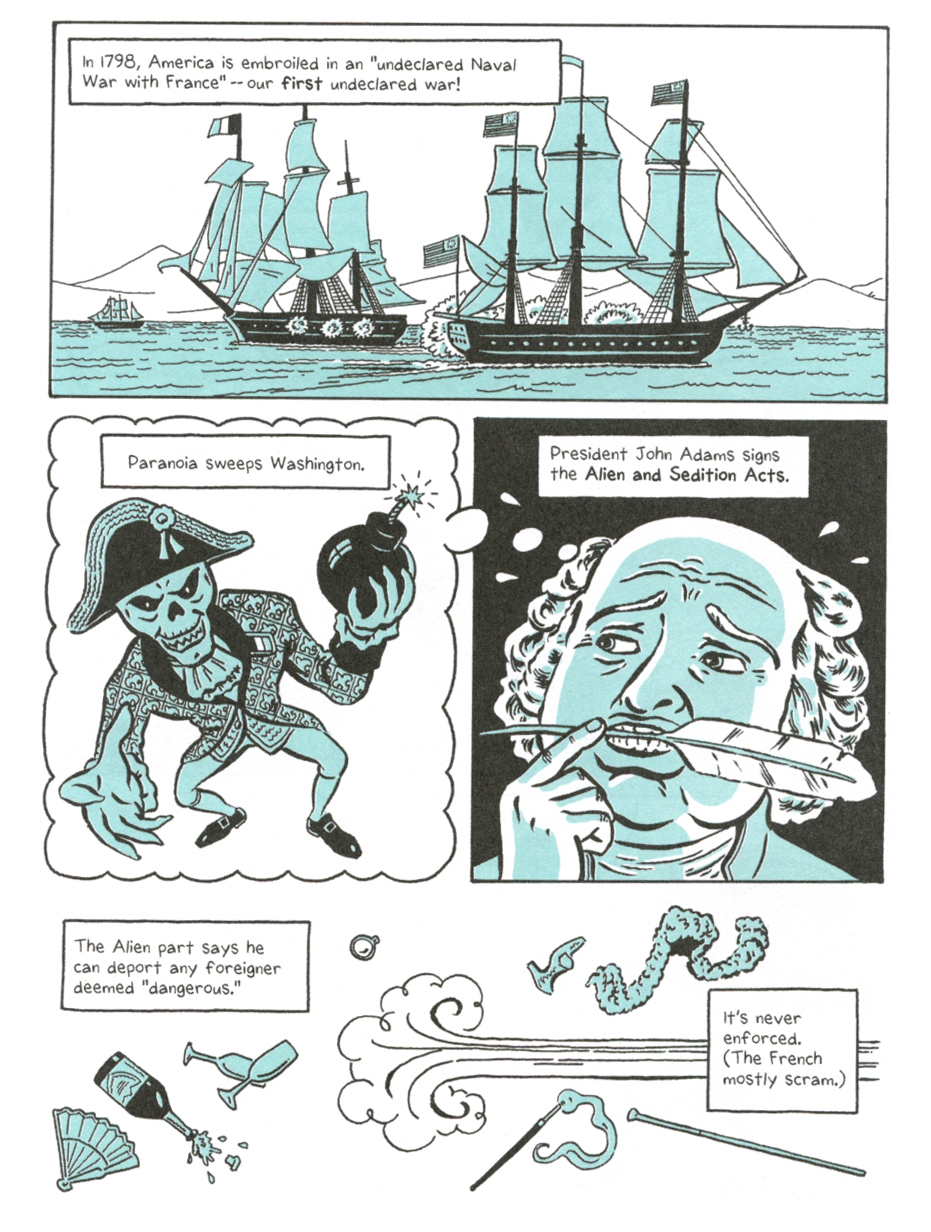
On the Media host Brooke Gladstone, in cartoon form, illustrated by Josh Neufeld for The Influencing Machine, “a media manifesto.”

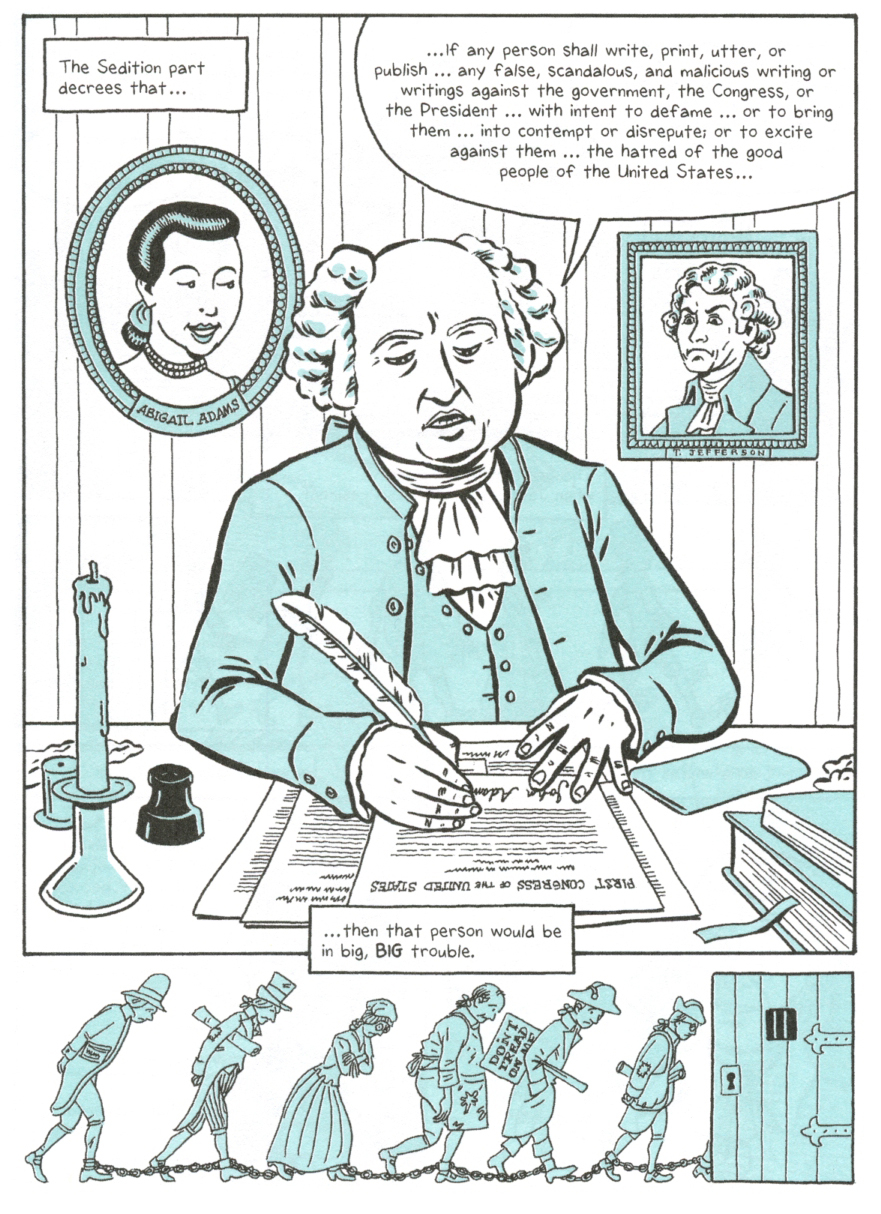
Brooke Gladstone is a brave woman. In the interest of explaining why media matters, she loses her head, plays the fool, embeds an Intel chip in her skull, becomes the robotic vitruvian woman, takes on the whole American political system (from its start in the 1700s), allows herself to be drawn in a hundred goofy ways by cartoonist Josh Neufeld, and…while on the high-wire, without a net…attempts to tell the truth about media and its influence on the ways that we think, believe, and act. In the early stages of this graphic non-novel’s development, it was “a media manifesto in comic book form.” Close enough. (If you’re interested, here’s how they did it.)

The Influencing Machine is now a paperback comic, the equivalent of a graphic novel, I guess, but it’s not easy reading. It’s a well-researched, deeply thoughtful examination of why media behaves as it does, how media interacts with law and government, and the interaction of history and philosophy. Pictures and the graphic novel style keep things light, and concise, but this is not a book to be read once, and it’s not a book to be read quickly. The starting point is news and public information, which may seem appropriate, but for most people, most media consumption is not news or information, it’s entertainment. And in that domain–which should include children’s programming, scripted comedy, scripted drama, and the variety shows that keep the masses satisfied (and have for centuries)–media’s influence is powerful, but rarely mentioned here.

She begins with a Victorian era story about machines that control people’s minds–or the fears that such a thing might someday exist.

Then, she explores the ideal of a perfect balance between effective governance and free flow of truthful information…only to find that such a balance is always outweighed by the government’s need for control.

Quoting German philosopher Arthur Schopenhauer (1788-1860):

Journalists are like dogs–whenever anything moves, they begin to bark.”

Most profound–and most evident in today’s journalism–is “The Great Refusal.” Simply stated, by Gladstone, “Few reporters proclaim their own convictions. Fewer still act on them to serve what they believe to be the greater good.” With pressure from government to suppress potentially important information (for example, think: embedded journalists and the trade-offs they must make), and lacking the necessary resources to provide information based upon research and time to consider the story so that it can be presented in context, most journalists simply parrot press releases or official statements. Along the way, they must steer clear of various biases, and play within what most people perceived as reasonable boundaries. This behavior gets everybody into trouble because the whole point of journalism should be uncovering stories that ask the difficult questions…but the system is not set up to encourage, fund, or accept that kind of journalism. Instead, posits Gladstone, we live within a comfortable doughnut. What’s more, any journalist who strays finds himself or herself either (a) famous, at least for a while, or (b) difficult to employ. The risk of the latter is very real, and so, the status quo rules.

And so it goes, as Gladstone attempts (and is drawn to be) a bird of a feather, flocking together in homophily while watching global warming destroy habitat–she calls the phenomenon of groupthink “incestuous amplification” and illustrates it with references to global warming and weapons of mass destruction. She considers reasons to be okay and reasons to panic. She wonders about dumbing down and frets about the half  of Americans who never read literature. She briefly touches on intellectual property laws, and G.K. Chesterton’s statement about journalism:

Journalism largely consists of saying ‘Lord Jones is dead’ to people who never knew Lord Jones was alive.”

And she wraps up with notions of globalism, and the ways that news is now a 24/7 global enterprise whose stories may affect us all.

There are few answers here, and the questions, well, they’re often difficult to shape and impossible to answer. At least she’s asking the questions, and placing herself in the middle of a digital storm. Thank you, Brooke, for steering clear of the obvious text presentation (mea culpa here, I’ll admit, as I write another few hundred words of text). The visual presentation, and the illustrations by Josh Neufeld, bring important ideas to life. And if there’s any interest in continuing the adventure to explore the many unexamined territories in the media landscape, count me among your first readers.

We need to talk about all of this stuff because the forces that demand silence are both powerful and ubiquitous. Even if it’s complex, even though it’s difficult to form into digestible bites, even if most people wonder why we’re obsessed with the way that media works, ought to work, and, sometimes, doesn’t work at all.

Below, some sample pages:

Success! Good Health! Longevity! Fabulous Children!

You can do it! You’ll need a college degree and you’ll need to move to a place where 21st century America’s promise shines. Seattle, the SF Bay Area, New York City,

Boston, and the ring around Washington, DC.–those are the places where innovation is held in high esteem and is most likely to be funded so that new companies can be born, grow, and change the economic picture for employees, shareholders, and those smart enough to live nearby.

These are the places where venture capitalists fund big opportunities, and if a company seems promising, a VC will often require a move to, say, Silicon Valley, or not to fund the company at all. The “thickness” of the job opportunities in the Silicon Valley (and a very small number of other places), and the thickness of people with the necessary skills to suit those needs, not only attracts the best (and highest paid) people to these centers, where their high incomes tend to generate more jobs for the local economy (usually with salaries that are higher than even unskilled high school dropouts will find at home). If you’re an attorney, you’ll make as much as 30-40% more if you work in these areas than in an old rust belt city. The same is true for cab drivers and hair stylists.

Much has been made of Google’s employee perks; they won’t play in Hartford or Indianapolis, but neither of those places, nor most other American cities, see the kinds of financial results and spillover effects in the community enjoyed by the area around San Francisco. This is becoming the area that drives the American 21st century. And it’s very difficult for other cities to get into the game.

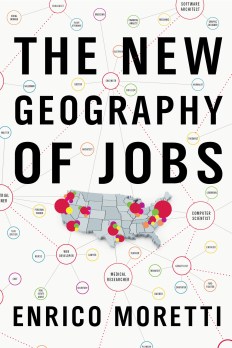
Author and UC Berkeley Professor Enrico Moretti has just published a book that presents a compelling picture of the much-changed US economy. The title of the book, The New Geography of Jobs, undersells the concept. Yes, if you can, you should move to any of these places, where you will make more money than you will at home–regardless of whether you are a high school dropout or a Ph.D. You will probably live longer, remain healthier, provide a better path for your children, live in a nicer home, have smarter friends, smoke less, drive a nicer car, you name it… the American dream lives large in San Diego, but in Detroit or Flint, Michigan, it’s gone and it’s not likely to return any time soon.

Average male lifespan in Fairfax, VA is 81 years. In nearby Baltimore, it’s just 66.

That’s a fifteen year difference. This statistic tracks with education attained, poverty level, divorce rates, voter turnout (and its cousin, political clout), lots more.

Want to remain employed? Graduate from college.

Nationwide unemployment rates: about 6-10% for high school only, 10-14% for incomplete high school, 3-4% for college graduates.

College degrees matter…far more than you might think. In Boston, with 47% of its population holding college degrees, for example, the average college graduate earns $75k and the average high school graduate earns $62,000. By comparison, Vineland NJ–just outside Philadelphia in South Jersey, has just 13% college graduates, and a college graduate earns an average of $58,000, with high school graduates at $38,000. Yes, it costs less to live in Vineland, but over a lifetime, people who live in Vineland are leaving hundreds of thousands of dollars on the table, perhaps as much as a half million dollars over a lifetime.

Real cost of college, including sacrificed employment: $102,000. At age fifty, average college graduate earns $80,000, but average high school graduate earns $30,000.

If a 17-year old goes to college, he or she will earn more than a million dollars lifetime. If not, it’s less than a half million.

What’s more, 97% of college educated moms are married at delivery, compared with 72% of high school-only grads. Just 2% of college-educated moms smoked during pregnancy compared with 17% with a high school education and 34% of drop-out moms. Fewer premature babies, fewer babies with subsequent health issues. Almost half of college graduates move out of their birth states by age 30. By comparison: 27 percent of high school dropouts and 17 percent of high school dropouts. The market for college graduates is more national; the market for non-grads is more local.

Caught in the middle? The best thing you can do is hang out with people who are pushing their way up the productivity curve. That is, MOVE! Leave the town where things aren’t happening, and take a job, almost any job with growth potential, in a place with high potential.

While the arguments about fencing lower-income immigrants out persist, most people earning graduate degrees today are immigrants. And a high percentage of people who start significant new businesses, funded by venture capital, are first generation Americans.

Today, an immigrant is significantly more likely to have an advanced degree than a student born in the US.

Foreign born workers account for 15% of the US labor force, but  half of US doctorate degrees are earned by immigrants. Immigrants are 30% more likely to start a business. Since 1990, they have accounted for 1in 4 venture backed companies. When they start a new business, they generate high-value jobs, which brings more money into the community (not any community, only the ones with a thick high-skill / high value workforce and a thick range of desirable jobs), and the people who fill these jobs generate more jobs in the retail and services sector, jobs that pay more in the high value areas than they do at home.

A century ago, investment money went to Detroit for its car industry, and to the midwest for productive factories. That era is ending. Innovation in the health sciences, technology, software, internet, mobile, and other fields is the driver of American productivity–but not everywhere. Clusters attract the best and the brightest from metros without the necessary thickness, leaving lesser places with fewer people who can make big things happen.

There is so much more here (sorry for the long blog post, but this is a very powerful book). We need to generate more college graduates, especially more men, and especially more people with STEM expertise (science, technology, engineering, math). We need to do a far better job in educating and creating opportunity (including opportunity for mobility) among those with fewer advantages. We’ve got a lot of work to do. First step: read the book!

A Book about Books

“I am an invisible man.”

“We were around Barstow on the edge of the desert when the drugs began to take hold.”

“On a sticky August evening two weeks before her due date, Ashima Ganguli stands in the kitchen of a Central Square apartment, combining Rice Krispies and Planters peanuts and chopped red onion in a bowl.”

So begins three contemporary books: Ralph Ellison’s Invisible Man (1952), Hunter S. Thompson’s Fear and Loathing in Las Vegas (1971), and Jhumpa Lahiri’s The Namesake (2003). One is about African Americans, another is about the counter culture, and the third opens with a view of new Americans, attempting to recreate a dish she recalled from her native India. Our tastes change with the times–only sixty years separate Ellison from Obama.

With so many words propelled at us each day, so many stories on so many media, there’s not much opportunity to consider the big picture, to develop a sense of the stories we are telling one another. I suspect that’s what caused English Professor Kevin Hayes to write A Journey Through American Literature (Oxford University Press).

In Hayes’s world, the word “literature” embraces poetry, travel writing, autobiography, and fiction. Whether Benjamin Franklin or Stephen Crane, Eugene O’Neill or T. Coraghessan Boyle, his examples consider the broad sweep of 250 years. His definition of literature includes bits of Seinfeld and The Simpsons, and acknowledges films as literature, too.

Skateboarding through media theory and aesthetics, Smithsonian American Art Museum is acknowledging videogames as art this summer. And I’m certain that every word in write in this blog, and every word you write in your email rants, will stand the test of time as great literature, too.

Yes, there is interesting, substantial work being done in all corners of art and media. Often, the work goes unnoticed, or receives a flash of publicity for fifteen seconds. It’s just too easy to forget about the good stuff until somebody says, or writes, “hey, this is worth a look!”

This summer, for me, Hayes is that somebody. Here’s a starter checklist:

  • Walden by Henry David Thoreau
  • The Adventures of Huckleberry Finn by Mark Twain
  • Their Eyes Were Watching God by Zora Neale Hurston
  • The Iceman Cometh by Eugene O’Neill
  • The Invisible Man by J.D. Salinger
  • Travels with Charley by John Steinbeck
  • Beneath the Underdog by Charles Mingus
  • China Men by Maxine Hong Kingston
  • The House on Mango Street by Sandra Cisneros

Yes, Hayes is an English professor. No, I will not write a term paper, nor will I abide by any deadline. This time, I’m not reading for the professor or the course or the grade. I’m reading for myself. And I plan to read these books not on a screen, but through the ancient technology of ink on paper. Some, I will buy in a used bookstore, some I will buy from the NEW bookstore that just opened not a mile from my home, some I will borrow, at no charge, from a good local public library.

Welcome to summer!

Digital Travel Guides and the Future of Publishing

As the Kent & Sussex chapter of a traveler’s eBook begins, the page shows the current temperature. Just a hint of what’s to come in digital travel guides…

Not enough room in the suitcase? Maybe it’s time to ditch the travel guidebook and try the eBook version instead. I did, and learned a lot about what a traveler’s eBook ought to be.

Travel guides are very different from other types of fiction and nonfiction books. They are only partially read. They are intensely used, but only for a few weeks. They are out of date shortly after they are published. And if you’re doing a lot of traveling, they can become quite heavy.

An eBook on an iPad? Less weight. Full color. An opportunity to integrate with digital maps and Trip Advisor, build an itinerary, make reservations, maybe connect with chapters in history or nature books.

Well, we’re not there yet, but we are seeing the beginning of a new era in travel guides.

Lonely Planet has yet to make its big move into iPad publishing, but they offer one excellent idea: the purchase of individual chapters as PDF files for just under $5 a piece. For example, Lonely Planet’s digital England book can be purchased for $17.49, or you can buy the Devon & Cornwall chapter for $4.95. Either way, it’s mostly well-written text with very helpful guidance, plenty of links, and, take note, designed for iPhone with only with 2x magnification feature on.

Fodor’s London Travel Guide is a full-featured app with plenty of maps, color images, lists with links, and easy access to places to visit, lodgings, restaurants, and nightlife. In fact, the app is organized so that it’s easy to read the text blurb about the London Zoo, then quickly refer to a restaurant map to find Lemonia, a highly-regarded Greek restaurant nearby. Read the description of Portobello Market, click, then there it is on a full-screen map. It’s easy to use and effective.

Working with an eBook design firm called Inkling, Frommer’s offers a more ambitious take on the digital travel guide. The eBook is organized in chapters, but each chapter begins with several points of entry: favorite moments in the region, a three-day trip, a five-day journey, favorite sites to visit, popular destinations in detail, and more. Choose the Cotswolds village of Moreton-on-the-Marsh and there’s a well-written description of the village, tips about what’s nearby, quick access to area maps, and an overall design that’s clearly designed for digital devices. This series is called “Day by Day”, so I expected an itinerary planner to coordinate with my iPad’s Calendar app. That’s not yet a feature, but I suspect it was discussed during this superior product’s design phases.

I used all three guides, often and successfully, and never once missed the books that I did not carry with me. My favorite: Frommer’s. But I suspect that next week’s BookExpo will find publishers to introducing the next generation of interactive travel guides.

What’s next? Certainly, full integration with Google Maps, Trip Advisor, Kayak and other reservations systems, Calendar, email. Those seem to be within reach, but they only scratch the surface of what could be done. There’s a gigantic social network opportunity here, whether it’s couch surfing or house swapping, or simply asking whether anybody in the Pembrokeshire area feels like taking a hike today. Right now, publishers are cautiously experimenting with books that become books on screens, but this caution may result in the demise of yet another industry. Travel publishers possess a unique opportunity to bring places to life, to involve community members (think Zagat’s but on a massive scale), to truly invent the future of publishing on a large, interactive scale. It’s interesting to contemplate whether this work can be done, or will be done, by travel publishers owned by much larger publishing conglomerates, or whether smaller, more flexible and potentially more innovative publishers will map this particular journey into the future.

Music and Activism… A Master Class

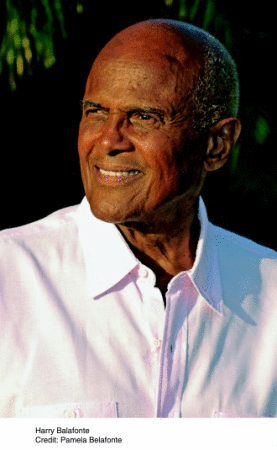
In August, 1964, $70,000 was a lot of money (it would be worth over a half-million today). Harry Belafonte filled a doctor’s bag with small bills, talked his buddy Sidney Poitier into traveling with him, and they boarded a plane from New York City bound for Jackson, Mississippi, then hopped a small Cessna for Greenwood, then drove in convoy to the Elks Lodge where they delivered the secret cash. The money was needed to keep the volunteers on site in Mississippi to encourage the Black population to register and vote. The Klan and the local police wanted the volunteers to go home. Harry and his show business friends saved the day. Turns out, this was not an altogether unusual day for Mr. Belafonte.

When I started reading Harry Belafonte’s autobiography, My Song, I didn’t know much about him. His song makes for quite a story.

No surprise that the started out poor, and became quite rich. What he did with the money, and the power of celebrity, is remarkable.

And how things happened, even more so.

The first few chapters set the scene: an angry young man who discovers the magic of theater, then tries to become an actor in New York City. He talks his way into the Dramatic Workshop at The New School for Social Research, where his classmates include Walter Matthau, Bea Arthur, Rod Steiger, Marlon Brando, Bernie Schwartz (later known as Tony Curtis), and Brando’s motorcycling buddy, Wally Cox. His early acting adventures aren’t going so well, so Belafonte is crying in his beer at the Royal Roost, a Harlem jazz club. Saxophone player Lester Young asks, “How’s your feelings?” and Harry tells him, “My feelings aren’t so good!” and Lester says “Why don’t you ask (club owner) Monte (Kay) to give you a gig?” Kay says “yes,” and Lester gives his young friend a send-off by backing Belafonte’s little intermission gig with his buddies, including Charlie Parker and Max Roach. Belafonte becomes a pop singer, and later, a folk singer specializing in music from his native Caribbean Islands, and story songs. And the list of “firsts” begins–the first Black to play the Coconut Grove in L.A., selling a spectacular number of records (competing with Elvis for the number one records in 1956, etc.), appearing on Broadway and in the movies (he had a deep crush on Dorothy Dandridge, being the first Black performer to host NBC’s Tonight Show (which he did for a full week  in 1968 with guests including Bobby Kennedy, Paul Newman, Bill Cosby, the troublesome Smothers Brothers, and Martin Luther King, Jr.) and as with any celebrity bio, the list of famous names is vast), and tremendous success in Las Vegas, first at the Rivera, then at the then-new Caesar’s Palace, and with that success, friendships with the mob.

And, then, in his words, “One day in the spring of 1956, I picked up the phone to hear a courtly southern voice. ‘You don’t know me, Mr. Belafonte, but my name is Martin Luther King, Jr.” So began a fast friendship and a very deep lifelong involvement in civil rights and social justice. With Paul Robeson as a role model, and Eleanor Roosevelt as an early friend in social reform, Belafonte agreed to perform at Carnegie Hall to raise money for the Wiltwyck School, where “mostly black children who had committed serious crimes but were too young to be incarcerated” were taught. With the Kennedy White House, his reach grew, providing guidance and often serving as a conduit between John, and more often, Robert Kennedy and the movement. He marched. He served in Martin Luther King’s kitchen cabinet, which often met at Belafonte’s Upper West Side apartment in Manhattan (Martin stayed there, too, and had his own bottle of Bristol Cream liquor for relaxing evening chats). He was King’s confidant, a close friend, and a principal fund-raiser for the entire Civil Rights movement. He was deeply involved in the SLCC and SNCC. He worked on the strategy side, and the movement benefitted from Belafonte’s gigantic rolodex and his ability to raise funds or contact celebrities for favors, often granted. He became deeply involved in improving life in Africa, first helping to build a (never built) performing arts center in Guinea, and later serving as a UN and UNICEF ambassador (replacing Danny Kaye), also with an African focus.

He introduced performers to American audiences, and helped Mariam Makeba (already a South African star) to build a powerful career. Much later, as a result of his encouragement, Fidel Castro established a facility for Cuban rap artists. But before that, it was Harry Belafonte who came up with the idea for “We are the World,” getting Michael Jackson and Lionel Ritchie and Quincy Jones involved, then fading into the background until the hard work of distributing funds to Africa was to be done, and he supervised. He helped to free Nelson Mandela, and then served as Mandela’s personal guide for his first visit to the USA, where he answered so many questions about the U.S. Civil Rights movement.

With the help of co-author Michael Shnayerson, Belafonte is a very good storyteller with a very good memory. At 84, he’s candid about his show business successes and failures, attempts to tell his version of the truth about civil rights and entertaining personalities, family matters, and his half century of therapy and shaky love and family relationships (TMI). The showbiz story is fun, but the book shines as Belafonte provides context and backstory about the day to day struggles of the American civil rights story. For that, this becomes an essential accompaniment to the Taylor Branch trilogy about Martin Luther King, Jr., and the equally remarkable (but lesser known) The Race Beat by newspaper reporters Hank Klibanoff and Gene Roberts.

(Digital) Money, Honey

We pay for just about everything with a credit card, a debit card, PayPal. Even parking meters accept card payments. Cash is dirty, difficult to store, easy to lose, and (for better or for worse) leaves no trace. The end of money has been predicted for a long time. Maybe now’s the time that money, like photographic film, drive-in theaters, and typewriters, fades away.

That’s the theory behind WIRED contributing editor David Wolman’s book, The End of Money published by Da Capo. The book is an easy read, filled with anecdotes, interesting histories, and a great many examples of alternatives to our current cash-and-coins conception of valuable exchange. Wolman points out the present system is, in fact, quite new, and that most of human history did not involve pennies, pfennigs, or pesos. He estimates that one of every twenty British coins is counterfeit. He points to cash on ice both in Alaska Senator Ted Stevens’ freezer and also in a visit to the fallen Icelandic economy. (There are so many wonderful slang terms: cold hard cash among them). He explores alternative currencies. The one about Liberty Dollars–“a private voluntary free-market currency backed entirely by silver and gold.”–is a long trip through the complexities of alternative currencies and contemporary Federal conceptions of money.

There’s discussion–not enough for my taste–about smart cards and the use of mobile devices as digital wallets. Here, the focus is on the many small daily transactions that remain cash-intensive, and the potential for a simpler, less costly, more manageable system based upon digital transactions. The upside: you’re never short a quarter for the parking meter; the downside: every time you park your car, you’re making an entry into your permanent record.

Be sure to read the crazy story. It’s just one paragraph on Wikipedia.

It’s interesting to muse on the current use of simulated currencies, if only to understand our possible future behaviors: accumulating gold coins in games, such as World of Warcraft; the possible connections between gamefied badges and currency that can be exchanged for real or virtual goods and services; the use of Quids on the (now gone?) website Superfluid, where “they’re placeholders for favors” (perhaps not unlike the favor/exchange economy that drives power and accomplishment in the nation’s capital). Where might frequent flier miles fit into the money equation? Or Disney Dollars that pay for fun in Orlando (now largely replaced by Disney Gift Cards because they yield far more digital data, and because the residue is easily converted to profit.) How about the barter economy that has been so well-nourished on the internet: you build my website, I do your taxes.

How does taxation fit into any of this? None of us love taxes, but we’ve certainly become attached to, say, our interstate highway system. I suppose most transactions will be digital, and so, there is a trackable moment of exchange, and at that moment, the tax authorities can step-in (digitally) and collect. How about pay checks? Direct deposit eliminates the old-fashioned notion of “cashing the paycheck”–and, perhaps, acknowledging the weirdness of Big Brother, preparing one’s own personal tax return may seem equally old school (armed with your entire digital financial life, the government could certainly outsource your tax return, mine to, to an outfit in Malaysia or Peru).

Are coins and cash going away? Not this year, but maybe in ten years. It’s fascinating to contemplate the possibilities. And, along the way, it’s fun to browse or read The End of Money.

It’s also fun to watch the CBS Sunday Morning report that was inspired by the book. If you can find the link, let me know and I’ll post it (couldn’t find it on the CBS Sunday Morning site).