Welcome to the Connectome

Diffusion spectrum image shows brain wiring in a healthy human adult. The thread-like structures are nerve bundles, each containing hundreds of thousands of nerve fibers. Source: Source: Van J. Wedeen, M.D., MGH/Harvard U. To learn more about the government's new connectome project, click on the brain.

Diffusion spectrum image shows brain wiring in a healthy human adult. The thread-like structures are nerve bundles, each containing hundreds of thousands of nerve fibers.
Source: Source: Van J. Wedeen, M.D., MGH/Harvard U. To learn more about the government’s new connectome project, click on the brain.

You may recall recent coverage of a major White House initiative: mapping the brain. In that statement, there is ambiguity. Do we mean the brain as a body part, or do we mean the brain as the place where the mind resides? Mapping the genome–the sequence of the four types of molecules (nucleotides) that compose your DNA–is so far along that it will soon be possible, for a very reasonable price, to purchase your personal genome pattern.

A connectome is, in the words of the brilliantly clear writer and MIT scientist, Sebastian Seung, is: “the totality of connections between the neurons in [your] nervous system.” Of course, “unlike your genome, which is fixed from the moment of conception, your connectome changes throughout your life. Neurons adjust…their connections (to one another) by strengthening or weakening them. Neurons reconnect by creating and eliminating synapses, and they rewire by growing and retracting branches. Finally, entirely new neurons are created and existing ones are eliminated, through regeneration.”

In other words, the key to who we are is not located in the genome, but instead, in the connections between our brain cells–and those connections are changing all the time.The brain, and, by extension, the mind, is dynamic, constantly evolving based upon both personal need and stimuli.

Connectome BookWith his new book, the author proposes a new field of science for the study of the connectome, the ways in which the brain behaves, and the ways in which we might change the way it behaves in new ways. It isn’t every day that I read a book in which the author proposes a new field of scientific endeavor, and, to be honest, it isn’t every day that I read a book about anything that draws me back into reading even when my eyes (and mind) are too tired to continue. “Connectome” is one of those books that is so provocative, so inherently interesting, so well-written, that I’ve now recommended it to a great many people (and now, to you as well).

Seung is at his best when exploring the space between brain and mind, the overlap between how the brain works and how thinking is made possible. For example, he describes how the idea of Jennifer Aniston, a job that is done not by one neuron, but by a group of them, each recognizing a specific aspect of what makes Jennifer Jennifer. Blue eyes. Blonde hair. Angular chin. Add enough details and the descriptors point to one specific person. The neurons put the puzzle together and trigger a response in the brain (and the mind). What’s more, you need not see Jennifer Aniston. You need only think about her and the neurons respond. And the connection between these various neurons is strengthened, ready for the next Jennifer thought. The more you think about Jennifer Aniston, the more you think about Jennifer Aniston.

From here, it’s a reasonable jump to the question of memory. As Seung describes the process, it’s a matter of strong neural connections becoming even stronger through additional associations (Jennifer and Brad Pitt, for example), repetition (in all of those tabloids?), and ordering (memory is aided by placing, for example, the letters of the alphabet in order). No big revelations here–that’s how we all thought it worked–but Seung describes the ways in which scientists can now measure the relative power (the “spike”) of the strongest impulses. Much of this comes down to the image resolution finally available to long-suffering scientists who had the theories but not the tools necessary for confirmation or further exploration.

Next stop: learning. Here, Seung focuses on the random impulses first experienced by the neurons, and then, through a combination of repetition of patterns (for example), a bird song emerges. Not quickly, nor easily, but as a result of (in the case of the male zebra finches he describes in an elaborate example) of tens of thousands of attempts, the song emerges and can then be repeated because the neurons are, in essence, properly aligned. Human learning has its rote components, too, but our need for complexity is greater, and so, the connectome and its network of connections is far more sophisticated, and measured in far greater quantities, than those of a zebra finch. In both cases, the concept of a chain of neural responses is the key.
Watch the author deliver his 2010 TED Talk.

Watch the author deliver his 2010 TED Talk.

From here, the book becomes more appealing, perhaps, to fans of certain science fiction genres. Seung becomes fascinated with the implications of cryonics, or the freezing of a brain for later use. Here, he covers some of the territory familiar from Ray Kurzweil’s “How to Create a Mind” (recently, a topic of an article here). The topic of fascination: 0nce we understand the brain and its electrical patterns, is it possible to save those patterns of impulses in some digital device for subsequent sharing and/or retrieval? I found myself less taken with this theoretical exploration than the heart and soul of, well, the brain and mind that Seung explains so well. Still, this is what we’re all wondering: at what point does human brain power and computing brain power converge? And when they do, how much control will we (as opposed to, say Amazon or Google) exert over the future of what we think, what’s important enough to save, and what we hope to accomplish.

Make Good Art!

Wonderful, level-headed speech to graduating students at Philadelphia’s University of Arts by writer Neil Gaiman. You may not know his name, but you know his work: Coraline, comic books,graphic novels (Sandman series) short fiction, books, here an episode of Dr. Who, there a Simpsons episode, the list is long. At age 15, he made a list of what he wanted to do, then got started, and apparently, never stopped.  He discusses the sense of fraud that successful creative professionals experience; the nonsense about creative people wearing a tie and going to an office every morning, the importance of learning to say “no”. He reset his balance between writing for a living and spending a lot of time writing emails by responding to each one. He encourages creators to take chances and make mistakes; you acknowledges that the ultimate life saver is the secret that creative people share that others do not: we have the ability to make art.

It’s a terrific video, and well worth twenty minutes (or so) of your time.

His response to things going awry, as they will: “Make good art!”

The one thing that you have that nobody else has: “You!” (Your ideas, etc.)

The moment that you believe that you’re walking down the street naked, that you’re showing too much, that’s the moment . But you’ll have no idea. And what would be the fun in making something that you know is going to work? (Gee, he’s smart!)

Dreaming of a Newer Deal

New_DealI just finished reading a book about the New Deal, that remarkable FDR-era transformation of America for the average American. Certainly, I knew and understood pieces and parts of the story, but there were so many factors, I needed a good writer (the author won a Pulitzer Prize) to put the whole thing into context for me. The author is Michael Hiltzik, and the book is called, simply, “The New Deal: A Modern History.”

What struck me about the story was just how bumpy the ride turned out to be. There was no master plan, only a sense from FDR’s Brain Trust that things were bad, and, rather than wasting a perfectly useful crisis, they ought to do powerful good. FDR was not the mastermind, but instead, the political driver, the leader who maintained the vision and  maneuvered around lots of political messes, and–nothing new here–other people in Washington who offered little assistance and, sometimes, difficult obstacles.

Mostly, though, the book made me wonder about our need, and our ability, to bring something like a New Deal into focus in this century. Roosevelt and his team worked their miracles in the 1930s, so that’s nearly 80 years ago. There was a lot of activity in the 1960s, too, beginning under Kennedy, and then, on a significant scale, under Johnson, and, since then, Obama has accomplished some good things that may last.

Given the vision, the opportunity, the need, the political will, the right circumstances, and, as with Roosevelt, the better part of a decade to get the work done, what might we hope to accomplish? I am, by no means, an expert, but I thought I’d get the conversation going with a list that seems, well, obvious. Here goes:

  1. The elimination of poverty in the U.S. As the theoretical administration begins to work on issues, high on that list ought to be urban poverty (1 in 3 children of color in the Philadelphia area live below the poverty line).
  2. Equal pay and equal opportunity for all Americans. Yes, there are laws. Now, we need programs to make those laws do the intended work.
  3. A rational retirement program so that all Americans can retire without fear of poverty. The New Deal got this ball rolling, but the current reality is terrifying: half of people over 70 unlikely to be able to feed themselves within the next decade.
  4. A modernization of the American approach to education. Too much money spent for uninspiring results, too much control in the hands of the unions, irrelevant curriculum, nearly half of high school students dropping out in the most troubled areas, out-of-control student loans and college costs, only about 1 in 4 Americans graduating college, massive shifts in technology, lack of resources, crumbling infrastructure, more.
  5. A modernization of the American approach to transportation. In the digital age, it’s time to rethink cars, highways, fuel consumption, pollution, driving, lack of public transportation in so many regions, lack of high-speed rail connections now available in so many other nations, lack of innovative new urban and suburban solutions.
  6. Government under the control of lobbyists, big money, and lifetime politicians. This entrenched thinking, these outmoded ways of operating, this political deadlock, those campaign funding rules, this list alone can keep a new Brain Trust busy for the entire decade.
  7. Controlling the  debt. Policies and practices in this financial realm are probably just the beginning of serious rethinking our financial policies. Of course, this ought to begin at home; a few good programs might help Americans shift from a life built on credit cards to a life build on savings and investments.
  8. A modernization of crime and punishment. Like several of the other agenda items, this one will require a lot of interaction with state governments. The number of people in prison, and the reasons leading to their incarceration, provide sufficient ammunition for serious government programs.
  9. Reducing the size and complexity of government. Physician, heal thyself.
  10. And, swinging back to the old New Deal… Reworking Social Security for the next generations. It’s time for some serious work so that everyone, or just about everyone, can live safe and secure, especially as we are living longer, healthier lives.

No, I didn’t touch international relations, and yes, I probably missed a lot of important ideas. Still, I think we ought to get this started.

Shadow Catcher

angelineThe woman in the photograph was a poor soul, without friends, the subject of ridicule among Seattle schoolchildren. She lived in a hovel. When the growing city of Seattle cleared its native population, she remained where she was, and the city grew up around her. Kick-is-om-lo was her name, but that was difficult to pronounce, so the local folk called her Princess Angeline. In 1896, Kick-is-om-lo was paid one dollar to pose for this picture–the equivalent of what she was able to earn in a whole week–by a struggling young photographer named Edward Curtis. To say this would be the first of many such images would be a substantial understatement.

Within a short time, Mr. Curtis’s photography practice was beginning to thrive, mostly in connection with his nature photographs on nearby mountains (he was, in his way, a predecessor of Ansel Adams, but that’s not why he became famous). Instead, he began to photograph the native people who lived within traveling distance of his home. His fledgling studio became a place to buy these extraordinary portraits, these scenes of natives who were both nearby and exotic, these souls who some perceived as savages and others as victims. They were dying. The number of natives was rapidly declining. Their languages were dying out. Soon, the people who spoke those languages would be gone, too.

Curtis found opportunities to photograph native people in their own habitats. He used a camera and an early sound recorder, and he began to build a collection. Some individuals trusted him, many did not. He was “deeply affected” by a Sun Dance that lasted five days. Neglecting his family, and in time, his Seattle photography business, he followed the path that many creative professionals have since followed. He began an obsessive effort to photograph, many, and then, most of the remaining native communities. His trips began to cover areas far from home. He would stay away for a year or more. In time, he found kindred spirits, including, for a long while, former U.S. President Teddy Roosevelt, who, like Curtis, enjoyed a deep appreciation of America’s natural and, to a somewhat lesser extent, native history. They became friends; Curtis made formal portraits of T.R.’s children and hung around the family estate at Sagamore Hill for a good while.

To continue, and to fulfill his creative vision, Curtis required far greater resources than his local photography business would ever provide. He required an investor at a time when the philanthropic community was just beginning to take shape. He planned to:

make a complete publication, showing pictures and including text of every phase of Indian life of all tribes yet in primitive condition, taking up the type, male and female, child and adult, their home structure, their environment, their handicraft, games, ceremonies, etc…

His bodacious plan: an expensive, limited edition twenty volume set containing “fifteen hundred full-page plates”

He managed to get himself into the office of J.P. Morgan, who reviewed the proposal ($15,000 per year for 5 years to cover all expenses), told wealthy banker that he had already spent over $25,000 on the project, that he was completely out of money.

Morgan said no. Actually, what Morgan said was, “I will be unable to help you.”

But Curtis didn’t take no for an answer. Instead, Curtis reached into his portfolio and began to cover Morgan’s desk with stunning photographs of natives, the likes of which Morgan had never seen: the salmon people of Puget Sound, the picture of Chief Joseph that Teddy (sorry… the President) loved so very much… And, bless his soul, Curtis left Morgan’s office with the commitment he needed.

But that’s just the start of an even wilder adventure that eventually finds Curtis producing one of the world’s first documentaries, and, eventually, finishing the whole project, destitute, so long after this intended deadline that, well, nobody cared about the books, Edward Curtis, or natives anymore (the Depression was an important reason why). The books, the original photographs, the obsessive life, all seemed to be for naught–until they were rediscovered decades later.

Now, you can see these pictures simply by clicking here. The link takes you to the Library of Congress collection of Edward Curtis’s work. Mr. Curtis overcame all sorts of stunning setbacks, but he did what he promised to do. And, thanks to him, we can at least begin to understand a culture that our people destroyed not so very long ago.

The one caution: nearly all of these images are very, very serious. Critics point out that Curtis’s vision of the stoic native presents an extremely limited, and so, distorted view, of the real lives of the people who made America.

The book is called Short Nights of the Shadow Catcher: The Epic Life and Immortal Photographs of Edward Curtis. It was written by Timothy Egan. The book was given to me as a gift. You should do the same for yourself, and for every creative soul in your life. It is a remarkable story, beautifully told, and of course, illustrated with the work of a master photographer.

One of the best ways to see the scope of Edward Curtis's work is to simply search his name on Google, and then look at the Images view. That's what I did to capture this sampling of his photographs.

One of the best ways to see the scope of Edward Curtis’s work is to simply search his name on Google, and then look at the Images view. That’s what I did to capture this sampling of his photographs.

Media Quiz – By the Numbers

Hawaii Five 0Duck

I’ve been meaning to write this one for some time. Hopefully, it will be as much for you to play as it was for me to write. Some TV, some from other media. The numbers are fascinating because they provide our collective media diet with a sense of scale. You may want to jot down your answers on a pad and pencil…

1. Which cable network is watched by the most people every day?

  1. Fox News Channel
  2. The Weather Channel
  3. Nickelodeon
  4. ESPN

2. How about the second most-watched?

  1. Disney Channel
  2. Nickelodeon
  3. Food Network
  4. TNT

3. With nearly 10 million viewers for its most popular episode, what was last week’s most popular series on cable?

  1. The Big Bang Theory
  2. NCIS
  3. Sponge Bob Square Pants
  4. Duck Dynasty

4. Among adults 18-34, which was the most watched cable network in prime time last week?

  1. Comedy Central
  2. MTV
  3. History
  4. TNT

5. How many people watched last Thursday night’s airing of Swamp People on History (the most popular episode of a prime time cable series that night)?

  1. 4 million
  2. 8 million
  3. 12 million
  4. 16 million

6. On that same night, how many people watched The Daily Show’s 11PM airing?

  1. Less than 2 million
  2. 3 million
  3. 4 million
  4. 5 million

7. Daily circulation of USA Today?

  1. Half-million
  2. 1.7 million
  3. 5.2 million
  4. 10 millon

8. Last week’s syndicated programs in order of popularity:

  1. Wheel of Fortune, Jeopardy!, Family Feud, Family Guy
  2. Family Guy, Jeopardy!, Family Feud, Wheel of Fortune
  3. Wheel of Fortune, Family Feud, Family Guy, Jeopardy!
  4. Jeopardy!, Wheel of Fortune, Family Feud, Family Guy

9. Number of people who watched CBS’s Sherlock Holmes drama series, Elementary:

  1. 5 million
  2. 10 million
  3. 15 million
  4. 20 million

10. On the same night, number of people who watched NBC’s The Office:

  1. 1 million
  2. 2 million
  3. 3 million
  4. 7  million

11. Circulation of Sunday New York Times.

  1. 1.2 million
  2. 2.4 million
  3. 4.8 million
  4. 9.6 million

12. You may know that AARP’s magazines top the circulation charts with over 20 million units. What’s next on that chart (with more than 7 million)?

  1. Reader’s Digest
  2. People
  3. Sports Illustrated
  4. Game Informer

13. The Fifty Shades of Grey book series has sold a total of more than ____ ebooks.

  1. 1 million
  2. 5 million
  3. 15 million
  4. 25 million

14. So far, this year, how many copies of Eric Carle’s The Very Hungry Caterpillar have been sold in the U.S.?

  1. 1 thousand
  2. 10 thousand
  3. 50 thousand
  4. More than 100,000

15. In a typical week, roughly how many units of each audiobook on the top 10 best seller list are sold?

  1. Less than 200
  2. 250-500
  3. 500-1,000
  4. 2,500 – 5,000

16. Last week’s best selling videogame in the U.S. was Injustice: Gods Among Us. If you were to combine the sales of units for X360 and PS3, how many units were sold?

  1. 35,000
  2. 135,000
  3. 350,000
  4. 1,350,000

17. Last week’s top grossing film was Oblivion. How many people went to see that movie?

  1. 500,000
  2. 1,500,000
  3. 6 million
  4. 16 million

18. Vinyl has enjoyed something of a resurgence. In fact, the re-release of The Beatles’ Abbey Road turned out to be quite popular How many units did the new vinyl version of Abbey Road sell last year?

  1. 300
  2. 3,000
  3. 30,000
  4. 130,000

All of the answers come from well-regarded sources of media research and data.

Let’s see how you did. The answers follow the WBZ-TV Test Pattern below.


test pattern

1. Which cable network is watched by the most people every day?

  1. Fox News Channel
  2. The Weather Channel
  3. Nickelodeon
  4. ESPN

(You must consider the sheer number of hours that our children spend in front of TV sets. Far more than just about any sports fan.)

2. How about the second most-watched?

  1. Disney Channel
  2. Nickelodeon
  3. Food Network
  4. TNT

3. With nearly 10 million viewers for its most popular episode, what was last week’s most popular series on cable?

  1. The Big Bang Theory
  2. NCIS
  3. Sponge Bob Square Pants
  4. Duck Dynasty

Duck solidly beats the competition with over 10 million viewers.

4. Among adults 18-34, which was the most watched cable network in prime time last week?

  1. Comedy Central
  2. MTV
  3. History
  4. TNT

5. How many people watched last Thursday night’s airing of Swamp People on History (the most popular episode of a prime time cable series that night)?

  1. 4 million
  2. 8 million
  3. 12 million
  4. 16 million

(Not as many people as I would have thought, but then, television viewership is now very fragmented, so it’s very difficult to garner audiences of any significant size.)

6. On that same night, how many people watched The Daily Show’s 11PM airing?

  1. Less than 2 million
  2. 3 million
  3. 4 million
  4. 5 million

The Daily Show is popular, but night after night, its ratings are fairly modest, especially in comparison with powerhouse series (like Duck Dynasty).

7. Daily circulation of USA Today?

  1. Half-million
  2. 1.7 million
  3. 5.2 million
  4. 10 millon

Actually, the number is above 1.6 million. 

8. Last week’s syndicated programs in order of popularity:

  1. Wheel of Fortune, Jeopardy!, Family Feud, Family Guy
  2. Family Guy, Jeopardy!, Family Feud, Wheel of Fortune
  3. Wheel of Fortune, Family Feud, Family Guy, Jeopardy!
  4. Jeopardy!, Wheel of Fortune, Family Feud, Family Guy

Wheel continues to kill in the ratings, night after night. The other series are in the top ten, but nobody beats Sajak.

9. Number of people who watched CBS’s Sherlock Holmes drama series, Elementary:

  1. 5 million
  2. 10 million
  3. 15 million
  4. 20 million

A good solid prime time series in 2013 rarely tops 10 or 12 million viewers.

10. On the same night, number of people who watched NBC’s The Office:

  1. 1 million
  2. 2 million
  3. 3 million
  4. 7  million

No surprise. The Office is ready for retirement. So, too, is the similarly rated Parks & Recreation.

11. Circulation of Sunday New York Times

  1. 1.2 million
  2. 2.4 million
  3. 4.8 million
  4. 9.6 million

How many readers?  Easily twice that number because the paper often lingers through the week.

12. You may know that AARP’s magazines top the circulation charts with over 20 million units. What’s next on that chart (with more than 7 million)?

  1. Reader’s Digest
  2. People
  3. Sports Illustrated
  4. Game Informer

The surprising answer has increased circulation int he past year by several hundred thousand. Next on the list is Better Homes and Gardens with roughly comparable numbers. Reader’s Digest comes in at about 5.5 million, followed by Good Housekeeping, Family Circle, and National Geographic in the 4 million range. For more, click on this link.

13. The Fifty Shades of Grey book series has sold a total of more than ____ ebooks.

  1. 1 million
  2. 5 million
  3. 15 million
  4. 25 million

14. So far, this year, how many copies of Eric Carle’s The Very Hungry Caterpillar have been sold in the U.S.?

  1. 1 thousand
  2. 10 thousand
  3. 50 thousand
  4. More than 100,000

15. In a typical week, roughly how many units of each audiobook on the top 10 best seller list are sold?

  1. Less than 200
  2. 250-500
  3. 500-1,000
  4. 2,500 – 5,000

16. Last week’s best selling videogame in the U.S. was Injustice: Gods Among Us. If you were to combine the sales of units for X360 and PS3, how many units were sold?

  1. 35,000
  2. 135,000
  3. 350,000
  4. 1,350,000

17. Last week’s top grossing film was Oblivion. How many people went to see that movie?

  1. 500,000
  2. 1,500,000
  3. 6 million
  4. 16 million

18. Vinyl has enjoyed something of a resurgence. In fact, the re-release of The Beatles’ Abbey Road turned out to be quite popular How many units did the new vinyl version of Abbey Road sell last year?

  1. 300
  2. 3,000
  3. 30,000
  4. 130,000

The best selling CD of the year was Adele’s 21; it sold over 4 million units.

Encouraging Schools to Join the 21st Century

Darryl WestConventional public schools are “arranged to make things easy for the teacher who wishes quick and tangible results.” Furthermore, “the ordinary school impress[es] the little one into a narrow area, into a melancholy silence, into a forced attitude of mind and body.” No doubt, you’ve had a thought similar to this one: “if we teach today’s students as we taught yesterday’s, we rob them of tomorrow.”

There’s a reason for the old school language. The words were published in 1915 by educator John Dewey. A century later, the situation has begun to change, mostly, according to Brookings Institute vice president Darryl M. West, as a result of the digital revolution. Mr. West advances this theory by offering an ample range of examples in his new book, Digital Schools.

Quite reasonably, he begins by considering various attempts at school reform, education reform, open learning, shared learning, and so on. Forward-thinking educators fill their office shelves with books praising the merits of each new wave of reform, and praise the likes of Institute for Play, but few initiatives taken hold with the broad and deep impact that is beginning to define a digital education.

digital schoolsBlogs, wikis, social media, and other popular formats are obvious, if difficult to manage, innovations more familiar in student homes than in most classrooms, but the ways in which they democratize information–removing control from the curriculum-bound classroom and teacher and allowing students to freely explore–presents a gigantic shift in control.

Similarly, videogames and augmented reality, whether in an intentionally educational context or simply as a different experience requiring critical thinking skills in imaginary domains, are commonplace at home, less so in class, and, increasingly, the stuff of military education, MIT and other advanced academic explorations, and, here and there, the charge of a grant-funded program at a special high school. More is on the way.

Evaluation, assessment, measurement–all baked into the traditional way we think about school–are far more efficient and offer so many additional capabilities. No doubt, traditional thinkers will advance incremental innovation by mapping these new tools onto existing curriculum, perhaps a step in the right direction, however limited and short-sighted those steps may be. The big step–too large for most contemporary U.S. classrooms–is toward personalized learning and personalized assessment, but that would shift the role of the teacher in ways that some union leaders find uncomfortable.

The power behind West’s view is, of course, the velocity of change in the long-promising arena of distance learning. During the past ten years , the percentage of college students who have taken at least one distance learning course has tripled, and  passed 30 percent in 2011. Numbers are not available, but I suspect we’ve now passed the 50 percent mark. The book does not address the stunning growth of, for example, Coursera. Kevin Werbach, a Wharton faculty member, taught over 85,000 students in his first Coursera course (on gamification)–students from all of the world. Indeed, the current run rate is 1.4 million new Coursera sign-ups per month.

Mimi Ito is one of the more influential thinkers about modern education and its future. Click to read her bio.

Mimi Ito is one of the more influential thinkers about modern education and its future. Click to read her bio.

The author quotes education researcher Mimi Ito:

There is increasingly a culture gap between the modes of delivery… between how people learn and what is taught. [In addition to] the perception that classrooms are boring… students [now] ask, ‘Why should I memorize everything if I can just go online? … Students aren’t preparing kids for life.”

Is this a ground-breaking book. No, but it is useful compendium of the digital changes that are beginning to take root in classrooms across America. Yes, we’re behind the times. In many ways, students are far ahead of the institutions funded to teach them. The book serves notice: no longer are digital means experimental. Computer labs are being replaced by mobile devices. Students are taking courses from the best available teachers online, and not only in college. Many students are enrolled nowhere; they are simply taking courses because they want to learn or need to learn for professional reasons. Without formal enrollment, institutions begin to lose their way. The structure is beginning to erode. Just beginning. And it can be fixed, changed, transformed, amended, and otherwise modernized. And so, the helpful author provides an extensive list of printed links for interesting parties to follow.

Just out of curiosity, I called up Darrell M. West’s web page–it’s part of the Brookings Institution’s site–and, as I expected, he is a man of consider intellect and accomplishment.  And so, I hoped I would find the above-cited links as a web resource. I looked for Education under his extensive list of topics of interest but it wasn’t there. (Uh-oh?) I did find a section on his page called “Resources,” but the only available resource on that page was a 10MB photograph of Mr. West. I couldn’t find the links anywhere. Perhaps this can be changed so that all readers, educators and interested parties can make good use of his forward-thinking work.

Sorry–one more item–I just found a recent paper by Dr. West, and I thought you might find both the accompanying article and the link useful.

Here's a look at 42-year-old John Dewey in 1902. To learn more about him, click on the picture and read the Wikipedia article.

Here’s a look at 42-year-old John Dewey in 1902. To learn more about him, click on the picture and read the Wikipedia article.

On Other People’s Bookshelves

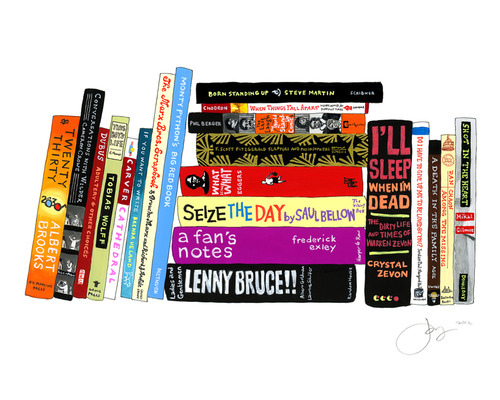
During the past few months, a clever oblong book entitled My Ideal Bookshelf has been widely covered in the media. Each two-page spread contains a brief essay about books and reading by a cultural somebody, and a painting of that person’s favorite books arranged as they might appear arranged on a shelf (in fact, not one of the painted arrangements includes an actual bookshelf).

Browsing the groupings of favorite books, I did what I always do. I took some notes, and made a list of books I would like to read someday.

I have wandered through a vast number of books about food and cooking, but so far, I have not taken on Larousse Gastronomique. So, thank you to chef and cookbook author Hugh Acheson for that reminder, and to chef Thomas Keller for suggesting the same book.

From author Junot Díaz, a recommendation for Divided Planet: The Ecology of Rich and Poor.

apatow_bookshelfJudd Apatow, famous for his comedy movies, surprised me with James Agee’s A Death in the Family, and reminded me of a popular book about comedians that I wanted to read, but never did: The Last Laugh.
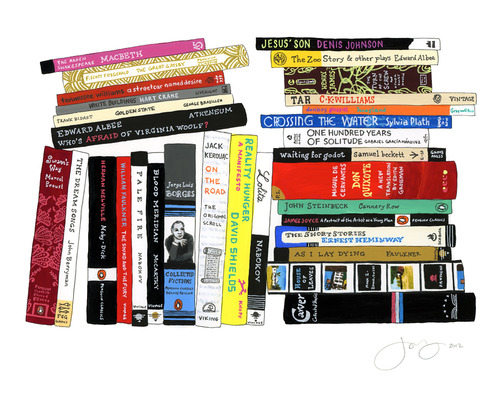
I was happy to see Dave Eggers highlight Edward P. Jones’s The Known World, a story about American slavery that I finished this winter, and now look forward to reading Denis Johnson’s book, Jesus’ Son which is “short, funny and impossibly lyrical…a book nobody doesn’t like.”

It was fun to see some of my all-time favorites, especially the obscure ones, on other people’s shelves: Chuck Klosterman likes Four Arguments for the Elimination of Television and Rudy Rucker’s The Fourth Dimension, and designer David Kelley likes The Care and Feeding of Ideas by Adams and the compendium, An Incomplete Education, and I do, too.

franco_bookshelfJames Franco wins for the most cluttered bookshelf, also the one with the most books. From his stacks, I think I will pick up another set of Raymond Carver stories, and the original scroll version of Kerouac’s On The Road. I suppose I should read Melville’s Moby Dick, which I have avoided so far for no good reason. Ditto for writer Philip Gourevitch’s suggested A Good Man Is Hard to Find by Flannery O’Connor and Dostoevsky’s The Idiot.
I am among the many who believes Professor Lawrence Lessig to be brilliant, so I was anxious to explore his bookshelf. Mostly, it was the scholarly law stuff that appealed to me, but it was encouraging to see Neal Stephenson’s Snow Crash sitting just below The Federalist Papers. 

Writer / designer / photographer Ben Schott included Dylan Thomas’s Under Milk Wood, but I think I will listen to Richard Burton on the BBC rather than reading it in book form. Patti Smith reminded me that I have not gotten my copy of Allen Ginsberg’s Collected Poems, 1947-1980. Editor Lorin Stein’s list includes Chuck Amuck by Warner Brothers animation director Chuck Jones, which I know I will enjoy.

It was interesting to see one of my architectural favorites, A Pattern Language, on chef Alice Waters’s list, and I suspect we both found it by browsing the same source, years ago, The Whole Earth Catalog. Pretty much, I want to read her entire bookshelf, from M.F.K. Fisher’s Consider the Oyster to Maria Montessori’s The Secret of Childhood.

rosanne_cash_bookshelf

Rosanne Cash’s mix of E.B. White, Mallory and The War of Art (another of my favorites, it’s way over on the left), and Tennyson and Solzhenitsyn was among the most intriguing collections.

Finally: good for William Wegman for including not only two Hardy Boys novels, but also bits of the World Book encyclopedia, The Golden Book Encyclopedia, and Girl Scout Badges and Signs.

I was very pleased, and felt very smart, when I saw so many of my personal favorites on other people’s shelves. And, I felt woefully illiterate when I realized just how many of the books–sometimes, whole bookshelves–with both authors and titles that were completely unfamiliar to me.

(So many books. So little time.)

Masterful Visualizing

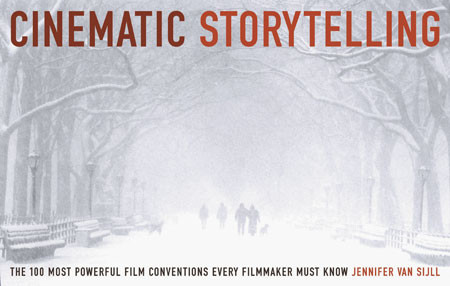
In my last post, I recommended a book entitled The Writer’s Journey: Mythic Structure for Writers by Christopher Vogler. As a companion, I recommend another book from the same publisher, Michael Weise Productions. This one is entitled Cinematic Storytelling: The 100 Most Powerful Film Conventions Every Filmmaker Must Know. It’s written by Jennifer van Sijll. Like The Writer’s Journey, Cinematic Storytelling is useful to the one telling the story, and to the reader or audience member on the receiving end. Why does this book matter? Because we’re rapidly developing into a world of visual storytellers–smartphones and digital cameras in hand–and it would be wonderful if everyone could do their job just that much better.

CInematicStory_website_largeBasically, this book is an encyclopedia of visual storytelling techniques, but it’s fun to browse because every idea is illustrated by frames from a well-known or significant film–and each sequence is presented with the relevant bit of the screenplay along with perceptive commentary from the author.

Some are easily understood by the audience, and as a result, they must be used judiciously by the filmmaker or storyteller: the slow-motion sequence in Martin Scorsese’s Raging Bull; the freeze frame that ends Butch Cassidy and the Sundance Kid; the fast-motion sequence in the French film, Amelie; the famous flashback in the Billy Wilder film, Sunset Boulevard; the visual match cut that transforms a bone into a spaceship in 2001: A Space Odyssey; the long dissolve between young Rose and Old Rose in Titanic.

A specialty lens was used by Orson Welles in Citizen Kane–perhaps the movie most often used as an example to illustrate a variety of techniques. Sometimes, a telephoto is the appropriate storytelling choice, and sometimes, it’s the wide angle. These are not random, on-the-fly choices; instead, they are carefully considered during the storyboard phases of film development.

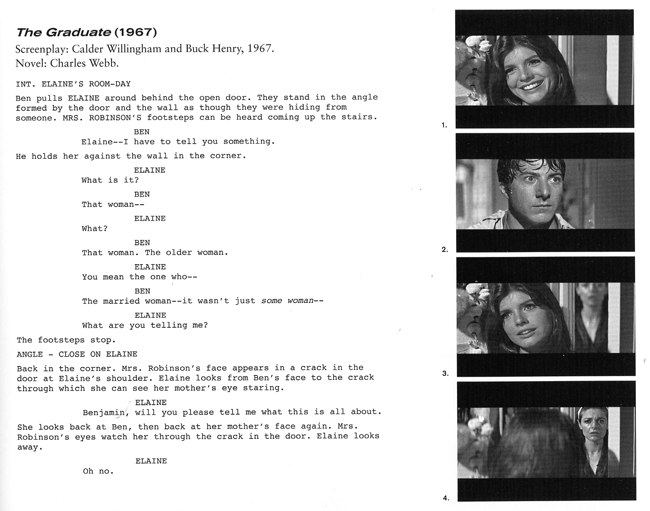
In this entry featuring The Graduate, the author explains the use of a "rack-focus"--here, shifting the focal point from one character to another. The author explains, "Unseen by Elaine, who is still facing Ben, Mrs. Robinson stands in the doorway. Mrs. Robinson is out-of-focus and ghost-like. When Elaine spins around, Mrs. Robinson is pulled into focus, and Elaine is thrown out of focus (Image 4). Every line in Mrs. Robinson's defeated face now shows. After a beat, Mrs. Robinson disappears from the door. When Elaine turns back to Ben, her face remains momentarily blurred, externalizing her confusion. At the moment of recognition, her face is pulled back into focus.

In this entry featuring The Graduate, the author explains the use of a “rack-focus”–here, shifting the focal point from one character to another. The author explains, “Unseen by Elaine, who is still facing Ben, Mrs. Robinson stands in the doorway. Mrs. Robinson is out-of-focus and ghost-like. When Elaine spins around, Mrs. Robinson is pulled into focus, and Elaine is thrown out of focus (Image 4). Every line in Mrs. Robinson’s defeated face now shows. After a beat, Mrs. Robinson disappears from the door. When Elaine turns back to Ben, her face remains momentarily blurred, externalizing her confusion. At the moment of recognition, her face is pulled back into focus.

Selecting a particular point-of-view (POV) can be a critically important aspect of storytelling, as with the below-the-swimmer underwater sequence just before the first swimmer is killed by a shark in JAWS. For which scenes is a low-angle shot most appropriate (character POV for E.T. would be one example), or for which would a high-angle shot be the better creative choice? When does it make sense to use a tracking shot (the camera is mounted on a tripod that glides along tracks; some low-budget achieve similar results by employing a wheelchair)?

Lighting is another variable. In American Beauty, there’s a scene illuminated by candlelight. In E.T., the search is conducted by flashlights and car headlights that illuminate an otherwise dark nighttime landscape.

In Barton Fink, individual shots of props (hotel stationery, an old typewriter) add visual context. Wardrobe is another defining option. So, too, is the use of location as a theme, a concept so masterfully used by director David Lynch in the vaguely creepy Blue Velvet.

It’s not always about what is seen. Sometimes, the scene contains less information, and the story or theme is carried by music or sound effects. Back to Barton Fink for the eerie sense of surreal sound and its ability to paint a picture of each character’s inner world.

Masterful Storytelling

WritersJourney3rddropWe live in remarkable times. Stories are told in every part of the world, and shared with millions of people. Once, this was the domain of the rich and powerful. Today, anybody can tell a story, and share the majesty of their ideas.

Of course, some stories are better than others. There is an art and a craft to all of this, a discipline studied in college programs and in private instruction taught by masters.

One such master is a Hollywood story consultant named Christopher Vogler. Since 1998, Vogler has been the industry expert on a particular, popular type of storytelling and character development. He explains it all in a wonderful book entitled The Writer’s Journey: Mythic Structure for Writers,  now published in its third edition by Michael Weise Productions.

No doubt, you are familiar with the structure of the mythical hero’s journey. You’ve seen it in so many movies. The hero of the story does not begin as a hero. Instead, he or she (more often, he) is an ordinary guy doing ordinary things every day. Then, something happens, and suddenly, he is thrust into an uncomfortable role, reluctant to proceed in anything resembling a heroic journey. Inevitably, the wizened old mentor or the playful talking dog shows up, and the ordinary guy begins to understand that he has no choice, that he must pursue the journey whether or not he wants to do so.

It’s Star WarsThe Wizard of Oz, Sister Act, Big, Raiders of the Lost Ark… you know the routine, but it’s still a story we love to experience, a story we love to tell. It’s the human experience, each time presented anew.

We’re on a mission from God” — Dan Ackroyd and John Landis, screenplay, Blues Brothers

So what’s so special about this book? Well, Vogler has a tidy way of breaking down each of the steps along the journey. For example, after leaving the ordinary world; hearing the call to adventure; refusing the call; meeting with the mentor; encountering tests, enemies and allies; and approaching an innermost cave, the hero is inevitably faced with an ordeal that must be overcome in order to move ahead with the journey. Joseph Campbell, whose book, Hero with A Thousand Faces, covers much of the same territory from a mythological analysis perspective, also arrives, at this point in the journey, at the greatest challenge and the fiercest opponent. So here’s the secret of the ordeal:

Heroes must die so they can be reborn.

To be clear, “the dramatic movement that audiences enjoy more than any other is death and rebirth. In some way, in every story, heroes face death or something like it: their greatest fears, the failure of an enterprise, the end of a relationship, the death of an old personality. Most of the time, they magically survive this death and are literally or symbolically reborn to reap the consequences of having cheated death. They have passed the main test of being a hero.”

Vogler goes on to explain that heroes “don’t just visit death and come home. They return changed, transformed.” So, the ordeal serves as a central core to the story, the place where the variety of story threads begin to tie together in a meaningful way. BUT–the crisis is not the climax of the story. That’s a completely different concept, a part of the story that arrives much later on (near the end, in fact.)

One reason why we love to watch the hero’s journey time and again is because every story is unique. Vogler explains how and why this may be true. Most often, the crisis occurs at the story’s mid-point, which Vogler describes as a tent pole–if it’s too far to one side, the tent sags / the audience’s interest wanes. (He reminds us that our word “crisis” comes from a Greek word meaning “to separate.” Vogler looks at the question of ordeal from many different perspectives, each one a driver that we’ve all experienced in the movies or in good fiction: a crisis of the heart, standing up to a parent, witnessing the death of a loved one, going crazy with emotion, and the list goes on.

If you’re sensing that The Writer’s Journey might be a useful tool for both constructing and de-construcing stories, you’re beginning to understand the value of Volger’s accomplishment. For the writer attempting to tell a story in a way that will ring true for the reader or the audience, this would seem to be an essential tool. For the reader, or the movie fan who wants to better understand the art and craft of storytelling, the deep secrets of the creative team, this book exposes the magic for the trickery that it is, then waves its cape to reveal far deeper magic within. For the English teacher, or professor, in search of a far better way to connect with students who ought to read or write with greater proficiency, here’s the elixir.

Of course, that’s only part of the story: the writing. Next up, from the same publisher: how to tell the visual story to ignite the audience’s imagination.

A Teacher Who Paints Ideas

When a student faces a new subject, there is a certain comfort in structure, process, facts, and the rigorous routine that defines most teaching situations. Teachers find comfort in that structure: first, the basics, then, perhaps, the materials, then, the history followed by waves of increasingly specific information. In theory, it all makes sense. In practice, when faced with the sloppiness of real life, the structure may be exactly what’s not needed because it interferes with the real learning that occurs as a result of experimentation and making glorious mistakes.

I guess that’s why I had so much trouble understanding what Tom Hoffman was doing. Instead of writing a book that began with materials (in this case, watercolor paints, brushes, papers, and accessories), he begins by admitting that watercolor painting is not easy to do, that it is sloppy, messy, difficult to master, wasteful of expensive paper, and then eschews anything resembling a traditional learning process. Instead, he focuses on the most dangerous of all educational concepts: ideas.

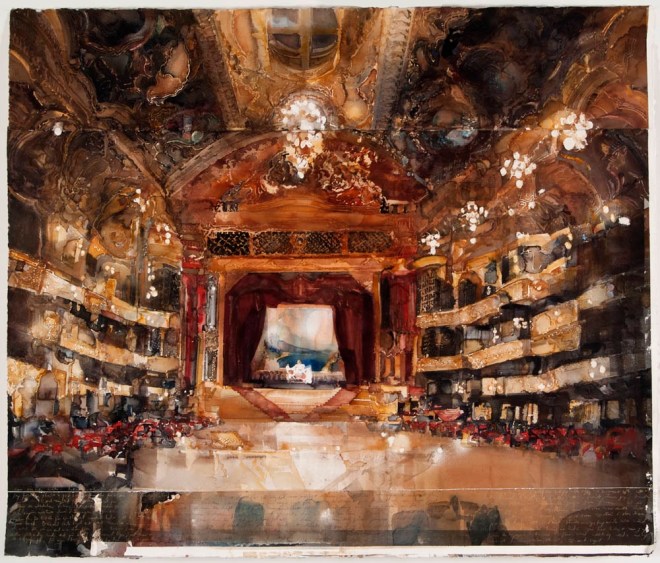
Allow me to begin where he first captured my imagination, with a watercolor painting by an extraordinarily talented artist named Lars Lerin.

operaQuoting Hoffman:

The palette is limited to three colors, and almost all of the edges of the shapes are hard. In the realm of value, however, the artist pulls out all the stops. Never merely black, his deepest darks remain full of color. He limits the lightest lights to just a few stops, making everything else seem to be lit by the low gleam of a lantern in a gilded pattern.

With this glorious visual introduction, he begins where most instruction books ought to begin: by encouraging direct observation, followed by critical thinking (would this make a good painting? what appeals to me, and might also appeal to the person looking at my finished work?) and creative thinking (how can I bring the visual ideas to life in the best possible way?) Hoffman does not begin by focusing on materials. He begins by focusing on the process that every artist shares. This leads to two very helpful essays, one entitled “Knowing Where to Begin” and the other, quite reasonably, “Knowing When to Stop.” In between, he explains the process by examining a very common part of the painting process: thinking through the best way to visualize the shapes and forms and values with just enough detail to pull it all together.

Hoffman Skaftafell

Simplicity in pattern and form, a very effective work by Tom Hoffman.

Step back for a moment. Imagine learning history that way. It’s never about the details. It’s always about the whole form. (But in school curriculum, it’s always about the details. Which we always forget.)

A very colorful Juarez Market in Oaxaca is filled with detail. It’s the centerpiece of a chapter entitled “Knowing What Not to Paint.” This leads to thoughts and illustrations about shape and form, and a key concept: simplicity.

A lovely streetscape by the esteemed watercolorist Alvaro Castagnet show how color and light can be handled in the simplest possible way, and yet, with skill, they can result in a painting that appears to be quite complex. The secret, Hoffman explains, is thinking in layers.

Thinking in layers is an additive technique–place one layer of color, then another–but it requires subtractive thinking to begin. That is, you must look at a scene, observe it carefully, determine which areas can be isolated and painted with a single color wash without interfering with other areas. For example, a red wall might be washed, but the blue roof should not be washed in the same layer–unless you’re seeking purple results.

A market in Puerto Rico, painted by Tom Hoffman, provides an illustration of wide dynamic range (note the darks at the top, the lights in the distance),  layering and simple design for optimum impact.

A market in Puerto Rico, painted by Tom Hoffman, provides an illustration of wide dynamic range (note the darks at the top, the lights in the distance), layering and simple design for optimum impact.

Hoffman also encourages the use of a wide dynamic range: the lightest lights and the darkest darks are what makes a painting come to life. Too often, he explains, the range is almost exclusively in the middle tones, and, as a result, the work lacks energy, contrast, and a compelling reason for anybody to pay much attention. Again, appreciate the metaphor because it applies to so many aspects of life: dark and light, silent and boisterous, and so on.

Final lesson: simplify to the point of abstraction. His most powerful work tends to be simple masses of color, artfully arranged.

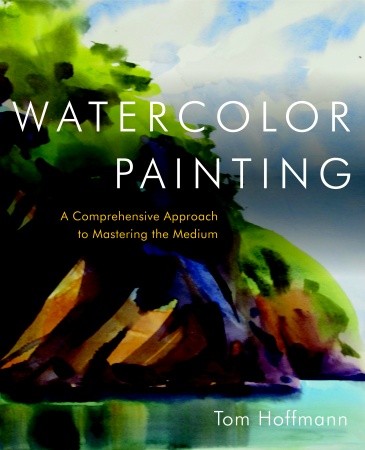
The name of the book is Watercolor Painting: A Comprehensive Approach to Mastering the Medium.

Watercolor Hoffman