One of the less well-lit areas of human history is the history of children. Today, there are television channels, endless videos and photographs, schools of every description, as well as the occasional well-publicized story of a child who built a business or a charity. Our contemporary view of childhood is very different from the views held in the past, but I’ve always been insecure about the details.
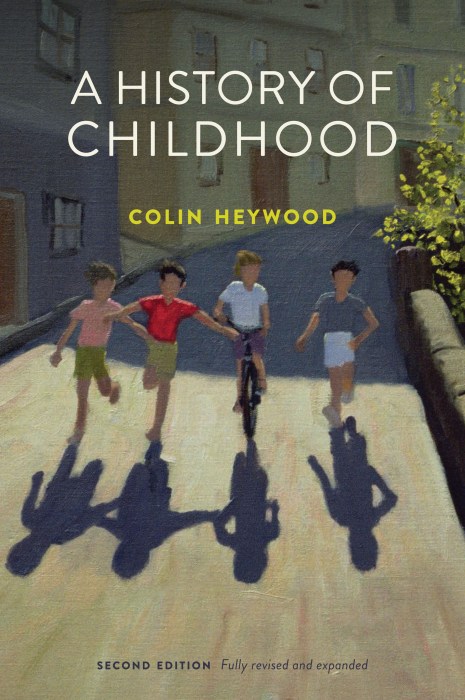
Looking for a good book about childhood’s past, I waited for the new Second Edition of A History of Childhood, written by a Professor Emeritus from the University of Nottingham named Colin Heywood. Although written with scholarly correctness, it’s accessible, and it turns out to be a pretty good story, too.
He gets started in the Middle Ages, “a society which perceived long people to be small scale adults. There was no idea of education… and no sign of our contemporary obsessions with the physical, moral and sexual problems of childhood. The ‘discovery’ of childhood would have to await the fifteenth, sixteenth and seventeenth centuries. Only then would it be recognized that children needed special treatment, ‘a sort of quarantine’, before they could join the world of adults.” These early years are complicated because religious belief dominated; Puritans, for example, “did not necessarily have a high opinion of infants, the more zealous brethren assessing they were born as ‘filthy bundles of original sin’…

The Age of Innocence by painter Joshua Reynolds, circa 1788
By 1788, there are lovely paintings of innocent children, representative of romantic view, if not of all children, then certainly the fortunate upscale among them. She seems to be the perfect child, but parents remained conflicted about just what they were raising. There were constant ideological conflicts between innocence and depravity, superb and dreadful behavior, honorable and horrifying treatment, nature and nurture, independence and dependence.
To begin his fourth chapter, Professor Heywood begins with a provocative question, “To begin at the beginning, were children wanted?” Happily, the answer through the ages seems to be yes… but not too many! There were critics opposed to the whole idea, including the fourteenth century poet Eustache Dechamps, who write “Happy is he who has no children, for babies mean nothing but crying and stench; they give only trouble and anxiety.” In the throes of motherhood, Hester Thrale (1741-1821) wrote in her diary, “this is a horrible Business indeed: five little Girls, too. & breeding again, & Fool enough to be proud of it! Oh Idiot!’ What should I want more Children for?”
After leading us through history of delivery, naming, godparents, and other ceremonies, we’re faced with the unfortunates, the unwanted children and their unhappy parents, and deepening the despair, the common death of infants and young children, no less a tragedy then.
Still, children survive and thrive. There are more and more of them, especially after we determine that they are better educated than put to work as small versions of farm hands and factory workers. In fact, they thrive, leading first to the astonishing 3 billion people on earth by 1900 (just as public education is beginning to take shape), then (beyond the scope of the book), taking us to 8 billion by about 2025.
As we begin toward the modern age, fathers have more time at home, so childcare, and the love of children, shifts from primarily a mother’s role, to an increasingly common model of shared parenting.
Heywood provides much more than a historical overview. He takes us into the room with the child as he or she grows up. Example: learning to walk, children were discouraged from crawling. Why? Indoors, floors were often shared with animals, and there was a certain discomfort in seeing one’s offspring propelling himself or herself in the same manner as a pig. There was also the cold of those floors, and the filth. Better to walk up on two legs–but not too soon, lest the child become crippled or otherwise deformed, as so many others seemed to be.
There have always been toys, and games, and nursery rhymes, too. And questions about gender stereotypes. “In antebellum America, for example, many girls preferred outdoor activities such as skating and sledding to playing with dolls. Toward the end of the century…three quarter of boys studied [were] playing with dolls, while girls sometimes acted more aggressively than their parents might have hoped.”
For those with mobility, some money and parents who would take them, there was “an impressive array of entertainments designed to instruct as well as amuse in eighteenth century England in the form of ‘exhibitions of curiosities; museums; zoos; puppet shows; circuses; automata; horseless carriages; even human and animal monstrosities.” Working class families made do with “cheap and cheerful entertainments such as dancing on the streets to a barrel organ or enjoying the hustle and bustle of a street market.”
There is evidence of children’s books in England as early as the 1470s–before Columbus visited the Caribbean. By the 1770s, there were plenty of children’s books, along with enough literate children to make good use of them.
Along the way–and beyond the frame of this article–we determine that children are worthy of their own education on a large scale, and that health care specific to childhood is a good idea, too.
Of course, I want to time travel, to talk to children and teenagers at the time they lived, in the places they lived. Even the best book on this subject–and this one is quite a good one–provides only snapshots and excerpts from earlier descriptions or diaries. Considering the great progress we have made on their behalf, I can only hope that someday, through some miracle of human genius, we’re able to travel back and understand the story more completely.

 I wondered whether, in fact, that might be true, so I meandered through 16 color pages of Christmas stuff for the home. There were a lot of pillows (I spend a third of my life sleeping), a bunch of decorative old-style lanterns (already own one), a LED outline of a cactus and another of a pink unicorn (probably not me), cups and glasses (I drink liquids, many times each day in fact), plastic Christmas tree ornaments with pictures of Mary, Santa, a teddy bear, an angel and a dove (not really me, but the angel was pretty), five different dining room chairs, and several plush reindeers on the same page as a small tower of nutcracker figurines.
 Professor Susan Engel remembers growing up. She recalls small details. Not only did she eat bugs, she remembers when and where, and which bugs she ate (potato bugs). As a pre-schooler, she remembers watching TV while sitting under the ironing board, comfortably asking all sorts of questions of Nonna, who was ironing the family’s clothes above her. In a one-room school house, Mrs. Grubb’s imbalanced approach to curiosity and education began a lifetime of inquiry. One of Professor Engel’s works-in-progress is a evaluative measure for curiosity, which seems consistent with the way most people think about school in the 21st century, and, to me, wildly counterintuitive.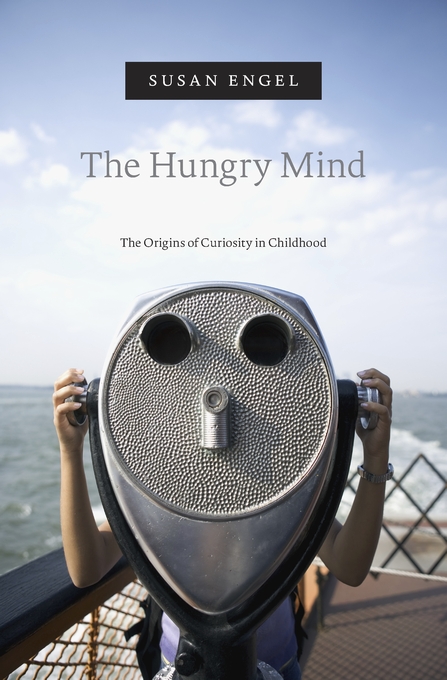
 This has been a rough week for the U.S. President. As questions pile up, I checked in on the line of succession. I cast no political aspersions. Instead, I just follow the rule of law, and check bios on government sites and in Wikipedia.

 In theory, Americans know a lot about how we elect our leaders. In practice, we may not. Returning to basics, here’s a quick rundown on what we need to know for Tuesday.

 Digital Insider