 New CD + DVD set: “Jazz & The Philharmonic,” recorded in Miami, dozens of performers doing a lovely job with jazz, classical (with a modern twist), traditional music, beautifully produced and engineered. You may have seen it on PBS—last February—but if you are among the many millions who missed out, this is a gift that you might consider for this year’s holiday season. Notably, it is one of the last recorded works supervised by Phil Ramone, whose list of credits is among the most impressive in American music history.
Want a sample? Try “Simple Gifts,” a theme that you will recognize from Aaron Copland’s “Appalachian Spring.” The performance (Mark O’Connor on violin, Dave Grusin at the piano) and the recording are spectacular.
 Also on the web page (click on above), a straight ahead performance of Johnny Mercer’s “Autumn Leaves” by Bobby McFerrin with some solid scat. (Later, on “Soloings,” McFerrin plays with his voice and the audience.) Backing McFerrin on “Autumn Leaves” is Grusin, Chick Corea, and The Henry Mancini Institute Orchestra (they are the “Philharmonic” in this concert). Corea returns for “Spanish Suite,” based upon the familiar classical work by Joaquin Rodrigo, “Concerto de Aranjuez.” It’s easy to forget how terrific Corea can be—this is a lovely setting for his piano work. The wonderful trumpet player Terence Blanchard (he is the Mancini Institute’s Artistic Director) contributes an interesting duet with vocalist Eric Owens on Bach’s “Fugue in C Major.,” then joins in on “Spanish Suite,” and later, on “Solfeggietto” by C.P.E. Bach. It’s great to hear this work performed with soloists and a full orchestra—reminds me of the good old days when the Boston Pops showed up with celebrity soloists on public TV.
For me, this concert was an introduction to a modern classical piano player named Elizabeth Joy Roe. She performers with Blanchard on “Solfeggietto,” and with Mancini director Shelly Berg on a piano duet version of Gershwin’s “The Man I Love.” Curious, I looked her up. Roe records classic music for Deutsche Gramophone, but she’s unique because she often performs duets. Not just any songs—an intriguing combination of Michael Jackson, ragtime and classical. Her version—on her website, not on the Jazz & The Philharmonic CD/DVD includes an all-out duet with Greg Anderson on Jackson’s “Billie Jean.” The video is as much fun as the piano work. Watch this (now)! She’s someone I want to know more about.
Okay—sorry—easily distracted by great music—back to the main story. What have I missed? Actually, one track, and it’s terrific. It’s called “Mountain Dance,” and it’s performed by Grusin and O’Connor with the Mancini Orchestra. Why terrific? It feels great, especially on a fine-tuned stereo system where the bass is as clear as the high notes. Again, a tribute to a recording that sounds much better than most.
There’s more on the DVD—a second McFerrin “Soloings”, another piece by Chick Corea entitled “Armadas Rhumba,” and, why not, a rousing version of “Also Sprach Zarathustra” (you know, the “2001: A Space Odyssey” theme).
What fun.
 To begin, think not about the objects, but about our desires. We want to know it all—but not all of the time. Sometimes, we just want to know whether it’s cold outside, or whether the dog has been fed. We don’t know the details, don’t really need to know the precise temperature or the moment in time when the dog’s bowl was filled with food. So instead of a thermometer, or, more intensely, a digital thermometer that reports temperature to the tenth of a degree, how about a glowing orb? Or, as author-scientist-innovator-professor David Rose describes his invention, an Ambient Orb. He writes, in his new-ish book, Enchanted Objects, “They aren’t disruptive. They have a calm presence. They don’t require you to do anything…They are there, in every room of the house with the exact information you expect from them.” So he reimagined a crystal ball that contains LEDs that change color, and report the information you need by glowing in your choice of hues. “As the colors change, you glance and know if the pollen count in the air is higher than usual.”
 Why not a jacket that hugs the wearer every time she receives a “like” on her Facebook page? (This, from one of David’s students.) Or a toothbrush that knows it is being used (and being used properly), and recognizes your good work, rewarding you with a discount at the dentist? (Oy. The gamification of dentistry! Nah, not in David’s hands. He’s smarter than that—check this out.) One of his entrepreneurial firms was hired by a big pharmaceutical firm to bring some life to the little plastic pill containers. Hoping to change the behavior of the the many patients who do not take our prescribed meds, David’s company, Vitality, changed the cap. The cap glows when you’re supposed to take a pill. Even better, the GlowCap texts you when you’ve forgotten to take a pill, and automatically sends refill messages your local pharmacy. The “adherence rate” is up to 94 percent, far better than the 71 percent achieved by a standard (boring, non-glowing, non-internet connected) vial. It’s information at a glance, again non-disruptive.
 David’s vision of the future: whatever the device may do, it must be affordable, indestructible, easily used, and, when it makes sense, wearable. Lovable, too—his clever illustration of interactive medicine packaging are based upon faces that transform themselves. They’re happy when you’re doing the right thing, grumpy if you’re not.
 David dreams of on-demand objects, and objects that learn and respond to personal needs. Vending machines, for example, that customize their offerings based upon “a prediction of what the person will like.” He envisions “digital shadows” for objects—information associated with physical objects enhanced by digital projection.
 Putting this another way,


 So here we are, caught between two ideas, two eras. In the former, large fortunes were made by the middleman. In the latter, there is no middleman. Make what you sell—the old American way (and, in fact, the way that many people in undeveloped nations continue to operate, with no clear path to a digital future). And then I think about Macy’s, Wal-Mart, and going back a bit, the much-criticized market domination of
 Driving the rural roads of Scotland, Ireland, and Wales, I’ve occasionally been fortunate enough to be blocked by sheep being moved from one pasture to another.
 Here’s a question: Why are one-size-fits-all performance standards inappropriate to the point of silliness when applied to dogs, but accepted without question when applied to kids? If someone tried to set up a national program to teach every dog to do everything that various breeds are able to do, the Humane Society and the American Society for the Prevention of Cruelty to Animals would have them in court in a New York minute. But when authorities mandate one-size-fits-all performance standards for kids, and the standards aren’t met, it’s the kids and teachers, not the standards, that get blamed.
 Geri Allen is one of those extraordinary jazz musicians whose influence runs wide and deep, but somehow, has not become as well-known as it ought to be. She’s a pianist with a resume that begins with a serious educational foundation: a master’s degree in ethnomusicology that has served her well (easy for me to see this because I’m approaching her life’s work some 35 years into a very good story). Her professional work begins with Mary Wilson and the Supremes in the early 1980s, and Brooklyn’s
  The awards began to roll in. Allen was in and out of the remaining avant-garde, which sounds much less radical now than in 1996 when she recorded “Hidden Man” with Ornette Coleman’s Sound Museum. In fact, by 1999, she was sounding very comfortable in a commercial setting, recording her popular CD, The Gathering, with Wallace Roney on flugelhorn and trumpet, Robin Eubanks on trombone, Buster Williams on bass, and Lenny White on drums, and others whose names are well-known from mainstream jazz records. A 2010 record, “Flying Toward the Sound,” made it to the top of many critic’s best-of-the-year lists.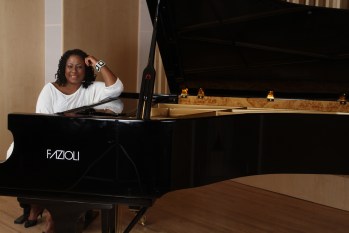
 Geri Allen has been one of those artists that I’ve wanted to know more about. Now that I’ve written this article, now that I’ve done some concentrated listening, I’m realizing that I am just beginning to understand what she’s all about. The latest album is elegant and wonderful, soulful and reflective, sophisticated and consistently interesting, but my collection is now woefully incomplete. I have listened to the two predecessors in the trilogy, but I want them for my very own. The same is true for the work she did with Paul Motian and Charlie Haden, and for the work she did in 2010 with her group, Timeline.









 Digital Insider