Literacy in the Era of the Image

The word literacy finds its roots in the eighteenth-century word literatus, which quite literally means ?one who knows the letters. But it has come to refer to much more than the ability to read an alphabet or other script. We think of literacy today as meaning “proficiency”–or more broadly, the ability to comprehend and to express or articulate.”

That’s the just the beginning of an interesting book by Stephen Apkon entitled The Age of the Image: Redefining Literacy in a World of Screens. As the title suggests, and as the introduction by director Martin Scorsese illustrates, there is more to 21st century literacy than comfort with the printed word. Apkon directs the Jacob Burns Center for Film and the Media Arts Lab, and so, he spends a fair amount of time thinking about the ways we exchange stories, ideas, and, of course, images.
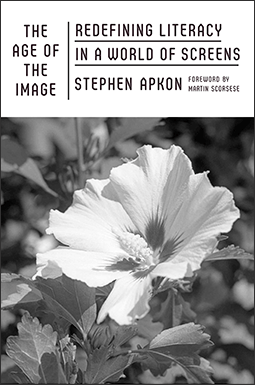
ageoftheimage_255pxTrying to understand multimedia literacy by reading a book is, of course, absurd, but Apkon does the best he can within the limitations of the printed word. This adventure is made more complicated because of the necessary stops along the way: in order to understand moving images, one must first understand still images, and so, there is the obligatory tour through Civil War-era photography, and so on. I’m geeky on these subjects, so I found these chapters interesting, but the book doesn’t really take off until we get to the chapter about the brain’s responses to visual images, the one that’s called “The Brain Sees Pictures First.” The bottom line message: context is king. Individual images without connection to a story are filtered by the brain and rarely provoke any long-term impact. They may capture attention (the brain is constantly on the lookout for potential danger), but they are quickly and efficiently filtered out and almost always forgotten. Showing portions of Charlie Chaplin’s “City Lights” to an audience, researchers found that “…when you connect images in a fashion that creates a narrative story in a literate way, you elicit powerful responses.”

Apkon further illuminates and magnifies his arguments through extensive conversations with researchers, discussions about the latest MRIs and their ability to measure brain impulses, and considers our image culture from many perspectives. And yet, so much of what he writes, I think we already know from daily experience. We ignore most of the images that we see, but we recall memorable stories. With digital technology, we are as much the creator as the consumer.

Yesterday, at a wedding, I was struck by the number of photographers, and their interaction with the one professional in the room. The pro would set up a shot–a crowd shot of all of the bride and groom’s college alums–and then, he would step back so that twenty other people could take the same picture using their phone/cameras. I’ve become a fan of watching the images that people capture, in real time, on their phones. Often, the results are excellent–the technology takes care of itself so there is no focus or exposure issue (most of the time). Instead, there is only composition, and because everyone see so many images, the composition is often strikingly good.

The interesting theories explored in the first half of the book fade into a discussion of production in the second half. I suppose this is inevitable because, these days, we are all producers, directors, and cinematographers.

That’s the hard part, of course. Here, it’s expressed in book form, but we’re facing the same issue in every classroom, and with every book we read. We’ve become literate consumers, and literate creators. I read a book and then I write about it. I think about what I’ve read, and then I generate additional media. You read what I write, and perhaps, what Stephen Apkon writes, and pass it along to friends where these ideas may take on a life of their own. Memes (old usage) floating around in internet space. Some are images, some are just ideas not yet captured in visual form. Which is the relevant impetus for literacy? Is it the words I wrote so easily by punching buttons on a keyboard without leaving my chair, or is the images that I create by lifting my phone to my eye, pressing just one button to shoot and another to send it to the world? Or is the new proficiency of literacy the ability to discern whether any of this babble is worth even a nanosecond of your time and attention?

(No good way to end this one. Feel free to write your own ending.)

Thoughts on Mobile, Part Three: Connecting Dots 4, 5, 6

Yesterday’s post ran long, so I decided to cut it in half. Here’s the rest of it, or the third in a series of two articles. (Something like that…)

A group video call on Skype.

A group video call on Skype.

Dot #4: Connectivity and Sharing. Here in the 21st century, we demand not only connectivity but sharing of information in real time. We fall short in whiteboard-type environments where we can see ideas and people simultaneously, and when we do, the interaction is sub-par, but this will steadily improve through Skype, Google, and new ventures. All portable devices must connect anywhere, at any time–this is a shortcoming of some apps (Evernote, for example) and some devices (most portable computers, unless a separate wireless hot spot is generated by a nearby cell phone). This is foolish retro-thinking. The next generation of computers, tablets, all devices should include built-in connectivity for WiFi, 3G, 4G, and so on. Fortunately, these devices and their related systems work very well. And, fortunately, the technology is constantly improving to allow more throughput, faster speeds, fewer problems, and increased security. What we don’t have quite yet is a kind of super-DropBox where it’s easy to share any document on any device, regardless of whether it’s in the cloud or on a specific device. VPN (Virtual Private Network) technology resembles a solution, but what we need is a more robust, full-featured, easy-to-use system. I suspect Apple and Google are hard at work developing something to do this job–they’re already on the way with Google Docs and the new iWork set for release later this year.

illo_newworld

Dot #5: Output. This one is confusing. I own an iPad which doesn’t do well in an environment where printed documents are the standard. Most printers won’t talk to a tablet–though some now have email addresses for that purpose (yes, some printers have email addresses–seems confusing, I know). When I was using a portable computer, I often printed documents. With the tablet, I find myself storing documents and reading them on the tablet’s screen. Far less printing. Almost none, in fact. My output is, typically, an email to someone who wants or needs to read something I wrote. I do print some documents for reference, but printed documents are difficult to revise, so I tend to focus on digital copies. The file folder in my briefcase were once filled with paper, but now, not so much. Even handwritten notes are being replaced by the notes that I take on the tablet–when they’re in Evernote, they’re very easily shared with my other devices and with other people via email or shared settings.

Dot #6: Portable. For me, this means the device goes just about everywhere I go. In that regard, the iPhone (any smartphone, really) is a suitable solution, if one with a too-small screen. There is access to web and email, phone, messaging, internet, iWork documents, Evernote, the list goes on. The tablet does not go everywhere because it’s a little too big, even for someone like me who is rarely seen outside my home without a shoulder bag. There’s some minor conflict here about size: the phone ought to be larger, the iPad needs to be both small enough to carry everywhere (the iPad Mini) but large enough to provide a full page of printed material or to create diagrams or word processing documents or spreadsheets or presentations (the iPad full-size model). At first, I was sure I would need a keyboard, so I bought one and thought I’d carry it everywhere. I don’t. In fact, I use the portable keyboard only when I have a lot of writing to do away from home–not so often, as it turns out.

How long does the device need to run between recharges? Eight hours seems pretty reasonable, more is nice.

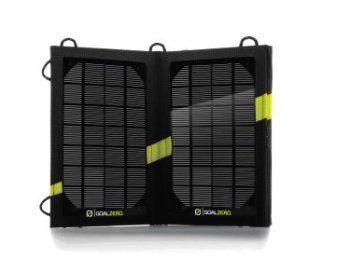
GoalZero's external solar charger is convenient, but this technology should be built into every portable device.

GoalZero’s external solar charger is convenient, but this technology should be built into every portable device.

Any accessories required, as one might carry with a portable computer? Absolutely not.

One further notion about portability: the device must be easily used anywhere. With an iPad or tablet of sufficient size, that’s anywhere at all, standing, sitting, lying down. With a portable computer, a desktop surface makes the process so much more comfortable–though some people can work with the computer on their lap (I need a fat pillow to do that, and the computer tends to slide around). The tablet can be raised or lowered to adjust for eye position and lighting; this is difficult to do with a portable computer.

Of course, everyone’s needs are different, and some people use their portable device as a power tool. For most users, I suspect this is overkill–just like a gigantic SUV might be for local grocery runs and soccer practice.

What’s next? I think we’ll see keyboards becoming vestigial, and improved touch screens as the standard for portable devices. I know the devices will become faster, contain more storage, offer better screens and longer battery power, and we all know that prices will remain quite low, but will slowly rise. There will be more pocketable devices, and attempts to move away from a traditional flat screen. OLED technology, for example, allows a screen to roll up for storage. This will be the next frontier, worthy because the size of the screen is the key determinant for portability. Once that dot becomes more flexibly defines, all of the other dots line up in support. That’s the longer-term future.

itri-6-inch-color-flexible-amoled-img_assist-300x315

For the shorter-term future, I’d look to combining my tablet and phone into a single device that works and plays nicely with a more powerful computer (which will also evolve) in my home or office.

And what about power? Since they can be charged almost anywhere, I like solar cells. They’re small, flat, and becoming affordable. I also like charging mats. AC adapters are probably unavoidable, but better batteries make them less essential.

Sorry for the long post, and for the multiple parts. This was interesting to write, so I just kept going.

Thoughts on Mobile, Part Two: Connecting Dots

Dot #1: Input. In order to operate any sort of computer, you need to provide it with the information floating around in your brain.

Dot #2: Display. In order to process the information that you’re pouring into the computer, you need to see, hear, or otherwise sense your work-in-progress.

Dot #3: Storage. Whatever you input and display, you need to be able to keep it, and, change it. Also, it would be best if there was a second copy, preferably somewhere safe.

Dot #4: Connection and Sharing. Seems as though every 21st century device needs to be able to send, receive, and share information, often in a collaborative way.

Dot #5: Output. In some ways, this concept is losing relevance. Once displayed, stored and shared, the need to generate anything beyond a screen image is beginning to seem very twentieth century. But it’s still around and it needs to be part of the package.

Dot #6: Portable. Truly portable devices must be sufficiently small and lightweight, serve the other needs in dots 1-5, and also, carry or collect their own power, preferably sufficient for a full day’s (or a full week’s use) between refueling stops.

Let’s take these ideas one at a time and see where the path leads.

Dot #1: Input. Basically, the “man-machine” interface can be achieved in about five different mays. Mostly, these days, we use our hands, and in particular, our fingertips, and to date, this has served us well both on keyboards (which require special skill and practice, but seem to keep pace with the speed of thinking in detail), and on touch screens (which are not yet perfect, but tend to be surprisingly good if the screen is large enough). ThinkGeek sells a tiny Bluetooth projector that displays a working keyboard on any surface.

20130616-213558.jpg

There is the often under-rated Wacom tablets, which use a digital pen, but this, like a trackpad, requires abstract thinking–draw here, and the image appears there. It’s better, more efficient, and ultimately, probably more precise, to use a stylus directly on the display surface. So far, touch screens are the best we can do. Insofar as portable computing goes, this is probably a good thing because the combination of input (Dot #1) and display (Dot #2) reduce weight, and allow the user direct interaction with the work.

20130616-215054.jpg

This combination is becoming popular not only on tablets (and phones), but on newer touch-screen laptops, such as the HP Envy x2 (visit Staples to try similar models). The combination is useful on a computer, but more successfully deployed on a tablet because the tablet can be more easily manipulated–brought closer to the eyes, handled at convenient angles, and so on.

Moving from the fingers to other body parts, speaking with a computer has always seemed like a good idea. In practice, Dragon’s voice recognition works, as does Siri, both based upon language pattern recognition developed by Ray Kurzweil. So far, there are limitations, and most are made more challenging by the needs of of a mobile user: a not-quiet environment, the need for a reliable microphone and digital processing with superior sensitivity and selectivity, artificial intelligence superior to the auto-correct feature on mobile systems–lots to consider, which makes me think voice will be a secondary approach.

20130616-215041.jpg

Eyes are more promising. Some digital cameras read movement in the eye (retinal scanning), but it’s difficult to input words or images this way–the science has a ways to go. The intersection between Google Glass and eye movement is also promising, but early stage. Better still would be some form of direct brain output–thinking generates electrical impulses, but we’re not yet ready to transmit or decode those impulses into messages suitable for input into a digital device. This is coming, but probably not for a decade or two. Also, keep an eye on the glass industry–innovation will lead us to devices that are flexible, lightweight, and surprising in other ways.

So: the best solution, although still improving, is probably the combination tablet design with a touch-screen display, supported, as needed on an individual basis, by some sort of keyboard, mouse, stylus, or other device for convenience or precision.

(BTW: Wikipedia’s survey of input systems is excellent.)

As for display, projection is an interesting idea, but lumens (brightness) and the need for a proper surface are limiting factors. I have more confidence in a screen whose size can be adjusted. (If you’re still thinking in terms of an inflexible, rigid glass rectangle, you might reconsider and instead think about something thinner, perhaps foldable or rollable, if that’s a word.

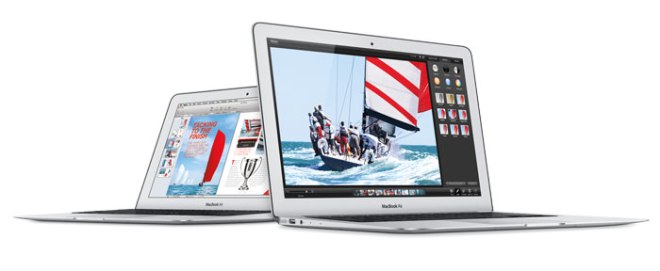
Dot #3: Storage has already been transformed. For local storage, we’re moving away from spinning disks (however tiny) and into solid state storage. This is the secret behind the small size of the Apple MacBook Air, and all tablets. These devices demand less power, and they respond very, very quickly to every command. They are not easily swapped out for larger storage devices, but they can be easily enhanced with SD cards (size, speed, and storage capacity vary). Internal “SSD” (Solid State Device) storage will continue to increase in size and decrease in cost, so this path seems likely to be the one we follow for the foreseeable future. Add cloud storage, which is inexpensive, mostly reliable (we think), mostly private and secure (we think), the opportunity for low-cost storage for portable devices becomes that much richer. Of course, the latter requires a connection to Dot #4: Storage. Connecting these two dots is the core of Google’s Chrome strategy.

Thoughts on Mobile Computing, Part One

It’s risky to generalize, but I suspect the following is true for most people, most of the time:

  • Higher-stakes projects involving significant amounts of concentration require a quiet work environment with a more powerful computer and a larger screen; and
  • Lower-stakes projects, initial planning, and work-on-the-go require a lightweight computing device, often with a smaller screen

Certainly, some people must work on the go, or prefer the flexibility of a more powerful computer on the go, and others, quite sensibly, prefer just one device, not two (or three, or more). Seems to me, the high-stakes machine ought to be a versatile notebook connected to a 20-inch or larger screen, with proper backup, and the low-stakes machine ought to weigh as close to two pounds as possible, offer all-day battery life, and easily connect to any WiFi, 3G, 4G, or whatever other service may be available. That is: the portable really ought to be portable, and no so much a full-scale machine unless you feel the need to combine functions into a single box.

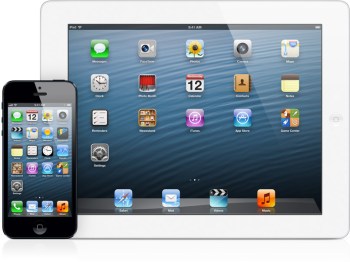
iPad and iPhoneWhen the latest upgrades to the MacBook Air were released last week, I thought I might finally break my pattern–iPad for portability, iMac for serious work in the home office–with an in-between machine that could do both. After hours of research and experimentation with the Air in various settings, I decided to wait until the autumn to upgrade the iPad, once again leaving the portable out of the mix. Why? The Air does not connect via 3G/4G, but instead requires a separate network to be established on my iPhone (clunky solution, but it works). And, to my astonishment, I actually prefer the touch screen to the keyboard when computing in a mobile environment. I sacrifice a degree of functionality for the reduced weight and increased connectivity, but then, most of my mobile work does not result in an elaborate finished product–this, I do on a computer.

I suppose that’s why the call from HP was so intriguing. Here was an opportunity to experiment with a portable computer in my daily life–something I have not done in several years, and an opportunity to experiment with a Windows computer, something I had not done in a decade or more. And, the computer would be running the intriguing Windows 8 operating system, the one with the cool colored tiles. What’s more, my sample model offered 3G/4G capability.

At the same time, I decided to learn more about the $250 Google Chrome portable computer sold by Samsung. It, too, offered the connectivity that the Air sadly lacks.

Keeping an open mind about new and better ways to work, I tried the HP EliteBook 2170p. The specs are similar to a MacBook Air, and the cost is about the same (around $1,000 for the basic model). It weighs less than 3 pounds–more than that seems too heavy, at least for me, to be carried everywhere–and the feature set is similar, too. There’s a light-up keyboard, an SD card slot (more versatile here, and, BTW, absent on even the latest MacBook Air), similar processor options, no HDMI slot (odd to see a VGA port on a contemporary computer, but this one is designed for older-style business use). Screen resolution is about the same, but the images on the Air are more vivid, and the type is easier to read. The 11-inch screen size is comfortable for light work, but challenging for serious word processing, spreadsheets, even word processing–and this is true for the Air as well. It’s possible to use this computer with a 3G/4G network; this feature is sadly lacking on the Air.

Windows8Today is Sunday the 16th, and I have lunch at noon. That’s easy to see on the colorful Windows 8 interface. Right now, it’s 68 degrees and it’s going to rain today. Click through for details, and the weird non-intutitive interface design returns. It’s unclear what to do next, the brief instructions are unclear and the type is often too small to read. Click once or twice more, and the whole deal looks like Windows from the turn of the century. For reasons I do not understand, several “chickets” appear on the right side of the screen. These offer a combination of settings, search, and device access–not sure why these are shown separately, but the more I dive into Windows 8, the more I come up with “why would they do it that way?” questions. I’ve now spent several hours with Windows 8. Overall, I’d give it a “meh.”
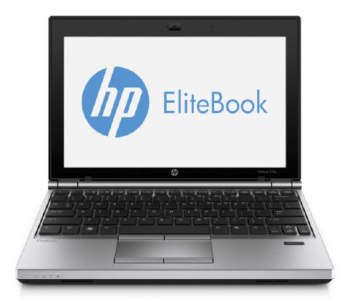
HP-Elite-BookHow about the HP Elite as an example of a contemporary portable computer? It’s okay, but the design is boxy, it’s a little heavy for the 11-inch screen it carries (the 13-inch MacBook Air also weighs 3 pounds). It offers just one operating system (Air offers both Windows and Mac for about the same price).

homepage-promo

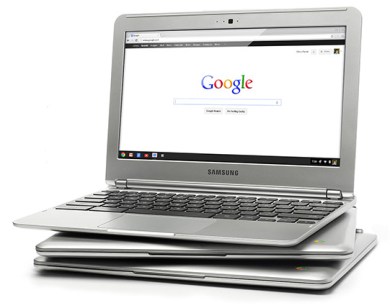
For one-quarter of the price, I think most people would be able to accomplish most of their tasks on Samsung’s Chromebook, which costs $250 ($329 with 3G, which is very useful). No fuss: buy one today at neighborhood Staples store. This is a basic, 2.4 pound (lightweight!) portable–not fancy, but it is reasonably well-built and functional, if you limit your desire for functionality to word processing, web browsing, spreadsheets, presentations, email, watching movies, listening to music, and a few dozen other activities. The Chrome Web Store makes the selection and installation of a great many Chrome apps available for use on any Chrome computer, and on any computer with a Chrome browser installed. This level of flexibility is hard to find in the Apple world and nearly impossible to find in the Windows world–Google and its users benefit from a design approach that is totally 21st century, and, in fact, totally new in the 2010s. It’s fresh, inexpensive, and it works.

Here's a small sample of the many apps available in the Google Chrome store.

Here’s a small sample of the many apps available in the Google Chrome store.

It’s not easy being a Windows computer maker in 2013. There is so much legacy–so many enterprise interests to be served–that there is limited available space for innovation. Easy of use, portability, interoperability, slick interfaces, web app stores, these are not ideas that fit comfortably into an enterprise structure that demands standardization (new approach is focused, mostly, upon customization), a work-anywhere approach, high levels of security and reliability, rock-solid applications, and more. HP is one of many Windows-based computer makers who struggle with these issues. This situation has been made much more challenging by Apple’s elegant design and passionate user base, and, now, things are even more difficult because Google is changing the game with a far lower cost structure. And in here, somewhere, is the growing Android ecosystem–not quite as well-positioned but a significant force just the same.

Swing back around to the simple demands of getting work done in the office and at home, I think I’ll stand pat with the iPad because it weighs about a pound-and-a-half and easily connects to either wifi or 3G (my next one will be 4G), and an iMac at home with a larger screen. No, the iPad is not perfect (but I have surprised myself with its flexibility, and with my comfort level in using the touch screen almost all of the time and the accessory keyboard almost not at all). Yes, I pay more for the privilege of using the integrated Apple system. Comparables are emerging, sometimes offering features that Apple cannot or will not, but in the horserace, it’s Apple, Google, and perhaps Android, with Windows off in the distance in a post 20th century haze.

Coming in Part 2: thinking a few years into the future.

The Crossley ID Guides: Raptors and more!

hawk

Perched on a fifth floor windowsill in downtown Trenton, New Jersey, a young Cooper’s Hawk stood close enough to peer into his (or her?) eyes. A thick glass window separated the hawk from television producer Rich Renner’s camera. The hawk visited frequently. We were interested, and the bird, no less so.

I know this is a Cooper’s Hawk because the bird matches the pictures and description in a new book called Crossley ID Guide: Raptors. If Rich’s photograph included the tail feathers, I could probably tell you whether we’re looking at a male or a female bird. I know a lot more from the descriptive text: this particular bird is probably under a year old because its coloration changes after its first molt, which occurs around age one. Here in the U.S., Cooper’s Hawk is a very common bird, seem most of the year in most of the states (less so in the Great Plains, where it’s mostly seen in warmer or cooler months).

5-Sharp-Shinned-Hawk

The Crossley ID Guide has become especially popular because the birds are shown (or digitally added to) natural habitats. The birds in flight, above, are Sharp-Shinned Hawks–apparently, the adults are often mistaken for Cooper’s Hawks. Here, the hawks are flying around one of the U.S.’s most popular birding sites (home of the annual World Series of Birding), Cape May, New Jersey.

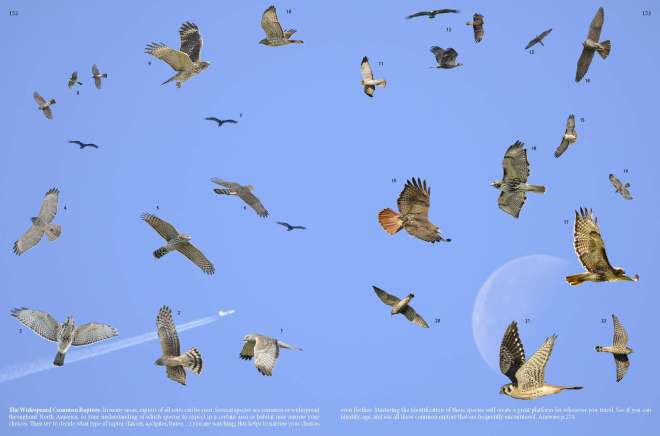
Birding, and books for birders, are more popular than ever before. This is, in part, due to interest from an aging baby boom population (especially with women), the availability of digital photography and the requisite long lenses (especially among the men), and, generally, a growing awareness of nature. In particular, the work of Richard Crossley, a long-time birder and bird photographer, has gained notice because of the inviting visual approach used in the books. The book is filled with lavish natural spreads, or composites, as above, and also with visual quizzes in which readers are asked to identify birds in flight, as below.

13-Widespread-Common-Raptors-Mystery-Plate

I especially like the Raptors book because the birds themselves are both fascinating and often present in the area where I live. When I spot a raptor flying above, I can’t help but stop and watch the bird in flight, often for quite a long time. They are very special birds, both from afar and close up, and the new ID Guide adds texture and context to their visual appeal.

The book about raptors is runs several hundred pages, but it that’s only about half as long as the weighty volume about Eastern Birds. This is a book that will entertain you all summer long, especially if you enjoy watching backyard birds, or if you’re willing to schlep this volume along on vacation. Here’s a layout of Glossy or White-faced Ibis, beautiful page after page featuring the secrets of owls in their habitats: Short-eared, Long-eared, Barred, Barn, Great Horn, Northern Saw-whet, Eastern Screech, Elf, Burrowing, and more. There are both Red-bellied and Red-headed woodpeckers, each in its own full-page layout. Chickadees, robins, thrush, various warblers, and the wonderful Little Blue Heron who seems to enjoy bathing in a creek just across from my home.

These are the birds you see every day, or sometimes, glimpse while traveling. They come alive in these layouts, making the Eastern Birds book one of the best browses around. The Crossley Raptors book has three things that the Eastern Birds book does not: first, those wonderful visual quiz layouts. the wonderful visual quizzes; second, lengthy descriptions about each individual species; and, third, my favorite part, which goes something like this:

On a frigid winter day, a mass of songbirds anxiously feeds on seed strewn in a grassy area cleared of snow, their bustling chatter discernible through the living room window. At once, they freeze, pinning themselves low to the ground in response to alarm calls from nearby jays. From the center of the yard a blue streak appears, seemingly materializing from thin air, moving swiftly toward the flock. The group scatters as a high-speed chase ensues. The small, compact hawk picks its target. It extends its long legs and talons outward and fans its long tail as it banks sharply and snatches a White-throated Sparrow from midair. The hawk disappears into the brambly thickets without moving a branch; the only evidence of the event is a plume of feathers softly floating to the ground.”

Each description begins that way: with an observer’s sense of the birds living their lives.

Special books, indeed. but don’t take my word for it. Try a free sample!

This link takes you to Princeton University Press’s FREE (yes, completely free) download of the new Crossley ID Guide: Raptors book as a .pdf, and also another free book about garden birds. Download here, then add it to your tablet or smartphone for reference wherever you happen to be.

Six Thousand Cheering Fans

MacBookAirI raced home tonight to watch two hours of programming that will never appear on television. You may not even recognize the name of the program: “WWDC2013” I don’t know how many other people watched, but I suspect it’s over a million.


It’s difficult to think of any company whose business partners are also its biggest fans. Throughout today’s Apple Worldwide Developer’s Conference, every time an Apple executive introduced a new feature, the crowd went wild–just like they do on “The Price Is Right.” Here, we’re talking about the addition of tags to file icons in the Finder menus, so the applause (which seemed genuine, and was likely not prompted by the “Applause!” signs that hang above game show audiences).

Think about this: Apple one of the top companies in the world. Twice a year, they hold an event in a large auditorium to tell partners and customers about the latest MacBook Air, or improvements in their  operating system, and they generate more excitement than the majority major league sporting events ( more press, too).

This phenomenon goes far beyond traditional product marketing or consumer behavior. On the very popular MacRumors website, which does nothing but track possible directions that Apple may go, there was a countdown clock with the number of days, hours and seconds until the big event. I checked the site at least once a day (okay, three or four times a day) to see whether anything new was posted. This is obsessive behavior, not at all reasonable, and completely dissimilar to anything else in my life. I’m hardly the only one who is engaging in this silliness.

Today, Apple announced that they now own the number one slots in desktop and notebook computer sales. Their five year growth is more than 5x the entire PC industry. Their iPad and iPhone are industry leaders. The entire ecosystem works together as one–and they’re improving their iCloud systems so that the experience is that much more satisfying, rich, and competitive. Each successful product adds to the value of the whole, not just for the company, for every participant in Apple’s supremely well-constructed and well-managed ecosystem. It’s a brilliant bit of 21st century thinking, and it’s remarkable that there aren’t a dozen other companies with similar schemes.

I probably spent more combined time with my iPhone, iPad and iMac than I do with anything else I own. They contain my creative work, my communications with just about everybody I know, my schedule, my written work… in short, they play a very significant role in my daily life. Do I have an emotional connection to these metal and plastic parts? I want to say no, but I did spend the evening watching two hours of Apple propaganda this evening (and rushed home to do it).

Is this some sort of a man-machine addiction? I do find myself at something of a loss if I’m separated from my stuff for too long. I do spend time with Apple products just as soon as I wake up and in the minutes before I head for my bedroom and sleep. And I’m not disclosing these personal habits because I think they’re unique. I suspect there are a few million people who are behaving in ways that are far more extreme than the ways I think about these tools.

I could go on, but I do have some things I want to do tonight. (No, I’m not going to stroke an iPad while I confirm tomorrow’s schedule. I’m going to watch the Samsung TV downstairs because we recorded the TONY Awards on CBS using the Verizon FiOS DVR last night when we were too busy shopping at IKEA to make it home in time for the show.) I am pleased with all of these brands because they deliver upon their promises, but none of them have managed to become a part of my life in  the way that Apple has managed to do.

Why? Mostly because the Apple stuff works so well (and if it doesn’t there’s the Genius Bar at the Apple stores, and Apple Care by phone). Nothing else I own has achieved that level of interoperability (to use a tech term). Taken individually as products or collectively as a complete system, it’s all elegant, reliable, and cool. And although my iMac tends to crash from time to time, and the iCal sync doesn’t work too tell on one of my devices, the whole thing is very, very impressive. Better, in fact, than just about anything else I own.

Balancing Technique and Inspiration

A new book about pastels from artist Jean Hirons.  If you buy it by clicking on the link (instead of buying from a more traditional source, the author earns more money for her self-published effort.)

A new book about pastels from artist Jean Hirons. If you buy it by clicking on the link (instead of buying from a more traditional source, the author earns more money for her self-published effort when you click on the book cover and make the purchase through Author House).

Ten or fifteen years ago, I decided to try my hand at pastels. That is, I bought a box of pastels, some paper, and started making bad art. At the time, there were two useful books available: Bill Creevy’s “The Pastel Book,” and Larry Blovits’s “Pastel for the Serious Beginner.” Both of these books were well-organized, and helpful, but neither provided the complete education that I wanted to pursue.

Over time, I bought more (and more) (and more) pastels, experimented with various types of paper, played with and decided that I pretty much hated fixative, bought a field easel, and started spending weekend afternoons making pastel paintings. To be honest, I didn’t much care whether each painting was worth showing to anybody; most of the paintings were wrapped in glassine (which does not smudge the painting) and placed, ever so carefully, into a box. Mostly, my concern has been learning how to pursue a creative process.

Along the way, I have bought just about every book about pastels that I could find. I’ve scoured the lists of the top publishers (then, North Light Books and Watson-Guptill, the latter now part of North Light). I’ve been inspired by the beautiful work and eye-opening creative thinking so elegantly presented by Elizabeth Mowry her two best books, “The Pastelist’s Year,” which looks at painting through the seasons) and “The Poetic Landscape,” which examines perception and the psychology of art through pastel painting. Both of Maggie Price’s books have proven very useful: “Painting with Pastels” and the more specialized “Painting Sunlight and Shadows with Pastels.” The out-of-print book that taught me ever so much was Doug Dawson’s “Capturing Light and Color with Pastel.” The more sophisticated, and modestly entitled, “Pastel Pointers” by Richard McKinley, is only part of a larger instructional program that can be pursued online or in the always-excellent Pastel Journal magazine.

Still, I wish I was just starting out today, if only to do so under the guidance of Jean Hirons and her new (self-published) book, “Finding Your Style in Pastel.”

"Antietam Barns" by pastel artist Jean Hirons

“Antietam Barns” by pastel artist Jean Hirons

From the very first image on the very first page, I sensed, I can probably do this. Immediately, my confidence level increased. A brief but substantive review of types (soft, hard) and brands (Sennelier, NuPastel) is followed by a rundown on the many surfaces (papers, mostly) now available (with running commentary on the advantages of each ground), and comments on strokes, blending, layering, and other techniques. I like the way Ms. Hirons keeps the story moving; she makes her points clearly and with the right illustrations, then moves on. (She is my kind of teacher!) There’s a lot of “show me what I need to know,” as with a quartet of small images to explain toning and underpainting (two methods of pre-painting a surface).

By page 63, she’s defining personal styles. This is, of course, what every artist wants to know. Basic techniques are fine, but how do I make my paintings my own? So begins one of the better explorations of composition, value, edges and color theory that I’ve seen in book form. As with the earlier chapters, the author does not linger; the pace remains solid, brisk and professional. Once again, two images from the artist’s online gallery help to make the point about the difference between the works of an artist who pursues a distinctive, personal style:

Carroll County Farm by Jean Hirons

Carroll County Farm by Jean Hirons

"Dandelion Spring" by Jean Hirons

“Dandelion Spring” by Jean Hirons

Same artist, different seasons, different color palettes, varying levels of edge sharpness, atmospheric color, amount of foreground detail, use of line and shape, mood, overall colorcast, color temperature, and so much more.

Hirons rarely insists upon one particular technique or approach. Instead, she runs through available options, the techniques required to achieve the desired effects, and well-chosen images to illustrate each point.

Along the way, she also addresses the questions that lurk in the back of every pastelist’s mind. To what extent do I paint the colors that I observe? How do shadows work: how dark, how much local color, how much should I shift the color temperature? How far should I go with my interpreted color? To what extent, and under which conditions, should I pursue abstraction?

Yes, there are some step-by-step demonstrations, but only a few (I’ve never been a big fan of books filled with step-by-step demos because I tend to lose interest unless I am actually painting at the same time as I am reading). Hirons uses them only in her final problem solving chapter (where they can do the most good).

In one of several appendices, the author recommends books about art, color, composition, landscapes, and, inevitably, pastels. Somehow, her list of recommended titles (which I just found as I was writing this last sentence) matches my list (at the top of this article) just about one-for-one. She adds “Pure Color,” a compendium of excellent pastel work by contemporary artists. To her list of materials sources, I would certainly add the venerable New York Central Art Supply near Greenwich Village.

Over time, self-published books can become hard-to-find (the author depletes the current stock and may or may not decide to continue to be a publisher–an especially challenging decision for an artist who is not, by trade, a publishing mogul). That’s why I always recommend that a self-published book be purchased immediately. In this case, the bound book–a 200-page, full color, very handsome paperback–costs just over $50, but the same book can be purchased for just $3.99 as an eBook. Despite my interest in all things digital, I would opt for the paperbound edition because I like surrounding myself with very good books. And this one fits, very nicely indeed, into that category.

The Wrong Picture

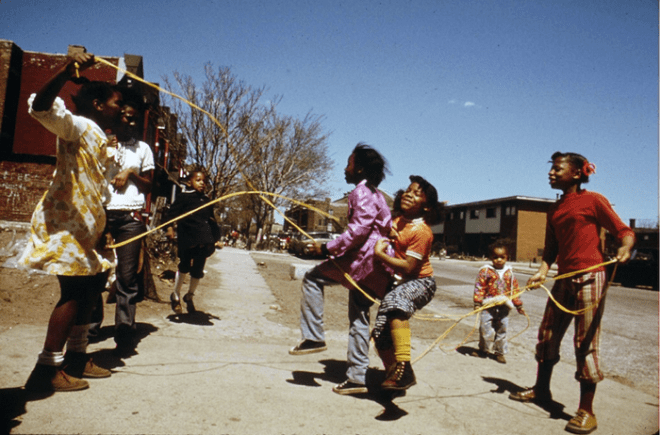
Black Children Play Outside The Ida B. Wells Homes, One Of Chicago's Oldest Housing Projects. There Are 1,652 Apartments Housing 5,920 Persons In 124 Buildings On The South Side, 05/1973

Black Children Play Outside The Ida B. Wells Homes, One Of Chicago’s Oldest Housing Projects. There Are 1,652 Apartments Housing 5,920 Persons In 124 Buildings On The South Side, 05/1973

John H. White was laid off this week. He is a photographer, or, more specifically, an out-of-work photojournalist.

He was replaced by an iPhone.

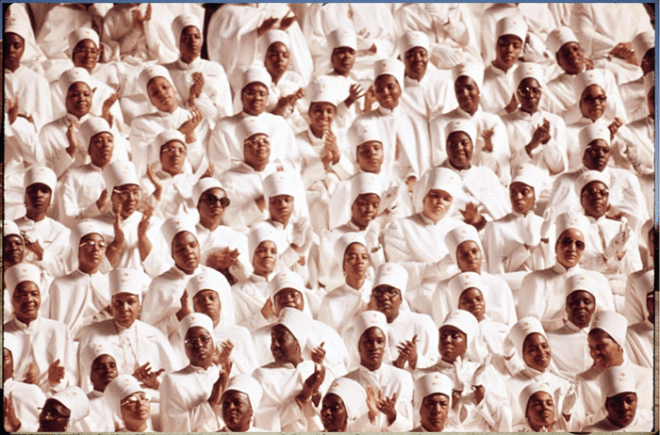
Black Muslim Women Dressed In White Applaud Elijah Muhammad During The Delivery Of His Annual Savior's Day Message In Chicago, 03/1974

Black Muslim Women Dressed In White Applaud Elijah Muhammad During The Delivery Of His Annual Savior’s Day Message In Chicago, 03/1974

As a much-deserved tribute to Mr. White, Chicago Magazine put together an online portfolio. The two images you see here are my favorite images; click on either one of them to see a portfolio of fifty superb examples of the extraordinary journalism that can be achieved by a skillful photojournalist.  The presentation of White’s work for the EPA is not as well-presented, but this site is also worth a visit.

Before moving on to the sharp point of this article, a word about the poetry of John H. White’s work. Consider the exquisite rhythm of both images, the special timing that allows the jump rope to wiggle and wave, the exquisite visual judgement Mr. White employed when filling his frame with Muslim women all in white. The sunny smile of the girl in orange and the placement of the innocent child in the background. This is photography at a high level; it is exceedingly difficult for most people, even serious amateur photographers with decades of experience, to achieve these results with the best possible equipment. (Imagine trying to achieve these results with an iPhone.)

The Chicago Sun-Times is one of America’s largest newspapers. Somehow, the management of the paper stumbled into what must have seemed like a wonderful idea at the time: teach the reporters to use an iPhone, and fire all of the photojournalists (including Mr. White). There’s been a lot of online chatter about the “difficult decision” and “the future,” but I have placed both phrases in quotation marks because both concepts are so insanely wrong-headed.

In today’s image-is-everything society, I suppose I could construct an equally compelling case for firing all of the writers on the staff of the paper, instead filling every page with photographs. Or, perhaps, establish some clever version of crowd sourcing, in which Chicago takes pictures of itself every day, and then, everyone posts captions (the most popular caption wins the top spot).

Certainly, there is a problem in the newspaper business: most papers have lost their business models, and much of their readership. And they have experienced a terrible cost-cutting decade (and more).

Firing the photojournalists may be a fine example of executive leadership discussions gone astray, but there is a larger problem here. The Chicago Sun-Times, and many other papers, aren’t sure how they should face the uncertain future. There are some answers, and, well, I sure hope the management of the Chicago Sun-Times (at one time, the largest of the 100 newspapers where my newspaper column appeared weekly), will consider them:

1. The Chicago Sun-Times is a very strong local brand. Even in a “newspaper town” like Chicago, the future of the “paper” is online.

2. Online, regardless of the platform, it’s all about multimedia: pictures, videos, infographics. Good writing matters, but anything longer than 1,000 words is too long for current use of the medium.

3. Investment in superior multimedia storytelling is the way to go. If the story makes use of video, some writing, lots of pictures, some audio, and powerful graphics, people respond.

4. If people respond, advertisers respond.

5. Focus on the best possible storytelling. Double down your previous investment in visual storytelling. Invest in more photojournalists, and teach them to become videographers if they’re willing and able. By all means, teach every writer how to shoot still images and video with their iPhones (or, go really crazy and invest in a high-quality pocketable digital camera for each of them–for far better results). Figure out how to get the crowd source journalism operating at its highest possible level, for that, too is the future.

I will steer clear of recommending that the executives who concocted this insane plan may find budget cuts in their own roles at the company, but only on the condition that they focus (a word that photographers often use, and for good reason) on the future of journalism so that the next budget cycle doesn’t require firing all of their writers.

Chi-Trib-Story

To read the Chicago Tribune story and watch the video, click on the image.

Welcome to the Connectome

Diffusion spectrum image shows brain wiring in a healthy human adult. The thread-like structures are nerve bundles, each containing hundreds of thousands of nerve fibers. Source: Source: Van J. Wedeen, M.D., MGH/Harvard U. To learn more about the government's new connectome project, click on the brain.

Diffusion spectrum image shows brain wiring in a healthy human adult. The thread-like structures are nerve bundles, each containing hundreds of thousands of nerve fibers.
Source: Source: Van J. Wedeen, M.D., MGH/Harvard U. To learn more about the government’s new connectome project, click on the brain.

You may recall recent coverage of a major White House initiative: mapping the brain. In that statement, there is ambiguity. Do we mean the brain as a body part, or do we mean the brain as the place where the mind resides? Mapping the genome–the sequence of the four types of molecules (nucleotides) that compose your DNA–is so far along that it will soon be possible, for a very reasonable price, to purchase your personal genome pattern.

A connectome is, in the words of the brilliantly clear writer and MIT scientist, Sebastian Seung, is: “the totality of connections between the neurons in [your] nervous system.” Of course, “unlike your genome, which is fixed from the moment of conception, your connectome changes throughout your life. Neurons adjust…their connections (to one another) by strengthening or weakening them. Neurons reconnect by creating and eliminating synapses, and they rewire by growing and retracting branches. Finally, entirely new neurons are created and existing ones are eliminated, through regeneration.”

In other words, the key to who we are is not located in the genome, but instead, in the connections between our brain cells–and those connections are changing all the time.The brain, and, by extension, the mind, is dynamic, constantly evolving based upon both personal need and stimuli.

Connectome BookWith his new book, the author proposes a new field of science for the study of the connectome, the ways in which the brain behaves, and the ways in which we might change the way it behaves in new ways. It isn’t every day that I read a book in which the author proposes a new field of scientific endeavor, and, to be honest, it isn’t every day that I read a book about anything that draws me back into reading even when my eyes (and mind) are too tired to continue. “Connectome” is one of those books that is so provocative, so inherently interesting, so well-written, that I’ve now recommended it to a great many people (and now, to you as well).

Seung is at his best when exploring the space between brain and mind, the overlap between how the brain works and how thinking is made possible. For example, he describes how the idea of Jennifer Aniston, a job that is done not by one neuron, but by a group of them, each recognizing a specific aspect of what makes Jennifer Jennifer. Blue eyes. Blonde hair. Angular chin. Add enough details and the descriptors point to one specific person. The neurons put the puzzle together and trigger a response in the brain (and the mind). What’s more, you need not see Jennifer Aniston. You need only think about her and the neurons respond. And the connection between these various neurons is strengthened, ready for the next Jennifer thought. The more you think about Jennifer Aniston, the more you think about Jennifer Aniston.

From here, it’s a reasonable jump to the question of memory. As Seung describes the process, it’s a matter of strong neural connections becoming even stronger through additional associations (Jennifer and Brad Pitt, for example), repetition (in all of those tabloids?), and ordering (memory is aided by placing, for example, the letters of the alphabet in order). No big revelations here–that’s how we all thought it worked–but Seung describes the ways in which scientists can now measure the relative power (the “spike”) of the strongest impulses. Much of this comes down to the image resolution finally available to long-suffering scientists who had the theories but not the tools necessary for confirmation or further exploration.

Next stop: learning. Here, Seung focuses on the random impulses first experienced by the neurons, and then, through a combination of repetition of patterns (for example), a bird song emerges. Not quickly, nor easily, but as a result of (in the case of the male zebra finches he describes in an elaborate example) of tens of thousands of attempts, the song emerges and can then be repeated because the neurons are, in essence, properly aligned. Human learning has its rote components, too, but our need for complexity is greater, and so, the connectome and its network of connections is far more sophisticated, and measured in far greater quantities, than those of a zebra finch. In both cases, the concept of a chain of neural responses is the key.

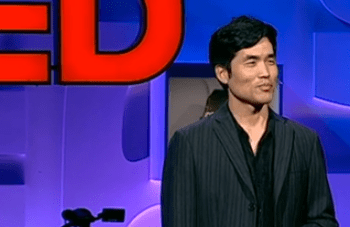
Watch the author deliver his 2010 TED Talk.

Watch the author deliver his 2010 TED Talk.

From here, the book becomes more appealing, perhaps, to fans of certain science fiction genres. Seung becomes fascinated with the implications of cryonics, or the freezing of a brain for later use. Here, he covers some of the territory familiar from Ray Kurzweil’s “How to Create a Mind” (recently, a topic of an article here). The topic of fascination: 0nce we understand the brain and its electrical patterns, is it possible to save those patterns of impulses in some digital device for subsequent sharing and/or retrieval? I found myself less taken with this theoretical exploration than the heart and soul of, well, the brain and mind that Seung explains so well. Still, this is what we’re all wondering: at what point does human brain power and computing brain power converge? And when they do, how much control will we (as opposed to, say Amazon or Google) exert over the future of what we think, what’s important enough to save, and what we hope to accomplish.

Make Good Art!

Wonderful, level-headed speech to graduating students at Philadelphia’s University of Arts by writer Neil Gaiman. You may not know his name, but you know his work: Coraline, comic books,graphic novels (Sandman series) short fiction, books, here an episode of Dr. Who, there a Simpsons episode, the list is long. At age 15, he made a list of what he wanted to do, then got started, and apparently, never stopped.  He discusses the sense of fraud that successful creative professionals experience; the nonsense about creative people wearing a tie and going to an office every morning, the importance of learning to say “no”. He reset his balance between writing for a living and spending a lot of time writing emails by responding to each one. He encourages creators to take chances and make mistakes; you acknowledges that the ultimate life saver is the secret that creative people share that others do not: we have the ability to make art.

It’s a terrific video, and well worth twenty minutes (or so) of your time.

His response to things going awry, as they will: “Make good art!”

The one thing that you have that nobody else has: “You!” (Your ideas, etc.)

The moment that you believe that you’re walking down the street naked, that you’re showing too much, that’s the moment . But you’ll have no idea. And what would be the fun in making something that you know is going to work? (Gee, he’s smart!)