Bend Me, Shape Me, See Right Through Me

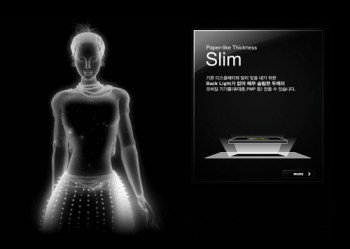
This falls into the category of “totally amazing stuff.” You’re looking at one of several Samsung screens that will probably be available sometime in 2012. Yes, that’s a cell phone. Apparently, Samsung (which is turning itself into an awesome company on the display side, BTW) is working with Nokia to bring this concept to life, and to market, and to change everybody’s notions of what a phone, and a display, can be.

Initially, Samsung’s new screens will be introduced in Nokia phones.  Soon after, there will be tablets that are not only flexible, but see-through. Imagine looking through a map, with interactive directions, and directly in front of you at the same time. (Certainly, there will be heads-up displays used in automobiles for just that purpose, but maybe that comes a bit later on.)

The technology is called “flexible AMOLED.”

Interesting? This is just one of many mind-blowing moments in Samsung’s (Japanese-language) video. And, if you want more insight, check out this article in the London Daily Mail.

Even more interesting a thoroughly conceptual video from Samsung which illuminates the company’s view of their future. (It may take a moment to load.)
Apple TV in 2012?

Here's one of several pictures of the current Apple TV interface. For more, visit http://www.apple.com/appletv/

Apple has been experimenting with home television since 2006, when the company introduced Apple TV. Released last year, second generation Apple TV has sold over 2 million units. Apple TV is an accessory. The new product will be a complete solution: a TV set with an Apple logo, Apple software, and Apple’s reinvention of yet another product category.

For those unfamiliar with Apple TV, here’s the Apple blurb:

“With Apple TV, everything you want to watch — movies, TV shows, photo slideshows, and more — plays wirelessly on your widescreen TV. No managing storage. No syncing to your iTunes library. HD movies and TV shows from iTunes and Netflix play over the Internet on your HDTV, and music and photos stream from your computer. All you have to do is click and watch.”

According to Smarthouse, there will be three Apple models: 32″, a mid-size, and 55″. It will include “A totally new software interface has been written that allows users to call up programs using voice commands via the new Siri personal assistant app…” It may be operated by your existing iPad or iPhone (provided it’s Siri-ous).

Add Apple’s FaceTime and the TV becomes a big-screen video conferencing center, fully compatible with millions of iPhones and iPads.

How might the new TV look? The first place that answers come together tends to be MacRumors, my favorite Mac site for its up-to-the-minute coverage, its willingness to republish rumors from reliable sources (often with smart commentary), and the site’s Buyer’s Guide, which tells consumers when to buy each Mac and Apple portable device.

How much will it cost? I’m guessing $1,199 for the low-priced model, and $1,99 for the high, with a $1,499 price point for the in-between model. Just a guess based upon Apple’s past practices. If I was in charge of television at Sony, or any other high-priced television manufacturer, I would be very, very concerned. And I would not bother to convince myself that, somehow, DroidTV (or whatever) is likely to win the race.

Why?

1. With the iPad turning three years old, Apple’s huge base of early adopters will be ready for a new, high-priced toy.

2. For a decade, Apple has been studying this market, figuring out the best integrated hardware, network, usability, operating system and app plays.

3. Apple already sells an accessory product with the base functionality already in place and operating in two million homes (three or four million by launch time).

4. Apple has a well-developed retail network–people like to see a TV before buying. Best Buy, Radio Shack, and Target sell Apple products.

No competitor enjoys these advantages.

Why Buy a Camcorder?

On my iPhone, I can shoot video. I can edit, too. I can shoot video on my camcorder, but I can’t edit (not easily, anyway). And that got me to thinking about just what I might want or need in a standalone video recording device.

Although you can find camcorders that record onto videotape or DVD, the standard recording format is now the SD card–the same type of card used in most digital cameras, but with far more available storage capacity.

Less than $200 buys a pocketable video camera and recorder, similar in design to the Flip camera that was popular a few years ago. JVC sells about eight different models, all quite similar to the Flip cameras and to one another. All shoot HD-quality movies, 5MP still images, and easily transfer creative work to a nearby computer via USB connection. The GC-WP10A is especially appealing because it’s waterproof, records time lapse, includes face detection, a 3-inch touch screen, and an image stabilizer to reduce shaky videography (which is a common problem with small hand-held cameras). Compare it with JVC’s GC-FM1BUS, which shoots 8MP still images and offers an HDMI output to digital TV screens, but lacks face detection. Spend fifty dollars less, and you’ll save money but sacrifice some features. If not JVC, you will find similar products from Kodak, Samsung, and lots of other companies. In this price range, there will not a tremendous difference in features or reliability.

If you’re heading in this direction, be sure to check out the Zoom Q3--made by a company now well-known for high-quality portable audio recorders (which I will write about in a future blog post). I really like the design of the Q3–and its emphasis on audio recording.

Beginning around $250, you can buy a digital camcorder with a long zoom len

s, image stabilization, and adequate low-light shooting capability in a package that easily fits into your jacket pocket. Try, for example, Panasonic’s HDC-SD80R, which sells for less than $300, with a 32x zoom lens (that is, if you are 32 feet away, you will appear to be just 1 foot away from the camera). If you visit Panasonic’s camcorder website, you w

ill find 23 similar Panasonic models with prices as low as about $200 and as high as $1,000+. What’s the difference? The HDC-TM900K sells for about $900, and includes three image sensors, which means superior image quality, manual control over exposure and focus (with manual control, more professional results are possible, but these require skill, practice and patience). The lens is better, too. Is one camera worth $600 more than another? If you’re shooting video for YouTube, the answer is probably “no” (though the manual controls would be useful). If you’re shooting video to be seen on a 50-inch HD monitor, the answer is “yes.”

For a few hundred dollars more, you can buy similar camcorders with interchangeable lenses.

But wait! That’s just the beginning!!

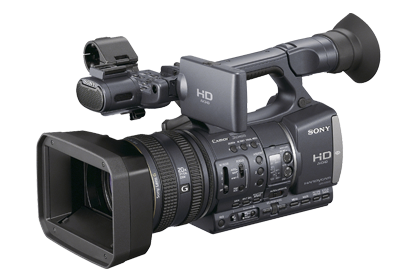
For professional quality results, plan to spend about $2,000 for a model similar to Sony’s HDR-FX7. The big difference between these lower-priced pro models and lesser lights is three-fold: image quality, technical capabilities, and creative control.

Image quality is easy to understand, and easy to see. The sensor and the associated image processing technology is superior to lower-priced models, and so is the lens. The viewfinder offers more detail, better contrast, more accurate color, and more detailed information about camera settings. The lens is, roughly, a 20x optical zoom. The zoom controls are smooth, and can be handled with nuance.

Jump to the $3,500 model HDR-AX2000 for professional XLR microphone connectors, even better image sensing and processing, and vastly improved low-light shooting. You could shoot a television series for a cable network with this camera. In fact, many professional production companies now use these cameras–and others like it–for just that purpose.

Look for a post about dual system audio recording in the near future.

So: which camcorder is right for you?

If you shoot a few minutes of video from time to time, and post your output on the web, then you may be able to use your smartphone.

If you shoot some videos, and some still pictures, and you really don’t need high quality audio, or even a microphone for the occasional interview, then you can use a recent vintage digital still camera. If yours is more than 2-3 years old, it may be time for an update if you want to shoot video.

If you are serious about still photography and videography, then you should consider a digital SLR, with its long zoom lens and substantial body size. Although most digital SLR bodies include a built-in stereo microphone, your work will be better if you attach a stereo microphone, or shoot “double system” with an entirely separate audio recorder (the topic of a future blog post).

In fact, it makes more sense to invest in a digital SLR than a standalone camcorder in the $300-$1,000 range. These are useful if you shoot a lot of video–but you can do the same, with greater flexibility–with a digital SLR.

If you serious about videography, then a serious prosumer or low-range professional camcorder is the appropriate choice. Most people who use these cameras devote considerable time to video editing–the camera alone isn’t going to make anyone a star. Fortunately, video editing software is now widely available at reasonable prices. Unfortunately, professional quality video editing requires a lot of time and careful work.

With any of these HD camcorders, the work can be stunning. For the best results, professionals rely on quality lenses, sensors, image processing and microphones.

Meet Boxie


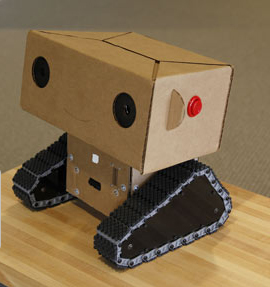
Boxie is a friendly little robot who lives and works at MIT Media Lab. He’s a busy little guy, and his story may change your perceptions of robots in our future.

Boxie Labcast

The Incomplete Turkey

No big surprise here: the number of viewers has remained constant for the past twenty years. Between 25 and 30 million people watch Macy’s Parade each year. Since there are just short of 300 million Americans, 1 in 10 Americans watches the Parade–9 out of 10 do not. This is a Great American Tradition, so I figured the numbers would be much higher. By comparison, last year’s Super Bowl (XLV) was the highest rated of all time–with 111 million viewers–more than 1 in 3 Americans.

For the whole Nielsen story, click here.

But wait! — Thats’ not the whole story! The oldest turkey feather in Nielsen’s graphic was 1991. What happened before 1991?

Turns out, the first parade coverage dates back to 1939, but that was experimental coverage by a then-experimental medium. In 1955, NBC started covering the parade (Nielsen’s turkey is missing 31 feathers, plus 2011).

I will contact Nielsen to solve the mystery of the missing feathers. Meantime, have a look at the small orange type just below Nielsen’s title (“Sum of Networks [NBC & CBS]…”) Turns out, the parade is a public event, so NBC’s rights have never been exclusive. CBS covers the parade without paying for rights. Over on ABC, there’s the Philadelphia parade, which has been on the air, locally, since 1966–it is also broadcast nationally, and claims bragging rights to the whole idea. It was Gimbels that invented the Thanksgiving Parade in 1920–before Macy’s glommed onto the idea four years later.

Siri, meet the family

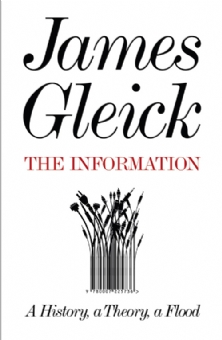
The UK cover is more interesting than the US cover, which is, somewhat appropriately, covered with the repeated words "The Information."

James Gleick nearly won a Pulitzer Prize for a biography about Isaac Newton, and another about Richard Feynmann, a colorful physicist who pioneered nanotechnology and quantum mechanics. His best selling book (more than a million copies sold) is the step-by-step, scientist-by-scientist, idea-by idea story of chaos theory entitled Chaos: Making a New Science.

Gleick’s 2011 book is called The Information. it begins with the European discovery of African talking drums in the 1840s, a percussive idea he eventually connects to Samuel Morse’s dots-and-dashes telegraph code, and, we’re off on a long tale not unlike the best of James Burke’s TV series, Connections. Gleick takes us through the development of letters and alphabets, numbers and mathematics, numerical tables and algorithms, dictionaries and encyclopedias. These stories, and their many tangents, set us up for Charles Babbage whose boredom with the Cambridge curriculum in mathematics leads to an early, impossible-to-build, 25,000 piece machine, awesome in its analog, mechanical, Victorian design. This, then, leads to the further develop of the telegraph, now caught up in a new conception called a “network” that connected much of France, for example.

By the early 20th century, MIT becomes one of several institutions concerned with the training of electrical engineers–then, a new discipline–and with it, machinery to solve second-order differential equations (“rates of change within rates of change: from position to velocity to acceleration”). This, plus the logic associated with relay switches in telegraph networks, provides MIT graduate student Claude Shannon with his thesis idea: connecting electricity with logical interactions in a network. Shannon’s path leads to Bell Labs, where he works on the “transmission of intelligence.” By 1936, a 22-year old Cambridge graduate named Alan Turing had begun thinking about a machine that could compute.

Well, that’s about half the book. Now, things become more complex, harder to follow, dull for all but the most interested reader. The interweaving connects DNA and memes (and, inevitably, memetics, which is the study of memes), cybernetics and randomness, quantification of information, and Jorge Luis Borges’ 1941 conception of an ultimate library with “all books, in all languages, books of apology and prophecy, the gospel and commentary on that gospel, and commentary upon the commentary upon the gospel…”

Eventually we obsolete CD-ROMs (too much information, too little space), and create Wikipedia and the whole of the Internet. In the global googleplex, the term “information overload” becomes inadequate. And yet, Gleick promises, it is not the quantity that matters, it is the meaning that matters. After 420 pages of historical text, I’m still wondering what it all means–and whether the purpose is mere conveyance as opposed to deeper meaning or its hopeful result, understanding.

Bagging It

This was the year I bought an iPad and my wife bought a Kindle. Then, we went shopping, each of us in search of a slim, durable, protective case. Function matters more than fashion. Each device would require a snug fit. I needed something weather-resistant because I planned to carry the iPad to meetings, with or without an outer bag or case. To save on shipping, we tried to find one company to serve our needs.

After visiting a handful of retail stores, we visited a dozen websites. We found a great little company called SF Bags. We were impressed by Gary, the owner, who appeared in videos to explain each of his products. There were eight entirely unique iPad solutions, and the same number of Kindle solutions. Mostly, they were the same designs, each customized for the iPad, Kindle, the 11-inch Mac Air, the 13-inch Mac Air, and a lot of other portable devices, including videogames and digital cameras.

For her Kindle, my wife decided upon the red Slip Case for Kindle; there were five other color options. It cost $27.

I chose the Ultimate Sleeve Case for iPad2 in the vertical format (horizontal is pictured) with checkered “lead iridium” ($55) instead of brown leather trim ($60). I was smart enough to order it with small d-rungs, but not smart enough to order the Suspension Strap Mini ($22) or the Vertical Mini-Pouch ($25) first time around. now, use the three items together, in place of a backpack or shoulder bag, as a slim kit for iPad2, wallet, iPhone, earpiece, keys and a small pad and pen.

I also picked up a protective case for my wireless Bluetooth keyboard.

SF Bags offers a remarkable selection of well-designed, well-made solutions for lots of portable products. Their designs include well-thought-out features like slash pockets in just the right places, small inside pockets that snuggly protect iPhones and other devices, and other features that speak to the intelligence of their planning and product development. SF Bags seems to be meticulous In its manufacturing and quality control. (Isn’t it great when a small company exceeds expectations?)

My wife is happy with her Kindle slip case. I bought my iPad kit for function, but often find myself answering questions about where I found my bag. Now, you know.

Here's the horizontal bag with the mini-pouch attached. The inside of the pouch is lined with soft neoprene.

Yikes!

Picture from Bureau of Labor Statistics job outlook for teachers. Their caption: "Teachers play an important role in fostering the intellectual and social development of children." http://www.bls.gov/oco/ocos318.htm

The next industry that could be decimated by technology: teaching.

Will Richardson thinks, writes and teaches others about the use of technology in education. In this blog posting, Will responds to a rosy Wall Street Journal article about the online learning business.

The ‘yikes’ part: “In Idaho, Alan Dunn, superintendent of the Sugar-Salem School District, says that he may cut entire departments and outsource their courses to online providers. “It’s not ideal,” he says. “But Idaho is in a budget crisis, and this is a creative solution.”

Please read Will’s post.

FOLLOWUP: When I spoke with my father about Will’s post, he told me an interesting story about two of his teachers. I suggested that he write the story as a brief essay, and submit it to Will. He did, and Will published it.

Extremely Long Player

1980s: I’m buying lots of LPs.

1990s: I’m buying lots of CDs.

2000s: I’m downloading lots of music files.

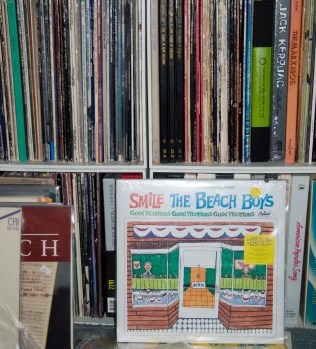
2010s: I’m buying lots of LPs.

What’s going on? As record companies contemplate the end of CD production, LPs are gaining popularity. TIME magazine caught the trend early, but failed to mention activity in vast used LP stores (separate blog post, in the works).

For newcomers, or those whose memory was fogged by digital d-rays, here’s what you need to know…

You need a turntable, a tone arm, a cartridge, a stylus, some cables, a phono per-amp, an amplifier, more cables, and loudspeakers. Back in the day, all of this stuff was combined in a “record player.”

Here in 2011-12, it’s more complicated–and that’s without the USB connection to your computer.

One popular, convenient choice is Audio-Technica’s PL-120, available for about $300. It includes everything you need except the amp and speakers. And, you can connect it to your computer to create digital versions of your LPs.

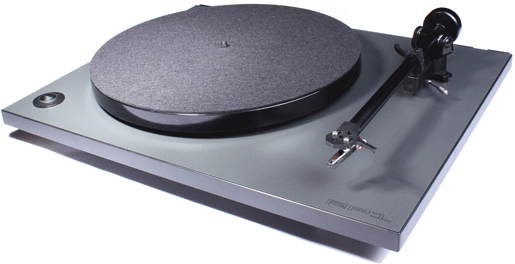
Rega's RP1 Turntable, an audiophile choice.

If you’re willing to invest more money for better sound, the audiophile choice is Rega’s RP-1, which includes a superior tone arm, a better drive system (to spin the platter) and other features that contribute to a cleaner, more focused presentation. The cartridge (which typically includes the stylus) is an accessory–each cartridge design possesses unique sonic characteristics–is a separate purchase. Rega’s RP1 accessory kit costs an additional $200, and includes Rega’s Bias 2 cartridge and several useful accessories.

Audio-Technica's all-in-one, lower-priced USB turntable.

Better would be another favorite cartridge, Audio-Technica’s ML-440. With turntable, tone arm and cartridge in place, you need a phono preamp. At about $150, one good choice is Music Hall’s PA 1.2. I leave the choice of amplifier and loudspeakers to you–the old system stored in your basement or found in a good used stereo shop will be just fine. Audiogon.com is an online store specializing in audiophile equipment, but a local dealer may provide both friendly advice and a place to listen before you buy.

How about a used turntable? Maybe from a reliable high-end dealer, but not from some random eBay source. Used cartridge? I wouldn’t do that. Instead, I would opt for the all-in-one Audio-Technica PL-120. But first, learn from:

Jerry Raskin’s Needle Doctor, which sells all sorts of cool stuff, not just needles!

Audio Advisor

Music Direct

1 in 25 Work as Creative Pros

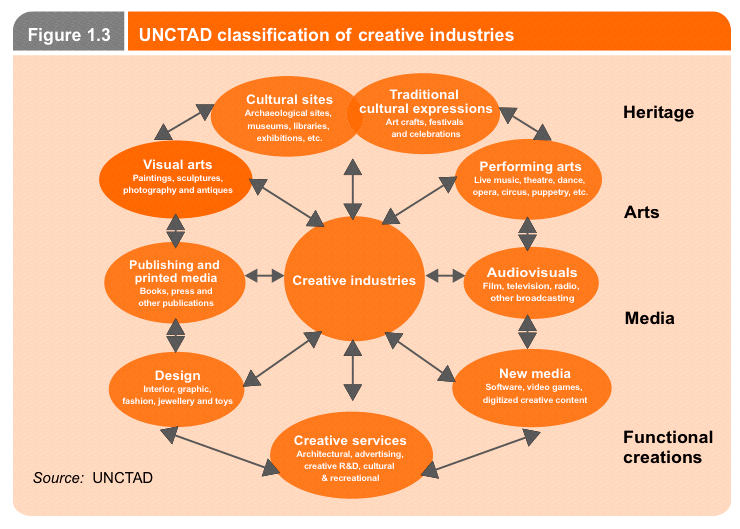
Above, an elegant way to think about the global creative economy, as presented in a 400+ page United Nations report.

1 in 25 people–that’s the revised figure for 2010–work in creative industries in the U.S. More than doctors, lawyers, even accountants. Industry sectors above, details below.

In the United States, roughly 150 million people work full-time. Six million of us work in creative professions. We’re writers and performers; musicians and visual artists; marketers and strategists; architects and specialists who invent, improve, or bring ideas to life. In total, more people work as creative professionals in the U.S. than doctors (700,000), lawyers (800,000), accountants (1,300,000), and engineers (1,600,000) combined. The number of creative professionals exceeds the number of teachers (3,500,000 teachers pre-K through high school, plus 1,700,000 more who teach in colleges and universities).

Our output–which provides employment for lawyers, accountants, executives, retailers, and many others–is responsible for more than ten percent of the U.S. Gross Domestic Product.

A reasonable global workforce estimate would exceed 10 million creative professionals. Nations with significant creative economies include Germany, the United Kingdom, France, Italy, the Netherlands, Ireland, Japan, China, India, Canada, Australia, and, among countries with developing industries, Mexico, Thailand, Indonesia, Argentina, Singapore, and Chile. According to the United Nations Creative Economy 2008 report, the export value of creative in 2005 was over $300 billion, or about 2-3% of the global economy. (Yes, I am reviewing the 423 pages of the 2010 report to update these figures–overall, trends are up).

The long list of creative industries was nicely summarized in the 2008 U.N. report, presented at a United Nations Conference on Trade and Development. The orange version, above, makes it all that much more clear.

Within each of these clusters, the professional model is similar. Projects are developed, produced, and distributed. Mostly, revenues are generated through direct transactions with individual consumers (movie admissions; DVDs; iTunes downloads;physical goods such as jewelry), sometimes through subscriptions; or by advertising to consumers who receive goods and services by paying only a modest transaction fee (magazine subscriptions), or no fee at all (most internet sites; broadcast radio and TV).

You can download the 2010 UN report here. (Yes, I will update my 2008 numbers when time permits.)