My 500-Year-Old CD

Day by day, there’s not much that we encounter from the year 1611. Shakespeare was busy writing The Tempest. Henry Hudson died. Marco de Dominis published a scientific explanation of rainbows. A year later, tobacco was first planted in Virginia, and the Dutch started using Manhattan Island as a trading center.

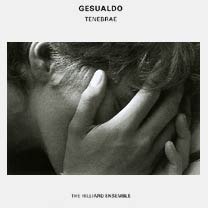
In 1611, Carlo Gesualdo wrote some of the most uplifting music for voices in the history of the medium, a book of madrigals. This creative work did not come easily. Count Gesualdo of Venoso’s story involves his instigation of the gang murder of his own wildly unfaithful wife (he plunged the sword into her body, and not just once, shouting, repeatedly, “she’s not dead yet!”), then moves through remarkable bouts with depression and abuse, including the dozen men to beat him daily (I’ll spare you details, but you can find them here and in lots of places on the internet). As crazy stories of composers lives go, he’s the hands-down winner. His story is deeply disturbing. His music is miraculous. Witness his captivating Tenebrae, one of the classic items from the formidable ECM catalog, first released in 1991, and consistently astonishing, a record I return to on a regular basis, a record that I recommend with little hesitation to any serious listener. And now, for 2012, witness the same Hilliard Ensemble treating five hundred year old music as if it was contemporary art. The newer disc is called Quinto Libre di Madrigali, and it is fascinating. The title and notes explain: this is the fifth of six books of madrigals, this one created late in the composer’s life. From the liner notes: “The whole collection constitutes a gallery of dramatically lit portraits of human emotions with a heavy emphasis on the extremes of joy and despair.”
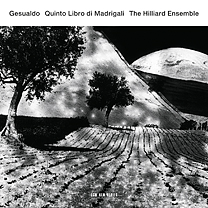
There are six voices: a soprano, a pair of countertenors, a pair of tenors, and a baritone. (Soprano Monika Mauch and second countertenor David Gould frequently sing with the four-man Hilliard Ensemble; on this recording, Mauch is stunning.) All six singers sound like angels, and if you close your eyes, it’s easy to imagine these voices climbing up a heavenly spire in search of their lord. They sing in unison, they sing in pairs, they sing in harmony, they sing alone. They climb. They intertwine. They rest and they bounce. They exchange leads almost as if they contain the souls of jazz musicians to come. In musical terms, Gesualdo’s music is often described as “deeply chromatic”–a madman coloring with the brightest possible pigments and an extraordinary level of precision, probably based upon some sort of serious mental illness that caused his creative light to burn just a little too brightly. Two years after he composed these madrigals, he was dead.

Gesualdo’s work is not background music. It is music that captures the imagination, and elevates the spirit in a primal, deeply human way. There are no musical instruments, only voices, and open space.

This is not the best choice of music to play through computer speakers. ECM sets high standards for each of its recording projects, and this one, in particular, demonstrates the care that must be taken in order to record a wide range of vocal performances. The precision, the soaring thrusts, the extraordinary quiet passages, the contemplative quality of the whole, all of this has been meticulously prepared for your enjoyment. Listening through inferior equipment is like trying to contemplate the Mona Lisa by looking at a postage stamp. Best to listen through quality headphones, or on a good stereo system. The CD sounds a whole lot better than a computer file with reduced clarity and range. Trust me on this one: buy the CD, and allow yourself the time and space to listen with your whole being.

The Hilliard Ensemble, plus two additional vocalists. If you’re intrigued, be sure to explore the ensemble’s work with composer Arvo Pärt as well.

Learning from Woody

On July 12, 2012, Woody Guthrie would have been 100 years old. This poster commemorates a life well-lived, and a voice that has never rested. You can support the Woody Guthrie Foundation if you buy this poster. You can learn a lot from Woody. I did, as explained below.

“Hey kids, want to sing a song? Some of you might know this song, but the words can be hard to remember. Here’s a sheet with the lyrics…”

This land is your land, this land is my land

From California to the New York Island

From the Redwood Forest to the Gulf Stream waters

This land was made for you and me.

Singing “This Land Is Your Land” as a group exercise begins an exploration of surprising dimensions. Note how broad, deep and wide Woody Guthrie’s river of highway manages to travel.

Just as most people’s knowledge of Martin Luther King begins and ends with an “I Have a Dream” speech and a murder in Memphis, most people’s knowledge of Woody Guthrie begins and ends with one popular song. Turns out, there was a lot more to Woody, and, a lot more to this particular song. Here’s a lyric that you might not have heard Woody sing:

 There was a big high wall there that tried to stop me;

Sign was painted, it said private property.

But on the back side it didn’t say nothing;

That side was made for you and me.

Woody sang this song (and many of his songs) with different verses (see note 1 below). Among folk singers, and storytellers, this remains common practice (also, among jazz musicians, but rarely among the commercial performers whose recordings are usually the definitive versions of their songs). In fact, Woody’s own life story can be difficult to follow because he often recalled his own life as a storyteller might– with different details depending upon his audience.

As I think about Woody Guthrie, and about how people learn, I envision a different kind of education than most people find at school, an education based upon individual learning and ideas that connect with one another, and with the heart and soul. I think that’s a better way to learn, or, at least, i think that’s the way I learn.

Turns out, Woody’s full name was Woodrow Wilson Guthrie, and he was named for a presidential candidate, then president of Princeton University. By age 14, Woody was living pretty much on his own in his hometown, Okemah, Oklahoma; his mother had been institutionalized with the Huntington’s Disease that would later take her life, and his father was living in Texas (see note 2 below). Woody becomes a street musician, then leaves for promise of California, one more Okie whose life was shaped by the Dust Bowl tragedy. In Los Angeles, he sang hillbilly music on the radio as part of a duo, but spent lots of his spare time thinking about, and writing about, working class people who could not find work. Woody wrote protest songs, and, for a few months, wrote for a Communist newspaper (though he was never a member of the Party).

Learning about Woody in the 1930s leads the interested student (me, among them) into the plight of real people during the Depression; ways in which creative people somehow earn a living; why creative people sometimes find traditional work difficult to do; the importance of unions for the working man; the story of the Grand Coulee Dam and the Columbia River; socialism and communal living; the blacklists of the early 1950s; life in a singing group; writing an autobiography; the usefulness of cartooning (Woody drew cartoons); the work of the Library of Congress in preserving the nation’s heritage; the slow demise of Coney Island and Brooklyn in the 1940s; deportation of immigrants; the emergence of Bob Dylan and 1960s folk singers in Greenwich Village; the life of Leadbelly, an ex-convict (doing time for murder) who sang his way out of lifetime in prison to become a popular folksinger (he was Woody’s friend; “Goodnight Irene” was one of his songs); Sacco & Vanzetti and questions regarding fair trials; the concept of an artist’s legacy; a son carrying on his father’s work and then finding his own way as an artist and a man; a granddaughter finding her way through the music industry, too.

Clearly, Woody’s music and Woody’s story appeals to me. In writing these two pages, I’ve learned a lot, and I’m certain that I will follow up. That’s how I learn. I wonder whether most people learn this way. I suspect they do.

Notes:

1 – An interesting question for aspiring musicians: when is a song “finished?” Is a song a continuing work of art that should be malleable, or is it final at the time it is recorded. This conversation quickly leads to another about copyrights and how they work: which version of the song would be protected by copyright, and why?

2 – Later, Woody Guthrie would die from the same hereditary disease. This leads the student to a study of genetics, family trees and genealogy, and diseases of the nervous system. George Huntington’s 1872 discovery of the disease is an interesting story about how diseases are identified, and how medical research has evolved. Back further, one theory of the “witches” burned in 1672 in Salem, Massachusetts connects the women involved with symptoms associated with Huntington’s disease. Playwright Arthur Miller told this Salem story differently when he wrote his play, The Crucible, to get people to think more critically about anti-Communist campaign waged by the dubious Senator Joseph McCarthy.

3 – Further encouragement: I’m not the first to see the value of Woody Guthrie’s life and art as a platform for further learning in a many related areas of knowledge. Guthrie curriculum materials can be found here.

“Absolutely, extraordinarily bad”

That’s how innerfidelity.com editor-in-chief Tyll Hertsens described the sound quality of  Beats by Dr. Dre headphones on the front page of this morning’s NY Times Business section (link below).

Yeah, they’re very heavy on the bass. And they’re best for music where bass drives the musical experience. And sometimes, if you listen loud, there’s distortion. On the other hand, Beats are fashion statement, and people wear them not only to listen, but to be seen listening.

Headphones as pictured (from the company website): $349. That’s a lot of money for a pair of headphones. Industry observers are impressed by the team of Dr. Dre and Monster Cable because they’ve opened a new market where price sensitivity matters less than lifestyle choices.

By comparison, a pair of AKG K240 Professional Studio Headphones cost $199.

If you have a pair of Beats, or manage to try a pair in a store, share your impressions.

http://beatsbydre.com/Default.aspx

http://www.nytimes.com/2011/11/20/business/beats-headphones-expand-dr-dres-business-world.html?partner=yahoofinance

http://www.innerfidelity.com/

Maria Bethânia – As Cancões Que Você Fez Pra Mim

Maria Bethânia is the sister of top Brazilian singer-songwriter Caetano Veloso. Born in 1946 in the interior region of Bahia, Brazil’s northeastern state, she’d planned to become an actress. In 1963, Bethânia and her brother moved to the nearby state capital city of Salvador, where she impressed audiences singing in a musical (written by her brother). Bethânia has been a professional singer ever since. While in Salvador, she and her brother became friendly with Gilberto Gil and Gal Costa, and the four led a significant cultural movement called Tropicálismo that changed Brazilian music and art. It was so radical that Veloso and Gil were exiled, but Bethânia and Costa kept the movement alive in Brazil. Bethânia is a dramatic singer whose versatility is matched by her desire to experiment with a wide variety of songs and genres, and a willingness to introduce works by up-and-coming songwriters.

This 1993 album was recorded twice. One version was recorded with Portugese lyrics (as above). The other, called Las Canciones Que Hiciste Para Mi (Philips 518-787), is in Spanish. Both are majestic. Each is a collection of 11 songs written by Roberto and Erasmo Carlos and sung with a small combo backed by an enormous string section (magnificently arranged by Graham Preskett). Bethânia’s powerful, dramatic interpretations are affecting on both the Portuguese and Spanish versions, but her passion breathes life into the Portuguese versions of “Fera Ferida,” “Palavras,” and “Eu Preciso de Você.” Analog recording, but sounds better than most digital discs.

Philips 518-214

Available only as an import, but worth the price: http://www.amazon.com/Cancoes-Que-Voce-Fez-Pra/dp/B0000015TF