A Forever Job

Tenure is a strange concept. Imagine — a job for life!

Not many professions support the idea of tenure. Outside of education, Federal judges work with a lifetime guarantee, as long as their behavior is “good” (a term that can be widely interpreted). Some clergy, and some research scientists may enjoy tenured positions, and some union workers, with especially strong contracts, may be assured lifetime employment, but the term tenure does not officially apply to them.

Mostly, tenure is used to describe the employment guarantee associated with teaching. K-12 teachers are afforded tenure, so even if their current compensation is lower than it might be in other professions, there is a assurance that it will go on for a very long time (and there is often an ample rest-of-life pension following that employment). Tenure is also associated with teaching at the college or university level, but the situation may not be simple, may be messy, and seems to be losing favor. This, according to Deepa Das Acevedo, a law associate professor at Emory University, and author of a new book entitled, The War on Tenure. It’s a world of work that’s largely unfamiliar to most people, except, perhaps when a professor’s private life is revealed in a movie or TV series.

Tenure applies to a very small portion of the overall population, but that doesn’t stop political campaigners from including the abolition or undermining of tenure in their speeches. When a scholar (assume all professors are scholars) works for a public university, they are, in fact, state employees. This may generate political conflicts — almost anything taught in a classroom these days may be deemed controversial and inappropriate by somebody — and that often affects stable employment.

Of course, it’s easy enough for any university to sweep away a current batch of pre-tenure or non-tenure employees with simple budget cuts, or in more difficult situations, through workplace pressure. This pressure can be strategically timed so that an individual scholar may believe they are on the path to tenure, only to find that state or board of governors or a third party has the power to erase the track completely. And then, of course, there is a question of academic integrity — at some point, many university scholars are required to make an ugly decision. Do they do what has been demanded and keep the pre-tenure or tenure job, or do they refuse, and place themselves on the job market with a vague black mark on their record?

There are lots of reasons why tenure may be denied, or pulled. These include academic misconduct (including plagiarism, which is now exceedingly difficult to sort out, given the growing role of AI), sexual misconduct (including, for example, well-founded or unfounded claims by students), or unprofessional conduct (such as bullying, which is often difficult to prove or disprove). When a university decides to shuffle departments, perhaps reorganize because their academic offerings require updating, tenure may disappear. Ditto for financial hard times for the institution.

So, tenure is not really a forever job. It may be better than most. Until it’s not. And when it’s not, a scholar with a fairly specific area of study may find themself difficult to place in another institution. That’s one reason why we have tenure in the first place — to support the many academic scholars whose fields of study are narrow but whose work is important. (But is all work important? How important?)

For the person seeking tenure, the path begins as an undergraduate. There is future value in selecting a program of study at a respected, sometimes specialized, institution. Often, this comes at a cost (and so, the debt begins to accumulate). Then, there’s graduate school, first for the master’s degree, then for the doctorate. Again, there is debt, and because these activities are so time-consuming, little opportunity to earn significant money in the process. So the debt becomes larger. There is a term for this situation: “PhD poverty.” Many institutions of higher learning operate food pantries. Hunger is a real issue. For those who come from low income poverty, “keeping mind and body together” is a real problem.

Then comes the post-doc phase: cheap labor for universities, and a necessary step if you want to become a professor. You may know post-docs by other names, such as fellows, lecturers, and visiting assistant professors.

The odds are lousy. Maybe 1 in 8 people make it to tenure track. As for the others — including the many who invest heavily, take on significant debt, and watch their dreams of an academic life go astray — there may be staff jobs at the university (that is, non-tenure track, and often, without the same prestige), or jobs in the larger marketplace (without tenure, and often not repaying the investment made by previously hopeful student).

Why should we care? Assume there are about 1.4 million college professors in the U.S., and about a third of them are tenured. Is that a lot? And why does this whole issue matter? Why write a book about tenure?

It matters because knowledge matters, because these people are the keepers of our knowledge, and they are the people who construct new knowledge, presumably with high standards in mind. Their work is different from other peoples’ work. They go deep. They think and construct models, then challenge one another’s models so everyone can think even more clearly. Their time horizons are different from other workers’ — they may take 10 or 20 years to work out what needs to be known, or done, and may work for lifetime, often with colleagues, to accomplish a very specific goal. Without institutional stability, and employment stability, this becomes very difficult to do. Why? In part because there aren’t many alternative ways to get this work done. Yes, it’s different. No, not every tenured scholar is producing essential knowledge. And no, it’s not a perfect system. But this is a situation where the perfect can easily become an enemy of the good. Although they are currently under attack, and always seem to be coping with the low hum of criticism, universities have a role, and scholars have a role, too. Which is why, in the end, we should be working to improve the system, and not tear it down.

Success! Good Health! Longevity! Fabulous Children!

You can do it! You’ll need a college degree and you’ll need to move to a place where 21st century America’s promise shines. Seattle, the SF Bay Area, New York City,

Boston, and the ring around Washington, DC.–those are the places where innovation is held in high esteem and is most likely to be funded so that new companies can be born, grow, and change the economic picture for employees, shareholders, and those smart enough to live nearby.

These are the places where venture capitalists fund big opportunities, and if a company seems promising, a VC will often require a move to, say, Silicon Valley, or not to fund the company at all. The “thickness” of the job opportunities in the Silicon Valley (and a very small number of other places), and the thickness of people with the necessary skills to suit those needs, not only attracts the best (and highest paid) people to these centers, where their high incomes tend to generate more jobs for the local economy (usually with salaries that are higher than even unskilled high school dropouts will find at home). If you’re an attorney, you’ll make as much as 30-40% more if you work in these areas than in an old rust belt city. The same is true for cab drivers and hair stylists.

Much has been made of Google’s employee perks; they won’t play in Hartford or Indianapolis, but neither of those places, nor most other American cities, see the kinds of financial results and spillover effects in the community enjoyed by the area around San Francisco. This is becoming the area that drives the American 21st century. And it’s very difficult for other cities to get into the game.

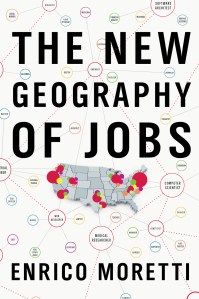
Author and UC Berkeley Professor Enrico Moretti has just published a book that presents a compelling picture of the much-changed US economy. The title of the book, The New Geography of Jobs, undersells the concept. Yes, if you can, you should move to any of these places, where you will make more money than you will at home–regardless of whether you are a high school dropout or a Ph.D. You will probably live longer, remain healthier, provide a better path for your children, live in a nicer home, have smarter friends, smoke less, drive a nicer car, you name it… the American dream lives large in San Diego, but in Detroit or Flint, Michigan, it’s gone and it’s not likely to return any time soon.

Average male lifespan in Fairfax, VA is 81 years. In nearby Baltimore, it’s just 66.

That’s a fifteen year difference. This statistic tracks with education attained, poverty level, divorce rates, voter turnout (and its cousin, political clout), lots more.

Want to remain employed? Graduate from college.

Nationwide unemployment rates: about 6-10% for high school only, 10-14% for incomplete high school, 3-4% for college graduates.

College degrees matter…far more than you might think. In Boston, with 47% of its population holding college degrees, for example, the average college graduate earns $75k and the average high school graduate earns $62,000. By comparison, Vineland NJ–just outside Philadelphia in South Jersey, has just 13% college graduates, and a college graduate earns an average of $58,000, with high school graduates at $38,000. Yes, it costs less to live in Vineland, but over a lifetime, people who live in Vineland are leaving hundreds of thousands of dollars on the table, perhaps as much as a half million dollars over a lifetime.

Real cost of college, including sacrificed employment: $102,000. At age fifty, average college graduate earns $80,000, but average high school graduate earns $30,000.

If a 17-year old goes to college, he or she will earn more than a million dollars lifetime. If not, it’s less than a half million.

What’s more, 97% of college educated moms are married at delivery, compared with 72% of high school-only grads. Just 2% of college-educated moms smoked during pregnancy compared with 17% with a high school education and 34% of drop-out moms. Fewer premature babies, fewer babies with subsequent health issues. Almost half of college graduates move out of their birth states by age 30. By comparison: 27 percent of high school dropouts and 17 percent of high school dropouts. The market for college graduates is more national; the market for non-grads is more local.

Caught in the middle? The best thing you can do is hang out with people who are pushing their way up the productivity curve. That is, MOVE! Leave the town where things aren’t happening, and take a job, almost any job with growth potential, in a place with high potential.

While the arguments about fencing lower-income immigrants out persist, most people earning graduate degrees today are immigrants. And a high percentage of people who start significant new businesses, funded by venture capital, are first generation Americans.

Today, an immigrant is significantly more likely to have an advanced degree than a student born in the US.

Foreign born workers account for 15% of the US labor force, but  half of US doctorate degrees are earned by immigrants. Immigrants are 30% more likely to start a business. Since 1990, they have accounted for 1in 4 venture backed companies. When they start a new business, they generate high-value jobs, which brings more money into the community (not any community, only the ones with a thick high-skill / high value workforce and a thick range of desirable jobs), and the people who fill these jobs generate more jobs in the retail and services sector, jobs that pay more in the high value areas than they do at home.

A century ago, investment money went to Detroit for its car industry, and to the midwest for productive factories. That era is ending. Innovation in the health sciences, technology, software, internet, mobile, and other fields is the driver of American productivity–but not everywhere. Clusters attract the best and the brightest from metros without the necessary thickness, leaving lesser places with fewer people who can make big things happen.

There is so much more here (sorry for the long blog post, but this is a very powerful book). We need to generate more college graduates, especially more men, and especially more people with STEM expertise (science, technology, engineering, math). We need to do a far better job in educating and creating opportunity (including opportunity for mobility) among those with fewer advantages. We’ve got a lot of work to do. First step: read the book!