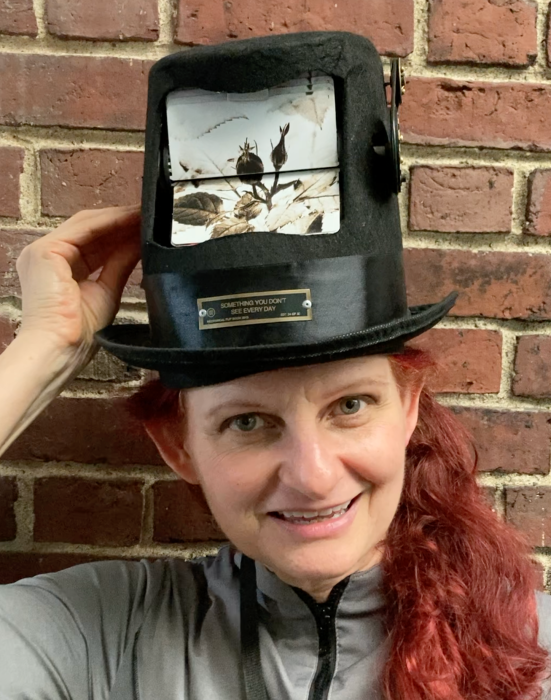
Wendy is walking around in top hat. The hat contains a window. Inside the window, there is a rosebud. During our brief conversation, the rosebud blooms into a full-sized red rose. With her partner, Mark, they have found a niche, making very clever flip books that capture the heart and the imagination. At their display table at the recent Automatoncon, an animal travels from one flip to another and another, employing mechanics and images printed on paper to bring ideas to life. In fact, anybody can do it — they sell a popular D-I-Y Flip-o-Scope that allows children, parents, and creative souls to animate images, and bring them to life.
That’s the whole point of automatons — you may recall the automaton in the center of the HUGO movie directed by Martin Scorsese, which was based upon the delightful picture book, The Invention of Hugo Cabret, by Brian Selznick — to simulate life through mechanical means. Every two years, AutomataCon provides a gathering place for wonderfully creative souls to compare notes, talk tech (which, in their world, is not digital), and show off their latest work. Significantly, the event is held at the small Morris Museum in Morristown, New Jersey, which houses one of the world’s largest collections of Murtogh D. Guinness Collection of historic mechanical musical instruments and automata. Mr. Guinness, of the famed brewing family, was a collector so serious about his prized assets, he built a building for the Morris Museum in exchange for a promise to keep the collect intact, alive, and productive.
Part of the promised outreach effort is AutomataCon, which brings, for example, Cecilia Schiller from her workshop in Northern Wisconsin to northern New Jersey. Cecelia’s long history in puppetry, theater special effects, and exhibits (such as a magical Christmas display, held annually in St. Paul, Minnesota’s Macy’s Department Store).

A puppet simulates life with the help of a talented human operator, but Cecilia’s sense of story takes her further with a full-scale puppet show that includes several children, puppets in a Punch and Judy stage, an puppet operator controlling those two puppets, and a colorful assembly of gears and operators down below the stage. All of it is control with a crank. It is magnificent. The images below provide some sense of what it does and how it works.

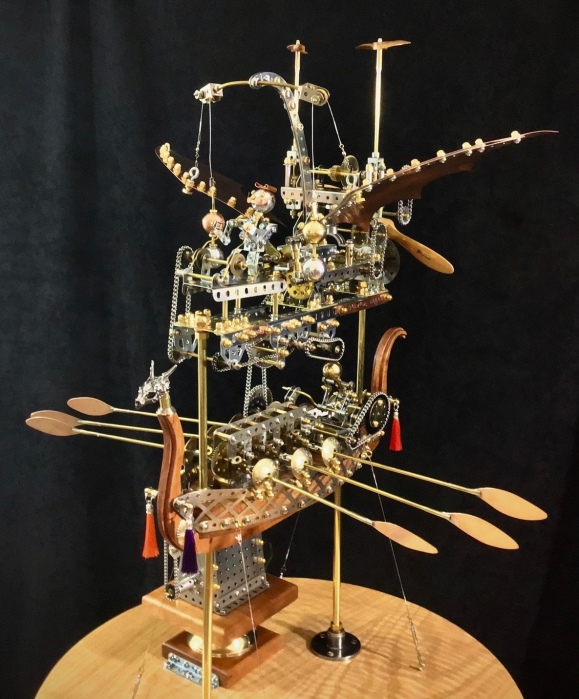
Dave Bowman discovered automata by visiting the Morris Museum. That was eleven years ago. Now, he makes magnificent metal automata of his own. We begins with Meccano parts — similar to an Erector set — but he uses only older sets because the steel girders are better for his purposes, and because the gears are brass-plated. Two recent favorites: a viking ship and a large bird, each with its own elaborate back story. He does not plan the creations. Instead, he engages in a long conversation with the imaginary beings. “You bond with them. You spend so much time creating them.” As with puppetry, the line between reality and fantasy can become blurry.

And yes, that is a real animal skull that forms the head. And, below, the made-up history is worth reading.
Of course, there is much more to discover. More artists whose work mimics real life. If you haven’t seen the movie HUGO, that’s a good place to start. And if you’re curious about AutomataCon, be sure to visit their website.

 Digital Insider