 The tiger is George’s Clemenceau, great friend of hedgehog Claude Monet, who turns out to be the last of the impressionists. The story picks up long after Monet had moved to his lovely garden home in Giverny, about halfway upriver from Paris on the way to Rouen. And may recall Rouen because that’s home to the ancient cathedral that Monet painted more than thirty times under all sorts of light. Monet was that kind of artist—obsessive, meticulous, perfectly happy to spend endless hours interpreting the London fog or wheat stacks (similar to hay stracks) not far from his home in the country. When author Ross King picks up Monet’s story, the artist is less enthusiastic about travel, but eager to serve and take healthy part in a lavish lunch before touring the beautiful Giverny garden, visiting the pond and lily pads, or showing off his latest work, most often very large paintings. By now, Monet is far more active than many men his age, still active enough to build a new studio adjacent to the house and fill it with new paintings. Cataracts and other health problems make seeing, and therefore painting with the specific colors he requires, a terrifying challenge. And there is a Great War on the horizon, so his life’s work may be destroyed by the German forces already notorious for precisely this sort of mayhem.
 He is also an extraordinarily difficult, insecure, proud man who feels that he must do more for France, provided that doing more is possible on his own exacting terms.
Caught in the middle of what always seems to be a dramatic mess is his faithful friend George’s Clemenceau, who happens to be the nation’s top politician, the man who runs France’s war effort, and is, for much of the book, the only person in the world who can control (and at times, even speak to) the artist.
And so begins the tale of Monet’s oversized, overwrought, absolutely spectacular series of giant water lily paintings—and the custom-redesigned building, The Orangerie, their central Paris home. It is a struggle to the death… the extreme uncertainty that amonet’s temperament, and eyesight, would remain in good working order until the grand decoration, as he called the collective works, were complete.
It’s easy to marvel at Monet’s paintings, but the difficulty he endured in bringing these paintings to life, protecting his work and his artistic soul, and stubbornly insisting that the work be displayed in a very particular way is awesome in the true sense of the word. Is this the craziness and crankiness of an older man who knows the end is near? It would be difficult to argue against that assessment. But here we are, more than a century later, visiting Paris and enjoying the artist’s work in precisely the way he wished, and it’s not easy to claim that his approach was wrong. At the time, sure he was difficult. In the long term, perhaps he was right. And there’s a lesson in there somewhere, not for all, but certainly for some creative professionals. some of the time. Perhaps stubbornness is under-rated.
 Author Ross King is both experienced and skillful in recounting the stories of great artists in their prime. One of his best titles is Brunelleschi’s Dome, another in the “is he a madman, or is he a genius?” genre that he handles so well. The best-selling Michelangelo and the Pope’s Ceiling is a story that has been told in motion picture form–The Agony and the Ecstacy–but his treatment of the material is especially vivid. High marks to Leonardo and The Last Supper, too.
(You should certainly spend time at The Orangerie’s website. It includes a wonderful history, and a virtual tour so you can see all of the great decoration paintings.)
 Sure,
Sure,  When I traveled this summer, I insisted upon reliable portable power for my flashlight, tablet and smart phone, but I wasn’t about to carry a Yeti. Fortunately, Goal Zero offers a nifty small battery and charger that makes an ideal gift. No AC power, but the USB system is very well designed. I especially like the Venture 70 Recharger because it will charge a tablet once or twice, or a phone a half dozen times. And, it comes with a built-in (very bright) flashlight. The USB cables frame the device and never get lost. You can charge the device via an AC/USB combination overnight. The Venture 70 costs $150, and you can add a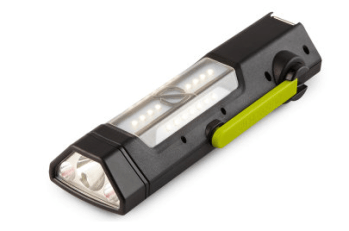


 Willingness to paint outdoors requires more than straightforward skills. It requires a real desire to be part of the place that you’re painting. It’s a mindset, an attitude, a combination of willingness to be flexible and a desire to capture the light and sensibility that you cannot quite find by referring to a photograph. That’s why the book begins not with a discussion of portable easels (that comes later), but with an insightful illustrated essay posing as Chapter 1: “Why Paint Outdoors?” He focuses on the mental game and also shows himself in the game, on the street, easel set up just beside a construction site so he can get just the right view, messy paint-covered sweatshirt and slight scowl and all. He ponders how much of the work needs to be done outdoors–if you finish up indoors, which is often tempting if the weather or other conditions aren’t ideal–does a plein air painting retain its plein air status if it’s only 20 or 30 percent painted outdoors? How about 70 or 80 percent? No matter. If you do any of the work outdoors, Doherty says it counts.
 As with most books of this sort, there are profiles of artists that the author admires, and lessons to be learned from each of them. There are also good large photographs of many types of plein air paintings, useful both for inspiration and also for studying technique. I like to see a good history chapter, too, in part because it’s fun to consider myself part of a longer tradition that once included John Constable, and Jean-Baptiste Corot, and best of all, painters who were part of the majestic Hudson River School.
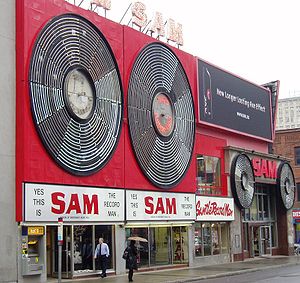 For many years, the very best place on planet earth to shop for LPs (or, if you prefer, records), was Yonge Street in Toronto, Canada. As it happens, Yonge (pronounced “Young”) is one of the world’s longest streets, but that’s not why I visited as often as possible. There were two very large record stores on Yonge Street around Gould and Dundas Streets — A&A Records, and my multi-floor, multi-building favorite, the flagship store for what became a 140-store chain,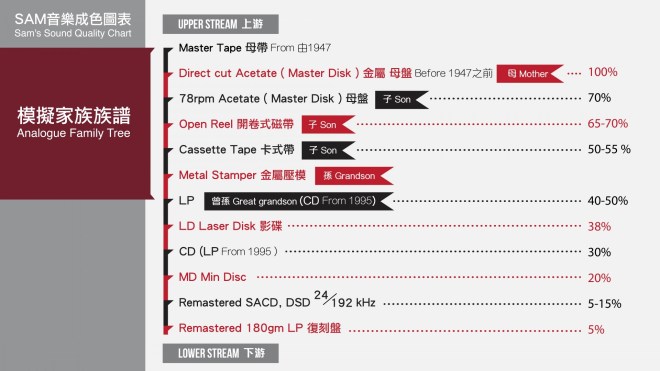
 The process begins with the master tape, but the metal stamper used to make the vinyl record is already second generation (“grandson” to the master tape), and the first pressing of the consumer record is the third generation, or great grandson. To James’s ears, you’re hearing less than half of the sound, and sound quality, that you would hear on the master tape. And that’s with a first pressing, under ideal conditions, listening to product from a record label that took the time and spent the money to get things right. Of course, most record companies don’t, or did not, lavish so much attention, which is why even the best used vinyl recordings from the golden age (say, 1960s and early 1970s before the oil crisis) don’t score much more than a 40 percent.







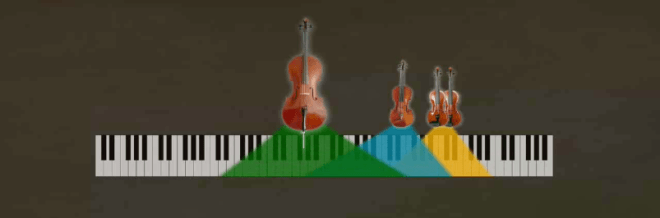
 A violin is not invented or perfected in a moment. It must be played, enjoyed, improved, adjusted, and sometimes, rebuilt, often over years, decades or centuries. In fact, many high quality violins are antiques that been rebuilt and rebuilt so often that little of their original material remains. Still, this is the way the culture has evolved. And that culture is not especially welcoming to an inventor with a better mousetrap. That’s why so many of Hutchins’ instruments ended up in musical instrument museums, and so few have been heard on stage in performance. Happily, there is the
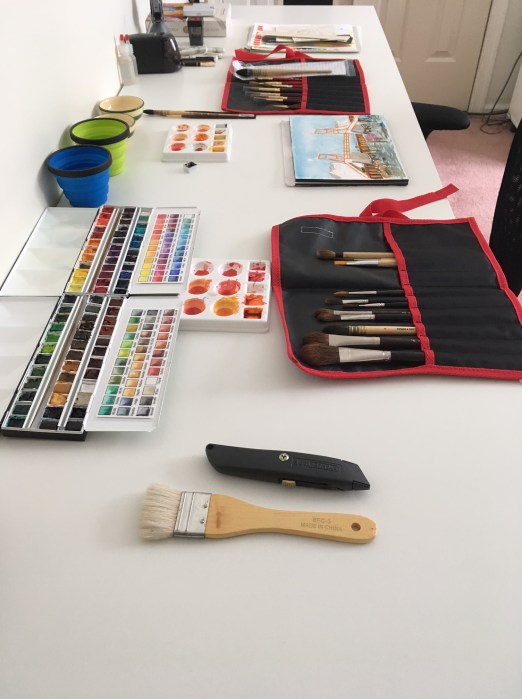 I started by creating as much open desk space as possible. IKEA to the rescue: a pair of white Limmnon 79-inch long, 23 inch deep desktops, each costing $45. One for each long wall, plus an ALEX 9-drawer white cabinet for storage, and a variety of old storage cubes recaptured from the basement and from other rooms. So far, I have not found the perfect roll-around task chair–a future project. The bookcases remained in place–the white Billy shelf units that are both inexpensive and look great.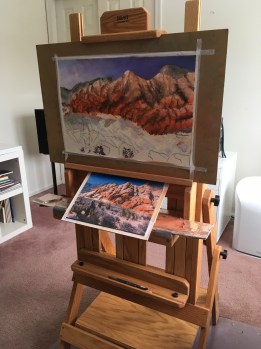
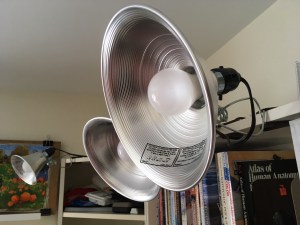 The flood lights were wonderful for work at the easel, but far too bright for every day room lighting, and totally useless for watercolor and drawing at the desk, I researched task lights–somewhat unfamiliar to me–and found a very cool company called
  The new


 What else? Plenty of time to organize too many art supplies. The need for pleasant music (mission accomplished thanks to some forgotten stereo equipment in the basement). And–big discovery, however obvious it may seem–once a painting is complete, it needs to live somewhere. When I kept all of the finished work in a box flat box, this was not a problem. Now, I felt the need to display recent work, if for no reason except my own assessments. Once again, IKEA provided a solution: 45-inch long Mosslandia “picture ledges” (just reduced: now just $9.99– and I hope they’re not being discontinued).

