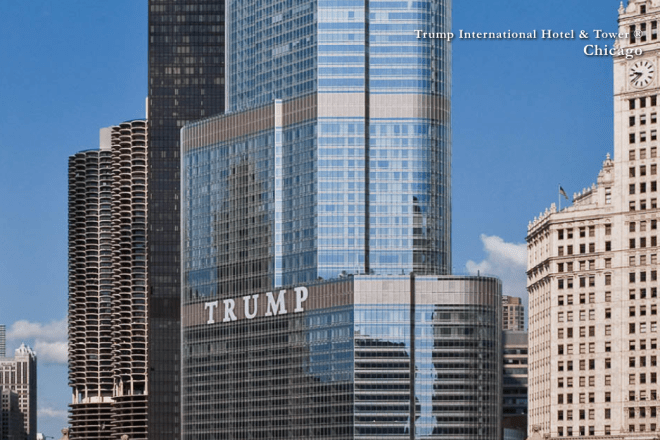
So here’s something that hasn’t happened before, at least not at this scale. The new President is a businessman, and his personal name is one of his business’s most valuable assets. He lives in Trump Tower, alongside “public figures, athletes, celebrities and other affluent sophisticates” in “one of New York’s most visited attractions.” The organization’s website publicizes 24 domestic properties including a Trump Plaza, a Trump Palace, a Trump Parc, and so on. There are 9 more international properties, and 5 more commercial properties. That’s about 40 current properties, and 32 bear his name. These properties are gorgeous–the Trump portfolio includes some of the finest real estate properties on the planet. Taking a dark view, each of these could become a target because the wealthy capitalist U.S. President’s name is on so many of them, and Federal authorities began to address this issue by adding security to the Trump Tower on Manhattan’s Fifth Avenue today.
For this article, my concern is elsewhere.
On the one hand, we require public figures to cease involvement in private business activities, and with good reason: decisions should be made on behalf of the public good, not for private gain. This seems wise, but the bright line becomes very fuzzy because the name Trump will identify a very public asset on January 20: the President of the United States. If I want to name my company Jefferson Bank or John Kennedy Ford, could I name my new store Trump Fine Jewelry because the President’s name is now public property?
On the other hand, we’ve just elected a President whose personal name is also a very valuable brand name. If The Trump Organization is required to change its name, or, at least, remove the new President’s name from the company’s real estate properties, that would be unfair to the company’s employees, partners and shareholders. And under normal circumstances, the Trump Organization would probably prevent me from using Trump Fine Jewelry. Maybe now the rules are different.
Some of Trump’s properties are outside the U.S. What is our national comfort level with the name of our new President on a magnificent building in Panama or Turkey?
Okay, deep breath, this about to become more complicated.
How do we feel about the President’s name on more than a dozen fancy golf courses? Again, they are spectacular, and part of their alure is the Trump brand name. Remove that name and the business suffers. Keep the brand name and we’ve got a U.S. President endorsing private businesses–very upscale businesses that are inaccessible to most people because these golf courses charge high prices and serve privileged clientele. And yet, it’s not fair to penalize those businesses, those investors, those partners, those customers. Trump also manages “both of Central Park’s public skating rinks” which seems like less of a problem, and maybe the six luxurious restaurants are also of little concern (except when a tourist says, “I want to visit one of the President’s restaurants”).
President-Elect Trump has also been successful in the entertainment business. This, from his website: “Additionally, Donald J. Trump is the co-owner and Executive Producer of the “Miss Universe Pageant,” “Miss USA Pageant”, and “Miss Teen USA Pageant” in partnership with NBC. Trump Productions recently Executive Produced the hit reality series “Pageant Place” on MTV. Additionally, Trump Productions premiered a brand new series on MTV in 2009 based on the #1 hit UK show “Ladette to Lady.”
And there’s the President-Elect’s successful management company for fashion models: “Trump Model Management is an expression of exquisite beauty and contemporary style…With a name that symbolizes success, the agency has risen to the top of the fashion market, producing models that appear on the pages of magazines such as Vogue, on designer runways, in advertising campaigns and blockbuster movies. We take pride in scouting and developing our own talent in the stars of today and tomorrow, as well as maintaining outstanding client relations. With unsurpassed management and direction, our diverse group of managers and scouts continue to impress the world with their taste and style.”
For professors of brand marketing and Presidential law, all of this presents a fascinating puzzle. Do we just leave things alone, and allow the name of the U.S. President to become a marketing tool for Miss Universe or a few dozen real estate holdings? Do we demand that the President-elect remove his name from some or all of these properties for the run of his term, and potentially destroy businesses that employ (I’m guessing) thousands of workers? Do we make some exceptions? Or do we do as little as possible and just allow the marketplace to do as it will?
Will some of the people who now operate the Trump Organization operate the nation? Will they be allowed to continue to work with both the private company and the U.S. Government? Or must they decide, as public officials have decided for a century or more, to cease their involvement with private concerns while serving in public office? For most politicians, these questions require several meetings with lawyers and accountants. In this situation, maybe it’s that simple.
I don’t know the answers, but I hope somebody does. And if something needs to happen, I guess there’s a short deadline: ten weeks and two days from today, it’s the Trump White House.

 The youthful exuberance is gone, the social awareness is increasing, the production is slicker by 1969’s “Stand” — “you’ve been sitting much too long—there’s a permanent crease in your right and wrong!” – “there’s a midget standing tall, and a giant beside him about to fall!” It feels a bit dated, a golden oldie, a solid memory but the controlled chaos and the crazy audio production is a thing of the past. From the same album (called Stand), there’s “Sing a Simple Song” and “Everyday People”— probably the group’s high water mark— and both of those songs bind the no-holds-barred past with the glossier, socially consciousness future. The same album’s “Don’t Call Me Nigger, Whitey” (same lyric, “Don’t call me whitey, nigger”) is a sincere push toward revolution.
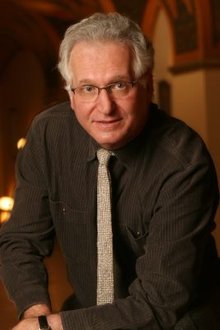 Since overtures “have become a rarity today,” the opening number carries the weight. Originally, A Funny Thing Happened on the Way to the Forum began with “a sweet little soft shoe about how romance tends to drive people nuts” but that misled the audience because the show was not about romance or charm, but instead, a boisterous vaudevillian take on three Roman comedies. Critics and audiences don’t enjoy mixed messages, so the reviews were lousy and the audiences stayed away. The creative team—a top-notch group that included Larry Gelbart, Stephen Sondheim, Hal Prince, George Abbott, and Burt Shevelove—didn’t know what to do. They asked director Jerome Robbins what he thought. He asked Sondheim (music, lyrics) to write something “neutral… Just write a baggy pants number and let me stage it.” Viertel: “He didn’t want anything brainy or wisecracking, but he did want to tell the audience exactly what it was in for: lowbrow slapstick carried out by iconic character types like the randy old man, the idiot lovers, the battle-axe mother, the wiley slave and other familiar folks. Sondheim wrote “Comedy Tonight” as a typically bouncy opening number, but he couldn’t resist his clever muse, and so, the “neutral” number’s lyrics go like this:
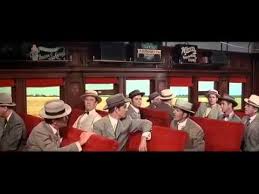 Another simulates the movement of a train pulling into River City, Iowa a century ago—serving to introduce the flimflam man named Professor Harold Hill—“Cash for the merchandise, cash for the button hooks, cash for the cotton goods, cash for the hard goods…look, whataytalk, whataytalk, whataytalk, whataytalk?…”to set the stage for The Music Man. Similarly Cabaret begins with the multi-lingual “Wilkommen” and Fiddler on the Roof begins with “Tradition.”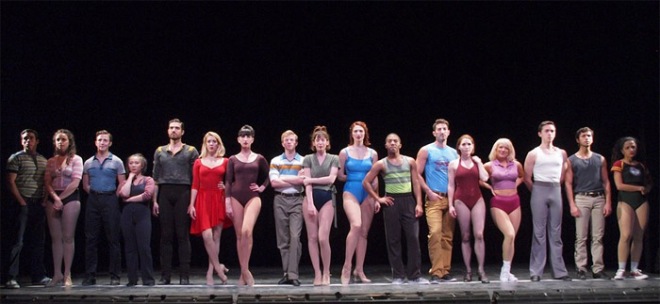
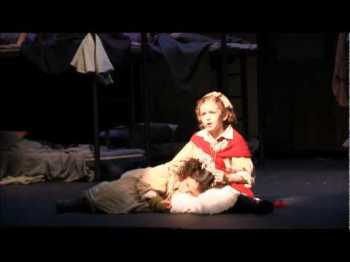 In Annie, the I Want song is “Maybe”– the orphan dreams of her parents. In Gypsy, the “I Want” song is “Some People,” and in “West Side Story,” it’s “Something’s Comin’” In Hamilton, it’s “My Shot.” It’s “Wouldn’t It Be Loverly” in My Fair Lady and “Somewhere That’s Green” in Little Shop of Horrors. Note the consistency of a place far away as a device to express desire—“ Part of Your World” in The Little Mermaid follows the same pattern.
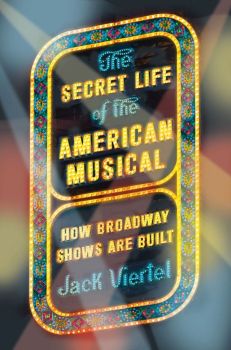 Gee, this is fun. Suddenly, every musical I’ve ever seen makes more sense than ever! I could go on about “The Candy Dish,” “The 11 O’Clock Number” and the construction of the ending, but that would make the whole blog article too long. Pace matters.
 The turnaround story begins, as it ought to begin, with a pitch from a creative professional to a producer. The two remarkable people in this particular scene are Public Theater producer Joseph Papp and choreographer-director Michael Bennett. Reidel: “Bennett arrived at Papp’s office at the Public Theater carrying a bulky Sony reel-to-reel recorder and several reels of tape. He had nearly twenty-four hours of interviews with Broadway dancers. He thought there might be a show somewhere in those hours and hours of tape. He played some of them for Papp. After to listening to the recordings for forty-five minutes, Papp said, ‘OK, let’s do it.”

 Enter the
  d the corner from the museum is The Four Way Restaurant, where Stax musicians, producers and engineers used to eat, and where I shared a table with a preacher who was touring the South, speaking about how Wal-Mart was destroying the local economy. Fried chicken, fried fish, side dishes of greens and yams. Preacher told me he would be heading next to Clarksdale, then on to Cleveland (Mississippi) and Indianola, just a few hours south. Next morning, I decided to skip a few speeches at a trade show and head for Clarksdale, figuring I’d be back just after lunch. I guess I didn’t anticipate driving down Highway 61, or waiting on Aunt Sarah to do her daily deliveries before serving lunch in what turned out to be one of the few places to buy lunch in the once-vibrant small city of Clarksdale. And if it wasn’t for my visit with Roger Stolle in the