The News About The News

the Creative Commons Attribution 3.0 Germany license. Attribution: Kai Mörk

News coverage of a press conference, not a TV camera in sight. But most people still get their news from their TV sets. Attribution: Kai Mörk. Creative Commons Attribution 3.0 Germany license.

During the past twenty years, each of the network’s evening newscasts have lost half of their viewers. These days, about 18 million Americans—that’s 18 million out of 240 million American adults—watch the nightly network news on ABC, CBS or NBC, with another 1 million watching PBS NewsHour. Still, most Americans still get their news by watching local and network television—that number hovers around 60 percent. If online is the second most popular source, it won’t be second for long, and it may have overtaken television in many peoples’ lives. Despite its convenience, radio is on a steadily decline; since 1991, it has lost about half of its role as a news provider. Its decline roughly matches the decline of newspapers, down.

For the most part, we pay for our news by watching and reading advertisements, and clicking on some, too. Advertising accounts for more than 2/3 of financial support for news. The second largest segment? Direct payments from the audience in the form of subscriptions, roughly 1/4 of the pie—the portion of your cable bill that pays for CNN, your subscription to a newspaper, your contribution to NPR or one of its member stations.

In the U.S., the news business is a very substantial: about $64 billion per year. That’s about 1/10 more than Google, which is, of course, just one company. Starbucks is about 1/4 of the size of the U.S. news business, but the global video game industry is about twice the size, so maybe Americans (alone) spend as much money on videogames as they do on news.

About 1/3 of all Americans now watch news video online, and that fraction increases to 1/2 for those in the 18-49 age group, but this is still a very small part of the whole news business—less than 10 percent of revenues, in fact.

Newspapers are changing—essentially eliminating their printing presses, trucks, ink and other 19th century concepts in favor of digital distribution. Among all newspapers, 1/4 to 1/3 of readers are using a digital device regularly, and among the 15 largest newspapers, nearly 1/2 of readers are enjoying their daily or weekly editions on screens, not on paper.

In just six years, Time Magazine and The Economist have lost about half of its newsstand sales—once a common model, picking up the magazine at the newsstand, now seems hopelessly old-fashioned. The New Yorker and The Atlantic have lost only about 1/4 of their newsstand sales. The decline is steady, and probably inevitable, but it’s difficult to explain why certain magazines have lost so much more than others. During the same period, revenues for Fox News Channel have doubled (but both CNN and MSNBC have shown only modest gains). In case you’re curious, it costs about $800 million a year to run Fox News, and about the same amount to run CNN (MSNBC costs less than $300 million.)

Five or six years ago, many journalists panicked because their industry seemed to be disintegrating. Some decided to take action. Since 2008, more than 100 digital nonprofit news outlets have popped up all over the country (in just about every state except Utah, the Dakotas, Mississippi, Alabama, and Utah. The San Francisco Bay area, Los Angeles, Washington DC, Philadelphia, New York City and Boston have been especially well-served. Some are sponsored by universities or nonprofits, some are independent, some are foundation funded. It’s certain a significant trend, albeit a new and fragile ecosystem. Many began with the financial assistance of a startup grant, typically under $100,000, that renewed only some of the time for a second go-round. Still, foundation funding is the principal source of funds for many of these fledgling operations. They deserve our support—especially during the critical early years. Happily, most surveyed felt that they would succeed in the long run through a combination of advertising, sponsorships, live events, individual subscriptions, and other forms of economic support. This an interesting phenomenon, and you can read more about it here.

The biggest change? Digital news sites are now strong enough to hire top journalists from newspapers, and entrepreneurs (Jeff Bezos, Pierre Omidyar) are investing in the future of news gathering and distribution. The good news: this once-doomed industry is again showing signs of life, imagination and energy. As you time permits, I encourage you to fully explore the SPECTACULAR collection of reports that comprise the Pew Research Center’s Journalism Project’s State of the News Media 2014 report. It’s all online. Or, download Overview PDF here.


The Future is Ours to Lose

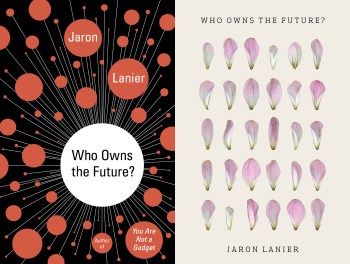
And in exchange for free internet searches, discounts on books and other merchandise, posting pictures of family and friends, and playing games, we’re giving it away. Giving away our means to earn a living. Giving away our privacy and most personal information. Giving away copyright protection, our health care data, our time. Making large companies and internet entrepreneurs wealthy. Waving goodbye to economic opportunities that could, in the mind of non-economist but future thinker Jaron Lanier in a creepily fascinating book called Who Owns the Future. From the book jacket, a clear explanation of a complicated book:

Lanier asserts that the rise of digital networks led our economy into recession and decimated the middle class…In this ambitious and deeply humane book, Lanier charts the path toward a new information economy that will stabilize the middle class and allow it to grow. It is time for ordinary people to be rewarded for what they do and share on the web.”

futureukuscomboCertainly, creative professionals have seen new opportunities, but many jobs have disappeared, crumbled, or become so easy for amateurs to do, there is little perceived need for professional work. Two examples: illustration and another is photography. What about people who drive for a living? Lanier: “A great portion of the global middle classes works behind a wheel. Many have entered middle-class life as a taxi driver or truck driver. It’s hard to imagine a world without commercial drivers. A traditional entry ramp into economic sustenance for fresh arrivals to big cities like New York would be gone. Wave after wave of middle class immigrants drove New York taxis. And I’m trying to imagine the meeting when someone tries to explain to the Teamsters that nothing like their services will ever be needed again.” You see this in the battles between the everyone-can-be-a-cabbie service Uber and the people who actually make their living by moving people.  Soon, cars will move without drivers. Lanier: “Both cabbies and truckers have managed to build up levees…they’ll be able to delay the change…there might be a compromise in which a Teamster or cabbie sits there passively, along for the ride, perhaps to man a failsafe button…the world of work behind the wheel will drain away in a generation.”

Lanier: “What about liberal arts professors at a state college. Some academic will hang on, but the prospects are grim if education is seduced by the Siren song… The future of “free” will beckon. Get educated for free now! But don’t plan on a job as an educator.”

Lanier’s Siren server combines a Siren’s song with a server that collects information, provides appealing benefits, and causes tremendous destruction as it is managed by a wealthy few. The Siren server is portrayed as a monster stomping the life out of everything in its path. Health care? Empathetic robots empowered by Big Blue’s encyclopedic database of knowledge, the processing speed of a digital chess champion, and unbelievably precise motor skills. The list goes on.

So what’s to be done? It’s tough for anyone to survive in the modern world with a “just say no to the Siren servers!” philosophy. So much relies upon credit cards, EZ-Pass, Android, and, yes, Netflix (now my most-used television “channel”). What’s more, there’s the “Pervasive Creepy Conundrums: online security, privacy, and identity.”

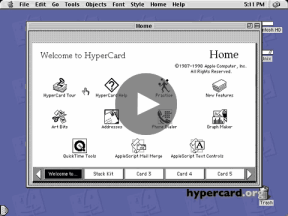
Lanier builds his case for divergence with a disheartening disclaimer: he cannot explain the idea simply. In fact, he can, and somehow, his editor did not delete most of chapters 16-20 because they take too long to set up a very good, very simple idea: two-way links. He appropriately credits an early home computing visionary, Ted Nelson, whose name may be familiar because he was the guy who originated HyperCard, which Ars Technica describes in a wonderful article entitled “25 years of HyperCard—the missing link to the Web.”

hypercard_tutorial_posterLet’s continue down that path: “The foundational idea of humanist computing is that provenance is valuable. Information is people in disguise, and people ought to be paid for value they contribute that can be sent or stored on a digital network.” I agree. For more about why and how I agree, see my recent articles about Google Books.

Simply: “If two-way linking had been in place, a homeowner would have known who had leveraged the mortgage, and a musician would have known who had copied his music.”

Lanier is right: That changes everything!

It’s a complicated fix, a change in the architecture of so many things digital, but it’s worth the shift. Here’s a straightforward example of why: “When you buy a physical book, you can resell it at will…” It is yours to own, sell, repurpose. “You can get the author to sign it, to make it more meaningful to you, and to increase its value.” With an eBook, you have only purchased “tenuous” rights within “someone else’s company store.” And so, “Your decision space is reduced.” It’s just not a fair deal. What’s more, this kind of thinking leads to the kinds of big company, big brother control that makes nobody comfortable (and few people wealth).

Lanier’s theory about “commercial symmetry” places everyone—companies and individuals, governments and other institutions—on a level playing field. Rules apply in both directions. People’s rights are not reduced. There is fair play. I am not required to subsidize ESPN on my cable bill; I don’t watch, and probably will never watch, most of the cable channels that I am required to fund each month. We’re trying to do something like this with health care—patient rights and all of that—but the health care system is not likely to share information about its economics. Students are graded by teachers, but (most of the time), teachers are not graded by students or (much of the time) by their employers or the larger body of taxpayers who fund their salaries, benefits and pensions.

Still, there is that looming question: is the value that we provide to, say, EZ-Pass or Netflix, transferable to real income for individuals who must earn a living. If Netflix discounted its services in exchange the data that we provide, would that result in more or less employment overall? Less, I suspect—but I’m operating within a present-day reality, and if we’ve learned anything from the future’s past, paradigm shifts change all of the rules.

Lanier probably doesn’t have the answers, but he writes in a way that makes you think, and he ignites meaningful conversations like this one. Smart guy, interesting book.

Lanier

The New Economics of Quality Television

The scheme worked. And it’s about to work again, this time in a way that nobody anticipated.

First time out, it was the early 1980s, and the new cable industry was winning a lot of franchises from municipal governments, and making a lot of promises. Among them: all sorts of new television channels. The scheme: customers pay a few dollars each month, and if enough households subscribe, there will be enough money for lots of new television programs. These days, over 100 million subscribers pay over $150 per month—that’s $150,000,000 x 12 months each year, enough money for Comcast to buy NBC and Universal Pictures.

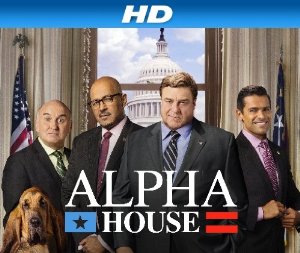
Alpha House

Here comes the next scheme, the next game changer. You’ve probably heard about Amazon Prime’s entry into the television programming space. According to the NY Times, here’s how the process worked:

After an invitation by the company, some 5,000 scripts were submitted last year, and in the spring, 14 pilots were commissioned. Amazon then stood back and watched what 215 million active customers clicked on.

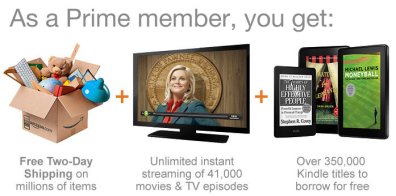
There are no commercials. There is a kind-of, sort-of subscription fee. Amazon is a company that sells a lot of products by mail. They compete with other companies that sell a lot of products by mail. One way to encourage Amazon customer loyalty is with a loyalty program that involves discounts. Amazon’s discount program is called Amazon Prime. You pay $79 per year, and you don’t have to pay for shopping. As an incentive, you can watch a growing number of television shows and movies. Some are free. Most are available pay-per-view for a few dollars.

In days past, television programs were produced to “sell soap.” The commercials paid the cost of operating the network and the cost of producing the program.

Now, television programs are being produced to “pay the shipping cost of the soap.” Somehow, this seems lower on the food chain. Will it work?

Amazon Prime offerYup. Why? Because Amazon, and Netflix, and to some extent Hulu, are not carrying 20th century baggage. They operate by analyze the actual viewing habits of real customers. It’s a good model and a not-so-good model. The good: their judgments will be right much more often than they are wrong. And that provides a solid foundation for a business. The not-so-good: gut instinct, loyalty, and softer judgments will ride a rougher road. In an extreme situation, where machines make all of the decisions, there would be no Seinfeld, no situation where an eager program convinced other executives to stick with a show despite its crumby ratings. In real world, that programmer’s ability to persuade will be blunted, not all of the time, but often, because the “data doesn’t lie.”
Of course, the arguments crumble when the actual process of making television programs enters the argument. Writers don’t much care about data, they care about story. As long as the distribution is reaching a large audience with sufficient promotion, and as long as they are paid a good fee, actors and directors don’t much care about the intricacies of new media distribution. Or do they? That’s the part where the game could change. The economics of Amazon and other data-based program services are vastly different from advertising and subscription models.

Why? Because data-based services do not solely rely upon the old-school revenue streams. Amazon’s game is global branding to drive mail order purchases for every available product in the world to every country in the world. If they need to pay John Goodman a dozen times what NBC would consider reasonable, that’s fine with Amazon. Their purpose changes the economics of the game. And because Amazon and its kin are working with data and  operating without the need to fill a 24/7 schedule, they can focus their resources on actual viewing habits, actual consumption patterns, and they can provide producers and writers and directors with moment-by-moment viewer data (when the viewer paused, when the viewer dumped out, how often the viewer re-watched the episode). When creative people learn to use this information in a productive way (imagine the creative battles before all of this settles down), the paradigm will shift, and no film student will graduate without a thorough understanding of data analysis in the creative process.

Armed with endless data, a global marketplace, (effectively) endless cash, and the ability to engage the biggest stars for whatever purpose Amazon deems necessary, the game change is about to begin.

BTW: I thought the Alpha House pilot was very good, entertaining, unpretentious, avoiding the nasty tedium that ultimately limited my fascination with House of Cards. Whether a computer made the judgement, or some clever program executives made it happen, I’ve gotta say “good job.” I look forward to watching the episodes in series, and discovering what else Amazon is unleashing.

“The forced, bloated expanding bundle”

I like the phrase. It was used to describe the way Americans are forced to subscribe to cable television–if you want cable, you must pay for a tremendous number of unwanted channels. In the industry, the result of unbundling is called “a la carte” cable service because the operator allows you to select, and pay for, only the channels that you will actually watch. Bundled cable is, of course, the reason why Comcast accumulated enough money to buy NBC and Universal Pictures. It’s a sweet deal for cable operators, and for the cable industry, which is funded by selling products to people who don’t want them, but cannot do anything except, to use an example, buy everything in the store in order to make sure they have access to the loaf of bread and the jar of peanut butter. It’s a brilliant marketing scheme, and an utter failure of anything resembling consumer protection in the United States.

I could go on and on, and I could also make a case for why some aspects of the bundling business have utterly changed the television industry for the better. Mostly, though, I wanted to introduce you to an article about shifts in Canada’s cable television business that was published by Reuters last week. Here’s the start of it… to read the whole article, click here:

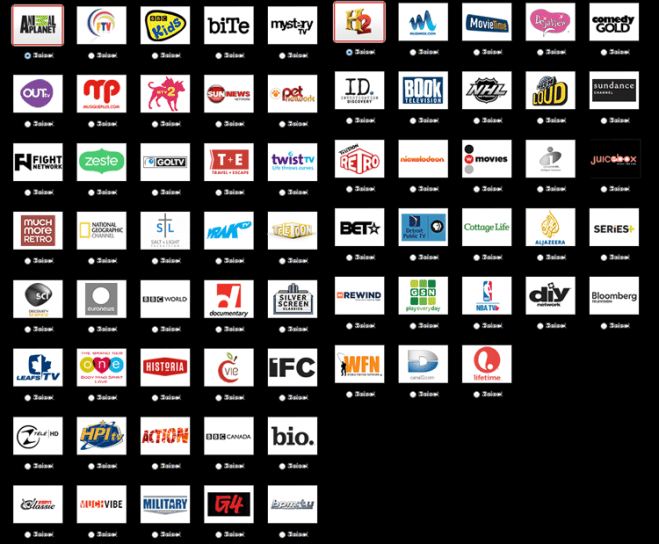
Subscribers to Rogers Cable in Canada can select from these a la carte channels. Most are not big name channels, but once the a la carte habits gains a foothold, the entire cable business may change.

Subscribers to Rogers Cable in Canada can select from these a la carte channels. Most are not big name channels, but once the a la carte habits gains a foothold, the entire cable business may change.

Analysis: Canadian Cable TV’s ‘a la carte’ menu begins to take hold

By Liana B. Baker and Alastair Sharp

NEW YORK/TORONTO | Thu Sep 19, 2013 12:49pm EDT

(Reuters) – A transformation in how some Canadian cable TV companies sell channels to consumers might be a sign of things to come in the much bigger U.S. market.

With “a la carte” pricing, cable companies are offering Canadians an alternative to “take-it-or-leave-it” bundles that effectively force viewers there – and in the United States – to pay for channels that they do not watch in order to get access to those they do.

(and so on)

AM, FM, UHF and the Future

Two weeks ago, The New York Times ran an article entitled “A Quest to Save AM Before It’s Lost in the Static.” The average listener to NPR is 56 years old, and new ones aren’t coming on board so quickly because of music services like Pandora. The big question that broadcast television executives are asking is whether there is a future for local television broadcast stations. In fact, the FCC is asking the same question, anxious to buy back a bunch of local television spectrum and sell it to the wireless operators because they say they represent the future. A century ago, we were trying to imagine a world where broadcast radio and television stations might someday exist. Now, we’re wondering whether we need them at all.

I really love this picture of a 1965 AM radio. It comes from a Ford Mustang. To see more, click on the radio.

I really love this picture of a 1965 AM radio. It comes from a Ford Mustang. To see more, click on the radio.

I suspect AM and FM radio are easier to defend because they provide news, sports, weather, emergency information, and entertainment for people on the road. Half of  radio listening happens either in a car or a truck (the rest happens at home, and to a  lesser extent, in workplaces). Once an also-ran, FM  is now the most popular part of the radio band. Music sounds much better on FM than AM radio, so AM is used, mostly, for talk, news, and religion (you knew that). Following the audience, many sports teams have moved to FM, leaving the AM landscape that much more barren. The New York Times article describes an effort to upgrade AM radio, an improvement requiring the replacement of every car and home radio. That seems as unlikely as the replacement of analog television seemed just a few years ago. But we did it.

The digital television transition moved some local broadcasters to other channels (“masked” with their old TV channel IDs so you never noticed), improved some signals for some households (worsened some signals for other households), and greatly increased the available television channels that could be transmitted by a single television station. Most network affiliates have made little meaningful use of  additional bandwidth, but MeTV, retroTV, and Antenna TV are among the entrepreneurial newcomers that make use of the additional bandwidth.  A handful of new non-commercial public networks have emerged, including several importing programs or full channels from other countries including Japan and France.

Jeannie_Bewitched_Website-960x445Where does  this lead? And how do we even begin to think about the future when so much television viewing is now on-demand and so much audio listening is via Pandora, podcasts, Sirius XM, and audible?

Let’s start with the audio side. Traditional radio listening is probably entering its final innings. The disruptive technology is mobile internet. It’s no longer a techno-stretch to include an internet device in an automobile or truck. Hundreds of channels are replaced by thousands. On-demand replaces scheduled programs.  ANy smart phone doubles as an audio file server, easily replenished via the cloud, and, with increasing reliability, the cloud itself becomes the server as the driver enjoys a live stream without considering its source. Program your vehicle with voice-activated instructions, and the car will know  you prefer Car Talk on Tuesday mornings during your commute. Brands matter, podcasts matter, but 24/7 feeds of country music and local news breaks don’t, or won’t. Press a button to see and hear local traffic conditions with appropriate automated warnings, and suggested re-routings. Sirius XM is trying to stay ahead of the curve by selling its own internet channel packages, and starting its own on-demand services. Good idea, but a half dozen companies will offer, more or less, similar subscription services, and, of course, everybody is competing with free (free has been the standard for AM and FM radio, and old habits are hard to change). Add audiobooks and podcasts to the mix, and the AM/FM prognosis becomes even more gloomy.

What about TV?With few exceptions, people watch programs, not networks. New matters less than buzz. If you haven’t seen it yet, last season’s Boardwalk Empire trumps  this season’s Girls. There is so much product,  so much fragmentation of viewing time, everyone plays catch-up almost all of the time. Catch-up has the potential to transform large numbers of viewers into video library consumers , not television viewers who know or care what’s on NBC on Wednesday nights at 9PM. In fact, if there was no broadcast television, viewers would quickly find alternatives on cable, on demand, and various internet services. Which is to say, 20th century television is probably enjoying its last laps. We just don’t need what we had before–there are better alternatives.

With broadcast radio and broadcast television, we established and continue to enjoy a public trust. As members of the public, we provide broadcast spectrum, at no charge, to the likes of CBS and its local affiliates, and they provide a mix of news, entertainment, and other useful or interesting stuff at no charge. The whole thing is monitored by an FCC that is not perfect, but generally watches out for abuses, and the public’s interests. That’s all good, and that’s in the process of going away.

In its place, there is no public trust, no assurance of an appropriate mix of news, entertainment and other useful or interesting stuff, and almost none of it will be provided at no charge. We are making a VERY POOR choice. We have missed a step. We are handing our mass communications to companies whose principal business is collecting monthly fees for services, not attending to the needs of the communities they serve, not attending to any national agenda or public interest. We have already seen bad behavior from operators who wish to constrain what is and is not made available through their commercially-controlled networks. We will see more control–all quite reasonable because these companies are not required, nor encouraged, to do good. They are required (by shareholders) and encouraged (by advertisers and subscribers) to keep the public interested, to capture our imagination and attention, but not for anything resembling good reason.

In short, we are missing a step. You and me, we have some interests to protect here. We should be unwilling to transfer control of all media to companies with no meaningful public interest requirement.

Let’s think about that. And let’s continue the conversation in the  near future.

Attack of the Three-Foot Robin

You may recall that I’m a relative newbie when it comes to really big  TV. Our family room’s western wall is now dominated by a 60-inch Samsung plasma  screen is dominated by a stunning picture of a red robin who must be at least three feet tall. There’s a common yellow throat, also larger than my dog. A bufflehead. An olive-sided flycatcher. These are among 118 birds that receive full screen credits, alongside author Jonathan Franzen, legendary Central Park birdwatcher and tour guide Starr Saphir, and other humans who, particularly during the migration months of late spring, watch birds in Central Park. You can watch them, too.

I watched Birders: The Central Park Effect on Netflix, mostly because I was too tired last night to make any sort of meaningful viewing selection. My wife found Birders, enjoys bird watching, and so, we both spent an hour stunned by the images, a pleasant story, and the depths of, well, dweeb behavior (the word used by Franzen to describe his feeling when peering through binoculars and shutting out the rough-and-tumble big city).

Birder-GirlWhen the day winds down, my wife and I try to catch at least an hour’s worth of television viewing. Apart from two or three network series, we mostly forget that CBS, ABC, FOX, and NBC exist. We watch HBO, but never when the network schedules programs. Just about all viewing is on-demand, and nowadays, most of that viewing is done on Netflix.

When we first subscribed to Netflix’s online service, it was just awful. That’s no longer true. Not with every episode of Mission: Impossible (some tedious, some superb), a wide range of foreign and independent films, and lots and lots of interesting documentaries. Recent viewing includes a doc about 1960s-1970s singer Harry Nilsson (whose life story causes every ‘and then I found myself howling at the moon’ episode of Behind the Music seem like child’s play), another about the strident, talented, and fatally flawed 1960s protest singer Phil Ochs, and, the list goes on. It’s all available any time, any where, on any device, so the idea of tuning into anything that’s scheduled for somebody else’s convenience on a plain old TV seems, well, kinda silly.

Originally, we re-subscribed to Netflix to watch Kevin Spacey pretend to be a powerful congressman on House of Cards. We’ve now watched three or four episodes. We’re done. Spacey is consistently terrific, but the it’s difficult to justify watching smarmy Washingtonians sluggishly gumming up the works of government when there are three three foot tall American Coots and Dark-Eyed Juncos in the room (no, I never tire of ridiculous bird names). I’m told the British series is excellent, and it’s likely that watching somebody’s else’s screwed-up government will be more entertaining than watching our own dysfunction. But it’s not high on the list.

Much higher, and now just completed after six one-hour viewing sessions, is Stephen Fry in America. Fry is a popular, literate Brit who travels through the lower forty-eight in his black London Cab (which made its way across the Atlantic by boat). Below, he is enjoying life in a hot tub on a houseboat on a man-made lake with nearly 2,000 miles of shoreline–“quite extraordinary” in his words.

Stephen-Fry

Fry travels to visit one of the few remaining residents of a Kansas ghost town (who remains optimistic about the tourist potential of his tumble-down main street), the man who runs Angola State Penitentiary in Louisiana, to paddle the Mississippi River with a man who truly loves his river, to hang out with Morgan Freeman in his blues club near the crossroads where Robert Johnson traded his soul for some superior guitar licks, spends a leisurely afternoon with a Western family that’s okay with the many nearby bears but not so much with the increasing number of aggressive wolves who have lost six of their dogs and an eleven-day-old coat to their hunger, and on from there.  We watched the series on Netflix. You can watch every minute of his adventures, for free, in high definition, on YouTube.

YouTube is becoming one my favorite “channels” (I don’t know the correct term, but video library seems clunky). This past weekend, I watched Paul Newman and Jane Curtin in an extraordinary big-screen production of Our Town, which was done on Broadway for Showtime and PBS. It’s here, and I’ve now recommended it to a lot of people because it is just terrific–a very different experience from our English class read aloud experience of the play in, what, tenth grade.

So what’s the point? Well, I’m pretty sure the point now goes well beyond binging on House of Cards (oy!), or Breaking Bad (not for me, either), or more than 250 original episodes of Mission: Impossible or Mary Tyler Moore or any number of other old TV series. There is a spectacular range of interesting programs now available, for free or at very reasonable prices, programs and films that you can watch on any device, on your own time. The only problem: it’s tough to know what’s available because (sorry to hammer this) House of Cards and its kinfolk get too much of the press. So here’s my attempt to shift the course of that river, one TV set at a time.

The Spacey McTaggart Lecture

So here’s Kevin Spacey telling the truth about the television industry, the movie industry, and the new reality that places creative people in control of their relationship with the audience. He is harsh, realistic, funny, and deeply experienced–and full of wisdom and insight gained through his Netflix deal, his work with the Old Vic theater in London, and a career that began, with the help of actor Jack Lemmon, at age thirteen.

I especially enjoyed Spacey’s celebration of “the third golden age of television” that began, more or less, with Hill Street Blues, extends through The Sopranos, on through House of Cards. Just in case you’ve missed one or two, he runs through a dozen-plus excellent television series whose connection to the audience is the result of powerful creative risks taken by creative people, and by the small number of laudable television executives with the guts to protect those creators.

Spacey connects the dots in a pattern that’s  obvious to anyone who is willing to face the truth about the television industry–and devastating to those who still believe in the status quo, appointment viewing, watercooler conversations, and television networks as the fundamental organizing principle of the home entertainment industry. Time and again, he celebrates the creative people…and resets expectations for the next generation.

The new generation of creatives is different. We’re no longer living in a world where someone has to decide if they’re an actor, writer, director or producer. These days, kids growing up on YouTube can be all of these things…

The James McTaggart Memorial Lecture opens the Edinburgh Festival. This lecture is 49 minutes long. I encourage you to watch the whole thing.

Let me tell this another way: he tells a heck of a good story.

(Here’s a link to the text version.)

The Big TV, Part Two

Yesterday, I wrote about big TVs in general. Today, it’s the specific–the 60-inch screen that we now watch every day. It’s a Samsung plasma screen with many of the latest features.

The most important feature is, of course, the screen itself. It’s extraordinary. Great color, great detail, wonderful contrast, never a ghost image, rarely any digital lag (sometimes a concern with fast-moving sporting events and slower-moving processors).

Second most important is sound. As I’ve written previously, most large TVs are made with the assumption that an external system will be added. This particular TV is fine, but on some frequencies, there’s a bit of distortion. Doesn’t happen often. Shouldn’t happen at all. A common problem, but it goes away with an external sound system. (Note the loudspeakers below.)

Samsung-2013-interfaceThird most important feature is the interface–the ways that we interact with the TV set. This requires some explanation.

Mostly, we work with two remote controls. One is used to switch the cable channels, a feature we’ve never quite mastered within the Samsung interface, so we simply switch the channel on our original cable remote and put it aside. The main remote is the Samsung, and like most TV remotes, it takes a bit to understand most of the features, and, like most remotes, it contains buttons and features that I will never take the time to comprehend. Mostly, it’s useful for volume up-down, and for maneuvering a cursor around the on-screen interface.

This interface is a point-and-click design, limited in its alphanumeric capabilities. Mostly, we select an app from the Smart TV interface, then scroll through a series of visual menus to find the movie or TV show that we want to watch. There’s an Amazon Prime app that we’ve used to watch every episode of “Arrested Development” at no additional charge, and there’s a Netflix app that we use to watch “House of Cards” and the strange assortment of movies and documentaries that is rich in niche material and (happily!) lacking in major mainstream movies. These work well enough, but everything falls apart with the oh-so-promising YouTube app–no fault of Samsung here, for YouTube develops its own software. It’s one of those circa-1983 interfaces where you must use the up-down-left-right arrows on the remote in order to choose each individual character, each space, each deletion of an error. For YouTube, with its many idiosyncratic titles, it’s simply dreadful.

There are some other useful apps–one to watch TED Talks videos, another to check the weather, another which provides access to what may be the slowest internet web browser I have ever encountered. In truth, these criticisms are beginning to melt away because each year’s models tend to improve upon the (few) weaknesses of predecessors, and here, I’m discussing a 2012 TV set, ancient in current technology terms.

If you look closely at the above picture, you’ll see that the 2013 Samsung interface is clean, easy to use, and features a tremendous number of apps (you can add or delete them at will). You are, of course, looking at the future of TV on this screen. There’s an app for YouTube and CNBC, another for USA Today and TED, one for HBO GO, and one for Netflix. Each of these is an independent experience essentially unaffiliated with Samsung, but it’s all here, all easily accessible in its “am I a TV channel or a web site? glory? There is so much video, so many images, so much text to be read on a screen that offers abundant clarity and contrast. It is now reasonable to read the Sunday paper on your TV set, stopping to check in, via Skype, with relatives calling from far away, checking email, doing all of that. At long last, we have arrived in the future, and so far, it seems to work pretty well. (See my comments about processing power in the yesterday’s post.)

And then, there’s 3D. This mystifies me. Yes, there are 3D glasses. Yes, they feel really silly. Yes, the effect is still that vaguely grainy, slightly out-of-phase experience. No, I have not felt much of a need to watch anything in 3D for anything more than a family demonstration. Maybe some time in the future.

How much does all of this cost? Less than $2,000, even for a larger screen.

So what else is new? The answer is clearly articulated, with only a modest amount of marketing-speak, on this page from Samsung’s website.

The Big TV, Part One

Overwhelming.

That’s the word we used when we first watched a 60-inch television set take over our family room.

No way would this TV set remain in the room. We had made a dreadful mistake. Living with this monster, even for a week, was simply unacceptable.

And then, we watched. Watching favorite movies, we noticed details in the background that we had never seen before. We’d darken the room and the experience felt superior to all but the best motion picture theaters. For the first time, we could clearly read every closed-caption, every sports score. In short, the experience was far better than we could have imagined.

Of course, the 60-inch TV set is not going anywhere. We’ve explored slightly smaller alternatives, but none offers the satisfying experience of the sheer size, scale and impact of the 60-inch screen.

Figuring out which screen type, which manufacturer, which features–all of that was useful research. Here’s the rundown.

Given the choice of plasma or LED technology, my eyes prefer plasma. I find the LED color palette to be too vivid, less lifelike, too difficult to adjust to my liking. Others may feel differently. During the inevitable research phase–which is not easy to do in the likes of Best Buy, but instead, far more successfully done in small, specialist shops because the sets are properly tuned and aren’t fighting big box store lighting–I found myself drawn to the plasma screens. Their reputation for greater power consumption, heat, reflectance and a darker room has proven to be a non-issue in our setup, which is, already, slightly darker than other rooms in the house. We have not noticed any change in our electric bill. If there is any substantial heat being generated, we simply haven’t noticed it.

Once the plasma decision was made, the choice of manufacturer became much easier. There’s a website that keeps up with the somewhat limited plasma industry, and apparently, there are just three companies in the consumer game: Samsung, LG, and Panasonic. The links in the previous sentence turn out to be quite useful. Each of these manufacturers offers their plasma wares in series form: the higher-end series include more features (3D, smart interfaces, etc.) and the lower-end series offer remarkably good image quality but less of the newest technology (improved black levels are a good example of what the higher priced devices offer that the lower priced models do not).

led8000_marquee_bullet1

“Smart TV” brands Samsung’s interface and feature package. Other manufacturers offer a similar suite of enhanced features. Buying a large-screen TV also involves selecting the best feature package for your needs. This can be complicated, but CNET and other specialist websites can simply the process. Often, reliable journalistic websites offer better, more up-to-date advice than you will find in a large retail store. Smaller specialty stores offer a better combination of well-trained sales personnel and a more home-like viewing environment.

In truth, the image quality on all of these plasma television sets is so extraordinary that individual reviews or product tests can describe only incremental differences. The details available on a true HDTV set are extraordinary, and the color rendition, especially on the plasma models, given proper adjustment, are just terrific.

The sound quality is a different matter. This is the one place where the beautiful, giant TV sets fall short. The reason, usually, is speakers that point in the wrong direction (down toward the floor or cabinet, not toward the listener) and are also too smaller to provide the fidelity that should be commensurate with the picture experience. (For more about this, see my previous blog post about audio systems for big screens–some of the specific products may no longer be current, but it’s easy enough to research newer models.)

None of these sets are easy to set up. They are all large, and require great care. A professional installer is recommended, especially for a set as large as 50 or 60 inches (remember, the measurement is on the diagonal). They are very well-made, but you want to be very careful about twisting or torquing the screen (or dropping it!).

Available as an accessory, the Samsung television keyboard serves as both a remote control and an input device with full alphanumeric entry. It also includes a touch pad. When the Bluetooth connection works properly, this is a wonderful addition to a smart television viewing experience.

Available as an accessory, the Samsung television keyboard serves as both a remote control and an input device with full alphanumeric entry. It also includes a touch pad. When the Bluetooth connection works properly, this is a wonderful addition to a smart television viewing experience.

Back to set-up. Each of these sets is a sophisticated computer and a TV set, and each offers a remarkable range of software features. The interface relies upon a fairly traditional TV remote control, and, increasingly, upon a screen interface that is navigated, mostly, by up, down, left and right arrows, or entry of numbers. This is a woefully inadequate way to control a device with so many features.  A touch-pad is a far better idea, and, in fact, a full wireless keyboard is an even better idea–when the Bluetooth feature works well enough to enable flawless communication between the TV set and what amounts to a rather large remote control.

Set-up also requires a level of coordination with other devices, including a DVD player,  an audio system, your wireless network, and, in the most-likely-t0-be-troublesome department, the cable box that is not specifically designed for use with such a modern TV set.

Of course, our original intention was simply to watch TV on a larger, prettier screen. We, like so many other consumers, were so self-assured when we insisted that the extra features were completely unnecessary, not at all interesting. Naturally, we spend nearly all of our viewing time with those special features. For the most part, they are the television equivalent of the iPad’s apps, but in the smart television world of 2013, those apps are, in essence, video-on-demand channels that provide access to a stunning amount of movies, television programs, and much more. These apps are also available on the newest Blu-Ray DVD players, game systems, and on other devices. On TV sets, the critical factor is the computer processing power built into the TV set. As a matter of common practice, TV manufacturers do not provide sufficient processing power to allow the apps to operate quickly and efficiently, so performance is often adequate, but could be so much better with only a small incremental price adjustment. The newer videogame systems offer both the same apps and also the increased processing power. Of course, you can plug any of those systems into the big TV and bypass the built-in apps entirely. Apple TV, which costs $100, serves the same purpose; similar products from Roku are also low-cost solutions.

So what’s it like to watch such a big TV? Stay tuned for tomorrow’s show, er, blog article.

Welcome to the Times Machine

It’s taken a decade or so, but newspapers are finally beginning to get the hang of this new media thing.

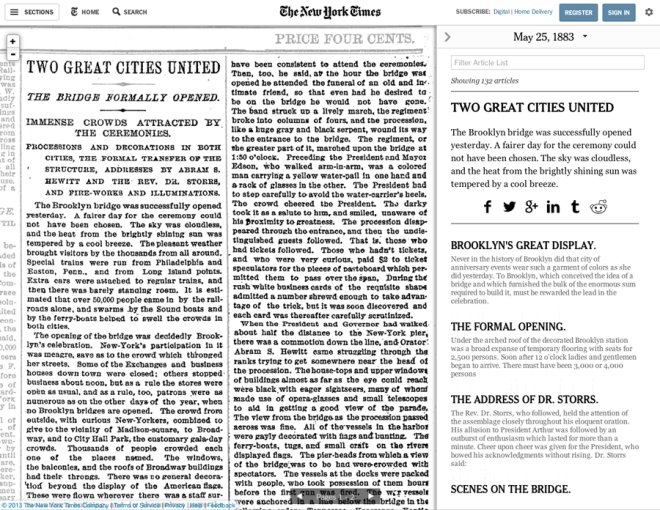
Among the most impressive new offerings: The New York Times Machine, an online experience that allowed me, in an instant, to read a story, originally published on May 25, 1883, entitled: “Two Great Cities United: Bridge Formally Opens.” From the text:

The Brooklyn Bridge was successfully opened yesterday. A fairer day for the ceremony could not have been chosen.”

Train service was extended from Easton, PA, Long Island, and other just-far-enough-away places. The service was decidedly a Brooklyn celebration. The people in New-York (at the time, the hyphen was still in common use) were less ecstatic, but showed up in the tens of thousands to join the celebration.

I know all of this because I am reading the actual printed page of the newspaper, the story in its original font, in its original presentation. I can see what happened on that day by reading other stories. There was an uprising of Italian railroad workers in Philadelphia who demanded their pay before they went back to work. The French government is having trouble with their colonial subjects in Madagascar who seem willing to “fight to the death” for their rights (The New York Times is remarkably even-handed in telling this story.) General Grant arrived in Chicago, and will leave for Galena tomorrow (in fact, that was the whole story).

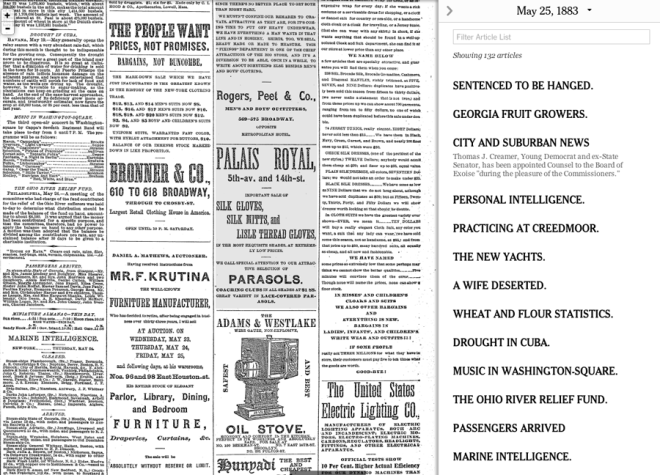
The interface is simple, and well-designed. On the left, which occupies about 3/4 of the screen, there is simply a picture of the newspaper. Click on a story, and it becomes large enough to read. (No way to copy contents just yet, but I hope that will be part of a future release.) On the right is a search window and a list of search results, each with a headline. Some stories are presented with a brief summary. Every story can be forwarded by Facebook, Twitter, Reddit, Google+, and more (this feature doesn’t work just yet, but it will soon).

After writing this initial draft of this article, I decided to explore some more. The Sunday New York Times for July 20, 1969 is filled with fascinating advertisements. I found a real zebra rug offered for just $195, marked down from $395, from Hunting World (“the sought-after high-contrast skins with the darkest stripes and the whitest backgrounds”). And now, the news… A judge in New Jersey determined that the conflict in Vietnam was, legally, a war. TV writer Jack Gould explained how television signals were transmitted from the moon. Bobby Seale led a Black Panther rally with about 3,000 people; most of them were white, and they shouted, repeatedly, “power to the people” while thrusting their fists into the air. Son House, Sleepy John Estes, Brownie McGhee, and Yank Ranchel were among the performers at the Newport Folk Festival (I wish I had been there!). Elsewhere in New England, last night, Ted Kennedy’s car ran off a bridge in Edgartown, Massachusetts, and the yet-unnamed female passenger was killed.  Ted Williams was managing the Washington Senators, host of that year’s baseball All-Star Game, celebrating the 100th anniversary of professional league play. And, the Pope, still watching black-and-white TV, arranged for a color set so that he could watch today’s Apollo moon landing. It is SO cool to see these original stories in their original form. This particular edition included over 450 stories–plus a whole lot of interesting (and not so interesting) advertisements, mostly from department stores.

The current version is a prototype (Beta version), so the range of dates and stories is very limited. Still, it’s fascinating to see what The New York Times Machine will be–and soon.

Below, a sample image. It’s far easier to read the real thing (just click here).

NYTimesMachine NYTimesMachine2