Peru: Serious Food Gaining Global Popularity

Ceviche with a Chinese influence, as served at El Tule in Lambertville, New Jersey. In the US, New Jersey is a significant population center for Peruvians. Sharing its menu with Mexican food, El Tule provides superior examples of traditional Peruvian dishes.

Start with a (non-alcoholic) iced glass of Chicha Morada, traditionally made from purple maize blended with pineapple, quinces, cinnamon and cloves. Then, have a look at the menu, a mix of traditional Latino cuisine with (of all things) Chinese influences.

Lomo Saltado is a good example of the cultural mix. Beef strips are marinated in soy sauce, vinegar, and spices, then stir-fried with tomatoes, yellow peppers, and red onions. It’s typically served with cut potatoes that resemble thick french fries, and with rice.

Why the Chinese influence? Apparently, roughly 1 in 10 people living in Peru are Chinese or claim Chinese origin. The history dates back to the 1850s, when contract workers from Macau (in the day’s vernacular, “coolies”) who replaced the slaves on the sugar plantations and guano mines. As their contracts expired in the 1860s and 1870s, they brought family, married Peruvian women, and opened small businesses, including restaurants. In fact, the largest Chinatown in Latin America is located in Lima: El Barrio Chino de Lima.

As with most Latin cuisines, the roots cross with other cultures (often, conquering cultures), but the deepest layers are native. In this vein, the ancient Carapulcra stew is based up0n a rich mix of pork, spice, a thick and richly flavored brown sauce, and potatoes.

In fact, Peruvian vegetables are fascinating in their own right, a range of vegetables that has not yet reached public markets and popular tastes in the US: caigua, or stuffing cucumber, similar to a pumpkin; yuca, also known as cassava, which replaces the potato (and must be carefully prepared to remove the toxic cyanide); and maiz morado, or purple corn. There’s an emphasis on root vegetables, and, in some cases, health benefits (explained on the linked page).

Escabeche is a Spanish dish, imported by Peru and by a large number of other Spanish-conquered nations. Meat or fish is marinated in an acidic mixture, sometimes with vinegar, sometimes with a citrus juice.

Ceviche is also common to many cultures, but Peruvians have evolved an impressive range of ceviche variations. Start with the basics: a white fish, lemon and/or lime juice (and there are all sorts of ongoing arguments about which lemon, which lime, because there are many varieties), salt, garlic, cilantro, and, often, some sort of fish concentrate. There’s a nice introduction to the Lima street version of ceviche here, and it includes some video. The roots of ceviche precede the Spanish conquest, and, according to this article, it was the Spaniards who added onions and lime. Ceviche is not easy to cook–the timing of the acid must be perfect, the balance of flavors is difficult to manage, especially in a busy restaurant kitchen.

One key ingredient, distinctive to Peru, is a spice called  huacatay.  A relative of the marigold, it’s also known as Peruvian black mint. Another is the aji, or pepper, some quite hot. Sweet potatoes are also common: recently, I tried the Peruvian version of a tamale, with mashed corn replaced by sweet potato (and excellent idea).

For more about Peruvian food, try these links:

World’s Best

The one familiar piece of local Peruvian cooking that has made its way to the US, the UK, and elsewhere is quinoa, a grain. Clearly, there’s lots more to explore. Here’s a list of restaurants and menus that specialize in traditional food from Peru:

Lima’s Taste, Greenwich Village, NY

Panca, Greenwich Village, NY

Macchu Picchu, Chicago, IL

Andina, Portland, OR

Puro Peru, Sunnyvale, CA

Aromas del Peru, Coral Gables (near Miami), FL

Sabor a Peru, Miami, FL

Ceviche, London, UK

Inca’s, New South Wales, Australia

Astrid & Gaston, various global locations, mostly in Latin America

Italian + Peruvian – Taranta, Boston

Thai + Peruvian – Thai Peru, Ventura, CA

Mexican + Peruvian – El Tule, Lambertville, NJ

As I scanned a wide range of websites, many promised that Peruvian cooking would be the next big thing. Some were old, some were new. All made me hungry.
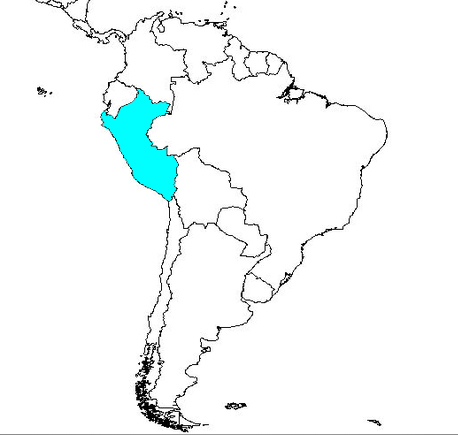
Just as a reminder, here’s Peru on the map of South America.

Gestures in a Virtual World

This slideshow requires JavaScript.

Two interesting articles, each overlapping the other, both worth reading because they may change your thinking about the ways we interact with computers and the virtual world.

The first article, from the BBC, is about surgeons in a London hospital who are learning to use voice commands and hand gestures to control medical instruments. The process, based upon Microsoft’s Kinect technology (more on this in the second article), allows greater precision and higher efficiency while eliminating some sterilization issues. For certain procedures, this “touch-less” approach to medicine is likely to become the norm within the next 10 years or so.

The second article, from the NY Times, is about Microsoft’s shift from “does not condone the modification of its products” and would “work closely with law enforcement . . . to keep Kinect tamper-resistant…” to an understanding that Kinect was going to become something greater than a videogame input device, and that Microsoft might not control the ways in which Kinect would be used in the marketplace. Eventually, Microsoft decided to release a non-game version of Kinect, still bound by a range of rules that are hopelessly out of step with today’s open-everything tech development world. The story is longish, and worth reading because, well, the article’s author said it so well:

The idea of a loosely knit band of outsider creative coders forcing a massive company to rethink a crucial new product is appealing.

I suspect both articles are the result of Microsoft’s publicity machine, both supporting an expanded view of Kinect specifically and Microsoft generally. No matter. Both are interesting, and the trend is worth a few minutes of your time. As the heat in this area increases, the keyboard, mouse, and other 20th century input devices become less likely to survive, at least in their present conception.

Stinking Bishop, or Why British Food Rules

The cheese is named for the Stinking Bishop pear, which is used to make the perry used to rinse the cheese at it ages. The cheese is soft, produced in limited quantities from the milk of once-nearly-extinct Gloucestershire cows. The great care associated with this special cheese is not unusual. In fact, special attention to local foods was a hallmark of my recent journey through the Cotswolds, the English countryside just east of Oxford. Never have I taken a trip where fresh food was so abundant, so front-and-center. If you’re still caught up in the mythology about lousy British food, reality has passed you by.

While we’re on the subject of cheese, I should note two very special cheese shops, one in the Cotswolds railroad village of Moreton-on-the-marsh (beautiful old main street, endless shops and old inns, railroad just a few blocks away). The Moreton shop is called Cotswolds Cheese Company; the one on swanky Jermyn Street in London is Paxton & Whitfield. In  Moreton, I tasted my first Single Gloucester (mild, classy and grassy, but nothing to get me excited about), and my first Double Gloucester (lots of fresh character, earthy, stronger and richer flavor), and also, a Burford (a simple, smooth cheddar). I bought a small hunk of each, a baguette and a blackcurrant-apple juice, and ate lunch on the short train trip to Oxford. In the second, I tasted Stinking Bishop and then benefitted from a very friendly cheesemonger who introduced me to several British cheeses, including an ale-washed Caerphilly that I happily munched whilst window shopping along Jermyn Street (where their London store is located). Great cheeses, all local to Britain, most produced within a two hour drive.

When I visited the Cotswolds, it was asparagus season, and, seemingly everywhere I went, delicate smoked salmon was available. I combined the two, as an appetizer, at Bourton-on-the-water’s Rose Tree Restaurant, and learned something about the taste of fresh English asparagus. It’s sweet. The taste resembles American asparagus–even my local variety here at home–but only somewhat. The flavor is delicate, and welcoming. And, apparently, May is its favorite time of year. I followed by Beef Wellington with local mushrooms and local beef. This was in keeping with another modern, organic restaurant in the same village, The Croft, where I enjoyed one of the beefiest, freshest tasting hamburgers I’ve ever eaten, and also, a tasty Steak and Ale Pie, the latter being a house speciality also available with chicken or fish. Of course, the ale was local.

If there was any lingering doubt about the quality of British country food, a visit to Daylesford Organic presented an extraordinary argument in favor of the flavor and beauty of fresh food. (To learn more, here’s a whole page filled with videos.) I wanted to try every gorgeous fruit and vegetable, then sit down for a proper dinner to enjoy the local, organic fresh meats, and then, dessert. But it was just 10 in the morning, and all I could fit into my post-breakfast appetite was a delicious little scone. Next time, I will build at least one day’s meals around a visit to Daylesford.

Back to Bourton. Here’s dinner at the Dial House, known for its local cuisine and extremely creative dishes (a completely delicious meal, worth the drive to Bourton the very next time you visit Britain):

  • Canapes – Ballantine Ham hock with cornichon (French gherkin) gel on top, smoked butter foam with poached mussels
  • Cauliflower with white truffle oil
  • Homemade – carmelized shallots with garlic and cumin
  • Salmon with lemon air with fromage blanc, keta (caviar), crispy salmon skin, panacotta and cucumber
  • Cornish Brill with cep purée (mushroom), sea aster (flower resembling a daisy)
  • Yuzu (Japanese lime/lemon) with coconut sorbet and chocolate strands
In fact, you should stay over (I did, at the Halford House, a B&B owned by the Dial and just blocks away), if for no other reason than to head for nearby Bibury and the fresh smoked trout (from the trout farm just down the road), and the excellent smoked salmon, both served at a fancy local establishment called The Swan.
Bourton-on-the-water and other Cotswolds villages are not very far from London, just about a 90 minute train ride to another world, a place largely untouched by the industrial revolution, a place whose focus is now shifting toward serious local food. One chef behind this trend is Rob Rees, a visionary I met over tea at Sudeley Castle in Wynchcombe; his unabashed promotion of the region and its stunning food is something you ought to know more about. Rob speaks eloquently about the importance of farm foods, and a local food economy, and more broadly, about the importance of proper food for growing children. He brings industry, government, and family kitchens together in ways that are altogether unique, as explained on his web site.
Oh, I nearly forgot about the side trip to Canterbury, which is on the eastern side of London (Cotswolds are on the west). Take the train to Canterbury West (there are two train stations), and when you walk out of the station, look immediately to the left. You will see an old train shed turned (six days a week) into a local farmer’s market called The Goods Shed. Sample the smoked haddock, made just outside of town, and note the smooth, non-fishy, salty-sweet flavor. Try the fruit-enhanced Florentine cookies. Taste the apple cider, also from nearby. Then, do the cathedral and your shopping, and return for dinner (here’s the spring 2012 menu). Mine included perfect scallops. The restaurant menu is built from produce available at the market.
——
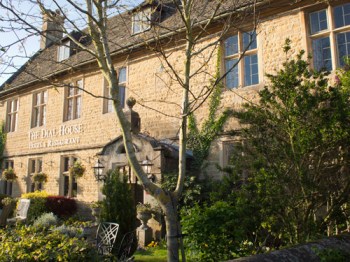
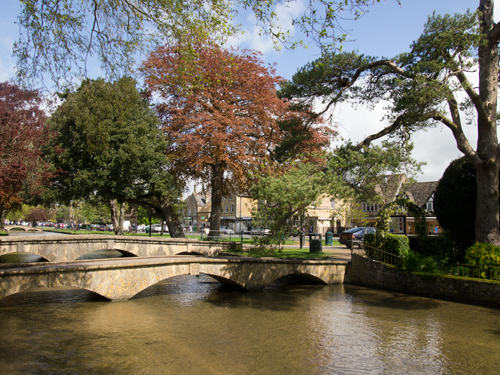
Me, I’m just back, ready to write some more about British food (a topic I never thought I would ever write about), this time from Cardiff and Pembrokeshire. More later. Meantime, enjoy Bourton-on-the-water in the photo below.

Music and Activism… A Master Class

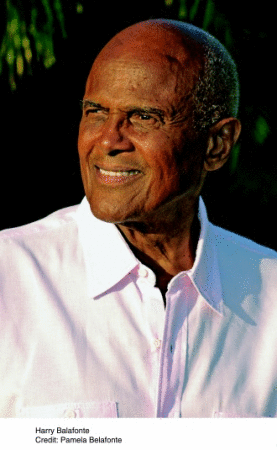
In August, 1964, $70,000 was a lot of money (it would be worth over a half-million today). Harry Belafonte filled a doctor’s bag with small bills, talked his buddy Sidney Poitier into traveling with him, and they boarded a plane from New York City bound for Jackson, Mississippi, then hopped a small Cessna for Greenwood, then drove in convoy to the Elks Lodge where they delivered the secret cash. The money was needed to keep the volunteers on site in Mississippi to encourage the Black population to register and vote. The Klan and the local police wanted the volunteers to go home. Harry and his show business friends saved the day. Turns out, this was not an altogether unusual day for Mr. Belafonte.

When I started reading Harry Belafonte’s autobiography, My Song, I didn’t know much about him. His song makes for quite a story.

No surprise that the started out poor, and became quite rich. What he did with the money, and the power of celebrity, is remarkable.

And how things happened, even more so.

The first few chapters set the scene: an angry young man who discovers the magic of theater, then tries to become an actor in New York City. He talks his way into the Dramatic Workshop at The New School for Social Research, where his classmates include Walter Matthau, Bea Arthur, Rod Steiger, Marlon Brando, Bernie Schwartz (later known as Tony Curtis), and Brando’s motorcycling buddy, Wally Cox. His early acting adventures aren’t going so well, so Belafonte is crying in his beer at the Royal Roost, a Harlem jazz club. Saxophone player Lester Young asks, “How’s your feelings?” and Harry tells him, “My feelings aren’t so good!” and Lester says “Why don’t you ask (club owner) Monte (Kay) to give you a gig?” Kay says “yes,” and Lester gives his young friend a send-off by backing Belafonte’s little intermission gig with his buddies, including Charlie Parker and Max Roach. Belafonte becomes a pop singer, and later, a folk singer specializing in music from his native Caribbean Islands, and story songs. And the list of “firsts” begins–the first Black to play the Coconut Grove in L.A., selling a spectacular number of records (competing with Elvis for the number one records in 1956, etc.), appearing on Broadway and in the movies (he had a deep crush on Dorothy Dandridge, being the first Black performer to host NBC’s Tonight Show (which he did for a full week  in 1968 with guests including Bobby Kennedy, Paul Newman, Bill Cosby, the troublesome Smothers Brothers, and Martin Luther King, Jr.) and as with any celebrity bio, the list of famous names is vast), and tremendous success in Las Vegas, first at the Rivera, then at the then-new Caesar’s Palace, and with that success, friendships with the mob.

And, then, in his words, “One day in the spring of 1956, I picked up the phone to hear a courtly southern voice. ‘You don’t know me, Mr. Belafonte, but my name is Martin Luther King, Jr.” So began a fast friendship and a very deep lifelong involvement in civil rights and social justice. With Paul Robeson as a role model, and Eleanor Roosevelt as an early friend in social reform, Belafonte agreed to perform at Carnegie Hall to raise money for the Wiltwyck School, where “mostly black children who had committed serious crimes but were too young to be incarcerated” were taught. With the Kennedy White House, his reach grew, providing guidance and often serving as a conduit between John, and more often, Robert Kennedy and the movement. He marched. He served in Martin Luther King’s kitchen cabinet, which often met at Belafonte’s Upper West Side apartment in Manhattan (Martin stayed there, too, and had his own bottle of Bristol Cream liquor for relaxing evening chats). He was King’s confidant, a close friend, and a principal fund-raiser for the entire Civil Rights movement. He was deeply involved in the SLCC and SNCC. He worked on the strategy side, and the movement benefitted from Belafonte’s gigantic rolodex and his ability to raise funds or contact celebrities for favors, often granted. He became deeply involved in improving life in Africa, first helping to build a (never built) performing arts center in Guinea, and later serving as a UN and UNICEF ambassador (replacing Danny Kaye), also with an African focus.

He introduced performers to American audiences, and helped Mariam Makeba (already a South African star) to build a powerful career. Much later, as a result of his encouragement, Fidel Castro established a facility for Cuban rap artists. But before that, it was Harry Belafonte who came up with the idea for “We are the World,” getting Michael Jackson and Lionel Ritchie and Quincy Jones involved, then fading into the background until the hard work of distributing funds to Africa was to be done, and he supervised. He helped to free Nelson Mandela, and then served as Mandela’s personal guide for his first visit to the USA, where he answered so many questions about the U.S. Civil Rights movement.

With the help of co-author Michael Shnayerson, Belafonte is a very good storyteller with a very good memory. At 84, he’s candid about his show business successes and failures, attempts to tell his version of the truth about civil rights and entertaining personalities, family matters, and his half century of therapy and shaky love and family relationships (TMI). The showbiz story is fun, but the book shines as Belafonte provides context and backstory about the day to day struggles of the American civil rights story. For that, this becomes an essential accompaniment to the Taylor Branch trilogy about Martin Luther King, Jr., and the equally remarkable (but lesser known) The Race Beat by newspaper reporters Hank Klibanoff and Gene Roberts.

(Digital) Money, Honey

We pay for just about everything with a credit card, a debit card, PayPal. Even parking meters accept card payments. Cash is dirty, difficult to store, easy to lose, and (for better or for worse) leaves no trace. The end of money has been predicted for a long time. Maybe now’s the time that money, like photographic film, drive-in theaters, and typewriters, fades away.

That’s the theory behind WIRED contributing editor David Wolman’s book, The End of Money published by Da Capo. The book is an easy read, filled with anecdotes, interesting histories, and a great many examples of alternatives to our current cash-and-coins conception of valuable exchange. Wolman points out the present system is, in fact, quite new, and that most of human history did not involve pennies, pfennigs, or pesos. He estimates that one of every twenty British coins is counterfeit. He points to cash on ice both in Alaska Senator Ted Stevens’ freezer and also in a visit to the fallen Icelandic economy. (There are so many wonderful slang terms: cold hard cash among them). He explores alternative currencies. The one about Liberty Dollars–“a private voluntary free-market currency backed entirely by silver and gold.”–is a long trip through the complexities of alternative currencies and contemporary Federal conceptions of money.

There’s discussion–not enough for my taste–about smart cards and the use of mobile devices as digital wallets. Here, the focus is on the many small daily transactions that remain cash-intensive, and the potential for a simpler, less costly, more manageable system based upon digital transactions. The upside: you’re never short a quarter for the parking meter; the downside: every time you park your car, you’re making an entry into your permanent record.

Be sure to read the crazy story. It’s just one paragraph on Wikipedia.

It’s interesting to muse on the current use of simulated currencies, if only to understand our possible future behaviors: accumulating gold coins in games, such as World of Warcraft; the possible connections between gamefied badges and currency that can be exchanged for real or virtual goods and services; the use of Quids on the (now gone?) website Superfluid, where “they’re placeholders for favors” (perhaps not unlike the favor/exchange economy that drives power and accomplishment in the nation’s capital). Where might frequent flier miles fit into the money equation? Or Disney Dollars that pay for fun in Orlando (now largely replaced by Disney Gift Cards because they yield far more digital data, and because the residue is easily converted to profit.) How about the barter economy that has been so well-nourished on the internet: you build my website, I do your taxes.

How does taxation fit into any of this? None of us love taxes, but we’ve certainly become attached to, say, our interstate highway system. I suppose most transactions will be digital, and so, there is a trackable moment of exchange, and at that moment, the tax authorities can step-in (digitally) and collect. How about pay checks? Direct deposit eliminates the old-fashioned notion of “cashing the paycheck”–and, perhaps, acknowledging the weirdness of Big Brother, preparing one’s own personal tax return may seem equally old school (armed with your entire digital financial life, the government could certainly outsource your tax return, mine to, to an outfit in Malaysia or Peru).

Are coins and cash going away? Not this year, but maybe in ten years. It’s fascinating to contemplate the possibilities. And, along the way, it’s fun to browse or read The End of Money.

It’s also fun to watch the CBS Sunday Morning report that was inspired by the book. If you can find the link, let me know and I’ll post it (couldn’t find it on the CBS Sunday Morning site).

The 21st Century Pen

Great idea no. 1: pull a quill, dip it in ink, and write on parchment. The idea lasted about a thousand years.

Great idea no. 2: figure out how the ink can be contained within the pen. After a century or so of experimentation, mass production of fountain pens began in the  1880s.

Great idea no. 3: the ballpoint pen goes on sale in 1945.

Almost great idea no. 4: LiveScribe, a pen that remembers what you wrote, when you wrote it.

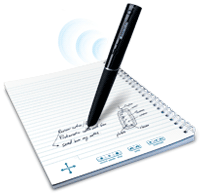
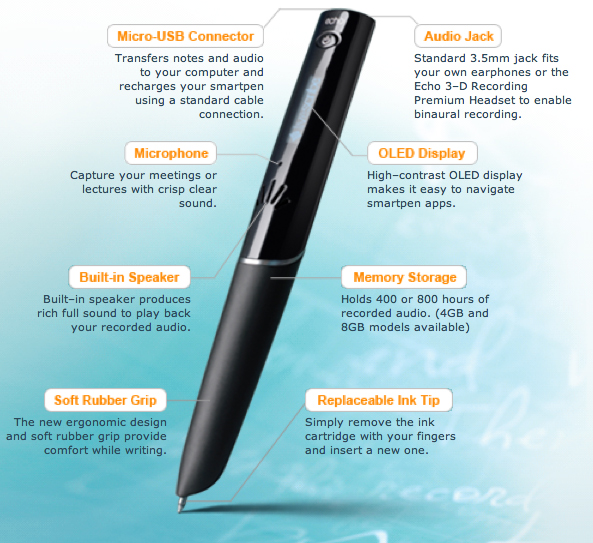
LiveScribe is, in fact, the brand name for several smart pens. The one I tried called is the Echo. Several Echo models are available for about $125-250; the difference between them is the amount of internal memory.  As you can see from the layout below, the pen records and stores up to 800 hours of audio, writes in ink, contains a small microphone and loudspeaker, and connects to your computer via USB for downloads and for charging. That’s half the story.


The other half of the story is the special paper required by the pen. It’s a tiny matrix of dots imprinted on “LiveScribe Dot Paper” available as notepads, sticky notes, journals, notebooks, sticky notes–you can even print the special paper on any laser printer. I think the notebooks are best–and I believe it is wise to invest in LiveScribe’s $25 Portfolio to keep both the pen and the notebook in a single binder so that neither strays far from the other. Both are required for LiveScribe to do its magic.

How does it work?

The Echo has an on/off button. When flipped on, I see the time and the remaining battery power. In the notebook, I find the crossed arrow and click on its center point. This causes the pen’s display to read (and the pen’s internal voice to say) “Main Menu.” Then, I choose another icon (located on every notebook 2-page spread) labelled “Record” and we’re off. The pen records audio and it also remembers what was written, by time. Press “Play” and you hear the recording. Click anywhere in your notebook’s written text and the pen will tell you when the text was written by day and date.

There are other features–and more coming as LiveScribe develops this ingenious device not only as a pen but as a portable computing platform. You can draw a small piano and play it with your pen. You can adjust date and time, configure for left or right-handed writing, adjust playback speed, calculate  (there’s a printed calculator on the inside front cover of the notebook–the result appears on the pen’s display).

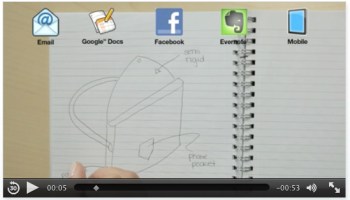
It all works well, but the display on the pen is pretty small, and it’s not easy to remember every command. You can send any page, or group of pages, to Facebook, Evernote, to your desktop, as a graphic in a text message, or as a graphic in an email. The trick is to remember how to do all of these things, especially if you don’t use these features every day. Here’s how the system works:

One more term that LiveScribe has begun to popularize: “PenCast.” That is: you write and draw with the pen, narrate your work, then package it up for viewing. It’s a bit like a traditional presentation, a bit like a conversation around a whiteboard, and it’s quite effective.

Sending the pen’s contents to your computer requires the installation of some free software as well as Adobe AIR, which is also free. Although free, the connection process is not intuitive. Here’s where the teeny screen on the pen becomes awkward, and the lack of printed “Connect to…” commands on the notebook pages results in a tedious exercise. If you don’t use the LiveScribe pen regularly, it’s very easy to forget how to send notes to email, Evernote, your desktop, etc. And when you do, the result is not an audio-visual file, but just a pdf (without the audio accompaniment). To get both, you must produce a PenCast–not hard to do, but again, you must remember the special particulars of this device. Given the large number of clickable commands in each notebook, I sure wish the “send” commands were included among them. And, I sure wish there was more visual feedback coming from the desktop software, where character counts are not limited, as they are on the pen.

One more not-wild-about-it: the pen’s tip should be covered when not in use, but the small plastic cover is small, slick, easy to use. Hopefully, a future pen design will erase this concern.

Still, this is an impressive step forward in the history of pens (seriously, this is how progress looks). As the LiveScribe community grows–and it is growing steadily–the design inefficiencies will become non-issues.

It’s interesting that this is, in essence, a paper-and-pen product, a kind of enhanced notebook system, as opposed to a fully digital solution. It’s nice to be able to take notes in a notebook, to use a pen on paper, and to know that there’s some technology to enhance the experience, and to transfer all of it to a computer for storage or sharing. It’s old-school in its way, but when you get the system working properly and you use it every day (so that the commands become natural, not tedious steps along the way), LiveScribe is an impressive product indeed.

Do You Think You Can App?


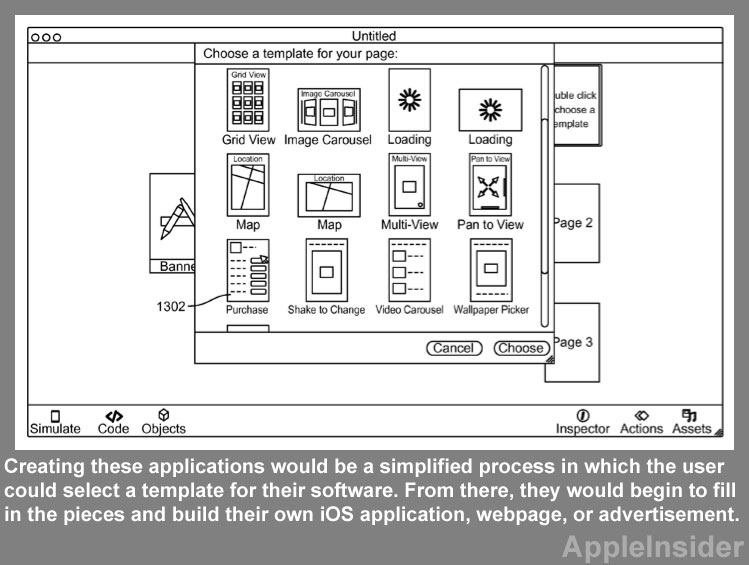
Think back to the time when you wondered whether you could desktop publish (before you knew what a “font” was), build your own website, or shoot or edit video? All of these were once unavailable to the average person. Now, Apple has filed a patent that could lead to make-your-own apps.

No surprise that message boards are filled with doubt. Making apps is too specialized, too complicated, too much of a commitment for the average person, too demanding in terms of knowledge and training and skills. Doubters point to iWeb, which was a make-your-own website tool that Apple provided, then pulled from the market.

Still, I wouldn’t dismiss the idea too quickly. No, most of us can’t or won’t build our own websites, but technology and invention race around the rocks–so we blog, and post images, and Tweet, and distribute information via tools that weren’t available the day before yesterday.

Do I want my own app? Sure, I guess, but the question suggests a solution chasing a problem.

If we flip the question, and assume, for example, that we (jointly) own an artisanal bread bakery, we might want to make it easy for our customers to know what’s baking, and what’s fresh out of the over, and we might not want to pay someone to build an app. A bake-your-own app might be just the thing for small business, or for authors who want to provide more than an eBook can easily provide, the list of potential problems that a homegrown app could solve is large. What’s more, the interactivity of a good app creates a high level of engagement between the provider and the customer, so apps could be the step beyond blogs and tweeting.

But I think there’s even more to the question. Blogs, tweets, apps–these assume current technology. And yet, we know that current technology lasts only a few years before the whole game changes. By 2015, we’ll be into advanced optical displays, a better cloud that makes the whole idea of local storage and local apps obsolete. Quite likely, we’ll be buying a broader range of devices–and I’m sure I don’t want a circa-2012 app as the my interface with thousands of internet radio stations (I really want easy-to-use internet radio in my car with lots and lots of stations from around the world).

Nothing is standing still–and that’s one of the challenges addressed in the Apple Insider article–how to build apps that easily (and automatically) customize for an increasingly varied range of devices.

Nico? On the top of the list?

On newsstands until July 25, 2012

Number 13 on the list of all-time best albums, according to Rolling Stone, is the 1967 Verve Records release, The Velvet Underground and Nico. It’s also the number 1 album on The  Observer’s 2005 list, “The 50 Albums that Changed Music,” which is, in fact, more interesting than the new Rolling Stone standalone $11.95 magazine now on newsstands.

I decided to explore the web in search of other top 500 lists, and their kin.

My very favorite list comes from the British music magazine, The Wire because it discards the arbitrary distinctions and deals with music, not categories. So we’ve got  work by Igor Stravinsky, Bessie Smith, Louis Armstrong, Jelly Roll Morton, Cecil Taylor, Lennie Tristano, Oliver Messaien next to the inevitable Stevie Wonder, Joni Mitchell, the Rolling Stones, the Beatles, and Marvin Gaye.

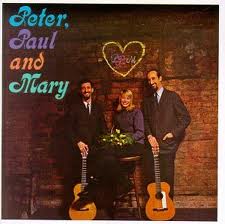
I especially like The Observer list because it acknowledges world music, beginning with their #24, Youssou N’Dour’s Immigres, and because each of the list’s entries are explained in a clever way: “Without this … N’Dour wouldn’t have met Peter Gabriel, there’d have been no African presence at Live 8. In fact, ‘world music’ would not exist as a section in Western collections.” Similarly, the Fairport Convention gets its due for introducing folk music into the British rock scene as #45, Liege and Lief, an absolutely lovely album with a lineup that includes the spectacular Sandy Denny as female lead vocalist. (Similar due should have been paid to Peter, Paul & Mary on the American / Rolling Stone side, as the celebrated Bob Dylan’s career (he occupies RS slots #4, #9, #16, #31… ten slots in all) would have mattered less without the spectacular success of their top ten single versions of Dylan’s “Blowin’ in the Wind” and “Don’t Think Twice, It’s Alright.”

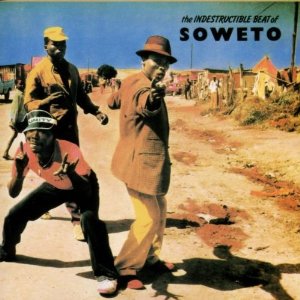
The Virgin 1000 list is fun because it is massive. And, sure enough, there’s that critically acclaimed Nico album in the top 15, with Miles Davis’s Kind of Blue nearby (these lists don’t quite know what to make of jazz, or country, or most of the other genres–no bluegrass, a bit of gospel, etc.), but every list seems to include Kind of Blue and John Coltrane’s A Love Supreme. For those who wish to explore jazz beyond the limited view of Rolling Stone and other mainstream music publications, one good starting place is an Amazon list of jazz recordings, whose top ten includes Ella Fitzgerald, Dizzy Gillespie, João Gilberto, Charles Mingus, and Thelonious Monk. An equally worthwhile list of world music recordings is also found on Amazon, a category mostly ignored by the RS list, save for Bob Marley albums, and, happily, The Indestructable Beat of Soweto, a stunning collection of South African music from the mid-1990s. On that Amazon world music list, I’m not sure that I would have placed Fela Kuti’s adventure with Cream drummer Ginger Baker at #3, but I’m sure glad to see the Bulgarian State Television Women’s Choir hanging out near Ali Farka Toure, Gal Costa, and Huun-Huur Tu, all artists with spectacular albums and names that most Americans have never heard before.

The top 200 albums on RS’s list also confused me because just three of those top 200 were made in the 21st century (Radiohead’s Kid A, Kanye West’s Late Registration, and Arcade Fire’s Funeral), just five if you go up to the top 250 (add: Green Day’s American Idiot and Eminem’s Marshall Mathers LP). Sure, there are the weird choices–that happens with any list like this–so The Zombies’ Odessey and Oracle claims slot #100, and  Quicksilver Messenger Service’s 1969 album, Happy Trails, makes it to #189.

And you know that I’m ending this article with my list of albums that Rolling Stone missed, but should have included:

  • T-Bone Walker – Complete Imperial Recordings
  • Folkways: The Original Vision – mostly songs by Leadbelly and Woody Guthrie
  • The Essential Pete Seeger – or any of the various compilations of his work for Columbia Records
  • Chet Atkins – Guitar Legend: The RCA Years
  • Peter, Paul & Mary – Moving or Album 1700 or Ten Years Together
  • Harry Nilsson – Harry and also Nilsson Sings Newman
  • Larua Nyro – Eli and the Thirteenth Confession, Gonna Take a Miracle, and the spectacular, surprising Time and Love 3-CD collection
  • Blood Sweat & Tears – their second album
  • John Sebastian – Best of, or his first solo album, John B. Sebastian
  • Billy Joel – Piano Man (among some of his best character / story work)
  • Elton John – his first album, as sweet as they come
  • Weather Report – the jazz group’s first album, self-titled
  • Van Morrison – Tupelo Honey
  • The Traveling Wilburys – their first album

Sorry my list isn’t longer or more interesting (kinda heavy on the late 1960s early 1970s–just as the RS was, in fact!). I’m writing away from home. More later on this.

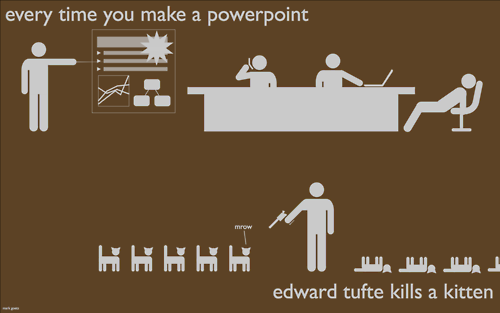
Edward Tufte Kills Two More Kittens

Last night, I was one of two keynote speakers for an innovation event. As a speaker, I’m supposed to be the teacher. Three people in the audience were fast asleep. I am their grateful student.

I spoke for over a half hour. I’m pretty sure we should pass a law, or perhaps, a constitutional amendment, that assures no speech will ever run longer than 20 minutes.

I structured my speech with over 100 clever little slides (I used Keynote, which is cooler than PowerPoint). Every visual cue was carefully tied to specific words in my written script. So I paid more attention to the script and the visuals than I did to the audience. Occasional ad-libs only made the speech longer.

The gentleman who preceded me, a college president, used Prezi. What a cool visual presentation! I remember almost nothing he said. (Too busy looking at the cool imagery.)

So here’s a digital insider take on speeches, the morning after. Just talk to the audience. Tell them what you know. Allow yourself one index card with three key points.

Anybody in the audience who want to see the charts, graphs, photos, etc., tell them to visit your website or blog. In that environment, they can study the visuals in their own time, not in a crowded auditorium. When they hear hear you talk about an important idea, they can visit your website for more information.

Which is to say: speeches are terrific for revving up the audience and introducing new ideas, but they are not very useful for detailed presentation of ideas. Websites are not a good way to rev up the audience and introduce new ideas–there is no personal touch, except, sometimes, with an extraordinary video–but for details and the day-by-day updates, they’re terrific.

I trust the guys in the back row slept well. Last night, they were the most powerful teachers in the room.

For more on Tufte/kittens:

Tufte Kitten Kill Count

Intro to Tufte:

The Visual Display of Quantitative Information

Bye Bye Bookstore (Mea Culpa)


I love bookstores. Also, record stores, art supply stores, just about any kind of store where creative work defines the merchandise.

And, I’ve been fortunate because there are three good independent bookstores less than a half-hour from my home: one in the county seat, one in a town dominated by tourists, and one in a university town that’s also an easy drive (plus, several more that sell used books).

Unfortunately, this month, we’re losing the neighborhood bookstore that’s just five minutes from home. They didn’t make it. They cite e-books, internet bookstores, and the nearby Barnes & Noble (the nearby Borders closed a few years ago). The economics confuse me. Maybe you can make sense of it all.

My family buys a lot of books: probably 40 or 50 books each year. We buy more books, for personal use, than anybody we know. Assume 50 books at $20 per book, and that’s $1,000 in retail business per year. I would be proud to say that we’ve bought all of them from our local independent booksellers, but I can’t say that because it’s not the truth. It would be fair to say that we’ve bought about 1/4 of those books while traveling (we especially like Toadstool Bookshop in New Hampshire, for example), and half of them online because of the convenience, price, or quick delivery. The other 1/4, we probably buy locally.

One good example: a biography of the old superstar, Will Rogers, priced at $24.95 in paperback from a local bookstore, available for $16.47 from Amazon (with free shipping). We’re smart consumers–we saved $8.48 because we bought from Amazon. In a year, we make this decision maybe 20 times, so maybe we save $200 per year by buying this way. As I said, we’re smart consumers.

But we’re stupid citizens. Our extra $200 per year matters to a local bookseller. If 100 customers paid the higher price instead of saving the money, that’s an additional $20,000 per year for the local bookseller. If 1,000 customers, the additional revenue nears a quarter-million dollars.

So here we are, all of us, the book lovers and the book consumers, happily saving money by shopping late at night and taking advantage of super saver shipping and the deep inventory that online booksellers provide… all the while forgetting about our neighbor, the small business person, who is spending every late night trying to figure out how to keep the local bookstore’s doors open.

When I think about this, I feel stupid. As I said, I really like bookstores, but just this morning, I ordered two books from Amazon, and I saved $7.33 on one of them and $15.78 on the other. This afternoon, I thought about visiting my local bookstore, the one that has been five minutes away from my house for the past few years.

It was closed.

I feel foolish. Why didn’t I do more to keep a community institution in place?