Traveling the world, I find myself drawn not the megapolis, but to the smaller cities where life seems so much more reasonable. The year 2018 included travel to Bulgaria, where I enjoyed Stara Zagora, an old place in the less-traveled center of the county, and in Slovenia, the charms of wandering around Ljubljana made me want to spend more time in sidewalk cafes along the old river bed. I really enjoyed my time in both Sheffield and Manchester, England, too.. And in Portsmouth, New Hampshire. Certainly, the charms of London and Paris, and New York City (we’re exploring Brooklyn like tourists) are abundant, but there is something hopeful and forward-thinking about smaller cities that have found their way in the faster-paced, deeply complicated, economically confounding 21st century.
Given endless time and money, I would explore every small city I could, and maybe that’s what I’m doing. Along the way, I’ve become quite jealous of James and Deborah Fallows, who managed not only to do the trip by traveling in their own small plane, but also visiting about two dozen small cities and writing a popular new book about their adventures. It’s called Our Towns: A 100,000 Mile Journey into the Heart of America.
What have I learned from my travels? What did they learn from their travels? Did we learn any of the same things?
- Most of these cities have a bona-fide downtown district where people shop, visit and hang out during the day, on weekends, and even at night. There are cafes, restaurants, retail open into the evening and sometimes later. I love finding the bookstore/cafe/bar that used to be a bank, the place where Tuesdays are open mic night, and people just sit around on comfy couches. One such place, the Book and Bar in Portsmouth, used to be a customs house and post office. It’s now open until midnight on Wednesday and Thursday nights, and until 1AM on Friday and Saturday nights. And it’s a great place to buy books. Food and drink are good, too.
- They are very open to people from other places, and welcome these people as neighbors. Yes, this runs counter to the nationalist thinking that dominates the national conversation. Fallows: “Cities as different as Sioux Falls, Burlington (VT), and Fresno have gone to extraordinary lengths to assimilate refugees from recent wars. Greenville (SC)’s mayor asked us to listen for how many languages we heard spoken on the streets from residents or from visitors.
- There is a research university nearby. Often, but not always. Why does this matter? The international students and faculty, which leads to international restaurants, and smart families demanding more from the community and local schools, too. This is usually tied to an appreciation of the importance of public libraries, children’s programs, and similarly positive activities and enterprises. In Manchester, there is a substantial university community. Ditto for Rochester, NY, which struggles with a proper downtown (it faded away in the 1970s, and never returned), but benefits from several neighborhoods that may qualify because of the restaurant, music, club and other activities nearly every night of the week. In this category, I would probably add a good independent film theater that sometimes shows foreign films, and, a good vinyl record store (or, several good vintage clothing shops, I guess).
- And a good community college, too. In the words of the Fallows: “Not every city can have a research university. Any ambitious one can have a community college…Just about every other world-historical trend is pushing the United States (and other countries) toward a less equal, more polarized existence: labor replacing technology, globalized trade, self-segregated residential housing patterns, and the American practice of unequal district-based funding for public schools. Community colleges are the main exception, potentially offering a a connection to higher-wage technical jobs for people who might otherwise be left with no job or one at minimum wage. East Mississippi Community College has taken people from welfare and prepared them for jobs in nearby factories that pay twice as much as local median household income. Fresno City College works with tech firms and California State University, to train the children of farmworker families (among others) for higher-tech agribusiness jobs…we saw a number of such schools that were clearly forces in the right direction. The more often and the more specifically people talk about their community college, the better we ended up feeling about the direction of that town.”
- They support several innovative schools. The specific approach or content associated with innovation seems to matter less than the imagination and bold decisions that make the school possible and allow it to thrive. It may be a specialty in technology, or mental health, or a maker culture, or it may celebrate the richness of local traditions, or global competence. The important idea here is the willingness of the community to take the time and the initiative to understand its responsibilities to the next generations, and to play an active role in their education. The Fallows celebrate “the intensity of experimentation.” As I spend time in schools throughout the world, the ones that stand out are the ones that want to stand out. For them, there is no crisis in education. There is opportunity and often success–accompanied by tremendous community involvement and authentic civic pride. You can see it on the children’s faces, you can easily observe it by watching behavior in the hallways and listening to the chatter, and, almost always, you can measure it (even with the over-the-top evaluation tools that many schools must use, regardless of their relevance to the ultimate goal of raising empowered kids).
- People share a common mythology, and most people tell the same story about their town. I first noticed this in Bulgaria–every school child knew all seven of their city’s previous names (Bulgaria has been ruled by the Turkish and other peoples for a very long time). They know the history. They use the same words and phrases to describe what is meaningful and beautiful. It’s a delightful sort of local propaganda, but it certainly builds unity and identity in a way that feels authentic. I saw this in Ljubljana, in Manchester, and in so many other places. Big city folks may treat these stories with skepticism as they point out inconsistencies and ironies, but these local belief systems are very important, and often guide small cities to do the right thing.
- National politics is over-rated, overwrought, and less interesting on a local level than national news would have us believe. In this country, coverage of ordinary people is lackluster and spotty. When you spend time in a cafe, or another public setting, you find good and decent people who care about one another and about their communities. They are concerned about what’s happening in the nation’s capital (I visited Whitesburg, Kentucky on the day of the Kavanaugh hearings, and that was a concern, but hardly the overriding concern of the day).
- A small number of people “make this town go.” They may or may not be politically ambitious. They may be educators, or religious leaders, or people in the community who care. So they build fire department buildings, make sure the hospitals are well-funded, and help people in need. They also make sure the community is engaged, and see one another at events that are both fun and meaningful. I met some of these people. The Fallows met a lot of them. We both saw the same thing–and this is probably a small city phenomenon, more difficult to achieve and sustain in a larger city. Often, the strength of partnerships between private companies and public service providers is just plain normal–not special, so it doesn’t get much attention. But it works.
- They drink local craft beer. Increasingly, according to James Fallows, the local craft brewery and its popularity is a useful indicator of city pride and city progress. Not sure I agree because we’re now seeing remote ownership of these enterprises–maybe ten or fifteen years ago, he was right. And in the places where local beer in a local brewpub is owned by, managed by, and lovingly nurtured by local dreamers, he’s spot on. Me, I look for a local maker culture, a local music culture, a local food culture (farm to table, etc.), and anything resembling a new independent bookstore. I want to see the old city bar transformed into an extremely popular and fairly priced breakfast place where college students, day workers, and politicians all order muffins, pancakes, fresh juice and fresher coffee from the same blackboard menu. That’s the place I ate breakfast in Cumberland, Maryland, a city whose history was so captivating, I spend over $20 on a picture book about its history, even though my time as a visitor was under four hours.

Muffin and Friend, Cafe Mark, Cumberland, Maryland, USA
 In theory, Americans know a lot about how we elect our leaders. In practice, we may not. Returning to basics, here’s a quick rundown on what we need to know for Tuesday.
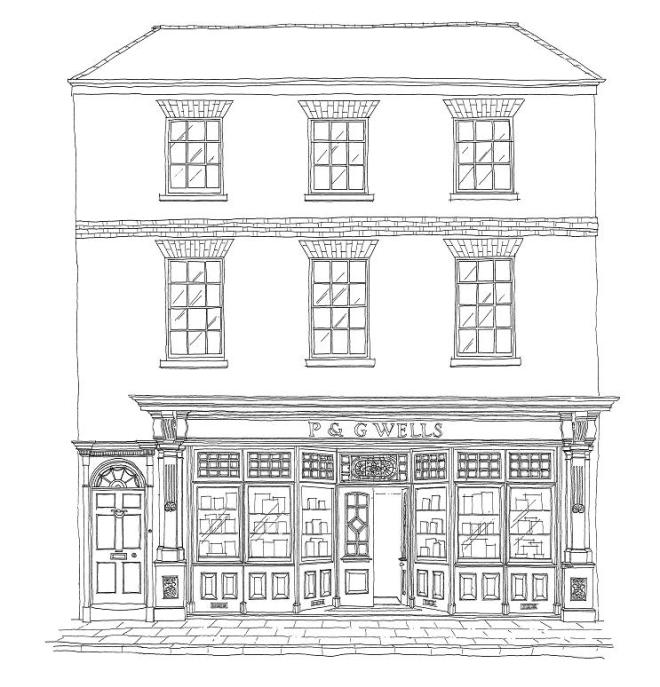
 The fun begins in York about 10,000 years ago. The Romans showed up about 2,000 years ago–certainly by 71 AD–and you can walk the
  After the Vikings, York weathered a less distinguished period. One of the worst episodes: the burning of Jews supposedly under government protection in the 1100s–an old castle is still on the site. By 1300, York was both an important government and trading center for England, and remained so until the 1500s. You can walk the streets and see medieval buildings–not unlike walking the world of Harry Potter (celebrated by several souvenir shops).

 What have I missed? The quiet pub where the World Cup semi-final victory for England was celebrated in a most dignified manner. The streets outside where everyone’s cheeks (probably both kinds) were painted with tiny English soccer flags, where people sang, loudly with with tremendous dancing exuberance, about how the Cup was “coming home.” Nearly every pub in town was pounding with energy and music–including, inexplicably, “Take Me Home Country Roads” and other boisterous (?) John Denver tunes to which every Brit seemed to know every word; the medley ended with the British (?) classic, “Cotton-Eyed Joe.” All great fun!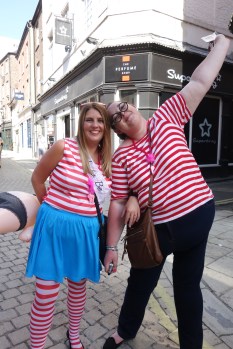



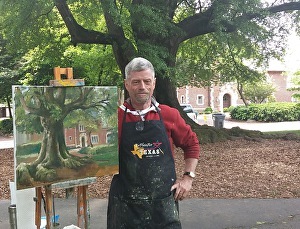 Willingness to paint outdoors requires more than straightforward skills. It requires a real desire to be part of the place that you’re painting. It’s a mindset, an attitude, a combination of willingness to be flexible and a desire to capture the light and sensibility that you cannot quite find by referring to a photograph. That’s why the book begins not with a discussion of portable easels (that comes later), but with an insightful illustrated essay posing as Chapter 1: “Why Paint Outdoors?” He focuses on the mental game and also shows himself in the game, on the street, easel set up just beside a construction site so he can get just the right view, messy paint-covered sweatshirt and slight scowl and all. He ponders how much of the work needs to be done outdoors–if you finish up indoors, which is often tempting if the weather or other conditions aren’t ideal–does a plein air painting retain its plein air status if it’s only 20 or 30 percent painted outdoors? How about 70 or 80 percent? No matter. If you do any of the work outdoors, Doherty says it counts.
 As with most books of this sort, there are profiles of artists that the author admires, and lessons to be learned from each of them. There are also good large photographs of many types of plein air paintings, useful both for inspiration and also for studying technique. I like to see a good history chapter, too, in part because it’s fun to consider myself part of a longer tradition that once included John Constable, and Jean-Baptiste Corot, and best of all, painters who were part of the majestic Hudson River School.




 Digital Insider