Digital Travel Guides and the Future of Publishing

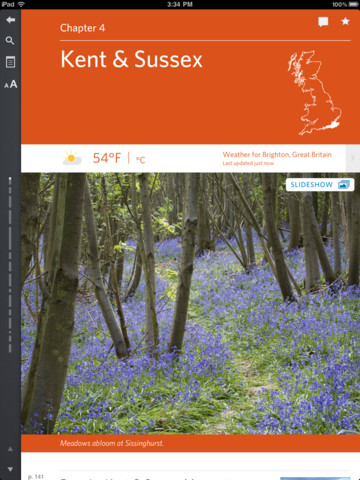
As the Kent & Sussex chapter of a traveler’s eBook begins, the page shows the current temperature. Just a hint of what’s to come in digital travel guides…

Not enough room in the suitcase? Maybe it’s time to ditch the travel guidebook and try the eBook version instead. I did, and learned a lot about what a traveler’s eBook ought to be.

Travel guides are very different from other types of fiction and nonfiction books. They are only partially read. They are intensely used, but only for a few weeks. They are out of date shortly after they are published. And if you’re doing a lot of traveling, they can become quite heavy.

An eBook on an iPad? Less weight. Full color. An opportunity to integrate with digital maps and Trip Advisor, build an itinerary, make reservations, maybe connect with chapters in history or nature books.

Well, we’re not there yet, but we are seeing the beginning of a new era in travel guides.

Lonely Planet has yet to make its big move into iPad publishing, but they offer one excellent idea: the purchase of individual chapters as PDF files for just under $5 a piece. For example, Lonely Planet’s digital England book can be purchased for $17.49, or you can buy the Devon & Cornwall chapter for $4.95. Either way, it’s mostly well-written text with very helpful guidance, plenty of links, and, take note, designed for iPhone with only with 2x magnification feature on.

Fodor’s London Travel Guide is a full-featured app with plenty of maps, color images, lists with links, and easy access to places to visit, lodgings, restaurants, and nightlife. In fact, the app is organized so that it’s easy to read the text blurb about the London Zoo, then quickly refer to a restaurant map to find Lemonia, a highly-regarded Greek restaurant nearby. Read the description of Portobello Market, click, then there it is on a full-screen map. It’s easy to use and effective.

Working with an eBook design firm called Inkling, Frommer’s offers a more ambitious take on the digital travel guide. The eBook is organized in chapters, but each chapter begins with several points of entry: favorite moments in the region, a three-day trip, a five-day journey, favorite sites to visit, popular destinations in detail, and more. Choose the Cotswolds village of Moreton-on-the-Marsh and there’s a well-written description of the village, tips about what’s nearby, quick access to area maps, and an overall design that’s clearly designed for digital devices. This series is called “Day by Day”, so I expected an itinerary planner to coordinate with my iPad’s Calendar app. That’s not yet a feature, but I suspect it was discussed during this superior product’s design phases.

I used all three guides, often and successfully, and never once missed the books that I did not carry with me. My favorite: Frommer’s. But I suspect that next week’s BookExpo will find publishers to introducing the next generation of interactive travel guides.

What’s next? Certainly, full integration with Google Maps, Trip Advisor, Kayak and other reservations systems, Calendar, email. Those seem to be within reach, but they only scratch the surface of what could be done. There’s a gigantic social network opportunity here, whether it’s couch surfing or house swapping, or simply asking whether anybody in the Pembrokeshire area feels like taking a hike today. Right now, publishers are cautiously experimenting with books that become books on screens, but this caution may result in the demise of yet another industry. Travel publishers possess a unique opportunity to bring places to life, to involve community members (think Zagat’s but on a massive scale), to truly invent the future of publishing on a large, interactive scale. It’s interesting to contemplate whether this work can be done, or will be done, by travel publishers owned by much larger publishing conglomerates, or whether smaller, more flexible and potentially more innovative publishers will map this particular journey into the future.

Stinking Bishop, or Why British Food Rules

The cheese is named for the Stinking Bishop pear, which is used to make the perry used to rinse the cheese at it ages. The cheese is soft, produced in limited quantities from the milk of once-nearly-extinct Gloucestershire cows. The great care associated with this special cheese is not unusual. In fact, special attention to local foods was a hallmark of my recent journey through the Cotswolds, the English countryside just east of Oxford. Never have I taken a trip where fresh food was so abundant, so front-and-center. If you’re still caught up in the mythology about lousy British food, reality has passed you by.

While we’re on the subject of cheese, I should note two very special cheese shops, one in the Cotswolds railroad village of Moreton-on-the-marsh (beautiful old main street, endless shops and old inns, railroad just a few blocks away). The Moreton shop is called Cotswolds Cheese Company; the one on swanky Jermyn Street in London is Paxton & Whitfield. In  Moreton, I tasted my first Single Gloucester (mild, classy and grassy, but nothing to get me excited about), and my first Double Gloucester (lots of fresh character, earthy, stronger and richer flavor), and also, a Burford (a simple, smooth cheddar). I bought a small hunk of each, a baguette and a blackcurrant-apple juice, and ate lunch on the short train trip to Oxford. In the second, I tasted Stinking Bishop and then benefitted from a very friendly cheesemonger who introduced me to several British cheeses, including an ale-washed Caerphilly that I happily munched whilst window shopping along Jermyn Street (where their London store is located). Great cheeses, all local to Britain, most produced within a two hour drive.

When I visited the Cotswolds, it was asparagus season, and, seemingly everywhere I went, delicate smoked salmon was available. I combined the two, as an appetizer, at Bourton-on-the-water’s Rose Tree Restaurant, and learned something about the taste of fresh English asparagus. It’s sweet. The taste resembles American asparagus–even my local variety here at home–but only somewhat. The flavor is delicate, and welcoming. And, apparently, May is its favorite time of year. I followed by Beef Wellington with local mushrooms and local beef. This was in keeping with another modern, organic restaurant in the same village, The Croft, where I enjoyed one of the beefiest, freshest tasting hamburgers I’ve ever eaten, and also, a tasty Steak and Ale Pie, the latter being a house speciality also available with chicken or fish. Of course, the ale was local.

If there was any lingering doubt about the quality of British country food, a visit to Daylesford Organic presented an extraordinary argument in favor of the flavor and beauty of fresh food. (To learn more, here’s a whole page filled with videos.) I wanted to try every gorgeous fruit and vegetable, then sit down for a proper dinner to enjoy the local, organic fresh meats, and then, dessert. But it was just 10 in the morning, and all I could fit into my post-breakfast appetite was a delicious little scone. Next time, I will build at least one day’s meals around a visit to Daylesford.

Back to Bourton. Here’s dinner at the Dial House, known for its local cuisine and extremely creative dishes (a completely delicious meal, worth the drive to Bourton the very next time you visit Britain):

  • Canapes – Ballantine Ham hock with cornichon (French gherkin) gel on top, smoked butter foam with poached mussels
  • Cauliflower with white truffle oil
  • Homemade – carmelized shallots with garlic and cumin
  • Salmon with lemon air with fromage blanc, keta (caviar), crispy salmon skin, panacotta and cucumber
  • Cornish Brill with cep purée (mushroom), sea aster (flower resembling a daisy)
  • Yuzu (Japanese lime/lemon) with coconut sorbet and chocolate strands
In fact, you should stay over (I did, at the Halford House, a B&B owned by the Dial and just blocks away), if for no other reason than to head for nearby Bibury and the fresh smoked trout (from the trout farm just down the road), and the excellent smoked salmon, both served at a fancy local establishment called The Swan.
Bourton-on-the-water and other Cotswolds villages are not very far from London, just about a 90 minute train ride to another world, a place largely untouched by the industrial revolution, a place whose focus is now shifting toward serious local food. One chef behind this trend is Rob Rees, a visionary I met over tea at Sudeley Castle in Wynchcombe; his unabashed promotion of the region and its stunning food is something you ought to know more about. Rob speaks eloquently about the importance of farm foods, and a local food economy, and more broadly, about the importance of proper food for growing children. He brings industry, government, and family kitchens together in ways that are altogether unique, as explained on his web site.
Oh, I nearly forgot about the side trip to Canterbury, which is on the eastern side of London (Cotswolds are on the west). Take the train to Canterbury West (there are two train stations), and when you walk out of the station, look immediately to the left. You will see an old train shed turned (six days a week) into a local farmer’s market called The Goods Shed. Sample the smoked haddock, made just outside of town, and note the smooth, non-fishy, salty-sweet flavor. Try the fruit-enhanced Florentine cookies. Taste the apple cider, also from nearby. Then, do the cathedral and your shopping, and return for dinner (here’s the spring 2012 menu). Mine included perfect scallops. The restaurant menu is built from produce available at the market.
——
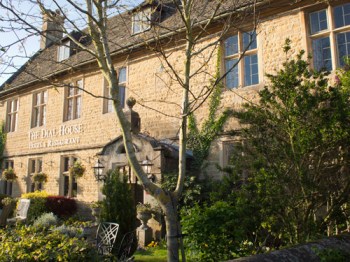
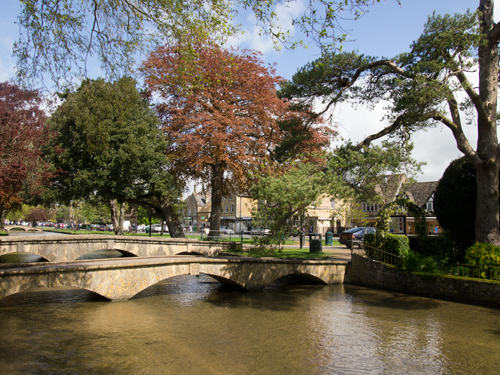
Me, I’m just back, ready to write some more about British food (a topic I never thought I would ever write about), this time from Cardiff and Pembrokeshire. More later. Meantime, enjoy Bourton-on-the-water in the photo below.

Music and Activism… A Master Class

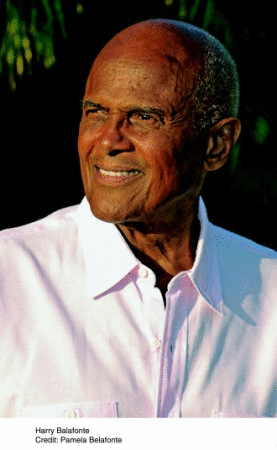
In August, 1964, $70,000 was a lot of money (it would be worth over a half-million today). Harry Belafonte filled a doctor’s bag with small bills, talked his buddy Sidney Poitier into traveling with him, and they boarded a plane from New York City bound for Jackson, Mississippi, then hopped a small Cessna for Greenwood, then drove in convoy to the Elks Lodge where they delivered the secret cash. The money was needed to keep the volunteers on site in Mississippi to encourage the Black population to register and vote. The Klan and the local police wanted the volunteers to go home. Harry and his show business friends saved the day. Turns out, this was not an altogether unusual day for Mr. Belafonte.

When I started reading Harry Belafonte’s autobiography, My Song, I didn’t know much about him. His song makes for quite a story.

No surprise that the started out poor, and became quite rich. What he did with the money, and the power of celebrity, is remarkable.

And how things happened, even more so.

The first few chapters set the scene: an angry young man who discovers the magic of theater, then tries to become an actor in New York City. He talks his way into the Dramatic Workshop at The New School for Social Research, where his classmates include Walter Matthau, Bea Arthur, Rod Steiger, Marlon Brando, Bernie Schwartz (later known as Tony Curtis), and Brando’s motorcycling buddy, Wally Cox. His early acting adventures aren’t going so well, so Belafonte is crying in his beer at the Royal Roost, a Harlem jazz club. Saxophone player Lester Young asks, “How’s your feelings?” and Harry tells him, “My feelings aren’t so good!” and Lester says “Why don’t you ask (club owner) Monte (Kay) to give you a gig?” Kay says “yes,” and Lester gives his young friend a send-off by backing Belafonte’s little intermission gig with his buddies, including Charlie Parker and Max Roach. Belafonte becomes a pop singer, and later, a folk singer specializing in music from his native Caribbean Islands, and story songs. And the list of “firsts” begins–the first Black to play the Coconut Grove in L.A., selling a spectacular number of records (competing with Elvis for the number one records in 1956, etc.), appearing on Broadway and in the movies (he had a deep crush on Dorothy Dandridge, being the first Black performer to host NBC’s Tonight Show (which he did for a full week  in 1968 with guests including Bobby Kennedy, Paul Newman, Bill Cosby, the troublesome Smothers Brothers, and Martin Luther King, Jr.) and as with any celebrity bio, the list of famous names is vast), and tremendous success in Las Vegas, first at the Rivera, then at the then-new Caesar’s Palace, and with that success, friendships with the mob.

And, then, in his words, “One day in the spring of 1956, I picked up the phone to hear a courtly southern voice. ‘You don’t know me, Mr. Belafonte, but my name is Martin Luther King, Jr.” So began a fast friendship and a very deep lifelong involvement in civil rights and social justice. With Paul Robeson as a role model, and Eleanor Roosevelt as an early friend in social reform, Belafonte agreed to perform at Carnegie Hall to raise money for the Wiltwyck School, where “mostly black children who had committed serious crimes but were too young to be incarcerated” were taught. With the Kennedy White House, his reach grew, providing guidance and often serving as a conduit between John, and more often, Robert Kennedy and the movement. He marched. He served in Martin Luther King’s kitchen cabinet, which often met at Belafonte’s Upper West Side apartment in Manhattan (Martin stayed there, too, and had his own bottle of Bristol Cream liquor for relaxing evening chats). He was King’s confidant, a close friend, and a principal fund-raiser for the entire Civil Rights movement. He was deeply involved in the SLCC and SNCC. He worked on the strategy side, and the movement benefitted from Belafonte’s gigantic rolodex and his ability to raise funds or contact celebrities for favors, often granted. He became deeply involved in improving life in Africa, first helping to build a (never built) performing arts center in Guinea, and later serving as a UN and UNICEF ambassador (replacing Danny Kaye), also with an African focus.

He introduced performers to American audiences, and helped Mariam Makeba (already a South African star) to build a powerful career. Much later, as a result of his encouragement, Fidel Castro established a facility for Cuban rap artists. But before that, it was Harry Belafonte who came up with the idea for “We are the World,” getting Michael Jackson and Lionel Ritchie and Quincy Jones involved, then fading into the background until the hard work of distributing funds to Africa was to be done, and he supervised. He helped to free Nelson Mandela, and then served as Mandela’s personal guide for his first visit to the USA, where he answered so many questions about the U.S. Civil Rights movement.

With the help of co-author Michael Shnayerson, Belafonte is a very good storyteller with a very good memory. At 84, he’s candid about his show business successes and failures, attempts to tell his version of the truth about civil rights and entertaining personalities, family matters, and his half century of therapy and shaky love and family relationships (TMI). The showbiz story is fun, but the book shines as Belafonte provides context and backstory about the day to day struggles of the American civil rights story. For that, this becomes an essential accompaniment to the Taylor Branch trilogy about Martin Luther King, Jr., and the equally remarkable (but lesser known) The Race Beat by newspaper reporters Hank Klibanoff and Gene Roberts.

(Digital) Money, Honey

We pay for just about everything with a credit card, a debit card, PayPal. Even parking meters accept card payments. Cash is dirty, difficult to store, easy to lose, and (for better or for worse) leaves no trace. The end of money has been predicted for a long time. Maybe now’s the time that money, like photographic film, drive-in theaters, and typewriters, fades away.

That’s the theory behind WIRED contributing editor David Wolman’s book, The End of Money published by Da Capo. The book is an easy read, filled with anecdotes, interesting histories, and a great many examples of alternatives to our current cash-and-coins conception of valuable exchange. Wolman points out the present system is, in fact, quite new, and that most of human history did not involve pennies, pfennigs, or pesos. He estimates that one of every twenty British coins is counterfeit. He points to cash on ice both in Alaska Senator Ted Stevens’ freezer and also in a visit to the fallen Icelandic economy. (There are so many wonderful slang terms: cold hard cash among them). He explores alternative currencies. The one about Liberty Dollars–“a private voluntary free-market currency backed entirely by silver and gold.”–is a long trip through the complexities of alternative currencies and contemporary Federal conceptions of money.

There’s discussion–not enough for my taste–about smart cards and the use of mobile devices as digital wallets. Here, the focus is on the many small daily transactions that remain cash-intensive, and the potential for a simpler, less costly, more manageable system based upon digital transactions. The upside: you’re never short a quarter for the parking meter; the downside: every time you park your car, you’re making an entry into your permanent record.

Be sure to read the crazy story. It’s just one paragraph on Wikipedia.

It’s interesting to muse on the current use of simulated currencies, if only to understand our possible future behaviors: accumulating gold coins in games, such as World of Warcraft; the possible connections between gamefied badges and currency that can be exchanged for real or virtual goods and services; the use of Quids on the (now gone?) website Superfluid, where “they’re placeholders for favors” (perhaps not unlike the favor/exchange economy that drives power and accomplishment in the nation’s capital). Where might frequent flier miles fit into the money equation? Or Disney Dollars that pay for fun in Orlando (now largely replaced by Disney Gift Cards because they yield far more digital data, and because the residue is easily converted to profit.) How about the barter economy that has been so well-nourished on the internet: you build my website, I do your taxes.

How does taxation fit into any of this? None of us love taxes, but we’ve certainly become attached to, say, our interstate highway system. I suppose most transactions will be digital, and so, there is a trackable moment of exchange, and at that moment, the tax authorities can step-in (digitally) and collect. How about pay checks? Direct deposit eliminates the old-fashioned notion of “cashing the paycheck”–and, perhaps, acknowledging the weirdness of Big Brother, preparing one’s own personal tax return may seem equally old school (armed with your entire digital financial life, the government could certainly outsource your tax return, mine to, to an outfit in Malaysia or Peru).

Are coins and cash going away? Not this year, but maybe in ten years. It’s fascinating to contemplate the possibilities. And, along the way, it’s fun to browse or read The End of Money.

It’s also fun to watch the CBS Sunday Morning report that was inspired by the book. If you can find the link, let me know and I’ll post it (couldn’t find it on the CBS Sunday Morning site).

Food: The Meta-layer

Past few months, everybody’s talking about the meta-layer. We don’t just watch TV. We add a meta-layer, tweeting about the Academy Awards, commenting on comments–ideas piled on ideas. We’re learning to comment on everything, with or without the requisite knowledge of the facts involved, rarely with the research needed to form a coherent opinion.

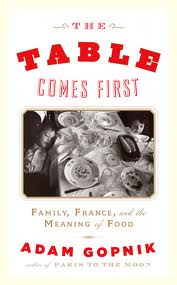
Not so with Mr. Gopnik, whose past stories about his young family’s life in Paris (Paris to the Moon) and their return to Manhattan (Through the Children’s Gate) are among my most-recommended books, and whose 2011 book, The Table Comes First: Family, France, and the Meaning of Food has provided several months of nourishing food for thought, or thoughts about food, probably some of each.

Where did restaurants come from? Who came up with the idea of not just eating outside the home, but dining there? (Long answer, begins around the French revolution). Quite rightly, he compares the restaurant customer to an aristocrat, accustomed to being served (and served beautifully). Gopnik delights in grazing through the thoughts of Brillat-Savarin and Grimod–two early, influential writers about food and dining–but I like the bit that he found in Robert Frost best:

“Home is a place where, when you have to go there, they have to take you in. A restaurant is a place where, when you go there, they not only have to take you in but act as though they were glad to see you. In cities of strangers, this pretense can be very dear.”

This is a book in which New Yorker writer Adam Gopnik thinks about food, and thinks about how others think, and have thought, about food. He goes deep, with some chapters so mired in philosophy or history that they eventually become indigestible. Fortunately, these are exceptions. And when the going becomes thick, he pauses for to write an email to Elizabeth Pennell, who wrote with intelligence and wisdom about food about a century ago; these chatty emails cover the true benefits of cinnamon, the best ways to cook lamb, the extraordinary use of hot air in the hard-to-find and hard-to-cook pommel soufflés, his dog Butterscotch’s love for steak, and other lighthearted stuff.

Adam Gopnik is a regular contributor to The New Yorker.

This is not a book to read over a single meal. It is, instead, book to be savored, bit by bit, over several months. There is simply too much information, too many glimpses and meta ideas, too much richness and provocation and serious research, to be enjoyed quickly. It is slow food for the brain–imagine that, in an era of emails and tweets–much of it about topics I’ve never really thought much about.

For example, Gopnik compares “cook it at home” recipe books that restaurants sell with the home game version of, say, Hollywood Squares. Certainly, there is a resemblance, but the resources and the spicing are entirely different, and so is the experience. He tells a long and funny/odd story about his search for a live chicken that can be purchased, cooked, and eaten within the bounds of New York City, and another about the cleverness of farming tilapia to feed large urban populations, then adds the zesty meta-layer, invoking Adam Smith and the total cost associated with what he believes to be a current fad for localism. And so:

“If Kenyan greens take less total energy than Plattsburgh tomatoes, then we should revel in them no matter how far they have to travel.”

And so it goes, through questions about whether we really can taste the differences between wines (or whether the situation and the artifice overpower the actual human capacity for taste), the imperfection of memory as it applies to the fancy French restaurants of 20th century Manhattan, why sugar was used mostly to flavor tea in England but became the impetus for the pasty industry in France, the various ethical arguments for and against the slaughter of animals for human consumption, and so much more.

As with his own food choices–today, spicy beans and rice, tomorrow, a complicated and challenging attempt at a classic French dish from a century ago–some sections are rich with friendly storytelling and some are thick with pretense, serious thinking, and historical reconsiderations. Unlike Twitter, you need not absorb every idea in an instant. There is time enough to consider the meta-layer, to appreciate the fine writing that has long been Gopnik’s strong suit, time enough to think about what Gopnik has said about what others have said and done, and perchance, to learn something about their ideas by reading Brillat-Savarin in the original (on my list, but not for this year).

1 in 25 Work as Creative Pros

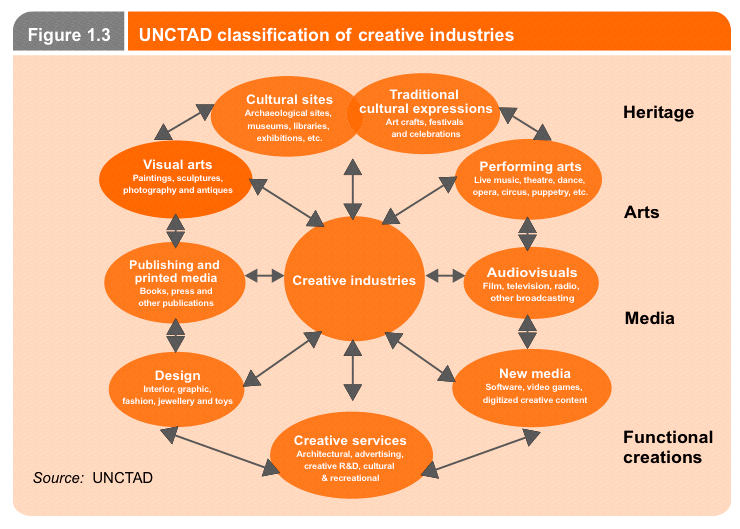
Above, an elegant way to think about the global creative economy, as presented in a 400+ page United Nations report.

1 in 25 people–that’s the revised figure for 2010–work in creative industries in the U.S. More than doctors, lawyers, even accountants. Industry sectors above, details below.

In the United States, roughly 150 million people work full-time. Six million of us work in creative professions. We’re writers and performers; musicians and visual artists; marketers and strategists; architects and specialists who invent, improve, or bring ideas to life. In total, more people work as creative professionals in the U.S. than doctors (700,000), lawyers (800,000), accountants (1,300,000), and engineers (1,600,000) combined. The number of creative professionals exceeds the number of teachers (3,500,000 teachers pre-K through high school, plus 1,700,000 more who teach in colleges and universities).

Our output–which provides employment for lawyers, accountants, executives, retailers, and many others–is responsible for more than ten percent of the U.S. Gross Domestic Product.

A reasonable global workforce estimate would exceed 10 million creative professionals. Nations with significant creative economies include Germany, the United Kingdom, France, Italy, the Netherlands, Ireland, Japan, China, India, Canada, Australia, and, among countries with developing industries, Mexico, Thailand, Indonesia, Argentina, Singapore, and Chile. According to the United Nations Creative Economy 2008 report, the export value of creative in 2005 was over $300 billion, or about 2-3% of the global economy. (Yes, I am reviewing the 423 pages of the 2010 report to update these figures–overall, trends are up).

The long list of creative industries was nicely summarized in the 2008 U.N. report, presented at a United Nations Conference on Trade and Development. The orange version, above, makes it all that much more clear.

Within each of these clusters, the professional model is similar. Projects are developed, produced, and distributed. Mostly, revenues are generated through direct transactions with individual consumers (movie admissions; DVDs; iTunes downloads;physical goods such as jewelry), sometimes through subscriptions; or by advertising to consumers who receive goods and services by paying only a modest transaction fee (magazine subscriptions), or no fee at all (most internet sites; broadcast radio and TV).

You can download the 2010 UN report here. (Yes, I will update my 2008 numbers when time permits.)

Paco de Lucia – One Summer Night…

Paco de Lucia was born Francisco Sánchez Gómez in 1947 in Algeciras, a southern port city in Spain. He learned the guitar from his father, his brother, and family friend Niño de Ricardo, a virtuoso. By age 7, de Lucia was playing flamenco guitar; by 12, he was recording. Before his teen years, he had won several guitar competitions. By 13, de Lucia was touring internationally with José Greco’s flamenco show. He started composing and playing backup for various Spanish singers, notably the great Gypsy singer (or cantador) Camarón de la Isla, with whom de Lucia worked from the late 1960s until the early 1990s. In addition to leading his own group, de Lucia has collaborated on projects with John McLaughlin, Chick Corea, Al di Meola, and even Placido Domingo. De Lucia is widely regarded as the finest living flamenco guitarist—and one of several musicians who has modernized the classic Spanish form.

Here’s the thrilling, no-holds-barred, blazing-guitar, high-energy concert recording that caused many rock fans to pay attention to a flamenco guitar player. Recorded by de Lucía’s Sextet in 1983, it’s terrific ensemble work with de Algeciras, a flutist named Jorge Pardo, and an equally facile percussionist, Rubem Dantas. John McLaughlin composed a pretty intro to “Alta Mar,” and “Chiquito” is dedicated to Chick Corea; listen for strong 1980s jazz/fusion influences in de Lucía’s interplay with electric bassist Carlos Benavent, and the flute and guitar arrangement that begins “Gitanos Andaluces.” But it all comes back to de Lucía’s straight flamenco.

http://www.amazon.com/Live-Summer-Night-Paco-Lucia/dp/B0000046UR