Google Books vs. Every Published Author, Part I

I have written several books. Perhaps you have purchased one of them. If you did, thank you. As a result of your purchase, I probably collected about $1.25 in royalties. You may have read the book, and perhaps, you lent it to a friend. You may have copied a few pages, or used the book for research, maybe even quoted from my book in your own work. That’s fine with me, and I am sure it would be fine with just about any author.

Of course, I wouldn’t expect you to make copies of the book and distribute it, for free or for a fee, and I certainly wouldn’t expect you to publish some or all of my book’s contents on the web–even if you believed that what you were doing would make the world a better place. I expect that you think about my book in much the same way.

Denny_ChinHowever reasonable, that’s no longer the way things work. Now, it seems, making the world a better place is reason enough to freely distribute copyrighted work without permission of the copyright holder. Here’s the logic and the new law of the land as set forth by U.S. Circuit Court Judge Denny Chin in a case decided this month in favor of Google (which scanned and distributed millions of books, without permission, in the public interest) and the Author’s Guild (which cried foul, lost, plans to appeal to a higher court, and may lose again).

“First, Google Books provides a new and efficient way for readers and researchers to find books. It makes tens of millions of books searchable by words and phrases. It provides a searchable index linking each word in any book to all books in which that word appears.” In short, Google Books completely transforms the use of books, especially in research, and it is currently in use in a great many research institutions.

Second, in addition to being an important reference tool, Google Books greatly promotes a type of research referred to as “data mining” or “text mining.” Google Books permits humanities scholars to analyze massive amounts of data — the literary record created by a collection of tens of millions of books. Researchers can examine word frequencies, syntactic patterns, and thematic markers to consider how literary style has changed over time.” So it’s fair to say that Google Books is a fantastic tool for scholars because it allows them to scan a lot of books quickly, identify and study patterns.

“Third, Google Books expands access to books. In particular, traditionally underserved populations will benefit as they gain knowledge of and access to far more books. Google Books provides print-disabled individuals with the potential to search for books and read them in a format that is compatible with text enlargement software, text-to-speech screen access software, and Braille devices. Digitization facilitates the conversion of books to audio and tactile formats, increasing access for individuals with disabilities. Google Books facilitates the identification and access of materials for remote and underfunded libraries that need to make efficient decisions as to which resources to procure for their own collections or through interlibrary loans.” Unquestionably, placing a lot of books in a gigantic database is very useful for all sorts of reasons and provides tremendous public interest benefits.

“Fourth…Google Books helps to preserve books and give them new life. Older books, many of which are out-of-print books that are falling apart buried in library stacks, are being scanned and saved.” Absolutely right, but “out-0f-print” and “public domain” are not the same thing. Many of my books are currently out-of-print, and I plan to republish some of them because they are my property. Anything that is in the public domain should be rescued for the good of the public. Anything that’s out-of-print, but still protected by copyright, cannot be reasonably treated in the same way.

“Finally, by helping readers and researchers identify books, Google Books benefits authors and publishers. When a user clicks on a search result and is directed to an “About the Book” page, the page will offer links to sellers of the book and/or libraries listing the book as part of their collections.” That’s nice, but let’s consider whether the copyrighted work should be there in the first place.

Somewhere along the way, my books were published, and a public library purchased a copy. We all understand that the library will buy one copy of the book and then distribute that book to any of its cardholders. Neither the publisher nor I, the author, granted the library any kind of right to digitize the book’s contents. Google borrowed my book from the library, scanned its contents (without my permission) and now distributes one book in whole and another in part (without my permission). And because my book is a useful book, a Federal judge has determined that this activity is not only permissible, but in the public interest.

The judge’s justification: the Fair Use doctrine that allows certain uses of copyrighted materials for the public interest. For more about that, be sure read part two (and part three).

Did somebody say “Giverny?”

I just stumbled onto a cache of more than 600 recent photos of Giverny, Monet’s home, surrounding town, delicious-looking French desserts, and watercolors. Not a bad way to end the day. Thought you would enjoy a look, in particular as an accompaniment to the previous blog post about this magical place.

Be sure to browse not only the photo collection but also the Paris Breakfasts blog, about which I will write a great deal at some point in the future.

Have fun!

Giverny-return

Goodbye, Columbus

Juan Ponce de León discovered "America" but Columbus gets the credit!

Juan Ponce de León discovered “America” but Columbus gets the credit!

(Hello, Ponce de León. What a story you have to tell! Those who are impatient may scroll down about 2/3 to the part I’ve marked in red white (grey, really) and blue.

It’s an odd story, one that brings tomatoes to Italy,, and eventually celebrates a favorite son for something he didn’t do.

You know that the Vikings first showed up in what is now North America. That happened about a thousand years ago. Some Vikings stayed for awhile, started families, and settlements.  The first child of European descent born on these shores was probably named “Snoori,” a name I’ve always liked.

For several thousand years before the Vikings visited, there were natives in North America and South America. They probably arrived, well, by taking the l-o-n-g way around, on foot and on animal, working their way up from Africa, then through Asia, and across the land bridge into what is now Alaska. Perhaps they arrived in other ways, but that seems less likely because boats were small and unsophisticated, and oceans were large and dangerous to navigate.

During the 1400s, Europeans were becoming rich by trading goods found in Asia. Mostly, these goods traveled on the Silk Roads, a series of trade routes that were subject to piracy, tribal feuds, and every kind of evil deed. There were all sorts of theories about the best way to travel not by land, but by sea. Nobody was particularly frightened about falling off the earth; the idea that the world was round, and that circumnavigation was possible was accepted long before Columbus showed up. (It’s one of the earliest urban legends, utter nonsense promoted in fanciful children’s books for a time.)

Columbus was an entrepreneur in search of capital for his new enterprise–put together half the necessary funds, and found the rest by sweet-talking King Ferdinand and Queen Isabella of Spain. They promised him a cut of the riches, and a ridiculous title, Emperor of the Ocean Seas. And they agreed to provide three ships. All for the glory of Spain, and the gold that everyone believed he would find. Make no mistake: it was all about the gold.

He took a wrong turn.

He was heading for what he believed was Japan, or, at least, Asia. Instead, he found an island in what is now the Caribbean Sea. (Certainly, Columbus Day should not be celebrated as a milestone in navigation history.)

Remember: Columbus was an entrepreneur. Perhaps it is that spirit that we should celebrate on Columbus Day. Certainly, there are very good reasons not to celebrate him at all, unless, of course, you share a very dark view of America and what it represents to the world.

Columbus kept a diary. Here, he writes about the native people, the Taino or Arawak people who greeted his crew with curiosity and apparent kindness.

They are very simple and honest and exceedingly liberal with all they have, none of them refusing anything he may possess if he is asked for it. They exhibit great love toward all others in preference to themselves.”

You’ll recall the Nina, the Pinta and the Santa Maria–the three ships provided by Spain for the first voyage. The Pinta’s captain defied Columbus’ orders, and abandoned the fleet. The Santa Maria was destroyed on a reef. Columbus high-tailed it back to Spain on the Nina, grabbing a bit of gold, kidnapping some natives. A second voyage was authorized, this time with the specific intention of becoming rich with gold. The Taino people were instructed, in no uncertain terms, to FIND THE GOLD.

Dressed in Taino garb and makeup, two contemporary Dominican girls demonstrate that these were real people with families and traditions. Each year, we celebrate an American hero who killed most of the Taino people.

Dressed in Taino garb and makeup, two contemporary Dominican girls demonstrate that these were real people with families and traditions. Each year, we celebrate an American hero who killed most of the Taino people.

Gold was not to be found. Columbus treated the Taino severely. He cut off their hands (Happy Columbus Day!)

Third Voyage. This time, a Priest named Bartolomé de las Casas joined, and kept a diary. It’s filled with documentation, generally considered reliable, about Columbus’ treatment of the natives: forced labor, brutality, horrific violence against children, babies being murdered by swinging them against trees or feeding them to dogs. From the Priest’s diary:

The Spaniards “thought nothing of knifing Indians by tens and twenties and of cutting slices off them to test the sharpness of their blades”, wrote Las Casas. “My eyes have seen these acts so foreign to human nature, and now I tremble as I write”

We celebrate Columbus Day because it was the beginning of the new world. In a twisted way, this is apt: the United States is the nation that was settled, mostly, by killing the natives who lived in this land. Those who believe that there is a greater reason for the celebration, an uplifting of humankind, the initiation of an era of discovery should probably consider where Mr. Columbus went, and did not go. No account brings Columbus into what is now the U.S.A. He traveled to several Caribbean Islands, notably Hispaniola (now, Haiti and the Dominican Republic,

Who discovered “America?” That’s a very challenging question. Let’s rephrase it: “Who discovered the United States of America” would trap out Canada, Mexico and the Caribbean Islands.

The earliest answer would seem to be the people who crossed Bernicia, the land bridge into Alaska around 16,000 BCE (before current era). Focusing only on the lower 48, there’s evidence dating back to about 13,000 BCE, known as the Clovis Sites.

The Vikings showed up, but probably not in what becomes the U.S.A. Sadly, our early attempts to invade, annex, or build a new country with friends nearby all failed, so Canada become a separate nation. After that, several hundred years (the Dark Ages) go by without much interest in or capability to explore, pretty much until Columbus and his kind.

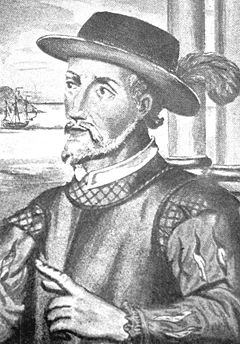
Juan Ponce de León traveled with Columbus on his second voyage. He was a volunteer, a gentleman from a noble family. There were 200 such gentlemen.

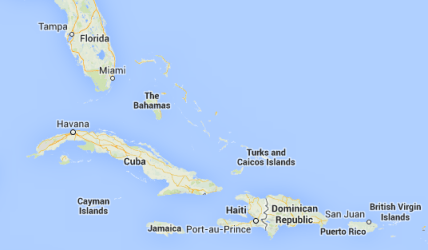
For your reference, here's a map showing Hispaniola (currently occupied by Haiti and Dominican Republic), Puerto Rico, and nearby Florida.

For your reference, here’s a map showing Hispaniola (currently occupied by Haiti and Dominican Republic), Puerto Rico, and nearby Florida.

Columbus and his entourage apparently visited Borinquen, which we now call Puerto Rico. (In fact, when Puerto Rico finally becomes a U.S. state, the Columbus legend will come true: in that case, he would have been the explorer who discovered what become the United States of America. [For those who wish to make a case that Puerto Rico is a territory of the U.S., so technically this is true today, I ask why, if Puerto Rico plays such an important role in American History, it has not been invited to join the club.)

In any case, as a result of his military leadership (de León was involved in a notable native massacre), he become Governor of the Spanish territory. Natives told him of a land to the northwest, a land that could be reached by “crossing many rivers’. He told the King, but remained as Governor until he lost out in a tussle with–who else–the son of Christopher Columbus, who was legally enforcing his father’s rights. Eventually, the King stopped the political nastiness, and after de León returned to Spain, he outfitted three ships and headed for some unexplored lands. He found what is now Florida on April 2, 1513.

Every year, we celebrate Columbus Day in the USA. Many of our Spanish-speaking neighbors in the western hemisphere celebrate Día de la Raza instead; it is, in many places, a celebration of the race, not Columbus the explorer.

Somehow, on April 2, 2013 — exactly 500 years after the first European explorer set foot on what is now a U.S. state, the first moment when Europeans visited the  part of the New World that became our nation–we did nothing.

Shooting with an iPhone

richardson-featured

So the new iPhone 5s includes an 8 megapixel camera. What can you do with a camera phone?

Turns out, quite a lot, especially if you happen to be an extremely skillful photographer whose credits include National Geographic.

Confirming the “it’s not the camera, it’s the photographer” theory, have a look at this work, read the article, and take the time to read the comments.

Here, then, is a sample image, a bit of the article in a Nat Geo blog, and a sampling of comments. Find it all here.

The photographer is Jim Richardson.

What surprised me most was that the pictures did not look like compromises. They didn’t look like I was having to settle for second best because it was a mobile phone. They just looked good. Nothing visually profound is being produced here, I would have to say. But it feels good, and I even noticed some of the folks on our tour putting big digital cameras aside once in a while and pulling out their cell phones when they just wanted to make a nice picture.

Alex of Virtual Wayfarer.com had this to say:

Not a fan of the either or approach that has been floating around, but definitely love the flexibility of using my phone as a camera. Scotland is incredibly difficult to photograph, so kudos for some wonderful shots. I actually find that with some vistas and views I have a much easier time capturing it accurately with my phone than my Canon. Interestingly, there were a number of shots I took on a recent Scottish roadtrip that were much better on the iphone (landscapes and Panoramas really are great on there if the light is right) than on my dSLR. Kudos!

Not quite convinced? Try the photographer’s Instagram exhibit, where you will find several dozen superb photographs. Among them, this image.

instagram

The Financial States of America

If you want to buy a house for cheap, buy one in Arkansas or Mississippi–those are among states in the center strip of the USA with the least costly houses. In fact, the swath extends from Nebraska to West Virginia–the flyover states. Houses in New York and California cost lots more. In fact, average home listings in the low-cost states are about four times lower than the averages in the highest states. That’s a large swing.

Here’s the map, a snapshot of a wonderful interactive map called The Financial States of America, published by moneychoice.org

Map1

Same website, same interactive map, but this time, I selected Well Being, and the results surprised me (of course, the site explains how they define and quantify well-being). No surprise that people in New Hampshire and Vermont are doing well. The surprise is that the every one of the “wellest” states is in the north–except Hawaii. The least well–the lowest ten states–are almost all connected in and beyond the Appalachians, with Oklahoma and Arizona in that group, too.  Here’s the snapshot (the interactive map would not translate to this blog, so I’m offering a few snapshots to encourage you to explore the map on your own).

Map2

The Minimum Wage map is fascinating because it shows how states that are near one another tend to make similar laws and accept similar rules. The states in the Deep South have no minimum wage. The states in the Pacific Northwest offer the highest minimum wage in the nation. Minnesota, Georgia and Wyoming offer the nation’s lowest minimum wage–an unjustifiable $5.15 to $6.20 per hour.

Map3

This is really interesting, to see American states behaving so differently from one another. One more, and then, you’re on your own. This one shows California with the nation’s highest GDP–the most productive economy, by far. Texas is second, and New York is third, and then, most other states don’t even come close. California’s GDP is now nearly $2 trillion dollars. If it was a country, it would compete with Italy and Spain, only about 10 percent smaller than the GDP of India. The state of New York competes, roughly, with South Korea. Texas’s economy is about the size of Mexico’s economy. By comparison, Michigan’s GDP is about the size of Denmark’s GDP–surprisingly small. Pakistan is slightly more productive than Connecticut. Tiny Delaware could fight it out with equally tiny Luxembourg. These match-ups are interesting enough to rate a Wikipedia article. Off the map, but NYC’s GDP is bigger than Spain’s. and Tokyo’s GDP is largely than Russia’s GDP (all GDPs are nominal). More GDP city data  here.

Map4

Enough of this. I could play with interactive maps all day long.

One more thing I found on the moneychoice site: an infographic about global money. This will keep me busy until bedtime…
The Future of Money: A Global Currency
Created by MoneyChoice.org

“The forced, bloated expanding bundle”

I like the phrase. It was used to describe the way Americans are forced to subscribe to cable television–if you want cable, you must pay for a tremendous number of unwanted channels. In the industry, the result of unbundling is called “a la carte” cable service because the operator allows you to select, and pay for, only the channels that you will actually watch. Bundled cable is, of course, the reason why Comcast accumulated enough money to buy NBC and Universal Pictures. It’s a sweet deal for cable operators, and for the cable industry, which is funded by selling products to people who don’t want them, but cannot do anything except, to use an example, buy everything in the store in order to make sure they have access to the loaf of bread and the jar of peanut butter. It’s a brilliant marketing scheme, and an utter failure of anything resembling consumer protection in the United States.

I could go on and on, and I could also make a case for why some aspects of the bundling business have utterly changed the television industry for the better. Mostly, though, I wanted to introduce you to an article about shifts in Canada’s cable television business that was published by Reuters last week. Here’s the start of it… to read the whole article, click here:

Subscribers to Rogers Cable in Canada can select from these a la carte channels. Most are not big name channels, but once the a la carte habits gains a foothold, the entire cable business may change.

Subscribers to Rogers Cable in Canada can select from these a la carte channels. Most are not big name channels, but once the a la carte habits gains a foothold, the entire cable business may change.

Analysis: Canadian Cable TV’s ‘a la carte’ menu begins to take hold

By Liana B. Baker and Alastair Sharp

NEW YORK/TORONTO | Thu Sep 19, 2013 12:49pm EDT

(Reuters) – A transformation in how some Canadian cable TV companies sell channels to consumers might be a sign of things to come in the much bigger U.S. market.

With “a la carte” pricing, cable companies are offering Canadians an alternative to “take-it-or-leave-it” bundles that effectively force viewers there – and in the United States – to pay for channels that they do not watch in order to get access to those they do.

(and so on)

Famous People from China

Ma_Yuan_-_Water_Album_-_Clouds_Rising_from_the_Green_SeaYeah, well, my list isn’t very long, either.  Easy enough to list Mao, Chang Kai-Shek, Chao en-Lai, maybe the classical pianist Lang Lang, and the basketball player Yao Ming. Maybe Jet Li, who is probably from Hong Kong (I checked; he is from Hong Kong).

Here’s one of the most powerful, significant, nations, one with enormous history, and I can’t name a half dozen important people from the whole country! (Genghis Khan? Kublai Khan?) I found a pop culture site and found out that Audrey Meadows, from TV’s The Honeymooners, was born in China. I also left out the architect I.M. Pei, who was born in Shanghai. Still, my list is so embarrassing, I figured I ought to know more. So I found a book about important people from China. Appropriately, it’s called Chinese Lives, and it begins, as it should, with a map of China’s many provinces, only half of which I knew by name (Hangxi, Anhui, Shaanxi, and Gansu were among the unfamiliar ones).

I wasn’t sure whether Confucius was a real person, so I never added him to my list, but there he is on page 22, a real person born in 551 BCE, just over 2500 years ago. He was a teacher, and a government minister, eventually becoming an acting Prime Minister. Apparently, he did not play the political game very well; he was exiled, and that allowed him to do his best work, in texts that he edited after he turned 67 years old. The ideas that he wrote, compiled and edited became the philosophical basis for a particular sort of Chinese education, the kind that led to government jobs. Lots of emphasis on “unwavering loyalty to the lord” in a “harmonious society.”

Mo Zi was born around the time that Confucius died. Mo Zi was an philosopher who toured China spreading his ideas of an “egalitarian society based upon devotion to the common good.” He was strongly anti-war, and in favor of universal love.

I especially enjoyed the story of King Wuling of the Zhoa, whose reign began around 325 BCE. The King had a problem, though. According to tradition, his military force dressed in long robes, and traveled into battle on chariot. By 307 BCE, his men were being routinely beaten by the barbarians who traveled not by chariot, but by riding directly upon the horses’ backs. The robes were a problem. King Wuling’s contribution: he convinced the Chinese troops to abandon their traditional gowns and instead dress like the barbarians–in trousers, with boots.

The book is filled with statesmen associated with dynasties whose names are vaguely familiar (I really should read a good book about the whole history of China), more philosophers, a slave who became emperor, military leaders, and more of the stuff I expected to see here.

And then, a familiar name and an unfamiliar one: Li Bari (familiar, also known as Li Po) and Du Fu (not). Both were Chinese poets around 700 or so. Here’s Li Po goofing on Du Fu in a poem:

I ran into Du Fu by a Rice Grain Mountain

In a bamboo hat with the sun at high noon

Hasn’t he got awfully thin since our parting?

It must be struggle of writing his poems.

I keep checking these dates because they are so far outside of the sphere of U.S. consciousness. Su Dongpo was a poet born in 1037, more than 700 years before anybody had an inkling that the United States would exist. He was a painter, too, and a good cook whose recipes survive (Dongpo-style pork remains a Chinese delicacy.) Here’s part of his poem, “Time ‘Immortal’ by the River:’

I drank at night on East Slope, sobered up, got drunk again.

When I came home it was some time past midnight

The houseboy was already snoring like thunder.

I pounded on the gate and got no response.

Then leaned on my staff and listened to the river noises.

A drunk dude sneaking into his house, screwed up again. Things don’t change much, I guess.

Ma Yuan was a court painter. He lived from about 1190 to 1225. If you search for his name (also called Qinshan), you’ll find a lot of wonderful images. The painting at the top of this article was painted by Ma Yuan.

timthumb.phpThere are good stories about emperor Kublai Khan, and the beginning of Chinese drama as initiated by Guan Hanqing. You may know Zheng He, an admiral who led a large fleet to Africa and other far away places a few decades before Christopher Columbus was toilet-trained (I wonder whether there were toilets in Genoa in the 1450s?) Rumors about Zheng He discovering the American mainland are, apparently, quite wrong, the work of someone who mistranslated Chinese historical documents.

There are eunuchs (Zheng He was one, in fact), bandits, rebel leaders, generals and writers who specialize in ghost stories, emperors and national heroes whose names you’ve probably never heard before (they were certainly new to me). There’s Cao Zueqin, “China’s greatest novelist” who died just before the American Revolution and Lu Xun, “Greatest Chinese writer of the 20th century”–a whole culture to explore.

Imagine someone in China first encountering the stories of George Washington, Abraham Lincoln, Louis Armstrong, Robert E. Lee, Billie Holiday, George Gershwin, Walt Disney, Norman Rockwell, and Bob Dylan–never having heard any of these names before, finding a book called American Lives.

Next Spring, Near Paris

Start saving your money. Next May, go to Paris. Leave early on the morning–there’s an 820AM from Paris’s Saint-Lazare Station to Vernon, and then, there’s the taxi. The train arrives at 9:05AM at Vernon, and the cab will get you to the front entrance of Monet’s home and gardens by about 9:15AM. You want to arrive early, perhaps catch the mist rising from the water garden, perhaps take a few pictures or just gaze before the crowds populate every view. (Get there earlier, if you can; it’s always best to arrive first-in-line here.)

Sigh.

Summer is ending. There is autumn color: the purples and luminous yellows, the garish reds and the beginnings of orange trees reflected in the water. But there is nothing like spring.

In 1883, Claude Monet settled in Giverny, a village fifty miles outside paris. He rented a house with an orchard, the future Clos Normand, the flower garden at the front of the house that broke with the traditional idea of a pleasure garden.

9781419709609So begins the tale, told mostly in large, vivacious images, of Claude Monet’s extraordinary gardens (and home), told with love and with style through Jean-Pierre Gilson’s photographs, with text by Dominique Lobstein. Published by Abrams–one of the best in the world at this type of book, the visual tour begins, as it should , in the purple haze and tangled wisteria branches hanging over the famous Japanese bridge. The photograph is subdued; there are no bright colors yet. On the next two-page spread, there are brightly–colored bushes and their quiet reflections, house peeking out of the background behind some trees. Flip to the next of these several two-page spreads and it’s a riot of roses, glowing in the sun, red, pink, nearly white, braced by green leaves so dark and sometimes so nearly translucent, bold as can be. The text begins.

And on the next spread, so does spring. After the prelude, spring commences with a field of pink tulips, clean green fences and stair rails, dark green-blue leaves, and the stunning-but-simple house with its own pink facade and blue-green shutters. The effect is stunning, as if in a painting–and here, that’s precisely the effect that the master painter intended. To be at Giverny is to live inside a Monet painting, at least for a morning.

It’s not all cluttered with noisy flowers and oh-so-subtle impressionist gardening. “Monet wanted a garden that could ‘breathe’ with flowers, bushes and an open vista…” so he removed the many trees from the old orchard, and replaced them with Japanese cherry trees that yield, at least for a brief time in the spring, lighter-than-air blossoms, punctuated, here and there, as in any number of his paintings, with spots of bright color; here, red and purple tulips.

I wish I knew the name of every flower (and I wish the author’s captions included this information!). The phenomenal two-page spread showing yellow towers of flowers two stories high, dappled with pink-and-purple irises, golden yellow somethings (frustrated…), and it’s followed by several more. (I want to it to be spring today, and I want to go to Giverny tomorrow.)

And then, when your head is beginning to explode because Monet was such a genius, there’s a pair of small green rowboats, a field of happy daffodils, and in the distance, the Japanese bridge that he painted so often. Here, with a less exhausting spectrum, it’s possible to rest and reflect, and observe. The yellowy green of the locust leaves in contrast with the deep green of the background trees–with just a hint of small violet flowers to set the counterpoint.

The flighty, wavy petals of mauve tulips surprise me every time I see them. Here, they’re pictured with the famous lily pad pond in the fuzzy distance, and the sharp, sun-dappled orange wallflowers in the foreground. Another two-page spread, one of my favorite two-page spreads in the book.

Just checking–I’m not even half way through the book. Some surreal lily pad images–two look as though they were made for a science fiction film, but they are real–and then, with a page turn, there are paths of dry ochre leaves on the ground, paths with strong color of fall, not spring. The quiet beauty of barren trees and cool skies, the yellowing willow and golden hour light, it’s bittersweet. Moreso because the last set of images show the house with shutters now closed tight.

But then, we get to go inside. A row of old copper pans artfully hung in front of a blue-and-turquoise tiled wall with cabinets. A yellow dining room whose walls are filled with Japanese prints (Monet collected them, and they are a highlight of every Giverny tour, but few people spend the time to look at them as closely as the artist once did). It’s a classy old country home, less formal than most. And then, there’s a small staircase leading down to a room with Persian carpets on the floor and a whole lot of miscellaneous Monet paintings almost haphazardly scattered on the walls. It’s his studio.

The book closes with snow. Which means spring is coming again. Soon.

Small Atlases Make Intriguing Gifts

Sometimes, it’s difficult to understand an idea without seeing a picture. I suppose that’s one of the reasons why I like the idea–if not always the execution–of infographics.  Give me a good map with abundant legend, little boxes with big information, arrows to guide me, and I’m more like to understand a complicated idea. The book publisher Dorling-Kindersley, also known DK, has developed a brilliant style based upon the visual display of encyclopedia information (you know their Eyewitness Travel Guides, for example).

Given sufficient free time, I’ll wonder about just about anything. One thing thing I’ve always wondered about is how mankind managed to populate every corner of the earth. Think about it–a small population in central east Africa with extremely limited resources, no meaningful transportation, little protection from the elements or from one another, somehow ended up in Siberia, South America, even Australia. How? Well, mostly, they walked. (Along the way, they struggled to invent the needle so that they could sew animal skins together, astonishing tech in their time).

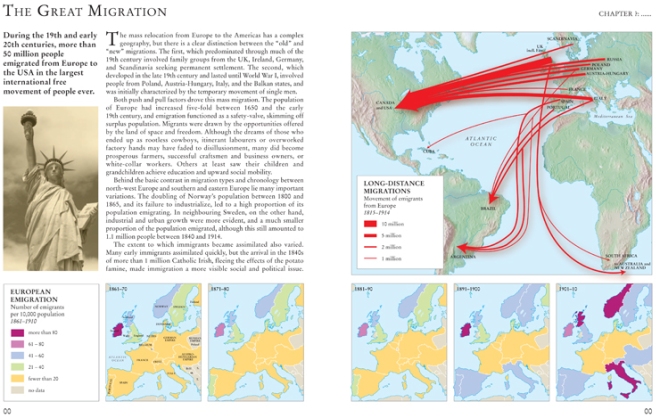
You can learn a lot about the world by studying migration maps. For example, just about everybody knows that a large portion of the U.S.’s black population came from Africa. Now Africa’s a big place. Where did they come from, exactly? Yeah, well, I had no idea until I checked a map in People on the Move: An Atlas of Migration by Russell King. There were two main “collection points”–one was Luanda, still the largest city in Angola (many of those slaves were controlled by Portuguese interests, so they ended up either in Brazil or the U.S.). Slaves leaving from Accra and El Mina (or, Elmina) mostly traveled to Brazil, Virginia or Louisiana. Some African slaves ended up in Portugal, too. The British, French and Dutch colonial slaves more often traveled to the Caribbean Islands.And that’s just part of the story: lots of African slaves were sent along Arab trade routes and up into Turkey–a much earlier system of human trade based upon ancient tradition.

MIGRATION_GreatSo that’s one migration. There’s another 13.5 million people moving during the period 1815-1915. Those people are moving, mostly, from Europe to America. Lots from Ireland, England, Scandinavia, and later, Spain, Italy, and eastern Europe–the peopling of America.
Migration is still a robust human endeavor. The oil boom in the Persian Gulf has been a magnet for several million people (the population of the United Arab Emirates [capital city: Dubai] has increased from 180,000 in 1966 to 4.4 million four decades later, with most of the new people foreign nationals). Lots of movement in the USA, too, first from to the west, then from the south, then from the rust belt to the south. People migrate for marriage, careers, college studies, so many reasons. Never really thought much about it, but this book has been fascinating.

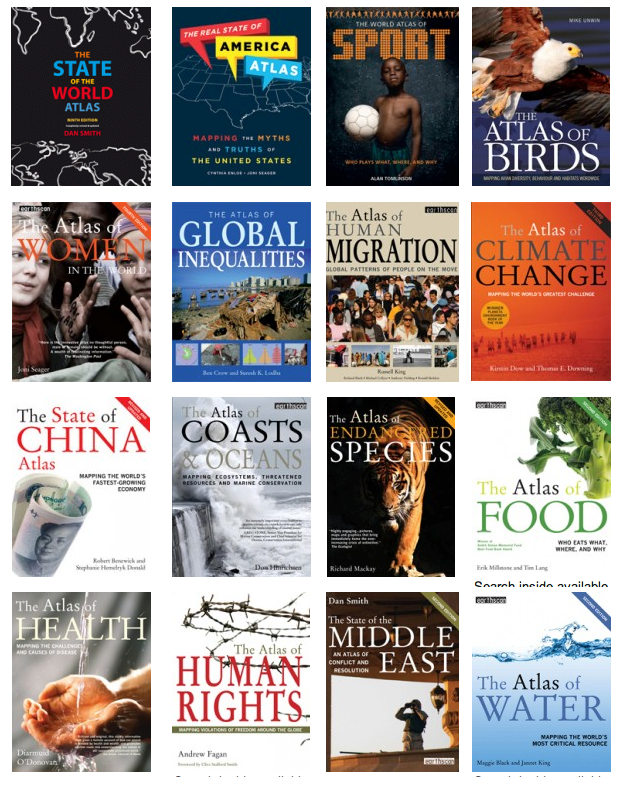
And it’s part of a series. All are published in the U.S. by the University of California Press, but they’re made by Myriad Editions and they’re available from other publishers in other languages in other parts of the world.

I first encountered the series through The Atlas of Global Inequalities by Ben Crow and Suresh K. Lodha. If you’re fascinated by headlines like “2% of adults possess more than 50% of all global wealth” and “50% of people possess only 1% of all global wealth,” this book is your next birthday present. The authors go very deep into graphing of statistical information, lavish in their use of shapes and colors to clarify confusing points, so this book requires, and rewards, quiet and attentive reading. The relationship between life expectancy and household income is striking–live long and prosper in New Zealand or Iceland, or live a few less years but live somewhat richer in the U.S.A, Norway, or Luxembourg. Life expectancy in Africa is 54 years, but in North America, the average is 79 years. Children born in central Africa are likely to live only half as long as children in western Europe.

There is, in fact, a wide range of topics covered in this series. I’ve been through these two, plus a more challenging topic, The Atlas of Human Rights, which tracks, mostly, violations of freedom.

Myriad-BooksOf course, I want to browse every page of every one of these 100+ page mini-atlases. I suppose The Real State of America and The State of the World ought to be the next ones that occupy a quiet afternoon, but The Atlas of  Water  and The Atlas of Food are no less intriguing.

Closing out this article, here’s an spread from The State of the World Atlas:

Obesity-Burger

The Spacey McTaggart Lecture

So here’s Kevin Spacey telling the truth about the television industry, the movie industry, and the new reality that places creative people in control of their relationship with the audience. He is harsh, realistic, funny, and deeply experienced–and full of wisdom and insight gained through his Netflix deal, his work with the Old Vic theater in London, and a career that began, with the help of actor Jack Lemmon, at age thirteen.

I especially enjoyed Spacey’s celebration of “the third golden age of television” that began, more or less, with Hill Street Blues, extends through The Sopranos, on through House of Cards. Just in case you’ve missed one or two, he runs through a dozen-plus excellent television series whose connection to the audience is the result of powerful creative risks taken by creative people, and by the small number of laudable television executives with the guts to protect those creators.

Spacey connects the dots in a pattern that’s  obvious to anyone who is willing to face the truth about the television industry–and devastating to those who still believe in the status quo, appointment viewing, watercooler conversations, and television networks as the fundamental organizing principle of the home entertainment industry. Time and again, he celebrates the creative people…and resets expectations for the next generation.

The new generation of creatives is different. We’re no longer living in a world where someone has to decide if they’re an actor, writer, director or producer. These days, kids growing up on YouTube can be all of these things…

The James McTaggart Memorial Lecture opens the Edinburgh Festival. This lecture is 49 minutes long. I encourage you to watch the whole thing.

Let me tell this another way: he tells a heck of a good story.

(Here’s a link to the text version.)