Long Overdue

bobbywatson2colorBobby Watson is a musician’s musician, well-known in some circles, but not a famous jazz saxophone, at least not these days. Those who were paying attention in the mid-1980s, or who have done their research on the best jazz albums of that era, tend to love Appointment in Milano, and Year of the Rabbit; recorded and released nearly twenty years later, Horizon Reassembled is also terrific. Browse Watson’s All Music listing, and you’ll find a half-dozen superior albums by one of jazz’s best saxophone players. Watson’s Check Cashing Day surprised me by showing up in the mail last week. Made me happy. Made me think, too. You can listen to some samples here. Let me tell you more about it.

Recorded to remember Martin Luther King, Jr.’s “I Have a Dream” speech fifty years ago, Watson’s creative partner on this project is a fellow artist from Kansas City, Glenn North. He’s a spoken word performer, and poet who does his best to speak the truth (that second link provides a good example of his work—listen with your ears, and don’t worry about the so-so video quality). Mr. North is also the education manager at the Kansas City Jazz Museum, a kin with Watson who has doubled on the academic side for decades. North’s work is accessible with whiffs of hip-hop language and cadence, straight talk that carries the right messages:

Black is a flock of one hundred crows flying across the moon.

Black is hot water, cornbread and black-eyed peas served with a wooden spoon.

Black is the floor of the Atlantic Ocean covered with fifty million ancestral bones.

Black is the thundercloud over The Congo as the panther starts to moan.

Black is what was before before, when there was no time or space.

Black is the mistreated, the misunderstood, the magnificently beautiful race.

Black is a thousand midnights buried beneath the cypress swamp.

Black is four nappy-headed boys cruising in a beat-up Mitsubishi Galant.

Black is a thousand hornets ready to attack.

And even though Black ain’t went nowhere, tonight, Black is back.

Good poem, but so much better with the beautiful soundtrack provided by the sweet sound of Bobby Watson’s saxophone and the bowed bass so handsomely played by Curtis Lundy. This is what concept albums ought to be, maybe used to be, and I now understand that I miss them. Music with a purpose, a point of view, something to say, something well-said. Watson’s quartet provides some straight-ahead jazz tracks, perhaps the best of them is “A Blues of Hope,” but there are plenty more.

Check Cashing DayThe most ambitious track is Secrets of the Sun (Son) featuring wonderful vocal work by formidable performer, vocal arranger and composer Pamela Baskin-Watson (his wife), Glenn North’s spoken word at its confident best, and a splendid arrangement that allows the quartet to shine.

The more I listen, the more I appreciate what this ensemble has done. Sure, it’s a wonderful jazz album, but Watson does that just about every time. He’s a pro, he’s been doing this forever, and he’s gifted. But there’s a lot more heart and soul here, a coherent focus, a grown-up reflection on what has happened, and has not happened, and what has decidedly not happened, since Martin gave the speech in front of the Lincoln Memorial. More from Glenn North, again presented with Watson’s spot-0n soundtrack.

I’m tired of welfare handouts and being played the fool.

I’m also tired of waiting for my forty acres and a mule.

Tired of being mis-educated in this country’s so-called schools.

Ain’t none of them teachers talking about my forty acres and a mule.

I bet you’d sing a different tune if it was me that owed something to you.

Save all the double-talk, and give me my forty acres and a mule.

You keep smiling in my face, but I know your heart is cruel.

Why else wouldn’t you give me my forty acres and a mule?

And why am I the one always getting arrested when you’re the one breaking all the rules?

You know my next question.

Where the hell is my forty acres and a mule?

I’ve been oppressed for over four hundred years, been the object of ridicule.

The least you could do is break me off my forty acres and a mule.

Compared to what you’ve done to me, what I’m requesting is miniscule.

You should be glad that what I’m asking for is forty acres and a mule.

The bill is up to four trillion dollars now and the man is way past due.

What do I have to do to get my forty acres and a mule?
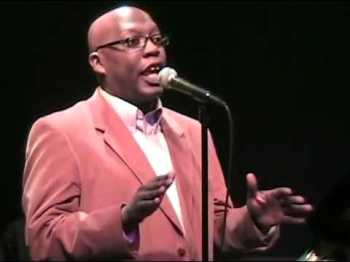
The poet and spoken word artist Glenn North.

The poet and spoken word artist Glenn North.

After writing several articles about intellectual property and fairness, I hope this brief excursion into Glenn North’s poetry is okay with him (if it’s not, I hope he will contact me so I can remove it or otherwise change the presentation). I wanted you to get a sense of what this people have done, and because I think it matters, and because I think it ought to set the stage for more concept albums about important ideas, I provided more than I might otherwise have done.

Hey, this is good work, and it deserves recognition. If you’re trying to track down something interesting and different to buy for friends or family, this is a good choice to add to the list. Normally, I hate it when a website starts playing music when I arrive. In the case of www.bobbywatson.com, I had the opposite reaction. Turn it up and enjoy.
Monroe to Baker to Pikelny

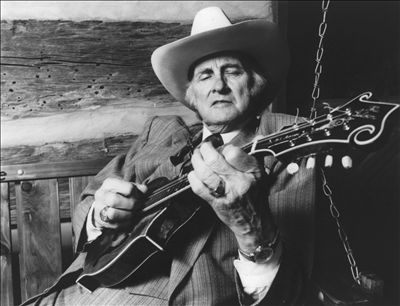
Bill Monroe, as pictured on his entry in the All Music Guide. Click on the pic to see the bio and his extensive discography.

Bill Monroe, as pictured on his entry in the All Music Guide. Click on the pic to see the bio and his extensive discography.

Let’s start with Bill Monroe. Bluegrass bandleader Doug Dillard said, “God only lays a Bill Monroe on you once in a lifetime, so pay attention.” He was born in 1911, grew up on a 655-acre farm in Kentucky, learned to sing and play the fiddle from his mom and his uncle Pen (Pendleton), an old-timey musician who took young Bill along on church and school gigs. His parents died young, so Uncle Pen raised him, then moved up north to find work near Chicago in the factories. By 1934, Bill and his brother Charlie were playing music full-time, among “country music’s first generation of professionals,” according to the extensive liner notes that came with my 4-CD box set, The Music of Bill Monroe from 1936 to 1994, essential for anyone with even the mildest hankering to hear bluegrass at home or in the car. His brothers wanted to play fiddle and guitar, so he concentrated on mandolin. Charlie sang lead, and Bill sang harmony. The first year, they stayed in the midwest and built a following on local radio in Iowa and Nebraska, then headed to Charleston, South Carolina (WIS) and Charlotte, North Carolina (WBT), where lots of live country music performances filled the airwaves. By 1936, they were recording for RCA Records, and in two years, they recorded sixty songs. The story is a good one, worth reading. It winds through local baseball, the Grand Ole Opry, and, eventually, stardom and reverence for his contribution to country music. Along the way, Monroe’s band, The Blue Grass Boys, included Lester Flatt and Earl Scruggs in the second half of the 1940s, and by 1957, a fiddler who stayed for twenty five years. His name was Kenny Baker.

Baker Plays MonroeYou can hear plenty of Baker’s work on the 4-CD box, and on many of the Monroe albums in the All Music discography. Baker’s name and work are held in very high esteem. Most knowledgeable fans agree that the one Baker album that everyone ought to own, or, at least, hear, is called Kenny Baker Plays Bill Monroe. Recorded in 1977 and not much more than a half hour long, the album is loving described in All Music Guide, and I really couldn’t say it any better:

Is this the best bluegrass album ever made? No matter what choice might be made in this regard, it would surely inflame the passions of some picker who wouldn’t agree. Nonetheless, consider some of the circumstances. The maestro Kenny Baker is one of the most straightforward, no-nonsense, clean and clear-cut players of bluegrass and old-time music.

There are twelve tracks. Do take the time to click on the album cover and listen to the samples of at least a few of them. I especially like “Road to Columbus,” “Cheyenne,” “Jerusalem Ridge” and “Ashland Breakdown,” but every track is magnificent. Also featured: Bob Black on banjo, Joe Stewart on guitar, and Randy Davis on bass. Bill Monroe sits in on mandolin.

So now it’s 2013. Watch this.

Noam Pikelny is playing “Big Sandy River,” a song that Bill Monroe and Kenny Baker recorded back in 1962 (they wrote the song, too). But he’s not playing it on fiddle, the way Baker did. He’s playing a note-for-note version of Baker’s fiddle arrangement on his banjo. In fact, there’s  whole album of note-for-note copies played by Pikelny on banjo. The album is called Noam Pikelny Plays Kenny Baker Plays Bill Monroe.

These kinds of tribute albums are pretty unusual—the best-known in recent memory is probably Rufus Wainwright’s recreation of Judy Garland’s Carnegie Hall Concert in 2006. But this album goes further than a simpler recreation.

Pikelny is a member of a particular class of musicians who have grown well beyond the homage into more rarefied artistic territory. I sensed this when I saw Pikelny’s partner in The Punch Brothers, Chris Thiele, playing with Yo-Yo Ma, bassist Edgar Meyer, and Stuart Duncan (who plays fiddle on the Noam-Kenny-Bill album) last summer as Goat Rodeo. In their hands, this music (Americana, bluegrass, bluegrassical, whatever you would like to call it) becomes a kind of exalted, accessible art form, art music for the 21st century that’s fun to hear, deeply engaging, meticulously crafted, and so wide in its appeal, it is (in a term sometimes applied to Duke Ellington), “Beyond Category.”

Which is to say; here’s another of a select group of 2013 CDs that would make an absolutely perfect holiday gift. Enjoy.

Google Books vs. Every Published Author, Part III

(Be sure to read parts one and two.)

The world is changing. As an author and creative person, I want as much intellectual property protection as possible. As a creator, I want as much flexibility as possible.

Here’s the summary of a very significant intellectual property case decided this month by U.S. Circuit Judge Denny Chin:

In my view, Google Books provides significant public benefits. It advances the progress of the arts and sciences, while maintaining respectful consideration for the rights of authors and other creative individuals, and without adversely impacting the rights of copyright holders. It has become an invaluable research tool that permits students, teachers, librarians, and others to more efficiently identify and locate books. It has given scholars the ability, for the first time, to conduct full-text searches of tens of millions of books. It preserves books, in particular out-of-print and old books that have been forgotten in the bowels of libraries, and it gives them new life. It facilitates access to books for print-disabled and remote or underserved populations. It generates new audiences and creates new sources of income for authors and publishers. Indeed, all society benefits.”

On the one hand, Google is providing a substantial public service by unearthing, scanning, and distributing works in the public domain that may otherwise be forgotten. What’s more, they’re placing everything into a searchable database that can be accessed by just about everyone who wants or needs it.

On the other, Google has gone too far by scanning and distributing works that are not in the public domain, but are, instead, owned and controlled by copyright holders. (Most are authors, who typically assign publishing rights to their publishers but retain their copyrights.) Here, in my view (not a lawyer, but an author and a business person), the solution is simple, reasonable, and available. Google must ask permission of copyright holders before freely distributing their work. (Yes, this is cumbersome, but Google is a company whose cleverness is exceeded only by its resources.) Of course, authors could be pro-active in making such grants because they believe, in their sole and reasonable judgment, that their work’s inclusion in the Google Books database would be in the public interest or would benefit the author’s work from a marketing point of view.

According to Joe Crawford of Moorpark, California, you are free: to share (to copy, distribute and transmit the work, and to remix (to adapt the work)  Under the following conditions: attribution – (You must attribute the work in the manner specified by the author or licensor (but not in any way that suggests that they endorse you or your use of the work). Joe established the rules for his copyrighted property. This is reasonable, and it is now done on a massive scale.

According to Joe Crawford of Moorpark, California, you are free: to share (to copy, distribute and transmit the work, and to remix (to adapt the work). Under the following conditions: attribution – (You must attribute the work in the manner specified by the author or licensor (but not in any way that suggests that they endorse you or your use of the work). Joe established the rules for his copyrighted property. This is reasonable, and it is now done on a massive scale.

In fact, Creative Commons has done a lot of good work in this area, making it easy for copyright owners to establish rules with regard to sharing, copying and other uses of their property.

The issue is not whether Google Books should scan and distribute books, and the issue not whether this activity results in a public good. The issue is whether making full digital copies of a book in a public library that is still protected by copyright, and then distributing the digital copy without permission of a copyright holder is, under any reasonable interpretation of the law, more similar to a 21st century card catalog or more similar to copyright infringement on a massive scale.

As an author, I am strongly inclined to vote in favor of copyright protection and a requirement that Google, or any other party, affirmatively secure permission of my intellectual property prior to its distribution.

As a producer and businessperson, I could reconsider that position because the current decision may apply to future projects in some interesting ways. For example, one might contemplate an online system of recommended books that include substantial portions of copyrighted work—full chapters, perhaps, or more—as a kind of public literacy project. Or, one might translate entire works into other languages to provide greater access to those works. In both cases, if the works are scanned into a database so that researchers might use them for educational purposes, no permissions should be necessary.

Let’s take that a step further. There is so much video now available on the internet, and, for the most part, it is very difficult to search within those videos. If you were to create a database of, say, movie scripts or, in a more advanced form, movie dialogue, you might well be able to show the whole movie, perhaps in “snippets” (the term used by Google for its portions of larger works), or, at least, include these movie excerpts in a series of online documentaries that explore, for example, the mythology of the Star Wars films, or the role of animal characters in Disney or Pixar films. If it’s all for the public good, and it’s all part of a searchable database, Judge Chin’s ruling suggests that Fair Use is both a reasonable defense with regard to challenges, and, in a larger sense, that this sort of activity is to be encouraged if it serves a research need, promotes the films, and transforms the ways that people consume these films.

It’s easy to be glib or flippant about the tremendous reach of the judge’s decision, but in the end, this isn’t about books, or Google. It’s about whether creative professionals will be able to earn a living in the future. With each step into a new digital future, that future becomes just that much more murky. In doubt about that? Read this.

Google Book Chronicles vs. Every Published Author, Part II

(Be sure to read parts one and three.)

The statement from Google:

As we have long said., Google Books is in compliance with copyright law and acts like a card catalog for the digital age, giving users the ability to find books to buy or borrow.”

Baseball pitcher Jim Bouton wrote a popular book called Ball Four. The book is out of print, but it is available through Google Books. Jim Bouton is a plaintiff in the case against Google Books because the work was used without his permission.

Baseball pitcher Jim Bouton wrote a popular book called Ball Four. The book is out of print, but it is available through Google Books. Jim Bouton is a plaintiff in the case against Google Books because the work was used without his permission.

And from the Author’s Guild:

Google made unauthorized digital editions of nearly all of the world’s valuable copyright-protected literature and profits from displaying those works…In our view, such mass digitization and exploitation far exceeds the bounds of the fair use defense.”

Of course, the Author’s Guild plans to appeal the decision, but, for now, it stands.

The judgment was written by U.S. Circuit Court Judge Denny Chin, who has been working with Google and the Author’s Guild on the future of Fair Use as it applies to Google’s insistence upon scanning and posting intellectual property without permission of the copyright holder. (Be sure to read yesterday’s post because it sets the stage for this one.)

This wonderfully cluttered bookshop in Tenby, Wales, UK is precisely the sort of mess that Google Books tries to solve. In the bookstore, there is no search, no apparent organization whatsoever (except those lovely Penguin classics in the spinner rack). On Google Books, every word of every book is part of a searchable database. (Photo by Howard Blumenthal, all rights reserved, do not duplicate or distribute without written permission.)

This wonderfully cluttered bookshop in Tenby, Wales, UK is precisely the sort of mess that Google Books tries to solve. In the bookstore, there is no search, no apparent organization whatsoever (except those lovely Penguin classics in the spinner rack). On Google Books, every word of every book is part of a searchable database. (Photo by Howard Blumenthal, all rights reserved, do not duplicate or distribute without written permission.)

Happily, my book, The Creative Professional, has not been violated by Google, but I will borrow from my own work to review the four “prongs” of Fair Use of copyrighted material:

  •  The first is the character of the use. “The focus of this factor is ‘whether the new work merely supersedes the objects of the original creation… or instead adds something new, with a further purpose or different character, altering the first with new expression, meaning, or message; it asks, in other words, whether and to what extent the new work is transformative.’”
  •  The second is the “nature and copyright status of the plaintiff’s work.” A work that is factual receives more protection than a work that is imaginative. Remarkably, an unpublished work is more likely to be protected than a published work.
  •  The third Fair Use test is the amount of material used. Fair Use protection is more likely to be extended when the percentage of the original work used in the new work is comparatively small.
  •  The fourth judgment is an evaluation of market impact. If the Fair Use was allowed, how might this use impact the market for the copyrighted material? If the copyrighted material is not currently in the market, or if its sales are minor and the use was otherwise fair, this factor may lead to judgment in favor of the defendant who claims that no infringement has occurred. However, if the material is not in the market, and sales are minor, but the use, based on the above three factors, was unfair, then discussion of this fourth factor may not enter in the decision at all. This becomes complex; whether you are defendant or plaintiff, you will want a smart lawyer who is well-schooled in the subtle features of Fair Use and copyright law.

Let’s add it all up:

  • Character of the use. Google’s use adds nothing new, except the ability for anybody to read AND COPY any portion of the copyrighted work without paying for it. I can’t argue that this is not, somehow, “transformative” but I can imagine the use of the term mostly in terms of, say, opening the back of an ATM and transforming bank customers into people who can take money freely, as they wish.
  • Nature and copyright status of the plaintiff’s work. It’s factual, and it’s under copyright for a reason. Copyright provides creative people with protection against unauthorized use. (This is a more complicated idea than one would think, so I’ll leave it to the lawyers to elaborate.)
  • The amount of material used. All of it. Every word. Seriously, is this what we really want as a society?
  • An evaluation of market impact. If we define market impact in two ways: sales of books and promotion of the authors for potentially greater market value, I think I can speak as an expert with regard to my own creative work: sales of books have not been affected in any measurable way, and NOT ONE PERSON has ever told me that they bought the book because they first saw it on Google. And I am no more famous than I was on the day before Google entered my life with their interesting theories and practices about Fair Use.

And let’s have a look at what the judge wrote in his decision:

  • Character of the use. “Google’s use of the copyrighted works is highly transformative…Google Books has become an important tool for libraries and librarians and cite-checkers as it helps to identify and find books…Google Books is also transformative in the sense that it has transformed book text into data for purposes of substantive research, including data mining and text mining in new areas, thereby opening up new fields of research. Google Books does not supersede or supplant books because it is not a tool to be used to read books. Instead, it “adds value to the original” and allows for “the creation of new information, new aesthetics, new insights and understandings.”…even assuming Google’s principal motivation is profit, the fact is that Google Books serves several important educational purposes. Accordingly, I conclude that the first factor strongly favors a finding of fair use.
  • Nature and copyright status of the plaintiff’s work. “the vast majority of the books in Google Books are non-fiction. Further, the books at issue are published and available to the public. These considerations favor a finding of fair use.” (Nonpublished works are subject to greater protection.)
  • The amount of material used. “Google scans the full text of books — the entire books — and it copies verbatim expression…Here, as one of the keys to Google Books is its offering of full-text search of books, full-work reproduction is critical to the functioning of Google Books. Significantly, Google limits the amount of text it displays in response to a search.  On balance, I conclude that the third factor weighs slightly against a finding of fair use.
  • An evaluation of market impact. Here, plaintiffs argue that Google Books will negatively impact the market for books and that Google’s scans will serve as a “market replacement” for books… a reasonable factfinder could only find that Google Books enhances the sales of books to the benefit of copyright holders. An important factor in the success of an individual title is whether it is discovered — whether potential readers learn of its existence. Google Books provides a way for authors’ works to become noticed, much like traditional in-store book displays…Google provides convenient links to booksellers to make it easy for a reader to order a book. In this day and age of on-line shopping, there can be no doubt but that Google Books improves books sales. Hence, I conclude that the fourth factor weighs strongly in favor of a finding of fair use.

Clearly, this is a topic that warrants a third article. See you tomorrow.

Google Books vs. Every Published Author, Part I

I have written several books. Perhaps you have purchased one of them. If you did, thank you. As a result of your purchase, I probably collected about $1.25 in royalties. You may have read the book, and perhaps, you lent it to a friend. You may have copied a few pages, or used the book for research, maybe even quoted from my book in your own work. That’s fine with me, and I am sure it would be fine with just about any author.

Of course, I wouldn’t expect you to make copies of the book and distribute it, for free or for a fee, and I certainly wouldn’t expect you to publish some or all of my book’s contents on the web–even if you believed that what you were doing would make the world a better place. I expect that you think about my book in much the same way.

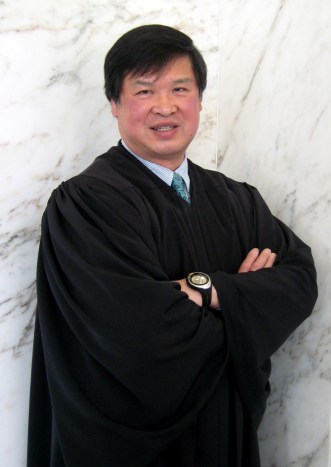
Denny_ChinHowever reasonable, that’s no longer the way things work. Now, it seems, making the world a better place is reason enough to freely distribute copyrighted work without permission of the copyright holder. Here’s the logic and the new law of the land as set forth by U.S. Circuit Court Judge Denny Chin in a case decided this month in favor of Google (which scanned and distributed millions of books, without permission, in the public interest) and the Author’s Guild (which cried foul, lost, plans to appeal to a higher court, and may lose again).

“First, Google Books provides a new and efficient way for readers and researchers to find books. It makes tens of millions of books searchable by words and phrases. It provides a searchable index linking each word in any book to all books in which that word appears.” In short, Google Books completely transforms the use of books, especially in research, and it is currently in use in a great many research institutions.

Second, in addition to being an important reference tool, Google Books greatly promotes a type of research referred to as “data mining” or “text mining.” Google Books permits humanities scholars to analyze massive amounts of data — the literary record created by a collection of tens of millions of books. Researchers can examine word frequencies, syntactic patterns, and thematic markers to consider how literary style has changed over time.” So it’s fair to say that Google Books is a fantastic tool for scholars because it allows them to scan a lot of books quickly, identify and study patterns.

“Third, Google Books expands access to books. In particular, traditionally underserved populations will benefit as they gain knowledge of and access to far more books. Google Books provides print-disabled individuals with the potential to search for books and read them in a format that is compatible with text enlargement software, text-to-speech screen access software, and Braille devices. Digitization facilitates the conversion of books to audio and tactile formats, increasing access for individuals with disabilities. Google Books facilitates the identification and access of materials for remote and underfunded libraries that need to make efficient decisions as to which resources to procure for their own collections or through interlibrary loans.” Unquestionably, placing a lot of books in a gigantic database is very useful for all sorts of reasons and provides tremendous public interest benefits.

“Fourth…Google Books helps to preserve books and give them new life. Older books, many of which are out-of-print books that are falling apart buried in library stacks, are being scanned and saved.” Absolutely right, but “out-0f-print” and “public domain” are not the same thing. Many of my books are currently out-of-print, and I plan to republish some of them because they are my property. Anything that is in the public domain should be rescued for the good of the public. Anything that’s out-of-print, but still protected by copyright, cannot be reasonably treated in the same way.

“Finally, by helping readers and researchers identify books, Google Books benefits authors and publishers. When a user clicks on a search result and is directed to an “About the Book” page, the page will offer links to sellers of the book and/or libraries listing the book as part of their collections.” That’s nice, but let’s consider whether the copyrighted work should be there in the first place.

Somewhere along the way, my books were published, and a public library purchased a copy. We all understand that the library will buy one copy of the book and then distribute that book to any of its cardholders. Neither the publisher nor I, the author, granted the library any kind of right to digitize the book’s contents. Google borrowed my book from the library, scanned its contents (without my permission) and now distributes one book in whole and another in part (without my permission). And because my book is a useful book, a Federal judge has determined that this activity is not only permissible, but in the public interest.

The judge’s justification: the Fair Use doctrine that allows certain uses of copyrighted materials for the public interest. For more about that, be sure read part two (and part three).

Did somebody say “Giverny?”

I just stumbled onto a cache of more than 600 recent photos of Giverny, Monet’s home, surrounding town, delicious-looking French desserts, and watercolors. Not a bad way to end the day. Thought you would enjoy a look, in particular as an accompaniment to the previous blog post about this magical place.

Be sure to browse not only the photo collection but also the Paris Breakfasts blog, about which I will write a great deal at some point in the future.

Have fun!

Giverny-return

YouTube, The Future of Classical Music

Valentina

For the millions who know her YouTube videos, this past Sunday’s full page article in The New York Times about classical pianist Valerie Lisitsa may be old news. I do love the quotes and the insights, mostly because the poke the sleeping bear that classical music has become.

“At pop events, audience members ubiquitously record the music, but the practice is invariably prohibited at formal classical spaces. At Carnegie Hall, ushers zealously race down the aisles to berate any device-toting offenders publicly.

I also admire the guts: when their bookings dried up, “they spent their life savings to hire the London Symphony Orchestra so Ms. Lisitsa could record the four Rachmaninoff concertos”

From Ms. Lisitsa:

There is a long train and we’re the last car on the train. Pop music is the first car. Now, any new song Lady Gaga does, she puts on YouTube first. And I don’t think she has any trouble selling her CDs.”

Here she is playing Rachmaninoff:

Shooting with an iPhone

richardson-featured

So the new iPhone 5s includes an 8 megapixel camera. What can you do with a camera phone?

Turns out, quite a lot, especially if you happen to be an extremely skillful photographer whose credits include National Geographic.

Confirming the “it’s not the camera, it’s the photographer” theory, have a look at this work, read the article, and take the time to read the comments.

Here, then, is a sample image, a bit of the article in a Nat Geo blog, and a sampling of comments. Find it all here.

The photographer is Jim Richardson.

What surprised me most was that the pictures did not look like compromises. They didn’t look like I was having to settle for second best because it was a mobile phone. They just looked good. Nothing visually profound is being produced here, I would have to say. But it feels good, and I even noticed some of the folks on our tour putting big digital cameras aside once in a while and pulling out their cell phones when they just wanted to make a nice picture.

Alex of Virtual Wayfarer.com had this to say:

Not a fan of the either or approach that has been floating around, but definitely love the flexibility of using my phone as a camera. Scotland is incredibly difficult to photograph, so kudos for some wonderful shots. I actually find that with some vistas and views I have a much easier time capturing it accurately with my phone than my Canon. Interestingly, there were a number of shots I took on a recent Scottish roadtrip that were much better on the iphone (landscapes and Panoramas really are great on there if the light is right) than on my dSLR. Kudos!

Not quite convinced? Try the photographer’s Instagram exhibit, where you will find several dozen superb photographs. Among them, this image.

instagram

Watercolor Artist Mark Stewart

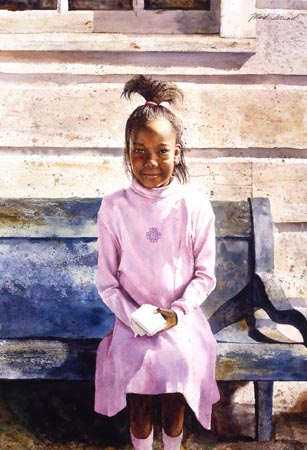
Mark Stewart - Pink Dress GirlEvery once in a while, I’ll find an artist on the web whose work I truly admire. I recently stumbled upon a Texas watercolorist named Mark Stewart, and I thought you might enjoy seeing some of his work. Of course, there’s no reason why you should read any of what I have to say… just go directly to his gallery pages and see for yourself.

At this level of excellence, artists are one-of-a-kind, but stylistic comparisons with other artists are part of the viewing experience. Somewhere between the watercolors of Andrew Wyeth and the southern portraiture of Mary Whyte (the subject of an upcoming article; watch this space), I find pleasure in the simplicity and near-realism of Stewart’s fine work.

Mark Stewart farmhouse

Here’s a painting called Colonial Day. Bear in mind that these are watercolor paintings–a medium notorious for its free-flowing, mind-of-its-own paint. What I suppose I like best here: the artist’s willingness to combine go-with-the-flow with an extreme level of precision and control. If you’ve looked twice and wondered whether you are, in fact, seeing a photograph, look more closely as the drape of her skirt, the green patch on the right side of the road, and you’ll find yourself in a watercolor-photographic dreamland. The artist is in control of your imagination. As life should be.

10014_450

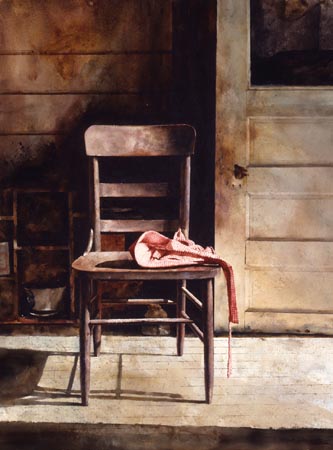
One more simple pleasure: a still life that seems to want to tell its full and detailed story. It’s called Bonnet Chair.

Bonnet Chair

So who is this man? He’s a working artist, one of perhaps a few thousand who can claim that distinction within the specialized world of watercolors. He makes his living by selling paintings, greeting cards, prints, and books–just like so many other artists who find their own way. For those who wish to dig deeper, he and his wife Sue enjoy writing about their lives, his process, his art, her feelings, and more. They do in book form (read it online), and also as a kind of ongoing dialogue. The conversations and interactions add texture to the visuals, but in the end, it’s the visuals that are so very compelling because they are so plain and so elegant. Here’s another, but I do hope you will visit the site and browse the gallery, and perhaps, support the artist as well.

Mark Stewart Flag

One final note: I started a meeting today with a favorite quote (which appears in many different forms) from Albert Einstein:

The most beautiful experience we can have is the mysterious–the fundamental emotion which stands at the cradle of true art and true science.”

I’m writing this blog article at the very end of the day, just before bedtime. As I was closing up shop for the day, I happened to glance back at Mark Stewart’s website, and I saw this quote, image, and artist’s photo blend together. A nice way to end the day.

Einstein-Stewart

A Fight Over A Postage Stamp

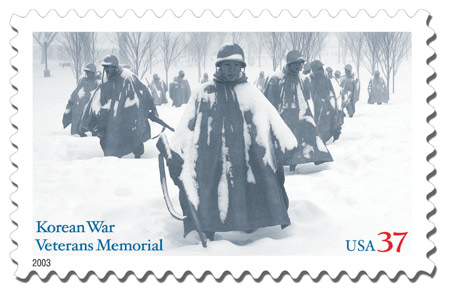
Korean War Stamp_1On September 20, 2013, the U.S. Postal Service was ordered to pay well over a half-million dollars to Frank Gaylord. He is a sculptor, the artist responsible for the Korean War Veterans Memorial in Washington, D.C., which is managed by the National Park Service for the American People. (Let’s not forget: when the U.S. Postal Service writes the big check, they’re paying him with my money, and yours).

The U.S. Postal Service issued a stamp picturing the work,  based upon a photograph whose rights were cleared prior to the stamp’s publication.

For several years, the Postal Service and Mr. Gaylord have been caught in a legal tussle about copyright infringement. It’s interesting, confusing (as these cases tend to be), and provides a useful snapshot of U.S. Copyright Law, Fair Use, the rights of artists, questions about public property, and more.

Here’s a quick rundown on the story from Stanford University’s CIS (Center for Internet and Law):

One of the important questions the case presents is whether this stamp makes fair use of the statue that appears in it. The image you see is a photograph of a sculpture taken at dawn in a snowstorm. The sculpture itself is called The Column, and is part of the Korean War Veterans’ Memorial in Washington DC. It features nineteen larger-than-life soldiers arranged in two columns, representing a platoon of soldiers on patrol in the Korean War. The Postal Service got permission to use the photograph that appears on the stamp, but not the column depicted in it, so the sculptor sued the Postal Service for infringing his copyrights in the sculpture.

The ruling is here.

A detailed analysis prepared by Harvard University’s Berkman Center for Internet and Society is here, and well worth reading, especially if you’re (a) interested in the ways of copyright law, and/or (b) a creative professional whose understanding of fair use could be more complete.

The story about the ruling, and the reason why the case is suddenly in the news, is here on Digital Photography Review. DPReview does a fine job in explaining the story, so there’s no reason for me to repeat it here.

I will, however, offer a picture of the stamp. In fact, I could not find a US Postal Service image of the stamp, but I did find a picture of the stamp from the Stanford CIS site:

So here are questions in my mind at the moment:

1 – If I reprint Stanford’s picture of a U.S. stamp on this website, am I violating Stanford’s rights? Is such a clearance necessary?

2 – Did Stanford get permission from the U.S. Postal Service to show the picture of that stamp on its website? Was such a clearance necessary?

3 – If Stanford did not get permission, do I need to get permission?

4 – If you decide to forward this article, stamp included, do you need to get permission from me, or have I already granted that permission through some online agreement with WordPress that I’ve forgotten all about?

I am still wading through the articles myself. I can’t help but wonder whether the sculptor ought to  share compensation with general or specific Korean War Veterans whose images were depicted as statues or, at least, served as inspiration. And, like you, I am confused because I thought a Memorial was, somehow, public property.

Comments always welcome.