I never thought this would be a problem. Turns out, some colored pencils are not only fragile, but too wide to fit into a traditional pencil sharpener. Too wide by a part of a millimeter, but still too wide to fit into the hole of many sharpeners.
To begin, let’s be specific. We’re talking about some traditional colored pencils, many types of pastel pencils, many types of watercolor pencils, even some black graphite pencils. Without obsessing about micro measurements, note that a Faber-Castell Polychromos colored pencil has a diameter of 7.6 millimeters, and that’s just too big to fit into a hole that is, say, 7 millimeters. It just won’t fit! Ditto for several other types of pencils made by Faber-Castell (a personal favorite), but also for the wonderful Caran D’Ache Museum Acquarelle — the finest colored pencils available — which measure 7.4 millimeters.
Many colored pencils are fragile. They’re not made of graphite (which people mistakenly call “lead”). Instead, they’re made from a mix of color pigments and a binder. A pastel pencil is, essentially, thin piece of pastel in a wooden tube. The part that is pastel is mostly pigment (finely ground particles of color) in a mix with some kaolin, clay, pumice or other minor additives. Even inside the pencil, the slender piece of pastel breaks easily. It shatters easily. Similarly, a watercolor pencil is a dowel of dried watercolor — similar to what you would find in a pan of watercolor — which is pigment, binder, and some dispersants (to disperse the paint evenly on the paper), preservatives in small quantities. Neither pastel pencils nor watercolor pencils have the stability associated with traditional graphite pencils. That’s why they break so easily when they are sharpened by, say, an electric pencil sharpener.
So, what are the options? I remember my uncle used to use a scalpel to sharpen each pencil by hand, essentially whittling the point, then rubbing it against an artist’s sandpaper tool. The process yields good results, but it is messy, and it’s hardly foolproof — the point can break.
A small handheld sharpener is a good idea, but sharpening many pencils often results in some wrist strain or pain. And the shavings must be collected, or the work must be done directly above a trash bin. Ah, but it’s not so simple. Many hand-held sharpeners have a hole that’s not large enough for the extra fractional millimeter of many colored pencils. So, you must try each sharpener to be sure your pencils will fit — and you must remember which brands of pencils fit into which sharpeners. Some hand-helds have two holes, one that’s too big and the other, too small. A hole that’s too big allows the pencil to fit, but as it bounces around while being sharpeners, the point often breaks. Grrrr…
Still, you might find a sharpener well-suited to the task. For example, I found the M+R cylinder sharpener, a heavy brass device with a replaceable blade. The small hole is a good fit for many colored pencils. Problem is, my wrist starts to ache if I sharpen too many pencils in one sitting.
Try an electric sharpener? Sure, but I have yet to find one that treats colored pencils gently. They break too often, and because they’re on the expensive side — several dollars per pencil — I question about whether this is a wise decision.
Stepping up, what I thought I wanted was an old-school rotary sharpener that attached to the wall. Turns out, these are kind-of rough on colored pencils, too.
That’s when I discovered the Caran d’Ache Pencil Sharpening Machine. It looks something like the old-school sharpeners, but it’s all-metal and built so it will last for a few generations. The design is reasonably clever, but flawed. Basically, you pull a front plate away from the sharpener and insert your pencil into a hole. Then, you feed your pencil further into the machine. It is held in place by three gnarly metal teeth — they bite into the pencil, and they leave an indentation that turns out to be exactly where I place my fingers when I draw. So, it’s uncomfortable. Once the pencil is in place, you turn the crank and the pencil is sharpened.But it is an elegant sharpener, and it does a nice job. Except that it’s not very adjustable — you can either generate a sharp point or a slightly stubby point. No other adjustments in the shape of the cone, the amount of wood being eaten up, none of that. In today’s market, this product is an insanely expensive pencil sharpener. It costs about $200! It even comes in designer colors — Klein Blue, bright red, military green, and blue. Those cost even more than the basic silver model.
Are there similar models that cost less? Yes, and one comes from Caran d’Ache. It’s made of plastic, not metal, and it is very good, but it costs about $100. I didn’t find much of a difference between that model and several similar models from M+R, Derwent (which makes watercolor and other pencils), or Carl (a leading Japanese maker). As I shopped, I kept an eye out for metal teeth — I wanted something that would sharpen effectively but not scuff up the pencils.
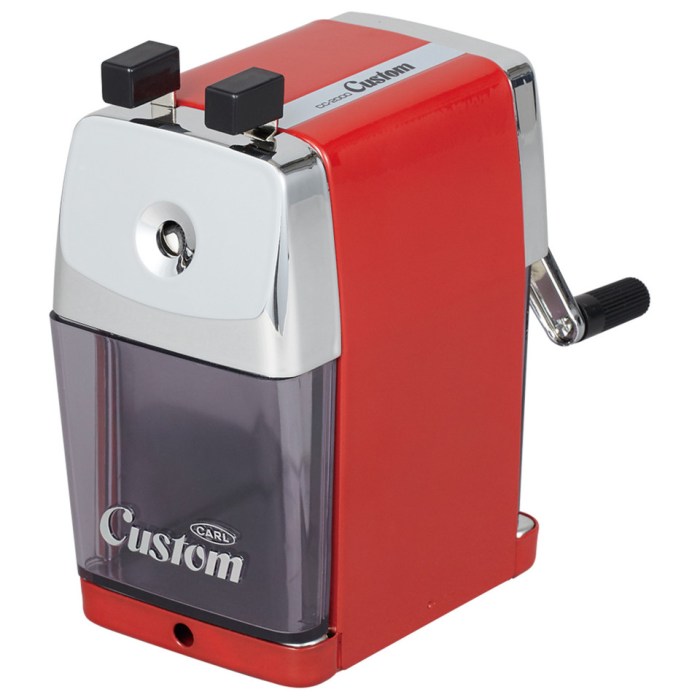
It took some effort, but I finally discovered a viable answer. It’s made by Carl, but it’s not the model that you are likely to find on most art or office supply websites. That is: this is not the Carl Angel-5, not the Royal and not the Premium. Instead, look for the Carl Custom, also known as the Carl CC-2000 (and, sometimes, the CC-2200). It is promoted as an especially quiet sharpener (which it is not). Adding to the confusion, if you order the CC-2000 from Amazon, they will send you the Angel-5. (This happened twice.) Instead, order directly from the manufacturer, pay a bit more, and accept the fact that you will pay for shipping.
The good news — it has teeth, but they are rubberized so they don’t mess with your pencils. It is solidly built, easily attached to any desktop, and it sharpens every pencil in my kit without issue.














 Digital Insider