
From yesterday’s New York Times, a special report on the death of another American newspaper. As is typical for the NYTimes, the story is in-depth, thoughtful, and well worth reading time (especially in its original Special Section print edition.) Original NY Times caption: “CreditTim Gruber for The New York Times”
Every few days, somebody sends me an interesting article about a nonprofit approach to journalism. There is usually a well-intended foundation involved, and an emphasis on discovering the future of local newspaper reporting, or something similar. These investments are made in the public interest. Unfortunately, interest from members of the public is often so limited, these journalist ventures cannot and do not sustain on their own. In the past, revenues from classified and display advertising masked this limitation. The only other form of reliable newspaper revenue, circulation (people paying for their newspapers) has long been insufficient to fund local journalism. All of this becomes more complicated when we add layers of television, radio, and internet storytelling.
The NPR model works because it is funded, in part, by Federal funds generated by taxing every American, and because some of those same people donate addition money to support not only journalism but entertainment programs as well. Given the competitive landscape in radio, NPR has developed a popular brand, so it is also able to attract advertising (which it calls “corporate support” to mask the whiff of commercialism).
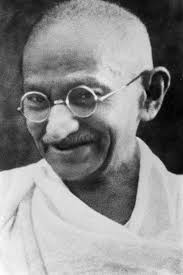
And that leads us to South Africa in 1903. Gandhi was an attorney fighting for the rights of people with Indian heritage. He was a member of the team that founded Indian Opinion, a newspaper published mostly in English with section in Gujarati. “Though…this paper, we could very well disseminate the news of the week among the community. The English section kept those Indians informed about the movement who did not know Gujarati, and for Englishmen in India, England and South Africa, Indian Opinion served the purpose of a weekly newspaper.”
Indian Opinion began with advertiser support. “[Some] of our best men had to be spared to do this….some of the good workers had be set apart for canvassing and [collecting bills] from advertisers, not to speak of the flattery which advertisers claimed as their due.”
And here’s the part that struck home for me: “…if the paper was conducted not because it yielded a profit but purely with a view to service, the service should not be imposed upon the community by force…only if the community wished. And the clearest proof of such a wish would be forthcoming if they became subscribers in sufficiently large numbers to make the paper self-supporting. [We] stopped advertisements in the paper. The community realized at once their proprietorship of Indian Opinion and their consequent responsibility for maintaining it…”
He goes on, “[The workers’] only care now was to put their best work into the paper, so long as the community wanted it, and they were not ashamed of requesting any Indian to subscribe to Indian Opinion, but thought it even their duty to do so. A change came over the internal strength and character of the paper and it became a force to reckon with….the community had made the paper their own.”
For those who could not understand the language, or afford the subscription price, neighbors would read the paper aloud, translate and explain the meaning of the stories.
With so much information flowing toward us every day, discussions about the future of journalism are constantly obscured and made unimportant. And newspapers continue to die. And the internet and NPR are insufficient replacements. Imposing solutions from above–foundation funded and such–are reasonable short-term solutions. More than a hundred years ago, Gandhi was dealing with very different realities, but his concept of pull vs. push is very much alive today.
I’m not read finished reading The Essential Gandhi: An Anthology of Writings on His Life, Work and Ideas, but this particular idea captured my imagination, so I thought I’d share it with you.

 I wondered whether, in fact, that might be true, so I meandered through 16 color pages of Christmas stuff for the home. There were a lot of pillows (I spend a third of my life sleeping), a bunch of decorative old-style lanterns (already own one), a LED outline of a cactus and another of a pink unicorn (probably not me), cups and glasses (I drink liquids, many times each day in fact), plastic Christmas tree ornaments with pictures of Mary, Santa, a teddy bear, an angel and a dove (not really me, but the angel was pretty), five different dining room chairs, and several plush reindeers on the same page as a small tower of nutcracker figurines.
 Professor Susan Engel remembers growing up. She recalls small details. Not only did she eat bugs, she remembers when and where, and which bugs she ate (potato bugs). As a pre-schooler, she remembers watching TV while sitting under the ironing board, comfortably asking all sorts of questions of Nonna, who was ironing the family’s clothes above her. In a one-room school house, Mrs. Grubb’s imbalanced approach to curiosity and education began a lifetime of inquiry. One of Professor Engel’s works-in-progress is a evaluative measure for curiosity, which seems consistent with the way most people think about school in the 21st century, and, to me, wildly counterintuitive.


 He wasn’t a rich man, and he wasn’t a well-educated man. “Marshall grew up in a two-room log cabin shared with fourteen siblings on the hardscrabble frontier of Virginia. His only formal education consisted of one year of grammar school and six weeks of law school.” And yet–this is the part that would make a terrific Broadway musical, or perhaps even an opera–Marshall becomes a military officer, influential attorney of local and then national renown, a diplomat to France, a congressman, U.S. Secretary of State, the biographer of George Washington, and eventually, the first really effective chief justice of the new United States of America (John Jay was the first, but the high court was just beginning to take shape; he was followed by one short-termer whose nomination went unapproved, and another, who was also operating in the early days of our judicial system).
 Willingness to paint outdoors requires more than straightforward skills. It requires a real desire to be part of the place that you’re painting. It’s a mindset, an attitude, a combination of willingness to be flexible and a desire to capture the light and sensibility that you cannot quite find by referring to a photograph. That’s why the book begins not with a discussion of portable easels (that comes later), but with an insightful illustrated essay posing as Chapter 1: “Why Paint Outdoors?” He focuses on the mental game and also shows himself in the game, on the street, easel set up just beside a construction site so he can get just the right view, messy paint-covered sweatshirt and slight scowl and all. He ponders how much of the work needs to be done outdoors–if you finish up indoors, which is often tempting if the weather or other conditions aren’t ideal–does a plein air painting retain its plein air status if it’s only 20 or 30 percent painted outdoors? How about 70 or 80 percent? No matter. If you do any of the work outdoors, Doherty says it counts.
 As with most books of this sort, there are profiles of artists that the author admires, and lessons to be learned from each of them. There are also good large photographs of many types of plein air paintings, useful both for inspiration and also for studying technique. I like to see a good history chapter, too, in part because it’s fun to consider myself part of a longer tradition that once included John Constable, and Jean-Baptiste Corot, and best of all, painters who were part of the majestic Hudson River School.




 A violin is not invented or perfected in a moment. It must be played, enjoyed, improved, adjusted, and sometimes, rebuilt, often over years, decades or centuries. In fact, many high quality violins are antiques that been rebuilt and rebuilt so often that little of their original material remains. Still, this is the way the culture has evolved. And that culture is not especially welcoming to an inventor with a better mousetrap. That’s why so many of Hutchins’ instruments ended up in musical instrument museums, and so few have been heard on stage in performance. Happily, there is the

 Digital Insider