Siri, meet the family

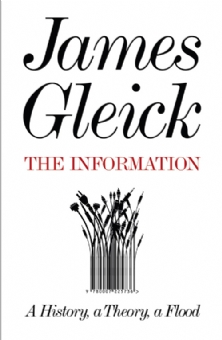
The UK cover is more interesting than the US cover, which is, somewhat appropriately, covered with the repeated words "The Information."

James Gleick nearly won a Pulitzer Prize for a biography about Isaac Newton, and another about Richard Feynmann, a colorful physicist who pioneered nanotechnology and quantum mechanics. His best selling book (more than a million copies sold) is the step-by-step, scientist-by-scientist, idea-by idea story of chaos theory entitled Chaos: Making a New Science.

Gleick’s 2011 book is called The Information. it begins with the European discovery of African talking drums in the 1840s, a percussive idea he eventually connects to Samuel Morse’s dots-and-dashes telegraph code, and, we’re off on a long tale not unlike the best of James Burke’s TV series, Connections. Gleick takes us through the development of letters and alphabets, numbers and mathematics, numerical tables and algorithms, dictionaries and encyclopedias. These stories, and their many tangents, set us up for Charles Babbage whose boredom with the Cambridge curriculum in mathematics leads to an early, impossible-to-build, 25,000 piece machine, awesome in its analog, mechanical, Victorian design. This, then, leads to the further develop of the telegraph, now caught up in a new conception called a “network” that connected much of France, for example.

By the early 20th century, MIT becomes one of several institutions concerned with the training of electrical engineers–then, a new discipline–and with it, machinery to solve second-order differential equations (“rates of change within rates of change: from position to velocity to acceleration”). This, plus the logic associated with relay switches in telegraph networks, provides MIT graduate student Claude Shannon with his thesis idea: connecting electricity with logical interactions in a network. Shannon’s path leads to Bell Labs, where he works on the “transmission of intelligence.” By 1936, a 22-year old Cambridge graduate named Alan Turing had begun thinking about a machine that could compute.

Well, that’s about half the book. Now, things become more complex, harder to follow, dull for all but the most interested reader. The interweaving connects DNA and memes (and, inevitably, memetics, which is the study of memes), cybernetics and randomness, quantification of information, and Jorge Luis Borges’ 1941 conception of an ultimate library with “all books, in all languages, books of apology and prophecy, the gospel and commentary on that gospel, and commentary upon the commentary upon the gospel…”

Eventually we obsolete CD-ROMs (too much information, too little space), and create Wikipedia and the whole of the Internet. In the global googleplex, the term “information overload” becomes inadequate. And yet, Gleick promises, it is not the quantity that matters, it is the meaning that matters. After 420 pages of historical text, I’m still wondering what it all means–and whether the purpose is mere conveyance as opposed to deeper meaning or its hopeful result, understanding.

Just My Type

US, UK covers - the UK version is more fun.

My dad taught me to appreciate the distinctions between one font and another. Before I finished high school, I knew about serifs, descenders, x-height, and Bodoni Bold. This was secret knowledge exclusive to graphic artists (and their attentive children).

Then, desktop publishing happened, and suddenly, everybody seemed to know about Baskerville, Times New Roman, Optima and Helvetica.

Fonts became cool. A movie was made about Helvetica.

Now, there’s a surpassingly energetic–and fun!–book about fonts, Just My Type, written by Simon Garfield.

In it, you’ll find the unfortunate story of Comic Sans, and the movement to eradicate its use.

I never thought much about the reasons why we have Helvetica, Ariel, Univers and Futura. And why I started to use Frutiger and Gill Sans in place of other sans serif fonts. Or why I never loved Brush Script or Souvenir. Turns out, each of these fonts is part of a story, either about technology’s progress or shifts in public sensibility or the renovation of a mass transit system (which requires signs of every size, plus maps).

Yes, this book is ridiculously geeky. No, there’s no reason why chapters must be read in order. Yes, there are lots of pictures–and examples that reminded me of our graphic past as defined by Gilligan’s Island, Obama’s first presidential campaign, the London underground, Letraset and Dymo tape, Pet Sounds, Penguin Books, Ikea, and T-Rex.

I wish I had the patience to read every story of every type font, designer and context. And I wish there were dozens of visual examples–more and more visuals to tell this very visual story.

Smaller than I thought

Just out of curiosity, I decided to explore the list of top U.S. newspapers by circulation.

Some things that I found interesting:

1. The top newspaper in the USA is not a general interest paper. It’s the Wall Street Journal, with a circulation of about 2 million.

2. The second largest paper is USA Today, and the third is The New York Times.

3. The daily circulation of The New York Times roughly equals the population of Rhode Island–just about 1 million people. On Sundays, the Times circulation equals the number of people in Idaho (1.3 million). And the NY Times is the biggest local paper in the USA.

4. Other big papers in the USA include The Washington Post, The Daily News (NYC), Chicago Tribune, and Chicago Sun-Times. Each is around the half million mark–roughly, the population of  our least-populous state, Wyoming.

Before this end-of-journalism web madness began, daily New York Times circulation was about 1.1 million in 1998. Not much of a change from today’s 1 million. In 1990–years before the internet’s introduction–The Daily News peaked around 2.3 million per day, but by 1990, circulation was down to 1.2 million, and now, it’s about half that amount. Based upon various conflicting, but helpful, sources, I believe newspaper circulation is down by around 1/3 since 1990–but that’s two decades ago, certainly plenty of time to reinvent an industry. In Chicago, that means 1 in 9 households gets a paper (either Sun-Times or Trib) every weekday. I’m curious whether that number was, say, 1 in 5 around 1960, or maybe even 1 in 3 around 1940. I’ll do some research on those details, and get back to you.

Regardless of the specific numbers, the trends are no secret. It’s clear that the music and newspaper industries made their technology decisions late in the game, limiting their options, struggling with their status quo for too long, allowing competitors to dominate. And, it’s pretty clear that the internet is a better way to deliver news than, say, newsboys standing on street corners. I wonder whether we still need print editions. And I wonder just how much energy, and paper, we spend printing, trucking and recycling millions of newspapers every day of the week. And on Sundays.

Power of the Press

http://www.huffingtonpost.com/2011/09/11/911-september-11-newspapers_n_957297.html

Admittedly, I am writing and you are reading on a device that is rapidly destroying print media.

Still, it’s worth the time to browse the ways that today’s remembrance was visually presented on newspaper front pages in US cities and throughout the world. There are so many lessons here: about journalistic priorities, visual communication, heart and soul, and more.

No other medium can do this.