If you want to buy a house for cheap, buy one in Arkansas or Mississippi–those are among states in the center strip of the USA with the least costly houses. In fact, the swath extends from Nebraska to West Virginia–the flyover states. Houses in New York and California cost lots more. In fact, average home listings in the low-cost states are about four times lower than the averages in the highest states. That’s a large swing.
Here’s the map, a snapshot of a wonderful interactive map called The Financial States of America, published by moneychoice.org

Same website, same interactive map, but this time, I selected Well Being, and the results surprised me (of course, the site explains how they define and quantify well-being). No surprise that people in New Hampshire and Vermont are doing well. The surprise is that the every one of the “wellest” states is in the north–except Hawaii. The least well–the lowest ten states–are almost all connected in and beyond the Appalachians, with Oklahoma and Arizona in that group, too. Here’s the snapshot (the interactive map would not translate to this blog, so I’m offering a few snapshots to encourage you to explore the map on your own).

The Minimum Wage map is fascinating because it shows how states that are near one another tend to make similar laws and accept similar rules. The states in the Deep South have no minimum wage. The states in the Pacific Northwest offer the highest minimum wage in the nation. Minnesota, Georgia and Wyoming offer the nation’s lowest minimum wage–an unjustifiable $5.15 to $6.20 per hour.

This is really interesting, to see American states behaving so differently from one another. One more, and then, you’re on your own. This one shows California with the nation’s highest GDP–the most productive economy, by far. Texas is second, and New York is third, and then, most other states don’t even come close. California’s GDP is now nearly $2 trillion dollars. If it was a country, it would compete with Italy and Spain, only about 10 percent smaller than the GDP of India. The state of New York competes, roughly, with South Korea. Texas’s economy is about the size of Mexico’s economy. By comparison, Michigan’s GDP is about the size of Denmark’s GDP–surprisingly small. Pakistan is slightly more productive than Connecticut. Tiny Delaware could fight it out with equally tiny Luxembourg. These match-ups are interesting enough to rate a Wikipedia article. Off the map, but NYC’s GDP is bigger than Spain’s. and Tokyo’s GDP is largely than Russia’s GDP (all GDPs are nominal). More GDP city data here.

Enough of this. I could play with interactive maps all day long.
One more thing I found on the moneychoice site: an infographic about global money. This will keep me busy until bedtime…

Created by MoneyChoice.org

 Yeah, well, my list isn’t very long, either. Easy enough to list Mao, Chang Kai-Shek, Chao en-Lai, maybe the classical pianist Lang Lang, and the basketball player Yao Ming. Maybe Jet Li, who is probably from Hong Kong (I checked; he is from Hong Kong).
 There are good stories about emperor Kublai Khan, and the beginning of Chinese drama as initiated by Guan Hanqing. You may know Zheng He, an admiral who led a large fleet to Africa and other far away places a few decades before Christopher Columbus was toilet-trained (I wonder whether there were toilets in Genoa in the 1450s?) Rumors about Zheng He discovering the American mainland are, apparently, quite wrong, the work of someone who mistranslated Chinese historical documents.
 Where does this lead? And how do we even begin to think about the future when so much television viewing is now on-demand and so much audio listening is via Pandora, podcasts,
 Now that I’ve written that title, let me check.
  Jarrett’s work is immediately magical, glorious in its improvisation and sonic exploration. He’s been doing these albums for decades, and yet, every time I put a Jarrett CD on (or, for that matter, an LP), I’m immediately transported into the filagree of his imagination, sipping a drink at an after-hours jazz bar where the player is extraordinary and I just don’t want the evening to ever end. Recorded live at the KKL Luzern Concert Hall, the CD called Somewhere begins with the mind-bending “Deep Space,” and here, it’s Jarrett’s show with just the right additional color and light provided by double bassist Gary Peacock and drummer Jack DeJohnette; later in the track (the second part is Miles Davis’s “Solar,” their interplay moves the music into an even more interesting exploration, a testament to the extreme skill, experience and love of experimentation that these three musicians consistently offer. So that’s one track, again the first, and again, a favorite. (And I suppose I should mention that the sonic fidelity of these recordings is at such a high level, it would be difficult to imagine a disc sounding any better.) There are some favorite standards here (mine, anyway); it’s difficult for me not to be captivated by Leonard Bernstein’s “Somewhere;” and the less-often-heard “Stars Fell on Alabama” and the Jimmy van Heusen- Johnny Mercer tune, “I Thought About You.” Ooops–I’m listening to the wrong track–that’s really catchy, and less schticky than I remembered: “Between the Devil and the Deep Blue Sea”–well, a little schtick for me. Back to the dark night sky and mystery of “Stars Fell…” and my mind easily drifts to Perseids and stardust. What a lovely album.
 The old guy in the crowd–Gary Burton is 70 to Keith Jarrett’s 68–opens with a Antonio Sanchez’s rocking drum, instantly establishing a more ambitious, brighter tone for the new Guided Tour, also from Mack Avenue. This is a quartet with Burton leading as one might do with a piano. Sanchez really drives this music. It’s a bigger sound than you would typically expect from a quartet. Burton is leading an exploration not entirely different from Jarrett, but more clearly articulated, more melodic, catchier. The difference is the way that Julian Lage is playing electric guitar, almost as if he’s playing in the style of Burton and his vibes on “Jane Fonda Called Again,” never passive or receding or relaxed, but instead, aggressive and punchy. Yes, they play pretty, too, working the pastoral mood on “Jackalope,” and the Latin romance of “Helena” (especially nice guitar from Lage on this one), but it is so much more fun when these guys really go for it, with Burton playing fast and strong. Best example is probably the last track, written by drummer Sanchez, called “Monk Fish.” Scott Colley is the capable, but less showy, bassist; tough to get a word in edge-wise when the other players are clearly having so much fun. Far livelier than the other two CDs, Guided Tour is a terrific introduction to the Burton’s massive catalog.
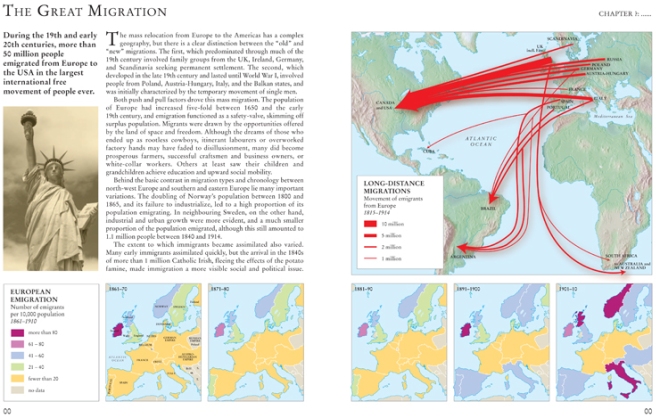 So that’s one migration. There’s another 13.5 million people moving during the period 1815-1915. Those people are moving, mostly, from Europe to America. Lots from Ireland, England, Scandinavia, and later, Spain, Italy, and eastern Europe–the peopling of America.



 Apple certainly knows how to generate buzz. They introduce two new telephones, and the internet lights up.


 Digital Insider