Encouraging Schools to Join the 21st Century

Darryl WestConventional public schools are “arranged to make things easy for the teacher who wishes quick and tangible results.” Furthermore, “the ordinary school impress[es] the little one into a narrow area, into a melancholy silence, into a forced attitude of mind and body.” No doubt, you’ve had a thought similar to this one: “if we teach today’s students as we taught yesterday’s, we rob them of tomorrow.”

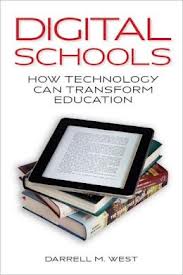
There’s a reason for the old school language. The words were published in 1915 by educator John Dewey. A century later, the situation has begun to change, mostly, according to Brookings Institute vice president Darryl M. West, as a result of the digital revolution. Mr. West advances this theory by offering an ample range of examples in his new book, Digital Schools.

Quite reasonably, he begins by considering various attempts at school reform, education reform, open learning, shared learning, and so on. Forward-thinking educators fill their office shelves with books praising the merits of each new wave of reform, and praise the likes of Institute for Play, but few initiatives taken hold with the broad and deep impact that is beginning to define a digital education.
digital schoolsBlogs, wikis, social media, and other popular formats are obvious, if difficult to manage, innovations more familiar in student homes than in most classrooms, but the ways in which they democratize information–removing control from the curriculum-bound classroom and teacher and allowing students to freely explore–presents a gigantic shift in control.

Similarly, videogames and augmented reality, whether in an intentionally educational context or simply as a different experience requiring critical thinking skills in imaginary domains, are commonplace at home, less so in class, and, increasingly, the stuff of military education, MIT and other advanced academic explorations, and, here and there, the charge of a grant-funded program at a special high school. More is on the way.

Evaluation, assessment, measurement–all baked into the traditional way we think about school–are far more efficient and offer so many additional capabilities. No doubt, traditional thinkers will advance incremental innovation by mapping these new tools onto existing curriculum, perhaps a step in the right direction, however limited and short-sighted those steps may be. The big step–too large for most contemporary U.S. classrooms–is toward personalized learning and personalized assessment, but that would shift the role of the teacher in ways that some union leaders find uncomfortable.

The power behind West’s view is, of course, the velocity of change in the long-promising arena of distance learning. During the past ten years , the percentage of college students who have taken at least one distance learning course has tripled, and  passed 30 percent in 2011. Numbers are not available, but I suspect we’ve now passed the 50 percent mark. The book does not address the stunning growth of, for example, Coursera. Kevin Werbach, a Wharton faculty member, taught over 85,000 students in his first Coursera course (on gamification)–students from all of the world. Indeed, the current run rate is 1.4 million new Coursera sign-ups per month.

Mimi Ito is one of the more influential thinkers about modern education and its future. Click to read her bio.

Mimi Ito is one of the more influential thinkers about modern education and its future. Click to read her bio.

The author quotes education researcher Mimi Ito:

There is increasingly a culture gap between the modes of delivery… between how people learn and what is taught. [In addition to] the perception that classrooms are boring… students [now] ask, ‘Why should I memorize everything if I can just go online? … Students aren’t preparing kids for life.”

Is this a ground-breaking book. No, but it is useful compendium of the digital changes that are beginning to take root in classrooms across America. Yes, we’re behind the times. In many ways, students are far ahead of the institutions funded to teach them. The book serves notice: no longer are digital means experimental. Computer labs are being replaced by mobile devices. Students are taking courses from the best available teachers online, and not only in college. Many students are enrolled nowhere; they are simply taking courses because they want to learn or need to learn for professional reasons. Without formal enrollment, institutions begin to lose their way. The structure is beginning to erode. Just beginning. And it can be fixed, changed, transformed, amended, and otherwise modernized. And so, the helpful author provides an extensive list of printed links for interesting parties to follow.

Just out of curiosity, I called up Darrell M. West’s web page–it’s part of the Brookings Institution’s site–and, as I expected, he is a man of consider intellect and accomplishment.  And so, I hoped I would find the above-cited links as a web resource. I looked for Education under his extensive list of topics of interest but it wasn’t there. (Uh-oh?) I did find a section on his page called “Resources,” but the only available resource on that page was a 10MB photograph of Mr. West. I couldn’t find the links anywhere. Perhaps this can be changed so that all readers, educators and interested parties can make good use of his forward-thinking work.

Sorry–one more item–I just found a recent paper by Dr. West, and I thought you might find both the accompanying article and the link useful.

Here's a look at 42-year-old John Dewey in 1902. To learn more about him, click on the picture and read the Wikipedia article.

Here’s a look at 42-year-old John Dewey in 1902. To learn more about him, click on the picture and read the Wikipedia article.

U.S. Education by the Numbers

Today, more students are enrolled in school than ever before. And the trend is accelerating. In fact, all of the population numbers in this article have increased by about ten percent in the past ten years; in the next decade, the acceleration will increase. For the moment, let’s focus on the U.S., and, in time, in future articles, the view will expand. Note that much of his information comes from the National Center for Education Statistics.

Before we dig deeply, I suppose it’s interesting to note that there are about 99,000 public schools (including just over 5,000 charter schools), plus more than 33,000 private schools.

640px-College_graduate_studentsThis year, there are slightly fewer than 50 million public school students, including about 15 million high school students in public school. Add another 5 million students in private school, including over 1 million in private high schools.
Each year, about 4 million students start high school. (Actually, the number is about 3.7-4.0 million). Remember that number: it’s the basis for some arithmetic below.

There are many ways to calculate high school graduation rates, and the Federal government has been improving the reliability, accuracy and precision of these metrics. Distribution is uneven: students in some ethnic groups, who live in some states or cities or districts, may fare better or worse (as poorly as 1 in 2 graduating, for example).

In our simple (and, perhaps, simplistic) calculation, it would be fair to assume that about 4 million students start high school and about 3 million finish high school.

About 2 in 3 males, and about 3 in 4 female, enroll in college.

Each year, just under 2 million bachelor’s degrees, plus just short of a million earn an associates degree. And although not everybody earns a bachelor’s degree in four years or an associate’s degree in two years, on average, the vast majority of people who graduate high school–that is, about 3 in 4 of the people who started ninth grade–earn a college degree.

What’s more, nearly one million advanced degrees (masters, doctorate) are awarded every year. It’s fair to assume more than a half million people earn these degrees each year–or about 1 in 6 f the people who graduated high school.

Taking this into the workplace, in 2010, nearly 3 out of 4 college graduates were employed, in comparison with just over 1 in 2 people with only a high school diploma. On average, those college graduates also earned more money: over $45,000 for the college graduates compared with just under $30,000 for high school graduates without a college degree.

All of this sounds terrific, but I wonder whether the numbers are correct.

Last spring, The Atlantic published an article that placed just over 40 percent of 18-24 year olds in college, and offered a graduate rate (within a generous six years) of just 56 percent. If I understand this story correctly: roughly 20 percent of 24 year olds earn a college degree. The Atlantic story was inspired by a report prepared by Reuters.

So why does the National Center for Education Statistics report 1.8 million bachelor’s degrees per year? (I may not be comparing [teacher’s] apples to apples, but this discrepancy seems to be quite large.)

The purpose of this article is not to challenge these sources, but instead, to try to get a fix on the actual numbers, and the state of U.S. education today. Why? If 3 in 4 people are indeed graduating high school, then we’re working on the right problem, especially if the vast majority of high school grads finish college and earn a good wage. However, if only 3 in 4 high school grads are attending college, and only 1 in 2 of them are actually finishing college, that only 1 in 4 Americans are college graduates.

Gee, those numbers seem wrong to me–the number of college graduates is probably over fifty percent–so why don’t the numbers add up?

(Help?)

On Other People’s Bookshelves

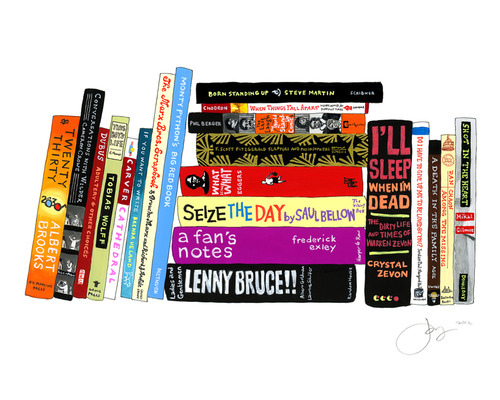
During the past few months, a clever oblong book entitled My Ideal Bookshelf has been widely covered in the media. Each two-page spread contains a brief essay about books and reading by a cultural somebody, and a painting of that person’s favorite books arranged as they might appear arranged on a shelf (in fact, not one of the painted arrangements includes an actual bookshelf).

Browsing the groupings of favorite books, I did what I always do. I took some notes, and made a list of books I would like to read someday.

I have wandered through a vast number of books about food and cooking, but so far, I have not taken on Larousse Gastronomique. So, thank you to chef and cookbook author Hugh Acheson for that reminder, and to chef Thomas Keller for suggesting the same book.

From author Junot Díaz, a recommendation for Divided Planet: The Ecology of Rich and Poor.

apatow_bookshelfJudd Apatow, famous for his comedy movies, surprised me with James Agee’s A Death in the Family, and reminded me of a popular book about comedians that I wanted to read, but never did: The Last Laugh.
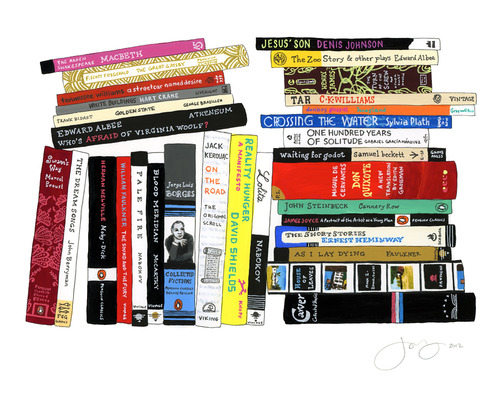
I was happy to see Dave Eggers highlight Edward P. Jones’s The Known World, a story about American slavery that I finished this winter, and now look forward to reading Denis Johnson’s book, Jesus’ Son which is “short, funny and impossibly lyrical…a book nobody doesn’t like.”

It was fun to see some of my all-time favorites, especially the obscure ones, on other people’s shelves: Chuck Klosterman likes Four Arguments for the Elimination of Television and Rudy Rucker’s The Fourth Dimension, and designer David Kelley likes The Care and Feeding of Ideas by Adams and the compendium, An Incomplete Education, and I do, too.

franco_bookshelfJames Franco wins for the most cluttered bookshelf, also the one with the most books. From his stacks, I think I will pick up another set of Raymond Carver stories, and the original scroll version of Kerouac’s On The Road. I suppose I should read Melville’s Moby Dick, which I have avoided so far for no good reason. Ditto for writer Philip Gourevitch’s suggested A Good Man Is Hard to Find by Flannery O’Connor and Dostoevsky’s The Idiot.

I am among the many who believes Professor Lawrence Lessig to be brilliant, so I was anxious to explore his bookshelf. Mostly, it was the scholarly law stuff that appealed to me, but it was encouraging to see Neal Stephenson’s Snow Crash sitting just below The Federalist Papers. 

Writer / designer / photographer Ben Schott included Dylan Thomas’s Under Milk Wood, but I think I will listen to Richard Burton on the BBC rather than reading it in book form. Patti Smith reminded me that I have not gotten my copy of Allen Ginsberg’s Collected Poems, 1947-1980. Editor Lorin Stein’s list includes Chuck Amuck by Warner Brothers animation director Chuck Jones, which I know I will enjoy.

It was interesting to see one of my architectural favorites, A Pattern Language, on chef Alice Waters’s list, and I suspect we both found it by browsing the same source, years ago, The Whole Earth Catalog. Pretty much, I want to read her entire bookshelf, from M.F.K. Fisher’s Consider the Oyster to Maria Montessori’s The Secret of Childhood.

rosanne_cash_bookshelf

Rosanne Cash’s mix of E.B. White, Mallory and The War of Art (another of my favorites, it’s way over on the left), and Tennyson and Solzhenitsyn was among the most intriguing collections.

Finally: good for William Wegman for including not only two Hardy Boys novels, but also bits of the World Book encyclopedia, The Golden Book Encyclopedia, and Girl Scout Badges and Signs.

I was very pleased, and felt very smart, when I saw so many of my personal favorites on other people’s shelves. And, I felt woefully illiterate when I realized just how many of the books–sometimes, whole bookshelves–with both authors and titles that were completely unfamiliar to me.

(So many books. So little time.)

Great App for Ideas; No iPad Version Yet

Although it currently lacks an iPad version, there’s a wonderful software application called Curio 8 that offers a remarkable combination of fully integrated features related to the world of ideas. I discovered it recently, and I’m just beginning to understand how useful Curio 8 can be.

Basically, Curio 8 combines these functions in a single package:

  • Note taking
  • Brainstorming
  • Mind mapping
  • Task management
  • Presentation


It’s a little bit OmniGraffle, a little bit Evernote, with some of the functions of Keynote, but it’s also a drawing program that’s also useful for presentations. Although it’s awkward to describe Curio 8 in terms of other software applications, this particular application more than holds its own in each of these categories (and more).

As in Keynote (Apple’s answer to Microsoft’s PowerPoint, very popular on iPads), you begin by choosing an “Idea Space” (in Keynote lingo, a “theme”). You can then drag documents (PDFs, RTF word processing files, image files; also, web links) into the Curio 8‘s Organizer, and assign properties to each of these items. For example: notes, metadata, color, style, size, color. In addition, as you would with Things or any of the GTD apps (“Getting Things Done,” a fancy to-do list), you can assign filters (“hot”,”under peer review,” etc.) You can also assign the name of an Evernote Notebook or an Evernote Tag because there is deep integration between Curio 8 and Evernote.

That’s only the beginning. Once the Curio 8 “project” is established, you can add any of these and more:

  • Basic shape, styled shape, stencil (all similar to OmniGraffle)
  • A list, such as a to-do list (complete with iCal syncing) or a bulleted list
  • A mind map (similar to XMind or any number of other mapping apps)
  • A table
  • An index card (similar to Corkulus)
  • An screen snapshot (similar to Grab)
  • An audio or video recording

Curio-ScreenThese audio and video recordings must be made live–there’s a built-in recorder. In this version, Curio 8 does not support, say, .mov files, but you can paste the link to a YouTube or Vimeo file (requiring Curio 8 to be used with an internet connection in order to see these files).

But wait! There’s more!! The next set of features allows various sorts of sketching, drawing and painting with a variety of pens and brushes.

You can export the Curio 8 project as a .tiff, .jpeg, .png, .PDF, .html, and for selected items, you can export, for example, a .csv file from a table.

Assets used in one Curio 8 project can be easily accessed for use in another (gee, I wish this was a common feature in Pages and Keynote).

In addition, there’s a bit of scripting that will recall, for example, FileMaker. You can assign an action to a specific asset within a project. Click on a shape and Curio 8 will automatically set up a new email message, or open a URL, or open a specific file.

Curio 8 is the work of a very creative guy named George who lives and works in North Carolina. His company is called Zengobi, and so, you can find out more about Curio 8 by visiting http://www.zengobi.com. In case you’re curious, Zen is, of course, a Japanese sect of Mahayana Buddhism “that aims at enlightenment by direct intuition through meditation” and Goby is a small fish that swims in the shallow waters near North Carolina.

Often, George reports to his users via his blog. On March 13, he boasted about the addition of “the #1 requested mind mapping feature: mind map relationship lines.” On March 4, he explained the difference between a Concept Map and a Mind Map (the latter allows only one parent diagram per child). Lots of detail, all very useful and all wonderfully focused on the customer’s needs.

ScrivenerThis is the joy of working with a small software company: the product is terrific, and the company is highly responsive to customer needs. The same can be said about Literature & Latte, makers of the equally useful Scrivener word processor for authors, academics, screenwriters and playwrights.

The frustration, both for the company and for the user, is the amount of time required to build applications. In both situations, users have been patiently waiting for an essential tool: the tablet version of the software. Both of these programs are feature-rich. They have set a very high standard and they now serve a very specific niche customer base that expects an extraordinary feature set and a supremely reliable product.Typically, a small company is doing all it can to manage a Mac version (Literature & Latte recently released its first Windows version, but Zengobi has not). Add an app, and not just an iPad app, but a fully functional Android app as well, and the resource tug becomes uncomfortable.

And so, Curio 8 users do precisely what Scrivener users have learned to do. Be happy with the Mac-based product and its evolving feature set, and wait, patiently, for the inevitable release of the iPad app. In both cases, it’s coming soon. Even larger companies must take their time with app development–learning a great deal from every iteration. I’ve become a big fan of the OmniGroup products, happily using OmniFocus to manage my daily affairs, but only on the iPad and iPhone. Turns out, those apps are now so good that the older Mac app is so far behind that I don’t really understand how to use it. So what is OmniGroup doing? Redeveloping the Mac app so that it works the same way as their iOS apps.

We’re all learning a lot from this new wave of software application development. And, mostly, we’re discovering that this is all a very new way of thinking. Getting it right takes time.

Masterful Visualizing

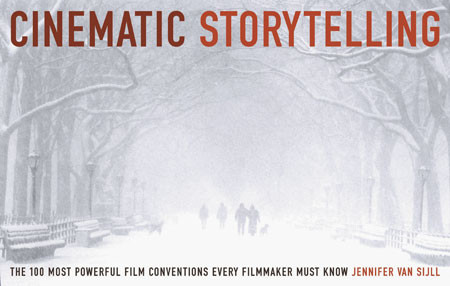
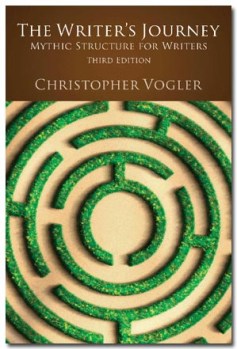
In my last post, I recommended a book entitled The Writer’s Journey: Mythic Structure for Writers by Christopher Vogler. As a companion, I recommend another book from the same publisher, Michael Weise Productions. This one is entitled Cinematic Storytelling: The 100 Most Powerful Film Conventions Every Filmmaker Must Know. It’s written by Jennifer van Sijll. Like The Writer’s Journey, Cinematic Storytelling is useful to the one telling the story, and to the reader or audience member on the receiving end. Why does this book matter? Because we’re rapidly developing into a world of visual storytellers–smartphones and digital cameras in hand–and it would be wonderful if everyone could do their job just that much better.

CInematicStory_website_largeBasically, this book is an encyclopedia of visual storytelling techniques, but it’s fun to browse because every idea is illustrated by frames from a well-known or significant film–and each sequence is presented with the relevant bit of the screenplay along with perceptive commentary from the author.

Some are easily understood by the audience, and as a result, they must be used judiciously by the filmmaker or storyteller: the slow-motion sequence in Martin Scorsese’s Raging Bull; the freeze frame that ends Butch Cassidy and the Sundance Kid; the fast-motion sequence in the French film, Amelie; the famous flashback in the Billy Wilder film, Sunset Boulevard; the visual match cut that transforms a bone into a spaceship in 2001: A Space Odyssey; the long dissolve between young Rose and Old Rose in Titanic.

A specialty lens was used by Orson Welles in Citizen Kane–perhaps the movie most often used as an example to illustrate a variety of techniques. Sometimes, a telephoto is the appropriate storytelling choice, and sometimes, it’s the wide angle. These are not random, on-the-fly choices; instead, they are carefully considered during the storyboard phases of film development.

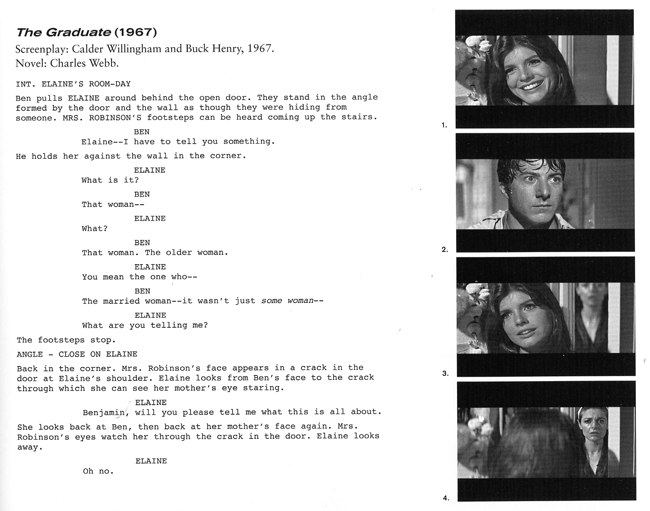
In this entry featuring The Graduate, the author explains the use of a "rack-focus"--here, shifting the focal point from one character to another. The author explains, "Unseen by Elaine, who is still facing Ben, Mrs. Robinson stands in the doorway. Mrs. Robinson is out-of-focus and ghost-like. When Elaine spins around, Mrs. Robinson is pulled into focus, and Elaine is thrown out of focus (Image 4). Every line in Mrs. Robinson's defeated face now shows. After a beat, Mrs. Robinson disappears from the door. When Elaine turns back to Ben, her face remains momentarily blurred, externalizing her confusion. At the moment of recognition, her face is pulled back into focus.

In this entry featuring The Graduate, the author explains the use of a “rack-focus”–here, shifting the focal point from one character to another. The author explains, “Unseen by Elaine, who is still facing Ben, Mrs. Robinson stands in the doorway. Mrs. Robinson is out-of-focus and ghost-like. When Elaine spins around, Mrs. Robinson is pulled into focus, and Elaine is thrown out of focus (Image 4). Every line in Mrs. Robinson’s defeated face now shows. After a beat, Mrs. Robinson disappears from the door. When Elaine turns back to Ben, her face remains momentarily blurred, externalizing her confusion. At the moment of recognition, her face is pulled back into focus.

Selecting a particular point-of-view (POV) can be a critically important aspect of storytelling, as with the below-the-swimmer underwater sequence just before the first swimmer is killed by a shark in JAWS. For which scenes is a low-angle shot most appropriate (character POV for E.T. would be one example), or for which would a high-angle shot be the better creative choice? When does it make sense to use a tracking shot (the camera is mounted on a tripod that glides along tracks; some low-budget achieve similar results by employing a wheelchair)?

Lighting is another variable. In American Beauty, there’s a scene illuminated by candlelight. In E.T., the search is conducted by flashlights and car headlights that illuminate an otherwise dark nighttime landscape.

In Barton Fink, individual shots of props (hotel stationery, an old typewriter) add visual context. Wardrobe is another defining option. So, too, is the use of location as a theme, a concept so masterfully used by director David Lynch in the vaguely creepy Blue Velvet.

It’s not always about what is seen. Sometimes, the scene contains less information, and the story or theme is carried by music or sound effects. Back to Barton Fink for the eerie sense of surreal sound and its ability to paint a picture of each character’s inner world.

Masterful Storytelling

WritersJourney3rddropWe live in remarkable times. Stories are told in every part of the world, and shared with millions of people. Once, this was the domain of the rich and powerful. Today, anybody can tell a story, and share the majesty of their ideas.

Of course, some stories are better than others. There is an art and a craft to all of this, a discipline studied in college programs and in private instruction taught by masters.

One such master is a Hollywood story consultant named Christopher Vogler. Since 1998, Vogler has been the industry expert on a particular, popular type of storytelling and character development. He explains it all in a wonderful book entitled The Writer’s Journey: Mythic Structure for Writers,  now published in its third edition by Michael Weise Productions.

No doubt, you are familiar with the structure of the mythical hero’s journey. You’ve seen it in so many movies. The hero of the story does not begin as a hero. Instead, he or she (more often, he) is an ordinary guy doing ordinary things every day. Then, something happens, and suddenly, he is thrust into an uncomfortable role, reluctant to proceed in anything resembling a heroic journey. Inevitably, the wizened old mentor or the playful talking dog shows up, and the ordinary guy begins to understand that he has no choice, that he must pursue the journey whether or not he wants to do so.

It’s Star WarsThe Wizard of Oz, Sister Act, Big, Raiders of the Lost Ark… you know the routine, but it’s still a story we love to experience, a story we love to tell. It’s the human experience, each time presented anew.

We’re on a mission from God” — Dan Ackroyd and John Landis, screenplay, Blues Brothers

So what’s so special about this book? Well, Vogler has a tidy way of breaking down each of the steps along the journey. For example, after leaving the ordinary world; hearing the call to adventure; refusing the call; meeting with the mentor; encountering tests, enemies and allies; and approaching an innermost cave, the hero is inevitably faced with an ordeal that must be overcome in order to move ahead with the journey. Joseph Campbell, whose book, Hero with A Thousand Faces, covers much of the same territory from a mythological analysis perspective, also arrives, at this point in the journey, at the greatest challenge and the fiercest opponent. So here’s the secret of the ordeal:

Heroes must die so they can be reborn.

To be clear, “the dramatic movement that audiences enjoy more than any other is death and rebirth. In some way, in every story, heroes face death or something like it: their greatest fears, the failure of an enterprise, the end of a relationship, the death of an old personality. Most of the time, they magically survive this death and are literally or symbolically reborn to reap the consequences of having cheated death. They have passed the main test of being a hero.”

Vogler goes on to explain that heroes “don’t just visit death and come home. They return changed, transformed.” So, the ordeal serves as a central core to the story, the place where the variety of story threads begin to tie together in a meaningful way. BUT–the crisis is not the climax of the story. That’s a completely different concept, a part of the story that arrives much later on (near the end, in fact.)

One reason why we love to watch the hero’s journey time and again is because every story is unique. Vogler explains how and why this may be true. Most often, the crisis occurs at the story’s mid-point, which Vogler describes as a tent pole–if it’s too far to one side, the tent sags / the audience’s interest wanes. (He reminds us that our word “crisis” comes from a Greek word meaning “to separate.” Vogler looks at the question of ordeal from many different perspectives, each one a driver that we’ve all experienced in the movies or in good fiction: a crisis of the heart, standing up to a parent, witnessing the death of a loved one, going crazy with emotion, and the list goes on.

If you’re sensing that The Writer’s Journey might be a useful tool for both constructing and de-construcing stories, you’re beginning to understand the value of Volger’s accomplishment. For the writer attempting to tell a story in a way that will ring true for the reader or the audience, this would seem to be an essential tool. For the reader, or the movie fan who wants to better understand the art and craft of storytelling, the deep secrets of the creative team, this book exposes the magic for the trickery that it is, then waves its cape to reveal far deeper magic within. For the English teacher, or professor, in search of a far better way to connect with students who ought to read or write with greater proficiency, here’s the elixir.

Of course, that’s only part of the story: the writing. Next up, from the same publisher: how to tell the visual story to ignite the audience’s imagination.

A Teacher Who Paints Ideas

When a student faces a new subject, there is a certain comfort in structure, process, facts, and the rigorous routine that defines most teaching situations. Teachers find comfort in that structure: first, the basics, then, perhaps, the materials, then, the history followed by waves of increasingly specific information. In theory, it all makes sense. In practice, when faced with the sloppiness of real life, the structure may be exactly what’s not needed because it interferes with the real learning that occurs as a result of experimentation and making glorious mistakes.

I guess that’s why I had so much trouble understanding what Tom Hoffman was doing. Instead of writing a book that began with materials (in this case, watercolor paints, brushes, papers, and accessories), he begins by admitting that watercolor painting is not easy to do, that it is sloppy, messy, difficult to master, wasteful of expensive paper, and then eschews anything resembling a traditional learning process. Instead, he focuses on the most dangerous of all educational concepts: ideas.

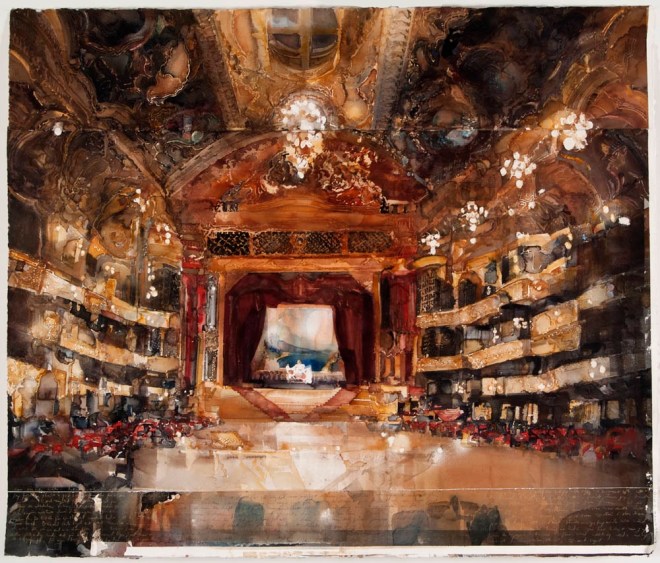
Allow me to begin where he first captured my imagination, with a watercolor painting by an extraordinarily talented artist named Lars Lerin.

operaQuoting Hoffman:

The palette is limited to three colors, and almost all of the edges of the shapes are hard. In the realm of value, however, the artist pulls out all the stops. Never merely black, his deepest darks remain full of color. He limits the lightest lights to just a few stops, making everything else seem to be lit by the low gleam of a lantern in a gilded pattern.

With this glorious visual introduction, he begins where most instruction books ought to begin: by encouraging direct observation, followed by critical thinking (would this make a good painting? what appeals to me, and might also appeal to the person looking at my finished work?) and creative thinking (how can I bring the visual ideas to life in the best possible way?) Hoffman does not begin by focusing on materials. He begins by focusing on the process that every artist shares. This leads to two very helpful essays, one entitled “Knowing Where to Begin” and the other, quite reasonably, “Knowing When to Stop.” In between, he explains the process by examining a very common part of the painting process: thinking through the best way to visualize the shapes and forms and values with just enough detail to pull it all together.

Hoffman Skaftafell

Simplicity in pattern and form, a very effective work by Tom Hoffman.

Step back for a moment. Imagine learning history that way. It’s never about the details. It’s always about the whole form. (But in school curriculum, it’s always about the details. Which we always forget.)

A very colorful Juarez Market in Oaxaca is filled with detail. It’s the centerpiece of a chapter entitled “Knowing What Not to Paint.” This leads to thoughts and illustrations about shape and form, and a key concept: simplicity.

A lovely streetscape by the esteemed watercolorist Alvaro Castagnet show how color and light can be handled in the simplest possible way, and yet, with skill, they can result in a painting that appears to be quite complex. The secret, Hoffman explains, is thinking in layers.

Thinking in layers is an additive technique–place one layer of color, then another–but it requires subtractive thinking to begin. That is, you must look at a scene, observe it carefully, determine which areas can be isolated and painted with a single color wash without interfering with other areas. For example, a red wall might be washed, but the blue roof should not be washed in the same layer–unless you’re seeking purple results.

A market in Puerto Rico, painted by Tom Hoffman, provides an illustration of wide dynamic range (note the darks at the top, the lights in the distance),  layering and simple design for optimum impact.

A market in Puerto Rico, painted by Tom Hoffman, provides an illustration of wide dynamic range (note the darks at the top, the lights in the distance), layering and simple design for optimum impact.

Hoffman also encourages the use of a wide dynamic range: the lightest lights and the darkest darks are what makes a painting come to life. Too often, he explains, the range is almost exclusively in the middle tones, and, as a result, the work lacks energy, contrast, and a compelling reason for anybody to pay much attention. Again, appreciate the metaphor because it applies to so many aspects of life: dark and light, silent and boisterous, and so on.

Final lesson: simplify to the point of abstraction. His most powerful work tends to be simple masses of color, artfully arranged.

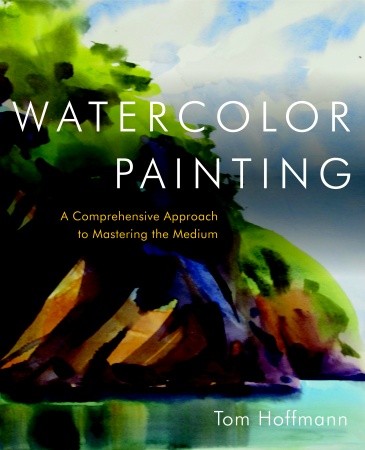
The name of the book is Watercolor Painting: A Comprehensive Approach to Mastering the Medium.

Watercolor Hoffman

Steve Wozniak: 1984 Speech

What fun! Here’s Apple co-founder Steve Wozniak speaking about the earliest days of Apple Computer, working with Steve Jobs, and more. It’s a moment in time, a speaking engagement from 1984. He is speaking to the Denver Apple Pi Computer club. Thank you, Vince Patton, for uploading these videos to YouTube for all to see. You can watch the whole speech, in order, here, or just sample some of the best moments on the video clips below.

Attending College, Ended up at Hewlett Packard (including the excitement of obsoleting the slide rule!)

Wozniak and his passion for programming:

College Pranks:

Making the Apple I Computer:

There are more, I think, but this will keep us all busy for a half hour or so.

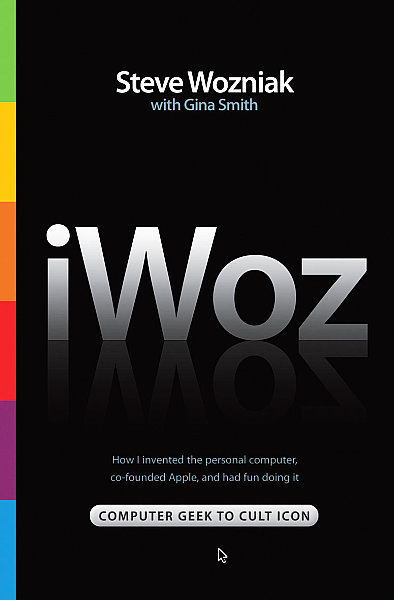
BTW, Wozniak is an articulate, engaging public speaker. The same is true of his work as an author. If you haven’t read his book, iWoz, I wholeheartedly recommend it.

iWoz

A Portable Speaker as Good as Your iPad

Tablets are spectacular inventions, but, as a rule, their internal loudspeakers do a poor job reproducing sound. With tiny loudspeaker drivers, often pointing in any direction except toward your ears, assisted by an amplifier never intended to seriously reproduce music, even the most appealing iPad is so uninterested in music, it contains only a single monaural loudspeaker.

Most people either enjoy the experience as-is, and don’t worry much about fidelity. Or, they use a pair of stereo headphones and enjoy the kind of audio that seems to exist inside the tablet (or phone), but won’t come out without some sort of accessory.

For months, I’ve been seeking a portable speaker for use with a tablet, or a phone, that provides the seemingly impossible combination of small size, convenient weight, sufficient amplification for listening at desk or in a bedroom, and, most important of all, clarity across the dynamic range (that is: nice clear highs, credible mid-tones and, perhaps most difficult in a tiny setup, bass is crisp and well-defined).

FoxL, basic model, front view, now apparently on sale for about $120.

FoxL, basic model, front view, now apparently on sale for about $120.

At a trade show, I found what I was looking for. It comes from a small company called soundmatters and it goes by the name of FoxL. In fact, there are several models.

The core of these devices is a hybrid loudspeaker design that soundmatters calls a “Twoofer,” which combines “tweeter” and ‘woofer.” This design allows a dynamic range that begins as low as 80Hz, or roughly what you would hear from a good tabletop stereo system, and also allows highs in the 20KHz range, which seems fairly commonplace. These speakers fit into a ruggedly constructed (mostly) metal box that is, truly, pocketable. The dimensions: 5.6 inches wide, 2.2 inches high, and 1.4 inches deep. It’s about the size of an eyeglass case. It weighs 9.5 ounces. (By comparison, the popular JAMBOX weighs 12 ounces, and, overall, it’s about 20 percent larger). Does the size matter? For a portable device, sure it does… the smaller (and lighter) the device, the more likely I will take it along in my shoulder bag.

But only if it sounds (very) good.

Right now, I’m listening to a recording by The Lincoln Center Jazz Orchestra led by Wynton Marsalis. The album is called Live in Swing City, and the tune is a complicated arrangement called “Chinoiserie” and it contains some very aggressive performances, lots of solos, deep notes, a barking saxophone, a sweet backup horn section, and a live audience in the background. Not an easy combination for a so-so audio system. The results are excellent–but I am careful to keep the audio level no higher than about 80% on both the iPad and the FoxL (which contains its own amplifier and volume control). The system can play louder, but bits of distortion and harshness make the listening just a bit unpleasant.

For something completely different, I switched to Peter, Paul & Mary, a trio that was always well-recorded, and whose individual voices and harmonies are both distinctive and familiar. The album is See What Tomorrow Brings and the song is “If I Were Free.” Mary is singing lead, and the nuances of her vocal are presented with appropriate warmth, if just the slightest bit lacking in punch. The guitars and the male background vocals sound clear and wonderful. The opening guitar on “Early Morning Rain” and Paul Stookey’s vocal sound ideal, and once again, the vocals are right, too.

The opening drums and other percussion on Vampire Weekend’s “Oxford Comma” grabs the listener with just the right power and clarity. The vocals sound fine. The more frenetic “Walcott” has enough bass and the right drum sound to fill a (very) small room.

“Way Over Yonder in the Minor Key” by Wilco on their Woody Guthrie tribute album, Mermaid Avenue, also sounds right. The vocal is crisp and clear, and when the background vocals kick in, with the additional instrumentation, everything holds together beautifully.

Dawn Upshaw brings her operatic voice to artful arrangements of Weill, Bernstein and other 20th century heroes on her album, I Wish It So. I’m very familiar with her version of Sondheim’s “There Won’t Be Trumpets” because it was one of a half dozen songs I used to test loudspeakers and sound systems for a feature story in Stereophile, a high-end audio magazine. Once again, Upshaw’s nuance in Upshaw’s voice is about right, but again, there’s a small lack of punch.

Presence turns out to be less of an issue for Karan Casey, who brings her pretty Irish voice to the ballad “She Is Like The Sparrow” on her self-titled album, but the low string accompaniment must be played at about 70% to avoid distortion. When the sound level is monitored, and the FoxyL is placed on its soft rubberized mat (supplied), the presentation is rich and quite wonderful.

Concerned about the occasional presence of distortion, I find some songs with distinctive and abundant bass. The little speakers sounded fine on Bonnie Raitt’s “Love Has No Pride,” and when Charlie Haden plays the bass behind James Cotton’s voice and harmonica on “All Walks of Life” from their Deep in the Blues album, the level of distortion was neither obvious nor troublesome. No problem on the Emerson Quartet’s version of various Beethoven String Quartets, either. In fact, they sounded terrific.

All of my listening was done with an iPad2 connected, by a supplied cable (miniplug to miniplug) to the most basic FoxL model ($149). For fifty dollars more, you can buy a Bluetooth model (I’m not a huge fan of Bluetooth for music listening because the sound, inevitably, cuts in and out). Both will run for 12 hours on a single battery charge (charger included). An additional $30 buys a total of 20 hours of battery life and a pretty silver enclosure. You can also charge via USB. My one complaint: a poor design on the back of the device–an easel stand is made of plastic and can be difficult to open.

Visit the website to learn more about an accessory subwoofer (also quite small) that plugs into any FoxL device.

FoxL with its subwoofer.

FoxL with its subwoofer.

Changed Channels: 2011 to 2013

All My ChildrenOn January 5, 1070, the ABC Television Network debuted a new half-hour soap opera series called All My Children. After seven years, the series was sufficiently popular to win an hour-long time slot. It remained on the air until September 23, 2011, cancelled due to changing audience and lifestyle behaviors.

On April 29, 2013, All My Children returns, with stories and many original cast members intact, five days a week, in its original half-hour form, but the series will not be seen on broadcast television. Instead, the series will be shown on Hulu’s website and on iTunes (if you want to watch on a tablet or phone, you must subscribe to Hulu Plus). One further inducement: in addition to All My Children, another long-time ABC daytime staple, One Life to Live, is also returning.

Taken as an isolated incident, the return of soap operas (or, politely, daytime dramas) is interesting news for the advertising and television industries. It’s not an isolated incident. Somehow, sometime between 2011 and 2013, something happened.

In my house, we occasionally watch a network television series at the time that it is being broadcast, but this is no longer routine behavior. Instead, we DVR anything we want to watch. The ease of simply pressing a button to record a program–a button that may be remotely operated by smartphone or tablet–turns out to be a radically new idea, different in both utility and convenience when compared with, say, VHS tapes. Alone, this convenience did not shift our behavior. Video-on-demand is also an interesting idea, but we have not used it as often as we thought we would. So that’s not the big shift.

Mel Brooks, Carl Reiner and Jerry Seinfeld eating corned beef sandwiches at Carl's place.

Mel Brooks, Carl Reiner and Jerry Seinfeld eating corned beef sandwiches in Carl’s living room.

Turns out, the big shift is the apps that are now on my TV, computer, iPad and iPhone. At first, I didn’t really understand the importance of the software. For me, HBO GO was the tipping point. The network offered not only current programs, but complete collections of all of their popular series, essentially for free to anyone subscribing to their cable service. Showtime has done the same with its Showtime Anytime app. Between HBO and Showtime, I have access to enough original programming to keep me busy for a decade. Still, the overall composition of our family’s media diet didn’t change as much as I thought it would. Then again, that was only 2012. By 2013, the shift occurred. The tipping point was a new TV set and one app in particular: Amazon Prime. Why this one? Well, it was kinda-sorta free: we buy enough books to justify the $75 annual “free shipping” charge; with this package, Amazon Prime comes as a bonus. We started by catching up on a whole lotta Twilight Zone episodes, then switched to Arrested Development. When we feel like “just watching TV,” we watch three or four Arrested Development episodes. And if we’re more ambitious, we choose a movie. Or, we fill-in with Jerry Seinfeld’s Comedians in Cars Getting Coffee via the Crackle app (two of the best episodes: the one with Carl Reiner and Mel Brooks, and the one with Ricky Gervais). I haven’t yet seen Crackle’s popular thriller series, Chosen starring Milo (Heroes) Ventimiglia. We haven’t yet bothered with Hulu and we’ve just signed on to Netflix, whose selection of online movies is  embarrassing and not worth the money.

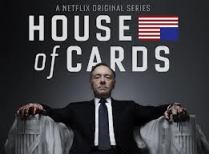
House of CardsWe are not, however, subscribing to Netflix for the movies. Instead, we’re watching its well-publicized entry into the world of high-end television drama: House of Cards with Kevin Spacey. We don’t have much interest in Netflix’s next series, Hemlock Grove, which begins on April 19, because we’re too busy watching West Wing reruns to bother with a werewolf thriller. Netflix has announced a pilot with WGBH for a new children’s series, and will launch its first animated children’s series, made by Dreamworks, based upon its motion picture, Turbo: F.A.S.T. Also from Netflix: a new Ricky Gervais comedy series called Derek seen on TV in the UK on their Channel 4, but here in the U.S., it’s not on TV, it’s on Netflix.

We may, however, sign up for Hulu+, in part because (guilty pleasure) I used to watch All My Children, but mostly because the app/channel (not sure what we’re supposed to call these “not-quite-networks”) is launching four new series, including a promising comedy spoof from the funny Seth (SNL) Meyers, The Awesomes.

On YouTube, you can watch more than forty original episodes of H+ The Digital SeriesThe first episodes ran in August. It’s a sci-fi thriller. Battlestar Gallactica: Blood & Chrome is the prequel to the cult-fave TV series seen on both YouTube and SyFy.

A scene from Tom Hanks' elaborate new Yahoo! Screen animated post-apocalyptic series, Electric City.

A scene from Tom Hanks’ elaborate new Yahoo! Screen animated post-apocalyptic series, Electric City.

On AOL On, On Yahoo! Screen, there’s a spoof of dating reality shows called Burning Lovebut the big news from this online channel is a new Tom Hanks project called Electric City. I’ve been having fun watching Video Game High School, which crosses reality and the cyber world.

Traditional television networks are trying their hand, too. FOX is debuting Short-Com Comedy Hour this summer.

More is on the way. And, I suspect, much of it will be better than average network fare for two reasons. First, creative decisions are being controlled by a smaller executive committee, and producers are being allowed more freedom (that will change, but for now, it’s worth savoring). Second, there’s a lot of talk about “the HBO Model” which assigns greater value to the quality of the property than to a third party relationship (in a typical network’s situation, every decision is affected by the opinion of the sponsor, and again, for this brief shining moment, the focus is on the creative work and not on the needs of the sponsors).

2013. The year that everything changed.