It was time to buy a new digital camera, and I think I’ve made a very good decision with Sony’s RX-100. This is a remarkably small, convenient, and capable product: 20 megapixels; a ring around the lens for manual focus (or other uses that I can easily set through menus); very good image quality; the ability to shoot RAW as well as JPG images; panoramic images; very good low light sensitivity with little visible grain; the list goes on. (In fact, one very good place to read about this, and other digital cameras is Digital Photography Review.

Here’s an example of the level of detail offered by Digital Photography Review. Their 10+ page review of this camera is typical of their excellent work–the site is the best source of information about digital cameras on the web.
Before I bought the camera, I studied review of the RX-100 and comparable cameras on the dpreview.com website. I found a newer model, RX-100 II, but decided to save the extra $150 and forego the tilting rear screen and a few other interesting features.
As I started using the camera, I began to understand why this camera was so well-reviewed. And I began to understand what it was, well, missing.
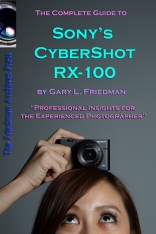
First and foremost, the camera comes with a pretty crumby manual. Having spent over $500 on a camera, it seemed reasonable to assume that Sony would tell me how to use it. I poked around on the web, and found a terrific solution to my dilemma. Imagine: a 400+ page book, fully illustrated, written specifically for people who bought the Sony RX-100. Unbelievable, but true. Turns out, this is one of a product line of ebooks from a small publisher, Friedman Archives.
 Those who follow digital photography will note that each of Friedman’s books addresses the needs of a more sophisticated photographer: the Sony RX100 takes its place beside the Olympus E-M1, the Fuji X100S, the Sony NEX-7 and other better speciality cameras. All of these cameras are packed with features, and these books provide an extraordinary amount of information and an abundance of visual examples, written in a style that is easy to understand. There is little tech-talk in these books. In fact, there is personal advice, written, in many cases, by Gary Friedman, who manages this small publishing operation. I read the Sony RX-100 book from cover to cover, then re-read sections of it. I loved Gary’s rundown on the settings that he uses for shooting, and the variations that he suggests for special shooting situations. Take a moment to consider this: there are dozens of available settings, and this author not only takes the time to explain how to use each
  one, but also how and why he selects, for example, “Drive Mode: ‘Single Shooting,’ unless I’m shooting either sports or grandchildren, in which case it’s ‘Continuous’ (with a lot of image deletions afterward. For more see page 90; or “Red Eye Reduction: I hate this feature. Off. Page 205.” or “Face Priority Tracking: Do you want the camera to give priority to faces when using Tracking Focus. I keep it On because, when shooting home movies, this feature can help the camera make better decision. Page 222.” Gary is a fine teacher. I keep the book on my iPhone (most smartphones include pdf readers) so that I can take my teacher along with me on every shooting expedition. (A great comfort.)
I cannot imagine buying an RX-100, or any other high-end camera, without also buying the how-to book from Friedman Archive. (Highest possible recommendation!) Still not sold? Have a look at the (many) sample pages from this book that Gary includes on his web site.
Another necessity: a viewfinder. Problem is, this camera has no way to attach a viewfinder. Except, perhaps, the tripod screw hole at the bottom of the camera? Here’s a clever entrepreneur at work. The company and product are called ClearViewer. Basically, what you’re buying is a magnifying glass that can be held parallel to the rear LCD screen, or folded up and away when it’s not in use. I place my eye directly against the ClearViewer magnifier, and sure enough, I can see the whole rear screen in tremendous detail. This is useful for settings, for focus, for composition–well, I don’t need to sell you on the idea of a camera viewfinder. On the plus side, this is small, inexpensive (under $40) and utter transforms the process of taking pictures with a compact digital camera. I can comfortably suggest that every serious compact camera user should own one.
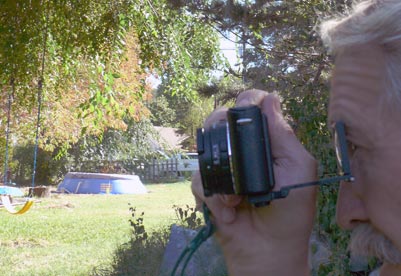 (For cameras with a hot shoe–the place where you would insert a flash, a similar model is available. The difference: the magnifier is suspended from the top, not connected to the bottom of the camera.)
ClearViewer is a great idea, very useful, small enough to carry everywhere (without even removing it from the camera), but I sure wish there was a deluxe model, one with a better magnifying lens. Still, this is a very useful invention, and it always comes along with my camera.
But wait! There’s more!!
One of the bizarre design non-features of many digital cameras absence of a place to screw-in a filter. Why does that matter? First, when shooting outdoors, you can both deeper sky colors, eliminate glare, and generally improve the whole image by shooting through a polarizing filter. And, in case you want to shoot with increased depth-of-field, which is useful if you like blurry backgrounds or silky smooth shots of babbling brooks, you may wish to shoot through a neutral density filter. (On the RX-100, this is a near-necessity because the camera’s few wide-open f/stops are available only with the widest-angle uses of the built-in zoom).
So how do you attach a filter to a camera that doesn’t accept filters?
Sony solved the problem with an adhesive add-on ring that must be carefully placed on the front of the camera, around the lens. I looked at Sony’s solution and instead opted for a slicker version of the same idea, this one from a small company called Lensmate. This video explains how the system works in detail, but here’s the essence: a small plastic rig allows you to precisely place the adhesive ring on the front of the camera; the ring (now part of the camera) is built to accept a bayonet mount (turn and snap into place–easy!); a second ring attaches to the bayonet mount and to a 52mm filter. Quick, simple, and it works.
Here’s a look at the Sony RX-100 with the adhesive filter ring attached, ready to accept the bayonet-and-filter assembly (you will not be able to see the ring very easily–it’s quite small and unobtrusive). The video link (above) also takes you to a lot of information about this product–I love small companies because they work hard to satisfy the customer.
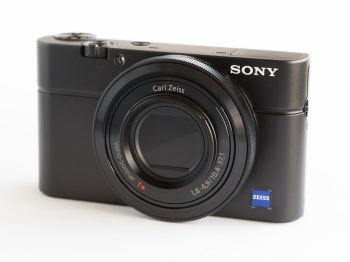
Lensmate offers after-the-fact accessories for many of the same cameras that are covered in Mr. Friedman’s books. More than filter adapters, they also offer grips, thumb rests, straps, and lots of other useful stuff that might have otherwise escaped your attention.
One remarkably good idea is a grip that attaches to the front of the RX-100 and, well, allows most people a more secure sense that their small $500+ box is well-in-hand. The distinguished, popular and versatile maker of these camera grips is a man named Richard Franiec whose products are available through his own kleptography website as well.
 There’s a good closeup look at the grip over on the left side of the camera (compare this to the grip-less version in the smaller image a paragraph or so up the page). The grip is meticulously designed, and, like the filter ring, it relies upon a super-strong, super-reliable adhesive. Once again, there is an installation video, a suggested rehearsal process before making the connection between grip and camera, and a pride in doing things right. It feels good to carry the camera with the grip, in part because it’s well-made and in part because you know that it’s the work of a man who identified the smallest possible niche within what is already a niche market, and built himself a business. It’s uncommon for grips to be reviewed, but Franiec can boast several, all quite positive. Here’s an example.


 Yeah, well, my list isn’t very long, either. Easy enough to list Mao, Chang Kai-Shek, Chao en-Lai, maybe the classical pianist Lang Lang, and the basketball player Yao Ming. Maybe Jet Li, who is probably from Hong Kong (I checked; he is from Hong Kong).
 There are good stories about emperor Kublai Khan, and the beginning of Chinese drama as initiated by Guan Hanqing. You may know Zheng He, an admiral who led a large fleet to Africa and other far away places a few decades before Christopher Columbus was toilet-trained (I wonder whether there were toilets in Genoa in the 1450s?) Rumors about Zheng He discovering the American mainland are, apparently, quite wrong, the work of someone who mistranslated Chinese historical documents.
 Where does this lead? And how do we even begin to think about the future when so much television viewing is now on-demand and so much audio listening is via Pandora, podcasts,
 Now that I’ve written that title, let me check.
  Jarrett’s work is immediately magical, glorious in its improvisation and sonic exploration. He’s been doing these albums for decades, and yet, every time I put a Jarrett CD on (or, for that matter, an LP), I’m immediately transported into the filagree of his imagination, sipping a drink at an after-hours jazz bar where the player is extraordinary and I just don’t want the evening to ever end. Recorded live at the KKL Luzern Concert Hall, the CD called Somewhere begins with the mind-bending “Deep Space,” and here, it’s Jarrett’s show with just the right additional color and light provided by double bassist Gary Peacock and drummer Jack DeJohnette; later in the track (the second part is Miles Davis’s “Solar,” their interplay moves the music into an even more interesting exploration, a testament to the extreme skill, experience and love of experimentation that these three musicians consistently offer. So that’s one track, again the first, and again, a favorite. (And I suppose I should mention that the sonic fidelity of these recordings is at such a high level, it would be difficult to imagine a disc sounding any better.) There are some favorite standards here (mine, anyway); it’s difficult for me not to be captivated by Leonard Bernstein’s “Somewhere;” and the less-often-heard “Stars Fell on Alabama” and the Jimmy van Heusen- Johnny Mercer tune, “I Thought About You.” Ooops–I’m listening to the wrong track–that’s really catchy, and less schticky than I remembered: “Between the Devil and the Deep Blue Sea”–well, a little schtick for me. Back to the dark night sky and mystery of “Stars Fell…” and my mind easily drifts to Perseids and stardust. What a lovely album.
 The old guy in the crowd–Gary Burton is 70 to Keith Jarrett’s 68–opens with a Antonio Sanchez’s rocking drum, instantly establishing a more ambitious, brighter tone for the new Guided Tour, also from Mack Avenue. This is a quartet with Burton leading as one might do with a piano. Sanchez really drives this music. It’s a bigger sound than you would typically expect from a quartet. Burton is leading an exploration not entirely different from Jarrett, but more clearly articulated, more melodic, catchier. The difference is the way that Julian Lage is playing electric guitar, almost as if he’s playing in the style of Burton and his vibes on “Jane Fonda Called Again,” never passive or receding or relaxed, but instead, aggressive and punchy. Yes, they play pretty, too, working the pastoral mood on “Jackalope,” and the Latin romance of “Helena” (especially nice guitar from Lage on this one), but it is so much more fun when these guys really go for it, with Burton playing fast and strong. Best example is probably the last track, written by drummer Sanchez, called “Monk Fish.” Scott Colley is the capable, but less showy, bassist; tough to get a word in edge-wise when the other players are clearly having so much fun. Far livelier than the other two CDs, Guided Tour is a terrific introduction to the Burton’s massive catalog.
 So that’s one migration. There’s another 13.5 million people moving during the period 1815-1915. Those people are moving, mostly, from Europe to America. Lots from Ireland, England, Scandinavia, and later, Spain, Italy, and eastern Europe–the peopling of America.


 Apple certainly knows how to generate buzz. They introduce two new telephones, and the internet lights up.
 Digital Insider