The Triple Revolution

I think I prefer that name to the simpler Networked: The Social Operating System by Lee Rainie, who runs the Pew Research Center for Internet and American Life, and Barry Wellman, a professor who runs NetLab in Toronto. The triple revolution is easy enough to understand: we’re living at intersection of three significant changes in modern life:

  1. Social networks, which encourage connections between people regardless of their physical location
  2. The widespread availability of the internet, which provides a never-before-possible power for information access, and transmission and reception of messages in every medium.
  3. The mobile revolution has transformed digital devices into “body appendages” that allow “people to access friends and information at will, wherever they go…”

These trends define the new space in which we live, and, armed with both the necessary research and a knack for explaining a wide range of interlocking ideas with clarity, the adventure begins.
NetworkedProfessor Wellman’s work helps to make the case that the old idea of groups has become the new idea of networked individuals. At first, the distinction may seem, well, academic. Then again, consider the number of people with whom you interact every day or every week. If you lived in, say, Europe of the 1800s, most of these people would share proximity, language, culture, friends, family members, transportation routes, and more. Today, those ties are not fixed in a group. Instead, the connections are more fluid, more varied, more precisely defined by the individual and not by his or her membership in a group. Boundaries are permeable. Connections may or may not be long-term. Something’s lost here in terms of long-term friendships and relationships with family members (some or many may no longer live nearby), and something’s gained in the richness of more diverse lives.

I remember working for a client named Steve, who carried his cell phone in a case the size of a lunchbox, and I remember working for a successful entrepreneur whose phone was built into her car’s dashboard, like a car radio. Both date back to the 1980s. At the time, not more than a few thousand people owned mobile phones. In fact, that first decade was slow going, but after 1995, the trajectory is very nearly a 45-degree angle, running uphill to over 300 million cell phones today, and more on their way. Fully 83% of the U.S. population owns a cell phone.

Those stats aren’t surprising, but the combination of internet growth, changes in our individual behavior, and the fact that so much can now be accomplished any time and anywhere sets up the story. Public and private spaces begin to blur–think about the number of people you saw on TV during the inauguration who were checking their cell phones. Nowadays, it’s perfectly acceptable to work just about anywhere–and the need for offices is beginning to fade, certainly for creative workers, and now, for many other types of workers, too. Companies are shrinking or closing their offices and instructing employees to conduct their business from home (in one case, a friend was told to “take the office furniture because it is no longer needed.” The authors consider the idea of “place-to-place” networks to be hopelessly old-fashioned; these days, it’s all about “person-to-person” networks. As family composition and roles have shifted (women working outside the home; household free time spend on digital devices; the individual activity of computing; a 25% drop in the average number of hours devoted to housework since 1965), we interact in different ways that don’t always connect generations effectively. For example, the authors describe a young woman who communicates daily with both of her parents while they complain that they never hear from her. What they want is personal touch. What she wants is regular contact. These are not the same, and as a result, there is conflict.

When attempting to explain the changed world of journalism, the explanations do not come so easily, in part because it is so very difficult to understand what’s really happening and why. With so many people writing and communicating on the web, in so many different ways, the old and traditional role of a reporter is difficult to outline in the new world. Where does credibility or experience or context fall? Do we perceive more value in a local person telling a story on the spot in, say, the changing Middle East, or an experienced reporter who provides the experience and wider view? What about people who comment on the work of the local observer or the reporter? Not all are pundits; many are simply trying to understand what happened by reviewing many sources and many stories.

And so the layers are applied, one after another. It’s not just that there’s a remarkable internet or an astonishing Wikipedia, and it’s not just that we’re able to access this material and respond to it at any moment from any location. It’s these phenomena mapped over a much-changed society and dramatically shifted individual behavior patterns. It’s all one large idea, and it’s time that we begin to think about these changes in a more holistic way. The data is here… enough of it to get the conversation started, anyway. And in this iteration, the writing and smart and the analysis is sharp. It was written about 18 months ago–one of the ironies of the book writing, publishing and reviewing process is that it takes more time than our triple revolution deems reasonable.

P.S. After I write each article, I search for pictures. My first search on the term “Networked” yielded a Wikipedia article that provided my evening’s dose of irony:

networked book is an open book designed to be written, edited, and read in a networked environment. It is also a platform for social exchange, and is potentially linked to other books and other discussions. Wikipedia is a networked book.
Colossal is shrinking, but massive continues to grow

Cool new internet toy: Ngram Viewer. It’s part of Google Books.

To see the graph in a larger size, click on it.

To see the graph in a larger size, click on it.

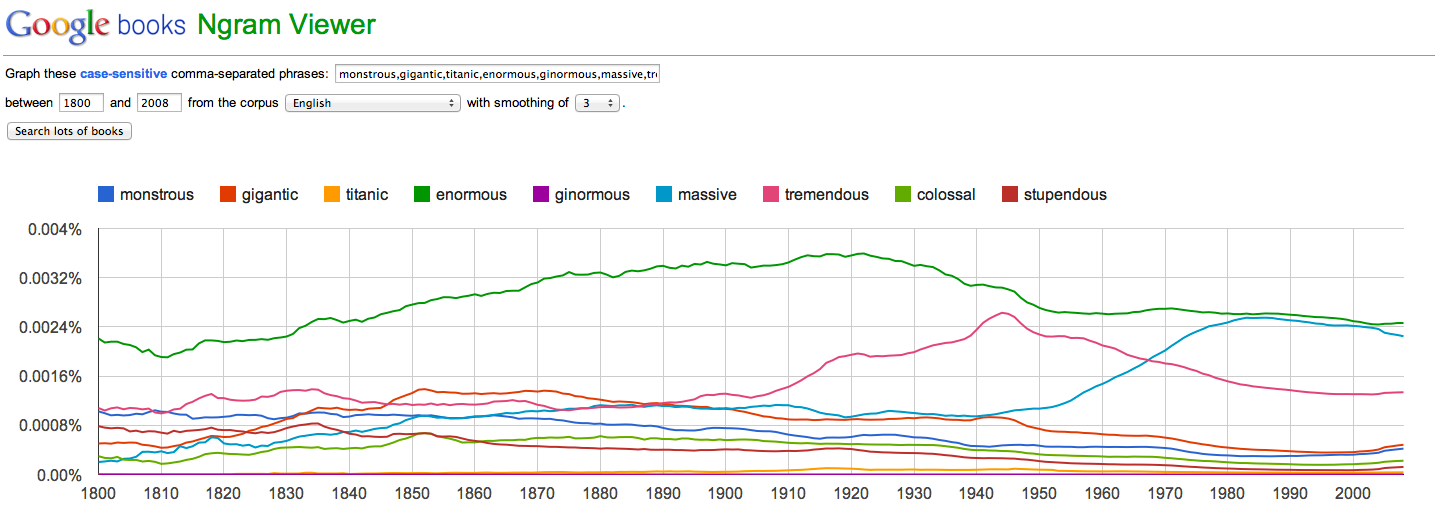
What did I learn in my little experiment? Well, “tremendous” seems to have peaked in the 1950s and it’s been a slow, gradual decline ever since. Nice jump for “massive” (the turquoise line), probably because of the technology revolution. “Titanic” never really amounted to much, and both “monstrous” and “colossal” gained some popularity in the 1800s, but the 1900s were unkind to them. “Stupendous” was doing a whole lot better before the Civil War. Ngram is fascinating (and addictive) and easy enough to try in just a minute or two.

You simply enter a group of words (proper nouns included) and identify a date range. In my illustration, I searched for words that mean “really, really big” from 1800 to 2008. Then, the Ngram tool searched the entire database of Google books, in a second or so, and returned a nifty graph.

You’ll find it here.

Best in Class

I guess I ought to begin with the obvious question: what is common thread that connects Louis Armstrong, Bob Dylan, Johnny Cash, Michael Jackson, Bruce Springsteen, Barbra Streisand, Frank Sinatra, Leonard Bernstein, Aaron Copland, Adele, and Beyoncé?

The answer is Columbia Records. Founded in 1888, it’s probably the oldest record label. Along with sister labels Epic, Okeh, and a few others–set the standard for the U.S. recording industry for half of the 20th century. This story, now in book form by Princeton history professor Sean Wilentz, is, well, epic. The book is called 360 Sound: The Columbia Records Story (the term “360 Sound” refers to a tagline associated with Columbia’s stereo LPs).

220px-BertWilliamsPhotoPortraitWithCigarette

“(I Ain’t Got) Nobody” was one of the many songs that made Bert Williams famous. He was among the first non-white stars in the United States.

After some novelty acts, Columbia establishes a firm footing with vaudeville superstar Al Jolson; the great singer and comedian who later starred in the Ziegfield Follies, Bert Williams, and one of the fathers of country music, Emmett Miller. A short time later, John Philip Sousa joined the label (at the time, his full band could not be recorded due to early microphones, so the sound was thinner than it was in live performances). Add W.C. Handy, and an equally impressive range of classical performers.

Columbia became a major force in “race records,” recognizing, early on, White consumer interest in Black performers. From this era came Bessie Smith, Louis Armstrong, Duke Ellington and artists that those familiar with the genres continue to buy: Blind Willie Johnson, for example. There was country (and western) music, too: Gene Autry, Bob Wills, Roy Acuff. Next came jazz pianist Art Tatum, Cab Calloway, and Count Basie. And Benny Goodman and Bing Crosby. And gospel music: The Golden Gate Quartet, Mahalia Jackson. And that’s all before the organization really found its way.

(As I said, this is an astonishing story. It’s wave after wave of the superb artists in every genre, all working, at one time or another, for the same label, or cluster of labels.)

So here comes the 1950s with Tony Bennett, Leonard Bernstein, West Side Story, My Fair Lady, South Pacific, Glenn Gould, Doris Day, Rosemary Clooney… and almost no rock n’ roll. Mitch Miller–a company executive and in his own right, a very popular recording artist as a leader of a singing group–was against the whole idea. Still, they were strong in every other genre–classical in particular, and jazz. It was here that Miles Davis recorded most of his best work, with Thelonious Monk, Dave Brubeck, and so many others. Unfortunately, although quite classy, there wasn’t much profit in classical, jazz or (most) Broadway recordings. Country was better: Flatt and Scruggs, Lefty Frizell, The Stanley Brothers, and eventually, Johnny Cash.

Along the way, there’s some tasty back-and-forth between Columbia and its long-time arch-rival (in just about every musical category), RCA Victor (which, in its golden age, was owned by RCA, which owned NBC to Columbia’s CBS). The two companies do their best to mess with the other, stealing artists, introducing competing record formats (the LP came from Columbia and the 45 came from RCA).

For a while longer, they stick with easy choices, and steer clear of the growing revolution: they sign Barbra Streisand, Andy Williams, Johnny Mathis (who sells an insane number of records), and Robert Goulet.

Columbia RecordsAnd then, it happens. They sign Bob Dylan. Everything begins to change. Simon & Garfunkel come next. Suddenly, the cool jazz label, the reliable country label, the powerhouse classical label, becomes the unbelievably great rock label. The Byrds are covering Dylan songs and selling lots of Byrds and Dylan records. Donovan is signed to Epic, and debuts with a hit (“Sunshine Superman”). There’s a new executive in charge (much of the whole story is told through the eras of individual executives). His name is Clive Davis, and now, Columbia is the place to hear Janis Joplin and Santana, Sly and the Family Stone, Leonard Cohen, Blood Sweat & Tears, and Chicago. They sign Earth Wind and Fire; Johnny Cash records an album at Folsom Prison; Monk and Miles are selling lots of jazz, with Miles into fusion, and appealing to rock audiences. And then, by the mid-1970s, there’s another wave of newcomers: Billy Joel, Aerosmith, and Bruce Springsteen. A great story is becoming better and better.

And then, another wave, this time bringing Willie Nelson to the company and making him a star. The jazz story continues to heat up with Weather Report, Herbie Hancock, and a newcomer from the young lions of jazz, Wynton Marsalis. On the classical side, Yo-Yo Ma is becoming a star.

All of this is one company, basically one record label. Of course, the story continues through hip-hop, Ricky Martin, an aging Bob Dylan, Michael Bolton and Lauryn Hill, Destiny’s Child and John Mayer. Chris Botti and Joshua Bell.

Yes, they’ve been bought and sold, multiple times (now owned by Sony). For me, the best part of the journey (oh yes, Journey was one of theirs, too), the best part of this coffee table book, is the era that picks up in the early 1950s and winds down about twenty years later. That’s when CBS was a very special place, in part because Columbia was just about the coolest record label around. It’s a good story, fun because of the memories, remarkable because of the achievement. And, I think, the best way to experience the era is on the vinyl records that Columbia invented, most of them now available, used, for about $5 at just about any good used record store.

columbia labels

So, I’ve been thinking about other labels with equally rich histories. The Warner Music Group includes Atlantic, Elektra, Nonesuch, and Warner Bros. Records. Historically, Atlantic’s strengths have been R&B and rock; Elektra’s have been folk and rock; Nonesuch has evolved into something like a (smaller) modern day Columbia Records with interesting artists, Broadway, classical, and international; Warner Bros. is, more or less, a popular music label. The crazy history of the labels that became Sony Music now encompasses Columbia’s long-time competitor RCA (Victor) as well as the Columbia labels; in just about every category, from Broadway to classical to country, RCA and Columbia were head-to-head, and although I want to write that Columbia did it just that much better on the rock and pop side, I’m reminded of the Jefferson Airplane (less so, the Starship), John Denver and others from the heyday (none were Dylan or Miles Davis–so maybe Columbia did do it better). In classical music, the labels now assembled under the current Decca Label Group, now part of Universal, include London/Decca and Deutsche Grammophon, but neither attempted the breadth of genres associated with Columbia. Similarly, the likes of Verve, A&M, and other Universal labels, lacked the grand ambition (and, probably, the monies available from CBS). EMI’s story is more complicated, and although its U.S. division, Capitol Records, released many pop and rock records, and some Broadway, it never established the breadth of material available from Columbia.

So, in terms of wide-ranging, deep-repetoire, and long history, it’s Columbia Records and its best competitor, RCA (Victor), but I urge you to have a look at all that Nonesuch has done, too.

A Bridge Called Feinstein

Nearly a century has passed, but the music lingers, and, I hope it always will. “Someone to Watch Over Me” is an absolutely lovely song. It was written 13 years short of 100 years ago, in 1926, for a Broadway show called “Oh, Kay,” a musical about bootleggers, an idea that seems no less distant. By any measure, “Someone to Watch Over Me” is an old song. And yet, the list of singers who have performed it make me question that 1926 date: Keith Jarrett, Barbra Streisand, Willie Nelson, Bennie Wallace (in fact, I bought the album last month, and “Someone” is the title track), Elton John, Sinéad O’Connor, Susan Boyle, Marcus Roberts…the list goes on.

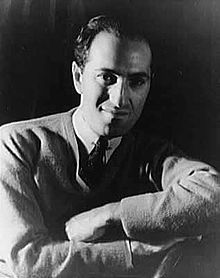
George GerhswinWhen he wrote the music for “Oh, Kay,” George Gershwin was 28 years old, That was seven years after his first hit song, “Swanee,” sung by the era’s superstar, Al Jolson, and if not quite the standard it was for half of the 20th century, it remains a classic. The same year that he first recorded another song that has run the better part of century, “Fascinatin’ Rhythm” with another pair of very famous stars, Fred and his sister/partner Adele Astaire. By that time, Gershwin had already composed, and become justly famous for, a more serious work commissioned by bandleader Paul Whiteman called “Rhapsody in Blue,” written in a form that wasn’t quite classical, wasn’t quite jazz, and wasn’t quite what we would now call pops. Still to come was Porgy and Bess, Hollywood, and in 1937, at age 38, the brain tumor that ended his life. By that time, George Gershwin was a national treasure.

Time passed. There was a war, then significant changes in the nation’s culture. The old songs, well, they didn’t matter so much any more. Sure, they were played on the radio, but newer forms of entertainment eclipsed many of the first half century’s great success stories.

And that’s why, when most people met a teenager who was crazy for the old songwriters and the old 78 rpm records, they didn’t make much of his hobby. In time, the collection required serious shelving (78s are quite heavy, and quite fragile), and the collector was learning the names of the composers who wrote those songs. Eventually, he made his way to Los Angeles, where he haunted the used record stores in hopes of finding treasures. He found a collection of records by Oscar Levant, a Gershwin friend, which led to Levant’s surviving spouse, which led to a dream job.

Ira Gershwin was looking for a new secretary–his long-time helpmate was dying–and our young hero got the job. He astonished the aging lyricist with his encyclopaedic knowledge of the music of the 1920s and 1930s (and 1940s, for that matter), and his astonishing depth of detail about all things Gershwin. And that’s how Michael Feinstein, born September 7, 1956 became the world’s greatest expert on Ira Gershwin, born December 6, 1896 (and on his brother, George, born two years later, in 1898). But Michael Feinstein had just begun.

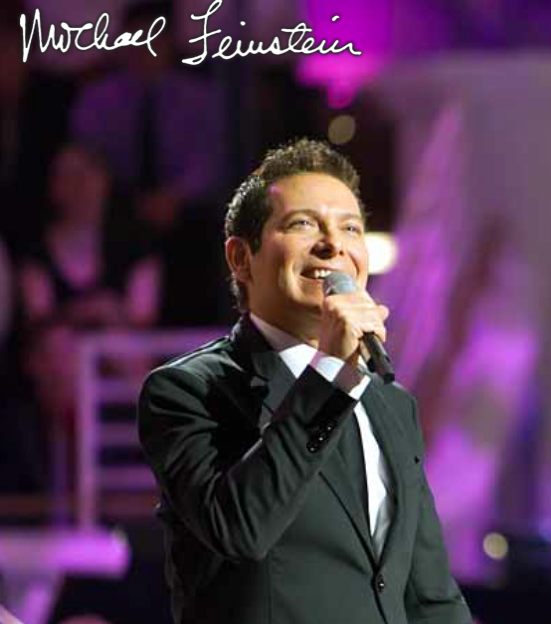
Michael FeinsteinBy the mid-1980s, Michael Feinstein was recording these songs, breathing new life (and a great deal of love) into the old records. And, because he had researched, catalogued and organized the entire Gershwin library, his work combined the verve of a dedicated performer with the wisdom of an academic. This led to recordings of music by Irving Berlin, then more Gershwin and more by other songwriters (sometimes, singing alongside them). In short, Michael Feinstein built a bridge from gentlemen songwriters born at the turn of the last century, and generated enough excitement to build a career for himself, energize any number of other performers to pay attention to this music, and then, he opened a cabaret so that the music could be heard live.

And then, he wrote a book about all of this, about his adventures in with the Gershwins, his love affair with the music, the history of the era and why it resonates today, and lots more. The book includes a CD filled with a dozen tracks, some rare, all interesting. It’s there to make absolutely certain that everybody who owns the book will have the opportunity to enjoy the music.

One small warning: Mr. Feinstein is not lacking in enthusiasm, and he is not lacking in detail. This coffee-table book is also a longish read, perhaps something to be enjoyed by reading a chapter every once in a while rather than reading it all through, in a single sitting, as if it was a novel or a traditional biography. It’s more than that, and so, it’s got an unusual title: The Gershwins and Me: A Personal History in Twelve Songs.

Gershwin book

From the FCC: A Summary of the Spectrum Auction Plan

imagesThe FCC posted a useful (11-page) summary that explains the upcoming television spectrum auction with a reasonable level of detail.

Why is the FCC beginning to shut down large amounts of television spectrum? Here’s why:

“In key areas, the United States leads the world in wireless infrastructure and
innovation. However, our successes in building a first-class wireless industry have also
created our greatest challenges; the skyrocketing usage of our wireless networks is
dramatically increasing demands on both licensed and unlicensed spectrum. The mobile
wireless landscape is undergoing a transformation as mobile broadband networks are
emerging not only as the foundation for communications services in the 21st Century,
but also as the infrastructure supporting economic growth and innovation in such wide-
ranging areas as entertainment, health care, public safety, education, and social service.
Like the railroads in the 19th Century, and the electrical grid in the 20th Century, our
mobile broadband networks are primary economic engines for our country. Spectrum is
a critical building block for these networks.”

Here’s more about the law that sets this process in motion:

“Congress, in passing the Middle Class Tax Relief and Job Creation Act of 2012
(“Spectrum Act”) in early 2012, authorized the FCC to conduct incentive auctions, with
the first auction to be of broadcast television spectrum. Congress further directed that
certain net proceeds from the broadcast incentive auction are to be deposited in the
Public Safety Trust Fund to fund a national first responder network, state and local
public safety grants, and public safety research, and the balance is to be used for deficit reduction.”

And how are they going about it?

Well, that’s the complicated part. The FCC needs to acquire spectrum from current users, and it needs to sell that spectrum to future users. This involves a pair of auctions. The mechanics of these auctions are not simple, and sometimes seem to be counter-intutitive.

As citizens, it’s important that people in the U.S. develop an understanding of what the FCC is doing, why, and what will happen as a result.

For those who do not live in the US, where a combination of local television stations, broadcast television networks, cable television networks, and a wide range of other services are commonplace, this whole adventure may be very difficult to understand, and may not make much sense. For those who wonder why the FCC directed a complete conversion from analog to digital television as a project separate from this latest shift, you should count yourself among the many.

Imagine the Possibilities

From the innovation consulting firm Idea Champions, Fifty Awesome Quotes on Possibility:

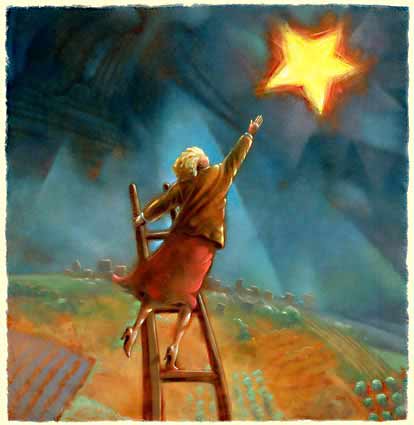
1. “Start by doing what’s necessary; then do what’s possible; and suddenly you are doing the impossible.” – St. Francis of AssisiWoman reaching for star

2. “Sometimes I’ve believed as many as six impossible things before breakfast.” – Lewis Carroll

3. “The Wright brother flew right through the smoke screen of impossibility.” – Charles Kettering

4. “In order to attain the impossible, one must attempt the absurd.” – Miguel de Cervantes

5. “The secret of life is to have a task, something you devote your entire life to, something you bring everything to, every minute of the day for the rest of your life. And the most important thing is, it must be something you cannot possibly do.” – Henry Moore

6. “It’s kind of fun to do the impossible!” – Walt Disney

7. “I am where I am because I believe in all possibilities.” – Whoopi Goldberg

8. “What is now proved, was once only imagined.” – William Blake

9. “Truth is stranger than fiction, but it is because fiction is obliged to stick to possibilities. Truth isn’t.” – Mark Twain

10. “The limits of the possible can only be defined by going beyond them into the impossible.” – Arthur C. Clarke

11. “Never tell a young person that anything cannot be done. God may have been waiting centuries for someone ignorant enough of the impossible to do that very thing.” – John Andrew Holmes

12. “God created a number of possibilities in case some of his prototypes failed. That is the meaning of evolution.” – Graham Greene

13. “Whether you believe you can or not, you’re right.” – Henry Ford

14. “Most people are not really free. They are confined by the niche in the world that they carve out for themselves. They limit themselves to fewer possibilities by the narrowness of their vision.” – V.S. Naipaul

15. “I don’t regret a single excess of my responsive youth. I only regret, in my chilled age, certain occasions and possibilities I didn’t embrace.” – Henry James

16. “In the beginner’s mind there are many possibilities, in the expert’s mind there are few.” – Shunryu Suzuki

17. “The future belongs to those who see possibilities before they become obvious.” – John Sculley

18. “One’s only rival is one’s own potentialities. One’s only failure is failing to live up to one’s own possibilities. In this sense, every man can be a king, and must therefore be treated like a king.” – Abraham Maslow

19. “The possibilities are numerous once we decide to act and not react.” – George Bernard Shaw

20. “We all have possibilities we don’t know about. We can do things we don’t even dream we can do.” – Dale Carnegie

21. “An optimist expects his dreams to come true; a pessimist expects his nightmares to.” – Laurence J. Peter

22. “When nothing is sure, everything is possible.” – Margaret Drabble

23. “Imagination is more important than knowledge. For knowledge is limited to all we now know and understand, while imagination embraces the entire world, and all there ever will be to know and understand.” – Albert Einstein

24. “I am neither an optimist nor pessimist, but a possibilist.” – Max Lerner

25. “If I were to wish for anything, I should not wish for wealth and power, but for the passionate sense of the potential, for the eye which, ever young and ardent, sees the possible. Pleasure disappoints, possibility never. And what wine is so sparkling, what so fragrant, what so intoxicating, as possibility!” – Soren Kierkegaard

26. “All things are possible until they are proved impossible. Even the impossible may only be so, as of now.” – Pearl S. Buck

27. “Until you’re ready to look foolish, you’ll never have the possibility of being great.” – Cher

28. “This has always been a motto of mine: Attempt the impossible in order to improve your work.” – Bette Davis

29. “You and I are essentially infinite choice-makers. In every moment of our existence, we are in that field of all possibilities where we have access to an infinity of choices.” – Deepak Chopra

30. “Some people see things as they are and say ‘Why?’ I dream of things that never were and say ‘Why not?'” – George Bernard Shaw

31. “The thing the sixties did was to show us the possibilities and the responsibility that we all had. It wasn’t the answer. It just gave us a glimpse of the possibility.” – John Lennon

32. “I love those who yearn for the impossible.” – Goethe

33. “Every man is an impossibility until he is born.” – Ralph Waldo Emerson

34. “If you can’t, you must. If you must, you can.” – Tony Robbins

35. “A likely impossibility is always preferable to an unconvincing possibility.” – Aristotle

36. “If someone says can’t, that shows you what to do.” – John Cage

37. “You must do the thing you think you cannot do.” – Eleanor Roosevelt

38. “Apparently there is nothing that cannot happen today.” – Mark Twain

39. “Most of the things worth doing in the world had been declared impossible before they were done.” – Louis D. Brandeis

40. “The possible’s slow fuse is lit by the imagination.” – Emily Dickinson

41. “I am always doing that which I cannot do, in order that I may learn how to do it.” – Pablo Picasso

42. “If we all did the things we are capable of doing, we would literally astound ourselves.” – Thomas Edison

43. “Shoot for the moon. Even if you miss, you’ll land among the stars.” – Les Brown

44. If one advances confidently in the direction of his dreams, and endeavors to live the life which he has imagined, he will meet with a success unexpected in common hours.” – Henry David Thoreau

45. “Everything you can imagine in real.” – Picasso

46. “Everything that is done in the world is done by hope.” – Martin Luther

47. “Dream as if you’ll live forever. Live as if you’ll die today.” – James Dean

48. “I don’t dream at night, I dream all day. I dream for a living.”
– Steven Spielberg

49. “The shell must break before the bird can fly.” – Alfred Tennyson

50. “If not you, who? If not now, when?” – Rabbi Hillel

CES 2013: What Mattered and Why

Just after Christmas, the Consumer Electronics Show convenes in Las Vegas to showcase all that’s new for the coming year. Most of it is upgrades, retreads, and modest improvements over the past year’s stuff. Some of it suggests a new shape for the industry, and for the ways that we work, play, and communicate. Here’s a brief rundown on what might matter most:

  • The disk drive maker Seagate will soon offer a “local cloud” storage device that you can set up in your home or office. Local storage, easily reached via local wi-fi. IT professionals will recognize this as a NAS, short for Network Attached Storage. At about $250 for 4TB, the lesser configurations don’t save enough money to be worth your time.
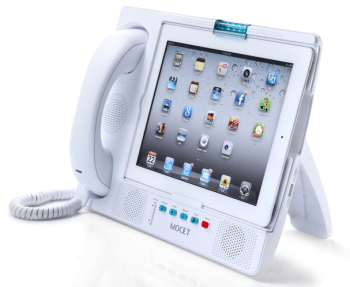
  • Expanded uses for phones and tablets. One shining example is the new MOCET iPad Communicator. Phones and tablets are extremely versatile. Adding capabilities beyond, say, a clock radio or external speakers, will become increasingly commonplace. Remember: you’re carrying a fairly powerful computer. Why not put it to use?

    MOCET

    To go to the site, click on the picture.

  • OLED is a video technology that allows for very thin screens–and flexible ones. The price of manufacture is dropping, so we’ll begin to see OLED screens enter the race between plasma and LED screens. Eventually, this organic (!) technology will win out, and become commonplace. (The “O” in OLED stands for “organic.)
  • Previously, I wrote about the new 4K screens. They’re beginning to be shown as demos.
  • Touch screens and gestures will begin to replace keyboards and remote controls. As the technology allows for greater precision, older ways of interacting with computers (and tablets) and with videogames and TV sets will shift our conception of an interface into the modern age.
  • Smart phones seem to be getting larger–more screen real estate is better for mail, web, games, and movies. Tablets seems to be getting smaller (the line between a small tablet and a big phone is becoming difficult to discern). Tablets are also becoming larger–imagine what you could do with a 20-inch portable tablet! Here, we’re starting to blur the distinction between a computer monitor, a TV set and a tablet. It’s tough to forecast where these trends are heading.
  • Samsung has become the Sony of the 2010s–an exciting company with innovation in every direction. The quality is there, too. But there are still lessons to be learned about user interfaces and design.
  • Very small storage devices are continuing to expand their storage dimensions. Kingston, for example, showed off a 1TB flash drive–larger than the popular thumb drives, but still quite portable.
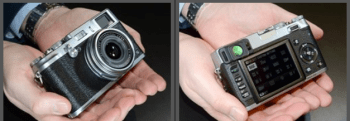
  • From DPReview's coverage, the latest Fujifilm digital camera. Click on the image to see their story.

    From DPReview’s coverage, the latest Fujifilm digital camera. Click on the image to see their story.

    It’s now a regular routine: cool new cameras introduced at CES. For a solid rundown, visit DPReview. I think my favorite stuff is the expansion of Fuji small-sensor line. These cameras look like the real think, shoot terrific images, and tend to be somewhat more intuitive in their interfaces. (More on these soon.)

  • Automotive electronics has always been a key aspect of CES. Sure, car stereos and car security systems remain center stage. Now that cars plug into wall sockets, the vehicles themselves are becoming digital devices. This time around, lots of cars as harbingers. Next time, I’ll bet we start seeing hybrid devices that confuse the definitions of bicycles, motorcycles, golf carts, and other short-range transportation devices.
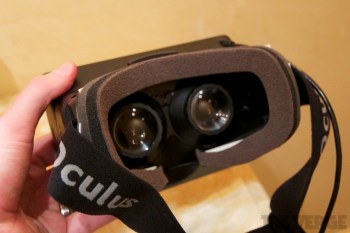
  • Oculus Verge

    To read The Verge’s story about the Oculus Rift, click on the image.

  • Your smartphone and/or your tablet will become a monitoring control center and remote control. You know how we’re beginning to program a DVR from afar? Or read date/time stamps on the foods in the fridge? It won’t be long before we all have a remote dashboard to tell us about the fuel in the car, the meds in the bathroom, when the last time the dog was walked, body fat, etc. add some robotic controls and digital life becomes even more interesting.
  • I’ve wondered why immersive video game displays have taken so long to gain traction in the marketplace. Now, it looks like the (Kickstarter-funded) Oculus Rift will change the way gamers see and experience the experience of game play. There’s good multimedia coverage in The Verge.

The Multiplier Effect

Quickly now… If you multiply 633 by 11, what’s the answer?

No doubt, you recognize the pattern, and you may recall the mental math process:

633 x 10, plus 633 x 1, or 6,330 plus 633, or 6,963, which is the answer (or, in terms used by math teachers, the “product”).

There is another way to solve the problem, a faster way that assures fewer computational errors, and does not involve any sort of digital or mechanical device. It does, however, involve a simple rule and a different way to write the problem down.

The rule is: “write down the number, add the neighbor.” The asterisk just above each number is there only to help you to focus. If you prefer, think of it as a small arrow.

Here’s how it works:

Mult by 11

Try multiplying 942 x 11  and you’ll quickly get the hang of it.

Do it once more, this time with a much larger number: 8,562,320 x 11. It goes quickly, as you’ll see.

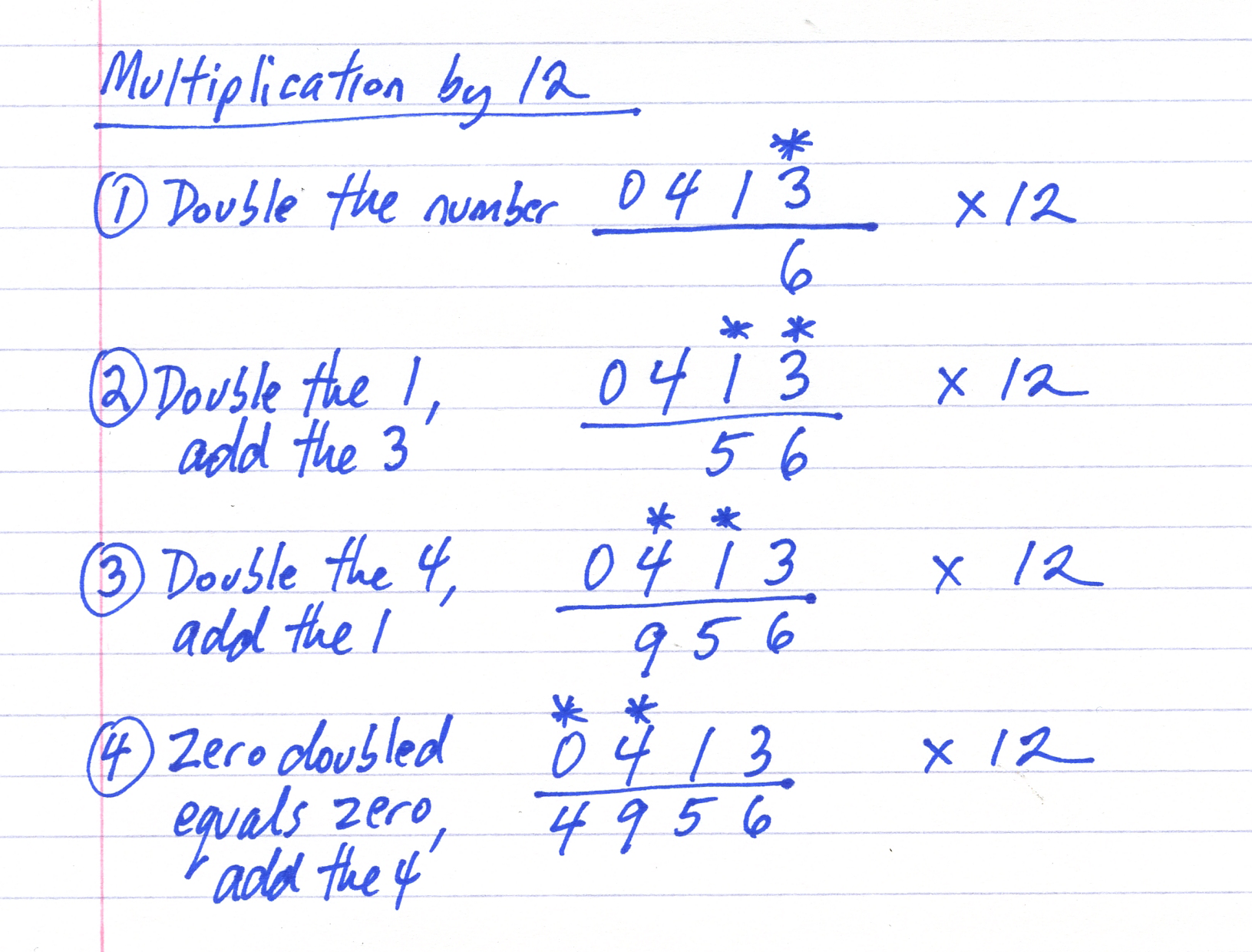
Multiplying by 12 is just as easy, but the rule changes to: “double the number, add the neighbor.” Here, my explanation includes specific numbers.

Mult by 12

In fact, there is a similar rule for multiplication by any number (1-12). And there are rules for quickly adding long, complicated columns of numbers, as there are for division, square roots and more.

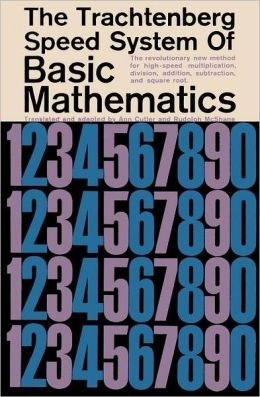
These rules were developed by a man facing his own demise in the Nazi camps during the Second World War. Danger was nothing new to him…this is the story and the enduring legacy of Jakow Trachtenberg, who first escaped the wrath of the Communists as he escaped his native Russia, then became a leading academic voice for world peace. His book, Das Friedensministerium (The Ministry of Peace), was read by FDR and other world leaders. His profile was high; capture was inevitable. He made it out of Austria, got caught in Yugoslavia, and was sentenced to death at a concentration camp. To maintain his sanity, Trachtenberg developed a new system for mathematical calculation. Paper was scarce, so he used it mostly for proofs. The rest, he kept in his head.

Madame Trachtenberg stayed nearby, in safety. She bribed officials, pulled strings, and managed to get Jakow moved to Dresden, which was a mess, allowing him to escape. Then, he was caught again, and was moved to Trieste. More bribes and coercion from Madame. He escaped. The couple maneuvered into a more normal existence beginning at refugee camp in Switzerland. By 1950, they were running the Mathematical Institute in Zurich, teaching young students a new way to think about numbers. A system without multiplication tables. A system based upon logic. A system that somehow survived.

A system that, against all odds, made it into my elementary classroom. One classroom in the New York City school district. For one year. The parents were certain that the teacher was making a terrible mistake, that the people in my class, myself included, would never be able to do math in the conventional way again. Of course, we learned a lot more than an alternative from of arithmetic.

And now, after decades out of print, in an era when arithmetic hardly matters because of calculators and computers, the original book is back in print. The brilliance of system remains awesome, and the book is worth reading just to understand how Trachtenberg conceived an entirely fresh approach under the most extraordinary circumstances.

20130113-222930.jpg

Snow Fall: Two Ways to Tell a Story

Several weeks ago, in the midst of a busy holiday season, The New York Times attempted to understand its future by telling the story of an avalanche. The story requires about a half hour of your time, and it is best experienced in a quiet room with a reasonably large screen.

Snow Fall

The place to begin is with the text-ish story, the one that requires a lot of on-screen reading, the one that includes various animated maps that show just where, how, and why the avalanche happened. Short videos (each one about a minute long) illustrate the story, and bring the people in the story to life. There are audio files of the emergency calls to Ski Patrol. There are slide shows that help us to understand the life of each skier. The writing is strong and skillful. The whole presentation is an impressive demonstration of how we might experience news and features in the rapidly-advancing future.

It feels like an experiment. The writing is long, more like a NY Times Magazine story than a web story. I felt myself drawn into the story and its environment, and found myself pressing the “volume up” buttons on my keyboard in expectation of some sort of soundtrack to accompany the reading of the text.  Short videos satisfied some of the craving for additional stimulation; they were nicely integrated into the flow of the story and the text presentation. The slide shows that introduce each character are a more awkward fit because they require the reader to leave the chronology of the intense storyline–which is told, mostly, in shades of grey–and to consider each character’s past life–which is told, mostly, in vivid digital color. The visual shift is jarring, made worse by the inclusion of completely irrelevant advertisements that are large enough to disrupt the entire experience (for this type of storytelling, I think I’d prefer a micropayment or subscription model, but I wouldn’t mind seeing an opening, mid-break and closing sponsorship presentation).

After I read, looked at the pictures, followed the maps, watched the short videos, and so on, I felt that I understood what happened at Tunnel Creek.

And then, I watched the 11-minute video documentary that told the whole story. I was struck by how much more effectively the documentary told the same story. The story was tight, the characters were crisply defined, the maps and visuals made more sense because they were narrated, the pace was brisk, the emotions were sharp and devastating. Less was a whole lot more. The documentary made the print-pictures-video-maps presentation feel like a bunch of reporters’ notes and script drafts. I felt certain that the doc had been produced by another team, but no, it had been made by the same New York Times staff.

And all of that confused me. I love to read (less so on the screen, moreso from paper), and I was very impressed by the quality of storytelling in the multimedia format. But after watching the documentary, I found myself wondering whether we’re making too much of this transmedia idea, and whether a well-produced audio-video presentation might provide a more reasonable multimedia future.

Sure, this is just one example, and an early one at that. I’m anxious to see what Atavist has online, and will write about their multimedia storytelling in the next few weeks.

In the meantime, do take the take to explore the NY Times presentations. They’re well worth your time and attention.

My Website Doesn’t Look So Good (on my mobile phone)

You’ve got a perfectly good website, looks great on any computer. The only problem: fewer and fewer people are seeing your website on a computer. More and more, it’s the way that the website looks on a mobile device that matters. Oh, sorry, one more problem: there are at least a dozen different mobile devices, and your website will not look the same on any two of them. Some text wraps, some does not. Some graphics are shown, others are cut-off. What a mess?

Check out the images below, and click on any of them to see a more complete picture with even more devices. Try it with your website, and then, either find a pre-made solution (WordPress offers one for blogs, for example), or start thinking about a secondary website design for your business, etc.

Every week, it’s a brave new world.

Diff view of website