Thanks, Bill!

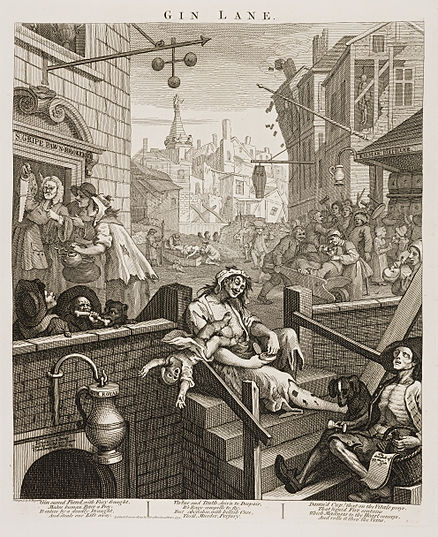
GinLane

Hogarth worked out every minute detail of even image: the angle of the robe behind the gin-soaked mother so that the eye is draw directly to her head; the leering muncher of the large bone, the position of the pawnbroker’s sign above their heads as a kind of upside down religious symbol; the distant grey of the growing city in which these denizens would never take part; so much more. That was the painter, and illustrator, William Hogarth’s intent: to tell remarkable, compelling stories through a series of images sold in a subscription series. His work was widely pirated.

If Bill Hogarth’s father, Richard, was alive today, he’d probably be writing a blog, cleaning up Wikipedia articles, and spending far too much time watching TED Talks. He was always busy writing what he hoped would be a popular play or a textbook for schoolchildren. As a boy, Bill tagged along with his father as he made the rounds from one coffee house to another, for that’s where the printers tended to meet their clients, customers, and friends. In a word, coffee houses in 1700s London were places to network. In time, Richard Hogarth managed to sell of his manuscripts to a a London printer named Curll; it would become a book that would “bring joy to learning through the playing of games” enabling (a then-radical) idea of learning without the direct assistance of a teacher. With tears of joy in his eyes, Richard Hogarth signed the publishing contract, and that, as would be inevitable in a story of this sort, was his undoing. When Curll demanded money to pay printing costs, Hogarth could not pay the bill, could not fulfill the requirements of a contract that he clearly did not understand. Richard Hogarth was placed in debtor’s prison, a nasty place where bribery could, at least, secure better living quarters for the fledgling author and his small family.

Son William was fortunate to secure an apprenticeship with an engraver, made some contacts, eventually earned some money, and became quite popular as both a painter and a storyteller. His prints, including the one pictured at the top of this article, were published in series, offered by subscription. The originals made money, but they were often copied (pirated) by unscrupulous printers throughout London. As he worked his way up London’s economic and social ladder, William Hogarth became a very popular painter, busy with commissions until the very last years of his long career. Battling syphilis (a very common theme in stories of this era), frequently lusting after young women (especially in his younger years), Hogarth often considered the fate of his father, and devoted much of his life to steering clear of any such problems.

Benefitting from his upscale connections, Hogarth began to pursue a new law, one that would protect creative people from piracy.  At the time, this was extraordinary; in London, and elsewhere, piracy was simply part of the system. Nobody much questioned the many illegal copies of an artist’s work. Printers published whatever they wanted to publish.  Standard business practices were uncommon. An artist who fought the system ran the risk of speaking truth to power, and could well end up in debtor’s prison, or worse (that is,  murders under dark bridges were extremely common at the time).

Hogarth had been painting, on commission, for a Select Committee of Parliament as they investigated gaols (now: “jails”). Hogarth painted the deliberations of the committee, made a friend of Sir Archibald Grant of Monymusk. In time, Hogarth visited the influential man in his home, and over tea and gooseberry tarts, they considered a plan. There was an act of Parliament from Queen Anne’s time that protected writers, so Sir Archibald, in his strong Scots accent, thought aloud:

The connection to the other Act is gud. They like laws that build on other laws.”

Sir Archibald wrote letters to several important people in Parliament. Hogarth hoped that James Oglethorpe would be one of them, but his London home was boarded-up. Sir Archibald explained that Oglethorpe was in the colonies, founding a new one called Georgia. A short time later, Oglethorpe returned, and Hogarth gained his support:

Of course, I’ll support you. The book trade is run by scoundrels and idle incompetents. Always has been, always will be. But we’ll fire a few shots at them, eh, Hogarth?…Show me where to sign!”

Hogarth’s Law eventually passed and became law. Of course, his very next set of prints were his poorest sellers to date–he probably made more money on the previous subscription series, even with the piracy. And then, of course, there was the matter of enforcement of the new law–uneven because there was no system to police the bookseller’s constant practices. Still, times did change, and we benefit from Mr. Hogarth’s good work today.

So: the next time you’re in London, make your way to Leicester Square (Leicester Fields in his day), and take note of the statue of the man who made the world safe for creative professionals.

And, if the story intrigues you, pick up a copy of a lovely novelization of his life entitled I, Hogarth by Michael Dean, from which this article is derived. There is much more to Hogarth’s story–a lusty one, in parts–intentionally reminiscent, in its way, of early British novels that were developing at the same time Bill Hogarth was telling his stories in pictures.
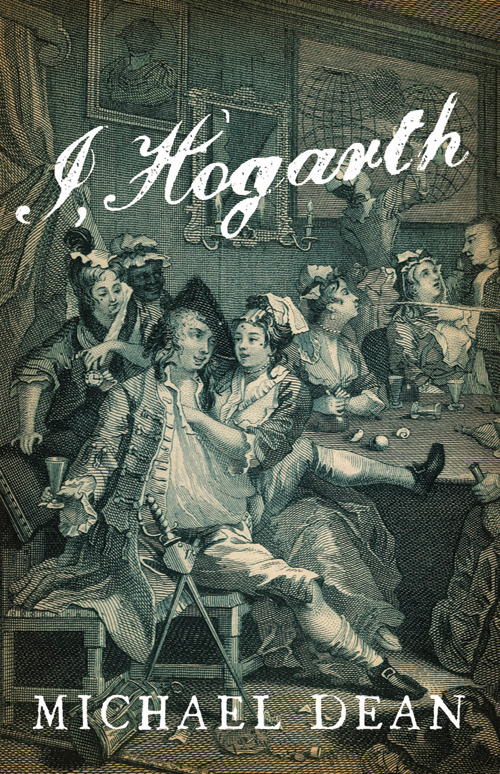
I-Hogarth-1-copy

The Big TV, Part Two

Yesterday, I wrote about big TVs in general. Today, it’s the specific–the 60-inch screen that we now watch every day. It’s a Samsung plasma screen with many of the latest features.

The most important feature is, of course, the screen itself. It’s extraordinary. Great color, great detail, wonderful contrast, never a ghost image, rarely any digital lag (sometimes a concern with fast-moving sporting events and slower-moving processors).

Second most important is sound. As I’ve written previously, most large TVs are made with the assumption that an external system will be added. This particular TV is fine, but on some frequencies, there’s a bit of distortion. Doesn’t happen often. Shouldn’t happen at all. A common problem, but it goes away with an external sound system. (Note the loudspeakers below.)

Samsung-2013-interfaceThird most important feature is the interface–the ways that we interact with the TV set. This requires some explanation.

Mostly, we work with two remote controls. One is used to switch the cable channels, a feature we’ve never quite mastered within the Samsung interface, so we simply switch the channel on our original cable remote and put it aside. The main remote is the Samsung, and like most TV remotes, it takes a bit to understand most of the features, and, like most remotes, it contains buttons and features that I will never take the time to comprehend. Mostly, it’s useful for volume up-down, and for maneuvering a cursor around the on-screen interface.

This interface is a point-and-click design, limited in its alphanumeric capabilities. Mostly, we select an app from the Smart TV interface, then scroll through a series of visual menus to find the movie or TV show that we want to watch. There’s an Amazon Prime app that we’ve used to watch every episode of “Arrested Development” at no additional charge, and there’s a Netflix app that we use to watch “House of Cards” and the strange assortment of movies and documentaries that is rich in niche material and (happily!) lacking in major mainstream movies. These work well enough, but everything falls apart with the oh-so-promising YouTube app–no fault of Samsung here, for YouTube develops its own software. It’s one of those circa-1983 interfaces where you must use the up-down-left-right arrows on the remote in order to choose each individual character, each space, each deletion of an error. For YouTube, with its many idiosyncratic titles, it’s simply dreadful.

There are some other useful apps–one to watch TED Talks videos, another to check the weather, another which provides access to what may be the slowest internet web browser I have ever encountered. In truth, these criticisms are beginning to melt away because each year’s models tend to improve upon the (few) weaknesses of predecessors, and here, I’m discussing a 2012 TV set, ancient in current technology terms.

If you look closely at the above picture, you’ll see that the 2013 Samsung interface is clean, easy to use, and features a tremendous number of apps (you can add or delete them at will). You are, of course, looking at the future of TV on this screen. There’s an app for YouTube and CNBC, another for USA Today and TED, one for HBO GO, and one for Netflix. Each of these is an independent experience essentially unaffiliated with Samsung, but it’s all here, all easily accessible in its “am I a TV channel or a web site? glory? There is so much video, so many images, so much text to be read on a screen that offers abundant clarity and contrast. It is now reasonable to read the Sunday paper on your TV set, stopping to check in, via Skype, with relatives calling from far away, checking email, doing all of that. At long last, we have arrived in the future, and so far, it seems to work pretty well. (See my comments about processing power in the yesterday’s post.)

And then, there’s 3D. This mystifies me. Yes, there are 3D glasses. Yes, they feel really silly. Yes, the effect is still that vaguely grainy, slightly out-of-phase experience. No, I have not felt much of a need to watch anything in 3D for anything more than a family demonstration. Maybe some time in the future.

How much does all of this cost? Less than $2,000, even for a larger screen.

So what else is new? The answer is clearly articulated, with only a modest amount of marketing-speak, on this page from Samsung’s website.

The Big TV, Part One

Overwhelming.

That’s the word we used when we first watched a 60-inch television set take over our family room.

No way would this TV set remain in the room. We had made a dreadful mistake. Living with this monster, even for a week, was simply unacceptable.

And then, we watched. Watching favorite movies, we noticed details in the background that we had never seen before. We’d darken the room and the experience felt superior to all but the best motion picture theaters. For the first time, we could clearly read every closed-caption, every sports score. In short, the experience was far better than we could have imagined.

Of course, the 60-inch TV set is not going anywhere. We’ve explored slightly smaller alternatives, but none offers the satisfying experience of the sheer size, scale and impact of the 60-inch screen.

Figuring out which screen type, which manufacturer, which features–all of that was useful research. Here’s the rundown.

Given the choice of plasma or LED technology, my eyes prefer plasma. I find the LED color palette to be too vivid, less lifelike, too difficult to adjust to my liking. Others may feel differently. During the inevitable research phase–which is not easy to do in the likes of Best Buy, but instead, far more successfully done in small, specialist shops because the sets are properly tuned and aren’t fighting big box store lighting–I found myself drawn to the plasma screens. Their reputation for greater power consumption, heat, reflectance and a darker room has proven to be a non-issue in our setup, which is, already, slightly darker than other rooms in the house. We have not noticed any change in our electric bill. If there is any substantial heat being generated, we simply haven’t noticed it.

Once the plasma decision was made, the choice of manufacturer became much easier. There’s a website that keeps up with the somewhat limited plasma industry, and apparently, there are just three companies in the consumer game: Samsung, LG, and Panasonic. The links in the previous sentence turn out to be quite useful. Each of these manufacturers offers their plasma wares in series form: the higher-end series include more features (3D, smart interfaces, etc.) and the lower-end series offer remarkably good image quality but less of the newest technology (improved black levels are a good example of what the higher priced devices offer that the lower priced models do not).

led8000_marquee_bullet1

“Smart TV” brands Samsung’s interface and feature package. Other manufacturers offer a similar suite of enhanced features. Buying a large-screen TV also involves selecting the best feature package for your needs. This can be complicated, but CNET and other specialist websites can simply the process. Often, reliable journalistic websites offer better, more up-to-date advice than you will find in a large retail store. Smaller specialty stores offer a better combination of well-trained sales personnel and a more home-like viewing environment.

In truth, the image quality on all of these plasma television sets is so extraordinary that individual reviews or product tests can describe only incremental differences. The details available on a true HDTV set are extraordinary, and the color rendition, especially on the plasma models, given proper adjustment, are just terrific.

The sound quality is a different matter. This is the one place where the beautiful, giant TV sets fall short. The reason, usually, is speakers that point in the wrong direction (down toward the floor or cabinet, not toward the listener) and are also too smaller to provide the fidelity that should be commensurate with the picture experience. (For more about this, see my previous blog post about audio systems for big screens–some of the specific products may no longer be current, but it’s easy enough to research newer models.)

None of these sets are easy to set up. They are all large, and require great care. A professional installer is recommended, especially for a set as large as 50 or 60 inches (remember, the measurement is on the diagonal). They are very well-made, but you want to be very careful about twisting or torquing the screen (or dropping it!).

Available as an accessory, the Samsung television keyboard serves as both a remote control and an input device with full alphanumeric entry. It also includes a touch pad. When the Bluetooth connection works properly, this is a wonderful addition to a smart television viewing experience.

Available as an accessory, the Samsung television keyboard serves as both a remote control and an input device with full alphanumeric entry. It also includes a touch pad. When the Bluetooth connection works properly, this is a wonderful addition to a smart television viewing experience.

Back to set-up. Each of these sets is a sophisticated computer and a TV set, and each offers a remarkable range of software features. The interface relies upon a fairly traditional TV remote control, and, increasingly, upon a screen interface that is navigated, mostly, by up, down, left and right arrows, or entry of numbers. This is a woefully inadequate way to control a device with so many features.  A touch-pad is a far better idea, and, in fact, a full wireless keyboard is an even better idea–when the Bluetooth feature works well enough to enable flawless communication between the TV set and what amounts to a rather large remote control.

Set-up also requires a level of coordination with other devices, including a DVD player,  an audio system, your wireless network, and, in the most-likely-t0-be-troublesome department, the cable box that is not specifically designed for use with such a modern TV set.

Of course, our original intention was simply to watch TV on a larger, prettier screen. We, like so many other consumers, were so self-assured when we insisted that the extra features were completely unnecessary, not at all interesting. Naturally, we spend nearly all of our viewing time with those special features. For the most part, they are the television equivalent of the iPad’s apps, but in the smart television world of 2013, those apps are, in essence, video-on-demand channels that provide access to a stunning amount of movies, television programs, and much more. These apps are also available on the newest Blu-Ray DVD players, game systems, and on other devices. On TV sets, the critical factor is the computer processing power built into the TV set. As a matter of common practice, TV manufacturers do not provide sufficient processing power to allow the apps to operate quickly and efficiently, so performance is often adequate, but could be so much better with only a small incremental price adjustment. The newer videogame systems offer both the same apps and also the increased processing power. Of course, you can plug any of those systems into the big TV and bypass the built-in apps entirely. Apple TV, which costs $100, serves the same purpose; similar products from Roku are also low-cost solutions.

So what’s it like to watch such a big TV? Stay tuned for tomorrow’s show, er, blog article.

Wallet, Cash, Phone, Keys – What Did I Forget?

OLED technology allows for flexible phone design. For more, click on the link to read a good article in TechWhiz.

OLED technology allows for flexible phone design. For more, click on the link to read a good article in TechWhiz.

It’s 2013. Why are we still asking that question? Why are we still messing around with credit cards and driver’s licenses, house keys and office keys, and so much more. No need. Not any more. It’s time for somebody to invent one slim, pocketable slab that takes care of everything. Here’s my plan. Feel free to patent it and make a fortune. As I’ve thought about this–a perfect thing to do on a rainy Saturday afternoon–I’ve come to realize that the elimination of my wallet may, in fact, provide the necessary tipping point for several large industries.

How big should it be? When cell phones became very popular, the coolest ones, like Motorola’s Razr, were about the size of a credit card, and maybe four times as thick. (I just checked Wikipedia: Razr was about 4 inches high, 2 inches wide, and about a half inch thick; a credit card is about 3 1/4 inches tall.) I think that’s a good basic size because it’s so pocketable.

On one side, I think I’d want a touch-senstive display that could also respond to my voice commands. The display probably uses OLED technology so that it is flexible, and easily expanded or reshaped. On the other, I want solar cells so that I can recharge the phone whenever I am near sunlight.

Pretty much, that’s the design. Add the usual extras: camera lens, flash, microphone (detachable for some advanced Bluetooth use and stow-able within the device so it doesn’t get lost, and can be charged with the unit), speaker, AC adapter of some sort.

Can I leave my wallet and other stuff at home? Or toss it all in the trash?

Yes, but not immediately.

Let me go through my wallet first. Just about everything is associated with data–credit card or debit card, both about to go the way of the drive-in movie theater and the men’s handkerchief. My AAA membership card, health care card, drug card, and public library card can all go away; they are nothing more than physical manifestations of an account number. Pictures of my dog, and, oh right, my family, all are printed versions of digital images.  Okay, fine, I no longer need the wallet. Except for the part that, so far, Google has not been able to build a viable digital wallet business–and neither has anyone else. (The reasons: lack of public acceptance for Near Field technology [NFC], and the control exercised by the credit card companies.)

How about cash? Really, I use it only at the local farmer’s market or for a quick slice of pizza. If everybody else is using data instead of cash, I will too. So let’s just make the decision, together: no more cash or coins!

Presumably, the phone is the easiest one to eliminate. Do I need a separate wallet and phone? Nope. If I can combine a phone and a camera and an email system and VPN access, I can certainly live without a standalone phone. Gone!

Keys! There’s the problem. Yes, I have a digital key to my office. It’s the smallest thing on my keychain. Car keys are already digital, but they still resemble keys. A truly reliable digital lock, sufficiently inexpensive to serve consumer needs, remains just a few steps in the future. Recently, Gizmodo reported on a company called SmartLocks: “August is the lock that requires no key, only an invitation…” The video, below, lays out the plan.

For those who travel often, the old concept of a Passport that’s the size of an old savings passbook needs some rethinking. It should be digital, but that probably introduces all sorts of opportunities for bad guys. (Though it’s difficult to imagine how a larger vs. smaller passport would matter much.)

So what are we missing? Real-world stuff, I suppose. A few weeks back, I wrote about the real world (fun to do that, from time to time, on a blog that’s called Digital Insider) and explored the usefulness of multi-tools. It turned out to be my most popular blog article of all time, so I’m pretty sure we’ll keep those around for awhile. Which means we will still require pockets, or belt loops, or some other way to carry stuff around.

Still, wouldn’t it be nice, just once, to leave the house without asking the dog, “do you have any idea where I put my keys?” Assuming the dog’s chip is working properly (let’s assume every dog would have one; many already do), he or she would simply cause your phone to ring, which would allow you to grab your keys and your money and your flashlight and your phone on the way to the veterinarian’s office. To which the dog might bark–“aren’t you forgetting something?”

The Brilliant Douglas Engelbart

Douglas Engelbart passed away recently. His name may be unfamiliar. His work is not.

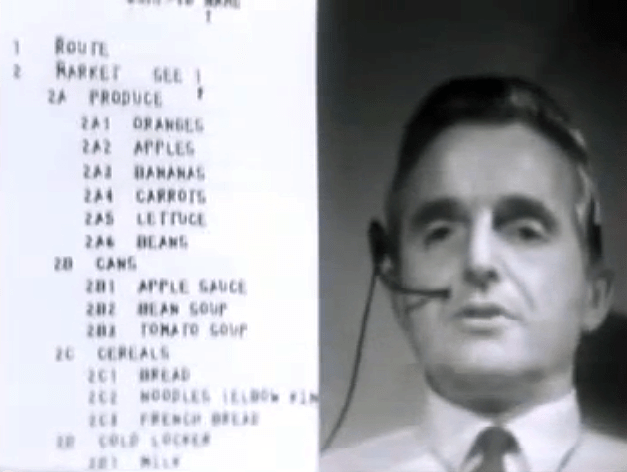
Engelbart was an engineer who invented, among other things, your computer’s mouse, and, by extension, his work made the trackpad possible as well. In his conception, the mouse was a box with several buttons on top and the ability to move what he called an on-screen “tracking point.” In 1968, this idea was radically new. I encourage you to watch Mr. Engelbart in action by screening the video, now widely known as “The Mother of All Demos” in the hardware and software community because of all that he presents. Among the innovations: a video projection system, hyperlinking, WSYWIG (what you see is what you get–the basis of word processing and more), teleconferencing and more. He’s clearly having a wonderful time with this demo, very proud of what has been accomplished, keen on the possibilities for a future that we all now accept as routine.

Douglas Englebart in "The Mother of All Demos," as this hour-plus presentation has come to be known.

Douglas Engelbart in “The Mother of All Demos,” as this hour-plus presentation has come to be known.

You’re actually able to point at the information you’re trying to retrieve, and then move it

Intrigued? Here’s a look at the input station. On the right is the mouse; at the center is the keyboard; and on the left is an interesting five-switch input device that allows quick typing by holding down each of the five keys in various combinations to enter characters without using the keyboard (some of these ideas were later revised for current trackpad use).

A very early version of a computer mouse as explained by its inventor, Douglas Engelbart.

A very early version of a computer mouse as explained by its inventor, Douglas Engelbart.

Still unsure about whether this video is worth your time? Think of it as a TED Talk, circa 1968.

Hungry for more? Watch this video on the Doug Engelbart Institute website. Here, he speaks about collective learning and the need for a central knowledge repository. The video was recorded in 1998, shortly after the internet first became popular. His vision recalls the era when we all dreamed about what the internet might someday be.

The complexity and urgency of the problems faced by us earth-bound humans are increasing much faster than are our aggregate capabilities for understanding and coping with them. This is a very serious problem; and there are strategic actions we can take, collectively. – Doug Engelbart

Welcome to the Times Machine

It’s taken a decade or so, but newspapers are finally beginning to get the hang of this new media thing.

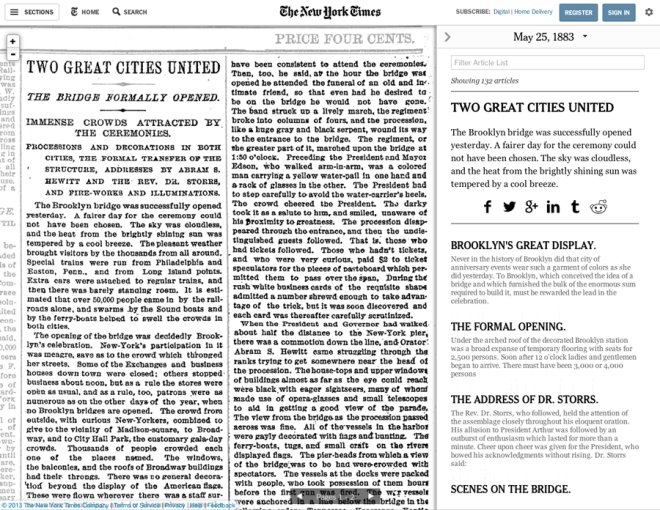
Among the most impressive new offerings: The New York Times Machine, an online experience that allowed me, in an instant, to read a story, originally published on May 25, 1883, entitled: “Two Great Cities United: Bridge Formally Opens.” From the text:

The Brooklyn Bridge was successfully opened yesterday. A fairer day for the ceremony could not have been chosen.”

Train service was extended from Easton, PA, Long Island, and other just-far-enough-away places. The service was decidedly a Brooklyn celebration. The people in New-York (at the time, the hyphen was still in common use) were less ecstatic, but showed up in the tens of thousands to join the celebration.

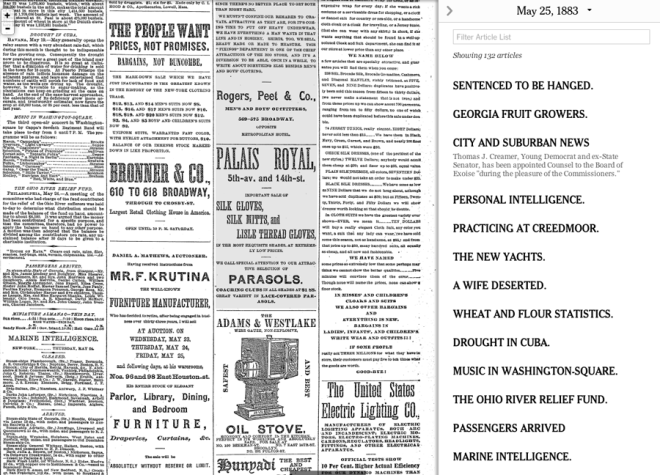
I know all of this because I am reading the actual printed page of the newspaper, the story in its original font, in its original presentation. I can see what happened on that day by reading other stories. There was an uprising of Italian railroad workers in Philadelphia who demanded their pay before they went back to work. The French government is having trouble with their colonial subjects in Madagascar who seem willing to “fight to the death” for their rights (The New York Times is remarkably even-handed in telling this story.) General Grant arrived in Chicago, and will leave for Galena tomorrow (in fact, that was the whole story).

The interface is simple, and well-designed. On the left, which occupies about 3/4 of the screen, there is simply a picture of the newspaper. Click on a story, and it becomes large enough to read. (No way to copy contents just yet, but I hope that will be part of a future release.) On the right is a search window and a list of search results, each with a headline. Some stories are presented with a brief summary. Every story can be forwarded by Facebook, Twitter, Reddit, Google+, and more (this feature doesn’t work just yet, but it will soon).

After writing this initial draft of this article, I decided to explore some more. The Sunday New York Times for July 20, 1969 is filled with fascinating advertisements. I found a real zebra rug offered for just $195, marked down from $395, from Hunting World (“the sought-after high-contrast skins with the darkest stripes and the whitest backgrounds”). And now, the news… A judge in New Jersey determined that the conflict in Vietnam was, legally, a war. TV writer Jack Gould explained how television signals were transmitted from the moon. Bobby Seale led a Black Panther rally with about 3,000 people; most of them were white, and they shouted, repeatedly, “power to the people” while thrusting their fists into the air. Son House, Sleepy John Estes, Brownie McGhee, and Yank Ranchel were among the performers at the Newport Folk Festival (I wish I had been there!). Elsewhere in New England, last night, Ted Kennedy’s car ran off a bridge in Edgartown, Massachusetts, and the yet-unnamed female passenger was killed.  Ted Williams was managing the Washington Senators, host of that year’s baseball All-Star Game, celebrating the 100th anniversary of professional league play. And, the Pope, still watching black-and-white TV, arranged for a color set so that he could watch today’s Apollo moon landing. It is SO cool to see these original stories in their original form. This particular edition included over 450 stories–plus a whole lot of interesting (and not so interesting) advertisements, mostly from department stores.

The current version is a prototype (Beta version), so the range of dates and stories is very limited. Still, it’s fascinating to see what The New York Times Machine will be–and soon.

Below, a sample image. It’s far easier to read the real thing (just click here).

NYTimesMachine NYTimesMachine2

Life with Lenny

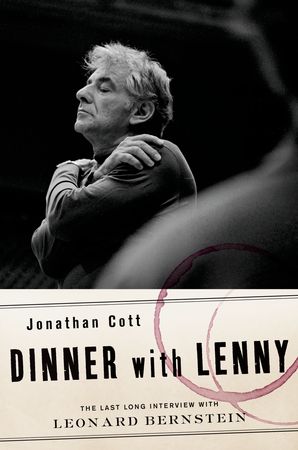
Dinner with LennyFor nearly all of his professional life, journalist Jonathan Cott has written for Rolling Stone magazine. In 1988, he pitched the idea of an interview with Leonard Bernstein to the editors, and a year later, Cott and Bernstein spent twelve hours together at Lenny’s home in Fairfield, Connecticut. They drank vodka (to better enjoy Lenny’s recording of a Sibelius symphony), ate chicken pot pie (Lenny to vegetarian Cott: “Vell, it vouldn’t hoit!,”referring to the old story…)

You don’t know the story? It really happened in the great days of Yiddish theater when the leading actor collapsed onstage during a performance. And a doctor rushed up to help him, but the actor was already dead. And out of the audience came a woman’s voice: “so gif him a little chicken soup!” And the doctor announced that the actor had died…and the woman called back to him, “Vell, it vouldn’t hoit”

For Lenny, it’s all about passion, the great story, the phenomenal breadth and joy of life. That’s the abiding theme of the whole conversation, one that spans, in book form (“Dinner with Lenny: The Last Long Interview with Leonard Bernstein,” written by Jonathan Cott and published by Oxford University Press). Here, he speaks of Alma Mahler–the famous composer’s wife. Cott begins with a question: “I’ve heard that Mahler had to talk to Freud about that problem…”, then Lenny answers:

“You know, Mahler made four appointments with Freud, and three times he broke them because he was scared to find out why he was impotent. His wife, Alma, was then ***ing everybody was was coming by–Gropius, Kokoschka, Werfel, and Bruno Walter, among others–sent him to see Freud. He was twenty years older than she, and she was the prettiest girl in Vienna,–rich, cultured, seductive… She tried to get me to bed. Many years ago, she was staying at the Hotel Pierre in New York–she had attended some of my New York Philharmonic rehearsals–and she invited me for “tea”–which turned out to be “aquavit”–then suggested we go to look at some “memorabilia” of her composer husband in her bedroom. [Laughing] She was generations older than I. And she had her hair frizzed up and was flirting like mad… She really was like a wonderful Viennese operetta. She must have been a great turn-on in her youth. But anyway, Mahler didn’t pay enough attention to her–she needed a lot of satisfying and he was busy writing his Sixth Symphony in his little wood hut all night…”

Cott is a long-time Bernstein fan. The infatuation began when Cott, then eleven years old, on November 14, 1954, watched Bernstein explain Beethoven’s  Fifth Symphony. The the first page of the score had been painted on the studio floor. Musicians, with their instruments, were standing on each stave. Bernstein explained Beethoven’s creative process by dismissing specific instruments from the score–here’s how it sounded with and without this woodwind, that brass instrument–and then, Bernstein conducted the first movement as Beethoven wrote it. Cott “made sure to watch Bernstein’s other Omnibus programs, such as “The World of Jazz,” “The Art of Conducting,” and “What Makes Opera Grand?” At age 15, Cott took Beth (his first “real” date) to see Bernstein’s Broadway smash, “West Side Story.” He became a lifelong fan.

After listening to the solo clarinet that begins his own Columbia LP recording of Sibelius’s first symphony, listening, with Cott, to the clarinet solo that begins the piece, Bernstein announces that the president of Finland had appointed him “Commander of the Order of the Lion,” then “started to sing–humming, crooning, moaning, shouting-out gospel style–as he conducted and danced along to the four movements of the symphony…All the while he added recitative-like interpolations, explanations, words of approval and disapproval, and assorted comments for my benefit about this impassioned, mercurial, wildly inventive work. ‘Listen, child!’ the maestro announced to me. ‘Here’s the Jewish rabbi theme…There’s Beethoven…There’s Tchaikovsky–it’s Swan Lake–and just wait for some Borodin and Mussorgsky later on…Some Grieg (but better than Grieg)…And now comes Sibelius. [L.B. sang and quickly wrote out for me on an old envelope the distinctively Sibelian rhythmic cell we’d just heard…] Now a wind…sighing…And now a pop song…”

So that’s a taste of it. Twelve hours of conversation with one of the 20th century’s iconic figures in music, free-associating with a compadre who was smart enough to keep the conversation going and catch just about all of the references (in fact, Cott called Bernstein for a followup just to make sure he understand everything that Bernstein had said). Lenny is a larger-than-life character in every decade. He was the boy wonder who leaped at the opportunity to first conduct the New York Philharmonic, on national radio, with far less than a full night’s sleep and a reasonably serious hangover. He was the teacher who brought classical music to the baby boomer generation through the clever use of the new TV medium. He was the conductor who performed Beethoven’s Ninth on both sides of what was, moments before, the Berlin Wall. He was the conductor who led the Israel Philharmonic as a celebration of the glory of a new Jewish homeland. He was deeply committed to  Civil Rights and the movement to stop the Vietnam War, despised Nixon, and, as an intellectual, still struggles to understand what happened and why:

That was a very bad time. There was nothing positive about that time. We were living under the thumb of Richard (****ing) Nixon, one of the greatest crooks of all time. But the point I want to make is that anybody who grows up–as those of my generation did not–taking the possibility of immediate destruction of the planet for granted is going to gravitate all the more toward instant gratification–you push the TV button, you drop the acid, you snort the coke, you do the needle. It doesn’t matter that it makes you impotent… Anything of a serious nature isn’t “instant”–you can’t “do” the Sistine Chapel in one hour. And who has time to listen to a Mahler symphony, for God’s sake?”

Cott answers, patiently, “I do.”

From the Dawn of Civilization to the Present Day

In connection with a large project that I’m developing, my office has been pleasantly cluttered with history books. In particular, I’ve been attempting to understand the broad sweep, which is, we all know, a fool’s mission. Stumbling from Mesopotamia to The American Dream has been great fun, far better than I remembered from anything I did in school, and, because of the latest cluster of colorful history books, a fun trip every step of the way.

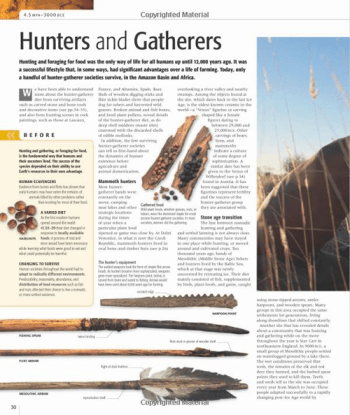
Appropriately entitled History: From the Dawn of Civilization to the Present Day, the 612-page tour of the human story is presented with the full DK Publishing treatment: lots of images, interesting sidebars, full layouts about expected and some unexpected topics (The American Dream, Leonardo DaVinci, Queen Victoria, Science vs. God, The Ming Dynasty, many more). You know the visual style from so many children’s books, Eyewitness Travel guidebooks, and more. Two examples below; in both cases, the links take you to the Amazon “see inside” sequence of selected pages from the book:

DK-First-Harvest-layout

DK-History-Layout

At first, I picked up this book in hopes of finding lots of illustrated timelines. Instead, I found myself browsing a kind of magazine about world history with articles about topics that I figured I should know more about. (In fact, there are timelines, but the type is small, the layout is idiosyncratic, and, candidly, there are better historical timeline books than this one, including the publisher’s own Smithsonian Timelines of History: The Ultimate Visual Guide to the Events that Shaped the World, described below).

This book excels in by telling well-chosen stories in simple, illustrated form, always offering enough depth of information to satisfy the curious. So here’s a two-page spread about Mesopotamia that begins by placing it in the area that now includes Iraq, southwest Iran, east Syria, and southeast Turkey. The name is derived from the Greek, “between two rivers,” which explains the site’s early evolution, noting that similar sites developed in the Indus Valley, and later, in China. Unlike the city-states, Mesopotamia was more like a nation that included several large cities whose names were, in 3,000 BCE, impressive: Uruk, Kish, Akkad, and Ur among them. The society was hierarchical: even in this era, inequality was the norm. There was music; there is a picture of a lyre from the era decorated with the bull’s head that was popular at the time. And there was a mathematical system based upon the number 60. You know the Mesopotamian system: it is the basis for our circle (360 degrees) and the number of minutes per hour (60).

Many pages ahead, there’s a four-page layout on City Life as it transformed normalcy in just 100 years, from 18oo to 1900. By 1819, the city of London was, well, here’s what the English poet Percy Bysshe Shelley wrote as early as 1819:

Hell is a city much like London…”

Creative Commons - Thierry Bézecourt

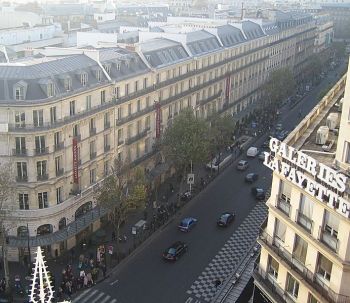
Boulevard Haussmann in Paris. Creative Commons – photo by Thierry Bézecourt

In 18oo, the largest city was Beijing (then, Peking) with not more than 1 million people. A century later, London was home to six times as many people, largely without the benefit of an extended period of growth and time to figure things out. Chicago’s population tripled in just fifty years. To move people around, the cities devised underground railroad systems, cable cars, and trolleys. In the 1850s, Napoleon III hired George Haussman to completely remodel the city, who “replaced entire medieval districts of narrow, cramped streets with wide boulevards…for which the city is now famous.”

Pages ahead, and it’s the Vietnam War, Raising the Iron Curtain, Superpower China, and Climate Change. A very comprehensive story, a terrific browse, a useful addition to the family or classroom library, as much fun as the old World Book Encyclopedia used to be, at least for those of us with a lot of time on our hands on rainy days after school.

The Smithsonian timetables book is more of a coffee table adventure, lavishly put together with artful two-page spreads about, for example, the Qing Dynasty, the Pacific Theater in WWII, the rise of the Ottoman Empire, and, Edo Period, a personal favorite because it pictures a large picture of the Hannya mask (Hannya being a female Noh character turned into a demon by jealousy and anger). Mostly, though, this is a book with an extensive timeline that runs on the bottom fifth of most spreads for more than 450 pages. Explanations appear, in shorter story form, above the timeline. Right now, the book is open to 1780-1784. There’s an engraving, a color picture of a Montgolfier hot air balloon with seven passengers aboard, making their way across Lyons. In 1781, William Herschel, an astronomer, discovered Uranus (on March 13, in case you’re curious). On the following spread, Britain is doing what it can to eliminate the slave trade, including (and I didn’t know this) establishing Sierra Leone as a place for freed slaves (similar to our Liberia, years later). Skipping past the two page spread about steam power, we’re now in 1789, when, within months of one another, we find George Washington becoming the first U.S. President (February 4) and Fletcher Christian leading the mutiny on the HMS Bounty (April 28). The Bastille was stormed that summer (July 14, which you probably knew), and the U.S. Congress proposed the Bill of Rights (September 28).

This book is filled with interesting tidbits: Marie Antoinette was 14 years old when she married Louis XVI; tiny Portugal’s empire was 4.6 million square miles; 2,000 bathers could simultaneously splash around in the Roman Baths of Caracalla; and, for what it’s worth, the number of eunuchs employed by the Ming Dynasty exceeded 100,000. Or, if you prefer, the number of diamonds in King George’s crown: 6,000.

The abiding favorite tidbit is a quote from the President of the United States, then Rutherford B. Hayes, who watched Alexander Graham Bell demonstrate the telephone in 1876 and then said,

That’s an amazing invention, but who would ever want to use one of them?”

Storytelling through Maps and Timelines

Creative Commons license: Nicholas Kenrick

Bagan today. Creative Commons license: Nicholas Kenrick

In the year 1100, the largest city, by far, was Kaifeng, which was twice the size of its nearest competitor, Constantinople, three times the size of the third city on the top five list, Marrakech, which was, at the time, about the size of Kalyan and Cairo. Never heard of Kaifeng or Kalyan? If today’s Kaifeng was located in today’s United States, it would be the nation’s second largest city; in China, where it has been a significant city for a very long while, it would be in the top forty or fifty cities. Kalyan is now part of Mumbai. A hundred years later, Bagan makes the list–it’s no longer an active city, but the site is as popular in Cambodia as Angkor Wat. Add another 100 years and the first of the European cities makes the top five list: Paris. By 1492, just as Europe is waking up to the possibility of its role as a global power, there are no European cities on the list. Instead, it’s Beijing with over a half-million people in the number slot followed by Vijayanagara, Cairo, Hangzhou, and from the Americas, Tenochtitlán.

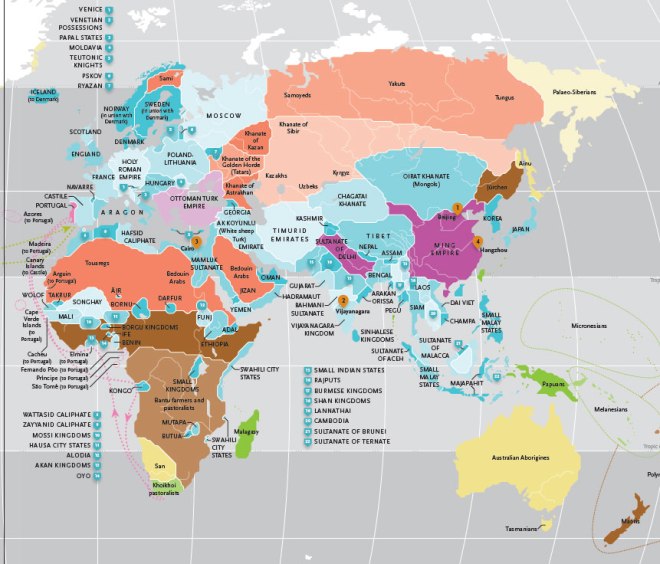
In 1492, the world map is a fascinating place filled with vaguely familiar names. A large swath of what is now Russia was then the Khanate of Siber; the Mongols are firmly in control of the large area that is now Mongolia; the only people in Australia are Aborigines; and the Caribbean and much of South America are under the control of the Arawak people (who will be killed, in large numbers, by European invaders and their diseases, the first of whom is Columbus). You’ve probably heard of Catherine of Aragon, a Henry VIII wife (remember “Divorced, beheaded, died; divorced, beheaded, survived?”–Catherine’s the one who Henry divorced, setting up a major tiff with the Pope). Anyway…Aragon occupies the eastern half of the Iberian Peninsula in 1492. The Inca are all along the Pacific side of what becomes South America, and the Mayas and the Aztecs are all over what becomes Central America and Mexico. Japan is Japan, Korea is Korea, and remarkably, Poland is a large country–actually a kind of joint project, so the place is called Poland Lithuania.

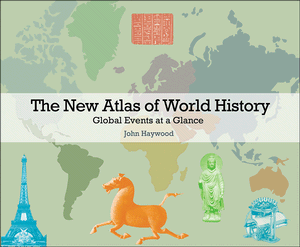
How do I know all of this? Because I’m having a blast browsing through a new combination of world atlas and history book. It’s called The New Atlas of World History: Global Events at a Glance and it’s been put together by research fellow at England’s Lancaster University named John Haywood.

NewAtlas World HistoryQuite sensibly, Mr. Haywood has produced a book whose broad horizontal pages alternate between an atlas view of the world at various intervals, and a timeline of significant events that describe that time in greater detail.

His story begins around 100,000 when ice sheets covered much of today’s Canada, all of today’s United Kingdom, and the rest of northern Europe. From the ancestral starting place in eastern Africa, homo sapiens migrate first into Asia and China, then across two land bridges, one to what becomes North America and the other (who knew?) across present-day Indonesia and the Indian Ocean across to Australia (which is how the place become populated with Aboriginal peoples). In fact, Europe was settled, or, at least, visited in large numbers, about 5,000 years after Australia. It took even longer for the people who took the now-Alaska land bridge to make their way all the down through the current United States and Mexico, eventually finding themselves in what is now South America.

Looking way ahead to, say, 1900, it’s again a fascinating map and story: there is no Poland, for example, because it has been obscured by the giant Russian Empire, and also, if I’m reading the map correctly, by the Austro-Hungarian Empire, too. On that map, Africa is a collection of colonies belonging to Belgium, Holland, Germany and other countries whose international colonization efforts were ended by a pair of wars that provided plenty of good reason to focus on life at home.

So here’s a rough look at the 1492 map of the world (click on it to see a full-screen PDF with far better detail):
Atlas_Map_Smaller

And, to accompany that layout, here’s a look at the adjacent page, this time providing a timeline view of events that mattered at the time (same story, click to see a PDF that’s easier to read):

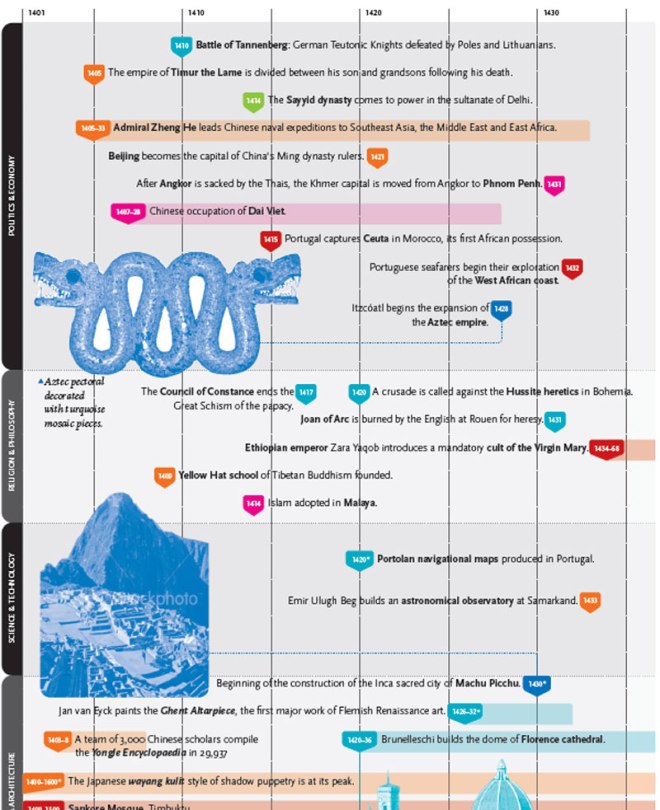
Timeline

Of course, the book offers more than just these two layouts. One of my favorites shows the migration routes to the United States, mostly from Europe, circa 1900. The same map contains the sobering stories of indentured servants leaving India for British colonies in Africa. Subsequently, a young attorney and activist named Mohandas Gandhi will understand his power by correcting the situation in South Africa (then, the Cape Colony) before returning to his native India.

So: here’s the history of the world in just over 200 pages, full-color, filled with fascinating stories told in some text, but mainly, through descriptive maps and pictures. It’s a thoroughly modern way to tell our story, and, as you might imagine, it has become a favorite. You’ll get some flavor of the work’s value by clicking on some the links on the book’s catalog page, but there’s really nothing quite like having the whole of it in front of you on a hot Sunday afternoon in the cool shade, preferably with an equally cool drink from some far-off land close at hand.

Big History

After admitting that we cannot yet answer the  obvious–and seemingly unanswerable–question about how and why everything   began, University of Sydney Professor David Christian begins with the creation of the universe about 13 billion years ago. It’s not every historian who would admit, simply:

About the beginning, we can say nothing with any certainty except that something happened.”

He continues explaining this madness: “We do not know why or how it appeared. We cannot say whether anything existed before. We cannot even say that there was a ‘before’ or a ‘space’ for anything to exist in (in an argument anticipated by St. Augustine in the fifth century CE) time and spare may have been created at the same time as matter and energy.”

After that, the big news is not so much the Big Bang Theory (explained here in detail that can be easily understood), but the shift to a neutral electrical charge, enabling the creation of atoms, first simply (mostly, hydrogen and helium atoms), then, in increasingly complicated ways. I like this quote:

Hydrogen is a light, odorless gas which, given enough time, changes into people.”

Leaping ahead, the sun and the planets show up around 4.56 billion years ago, and, helpfully, Professor Christian helps us to understand an earth bombarded by small planetesimals (excellent word, new to me) and without much atmosphere.

The early earth would indeed have seemed like a hellish place to humans.”

As the mix of gases shifted from methane and hydrogen sulfide to carbon dioxide, the early atmosphere would have appeared red–that is, the sky would have seemed to be red, not blue. The blue sky came about because the new oceans–made possible by a drop in temperatures below 100 degrees celsius–allowed oceans to form, and those oceans absorbed much of the CO2.

How about the question of the beginning of life on earth? Again, Christian offers a coherent answer:

Living organisms are constructed, for the most part, from compounds of hydrogen and carbon. Carbon is critical because of its astonishing flexibility. Add hydrogen, nitrogen, oxygen, phosphorous, and sulfur, and we can account for 99 percent of the dry weight of all organisms. It turns out that when conditions are right and these chemicals are abundant, it is easy to construct simple organic molecules, including amino acids (the building blocks of proteins, the basic structural material of all organisms) and nucleotides (the building blocks of genetic code).”

Of course, it’s one thing to assemble the building blocks and another to assemble these parts into a wooly mammoth, or even an amoeba. Christian admits that this is the tricky part: complexity is the appropriate term that causes contemporary scientists to scratch their heads and wonder. The pieces seem to be there, but the complexity of their union and the spark of life may not be so simple.

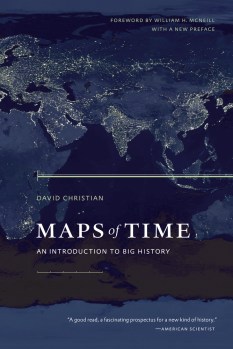
Maps of Time

Book: Maps of Time: An Introduction to Big History by David Christian

Sure, multi-cell animals are interesting footnotes, but really, isn’t history all about us? Not exactly, not according to the good professor. Turns out, we are just one of many species, and in the scheme of big history, humans are a kind of, well, a kind of weed. We just keep growing, taking everything over, killing off other species, treating the whole earth as our own private amusement park. Within our lifetimes, there will be 10 billion humans on earth, an astonishing increase given that there were, in 1800, just a billion of us. Every dozen or so years, we add another billion or so.

As humans began to migrate into Europe and Asia from their original home in Africa, large animals became extinct because we hunted them down, ate them, used their hides for clothing, used their bones for tools. Giant sloths in the Americas, giant wombats and kangaroos in Australia, mammoths in Siberia. We killed them faster than they could reproduce, and so, they’re gone.

So what makes us so special? Is it really all about thumbs? Sure, thumbs make a difference, but it’s something else entirely. Professor Christian uses the term “collective learning” to describe our “pooling and sharing of knowledge…the types of knowledge that, over time, have given humans their unique power to manipulate the material world. Two factors stand out: the volume and variety of information being pooled, and the efficiency and speed with which information is shared.” Here, he’s not referring to the digital age, but the era before we developed any meaningful form of writing, drawing, or communicating with anything resembling a modern language.

By now, we’re about halfway through the book. Next will come the domestication of animals–in which humans figure out that an animal that is killed for its meat is useful only in the short-term, but an animal that is kept alive for its milk is useful in the long-term. This concept of domestication applies not only to meat/milk animals, but to others whose wool, or other production, can be used not only to satisfy basics needs, but also for exchange to other humans. In time, it’s the idea of exchange that becomes the driver, resulting first in local trade between tiny settlements, then trade routes as fewer people are tied to subsistence farming or hunting/gathering and more are available (typically, more men are available) for pursuits involving trade, travel, and, in time, the accumulation of wealth.

Along the way, humans attempt to understand how and why their world works. Since the ground, the soil, the earth provides the food we eat, we begin to explain the world in terms of an earth spirit. Similarly, the sky seems to contain the origins, the mystical, the unknowable, and so, this, too, becomes a kind of spirit. In time–and mostly within a period of just a few thousand years, mostly in southwestern Asia–we gather these beliefs in the form of religions.

As we, as contemporary, educated humans with every conceivable benefit, attempt to understand our world, and its big history (now a common term combining history and science, by the way), Professor Christian readily admits to what he has done. He has wrapped our beliefs, our knowledge, our stories into what calls “a modern creation myth.”