A Great Idea for Great Ideas

Once upon a time, OmniGraffle software was provided free with every Apple Mac computer. That’s how I learned about it. Now, I use OmniGraffle on my iPad and the desktop. When it comes to sketching out ideas, and presenting them in a clear and colorful manner, there is no better (or easier-to-use) product.
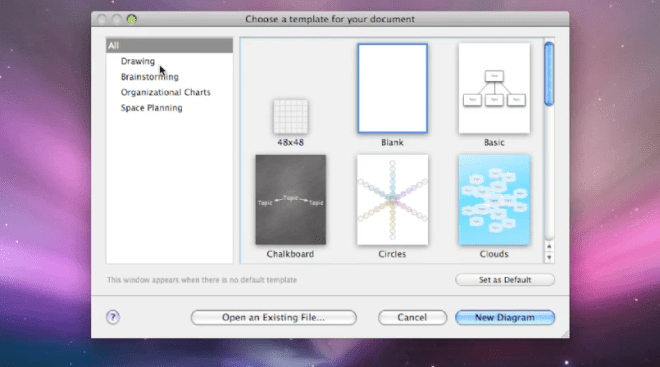
So, what does OmniGraffle do? Well, it depends upon what you want it to do. Start with a blank sheet, or some on-screen graph paper, or set yourself up for a cloud cluster (also called a mind map), or a whiteboard, or a chalkboard. There are connected notes, so you can use it as a kind of bulletin board, Whatever works for you, you’ll find the basic template in the full Standard or Professional version for use on the Mac (a great many features are available on the iPad version, which may suffice for some users).

Choose the template, then start drawing. Easy enough to begin with a box, color it, shade it, add text, make a copy, the sorts of things that you do in PowerPoint or Keynote all the time. Here, the tools are more varied, more versatile, including a bezier tool to draw shapes as you would in Adobe Illustrator (if you don’t know how to do this, it’s worth asking someone for help, but once you understand how it works, you’ll find yourself using this tool quite often).

So, let’s say that you begin with a free-form drawing, a visual exploration, a sketch to explain an idea to yourself or to others. It begins to make some sense, so you want to change its form, maybe move into a cloud of connected ideas, or a set of related on-screen index cards, or an organizational chart with colors to indicate levels or positions. Easy to do–this software is designed for versatility, and for intuitive thinking. The results can become quite sophisticated–and yet, they are not difficult to pull together, even under the pressure of time.

Automatic layouts save time, and make everything look a lot tidier, a lot more clear. There’s quick and easy access to frequently used tools, like color palettes and the font selector. There’s a user community called Graffletopia that creates “stencils” that can be used to create, for example, a director’s plan for film, or visualizations for software programmers. Browsing through Graffletopia, the utility of OmniGraffle becomes very clear: this is a visualization tool for working professionals. It’s easy to use, versatile, and, you’ll find, quite popular among certain knowledgable groups.

OmniGraffle is not a drawing tool, but instead, it is a tool for making (and easily revising) diagrams. I like the language from Omni’s website: “OmniGraffle knows what makes a diagram different from a drawing, and gives you the tools to create amazing diagrams quickly and easily. Lines stay connected to their shapes, unlike with illustration programs, where you would have to redraw your diagram every time you moved something.” As someone who often uses visuals to explain–and has become quite tired of the limitations of, say, Keynote or the level of sophisticated required for Adobe Illustrator–OmniGraffle feels just right to me. I find that the interface is intuitive (best if you’re already a Mac user), and that, from time to time, I need to take a moment and figure out how a tool works. That’s good–it’s just a few steps more sophisticated than my current abilities.

Most of the time, I’m sketching a diagram between meetings, capturing the basic idea. And although I can complete a pro-quality diagram on the iPad (and often do), I find myself in need of some certain advanced features, such as import/export from/to Visio (a Windows-only product). Most of the time, my diagram is on the simple side: colored boxes with type, perhaps a cloud to indicate an interesting idea. By holding my finger down, then dragging, I can group my clouds and/or boxes. Better yet, a smart selection tool allows quick selection of, for example, just the blue rectangles. I can create Adobe-style layers, then copy, or turn them on and off. Very handy, qick, and effective. Easily learned, too, in daily use, the iPad version has proven to be extremely useful, in part because it combines some of the best features found in OmniGraffle Professional (such as tables) with a sophisticated automatic diagramming tool, and a freehand tool, too.

To be clear, there are three different OmniGraffle products, each with its own unique set of benefits.

OmniGraffle for iPad costs $49.99 from the AppStore–a high-priced product that turns out to be a very good value because it does so much, so easily. OmniGraffle Standard, for Mac, costs $99.99, and OmniGraffle Professional, also for Mac, costs $199.99. Compare their features here. And, happily, you can get a free trial download for either of the Mac products (and any of the many excellent OmniGroup products). They do things the right way. It’s impressive.

Easy-to-Use Audio Studio-to-Go

The Zoom H4n has become one of my favorite tools, but most people have never heard of it, or seen it, or even know that such a thing exists.

Zoom makes portable audio recorders–pocket sized recording studios about the size of Sony’s original Walkman, but so much more versatile. This is the ideal companion for a digital camera or camcorder–with far better sound, and far more control over the recording process. It’s ideal for recording of music rehearsals, recitals, and performances. It’s handy for audio interviews, and for the recording of meetings. With proper cabling and a phono pre-amp, you can digitize your vinyl LPs. It’s a useful four track audio recorder, so you can use it to make a record. And, of course, you can use it to listen to music, speeches, podcasts, any audio recording with remarkable fidelity because everything is digital.

Let’s take it from the top…and the bottom.

On top, there is an X-Y (crisscrossed) pair of small microphones. The quality is good, the sound is clean, and they can each be adjusted to cover either a 90-degree pickup area (for more intimate situations or to reduce unwanted noise), or a 120-pickup pattern (to pick up a wider area). Or, plug one or two professional microphones into the bottom (1/4 inch phono plugs or XLR connectors). Or, plug an 1/8 inch mini stereo cable into the mic jack on the back). Control the input level by watching digital VU meter on the small golden screen (backlit when necessary) and adjusting the rocker switch with one finger during the record session.

Here’s a closer look at the screen. No, it’s not iPhone quality, but yes, it’s functional. Time code runs on top, file number next, then sound levels. Buttons below allow track selection, and in another mode, allow selection of files and formats. Buttons are small, screen is small, but everything works fine in the field.

You can choose to record in either .wav (high quality) or .mp3 (low quality, but smaller file sizes) at various sample rates. In multitrack mode, you can record on each of up to four tracks, or play back on up to three of them. Buttons are small, but overdubbing is within the capabilities of this little machine, and that’s useful if you are recording your own tracks for a music demo, for example, because you can listen to your primary vocal while laying down a harmony track, for example, or listen to the drum track while playing your saxophone).

For more sophisticated work–and an easier time–use the Zoom H4n as the interface between, say, your microphones and a more robust Digital Audio Workstation (such as Logic Pro, Garage Band and Samplitude), but, sadly, not ProTools, which requires only M-Audio devices.

Need a metronome or a guitar tuner? They’re built-in, too.

You will record on an SD card. Power comes from either an AC cable or handy AA batteries. You can plug the Zoom H4n into your computer via a USB micro connector. If you need more battery time, flip into “stamina mode” which shuts down some features and dramatically increases recording time (6 hours in normal mode, 11 in stamina mode).

 The Zoom H4n is all so well thought out! I wish every product was as thoughtfully designed!

Recently, I used the Zoom to record audio interviews while recording video interviews on the Olympus PEN EP-3 digital (still) camera. I placed the Zoom just out of frame, and later, in editing, matched the audio track from the Zoom with the EP-3’s video and audio tracks (once synchronized, the Olympus audio track was muted, and subsequently, replaced). Under the right circumstances, this is a better solution than a wired external microphone or a finicky wireless microphone. What’s more, the Zoom provides broadcast-quality results. The sound quality is fabulous. And because the Zoom is small, it fits into my small shoulder bag alongside the small micro four thirds Olympus PEN EP-3. This is a complete HD quality remote shooting rig that I can easily carry in a shoulder bag with plenty of available space for an iPad, wallet, cell phone, ear buds, and (much) more. Add a 32GB SD card, and I can carry hundreds of record albums with me, just in case I feel like listening, not recording.

There is so much more. If you’re intrigued, simply download the instruction manual.

The Zoom H4n price: under $300. And, for $199, you can enjoy a similar device with reduced features with an H2n (seems less sturdy to me, though). And if that’s still too much, Zoom offers a $99 alternative, model H1.

4K will be 4x better than HDTV

Even higher definition TV. Much higher. With 3D. Without glasses. We may never leave home again.

So says long-time consumer electronics public relations executive Lois Whitman in her blog, DigiDame. According to Lois: Current HD maxes out at 1080 lines or a 1080p picture. 4K HD is 4096 lines, or 4096p.

Ars Technica is a whole lot more critical.

IMHO, this is going to make spectrum reallocation more complicated. Right now, television stations and broadband operators are wrangling to use over-the-air spectrum for delivery of, well, television and broadband services. HDTV is a heavy user–and this new 4K technology will require a lot more bandwidth. Perhaps not over-the-air bandwidth, which might be put to better uses, but when we consider the available bandwidth built out by cable and satellite operators, well, 4K is likely to overwhelm their infrastucture, too. We’ll need new superDVDs or some other medium to carry the data associated with this new format… and I’m certain that will arrive soon enough.

As we Americans (and folks around the world) consider public telecommunications policy and the use of all sorts of bandwidth for television signal delivery, will 4K make the discussion, well, at least 4x more interesting? Will Snow White and the Huntsman be 4x more fun in 4KTV? Apparently, the answer is yes if (a) you sit really close to your new 4KTV, or (b) yes, if your screen exceeds 60 inches (not popular in most homes, just too darned big).

The question is: will viewers find 4x four times more interesting than HDTV? As Apple pushes its retina displays, and camera manufacturers begin to push the 20+ megapixel sensors for even-better-than-the-best imagery, when do we reach the point of diminishing returns? Does anybody need or want a 4K TV? And how might that answer change when 4K TVs are the only kind of TV that Best Buy (or whatever retailer manages to stay alive) sells in 2015?

Cool stuff, but I sure would like the manufacturers to focus on something more important than RHDTV*.

—–

* Ridiculously High Definition TV, a term I made up. You may also see the term QFHD (Quad Full High Definition), which somebody else made up.

Success! Good Health! Longevity! Fabulous Children!

You can do it! You’ll need a college degree and you’ll need to move to a place where 21st century America’s promise shines. Seattle, the SF Bay Area, New York City,

Boston, and the ring around Washington, DC.–those are the places where innovation is held in high esteem and is most likely to be funded so that new companies can be born, grow, and change the economic picture for employees, shareholders, and those smart enough to live nearby.

These are the places where venture capitalists fund big opportunities, and if a company seems promising, a VC will often require a move to, say, Silicon Valley, or not to fund the company at all. The “thickness” of the job opportunities in the Silicon Valley (and a very small number of other places), and the thickness of people with the necessary skills to suit those needs, not only attracts the best (and highest paid) people to these centers, where their high incomes tend to generate more jobs for the local economy (usually with salaries that are higher than even unskilled high school dropouts will find at home). If you’re an attorney, you’ll make as much as 30-40% more if you work in these areas than in an old rust belt city. The same is true for cab drivers and hair stylists.

Much has been made of Google’s employee perks; they won’t play in Hartford or Indianapolis, but neither of those places, nor most other American cities, see the kinds of financial results and spillover effects in the community enjoyed by the area around San Francisco. This is becoming the area that drives the American 21st century. And it’s very difficult for other cities to get into the game.

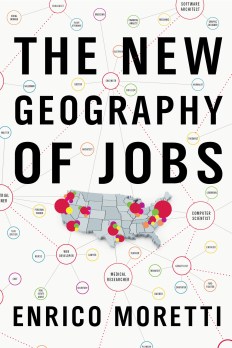
Author and UC Berkeley Professor Enrico Moretti has just published a book that presents a compelling picture of the much-changed US economy. The title of the book, The New Geography of Jobs, undersells the concept. Yes, if you can, you should move to any of these places, where you will make more money than you will at home–regardless of whether you are a high school dropout or a Ph.D. You will probably live longer, remain healthier, provide a better path for your children, live in a nicer home, have smarter friends, smoke less, drive a nicer car, you name it… the American dream lives large in San Diego, but in Detroit or Flint, Michigan, it’s gone and it’s not likely to return any time soon.

Average male lifespan in Fairfax, VA is 81 years. In nearby Baltimore, it’s just 66.

That’s a fifteen year difference. This statistic tracks with education attained, poverty level, divorce rates, voter turnout (and its cousin, political clout), lots more.

Want to remain employed? Graduate from college.

Nationwide unemployment rates: about 6-10% for high school only, 10-14% for incomplete high school, 3-4% for college graduates.

College degrees matter…far more than you might think. In Boston, with 47% of its population holding college degrees, for example, the average college graduate earns $75k and the average high school graduate earns $62,000. By comparison, Vineland NJ–just outside Philadelphia in South Jersey, has just 13% college graduates, and a college graduate earns an average of $58,000, with high school graduates at $38,000. Yes, it costs less to live in Vineland, but over a lifetime, people who live in Vineland are leaving hundreds of thousands of dollars on the table, perhaps as much as a half million dollars over a lifetime.

Real cost of college, including sacrificed employment: $102,000. At age fifty, average college graduate earns $80,000, but average high school graduate earns $30,000.

If a 17-year old goes to college, he or she will earn more than a million dollars lifetime. If not, it’s less than a half million.

What’s more, 97% of college educated moms are married at delivery, compared with 72% of high school-only grads. Just 2% of college-educated moms smoked during pregnancy compared with 17% with a high school education and 34% of drop-out moms. Fewer premature babies, fewer babies with subsequent health issues. Almost half of college graduates move out of their birth states by age 30. By comparison: 27 percent of high school dropouts and 17 percent of high school dropouts. The market for college graduates is more national; the market for non-grads is more local.

Caught in the middle? The best thing you can do is hang out with people who are pushing their way up the productivity curve. That is, MOVE! Leave the town where things aren’t happening, and take a job, almost any job with growth potential, in a place with high potential.

While the arguments about fencing lower-income immigrants out persist, most people earning graduate degrees today are immigrants. And a high percentage of people who start significant new businesses, funded by venture capital, are first generation Americans.

Today, an immigrant is significantly more likely to have an advanced degree than a student born in the US.

Foreign born workers account for 15% of the US labor force, but  half of US doctorate degrees are earned by immigrants. Immigrants are 30% more likely to start a business. Since 1990, they have accounted for 1in 4 venture backed companies. When they start a new business, they generate high-value jobs, which brings more money into the community (not any community, only the ones with a thick high-skill / high value workforce and a thick range of desirable jobs), and the people who fill these jobs generate more jobs in the retail and services sector, jobs that pay more in the high value areas than they do at home.

A century ago, investment money went to Detroit for its car industry, and to the midwest for productive factories. That era is ending. Innovation in the health sciences, technology, software, internet, mobile, and other fields is the driver of American productivity–but not everywhere. Clusters attract the best and the brightest from metros without the necessary thickness, leaving lesser places with fewer people who can make big things happen.

There is so much more here (sorry for the long blog post, but this is a very powerful book). We need to generate more college graduates, especially more men, and especially more people with STEM expertise (science, technology, engineering, math). We need to do a far better job in educating and creating opportunity (including opportunity for mobility) among those with fewer advantages. We’ve got a lot of work to do. First step: read the book!

This Just In… (from Aaron Sorkin)

I just watched The Newsroom on HBO. Aaron Sorkin in back on TV!

Probably fair to say that I was one of the dozen people who watched Studio 60 on the Sunset Strip with any regularity. Most people will recall Sorkin’s The West Wing with greater clarity.

Here’s the scoop. Jeff Daniels is a far better news anchor here than William Hurt was on Broadcast News, but the anchor is again struggling with a smartest-one-in-the-room brunette who is suddenly his Executive Producer. Once again, the anchor is a guy with issues, but in Sorkin’s hands, those issues drive the storyline. Daniels’ Will McAvoy has serious doubts about the news, his role in it, and whether journalism will ever matter more than ratings. Fortunately, there’s a moral compass, albeit one who drinks a lot. Sam Waterston is quickly mastering the craggy, seen-it-all puppeteer by way of Ben Bradlee.

Episode one contains the usual Sorkin hijinx: a bit of slapstick from the good-looking young man who doesn’t speak up until he saves the day (think Sam Seaborn, but see Jim Harper, above), the aforementioned brunette (MacKenzie McHale, who served embedded time) who takes control and out-maneuvers her mean spirited anchor (for whom she continues to carry the torch), insecure occupational glue (as the old newsroom crew is dismissed and the new one takes charge before job interviews are complete), backstories that just begin to reveal themselves, “let’s watch that again with closed captioning on” fast-talking during the key scenes, the busy workplace where important and loopy things happen simultaneously, the earnest speeches (one about Man of La Mancha) that deflate moments after their most dramatic deliveries, the open story lines that make me want to watch the next episode.

It’s all here. It’s good television. It moves, it winds, it surprises, it’s fun to watch, and it’s smart. And there’s sex, no violence.

It’s early yet, and Sorkin is still finding his footing. But it’s a real Sorkin show, and, well, it’s been a long time since The West Wing.

Now, if Stephen Sondheim would write a brilliant new musical for Broadway, everything will be back to normal.

A Book about Books

“I am an invisible man.”

“We were around Barstow on the edge of the desert when the drugs began to take hold.”

“On a sticky August evening two weeks before her due date, Ashima Ganguli stands in the kitchen of a Central Square apartment, combining Rice Krispies and Planters peanuts and chopped red onion in a bowl.”

So begins three contemporary books: Ralph Ellison’s Invisible Man (1952), Hunter S. Thompson’s Fear and Loathing in Las Vegas (1971), and Jhumpa Lahiri’s The Namesake (2003). One is about African Americans, another is about the counter culture, and the third opens with a view of new Americans, attempting to recreate a dish she recalled from her native India. Our tastes change with the times–only sixty years separate Ellison from Obama.

With so many words propelled at us each day, so many stories on so many media, there’s not much opportunity to consider the big picture, to develop a sense of the stories we are telling one another. I suspect that’s what caused English Professor Kevin Hayes to write A Journey Through American Literature (Oxford University Press).

In Hayes’s world, the word “literature” embraces poetry, travel writing, autobiography, and fiction. Whether Benjamin Franklin or Stephen Crane, Eugene O’Neill or T. Coraghessan Boyle, his examples consider the broad sweep of 250 years. His definition of literature includes bits of Seinfeld and The Simpsons, and acknowledges films as literature, too.

Skateboarding through media theory and aesthetics, Smithsonian American Art Museum is acknowledging videogames as art this summer. And I’m certain that every word in write in this blog, and every word you write in your email rants, will stand the test of time as great literature, too.

Yes, there is interesting, substantial work being done in all corners of art and media. Often, the work goes unnoticed, or receives a flash of publicity for fifteen seconds. It’s just too easy to forget about the good stuff until somebody says, or writes, “hey, this is worth a look!”

This summer, for me, Hayes is that somebody. Here’s a starter checklist:

  • Walden by Henry David Thoreau
  • The Adventures of Huckleberry Finn by Mark Twain
  • Their Eyes Were Watching God by Zora Neale Hurston
  • The Iceman Cometh by Eugene O’Neill
  • The Invisible Man by J.D. Salinger
  • Travels with Charley by John Steinbeck
  • Beneath the Underdog by Charles Mingus
  • China Men by Maxine Hong Kingston
  • The House on Mango Street by Sandra Cisneros

Yes, Hayes is an English professor. No, I will not write a term paper, nor will I abide by any deadline. This time, I’m not reading for the professor or the course or the grade. I’m reading for myself. And I plan to read these books not on a screen, but through the ancient technology of ink on paper. Some, I will buy in a used bookstore, some I will buy from the NEW bookstore that just opened not a mile from my home, some I will borrow, at no charge, from a good local public library.

Welcome to summer!

Go-Anywhere Hard Drives + MacAir Storage Ideas

This year, one of my projects has been a documentary about my father. I shot the documentary with an professional HD camera, edited in Adobe Premiere Pro on an iMac, and found myself in a mess of troubles. Then, I learned that serious editing requires an external hard drive. I’ve become a fan of these small devices, in part because they speed up the process and reduce crashes, and in part, because it’s easy to tote the whole project from one computer (at my home) to another (in my office, an hour away). When files are especially large, it’s helpful to bypass digital transfer via ftp and the like, and simply ship the entire drive from one place to another.

Mostly, I’ve been using  GoFlex Pro drives from Seagate. All of the images, video, and audio files that I recorded in the UK in May are now on a 750GB drive that costs about $125. It’s about 3 inches by 5 inches by a half-inch thick, and weighs about a third of a pound. At 7200RPM, it’s fast. It comes with a removable cable adapter, so you can use it as a FireWire 800 drive (for video editing), or as a USB 2.0 drive (offering about half the data transfer speed of FireWire 800, but useful because not every computer includes a FireWire 800 jack). Facing the future, you can buy a Thunderbolt adapter, which allows a connection that’s a dozen times faster than FireWire 800. The flexibility may be useful, but the cost is high: a $90 adapter for a drive that costs $125. (Note that Thunderbolt portable drives are not yet available, and that Thunderbolt desktop drives are still quite costly.) In any case, this drive is designed for use by either a Mac or a Windows computer.

If you haven’t explored portable external drives in a while, you’re likely to be surprised by their appealing combination of small size, light weight, high capacity, speed, and reasonable price. Some even come in colors (not sure why this is important, but it is a trend worth noting). Whether you’re buying for back-up, for convenience (no need to bring your laptop; just bring the drive), or for special projects, they’re worth a look.

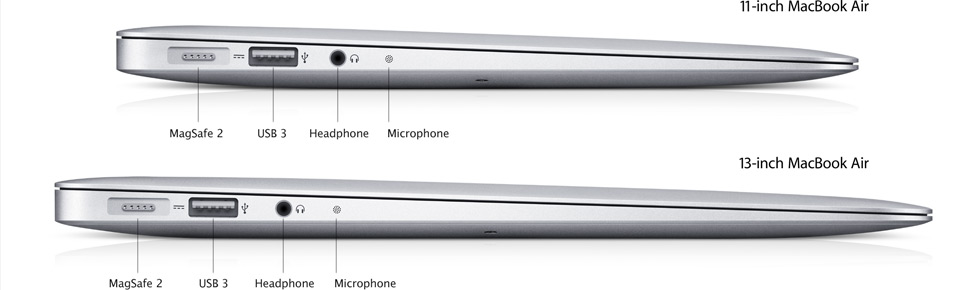
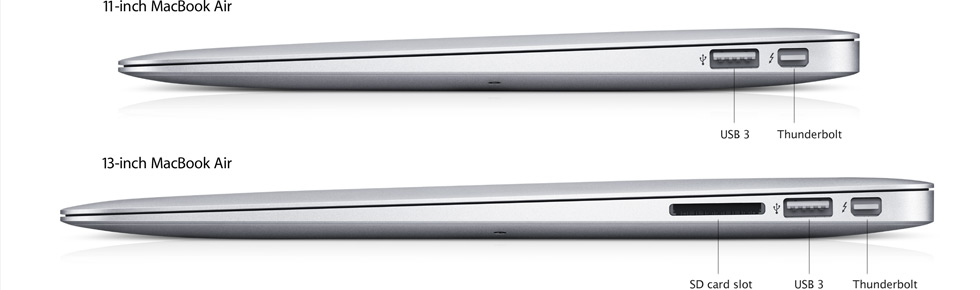
What’s more, if you’ve got your eye on one of those new MacBook Air models, the portable drive adds a lot of storage without requiring a large investment in dollars or weight. Buy an 11-inch with just 64GB internal storage for $999 from Apple, then spend about $125 more to increase your available storage by 750GB (with USB 2.0, you’ll be transferring at a half a gig per second, not speedy, but certainly acceptable for most uses). Better yet, spend $225 for 10 GB per second Thunderbolt speed–Thunderbolt is now standard on every Air. By comparison, you may beef up storage with a 64GB or 128GB SD card, but transfer speed is under 100MB per second, a whole lot slower than other options. Below, left-side and right-side views of the new Air, showing both USB 3.0 and Thunderbolt connectors.

The Magical Watercolours of Joseph Zbukvic

Joseph Zbukvic is one of the world’s best watercolor painters. In an era when technology dominates art, it’s wonderful to see what this man can do with paint, water, brushes and paper.

I encourage you to watch the entire 20-plus minutes of the video (link below). If you want to get right to the good stuff, pick it up around 2-3 minutes in. This is an Australian TV series. Put Some Colour in Your Life. You will want to start paying close attention when the artist begins his version of “working in Photoshop”–a digital-free approach to thinking through a picture. I watched, I paint, and I learned more in twenty minutes than I’ve learned from dozens of how-to books. This is phenomenal work, gimmick-free, technology-free, just the good stuff. Click here to watch.

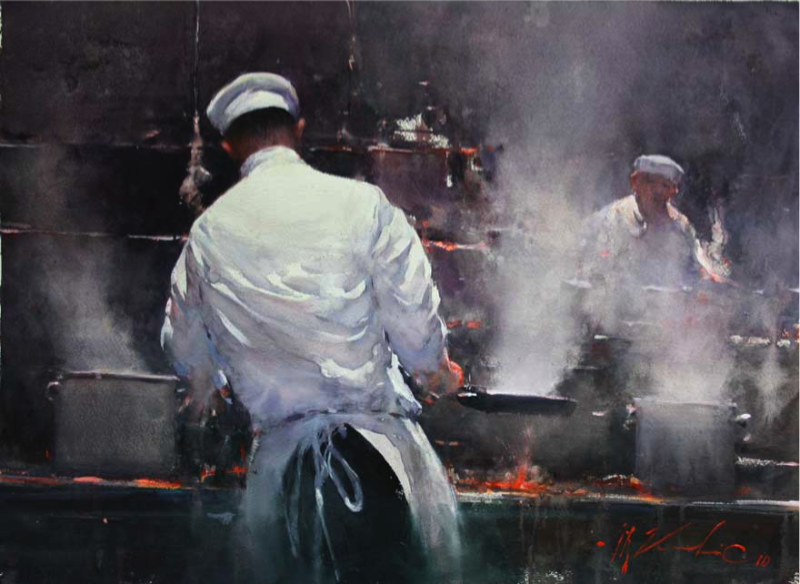
Here’s a look at some of the artist’s work. Be sure to visit the gallery section of the artist’s website.

My 500-Year-Old CD

Day by day, there’s not much that we encounter from the year 1611. Shakespeare was busy writing The Tempest. Henry Hudson died. Marco de Dominis published a scientific explanation of rainbows. A year later, tobacco was first planted in Virginia, and the Dutch started using Manhattan Island as a trading center.

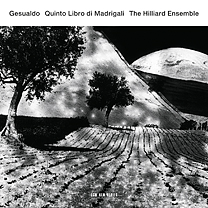
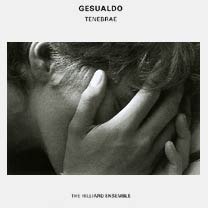
In 1611, Carlo Gesualdo wrote some of the most uplifting music for voices in the history of the medium, a book of madrigals. This creative work did not come easily. Count Gesualdo of Venoso’s story involves his instigation of the gang murder of his own wildly unfaithful wife (he plunged the sword into her body, and not just once, shouting, repeatedly, “she’s not dead yet!”), then moves through remarkable bouts with depression and abuse, including the dozen men to beat him daily (I’ll spare you details, but you can find them here and in lots of places on the internet). As crazy stories of composers lives go, he’s the hands-down winner. His story is deeply disturbing. His music is miraculous. Witness his captivating Tenebrae, one of the classic items from the formidable ECM catalog, first released in 1991, and consistently astonishing, a record I return to on a regular basis, a record that I recommend with little hesitation to any serious listener. And now, for 2012, witness the same Hilliard Ensemble treating five hundred year old music as if it was contemporary art. The newer disc is called Quinto Libre di Madrigali, and it is fascinating. The title and notes explain: this is the fifth of six books of madrigals, this one created late in the composer’s life. From the liner notes: “The whole collection constitutes a gallery of dramatically lit portraits of human emotions with a heavy emphasis on the extremes of joy and despair.”

There are six voices: a soprano, a pair of countertenors, a pair of tenors, and a baritone. (Soprano Monika Mauch and second countertenor David Gould frequently sing with the four-man Hilliard Ensemble; on this recording, Mauch is stunning.) All six singers sound like angels, and if you close your eyes, it’s easy to imagine these voices climbing up a heavenly spire in search of their lord. They sing in unison, they sing in pairs, they sing in harmony, they sing alone. They climb. They intertwine. They rest and they bounce. They exchange leads almost as if they contain the souls of jazz musicians to come. In musical terms, Gesualdo’s music is often described as “deeply chromatic”–a madman coloring with the brightest possible pigments and an extraordinary level of precision, probably based upon some sort of serious mental illness that caused his creative light to burn just a little too brightly. Two years after he composed these madrigals, he was dead.

Gesualdo’s work is not background music. It is music that captures the imagination, and elevates the spirit in a primal, deeply human way. There are no musical instruments, only voices, and open space.

This is not the best choice of music to play through computer speakers. ECM sets high standards for each of its recording projects, and this one, in particular, demonstrates the care that must be taken in order to record a wide range of vocal performances. The precision, the soaring thrusts, the extraordinary quiet passages, the contemplative quality of the whole, all of this has been meticulously prepared for your enjoyment. Listening through inferior equipment is like trying to contemplate the Mona Lisa by looking at a postage stamp. Best to listen through quality headphones, or on a good stereo system. The CD sounds a whole lot better than a computer file with reduced clarity and range. Trust me on this one: buy the CD, and allow yourself the time and space to listen with your whole being.

The Hilliard Ensemble, plus two additional vocalists. If you’re intrigued, be sure to explore the ensemble’s work with composer Arvo Pärt as well.

Green, Blue, and Extremely Portable

One side is green and the other is blue. It stretches so your chroma-key productions have a lightweight, flat background. But it’s a good idea to stretch even more with clips.

Or: chroma-key, anywhere.

It’s amazing how easy portable video production has become. You can shoot high definition video with a smart phone, a tablet, a FlipCam (and similar products), an inexpensive video camcorder, a digital still picture camera… The list goes on.

Most of the time, the recorded video is real life… people in action, scenery, and so on. Sometimes, it’s interesting to explore new creative domains. Often, these explorations involve the placement of people or objects in imagined places, and this is often achieved through a technical miracle called chroma-key.

What can you (and some kids) do with chroma-key? Here’s a step-by-step example that’s fun to watch. (Click to watch the video.)

You know chroma-key: it’s the technology used to place your local meteorologist in front of a digital weather map. The subject performs in front of a green screen, and then, all of the green is (miraculously) dropped out of the image so that it can be replaced with your choice of alternative video. In fact, any color can be used as the chroma-key color, but most often, a deeply saturated green or blue is used because these colors are not (usually) seen in the colors of human skin or hair or eyes. The colored area is usually painted, or created with a cloth stretched very tightly and lit evenly. When using chroma-key, folds and shadows cause difficulty.

With these challenges in mind, I had very high hopes for the FlexDrop2 from Photoflex. The portable package is a big, lightweight fabric disc, not quite a yard in diameter. It sets up with not much more than the flick of a wrist, and opens to a taut five foot by seven foot panel. Very cool.

Mostly, the FlexDrop is flat, but the use of a small clamp here and there is necessary to eliminate all visible shadows and wrinkles. Unfortunately, it’s not a standalone device…it is designed to be attached to a lighting stand or other pipes or tubes (and these are rarely lightweight).

Hands on, FlexDrop2 really works. One person can stand in front of a field of nothing but blue (one side) or green (the other), and then, live or with a good edit application, the chroma-key process can be used to drop out the blue or green and drop in any video still, animation, graphic, or footage. Two people? Hang the FlexDrop2 horizontally. Another good use: as a background for stop-motion animation, but you will need to dress the tabletop surface with an additional green or blue cloth (exactly the same color as FlexDrop2).

At $165, the FlexDrop2 is a nice-to-have, a bit expensive unless you use it often. And, of course, there are less costly ways to make chroma-key happen: buy a cloth and stretch it yourself, paint a wall, etc. But this one is handy, portable, stretches nicely, stores without taking up much space, and does the job in a professional manner. One catch: it’s not so easy to collapse and pack away. This video shows you how to pack it up.

BTW: Thanks to Kristy and to Rebecca for their help with this article.