Good Old USA vs. the 21st Century

They are: Destination America, and Veria Living. They come to the screen with very different stories, and two very different world views. I’m finding myself watching both of these channels with interest.

I suppose I ought to start with Destination America, and, inevitably, a new series called United States of Food. I caught the episode called United States of Steak (don’t worry, more episodes are on the way: bacon, and burgers among them). The beefy Todd Fisher gets his Guy Fiere on, but focuses on the excellent prime rib served at Boston’s Durgin Park, the superior chicken-fried steak found in Texas, and a Brooklyn classic t-bone from Peter Luger.

You may recall the well-intentioned Planet Green from Discovery Networks. That’s gone now. Destination America is its replacement. So what else besides beef? A series called Super Duper Thrill Rides, another called Fast Food Mania, and a modern day gold rush called Ghost Town Gold. There are shows about crop circles and Vegas gambling, Area 51 and Sasquatch, UFOs and national parks. As easy rolling brainless television goes, it’s fun.

(Isn’t it weird that cable channels are replaced as if they were TV shows? I know it makes business sense, but everything seems so darned flimsy.)

The other new network (well, new to me, anyway) is called Veria Living. In sharp contrast with Destination America’s approach, this is a channel devoted to healthy living and wellness. It’s based in New York City, but the money and the distribution power are the result of a growing media industry in India. Zee Networks is one of India’s largest media brands; slowly but surely, Zee has been increasing its presence in the US, and elsewhere in the “Indian diaspora.”

The first show I watched on Veria was Good Food America with Nathan Lyon. Other shows are about fitness, healing, yoga, and other good stuff. I especially enjoyed watching Nathan Leroy (yes, two different Nathans host different series) on Under the Sun, visiting Tuscany for an organic lunch (all local ingredients eaten on the patio of a rustic/elegant home that the local couple had built on their own). I’ve watched him, with some jealousy, enjoying organic strawberries in Finland… and you can, too. Veria’s viewers are enjoying a $200+ million investment in original programming, all of it celebrating a healthy, joy-filled lifestyle.

Does Discovery’s loss of interest in Planet Green and Discovery Health suggest likely failure for Veria Living? Is Veria Living’s internationalist approach likely to succeed and change people’s lives for the better, or will Veria Living learn the lesson that so many cable networks (A&E, History, Bravo, etc.) have learned, that downmarket is the only road to success? And, perhaps most important, after Todd Fisher travels on behalf of steak, burgers and bacon, where will he go next?


Soundbar vs. Surround

From the Crutchfield site (the image is your link), a look at an Artisan soundbar mounted just below a Samsung flat screen TV set. Although visually appealing, inexpensive and easy to install, soundbars don’t always play well with TV sets. What’s more their sound quality is outdistanced by even a modest surround sound system.

Roughly 4 out of 5 American households now watch television on a flat screen. A smaller number have made their new TV sets part of a full-scale home theater with a proper surround sound audio system. If you haven’t yet taken the plunge (many people do not, mostly because of the wiring and additional equipment required), consider a soundbar.

What’s a soundbar? It’s a long, slender box that’s meant to be placed, or mounted, several inches above or below your flat screen TV. Inside the box, you’ll find at least three loudspeakers: one on the left, one on the right, and one in the center. These easy-to-install setup effectively replaces the older idea of three standalone boxes (one for the left stereo channel, one for the right, one for the center audio channel used in a surround sound setup). Packaged as a single unit, the soundbar is less cumbersome, requires less space, and fits into any flat screen setup.

A typical setup is best enjoyed with at least three additional loudspeakers: a sub-woofer (to emphasize the sounds heard in the lowest portion of the audible spectrum), and a pair of rear speakers (to provide the same 3-D effect that you hear in movie theaters).

Polk Audio’s SurroundBar  (several hundred dollars) is not typical. Patented technology provides the 3-D effect without the addition of rear speakers. Yamaha’s more costly (nearly $2,000) solution, the YSP-5100,  does the job with more sophisticated technology to provide even better sound.

Many soundbars offer a wireless connection to a nearby sub-woofer. (Personally, I prefer wires because they’re easily hidden and more reliable).

It’s all a fine idea, at least in theory. In practice, the concept is new and often tricky in a real world setup. Most TV sets are not yet designed to work with a soundbar so there are conflicts and problems associated with volume adjustments and the visual feedback that a typical on-screen volume control provides. CNET reports other issues that should be familiar to you before your purchase a soundbar.

Seems to me, the soundbar falls into the category of “good idea, but it needs work.” Personally, I prefer the superior sound and slightly more complicated setup of a small surround sound setup. One small loudspeaker left and right, one in the center, and you’ve spent about $300 comparable to a typical soundbar, but the stereo separation will be far better, and the hassles will be fewer. You can buy a decent stereo surround sound receiver for under $200. (If these prices are high, you can buy good stuff used at Audiogon or from similar sources. A subwoofer can be purchased at reasonable prices, too, and used gear in this category is often a safe bet.

Guest Article: Legal Developments / Over-The-Top TV

Aereo’s marketing materials. The service is now launching in the New York City area.

With Aereo now in launch mode, this unconventional service (based upon thousands of tiny television antenna–each smaller than a dime), the television industry is facing some interesting questions about even its most basic operating assumptions.

As a result of reader interest in the blog post “I Want to Watch TV on My iPad,” here’s a legal view of the Aereo situation.This material is used with permission of the law firm Drinker, Biddle & Reath, and it originally appeared in the firm’s Antenna newsletter as “Legal Developments Affecting Over-the-Top TV.” The article was written by DBR communications attorney Howard Liberman and and his associate, Jennifer T. Criss.

—–

The past several weeks have seen important developments regarding “over-the-top” television. More and more consumers are moving away from traditional means of watching television and are embracing services that provide access to television programming directly on computers, tablets, and mobile devices. While some services such as Hulu distribute copyrighted content with permission of copyright owners, other over-the-top services are providing access to copyrighted content without obtaining copyright licenses or paying retransmission fees to TV stations.

One such over-the-top service, Aereo, provides the signals of local broadcast stations to subscribers who “rent” one of thousands of miniature antennas located in Aereo’s facility, for a monthly fee. In March, numerous television broadcasters, including ABC, CBS, NBC, Fox, and PBS. brought suit against Aereo for copyright infringement. While local stations would ordinarily be available for free to any household with an antenna, today most consumers receive access to local stations through subscriptions with cable or satellite providers. The broadcast companies argue that Aereo, which is backed by Barry Diller, is infringing copyrighted material by allowing its users to access live broadcasts over the Internet. Aereo asserts that it is simply providing access to programming that consumers are able to receive for free by allowing consumers to rent its miniature antennas either on a recurring or a per-program basis.

On July 11,2012, Judge Alison J. Nathan of the U.S. District Court for the Southern District ofNew York ruled that Aereo can continue providing services to its subscribers while the case moves through the courts. Judge Nathan concluded that Aereo does not retransmit broadcast channels to its customers because the company provides an individual miniature antenna for each customer rather than offering access to a single, large antenna that transmits signals to all Aereo subscribers. The court disagreed with the television broadcasters’ claim that they would be irreparably harmed and lose numerous customers should Aereo continue its activity until a final ruling in the case.

For now, Aereo operates only in New York City. But Aereo is planning to expand into additional U.S. markets. Thus, it is important for all TV broadcasters to be aware of developments in this litigation. In the meantime, the FCC is considering what constitutes a “channel” within its definition of “multichannel video programming distributor” (“MVPD”). The FCC is questioning whether Internet-based services such as Aereo and Hulu should be considered MVPDs if they distribute more than one broadcast or cable television channel. Including these services as MVPDs could mean that television stations could seek retransmission consent payments for the delivery of their signals by these systems.

As the Aereo case and the FCC proceeding move forward, it is clear that consumer access to television is rapidly changing. With companies such as Google, Apple and Sony considering offering video channels directly to subscribers via the Internet and going “over the top” of cable and satellite providers, defining what constitutes a “retransmission” and what service qualifies as an MVPD is critical to shaping the next decade of television viewing. Today’s viewers don’t just want their MTV; they want their MTV available inexpensively, 24-7, and on their computers, tablets and smartphones. These two proceedings – the Aereo litigation and the

FCC’s effort to re-define “MVPD” – will have a major impact on the future of over-the-air broadcast television.

This issue also has the attention of Congress. Hearings have been held in both the House and the Senate in recent weeks, as lobbyists and trade associations are gearing up for the introduction of legislation — perhaps this year – to make substantial revisions in U.S. communications laws for the first time since the passage of the landmark 1996 Act. We will monitor all these proceedings and provide updates in future issues.

Reruns!

Hey, it’s summer, it’s hot, and there are several early articles that appeared before most people knew this blog existed.

So, allow me to recommend three interesting posts that you may have missed:

The first is entitled The Ultimate Road Trip. It’s about the astonishing story of the interstate highway system–a system that is now beginning its old age, with not much attention to its replacement.

The second is about Boxie, a fascinating (and friendly and cute) MIT robot.

The third is about the cost of educating America’s children, one by one.

I hope you enjoy reading as much as I enjoyed writing!

Best,

HB

Next-Generation Camcorder

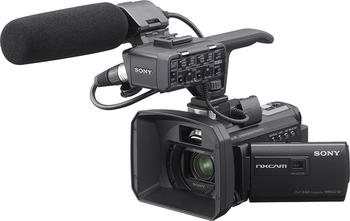
Just when you thought you’d need only your cell phone to shoot video, Sony introduces two new ideas that may change the game a bit: a gyro-stablized lens and a built-in projector. Have a look at the new, remarkably small Sony HXR-NX30, a $2,000 camcorder just arrived from the future.

Weighing about two pounds and stretching to a foot with battery attached, this small HD camcorder solves a constant problem for journalists and other hand-held videographers: the gyro system is, essentially, a built-in Steadycam-like feature. Without the extended balance mechanisms. Small enough to tuck into a medium-sized shoulder bag.

The built-in project is fairly modest, more useful for screening the days’ work on a hotel wall than for a public screening. Still, the projected images can be as large as about three feet (diagonally), and if they aren’t beautiful HD quality, they are far, far better than the images you’d be watching on the built-in 3-inch LCD screen.

Although the results are suitable for professional purposes, this is, in essence, a prosumer camcorder. It’s nice to see nearly 100GB of built-in memory (which goes quickly when shooting in HD), and it uses SD cards. There are XLR connectors for professional microphones, and a decent amount of control for just about every application. And there are a gaggle of other useful features, all common in this price category.

The news here is the built-in stabilization. Many will purchase this camera for that feature alone. And, hopefully, we’ll see lots of cameras with a similar feature–it should become standard in two or three years.

The Mind of Howard Gardner

From his Harvard bio, one of my personal heroes. Few academics have captured my imagination, and affected my thinking, as consistently or as deeply as Howard Gardner.

Harvard Professor Howard Gardner has written more than a dozen books with the word “mind” in the title. Few researchers have spend so much of their professional careers thinking about how our minds work, whether our minds might be better trained, and whether our minds can be put to better use. He’s a brilliant thinker, and I have thoroughly enjoyed reading his evolving work over these past few decades.

Earlier this year, with co-author Emma Laskin, Gardner republished Leading Minds: An Anatomy of Leadership with a new introduction, and that led me to the slimmer 5 Minds for the Future, a slim book that captures his evolving philosophy in a succinct, deeply meaningful way.

From the start, Gardner’s 5 Minds for the Future is more contemporary, acknowledging the tangentially  overlapping work of Daniel Pink, Stephen Colbert (“truthyness“)  and the enormous changes brought about by globalization. Gardner is famous for his theories about multiple intelligences (“M.I.” these days), but M.I. is not what this book is about. Instead, Gardner presents his case as a progression from basic to higher-level thinking, and his hope that we will climb the evolutionary ladder as a collective enterprise.

He begins by revisiting one of his favorite themes, the disciplined mind (which provided both title and subject matter for his 1999 book). Here, the goal is mastery, which requires a minimum of a decade’s intense participation, a thorough examination of all relevant ideas and approaches, deep study to understand both the facts and the underlying fundamentals, and interdisciplinary connections. This is serious work, and it must be accomplished despite the sometimes crazy ways that schools think about learning, and the equally crazy ways that the workplace may value or advance those with growing expertise. The disciplined mind does not simply accept what has been written or taught. Instead, the disciplined mind challenges assumptions, and digs deep so that it may apply intelligence when conventional thinking does not produce valuable results. No surprise that Gardner is deeply critical of those who invest less than a decade in any serious endeavor, or those who fake it in other ways.

Next up the ladder is the synthesizing mind which accomplishes its work by organizing, classifying, expanding its base of knowledge by borrowing from related (and unrelated) fields. Placing ideas into categories is an important step up the ladder because the process requires both (a) a full understanding of  specific disciplines and how they relate to one another, and (b) the means to convey these ideas to others. And so, Gardner views the Bible (a collection of moral stories), Charles Darwin’s theories, Picasso’s Guernica, and Michael Porter’s writings about strategy as related endeavors. At first, this seems to be a stretch. Then again, each of these are bold combinations of ideas based upon a complete understanding of a domain–(a) above–conveyed in a way that connects people to the synthesized ideas (b).

You may know Mihaly Csikszentmihalyi as the author of the excellent book FLOW, but his best work may be a book simply entitled CREATIVITY.

Then, there’s the creating mind. At this stage, the progression begins to make a lot of sense. Novel approaches are not based upon random ideas that may or may not work. Instead, the creating mind grows from deep study of a specific domain in a disciplined manner, followed by various attempts to organize that knowledge in ways that propel an argument forward. At a certain point, the argument has been advanced, and the opportunity for new thinking presents itself. Many creative professionals are required to advance new ideas without the requisite discipline, and so, our society generates lots of ephemeral stuff. In the creative space, Gardner’s thinking has been affected by Mihaly Csikszentmihalyi, who believes:

creativity only occurs when–and only when–an individual or group product is recognized by the relevant field as innovative, and, sooner or later, exerts a genuine, detectible influence on subsequent work in that domain.”

I would argue that the respectful mind ought to precede the disciplined mind as the ladder’s first rung, and Gardner provides ample evidence to support my argument. For one thing, the respectful mind is the only one of Gardner’s five minds that can be nurtured beginning at birth. What’s more, the ability to “understand and work effectively with peers, teachers and staff” would seem to be a prerequisite for any disciplined approach to learning and personal development. The whole chapter is nicely encapsulated by a sentence from renowned preschool teacher Vivian Paley:

You can’t say ‘you can’t play.'”

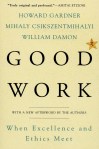
A decade ago, Gardner, Csikszentmihalyi, and William Damon wrote a book called Good Work, and this effort has expanded into The Good Work Project. Central to this effort is the ethical mind, which carries a meaning well beyond the ethical treatment of others. Here, we begin to touch upon the idea of professional or societal calling, and one’s role within a profession or domain. It begins with doing the best work possible–that is, the work of the highest quality, as well as work of redeeming social value–but it’s not just the work itself, it’s the way that you apply yourself to the job at hand. Here, Gardner covers the diligent newcomer, the mid-life worker who continues to pursue excellence every day, the older mentor or trustee whose role is to encourage others to build beyond what has already been accomplished.

In less than 200 pages, Gardner accomplishes a great deal. If time permits you to read only two Gardner books, I would start with Frames of Mind, which explains his theory about multiple intelligences, then jump to 5 Minds for the Future. After these two, you’ll probably want more. His book about leadership, mentioned above and discussed below, is certainly worthwhile. And Good Work will fill your head with wonderful ideas and inspiration for all you could do to help make the world a better place.

BTW: If you want to watch Gardner discuss 5 Minds for the Future, you’ll find his 45-minute video here.

As for Leading Minds, it’s an extraordinary book, a collection of analytical biographies written as parts of a whole, a cognitive view of leaders and leadership. He examines leaders by taking part their fundamental identity story: who they are, how their domain and influence grew, how and why they succeeded, how and why they were unable to accomplish their ultimate goals. This is not a book whose core ideas can be reduced to a few bullet points. Instead, it’s a few hundred pages of reflection on the nature of leadership shown through the examples of Albert Einstein, Mahatma Gandhi, Martin Luther King, Jr., Alfred P. Sloan, Eleanor Roosevelt, and a half dozen other 20th century figures. The significance of some names is fading; it was disappointing to find that this revised edition of a 1995 work did not include anyone who made his or her mark in the 21st century.

Outta Here! – A Friendly How-to Guide

With good cell phone service and a robust Internet connection, we’d like to think we can live, and work, pretty much anywhere. True enough, if the term is days, weeks or months, but what about years? What about (gasp!) forever?

Why leave? You’ll find lots of good reasons (good stories, too) in the newly revised second edition of Getting Out: Your Guide to Leaving America by Mark Ehrman:

The US had become unbearable after 9/11…We purchased 1.25 acres of land about 20 minutes south of Oaxaca…There is nothing like living, immersing oneself entirely, in another country, culture, language, etc.” — Cara Smiley, 40

I have been leaving the US all my life–starting with study abroad and then the Peace Corps…” — Kerry Kittel, age 49

Life here in Copenhagen is just so much more livable than any place I’ve experienced in the US. I take a train and boat to work. I ride my bicycle to buy groceries…” — Bill Agee, 50

You might think of this as the ultimate traveler’s book (no tourists allowed). Pages of (fascinating) personal stories are followed by advice about visas, second passports, and citizenship. There are many ways to gain citizenship, or at least, residency… marry in, play your ethnic race card, buy your way in, teach English, etc.

Fantasizing about where you might go…and stay? If you’re looking for the world’s highest rate of Internet penetration, try Greenland, Iceland, Norway, or Finland. Best infrastructure? Switzerland, Hong King, Singapore, France, Iceland, or Sweden. Fastest Internet? South Korea. Safest? Germany, or Canada. Growing job market? China, India, Taiwan. Best place to start a new business? New Zealand, Australia or Canada.

Need a more in-depth analysis? That’s the second half of the book. Sixty-one countries, each considered in terms of governance, Internet, healthcare, working there, taxes, women’s issues, life expectancy, moving there, and more.

If i was among the 300,000 who left home, where would I like to go? In fact, I would love to spend a month, maybe several, in every one of those sixty countries–but I suppose that answer evades the question. If I had to choose today, my starter list would probably include:

  • Bahamas
  • Canada
  • Denmark
  • France
  • Italy
  • Japan
  • Sweden
  • United Kingdom

Where would you go? And stay?

—–

And, from the same publisher, the real dirt on living in the country. The book is called (of course!) Get Your Pitchfork On!

Pastrami…on the road

(Hey! Don’t start here!! Start with the first part of this article.

When we last met, we discussed the excellence of the pastrami sandwich available at Manhattan’s Second Avenue Deli and Katz’s. If you’ve let a week go by without one of their sandwiches, there’s still time to correct the error of your ways.

Once a familiar sign throughout the five boroughs (okay, maybe not Staten Island), the kosher delicatessen is becoming an endangered species. (Those three Hebrew letters, read from right to left, spell the word Kosher, but some also feature non-Kosher foods on the menu.)

With David Sax as our guide (see his book, Save the Deli), we first travel to the Bronx for “hush puppies”–little hot dogs wrapped in potato–at Liebman’s, which carries a full New York deli menu, and continues a generation-old tradition. It’s a neighborhood place, worth the easy trip from Manhattan. Then, not so far from Yankee Stadium, there’s Loeser’s, a comfy old fashioned place that David describes in his blog. In Queens, the queen is Ben’s (with restaurants on Long Island and Manhattan), but neighborhood places like Buddy’s remain.

Knishes from Knish Nosh in Queens (and now, in Manhattan, too!). They don’t get much better than this.

While in Queens, there is one place where you must eat. It’s called Knish Nosh (for the uninitiated: a Knish [KUH-nish] is a large baked dumpling, and Nosh is casual eating, nibbling–the noun form would be a nosh, and the verb form, noshing). Few may disagree, but this is probably the place to buy the best knishes in New York City (maybe even the world). Potato or kasha would be the purist’s choice, but mushroom, mushroom/carrot, sweet potato, and spinach would also score on a top knishes list. And–who knew?–there are now Knish Nosh outposts near Central Park and 106 Street, near CitiField (where the NY Mets play) around Flushing Meadow Park, and in Florida, too.

In Brooklyn, where there may have been as many kosher delis as churches, choices are few, but the few choices are good ones. There’s Adelman’s, a throwback to the era when Brooklyn might have been the center of the world, and here’s a rundown on the others–with pix of tasty sandwiches.

A good home-cured corned beef sandwich served in Newark, NJ at the long-running Hobby’s.

Across the Hudson, Hobby’s Deli is all that remains of a once-grand tradition in downtown Newark. It’s favored by the city’s power elite, quite the place to meet friends and business associates while enjoying a corned beef or pastrami sandwich. In northern New Jersey, it’s Eppes Essen in Livingston, and others celebrating the old style, often with a more generalized deli menu alongside the kosher favorites. Outside of NYC and its suburbs, demand is lower, so options are few. Philadelphia has Famous 4th Street, and Baltimore, Attman’s, where you can enjoy a terrific sandwich and then wander by the Inner Harbor or Fell’s Point, both nearby.

Old-style delis are famous for pastrami and corned beef, chicken soup and kneidlach (matzo balls), but there’s nothing quite like a kosher hot dog. In fact, there’s a wonderful category of Jewish sausages–frankfurters, “specials” (fat hot dogs), Kosher bologna, Kosher salami (soft or, for connoisseurs, the garlicky hard version). Here’s Nate N’ Al’s take on the simple dog.

For old-style New York City deli, however, you’ll need to follow the Jews to southern California. Nate n’ Al’s is the Beverly Hills institution–the place where Larry King and half of the entertainment industry seem to gather on a regular basis. The sandwiches are worth the trip (for years, my NYC-LA routine required lunch at Nate n’ Al’s immediately after landing at LAX). Here, the sandwiches are special, but it’s the chicken soup that reminds everyone of their bubba (translation from the Yiddish = grandma). Sax calls it “some of the finest chicken soup known to man–a wide bowl of silky broth dominated by a single, almost meaty matzo ball.” He also recommends the kishke (KISH-kuh) at Brent’s–a once-standard, now hard-to-find slice of Jewish sausage made by stuffing a cow’s intestine with matzo meal and schmalz (chicken fat); remember, all of this is based upon peasant food! (In fact, kishke is delicious, but only when freshly prepared; the frozen alternative is just awful.) One LA old-school favorite is found downtown, near the La Brea Tar Pits (no, it’s not that old): Langer’s. Here, it’s all about the perfect pastrami sandwich. Again, Sax:

How do you describe the taste of a perfect pastrami sandwich?…The specific flavor profile–at once peppery, smelling of the sea, and hinting of butterscotch–would sound contradictory and confusing. Any turn of phrase or illustrative metaphor–how the peppercorns and salt and sugars dazzled my taste buds like a Chinese New Year’s fireworks show going off in my mouth00would never measure up to the real thing. It is simply legendary…”

So it’s off to Las Vegas, where the casino outposts of the Carnegie and Stage Delis smell as sweet but taste nowhere near as good as the NY originals, and then, down the road to nearby Henderson, where New Jersey’s Michael Weiss takes the craft seriously, and “pickled his own corned beef and tongues, cured and smoked his own pastrami, and baked his own bread and pastry,” according to Sax. The result is deli magic. Deli done right. Worth a trip just to rediscover the roots of this fading cuisine. Houston is home to “a traditionalist succeeding jun a modern market”, Kenny and Ziggy’s, where “the giant noodle kugel [pudding] had the consistency of a soufflé.” Watch them on Food Network.

Outside the U.S., three delis belong on every foodie’s bucket list.

The first is Schwartz’s in Montreal, where the smoked meat sandwich more or less combines all that is sacred about corned beef and pastrami. Here, the spectacular sandwich begins as “raw brisket from Alberta” which is then “rubbed with a mixture of coarse salt, cracked peppercorns, and Schwartz’s special spice mix, which involves much less sugar than a New York style pastrami, with more pepper and fewer aromatic spices. Briskets are then cured in plastic barrels for a…week…ready to enter the smokehouse…stained with burnt fat and old spices…[where they] smoke for five to seven hours…” (While in Montreal, be sure to sample the uniquely sweet, smallish, delicious bagels from St. Viateur.

The second must-visit is to B&K Salt Beef Bar, home to “stupendous” chopped liver (made from ox, not chicken, as is the US tradition), followed by a sandwich of either hand-cut tongue or salted beef, cured for a remarkable two-and-a-half weeks. Both are made with good Scotch beef, and that makes all the difference.

The third diverges from the peasant food history. It’s located in Antwerp’s diamond district. Hoffy’s treats delicatessen as fine food, with small portion sizes (take that, Carnegie Deli!). Start with the pickles, which are always difficult to get right. In New York delis, the brine must contain the right balance of salt, dill, garlic, and other herbs and spices–otherwise, they just don’t taste like sour pickles or, with a different recipe, half-sours. Here at Hoffy’s, the focus is on the garlic, and the flavor soars. Meats are lean (never the case in a New York deli), extremely tender (similar to NY deli), and according to Sax, the best is the veal–a meat not often associated with NY deli–“creamy pink and tasted almost sweet.” Portions are small, and elegant: bite-sized portions of stuffed cabbage, gefilte fish, chopped liver, and apple kugel.

There are so many Jewish specialities, so many variations, such unique flavors and delicacies, each wrapped in years of tradition. Blintzes and lox, the bialy and the plateful of rugeluch; the mushroom barley soup and latkes. But the tradition is fading. The people who opened the delis came from an Eastern Europe that no longer exists. There will be no more Jews with the old traditions emigrating from Poland or Lithuania or the Ukraine. They’re gone. There are fewer Jewish neighborhoods to support the delis–the people who used to live, in great (but poor) communities, in Brooklyn or lower Manhattan now live with everybody else. The small delis can no longer support themselves–except in areas where the tradition lives strong, as it does, largely due to the Jewish show business community, in Los Angeles. And yet, this is a cuisine worth nurturing, worth embracing. How? I guess that’s why Sax calls his book Save the Deli! Without a concerted effort, the few remaining delis will be gone, and with them, a great cuisine may vanish, or, perhaps worse, may be reduced to Nathan’s hot dogs, Einstein’s bagels, and the occasional frozen knish.

Long may it wave! A corned beef sandwich from Attman’s in Baltimore, founded 1915. Will they survive the next 100 years?

The Google of Its Day

No, it’s not easy to detect the precise moment when the trouble began, when the world began to change, when everything that worked for a century suddenly stopped working. There are theories, and books written, and somehow, the old ways seem distant, and inconceivable in their naiveté. And there are new ideas, new companies, new ways of thinking and connecting that don’t much resemble the old. But one thing is clear: everything else may change, but in my world, in your job, in our town, everything is going to be just fine if we just cut some costs, say the magic words “social networking” three times daily, and reinforce one another’s thinking about the value of maintaining the status quo.

I keep thinking about Kodak. George Eastman was 24 years old when he (and other hobbyists) figured they could build an industry by making photography easier. From 1878 until 1883, he opened a factory, and by 1888, he was selling shares. He struggles to find a market in the US, finds one in Europe, brings it all back home, and by 1900, Kodak is the hot start-up company. It sells cameras for $1 and rolls of film for 15 cents. By 1907, Kodak employs 5,000 people (about the number it employs today). By 1914, Kodak builds a skyscraper. By 1924, George Eastman gives half of his $75 million (in today’s dollars, $2 billion) fortune to charitable causes–including $12 million in start-up funds for what becomes MIT. In 1932, at age 77, Eastman kills himself (the suicide note read: “Why wait?”). Still, Kodak kept on growing: in 1935, Kodak introduced Kodachrome color slide film, in and jumping ahead to 1962, Kodak sales exceeded $1 billion, and the company was heavily invested in future technologies, a strategy employed well into the 2000s, when the company was an early leader in digital photography at all levels, from medical imaging to consumer cameras.

Kodak was the Google of its day. — The Economist (see history or official Kodak history)

Today, Kodak is almost non-existent. Nearly gone. After closing its factories, leaving the camera business and nowadays, selling off its patents, a century’s success is fading like the (Polaroid) snapshot in Back to the Future 2.

Why did Kodak fail? Some theories:

Kodak did not fail because it missed the digital age. It actually invented the first digital camera in 1975. However, instead of marketing the new technology, the company held back for fear of hurting its lucrative film business, even after digital products were reshaping the market. — Forbes.

And then there are companies like Kodak — which saw the future and simply couldn’t figure out what to do. Kodak’s Chapter 11 bankruptcy filing on January 19 culminates the company’s 30-year slide from innovation giant to aging behemoth crippled by its own legacy. — Knowledge@Wharton

The company might have been able to innovate more quickly on the digital front if it had set up a separate lab in Silicon Valley, then allowed it to grow independently and tap into the area’s tech culture and expertise.” — Knowledge@Wharton

And what should Kodak have done?

— Enter the cell phone business? It tried this a bit. Didn’t work.

— Recognize that it was really in the memory business and diversify into storage? Nice try.

— Increase its R&D? Kodak did that, spending most of the money on improving film technology.

— Diversify into healthcare? It did that too. Didn’t work.

— Spin off its chemical business? It did that, generating some cash. But small potatoes.

— Integrate backwards into semiconductors? Way out of its competency.

In the end, Kodak (now on the brink of bankruptcy) was a well run company that failed. It was an early technology company, and it never lost its technology roots. It then became a marketing behemoth and a superb consumer company. It then morphed into a financially run enterprise and it did that well–until it failed. — Information Week

And what does this mean for the rest of us?

That’s a question I want to explore in future blog articles. Clearly, the digital revolution in motion, gaining considerable momentum as the spookiness of the dot.com bubble fades from memory. I would imagine that schools and education will be the next frontier, the next “it can’t happen here” that will be utterly transformed, but there are significant political and economic class issues driving the status quo. I wonder whether the top ranks of the Fortune 500 will continue to be dominated by companies associated with cars and fuel in thirty years (remember: thirty years ago, Kodak was still hot stuff). We’re been seeing tremendous technology-driven changes in health care, and now, with new rules and an increasingly stable economy, and the dreadful statistics about health care needs of aging baby boomers, the opportunities in this area seem rich, particularly in the digital space (tele-medicine,  patient education, digital tracking of patience care, etc.)

Infographic: US Education Spending vs. Results

Doing some research, I came upon this colorful infographic that compares educational investment and results in a dozen different countries. No big surprises, but it’s easy to follow. It’s clear that Mexico spends a very small amount per student and achieves only modest results, and it makes sense to see France in the middle of per-capita spending and also in the middle of the results. Clearly, the US and the UK are out of whack–spending is high, but their results are middling. Why the mismatch? And why is the US’s purple circle so much larger than any other circle? Population accounts for only part of the reason why.

U.S. Education versus the World via Master of Arts in Teaching at USC
Via: MAT@USC | Master’s of Arts in Teaching