Is the iPad Mini Coming This Fall, Not Summer? (Updated)

Key facts, or, at least, key rumors courtesy of MacRumors:

  • $250-300 retail price
  • “A 7.85-inch “iPad mini” display with a resolution of 1024×768 would carry a pixel density of 163 pixels per inch, exactly the same density as the non-Retina iPhone and iPod touch models.”
  • Competes with upcoming Windows 8 devices

No, this is not a definite product. But it is an intriguing rumor.

But today’s visit to Barnes & Noble, and yesterday’s visit to B&H Photo in Manhattan confirm one counterintuitive idea: in comparison with competitive products, the iPad is kinda big. I like it that way, but I use my iPad for business purposes. For casual use, something smaller might be just the thing.

UPDATE as of July 3, 2012:

“The new model will have a screen that’s 7 inches to 8 inches diagonally, less than the current 9.7-inch version, said the people, who asked not to be identified because Apple hasn’t made its plans public. The product, which Apple may announce by October, won’t have the high-definition screen featured on the iPad that was released in March, one of the people said.”–reported by Bloomberg, posted in MacRumors.

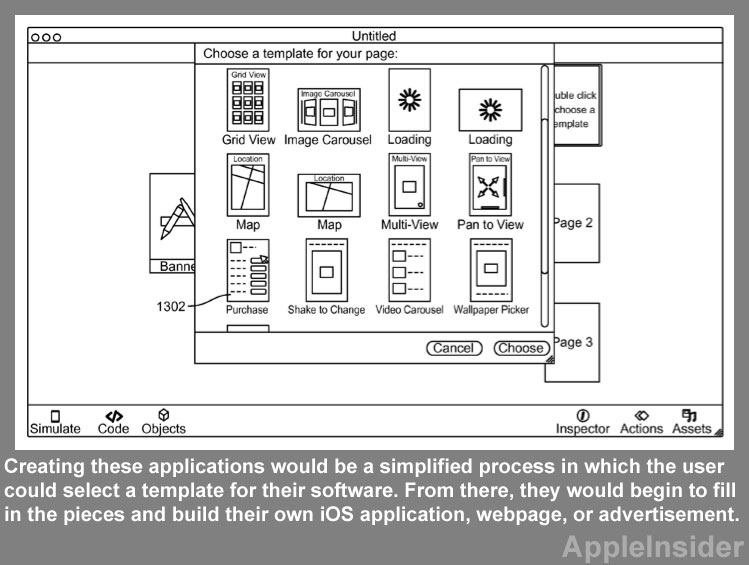
Do You Think You Can App?


Think back to the time when you wondered whether you could desktop publish (before you knew what a “font” was), build your own website, or shoot or edit video? All of these were once unavailable to the average person. Now, Apple has filed a patent that could lead to make-your-own apps.

No surprise that message boards are filled with doubt. Making apps is too specialized, too complicated, too much of a commitment for the average person, too demanding in terms of knowledge and training and skills. Doubters point to iWeb, which was a make-your-own website tool that Apple provided, then pulled from the market.

Still, I wouldn’t dismiss the idea too quickly. No, most of us can’t or won’t build our own websites, but technology and invention race around the rocks–so we blog, and post images, and Tweet, and distribute information via tools that weren’t available the day before yesterday.

Do I want my own app? Sure, I guess, but the question suggests a solution chasing a problem.

If we flip the question, and assume, for example, that we (jointly) own an artisanal bread bakery, we might want to make it easy for our customers to know what’s baking, and what’s fresh out of the over, and we might not want to pay someone to build an app. A bake-your-own app might be just the thing for small business, or for authors who want to provide more than an eBook can easily provide, the list of potential problems that a homegrown app could solve is large. What’s more, the interactivity of a good app creates a high level of engagement between the provider and the customer, so apps could be the step beyond blogs and tweeting.

But I think there’s even more to the question. Blogs, tweets, apps–these assume current technology. And yet, we know that current technology lasts only a few years before the whole game changes. By 2015, we’ll be into advanced optical displays, a better cloud that makes the whole idea of local storage and local apps obsolete. Quite likely, we’ll be buying a broader range of devices–and I’m sure I don’t want a circa-2012 app as the my interface with thousands of internet radio stations (I really want easy-to-use internet radio in my car with lots and lots of stations from around the world).

Nothing is standing still–and that’s one of the challenges addressed in the Apple Insider article–how to build apps that easily (and automatically) customize for an increasingly varied range of devices.

What about Black-and-White?

Back in the analog stone age, shooting in monochrome was a creative choice made in advance. You’d buy a few ISO 400 rolls of Ilford HP5 or Kodak Tri-X, and head out for a day of serious photography, hoping for just one image worthy of framing.

In fact, black-and-white analog photography offers several advantages. There is at least four times as much picture information, so contrasts can be stronger, textures can be more refined, and enlargements can be, well, larger. About half of this work is done in the field, mostly by selecting and composing with intelligence, and by selecting an appropriate optical filter to place on the lens. For example, sky contrast can be dramatically increased by using a red filter, but sometimes, detail in shadows is lost with a red filter, so an orange filter may be more suitable. Corrections are then made in the analog or digital darkroom, a trial-and-error process that becomes easier after a lot of hours of experimentation and instruction.

Working with a digital camera, the best black-and-white images are derived from color images, but maybe not in the way you’d think. The adventure begins with a digital camera that can shoot RAW images–so plan to spend at least $500 on the camera. Lesser cameras, and less-than-serious photographers with better cameras, shoot in JPG to jam more images onto an SD card. If you start with a JPG created in the camera, your black-and-white images will lack detail, clarity and snap. Your expensive digital camera offers an instant monochrome option. No, you shouldn’t use it, not if you are serious about your photography.

Instead, you can achieve miracles by post processing your RAW image in Aperture, Photoshop, or other software capable of handling RAW images. With desktop software, you can add the equivalent of colored filters and gradient filters, with a level of precision unavailable in the field, and unavailable in old school darkrooms.

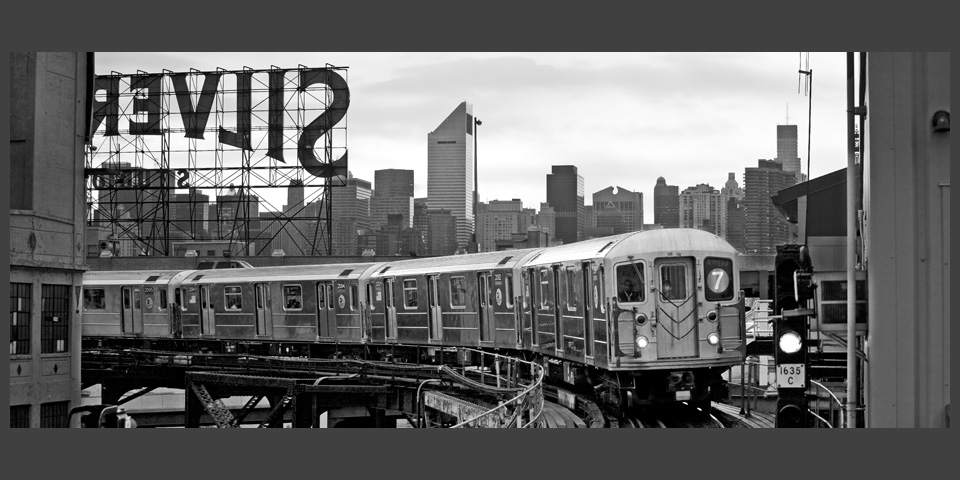
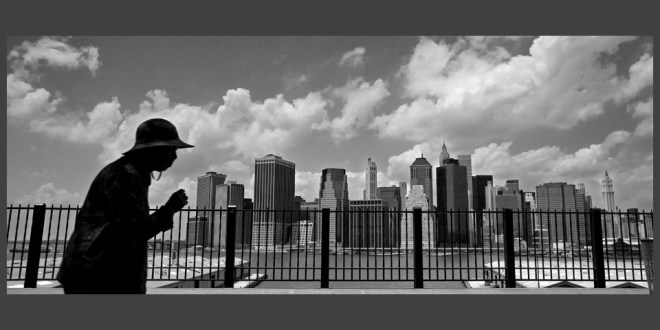
In his book, Hoffmann goes into considerable detail about how this picture was made, and why it is so effective. He’s a very good teacher.

Is it worth the time? It’s worth the time if you train yourself to create the best possible images by learning a lot about composition, mood, street photography, landscape work, architectural photography, and abstract work from a master teacher. I’ve spent the past month or two studying the second edition of a fine book entitled The Art of Black and White Photography by Torsten Andreas Hoffmann, published by Rocky Nook Press. He provides the necessary technical information, but spends most of his instructional time on important photographic ideas: how to avoid the cliché, achieving balance, dealing with visual irritations that cannot be moved, capturing people in their natural surroundings, visual rhythm, form and composition. Hoffmann is especially effective when he writes about, and photographs in, a strongly graphic style: strong contrasts, superior use of line and form, repetition to suggest speed or solidity. (Study the three Hoffmann images in this article, and notice, for example, the repeated pattern of small verticals–the fence posts in the top image, the decorative balusters in the second, and the train doors in the third supported in the distance by the verticals of the Manhattan skyline). These are not snapshots–they are photographs–and if there was any doubt about a blurry line between those two ideas, it disappears here. These are advanced ideas, most suitable for the experienced photographer or for the ambitious newcomer. The reward is in the learning, of course, and also in the tour of Hoffmann’s portfolio, which is sampled in this article and offered in expansive form on the photographer’s website.

The photographer is based in NYC. This image is one my favorites, but it comes from his website, and does not appear in the book.

Nico? On the top of the list?

On newsstands until July 25, 2012

Number 13 on the list of all-time best albums, according to Rolling Stone, is the 1967 Verve Records release, The Velvet Underground and Nico. It’s also the number 1 album on The  Observer’s 2005 list, “The 50 Albums that Changed Music,” which is, in fact, more interesting than the new Rolling Stone standalone $11.95 magazine now on newsstands.

I decided to explore the web in search of other top 500 lists, and their kin.

My very favorite list comes from the British music magazine, The Wire because it discards the arbitrary distinctions and deals with music, not categories. So we’ve got  work by Igor Stravinsky, Bessie Smith, Louis Armstrong, Jelly Roll Morton, Cecil Taylor, Lennie Tristano, Oliver Messaien next to the inevitable Stevie Wonder, Joni Mitchell, the Rolling Stones, the Beatles, and Marvin Gaye.

I especially like The Observer list because it acknowledges world music, beginning with their #24, Youssou N’Dour’s Immigres, and because each of the list’s entries are explained in a clever way: “Without this … N’Dour wouldn’t have met Peter Gabriel, there’d have been no African presence at Live 8. In fact, ‘world music’ would not exist as a section in Western collections.” Similarly, the Fairport Convention gets its due for introducing folk music into the British rock scene as #45, Liege and Lief, an absolutely lovely album with a lineup that includes the spectacular Sandy Denny as female lead vocalist. (Similar due should have been paid to Peter, Paul & Mary on the American / Rolling Stone side, as the celebrated Bob Dylan’s career (he occupies RS slots #4, #9, #16, #31… ten slots in all) would have mattered less without the spectacular success of their top ten single versions of Dylan’s “Blowin’ in the Wind” and “Don’t Think Twice, It’s Alright.”

The Virgin 1000 list is fun because it is massive. And, sure enough, there’s that critically acclaimed Nico album in the top 15, with Miles Davis’s Kind of Blue nearby (these lists don’t quite know what to make of jazz, or country, or most of the other genres–no bluegrass, a bit of gospel, etc.), but every list seems to include Kind of Blue and John Coltrane’s A Love Supreme. For those who wish to explore jazz beyond the limited view of Rolling Stone and other mainstream music publications, one good starting place is an Amazon list of jazz recordings, whose top ten includes Ella Fitzgerald, Dizzy Gillespie, João Gilberto, Charles Mingus, and Thelonious Monk. An equally worthwhile list of world music recordings is also found on Amazon, a category mostly ignored by the RS list, save for Bob Marley albums, and, happily, The Indestructable Beat of Soweto, a stunning collection of South African music from the mid-1990s. On that Amazon world music list, I’m not sure that I would have placed Fela Kuti’s adventure with Cream drummer Ginger Baker at #3, but I’m sure glad to see the Bulgarian State Television Women’s Choir hanging out near Ali Farka Toure, Gal Costa, and Huun-Huur Tu, all artists with spectacular albums and names that most Americans have never heard before.

The top 200 albums on RS’s list also confused me because just three of those top 200 were made in the 21st century (Radiohead’s Kid A, Kanye West’s Late Registration, and Arcade Fire’s Funeral), just five if you go up to the top 250 (add: Green Day’s American Idiot and Eminem’s Marshall Mathers LP). Sure, there are the weird choices–that happens with any list like this–so The Zombies’ Odessey and Oracle claims slot #100, and  Quicksilver Messenger Service’s 1969 album, Happy Trails, makes it to #189.

And you know that I’m ending this article with my list of albums that Rolling Stone missed, but should have included:

  • T-Bone Walker – Complete Imperial Recordings
  • Folkways: The Original Vision – mostly songs by Leadbelly and Woody Guthrie
  • The Essential Pete Seeger – or any of the various compilations of his work for Columbia Records
  • Chet Atkins – Guitar Legend: The RCA Years
  • Peter, Paul & Mary – Moving or Album 1700 or Ten Years Together
  • Harry Nilsson – Harry and also Nilsson Sings Newman
  • Larua Nyro – Eli and the Thirteenth Confession, Gonna Take a Miracle, and the spectacular, surprising Time and Love 3-CD collection
  • Blood Sweat & Tears – their second album
  • John Sebastian – Best of, or his first solo album, John B. Sebastian
  • Billy Joel – Piano Man (among some of his best character / story work)
  • Elton John – his first album, as sweet as they come
  • Weather Report – the jazz group’s first album, self-titled
  • Van Morrison – Tupelo Honey
  • The Traveling Wilburys – their first album

Sorry my list isn’t longer or more interesting (kinda heavy on the late 1960s early 1970s–just as the RS was, in fact!). I’m writing away from home. More later on this.

Edward Tufte Kills Two More Kittens

Last night, I was one of two keynote speakers for an innovation event. As a speaker, I’m supposed to be the teacher. Three people in the audience were fast asleep. I am their grateful student.

I spoke for over a half hour. I’m pretty sure we should pass a law, or perhaps, a constitutional amendment, that assures no speech will ever run longer than 20 minutes.

I structured my speech with over 100 clever little slides (I used Keynote, which is cooler than PowerPoint). Every visual cue was carefully tied to specific words in my written script. So I paid more attention to the script and the visuals than I did to the audience. Occasional ad-libs only made the speech longer.

The gentleman who preceded me, a college president, used Prezi. What a cool visual presentation! I remember almost nothing he said. (Too busy looking at the cool imagery.)

So here’s a digital insider take on speeches, the morning after. Just talk to the audience. Tell them what you know. Allow yourself one index card with three key points.

Anybody in the audience who want to see the charts, graphs, photos, etc., tell them to visit your website or blog. In that environment, they can study the visuals in their own time, not in a crowded auditorium. When they hear hear you talk about an important idea, they can visit your website for more information.

Which is to say: speeches are terrific for revving up the audience and introducing new ideas, but they are not very useful for detailed presentation of ideas. Websites are not a good way to rev up the audience and introduce new ideas–there is no personal touch, except, sometimes, with an extraordinary video–but for details and the day-by-day updates, they’re terrific.

I trust the guys in the back row slept well. Last night, they were the most powerful teachers in the room.

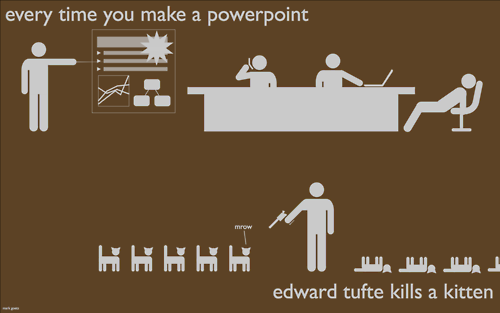
For more on Tufte/kittens:

Tufte Kitten Kill Count

Intro to Tufte:

The Visual Display of Quantitative Information